
Just back from: a day trip to Venice
Regular readers of this blog will know how I’ve made a number of day trips by air to some of Europe’s most captivating cities. Yesterday saw me jet off to Venice, in perhaps my most ambitious trip yet.

You’ll find a full list of the others at the bottom of this post or on my Index page here:
https://juliamhammond.wordpress.com/index/
While I’m not suggesting for a minute you’re going to truly get under the skin of your chosen destination in such a short space of time, it is great when you have little or no holiday left but still have that pressing need to travel. Or in my case, a desire to keep two dogs out of kennels and into Daddy Day Care which is always a priority. If you believe those predicting Brexit will put an end to cheap European flights from the UK, time could be running out to snap up a bargain. Here’s the how, where, when and what of Venice in a day.
Getting there
My local airport is Stansted, the main UK base of Ryanair, and once again it was to the controversial budget carrier that I looked for my cheap fare. Normally, Ryanair flies in to Treviso airport, but while the airport has been closed for essential runway maintenance, flights are being rerouted to Marco Polo instead. Marco Polo also has the advantage of being closer to the city and well connected by both boat and bus. The current closure lasts until 18 October, but it’s worth keeping an eye out as it’s not the first time I’ve read flights have been diverted. My flight departed on time from Stansted at 0620 and touched down ten minutes ahead of schedule at 0910. The return left a few minutes after its scheduled departure time of 2230 and taxied to the terminal to unload us at 2355, about 15 minutes late. Total ticket cost this time was £34 return. I should also add, as per usual I didn’t bother with a seat reservation and got a randomly allocated window seat on the outbound flight and an aisle on the return leg.

To reach Venice from Marco Polo it’s possible to catch a bus. An express service takes around 20 minutes to make the journey to Piazzale Roma, near the top end of the Grand Canal and the city’s Santa Lucia station. Return tickets cost 15 euros. But to arrive in style, I figured I needed to arrive by boat, though my budget most certainly doesn’t stretch to water taxis. There are, however, direct transfers from the airport with Alilaguna who offer a reliable service on one of three routes. This is double the price of the bus at 30 euros for a return, but in my mind well worth the cost. However, I should mention you do sit low in the boat, which isn’t great for sightseeing if you aren’t tall.

I opted for the orange route as it takes you via Cannaregio and then down the Grand Canal. Journey time to the Rialto Bridge was just under an hour. From there, the boat continues down to Santa Maria del Giglio, just short of St Mark’s. It was busy, and I had to wait for one boat to leave before getting on the second one, which added about a 30 minute delay to my journey. However, the boats serving the blue route were bigger and there wasn’t a wait. They loop via Murano and Giudecca instead, and calling at San Marco on the way. This is a really convenient option if seeing Murano’s famous glass is on your wishlist. However, it does take about 90 minutes to get to San Marco and it doesn’t transit the Grand Canal. The way I see it is that this transfer is part of your day out rather than just transport, but if time is the priority then the bus is a no-brainer.

Note: From Treviso, an airport bus scheduled to coincide with arrivals takes around 70 minutes to reach Piazzale Roma. Make sure that you’re on the ATVO bus and not the Barzi bus as the latter calls at Mestre station rather than Santa Lucia (requiring a second train journey to get to the city) and also Tronchetto Island which is again inconvenient for Venice’s top attractions.
The links you’ll need (including timetables, fares and maps):
ACTV bus and city boats: http://actv.avmspa.it/en
Ailaguna boat: http://www.alilaguna.it/en

Getting around
Venice is time-consuming to get around, which is why I refer to this as my most ambitious day trip to date. Because of the lack of roads, you either have to walk or take to the city’s canals. It’s a pleasure to wander on foot, but the downside is that many alleyways are dead ends leading to canals or courtyards. Without a good map (or even with one) you’re likely to get lost. I relied on a combination of paper map, Google map navigation on my phone and a general sense of direction.

Those of you who know me will realise the latter is pretty much non-existent. Narrow streets and a maze of densely packed buildings mean that sometimes Google maps don’t quite have your location right. I also struggled with night mode, as the canals and alleys have almost no contrast – the waterways are such an essential aid to navigation that I switched it back to day mode. Fortunately even with very limited Italian, people were helpful to my pitiful “Scusi, dove Rialto Bridge?” attempts at conversation and pointed me in the right direction with a smile.
There has been a lot in the press about how residents are fed up with the city being overrun by tourists; the historic centre’s residential population numbers only 55,000 now, compared to an estimated 28 million visitors annually. Do the maths: that’s more tourists per day than the number who actually live there. Whether it was because I visited in the quieter shoulder season or whether such irritation has been exaggerated in the press, I didn’t see any indication of frustration with tourists invading locals’ space. But it’s certainly not an issue to brush under the carpet.

Due to the unhappy marriage of being time-poor and totally incompetent at map reading, I decided to splurge on a day pass for the city’s ACTV boats. This cost 20 euros and can be purchased at the many ticket booths near the jetties. (The jetties themselves are easy to spot being a) near the bigger canals and b) on account of their bright yellow livery as in the photo below.) You do have to validate the pass before you step onto a floating jetty, or risk a hefty fine. Look for a white oval terminal as you step off dry land and tap the card against it. I got my money’s worth hopping on and off, but you’ll need to make several journeys to cover your outlay.

Things to do
With so many sights to choose from, whittling down what’s easily a month’s worth of sightseeing into the nine hours I had in central Venice was tricky to say the least. It helped that this was my third trip to Venice, so I’d already seen the main attractions and (fortunately for me) years ago, well before selfie sticks had been invented. I was also keen to test out the new policy of the Venice authorities which is to encourage people to explore off the beaten track. You’ll find a wide choice of suggestions here (when they first pop up, you might think they’re written only in Italian but they’re actually dual language with English too):
http://www.veneziaunica.it/en/content/itineraries


I began my day by alighting at the Rialto Bridge boat jetty and crossing the bridge itself to the adjacent market. Originally the market moved to this location in 1097, but a 16th century fire destroyed almost everything in the vicinity. The market was rebuilt and despite being a stone’s throw from the tourist crap which lines the bridge and its environs, manages to retain more than a little of its charm. There’s plenty to see, including more varieties of mushrooms than you could ever expect to see back home, capsicums done up like posies of flowers plus of course a pungent but vibrant fish market.

There’s a treat tucked around the back of the market in a hard to find alley (even with the address, Sestiere San Polo 429, it was concealed so well it took me a while to find either of its two doors) What I’m referring to is Cantina do Mori, the bacaro which claims to be the oldest in Venice. This tiny bar whose ceiling is hung with dozens of copper pots still retains a customer base who are happy to share their local with tourists like me. It’s been around since 1462 and once counted the infamous lothario Casanova among its clientele. Today, it’s still a popular place to go and have an ombra (Venetian slang for glass of wine) and soak up the alcohol with some cicheti (or in English, cicchetti), the Venetian equivalent to Spanish tapas.


Eventually, I prised myself away from the bar and its surroundings. I decided first to take a stroll in search of Venice’s narrowest street. Calle Varisco is just 53cm at the little end, though mercifully for pedestrian flow, it widens as you walk down. If I’m honest, I was a little underwhelmed; several properties off the street were having work done and there was a fair bit of rubbish around as a result. Forget what you’ve read: it’s not the narrowest street in the world (that’s a German one) and it’s not even close to being the slimmest in Italy.

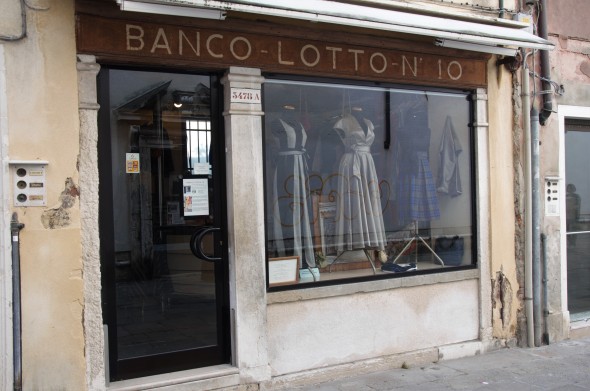
Moving on, I headed north and picked up a boat which looped around the Castello district to bring me to the San Zaccaria stop. I was hoping to see if the church’s flooded crypt was underwater, but it closes from 12 noon until 4pm each afternoon so was out of luck. Nearby though, I passed Banco-Lotto No. 10 which sells clothing made by inmates at the women’s penitentiary on Giudecca Island. Sadly, that too was closed, though it shouldn’t have been according to the sign on its doorway. The clothes looked fabulous, even for someone with my limited fashionista skills.
Next up was a bookstore, and one which proves that Amazon can’t provide everything. The Libreria Alta Acqua is a treasure. Books stacked in precarious piles fill every inch of available space. Balanced on shelves, filling redundant gondolas and bath tubs, they represent what a bookstore should be.


This is a place to be savoured, to potter and to forget the time or anything else on your mind. The store owner wandered about, leaving the rather scary looking cat to mind the till while he wheezed and tutted to himself looking for items unspecified but clearly important. I think I could have watched him all day too. Out back was the tinest of courtyards with a sign imploring people to climb up some wobbly stairs made of old books to see the view over the canal.


I couldn’t resist walking south via St Mark’s Square. This might sound odd as I really hate the crowds and the tourist paraphernalia but I think I wanted to see just how bad it was. On the way, in Calle del Mondo Novo, my nose caught the aroma of a cheese and ham store as my eye was drawn to a pig in the pizza shop window opposite. Incidentally, I read that you should never eat pizza in Venice as wood-fired ovens are banned with just a tiny handful of exceptions. The store, Prosciutto e Parmigiano, is known locally as Latteria Senigaglia (that was the name of the original family-run dairy produce store which was set up in 1940).


In St Mark’s Square, I navigated a sea of people who couldn’t have been more synchronised in pointing their mobile phones towards whatever their guide was pointing out had a musical soundtrack been in place. Pausing only to recreate the famous shot of the gondolas lined up facing out across the lagoon, I hopped on another vaporetto. This one was bound for the church of San Giorgio Maggiore. From the top of its belltower, or campanile as they’re called, the views across the city are splendid and of course you look out over the campanile in St Mark’s Square rather than from it. It costs 6 euros to ascend, but for that they provide a lift, and free entertainment when the bells chime the hour, frightening unsuspecting visitors. Best of all – no queues.

It was mid-afternoon and I wanted to explore a little more before I left, so I took a boat a short way up Canale della Giudecca, jumping off at Spirito Santo church to cut back through to the Grand Canal near the Peggy Guggenheim art collection. Another vaporetto took me to Venice Casino from where I could cut through to the district of Cannaregio. This is on the Venice authorities’ recommendations list and is where you’ll find the Jewish Ghetto. It lacked the crowds of St Mark’s and it’s probably very uncharitable of me to hope that the city’s campaign is unsuccessful and it stays that way.


I had planned to have an early dinner in Osteria al Bacco, which is one of the area’s most highly rated restaurants, but got sidetracked by the wonderful Al Timon instead. You do need to book ahead for dinner reservations, though they don’t always serve what they display in the window. Get there right on the dot of six when they open to grab a table for cicheti and a Spritz – for something classically Venetian, swap the fashionable Aperol for Campari.


Time was ticking on so I took a last vaporetto ride along the Grand Canal and then bought a ticket for the boat back to the airport. I’d definitely recommend a visit outside of summer and most importantly, away from the crowd. Venice is never going to be one of my favourite cities, but it’s growing on me.
The other day trips by air:
Ibiza
https://juliamhammond.wordpress.com/2017/05/13/just-back-from-a-day-in-ibiza/
Copenhagen Christmas markets
https://juliamhammond.wordpress.com/2016/12/05/just-back-from-a-day-at-copenhagens-christmas-markets/
Regensburg
https://juliamhammond.wordpress.com/2016/11/25/just-back-from-a-day-trip-to-regensburg/
Belfast
https://juliamhammond.wordpress.com/2016/10/17/just-back-from-a-day-trip-to-belfast/
Budapest
https://juliamhammond.wordpress.com/2016/10/07/just-back-from-a-day-in-budapest/
Bremen
https://juliamhammond.wordpress.com/2016/06/07/just-back-from-a-day-trip-to-bremen/
Lisbon
https://juliamhammond.wordpress.com/2014/10/20/just-back-from-a-day-trip-to-lisbon/
Amsterdam
https://juliamhammond.wordpress.com/2015/01/26/just-back-from-a-day-trip-to-amsterdam/
Priorities
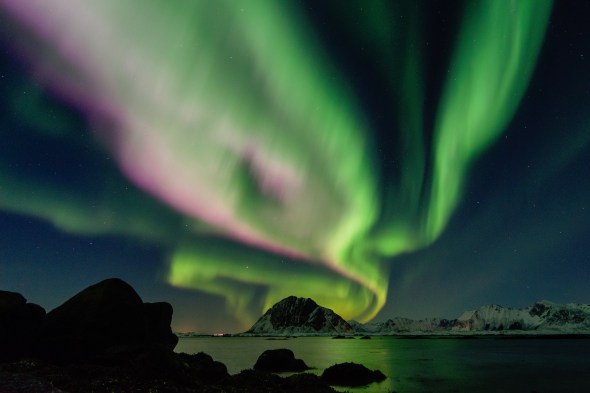
I sat up half the night to watch the Northern Lights. She said she was cold and wanted to go to bed.
I wandered the streets of New York all day. She said her feet hurt and could we go back to the hotel.

I saw three lion cubs playing in the grass just in front of me. She said that the trouble with safaris was that you had to sit in a truck for so long before you saw anything.

I drank mint tea perched on a packing crate deep in the souk. She said was there a Starbucks anywhere because she needed a decent coffee.

I found a quaint b and b to stay in. She said she wanted a choice of pillows and twenty-four hour room service.

I said I worked to travel and saved every penny I had for my next trip. She said she’d rather get those replacement windows in before the winter if it was all the same to me.
How does a country come up with its name?
Have you ever wondered where a country’s name comes from? Some, like Ecuador – named after the Equator which bisects it – link to their geography. Others, named by those who rediscovered them, focus on history – Viscount Jean Moreau de Sechelles was France’s Finance Minister at the time and is now immortalised in the Indian Ocean. For still more, the origin of their name is disputed or unknown. Here are the stories of how five of the world’s countries got their names.
Pakistan
Pakistan is a relatively new nation and its name is an artificial creation. Yes, Pakistan is actually an acronym, combining some of the most important Muslim regions. The first to use it was Choudhry Rhamat Ali, long before Pakistan was partitioned from India. He referred to Pakstan (no i) in a pamphlet, combining letters from the five northernmost regions of the British colony – Punjab, Afghania, Kashmir, Sindh and Baluchistan (the latter providing the -tan suffix). The extra i was added later to make the name easier to pronounce.
Argentina
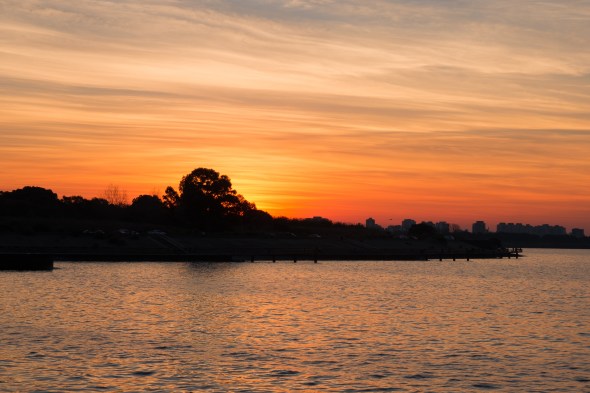
The word “argentine” means “resembling silver” and thus Argentina is the land of the silver. When the Spanish conquistadors first set eyes on the Río de la Plata in the 16th century, some accounts refer to the silvery colour of the water in the sunshine. More likely, the name comes from the gifts of silver given to members of Juan Díaz de Solís’ expedition. They were also told of a mythological mountain, rich in silver. They named it Sierra de la Plata, but it is more likely to have been Cerro Rico de Potosí, one of the largest silver mines found in modern day Bolivia.
Tuvalu
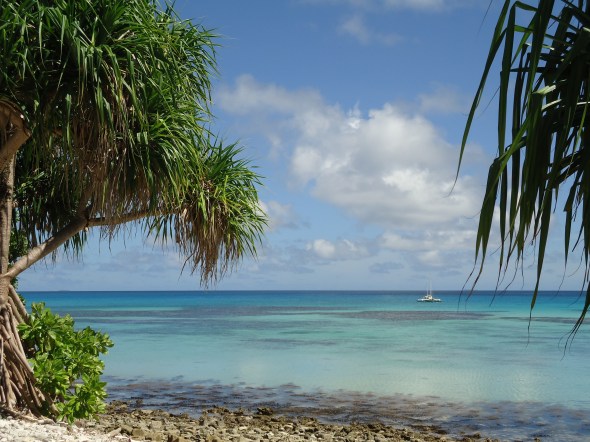
Prior to independence, Tuvalu was called the Ellice Islands and governed by Britain first as a protectorate and later as a colony, in partnership with the Gilbert Islands (now known as Kiribati). But by the 1970s there was a mood for change and the majority of Ellice Islanders wanted to go it alone. They got their wish, becoming a separate British dependent territory in 1975 with full independence coming three years later. The country’s fresh start warranted a new name: Tuvalu. It means “eight standing together”. Actually there are nine island groups but one is so close to sea level they probably classed it as sitting down. Global warming is not going to be good news in these parts.
Burkina Faso

Another name change though this time long after independence – the country used to go by the unoriginal moniker of Upper Volta. In 1984, the then president Thomas Sankara chose Burkina Faso, which translates as the “land of honest men”. Given that Sankara seized power in a revolutionary coup, not exactly the most honest way of filling those shoes, the name was somewhat aspirational. Sankara himself was assassinated in a coup three years later.
Moldova

Fans of the crappy 1980s TV series Dynasty will be familiar with Moldavia but few at the time realised it was a real place, a historic region now split between Romania and Moldova. Moldova takes its name from the river that actually flows in the Romanian half. Several theories exist as to how it got its name, the best of which is a legendary tale. Dragos Voda, a Maramures nobleman was hunting with his pet dog. The dog, Molda, chased a bison into the river and drowned. The heartbroken Voda ordered that from that moment on, the waterway was to be called the Moldova River.
Want to add to the list? Why not post the meaning of your country’s name in the comments?
A beginner’s guide to Central America
The seven countries of Central America – Panama, Costa Rica, Nicaragua, Honduras, El Salvador, Guatemala and Belize – fill an ancient land bridge joining the continents of North and South America. Volcanic, verdant and vibrant, they offer the traveller some of the best tourist experiences in Latin America. The difficulty is not in deciding to go, it’s working out what to leave out from your itinerary when there’s just so much to see and do. This guide is designed to get you started.
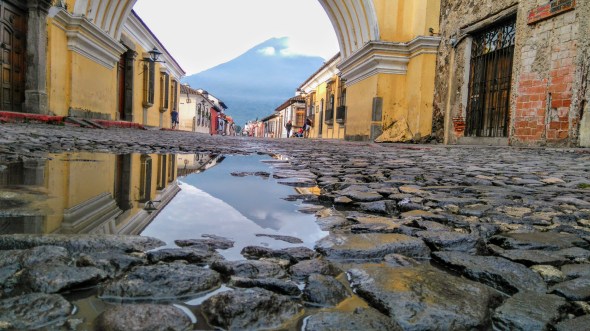
Antigua’s famous arch frames Volcan de Agua perfectly
Getting there
For many years, getting to Central America from the UK generally meant an indirect flight, and often the cheapest flights are still those which hub through the USA. Try looking for flights with United via Houston, American via Miami or Delta via Atlanta. Some tour operators also offer flights without the need to buy one of their packages as well. Thomson (Tui) for example fly direct to Liberia in Costa Rica and they often have deals available last minute for around £300. Schedules are less flexible, however and the once a week flight might not suit your needs.
If you’re looking for a European-based airline, British Airways can get you to Costa Rica non-stop and recently, Air Europa commenced the first ever direct trans-Atlantic flight to Honduras, departing from Madrid. Another alternative is to combine Central America with Mexico – you’ll find plenty of deals via Cancun which is easily combined with Belize and Guatemala. Similarly, you could combine Panama with delightful Colombian city of Cartagena. Shop around. You should be able to pick up return flights from Europe for under £400.

Shop around for a good deal
Getting around
Depoending on your budget, you’re either going to be seeing a lot of airports or taking a long-distance bus. Try Avianca El Salvador, formerly branded as Taca, and Copa Airlines, both of which have extensive networks across the region. if your time is relatively short, this is a good way of freeing up time for sightseeing. Book well in advance to secure the best deals.
As with elsewhere in Latin America, many companies offer relatively comfortable “luxury” coach services but you’ll also find plenty of chicken buses knocking around on the shorter routes which make up for what they lack in comfort with bucketfuls of character. The big name in the bus world is Tica, kind of a Central American version of Greyhound. I’ve also had good experiences with Hedman Alas in Honduras and King Quality. At peak times you’re best to reserve your ticket a few days in advance.
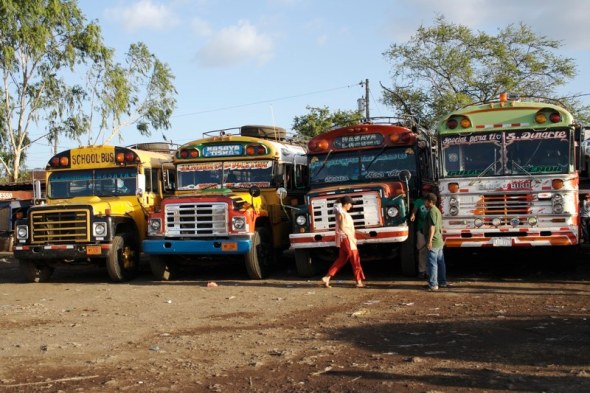
Local buses in Nicaragua
Check out point to point transfers too. For instance, Gray Line offer hotel to hotel transfers at reasonable prices in Costa Rica and similar tourist shuttles are also easy to find between Guatemala’s main hubs.
One thing to note is safety. In some parts of Central America, buses can be held up by armed gangs. Opt for a better company who videos passengers on entry and screens luggage and pick a day bus rather than overnight travel on the most notorious routes. Keep up to date with safety by monitoring the FCO’s travel advice by country.
https://www.gov.uk/foreign-travel-advice
What to see
There’s way to much for me to cover here, so you should consider these itineraries just a start and delve into one of the many online resources or good guide books on the region to help you make your own detailed plans.
A week in Panama
Begin in Panama City and spend at least a day absorbing the atmosphere of the Casco Viejo, the city’s old town. Some compare it to Old Havana and whether you agree or not, if you like Cuba you’ll like this too.

Casco Viejo
The canal zone is a worthwhile day trip, easily accessed from the capital. You’ll pass through the Gaillard Cut, where the Chagres River flows into the canal as well as several locks before returning to the city. I booked this through my accommodation La Estancia B&B, which has since closed, but the company they used is still very much in business and takes direct bookings.
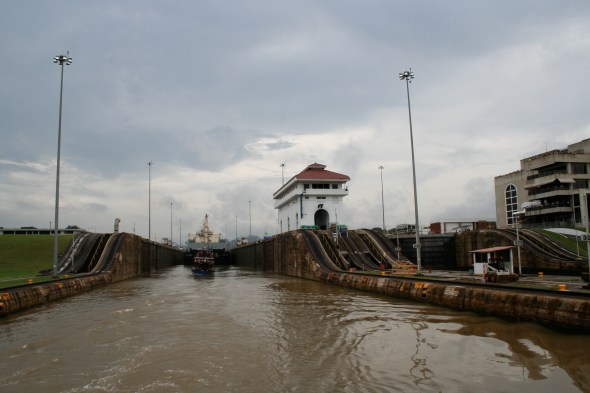
Panama Canal
Another excellent day trip is to Emberá Puru. Guide Anne de Barrigon will take you into the rainforest to meet the Emberá tribe and learn a little of their way of life. She knows her stuff – she married a villager! Part of the journey involves travelling upriver in a dugout canoe which is sure to prove a memorable experience as well.

Embera kids
Extend your trip either by spending more time in Panama City or by kicking back and relaxing on one of Panama’s beautiful islands, in the Bocas del Toro archipelago or in San Blas.

Isla Diablo, San Blas
Panama links:
Embera Puru:
http://www.emberavillagetours.com/
Canal transits:
http://www.panoramicpanama.com/en/panamacanaltransit
A week in Costa Rica
With so many national parks to choose from, it’s hard to whittle them down. If you only have a week, I’d recommend splitting it into two. Focus on Tortuguero for a two night stay. I based myself at Laguna Lodge which from July to November can offer turtle watching walks. The beach and surrounding canals offer a chance to see plenty of birdlife and just unwind.

Tortuguero
Then move on to La Fortuna, a pleasant little town which is the jumping off point for Volcan Arenal. There are hot springs, nature walks, horseback rides and of course, the chance to watch for any activity coming from this active volcano. The Arenal Observatory Lodge makes a great base, especially if you choose one of the rooms directly facing the volcano. Nearby, they can also offer activities such as ziplining and whitewater rafting if the volcano isn’t making your adrenaline pump enough.
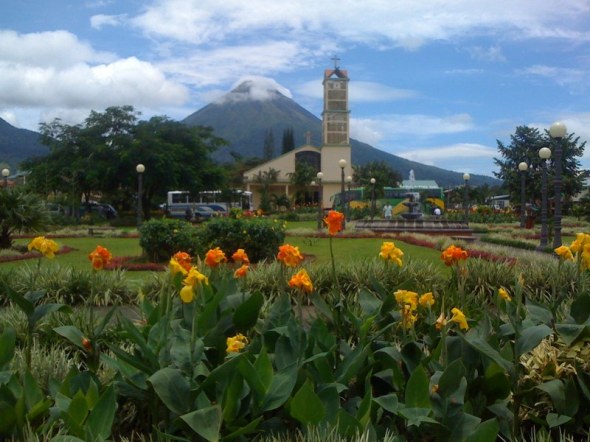
La Fortuna with Arenal in the background
Costa Rica links:
Tortuguero:
http://www.lagunatortuguero.com/
Arenal:
A week in Nicaragua
My suggestion for a week in Nicaragua would be to base yourself in the charming city of Granada. It sits on the shores of Lake Nicaragua and has a wealth of delightful streets to lose yourself in, crammed with historic buildings including the egg yolk yellow cathedral. Tourist infrastructure is good and there are plenty of hotels and restaurants to choose from.

Granada
From the city, there are plenty of day trips to keep you absorbed. Head up Volcan Mombacho where a truck will drive you up into the cloud forest. Alternatively, stand on the crater rim of the active Volcan Masaya and sniff the sulphur. It’s currently more active than it was when I visited; take a guide for a night tour and you might be able to see the lava lake that’s filled the crater. Check conditions locally before you go.
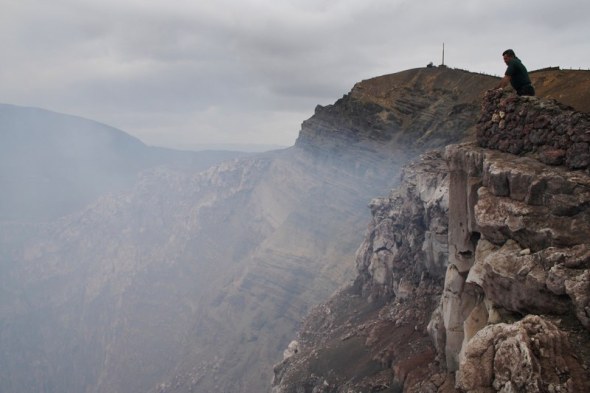
Masaya volcano
Laguna del Apoyo is another option. This crater lake is now a nature reserve and there are plenty of activities that can be arranged here such as kayaking, swimming and boating. Extend your trip by visiting Ometepe Island with its twin volcanic peaks.
Nicaragua links:
Volcan Mombacho:
Volcan Masaya activity:
https://www.volcanodiscovery.com/masaya.html
A week in Honduras
Getting around Honduras can be a little worrying as there are serious safety concerns within and between its two largest cities, San Pedro Sula and Tegucigalpa. Persevere and base yourself in the safe and sleepy town of Copan Ruinas. The nearby ruins are free of the crowds that plague other Mayan sites in the region and you’ll see plenty of raucous scarlet macaws to boot.

Scarlet macaw at Copan’s ruins
It’s easy to arrange a trip to the nearby Finca el Cisne, which focuses on Criollo chocolate and coffee growing. Day trips give you the opportunity to explore the plantation and take a scenic horseback ride in the surrounding countryside; it’s also possible to extend your stay overnight.

Preparing the horses at Finca el Cisne
If you can drag yourself away, extend your stay with a trip to Roatan. Honduras boasts a lengthy Caribbean coastline, but it’s the Bay Islands which draw the tourists. The usual water-based activities are available and the sunsets are a spectacle. If you’re looking for a guide to help you explore the island, then Cleve Bodden comes highly recommended. He’s warm, funny and above all, knowledgeable about his island home.

Roatan sunset
Honduras links:
Finca el Cisne:
Cleve Bodden:
https://www.facebook.com/clevestoursandadventures/
A week in El Salvador
Beginning from San Salvador, the country’s capital, take a drive to Lake Coatapeque, popular on weekends as a family hangout. Continue towards the picturesque Ruta de las Flores. This 36km road winds through village after village adorned with flowers, dotted with art galleries and sprinkled with more cafes than you could ask for. From Juayua to Ataco via Apaneca, there’s much to keep you busy.
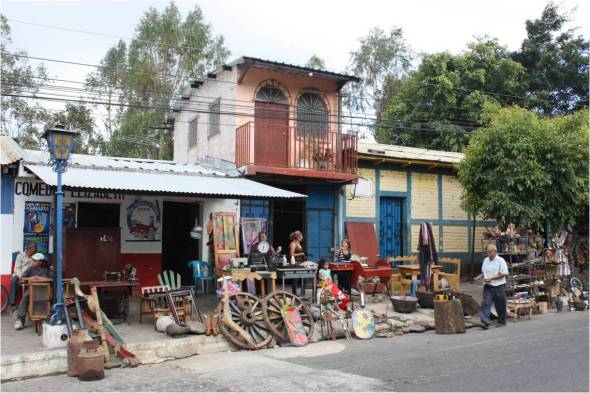
Ataco
Suchitoto should be your base for the rest of your week. Team up with El Gringo, who can provide accommodation as well as tour guiding services. Together, we visited Project Moje, a gang rehabilitation project, as well as the arts and crafts centres of Ilobasco and San Sebastian.
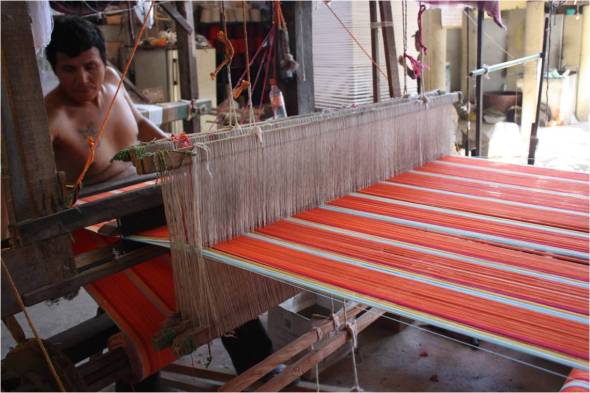
Textile weaving in San Sebastian
El Salvador links:
El Gringo:
http://www.elgringosuchitoto.com/
Project Moje:
A week in Guatemala
The obvious base to begin your week in Guatemala is the pretty town of Antigua. There’s a wide choice of hotels, restaurants and cafes and a well-developed tourist infrastructure. The town has lots of attractions in its own right, including the chance to make your own chocolate, but also makes a convenient base for side trips to the atmospheric market at Chichicastenango and beautiful Lake Atitlan.
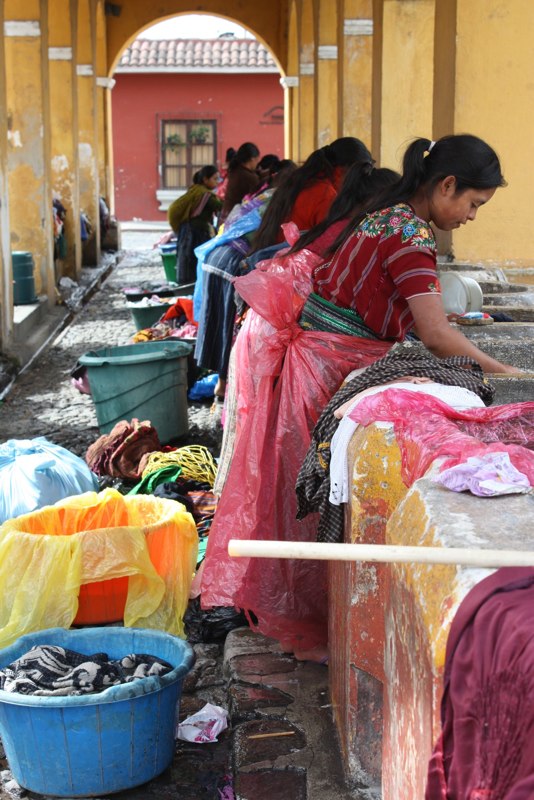
Doing the washing, Antigua-style
If you’re looking for the other must-see, then it has to be Tikal. Of all the Mayan sites in the country, this is the stand out attraction. Deep in the jungle, it was abandoned over a thousand years ago, but its iconic ruins make this a UNESCO World Heritage Site. Don’t miss the Lost World Pyramid and the Temple of the Grand Jaguar. There have been issues with tourist safety in and on the way to Tikal so as with Honduras, it’s especially important to keep abreast of government advice.
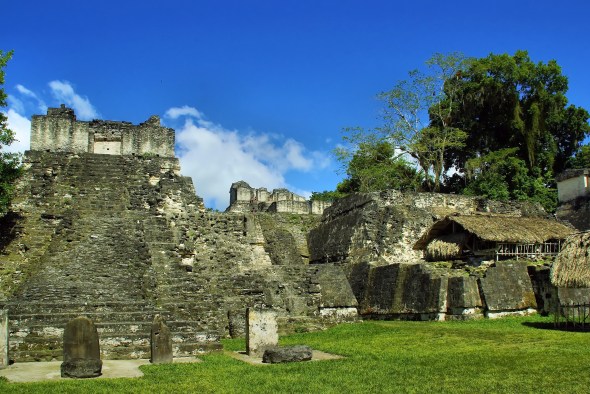
Tikal
Guatemala links:
Chocolate making:
https://www.chocomuseo.com/english/our-locations/antigua-gua/
Tourist shuttle service:
https://www.graylinecostarica.com/costa-rica-shuttle-services-and-tourist-bus
A week in Belize
Belize was known as British Honduras until 1981 and English is its official language. I think this more Caribbean, less Latino feel is why it was my least favourite of the seven countries. That’s not to write it off though. Transferring at the airport onto a little plane to head out to Ambergris Caye was laid back and fun, but the views down to the water were spectacular. The diving’s great, with access to the famous Blue Hole a possibility.

Looking down on the islands from the air
It’s worth heading back to the mainland as Belize has some interesting Mayan sites to visit. I visited Lamanai on a day trip from Ambergris Caye, heading inland on an old American school us and then up the New River by boat. There’s a Mennonite community living in Shipyard, not far from the ruins, and you might get a glimpse of them going about their business as you pass by. There are other worthwhile Mayan ruins to see in Belize, among them Caracol and Altun-Ha.

Head upriver to Lamanai, whose name means “submerged crocodile”
If you want to extend your time in Belize, Placencia gets a good write up as a place to chill out and recharge the batteries.
Belize links:
Lamanai tours:
http://www.lamanaitour.com/lamanai-tour-ambergris-caye/
Ambergris Caye information:
In summary
You’ll need several months to do justice to all seven countries in the same trip, but it’s easy to combine a couple of neighbouring nations and concentrate on one part of the region. For me, the countries that are least developed are the ones I’m drawn to revisit – El Salvador, Honduras and Nicaragua. But each one rewards the traveller, so whichever you choose, I’m sure you’ll have a great trip!
What to do if you’re impacted by Ryanair’s cancellations
If you’re affected by Ryanair’s announcement that they are cancelling many hundreds of flights over the next six weeks, you’re going to need to know your rights. This is how the news broke:

If your outbound flight has been cancelled at short notice:
First, see if you can rebook. According to Ryanair’s website, this should be possible online. People are reporting on social media that the Ryanair helplines are overwhelmed and they’re not able to complete a rebooking over the phone. Obviously with so many people chasing so few seats at short notice, many are going to be disappointed. So what then?
If you cannot find a satisfactory rebooking (e.g. your flight is being rebooked but so late into your holiday to make it as good as useless) then you’ll need to apply for a refund. You may also be entitled to compensation. These are your rights under EU law if the destination is within the EU or if it’s an EU carrier like Ryanair:
Flight cancellation
Flights under 1500km – 250 euros compensation
Flights over 1500km – 400 euros compensation
Note: this only covers you if your cancellation occurs 14 days or less before your flight. If you are due to travel in more than 14 days’ time and your flight is cancelled, this will be treated by the airline as a rebooking or rerouting. You still have the right to cancel with a full refund of what you paid for the flights, but will not be eligible for additional compensation.
Delayed arrival whether with Ryanair or alternative carrier
Flights under 1500km – 2 hours
Flights over 1500km – 3 hours
If you are delayed, you are also entitled to food and accommodation vouchers. Full details here:
http://eur-lex.europa.eu/legal-content/EN/TXT/?uri=LEGISSUM:l24173
Note that it can take many months to secure this compensation, despite EU regulations stating refunds must be paid within a week. Remember you will need to keep all receipts and boarding passes. It’s also a good idea to send letters recorded delivery if you are getting nowhere by email.
If you decide not to travel, have a look at what expenses you’ll incur, such as accommodation that cannot be cancelled at short notice. The airline is not liable for this. It will need to be claimed back from your travel insurance company. Making a claim such as this doesn’t affect your right to EU compensation if applicable.

If you’re abroad and your inbound flight has been cancelled:
The above applies but you’ll also have to factor in whether you need to be back home as a matter of urgency or can afford the time and money (up front at least) to extend your trip. You might find it easier to deal with staff face to face at the airport though this can add to your stress as there will be a lot of other angry passengers there which isn’t going to make you feel better.
You can try to persuade the airline that rebooking you with an alternative carrier e.g. a seat on a rival airline is a better idea. You’ll have more bargaining power if the airline itself is very tight for space and is struggling to get you somewhere, especially if you’re stranded and they’re having to pay for your overnight accommodation. Remember if you pay for your own alternative flights, you’re out of pocket.
It can be very hard to get them to pay, as I found out with CityJet a few years ago. CityJet refunded their own flight (that they cancelled fifteen minutes before departure) but because I didn’t want to wait for an alternative with CityJet or spend another night in Paris even at their expense, I paid for the Eurostar alternative. I eventually funded it out of the compensation I received eight months later. Read the full story here:
https://juliamhammond.wordpress.com/2015/03/06/finally-a-win-against-cityjet/
If you can get through on a helpline, that is often better, but you will need to be patient. Be as calm, polite and flexible as you can, particularly if you need to get back home in a hurry. Remember the person on the phone isn’t directly to blame and venting your frustration isn’t going to get you anywhere.
If you’ve a flight coming up which is currently unaffected:
This currently is where most Ryanair passengers are, fortunately, and the social media furore should calm down for the most part now that people know where they stand. Nevertheless:
Have a Plan B. Research alternative airlines or other means of transport on the inbound leg. Check your email on a regular basis so that if your flight is next to be affected, you’re amongst the first to know – and fight for the seats that might be available on alternative flights.
Print out or save to your phone a copy of the EU regulations (see link above) so that there can be no dispute with airline staff about your rights – it will be in black and white.
Double check your travel insurance, especially the limits and excesses for flight delays and flight cancellations. Again, keep all receipts and boarding passes as you’ll need them to make a claim. Keep proof of the cancellation.

What now?
Ryanair’s lack of consideration for their customers, though not a surprise, is still a concern. They won’t be the first and last airline to do this. I’ve had similar late in the day cancellations from American Airlines (weather related issues leading to a 48 hour delay in New York when I should have been in Nicaragua) and as mentioned, with CityJet (who didn’t even inform us the flight was cancelled, just checked us in as normal and quietly removed our flight from the departures board). But for the record, Ryanair, you need to remember who keeps your staff in a job and your planes in the air.
Update 17 September from the excellent Simon Calder at The Independent:
Update 18 September of full list of cancellations on the Ryanair website:
https://www.ryanair.com/ie/en/useful-info/help-centre/travel-updates/flight-cancellations7
How to reduce your risk of being caught up in a Caribbean hurricane
As Irma finally begins to blow herself out, the US and many Caribbean islands have been left reeling from her effects. Sustained 185mph winds have been recorded during this Category 5 storm, beaten only by Hurricane Allen in 1980 which registered winds of 190mph. On top of that, of course, are the floods which result from torrential rain and the even more dangerous storm surges caused when winds slam ocean water back onshore with terrifying force. Even a Category 1 hurricane is not to be taken lightly, as those who live in hurricane-prone regions will testify. For casual holidaymakers unused to such events, it’s even more frightening. So has seeing Irma’s devastation marked the end of your Caribbean holiday plans? Here’s why it shouldn’t and how you can avoid getting caught up in such a disaster.
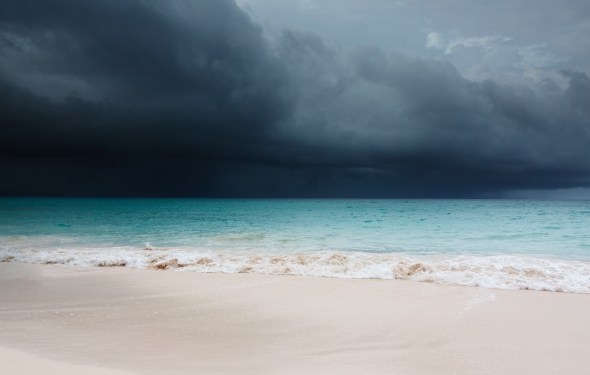
Choose your island carefully
Statistically, some Caribbean islands are hit by hurricanes far more often than others. According to data compiled by stormcaribe.com for storms between 1944 and 2010, you’re most likely to be affected if you’re in Abaco in the Bahamas, with Grand Bahama, Bimini and New Providence islands hot on its heels. A couple of islands in the Netherlands Antilles also occur in the top ten, notably Saba and St Eustatius. Making up the numbers are Nevis, Key West, Tortola in the BVI and the Cuban capital Havana.

Conversely, the bottom of the list features some well known names. Barbados, Grenada, St Lucia and St Vincent are much less likely to experience a hurricane. Such severe storms rarely if ever take a southerly track, making the likes of Trinidad and Tobago, Aruba, Curacao and Bonaire the safest bet in the region. For the full list check out this link:
http://stormcarib.com/climatology/freq.htm
A broader picture (and more up to date, factoring in storms up to 2016) is offered by Hurricane City. Their list factors in storms as well as hurricanes, giving a more rounded and perhaps more accurate appraisal of the risk posed for the Caribbean, Bermuda and the USA. Joining the Bahamas to represent the Caribbean in the top ten are the Cayman Islands. Because this list encompasses storms as well, there are a few northerly locations there too:
http://www.hurricanecity.com/rank.htm
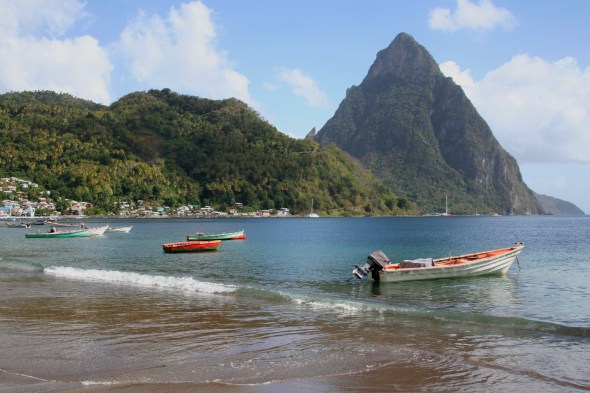
Avoid peak hurricane season
If you really want to go to the islands that lie in the path of potential hurricanes then you’ve got to be picky about when you go. Technically, the Atlantic hurricane season begins in June, but rarely do we see really damaging hurricanes before late August. 2005 was a bumper year for big storms – Katrina among them – and was the year when we saw the earliest Category 4 storm (Dennis on July 8th) and Category 5 storm (Emily on July 17th). The storm season officially comes to a close at the end of November though on rare occasions they can continue until December or even January. Yes, you guessed it, that happened in 2005 too. They’d already run through the named hurricanes by October when Wilma hit and eventually needed to borrow six letters of the Greek alphabet. Tropical Storm Zeta finally brought the season to a close when it dissipated on January 6th 2006.

Check the NOAA forecasts
Each year, the National Oceanic and Atmospheric Administration (NOAA) offers a forecast for the upcoming season. They take in a number of factors such as ocean temperatures and, though it’s not an exact science, have a good track record in identifying busy years. So far, 2017 is falling in line with predictions. It kicked off with Tropical Storm Arlene in April – two months ahead of schedule – and with the likes of Harvey and Irma, is set to be another of those unforgettable seasons. If you want to avoid being caught up in a severe hurricane, then if it’s been quiet, you’re much less likely to find yourself in trouble if you want to make a late booking. And if the worst happens, this leaflet is packed with useful advice:
Click to access TropicalCyclones11.pdf
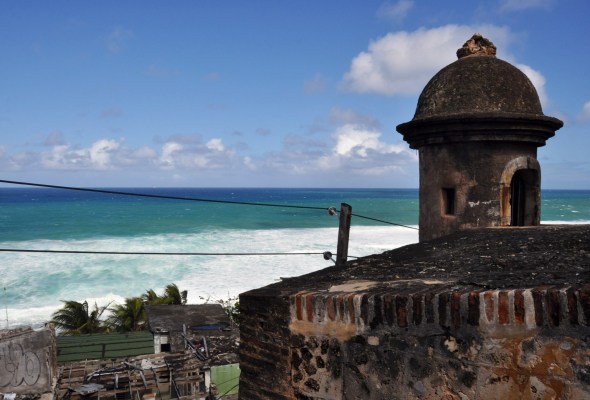
My thoughts are with those who found themselves in the path of recent Atlantic hurricanes. I hope that those affected get back on their feet and that the impacted economies recover as quickly as possible. Once they do, they’re going to need your tourist dollars, so don’t write off this beautiful region just yet.
Ten of the best European cities
Recently I posted a blog about my ten favourite American cities; you can read it here if you missed it.
https://juliamhammond.wordpress.com/2017/08/31/ten-of-the-best-american-cities/
Among the comments was a good-natured challenge from Andrew Petcher of Have Bag, Will Travel, suggesting that Europe’s cities have a lot more to offer the visitor. It got me thinking about which would make my Top Ten and after some deliberation, here are my choices.
Cáceres, Spain
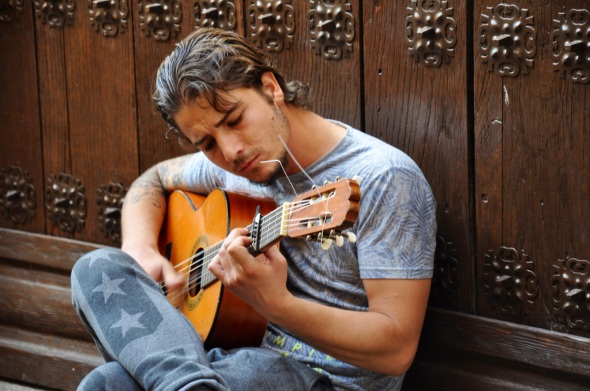
In the heart of beautiful Extremadura, Cáceres is one of those finds that you agonise over telling others about for fear of drawing the crowds. This is the kind of place you’ll want to keep for yourself. The labyrinthine Ciudad Monumental, crammed full of mediaeval mansions and delightful churches, absorbs as much time as you’re prepared to give it. I’d have still been there were it not for the promise of the tastiest suckling pig in the region and late night drinks in the palm-lined Plaza Mayor.
Lisbon, Portugal
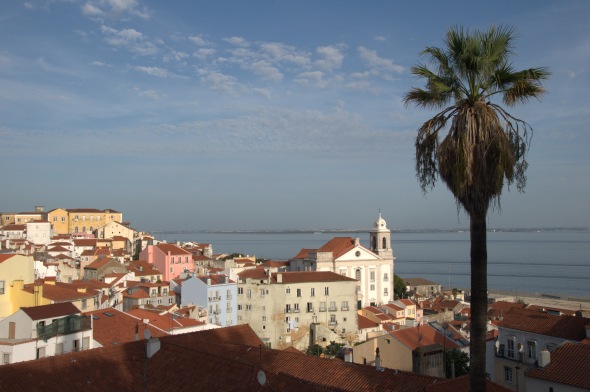
Over the border, the Portuguese capital is one of the most absorbing on the continent. Its rich maritime history is proudly remembered across the city such as in Belém’s Monument to the Discoveries. The #28 tram ride linking the lower and upper towns might be touristy, but it’s still a must for its heritage wooden cars and the views along the way. But again, it’s food that is my fondest memory, particularly the delicious Pastéis de Belém warm out of the box – you’ll have to queue, but it’ll be worth it.
Stockholm, Sweden

The reason I’m so taken with the Swedish capital is that it doesn’t have to be a city break at all, if you don’t want it to be. The Feather Islands are just a thirty minute boat ride away, but a tranquil spot for lunch and a short stroll if you’re fed up with city traffic and noise. Skeppsholmen Island reveals a collection of historic boats and Benny from ABBA’s recording studio, while Djurgården Island is where you’ll find the ABBA museum and the astonishingly well-preserved 17th century Vasa ship.
Bremen, Germany
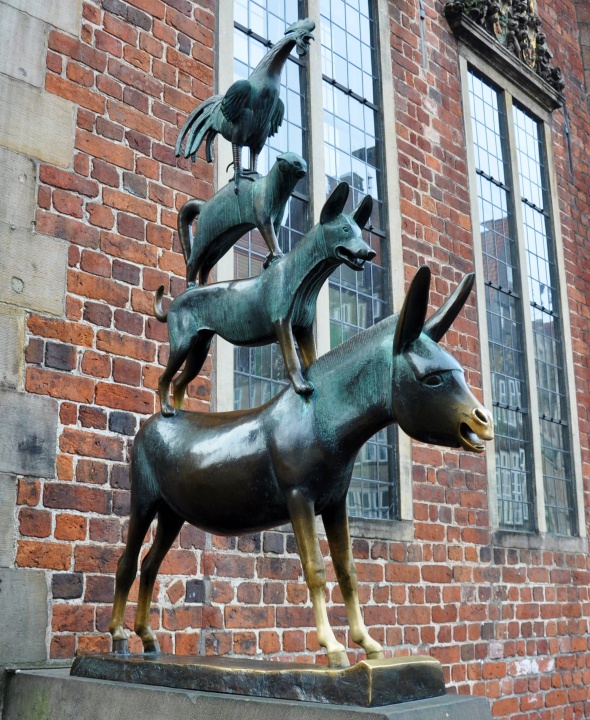
Of Germany’s cities, Bremen stands out. The Schnoor quarter is packed with timber-framed houses once occupied by fishermen but now home to a plethora of boutique shops selling artisan crafts. The city’s historic heart is eclectic, its Flemish-style Schütting, a 16th century guild hall, and the windmill in Wallenlagen Park a reminder of how close you are to the Netherlands. But it’s four small creatures that were the reason for my trip – donkey, dog, cat and rooster from the Grimm’s fairytale.
Krakow, Poland

Krakow is one of those cities that no matter how many times you visit, you’ll never tire of it. Nowhere is this more true than in the Old Town’s largest square, Rynek Glowny. It’s dominated by the centuries-old Cloth Hall; duck under its arches to find shops selling amber and other local wares. I enjoy it best at night, when huts selling pierogis and tender ham hocks draw people away from the many souvenir stalls of the market.
Salzburg, Austria
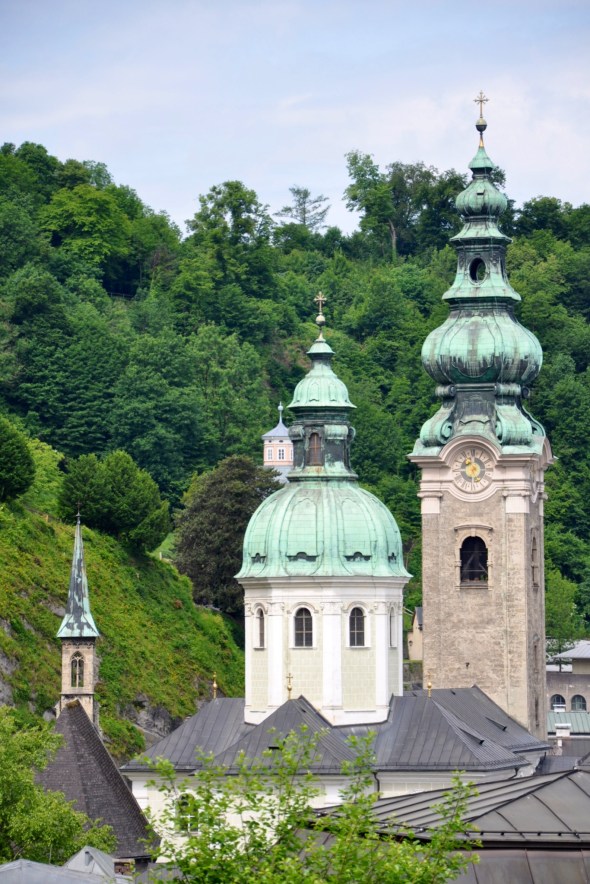
I first squealed with delight at Hellbrunn’s trick fountains as a small child. Years later, I returned to find I wasn’t too old to have the exact same reaction. Just as much fun was a bicycle tour of the main sights featured in The Sound of Music – yes I know Mozart was born there but I’d much rather be yodelling with a lonely goatherd. This December I’m visiting the city’s Christmas markets for the first time. Can. Not. Wait.
Bologna, Italy
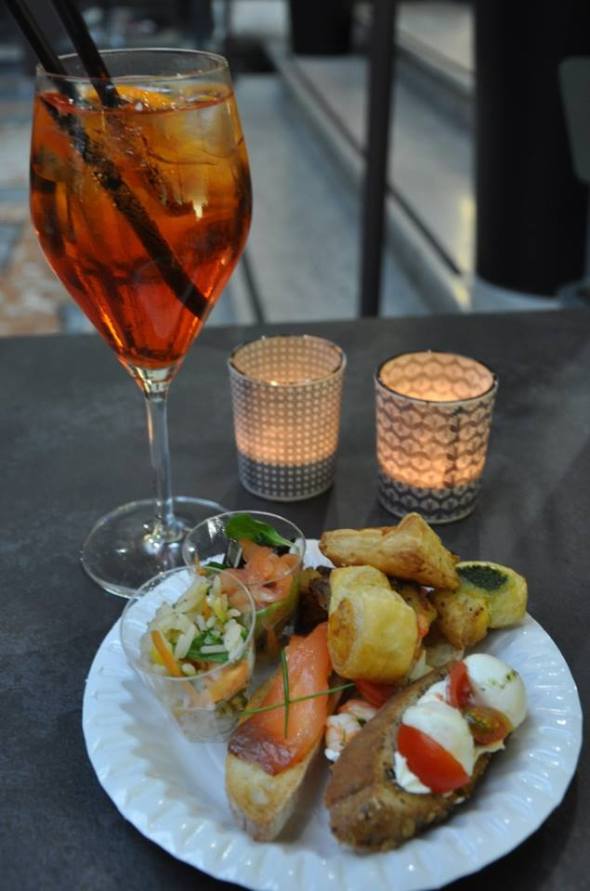
Give me a choice of Italy’s large cities, and this would be my choice, rather than Rome or Florence or Milan or Venice. Why? This is a city that is focused on food, from the delis that cram into its narrow alleyways to the platefuls of snacks laid out to soak up the Aperol Spritz at passeggiata hour. Thoughtfully, they even built a tower to climb so you can work off some of the calories; it’s 498 steps to the top of Torre Asinelli.
Dubrovnik, Croatia
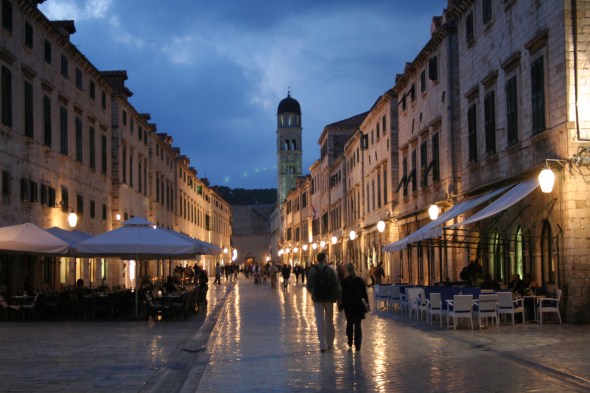
To see Dubrovnik at its best you’ve got to time it so that the cruise ships aren’t in dock, and that takes some planning – or at least an overnight stay. You’ll be rewarded with empty city walls to walk, piazzas and cobbled streets lined with cafes and restaurants and a host of other sights that are far better without the crush.
Riga

When it comes to the Baltics, it was a tough decision for me to choose between the Latvian capital Riga and its Estonian counterpart Tallinn. In the end, I opted for the former. Don’t miss the Three Brothers, the oldest buildings in the city, and the House of the Blackheads which houses Parliament. Both are a must for architecture fans. They also have some innovative ideas to help you avoid putting a dent in your bumper.
Budapest
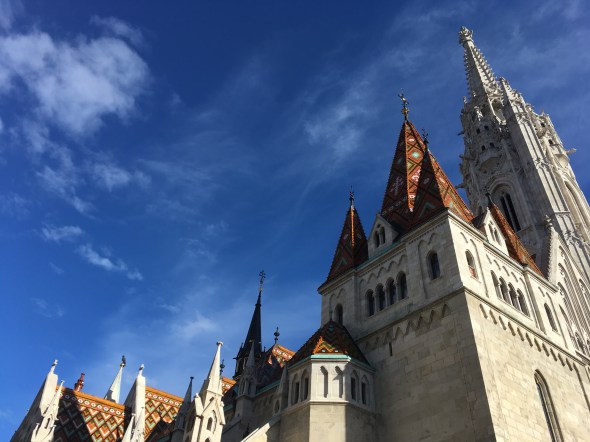
Bisected by the River Danube, this is a city with a split personality, so whatever mood you’re in, you’ll find half the city to suit. Fishermen’s Bastion in Buda is a good place to get your bearings, and admire the Gothic architecture of Parliament across the water. After coffee in Cafe Gerbeaud, the market hall in Pest is perfect for stocking up for a riverside picnic. And don’t forget the city’s many thermal baths for when your muscles begin to ache.
So there you have it. Apologies if you were looking for Amsterdam or Paris, Berlin or Barcelona. While I enjoyed the latter pair, the first two still fail to wow me. And I’ve deliberately stuck to mainland Europe, hence the lack of London, York, Bath or Leeds. What would you have included on your list of Top Ten European cities?
Ryanair’s baggage changes penalise those already booked
Today Ryanair have announced that from 1st November, their policy on cabin baggage will change. Currently, up to two bags can be taken on board, one of standard dimensions (55cm x 40cm x 20cm) and one smaller item (35cm x 20cm x 20cm). Currently, a small wheelie fits and can be stowed in the overhead bins, while the smaller bag, perhaps a day sack, can be placed under the seat in front. On busy routes, some passengers are asked to place their larger bag in the hold free of charge.

Today Ryanair have announced changes to their policy. Basically, customers opting not to pay for Priority Boarding will lose the right to take some of their carry on with them as they board the plane, instead handing it to staff to put it in the hold.
I have two Ryanair flights coming up, one in October to Venice and one in December to Salzburg. My Salzburg flight will be affected by the changes. I was planning to take a bag that was smaller than their maximum dimensions but slightly larger than those of a smaller item. Now, I have to either rethink the size of that bag or pay a £6 priority boarding fee for each leg to be able to take the luggage I planned. The Ryanair website states that the policy will be introduced on 1st November for all travellers, regardless of when they’ve booked.
That’s not playing fair. We took out the contract and now the details are unilaterally being changed. If I take the bag I planned, and the policy is implemented as per the rules, I’ll either have to check it at the gate free of charge and incur a delay when I arrive waiting for luggage, or risk being denied boarding. So effectively, my flight has gone up by £12 if I wish to take the luggage I planned. Had I paid for Priority Boarding at the time of booking, it would have cost £5 each way; to do so retrospectively it will be £6 each way.

I understand why Ryanair have taken this step. The amount of luggage being dragged on board is reaching ridiculous levels and boarding is a much slower process because of it. But it does seem underhand to introduce a change to existing bookings without notice. Will this be the end of my love affair with Ryanair? Probably not. Do I feel like I’ve been cheated out of £12? Yes. The Ryanair haters are going to have a field day with this, and for once, rightly so.
Are you affected? Full details from Ryanair’s website here:
Ten of the best American cities
The USA’s diversity makes it one of my favourite countries and there are many cities I’ve revisited – or hope to do so – over and over again. Here’s my top ten: what are yours?
New Orleans, Louisiana

Sultry New Orleans ticks all the boxes: history, colour, a sense of fun and plenty of quiet, atmospheric corners to retreat to when the buzz gets too buzzy. The mansions of the Garden District stand in haughty contrast to the tackiness of Bourbon Street, but you don’t have to stray far from the notoriously crass party hub to find wrought iron balconies and heart-lifting melodies within the iconic French Quarter.
New York, New York
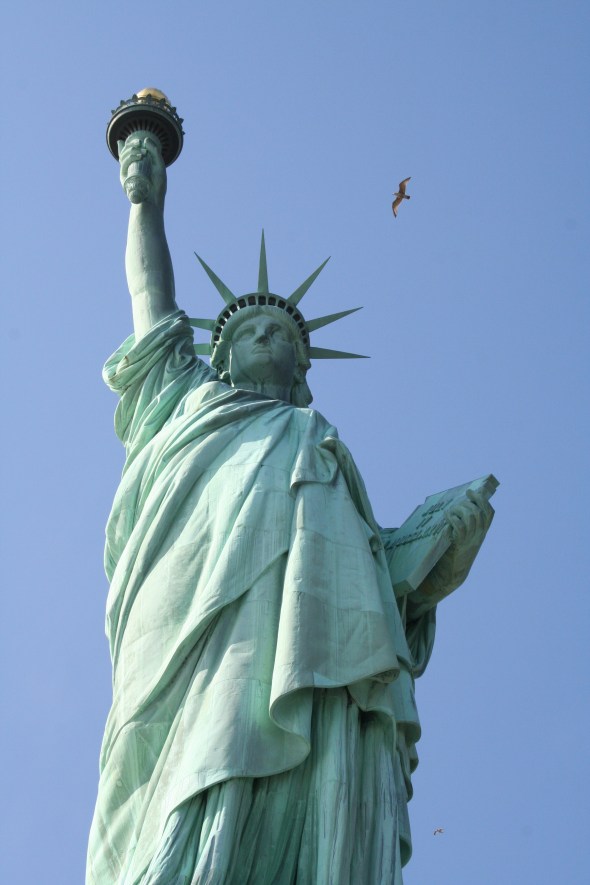
I’ve been back to New York countless times yet never tire of the place. But now I’ve ticked off the sights, on recent trips my focus has been on some of its most fascinating neighbourhoods and ethnic food joints. It delivers. But then I’d expect nothing less from the self-styled “Capital of the World”. Where else can you enjoy a southern-style Gospel brunch, El Salvadorean pupusas for lunch and the most succulent steaks outside Argentina for dinner?
Savannah, Georgia

Savannah’s centre has a split personality. On the one hand, its genteel tree-filled squares host historic mansions, each with its own intriguing tale to tell. Yet barely a stone’s throw away lies River Street, which comes alive each evening with bars and restaurants thronging with customers. This Georgia gem has it all – and some of the best beaches in the State just a short drive away.
Charleston, South Carolina

Elegant Charleston oozes sophistication from every cobble and porch, yet somehow manages to make you feel you’re worthy of a stay here. Beautifully tended gardens force you to stop and stare, even though you know you shouldn’t intrude. Yet in the bay lies Fort Sumter where the first shots of the Civil War were fired – there’s passion and fervour behind that steely façade.
Bar Harbor, Maine

A visit to Maine is a lesson in Geography, as Down East is actually north and residents travelling south to Boston say they’re going up. The map might be a bit squiffy but there’s no mistaking you’re in New England with fresh lobster, seal boat trips and the dark greens of Acadia’s firs and pines set off to perfection against a muted palette of pink granite and yellow sand.
Philadelphia, Pennsylvania

The Liberty Bell draws a crowd who queue patiently to inspect the crack in the iron that signalled the very first reading of the Declaration of Independence. Beyond that historic district is a city that is proud of its heritage and isn’t afraid to work hard to make a living. Best time to visit? New Year’s Day, when Philly lets its hair down for the annual Mummers Parade.
San Antonio, Texas

The city famed for the Alamo delivers, but the surprise is that the Alamo is overshadowed by the city’s other attractions. The River Walk, a flight of steps down from street level, is lined with restaurants and bars where minutes turn into hours without you even noticing that the time’s passed. With plenty of museums, galleries, and a Stetson hat store to rival anything anywhere, this place begs to be revisited.
Seattle, Washington

The iconic skyline with the instantly recognisable Space Needle might be what draws visitors to Seattle (or at least fans of Grey’s Anatomy) but this is another city where the memorable attractions are those which you didn’t know about before you landed. The fascinating story of a city built on lumber and a whole other world of underground storefronts and sidewalks awaits visitors who’ve watched the fish fly at Pike Place Market and sipped their coffee in the Starbucks where it all began.
San Francisco, California
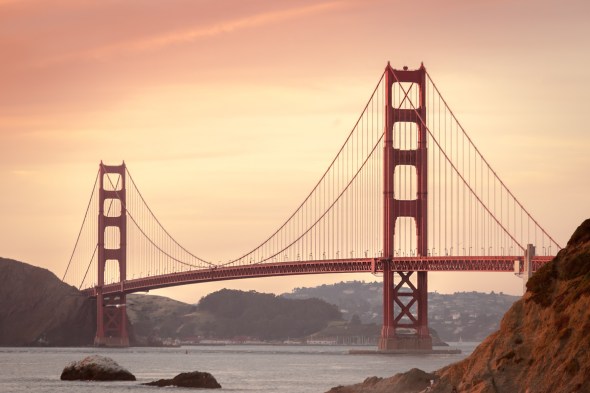
The seaplane pilot wore a grin with a span to rival that of the Golden Gate Bridge. Visibility, he said, was the best he’d seen in thirty years. Luck like that burns memories into your brain so deep they never fade. And under blue skies, sights like Alcatraz, Fisherman’s Wharf and the artists of Sausalito don’t get any better. Just check those brakes before you drive down the world’s most crooked street…
Memphis, Tennessee

Green shag pile carpet on a stairwell ceiling? Check. Acid yellow walls framing a bank of chunky televisions? Check. A private jet in the car park bearing the name Lisa Marie? Check. Graceland might not impress in terms of size but its Seventies style will leave you gawping, mouth open wider than the zip on that white jumpsuit. Oh yeah, and there’s music on Beale Street when you’re ready to return to the present.
There you have it; I’m sure Miami, Chicago and Boston will have their fans, as will Vegas, DC and the City of the Angels. What makes your list?
Five foods you must try on your travels
I love food. I love travel. And I love nothing better than combining the two.
The more I’ve travelled, the more adventurous I’ve become with the foods I’ll try. Some I’ve enjoyed, others not so much. There’s not much I’ve regretted eating, apart from the vile black chuño potatoes that popped up from the bottom of my soup bowl in Peru together with a wrinkled chicken’s foot. Dried in the Andean sunshine, chuño potatoes are bitter and a staple of altiplano cooking. And I hope I never have to eat one again as long as I live.
But here’s what I would recommend.
Cuy

Making short work of a roasted cuy dinner
It took a while for me to pluck up the courage to try cuy, for cuy is guinea pig and where I come from, guinea pigs are for cuddling. But in Peru, they’re for eating and have been for at least 5000 years. It’s such an iconic dish they even have a national holiday for the fluffy creatures – it’s the second Friday in October. Roasted cuy, particularly if you ask for it to be served with the head removed, isn’t likely to induce a gag reflex. It’s tasty, albeit rather fiddly to pick off the many small bones. It tastes not dissimilar to the dark meat of a chicken – though doesn’t everything? You won’t find it very filling, but it’s often served with a huge potato, so that should fill you up.
https://juliamhammond.wordpress.com/2016/04/13/a-beginners-guide-to-peru/
Hákarl
Trying hákarl, fermented shark meat
I’m not going to try to con you that hákarl is going to be the holiday taste sensation you try to recreate back home in your own kitchen. Like chuño potatoes, once was enough for this fermented shark meat which is an Icelandic delicacy. But unlike chuño potatoes, I’m glad I tried hákarl, and unlike Gordon Ramsey, I didn’t spit mine halfway across the room either. It had the texture of a piece of Parmesan that’s gone hard in the back of the fridge and a pungent ammonia-like aroma which didn’t endear it to my nostrils. Try it and see how bad it is. But don’t expect to see the locals doing the same. Sense has prevailed and they no longer eat the stuff.
https://juliamhammond.wordpress.com/2015/01/24/a-beginners-guide-to-iceland/
Suckling pig
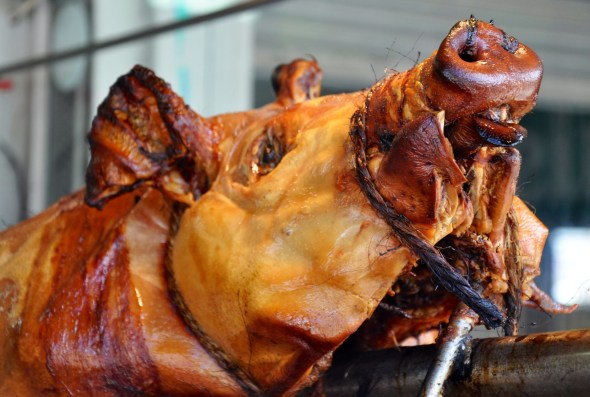
Suckling pig on a lechonera spit
Guavate, a short drive from the easternmost point of the Ruta Panorámica, is home to the tastiest suckling pig that I’ve eaten anywhere. On Sundays, half the island’s population winds its way up the steep switchbacks to eat at one of the village’s many lechoneras. Whole pigs rotate on spits, drawing in the punters, while chefs armed with machetes hack the glistening animals into bite sized pieces. This isn’t fancy dining: you’re just as likely to get a lump of bone as you are a hunk of melt in the mouth pork, but the crackling is first rate.
https://juliamhammond.wordpress.com/2017/01/10/puerto-ricos-ruta-panoramica/
Yemas de Pizarro

Bakery window, Trujillo
Don’t think for one minute that because this is a photo taken through a shop window, these yummy yemas didn’t make it into my sticky hands. They did, and I enjoyed them so much I went back for seconds, much to the bakery assistant’s amusement. Central Spain is good for pastries and these were an improvement on the already delicious yemas I’d tried a few years before in Ávila, a couple of hours to the north-east of Trujillo. Eat them on an empty stomach as they are filling and sickly sweet.
https://juliamhammond.wordpress.com/2016/07/12/a-beginners-guide-to-extremadura/
Beignets
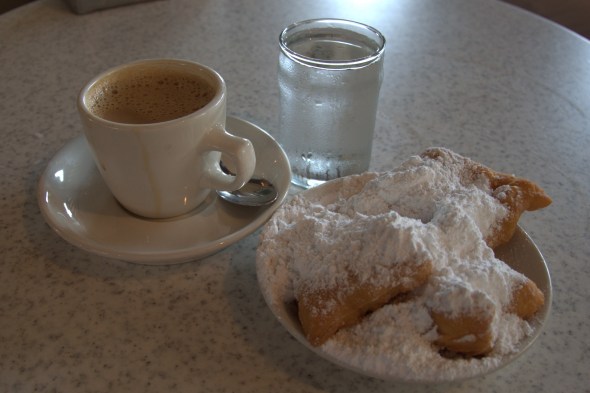
Icing sugar overload!
My final choice – and what a tough job it’s been whittling the list down to five – comes from New Orleans. No visit to the Big Easy can be complete without sampling the beignets at Café du Monde in the heart of the French Quarter. Brought to New Orleans by the French in the 18th century, these fried sweet balls of dough are served hot and buried in icing sugar. Take them as I did with a cup of chicory coffee, another local speciality.
https://juliamhammond.wordpress.com/2017/01/27/a-beginners-guide-to-new-orleans/
There are as many must-try foods that I’ve left off the list as included on it: lemony yassa poulet in Senegal, freshly caught lobster in Maine or snow crab in Seattle, Salzburger Brez with cherry filling, real Italian gelato, Swiss fondue… What would your top five be?
Welcome to the Wiviera!
Fresh air and water are always a good combination. With excellent rail links as well, it made the riverside town of Wivenhoe a good choice for my third outing with Greater Anglia this summer. There’s an easy but very pleasant 4km walk that takes you along the banks of the River Colne from Hythe to Wivenhoe. The really good news is that if you don’t wish to walk it in both directions, the path is easily accessible from Hythe station and leads you straight into the station car park at Wivenhoe. Both the path and the railway line follow the banks of the Colne Estuary, offering splendid views. As a walk, it couldn’t be more convenient if it tried!

If you’ve been following my previous blogs, you’ll know that I’ve enjoyed days out by train to Harwich and to the East Anglian Railway Museum. Greater Anglia have some very affordable advance fares across their network as well as £2 child fares and many other offers. It’s well worth checking out their website if you’re at a loose end this summer.
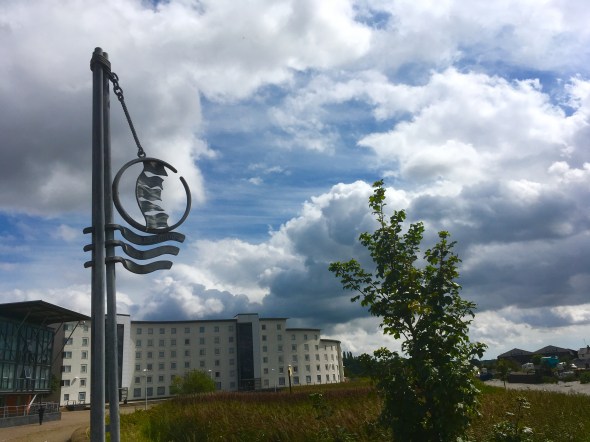
I set off from Hythe station just before lunchtime and walked along the riverbank towards the University buildings and on towards the new apartments that are springing up. I’d come this route a thousand times – it’s on the way to B&Q and Tesco – but from the car, you just don’t see what’s under your nose. There’s some fantastic artwork to be seen.


Information boards telling a little of the area’s history help provide context. In parts, they form trail markers. You can’t miss them in their steel cages.
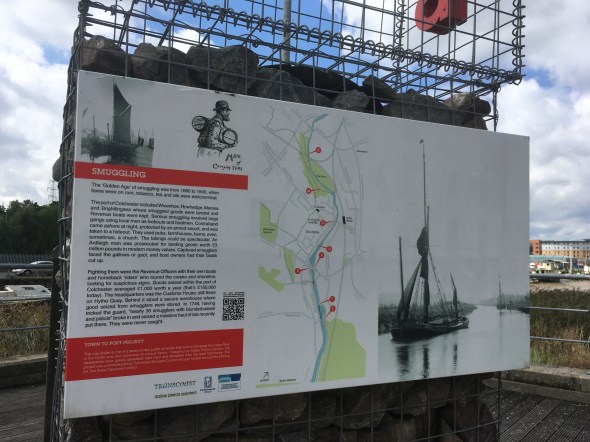
Following the river, I passed the iconic lightship and headed off in the direction of Wivenhoe. Urban becomes rural pretty quickly and it’s a pleasant and flat walk past riverside meadows, reed beds and woodland. Even on a weekday, there were plenty of joggers and cyclists using the trail, as well as a man in a wheelchair walking his dog. This is a trail for everyone to share.

Towards Wivenhoe, there’s a board marking the entrance to the Ferry Marsh Colne Local Nature Reserve; the name’s a bit of a mouthful but it’s well worth the diversion. There’s plenty of seating along the river banks on which to sit and watch the birdlife and see what the ebb and flow of the tide reveals. If you’re lucky you could even see otters or water voles.

But it was Wivenhoe that I’d come to see. From its railway station, I found myself on the charming quayside in just a few minutes. Wivenhoe Quay is packed with buildings of historic interest, among them The Nottage, open on weekends, housing a museum with an eclectic collection of nautical items. Every Saturday and Sunday afternoon until September 3rd you can visit to learn more about Captain Nottage, the Victorian army officer and keen yachtsman whose name is on the door.


Next door to The Nottage is the excellent Rose and Crown pub. Its outside tables are perfectly placed to watch the comings and goings along the Quay and the food’s not too shabby either. In the sunshine, there are few places in Essex more attractive for an al-fresco lunch.


I wanted to see something of Wivenhoe and began to explore its quiet streets. Just along Rose Lane, I noticed a blue plaque commemorating the great Miss Marple actress Joan Hickson, who once made her home here. Around the corner, I couldn’t resist browsing the produce on offer in the Village Deli. Owner Mike had an interesting take on the calorie issue presented by the ice cream on sale. According to him, if you use the attached spoon correctly, the calories can be neutralised and thus don’t count. That’ll be a salted caramel tub for me, then, and…

Along the High Street I found the Wivenhoe Bookshop, the kind of place that almost doesn’t exist anymore. Staff member Sue told me they’ve worked hard to create a space that works as a community cultural hub as well as a bookstore. Coming up there are writers’ workshops, book signings, a knitting group and even a philosophy breakfast, reflecting the University of Essex presence on the edge of town. You don’t have to be a local to get a warm welcome. The place has a homely feel – the sofa in the back room was just the kind of sofa you’d want to sink into on a rainy afternoon. I was blessed with blue skies so it was time to move on.
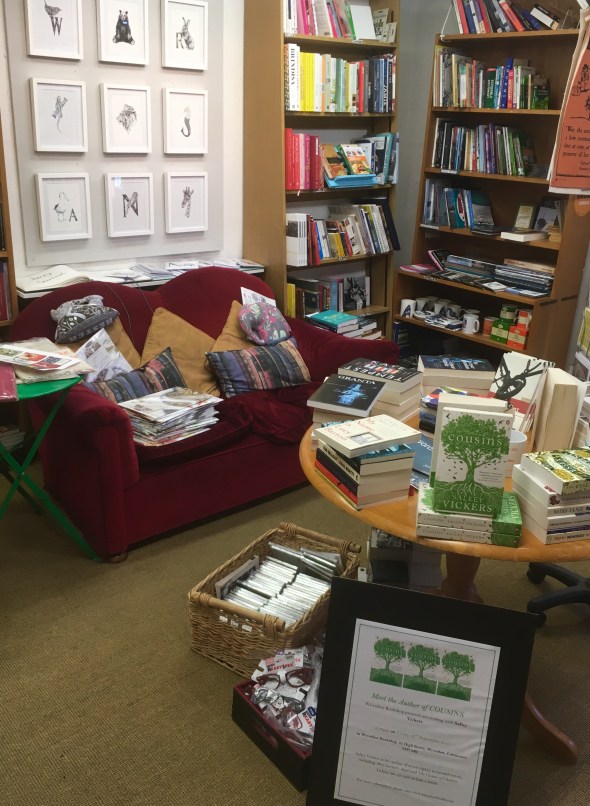
My final port of call was to The Sentinel Gallery, run by the delightful Pru Green whose enthusiasm for art is catching. Inside, work from some of East Anglia’s most talented artists was on display as well as some of the most colourful pottery you’ll find in the county. The modern structure features angular lines and huge panes of glass. It stands in stark contrast with the very traditional buildings that surround it, but it doesn’t jar. And the light which floods into the exhibition space is incredible. Even if you’re no art expert, this place is worth a visit, though don’t come on a Monday or a Tuesday as they’re closed.


Wivenhoe, I decided, had much to recommend it and if you want to see for yourself, there’s a ton of special events still to come this summer. The Sunday, August 20th, sees the Wivenhoe Crabbing Competition, great fun for all the family; register on the Quay from 10.30am. The town hosts its Beer Festival from September 1st to 3rd with the Art Sea Music Festival following close behind on September 9th. Throughout the summer season, a weekend foot ferry links Wivenhoe to Rowhedge and Fingringhoe so long as the tide is high enough. With limited parking in Wivenhoe, it’s a really good idea to take the train.

With thanks to Greater Anglia for providing transport to and from Wivenhoe.
Links
Rail tickets and offers from Greater Anglia
https://www.greateranglia.co.uk/
The Nottage Maritime Institute
http://www.nottagemaritimeinstitute.org.uk/
Rose and Crown pub
https://www.facebook.com/Rose-Crown-Wivenhoe-173216156080059/
Village Deli
Wivenhoe Bookshop
The Sentinel Gallery
Explosive Mount Yasur, highlight of my Vanuatu trip
I’ve been reminiscing about a trip I made to Vanuatu as the BBC Travel website commissioned an article about Bislama, the language spoken there. Some people might question the amount of money spent on travelling, but in my opinion it’s money well spent as you treasure those memories forever. So, beneath the link to the article, you’ll find some of my favourite photos from that unforgettable trip.
http://www.bbc.com/travel/story/20170814-how-one-language-unites-83-islands

Working in the fields is a tough job
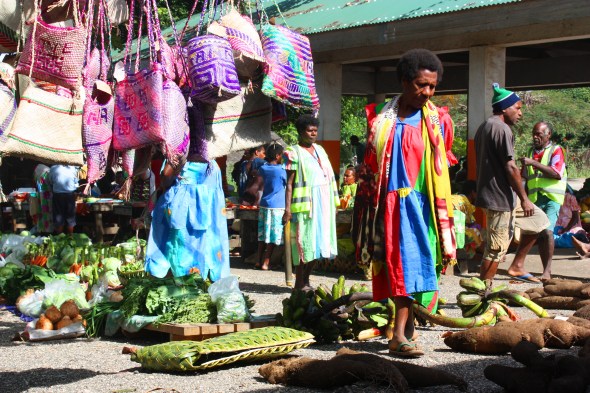
Women in Mother Hubbards at the market

Produce at the market, in the foreground is taro

Lenakel petrol station

AIDS awareness poster in Bislama
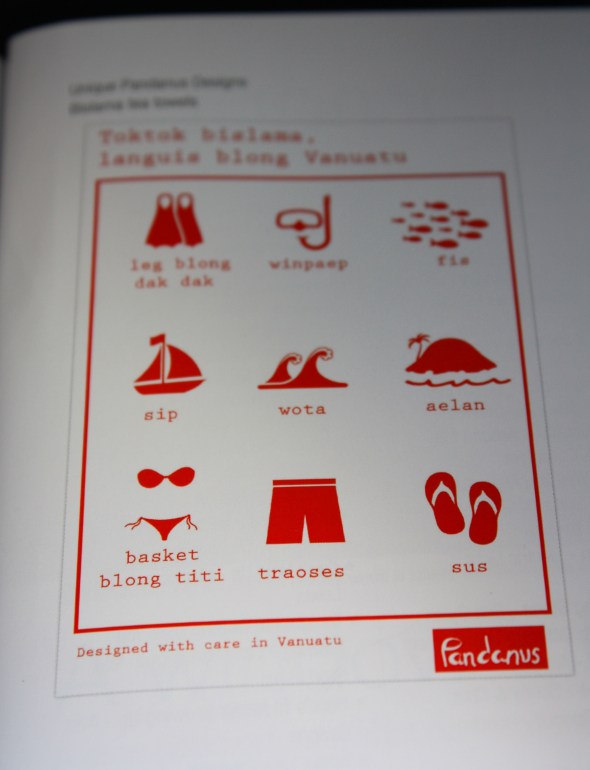
The Air Vanuatu tea towel
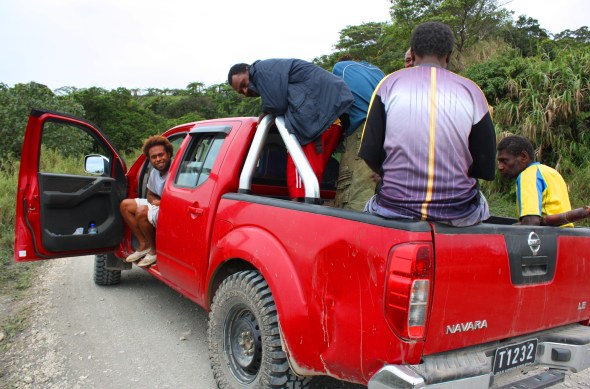
My ride to the volcano

Post box on the side of the volcano

Dusk on Mount Yasur

Terrifying, enthralling, spectacular
Stepping back in time at the East Anglian Railway Museum
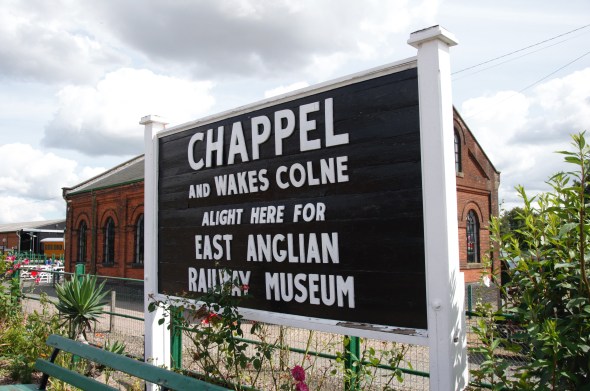
“Time flies by when I’m the driver of a train, and I ride on the footplate, there and back again.” Chances are, if you’ve just sung this rather than read those words, you grew up on a diet of Chigley and you remember as fondly as I do Lord Belborough and his steam engine Bessie.
But until yesterday, though I’d been on many a steam train, I’d never experienced what it’s like to ride on the footplate. Thanks to train driver Michael and his sidekick Kim, whose role is that of fireman, I got to tick it off my bucket list. Stood between Michael and Kim, I tried to keep my balance and time my barrage of questions to avoid interfering with their safety checks and operational duties. With a carriage-load of passengers on board, even on such a short demonstration trip, it was important that things were done properly.


Teamwork was key, with both volunteers working together to ensure everything ran smoothly. It was hot work. As Kim stoked the firebox with coal, the blast of heat coming from inside was palpable. Kim wiped a smear of coal dust from his nose and grinned as I wiped the sweat from my own forehead. I was glad this was the museum’s 1905 vintage engine when Michael mentioned that had I ridden on the footplate of one of the other two working engines I’d have been much hotter, as the furnace would have been level with our faces instead of by our feet.


Whatever your age, there’s something special about a trip to a railway museum and the chance to see a working steam engine. If you’re reading this and nodding your head in agreement, then I’d recommend you visit the East Anglian Railway Museum at Chappel and Wakes Colne. While riding on the footplate was a special treat, visitors will sometimes be able to take advantage of the museum’s “Taster for a Tenner” promotion where you can learn how to drive a diesel loco for just £10.

This summer, Greater Anglia are making it better than ever to travel by train. For a number of attractions across East Anglia and London, the East Anglian Railway Museum being one of them, presenting your rail ticket gets you 2FOR1 admission. If there’s just two of you, Greater Anglia’s advance fares will also keep your costs down. For larger groups, check out the Group Save tickets, a good deal for families and groups of friends looking for an affordable day out. Even better, Group Save can be used in conjunction with the 2FOR1 offer. With rail tickets for children costing from just £2, arriving at the EARM by train makes a lot of sense. Chappel and Wakes Colne station lies between Sudbury and Marks Tey on the pretty Gainsborough Line. From Marks Tey there are frequent connections to London’s Liverpool Street as well as Ipswich and beyond.

I chose to time my visit to coincide with one of the EARM’s regular special events. The 1940s Vintage Tea Dance marries our nostalgia for the age of steam with a love of music, dance and reminiscing about the war. Headlining the event were the fabulous Fox, Wiggle and Sass. Perfectly co-ordinated in red polka dot dresses, hair coiffed in immaculate victory rolls and lips painted a perfect scarlet, the girls had the Forties look down pat.


Aimee (Fox), Amy (Wiggle) and Gemma (Sass) hail from what they term the Bermuda Triangle of Essex: Layer de la Haye, Finchingfield and Witham. Over the last four years, they’ve been hired for countless weddings and private parties, but coming back to the EARM is special as it was the first gig they ever played. This talented trio made performing the harmonies and melodies of iconic Forties classics like “Ac-Cent-Tchu-Ate the Positive” and “It’s a Good Day” as well as swing hits like “Sing Sing Sing” look simple.


Watching them perform was a full house – or rather goods shed – of people, many in 1940s costume themselves. Servicemen danced with WVS volunteers while onlookers sipped tea from vintage china and ate cream teas. Sharon from Swing Jive Sudbury was on hand to teach everyone the basics so even complete beginners could join in the fun.


Also in the goods shed, Bunty Bowring had laid out a fascinating collection of 1940s vintage clothing, showing how in times of rationing, make do and mend were of vital importance. Together with husband Richard, who was dressed as one of the Home Guard, she shares her passion for all things wartime by giving regular talks to various local organisations. Outside the goods shed, meanwhile, members of the Suffolk Regiment Living History Society had brought their rifles, kit bags and even their trucks and The Viaduct mini-pub was open for those wishing to sample the local beer.


The event had been fun, but to leave without exploring the museum’s regular exhibits would have been a travesty. I began at the signal box where a series of colour-coded levers ensured a train couldn’t enter a stretch of track while another was in the way. The blue one shown in use here is pulled to activate a points lock, making sure the points don’t move as the train’s wheels pass over the top. Young kids will love pulling the levers so much it will be hard to drag them away.

Across the footbridge, the restoration shed gives you the chance to see some of the museum’s many engines and carriages being brought back to their former glory. Many of the volunteers work on these projects on Wednesdays, making this a good day to find out about what’s going on. There’s plenty of restored rolling stock to have a look at, including some vintage wooden carriages and recreations of station buildings and platforms.


The exhibitions in the on-site heritage centre explain the impact of Beeching’s cuts on the Gainsborough Line, which once would have continued on to Cambridge. Sudbury’s population grew sufficiently to save the Marks Tey to Sudbury stretch from the same fate. But other long-lost lines are covered too, including the Crab and Winkle Line which ran from nearby Kelvedon to the coast at Tollesbury. Take a walk around Tollesbury Wick and at low tide, you can still see the railway’s wooden sleepers disappearing into the mud.

EARM staff say that visitors often remark on how much there is to see at the museum and I’d have to agree. I made it through the level crossing gates back to the regular platform just in time to catch my train. Whether you time your own visit for an event day or not, you’re sure to have a rewarding and enjoyable day out. The volunteers were without exception keen to share their knowledge and enthusiasm. Best of all, taking the train instead of the car gave me the chance to mull over what I’d seen and done. My verdict: I’m going back – and next time I’m taking a 2FOR1 friend.
With thanks to Greater Anglia for courtesy train travel to and from the museum and to the East Anglian Railway Museum for a great day out.
Links
Greater Anglia’s offers
https://www.greateranglia.co.uk/offers/offers-in-east-anglia
East Anglian Railway Museum
Fox, Wiggle and Sass
https://www.facebook.com/foxwiggleandsass/
Swing-jive Sudbury
http://www.swingjive-sudbury.co.uk/
Richard and Bunty Bowring
Email: bowring40s_talks@hotmail.co.uk
Suffolk Regiment Living History Society
Border control queues in Europe – and how to beat them
Today’s news has been full of horror stories of British travellers caught up in excessive queues at some of Europe’s busiest airports. If you haven’t seen it, try this article from the BBC:
http://www.bbc.co.uk/news/uk-40824027
Sadly, though changes in legislation have worsened the situation, it’s nothing new. Miss your flight, and you’ll find the airline and the airport pass the blame back and forth, leaving you frustrated and potentially out of pocket. So what can you do?

Take out a decent insurance policy
Many travel insurance policies will cover you for missed departures, but check the small print in case there are any exclusions. Also check the amount covered – and work out whether this is going to be sufficient to cover a night in a hotel and the cost of a replacement flight.
Get to the airport early – and don’t wait for your gate number to be displayed
Queues for security are going to be lengthy in peak summer season, so you should be aiming to get to the airport in plenty of the time regardless. But once you’re through security, you need to go through passport control too. In some airports, this can be tucked away in a quiet wing of the airport serving just a few gates.

If your gate isn’t displayed early, by the time you start to line up, you may have cut it too fine. I almost missed a flight from Malaga to London a couple of years ago for this very reason – so don’t risk having to be very un-British and queue jump like I did. And if I pushed in front of you and you’re reading this, I’m very sorry – and hope you made your flight too!
My advice is to go through passport control even if your gate isn’t displayed on the boards – if there are multiple passport controls, in my experience the border control officials will redirect you. Just look suitably apologetic as I did and make sure you head off in the right direction.

Consider booking a package
If you book a package holiday with an operator with has its own fleet of planes, such as Thomson (other operators are available!), then the same company is responsible for getting you from the hotel to the airport and from the airport to Britain. At the very least this is going to reduce the buck-passing.
Have you any tales to tell? I’d love to hear your experiences.
Harwich: the town that rocked
It’s the people that make a place special. How often have you read that? It’s been written so often it’s a travel cliché. But sometimes it’s also true.
Greater Anglia have a range of offers on rail journeys across the network this summer. To find out more, look at the #lettheadventurebegin video on their website; the address is at the bottom of this blog. They invited me to pick somewhere in the network and in return for a rail ticket, they asked me to blog about my trip. I chose Harwich. I’ll admit that having consulted the timetable, I was a little concerned. To reach Harwich from my starting point necessitated two changes of train and with just a few minutes between each, I anticipated spending half the morning in Manningtree. After all, this wasn’t Switzerland, was it? I needn’t have worried. The trains were punctual, the connections made without even having to power walk and the carriages clean and comfortable. The views as we made our way on the Mayflower Line along the River Stour were the icing on the cake, and I thought what a refreshing change it was not to have to focus on the road and be able to enjoy them.


A ten minute stroll from Harwich Town station and I was already beginning to appreciate the town’s long maritime history. Using a walking trail map I’d found online, I ticked off both the High and Low Lighthouses, the second of three pairs of lighthouses that had been built around here to aid ships’ navigation along the North Sea coast. To ensure they maintained the correct course, the two lights needed to line up, one above the other.
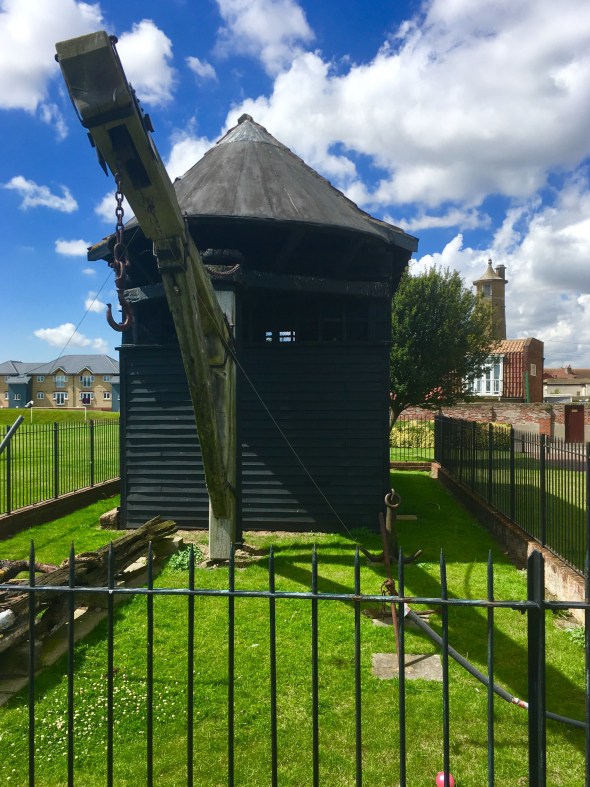
The Treadwell Crane was fascinating too, operated by men walking on the inside of the wheels. I was grateful for the Harwich Society’s comprehensive website, for though an informative sign had been placed near the crane, it had been positioned at the foot of a steep grassy bank. To read it, I’d probably have been best off lying flat on the turf.
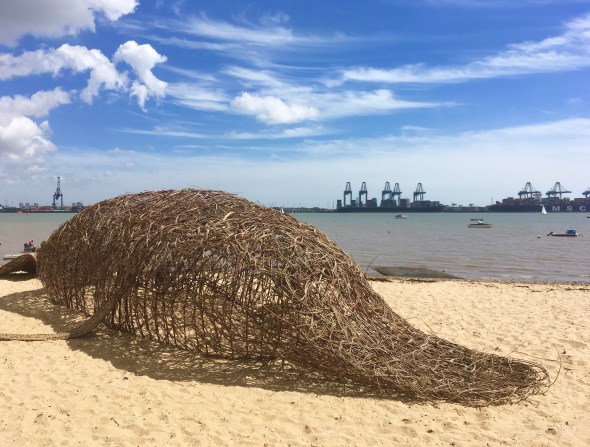
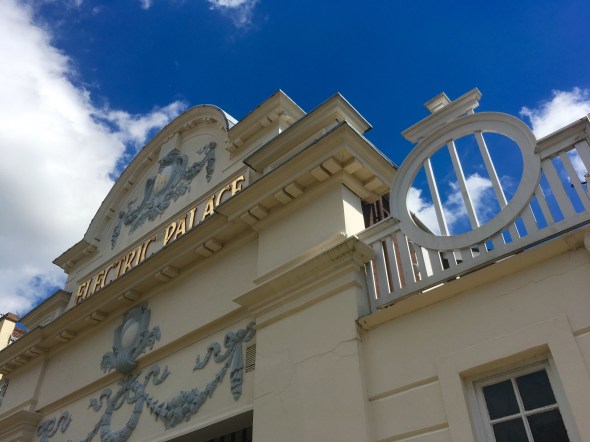
Heading along the estuary, I walked past the impressive murals on Wellington Road and doubled back to take a look at the Electric Palace. Built in 1911, there were two entrances, one to access seats costing a shilling, the other a more affordable sixpence. The cinema still holds regular screenings today, though the reminder to patrons to turn off mobile phones is a more recent addition to the signage.
Update July 2019: the Electric Palace is closed for extensive renovations and is currently scheduled to open in late spring 2020.
It was time to pop in to The Pier Hotel, right on the quayside. Looking like a little piece of Shoreditch, the hotel was slick, contemporary and on-trend, its staff welcoming. Manager Chris told me that I could find 113 different gins on the NAVYÄRD bar’s drinks menu, and I wondered how long you’d have to stay to work your way through them at what the government would deem an acceptable rate. With the view over the confluence of the Stour and Orwell right in front of the hotel’s terrace, it would be an absolute pleasure, though one which would have to wait for another time. I had a boat to catch, and it wasn’t going to wait.


A foot ferry had connected Harwich to Felixstowe for over a century, but it was under threat of closing for good when Austrian Christian Zemann spotted it was up for sale. Seeing the potential – it’s easily an hour’s drive from Harwich to Felixstowe – he bought the business. Though he’d always dreamed of making his living on the water, he didn’t know Harwich, nor the area which surrounded it. It was a gamble, but one that paid off.


With hard work and a nose for opportunity, Christian has expanded the business, running not only the foot ferry but evening cruises, bicycle rental and seal boat trips as well. In fact, he’s already bought a larger boat, increasing the capacity of the ferry from 12 passengers to 58. The level of commitment Christian has shown is extraordinary. Troubled by the drenching some of his passengers were getting out on deck, he invested £15000 in stabilisers to stop the new boat from tossing and pitching. I’m pleased to report it worked.


Christian’s latest venture, the boat trips to the grey and harbour seals that make their home at nearby Hamford Water, have already proved to be a gold mine. Once down to only a handful in number, there’s now a small but thriving colony of around 70 seals at the reserve. I asked Christian how close he got. “Well, the channel’s pretty narrow, so if I kill the engine, then you can hear them breathe,” he said. That sounded close enough to me.


Back on shore, there was one vessel on the quayside that just couldn’t be ignored, not least because of its scarlet livery. Built in 1958, LV18 was Trinity House’s last manned light vessel before it was retired from service in 1994. But as with the Harbour Ferry, this was a boat that wasn’t going to go quietly, thanks to one man – the ebullient and utterly charming Tony O’Neil. He bought the vessel for a nominal £1 and the Pharos Trust was set up to oversee its restoration. It opened in 2011 as Harwich’s quirkiest visitor attraction.
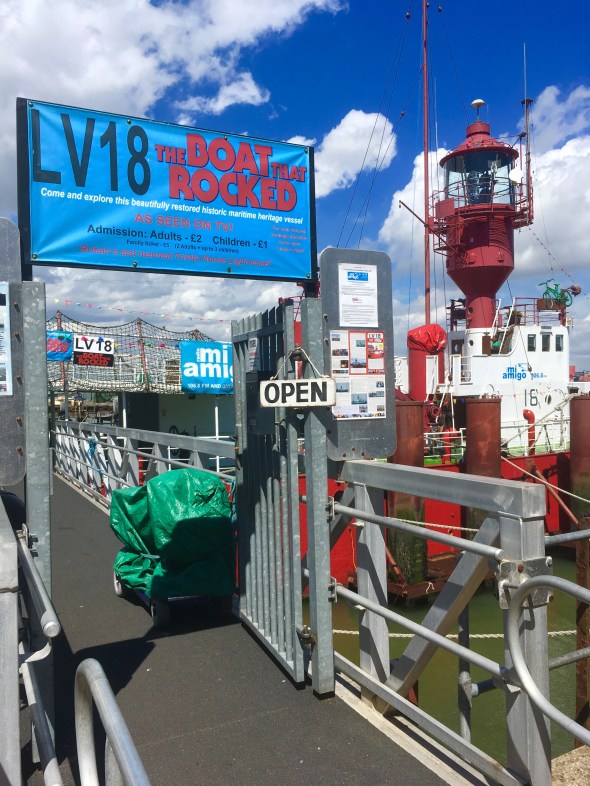
Update July 2019: since I took this photo, the cost of admission has risen to £4 for adults and £2 for children. Family tickets (2 adults and 4 children) are £10.
A musician by trade, Tony has a passion for radio. Visitors to the ship can see some of his extensive collection of antique and vintage radios on board, but with an estimated 1600 in his collection, some remain in storage in the hold. That passion for radio also manifests itself in broadcasting. Tony once worked for Radio Caroline and his enthusiasm for pirate radio is undimmed. The likes of John Peel, Tony Blackburn, Emperor Rosko and Johnnie Walker all broadcast from radio ships anchored just outside UK territorial waters and the tenders that facilitated their commute came from Harwich.


Even the beautiful garden that you see on deck has a musical connection. The scented plants that form part of it are there in homage to John Peel. His 1967 show for pirate station Radio London was named “The Perfumed Garden.” Johnnie Walker is still involved. He’s a patron of the Pharos Trust and will broadcast from LV18 this August.

For anyone keen on maritime history, Tony has preserved some of the cabins on board just as they would have been when the vessel was in use as a lightship. There’s also a chance to see what a pirate radio station would have been like. There’s so much in the way of nautical and radio memorabilia that some have dubbed it a “floating prop shop”. Unsurprisingly, it caught the eye of the production team working on the 2008 movie “The Boat that Rocked” and with a splash of yellow paint for the occasion, doubled as Radio Sunshine.
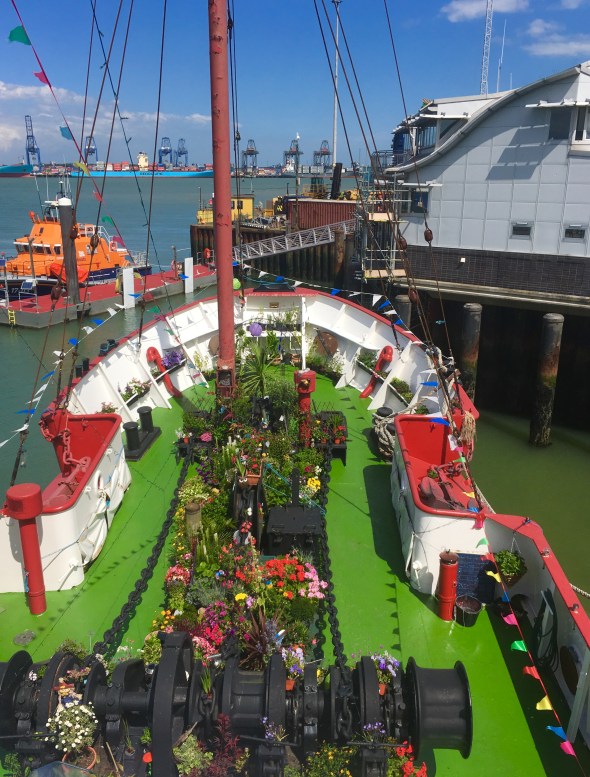
It is individuals like Christian and Tony that are breathing life into a town that once lay forgotten at the end of the line. Their energy and commitment to this corner of Essex is helping to make Harwich the town that rocks.
Links
Greater Anglia trains:
https://www.greateranglia.co.uk/
Harwich Harbour Ferry:
http://www.harwichharbourferry.com/
Seal boat trips:
LV18:
Harwich Society:
The Pier Hotel:
Tourism on my doorstep: Colchester’s Bourne Mill
Eighteen months ago, I moved to a village close to Britain’s oldest recorded town. Colchester was mentioned by Pliny the Elder in 77 AD; it was then known as the Roman settlement of Camulodunum. After much time spent doing DIY and decorating the house, I decided it was time to get out and explore the town on my doorstep. Today that took me to the delightful Bourne Mill, a National Trust property just outside Colchester town centre.

Bourne Mill with the stream running beneath it
If you live in East Anglia, you might be interested to know that Greater Anglia are running a promotion this summer called Let the Adventure Begin. There’s also a competition running until mid-August in which you could win first-class train tickets to any station on their network:
Win that, and you too could be exploring Colchester. Visitors today can see plenty of evidence of the town’s long history, from the Roman Berryfield mosaic at Firstsite to surviving groundworks of the Roman theatre which can be seen in Maidenburgh Street in the town’s Dutch Quarter. The Tourist Information Centre run a superb bi-weekly walking tour which I highly recommend.

Colchester Castle
Now, look closely at the photo above and in particular, the materials used to build the castle. The structure that you see is Norman. Construction began in 1076, similar to the Tower of London, but all is not what it seems. The foundations stand on what was the Temple of Claudius dating from about 55-60 AD and many of the building materials were recycled from Roman Colchester. In particular, look at the red stones that form the cornerstones – they look almost like roof tiles. These crop up elsewhere too, for example, in the remains of the fortifications that once encircled the town (you can make them out about halfway up the original wall to the left of the picture below):
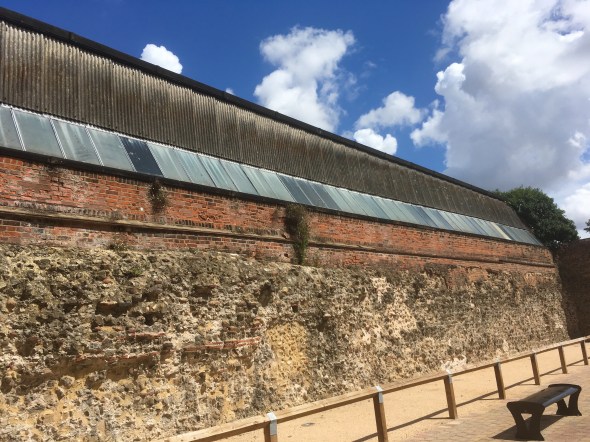
Roman wall near St Botolph’s Priory
I shouldn’t have been surprised, therefore, to see the same materials plundered to build Bourne Mill, located about a 20 minute walk away. This National Trust property was originally a fishing lodge used by the monks of St John’s Abbey. A stream, the Bourne, emerges a short distance north of the site and spills out to form a large pond, thought to have been created artificially as there appears to be no geological reason for the water to widen.

The pond at Bourne Mill
After the dissolution of the monasteries during the reign of Henry VIII, St John’s Abbey passed to the Lucas family and later, they began to demolish it. Seeking to improve on the monks’ fishing hut, they constructed what’s now Bourne Mill. The stones were cannibalised and together with those Roman bricks, pieces of flint and some Walton-on-the-Naze septaria to hold it all together, this wonderful building was the result.

Bourne Mill
Well actually, not quite.
What Sir Thomas Lucas built was a single story dwelling, thought to be a place where he could go with his well-heeled mates to fish and then hang out over dinner. On the ground floor, there are two fireplaces which lend credence to this theory. Carp, pike and wildfowl would have been plentiful so it seems likely that this story is true. This beautiful banner, stitched by the Colne and Colchester Embroiderers Guild, tells the story.
Wall hanging at Bourne Mill
But that story doesn’t end there, of course. Now that Britain was Protestant, it became a haven for those fleeing religious persecution in Catholic Europe. Granted refuge by Queen Elizabeth 1 in 1565, they boosted the town’s population, congregating in what would later become known as Colchester’s Dutch Quarter. Though they kept themselves separate when it came to socialising and marriage, they did have a profound effect on the north Essex landscape and economy, bringing their weaving industry skills and breathing new life into a flagging industry.
Bourne Mill prior to its use as a corn mill
The Dutch introduced new worsted draperies, known as bays and says. They were lighter and cheaper, and not surprisingly proved very popular. A method of quality control was introduced in 1631, immediately raising the status of Colchester cloth. That Dutch seal automatically meant that your cloth fetched a higher price; faulty workmanship, on the other hand, would lead to fines (called rawboots) being levied.
Bourne Mill grew an upper storey, recognisable by the gable ends that are also commonly found in the Netherlands and Belgium. It became a fulling mill, a place where cloth was softened to make it more wearable. A waterwheel would have made the process of hammering the fabric much less labour-intensive. Initially urine, collected from the poorhouse, would have been used in the process; the ammonia it contained helped to clean and whiten the cloth. Later, Fuller’s earth would have been used instead. Afterwards, the cloth was stretched on frames known as tenters to dry – attached by tenterhooks.
Part of the wheel mechanism
After a while, the Essex cloth industry fell into decline once more. The cloth industry, bay especially, was vulnerable in the 18th century to disruption by wars, competition from rival manufacturers, and the import of cotton. As the cloth industry declined, the fulling mills were converted to grind corn or grain, competing with the many windmills that dotted the landscape. By around 1840, Bourne Mill was no longer in use as a fulling mill. It was converted to a corn mill by 1860 and it’s for this purpose that the uppermost floor and sack hoist would have been installed. Later, it was steam driven, but the last miller hung up his apron in 1935.
Bourne Mill today
Honestly, I was pleasantly surprised at just how much there was to see and learn at Bourne Mill, expecting only to see a waterwheel and not a lot more. The team of volunteers work hard to bring the Mill’s history to life and succeed in communicating their enthusiasm. I’d especially like to thank Liz Mullen and Joan Orme for their insights and for not burdening me with more historical detail than I could cope with.
Acknowledgements and practical information
I’d like to say thanks to the National Trust who provided me with a free pass to visit Bourne Mill. If you’d like to do the same, entrance costs £3.75 for adults and £1.90 for children. The place is open from Wednesday to Sunday inclusive, from 10am to 5pm. Dogs are welcome on a lead, though there’s a steep ladder-like staircase to the upper storey which they won’t be able to access. There’s a small cafe too and plenty of picnic tables perfect for sitting and watching the ducks, including Joan’s favourite with the quiff.

Check out that fluffy head!
There are plenty of things to do with the kids, including free use of the Mill’s pond dipping equipment, making this a good choice now that the school summer holidays are upon us:
https://www.nationaltrust.org.uk/bourne-mill/features/things-to-see-and-do-at-bourne-mill
The National Trust website also has a guided walk which you can follow to get a better grasp of your surroundings. I shall be back soon to try it out.
https://www.nationaltrust.org.uk/bourne-mill/trails/bourne-mill-a-wee-wander
If you’d like to begin with the Camulodunum to Colchester walking tour, then this takes place at 11am on Saturdays year-round, with additional walks on Wednesdays at the same time throughout the summer. Walks need to be pre-booked as they do fill up; adults cost £4.30 and children £3.10. Find out more here:
http://www.visitcolchester.com/things-to-do/tours-sightseeing.aspx

At Bourne Mill, parking is limited on site – Sir Thomas Lucas didn’t plan ahead – but you should be able to find roadside parking nearby. Better still, take the train. Greater Anglia’s nearest station is Colchester Town. It’s about a 20 minute walk from the town centre to the Mill, but you can catch a bus to Mersea Road from outside the station if your feet have had enough.
The fastest connections from London Liverpool Street to Colchester’s main station take just 46 minutes and just over an hour to the Colchester Town station right in the centre of town. More details can be found on the Greater Anglia website:
https://www.greateranglia.co.uk/
#lettheadventurebegin
Julia’s 12 golden rules of travelling
Over the years I’ve picked up a few things that I’d like to share with you. Whether you’re planning your first big trip or an experienced traveller wishing to compare notes, these are the things that I consider my golden rules.

Prepare but don’t over plan
Good trip preparations are key to a successful and safe trip. Over plan, however, and with the rigid itinerary you’ve set yourself, you won’t be able to take advantage of unforeseen opportunities. I try where possible to keep arrangements flexible, such as booking accommodation on a free cancellation basis, enabling me to change my plans if I want to. You need to know enough to be safe, and yet still leave yourself open to the thrill of a surprise discovery. Build in some down time: an exhausted traveller is not a happy traveller.
Take risks but be careful
Can you even be careful if you’re taking a risk? I’m not sure! But what I’m getting at is that you’ll need to take calculated risks. If you’re planning to ride a horse, wear a helmet. If you’re going to be up close to the really wild wildlife, listen to advice about what you should wear. If you want to visit a bar in the dodgy part of town, don’t get hammered and take a taxi home. If you’re using local transport, seek out the one with the best safety record and don’t travel at night. I’ve ignored all of these of course.

Ditch the guide book and ignore the must-sees
Forgive me if this seems to contradict my opening rule (though rules are made to be broken of course!) I do still usually start with a guide book, especially if the area is one I’m less familiar with or the trip is a longer one. But the trouble with guide books is that they have a tendency to funnel everyone to the same places. If you deliberately ditch the must-sees, you’ll often have the places you visit to yourself. And if you really can’t bear to give up that Top Ten list, travel off season when the crowds will thin.
Step outside your comfort zone
Whether this means taking a trip to somewhere you’ve never been before or attaching yourself to the end of a bungee cord, this will mean different things to different people. But the underlying principle is the same. Challenge yourself. Try something new. Spread your wings. Fly.

Don’t be scared to try solo travel
For some, the idea of solo travel is about as far from their comfort zone as they could possibly get. Possibly, that first trip might be daunting. The first few hours of my first solo trip (to France as an exchange student aged 17) were scary. Three decades later, I remember shopping for live crab and watching it wriggle alarmingly close to my ankles in the footwell of the car. I remember getting mud between my toes hunting for crevettes on the beach. I remember the smoothness of the hot chocolate I had for breakfast and how enormous the bowl was that I sipped it from. I remember visiting the local library (didn’t I know how to live it up on holiday!) But one thing I don’t remember anymore is the fear.
Do no harm
Be nice. Respect your environment, both cultural and natural. You know the saying, take only photographs. That.

Take your time
It’s always tempting to pack too much into an itinerary. Sometimes you just have to trust that if it’s good enough, you’ll go back for it one day. But rushing around ticking off sights is no fun and you won’t remember where you’ve been or what you’ve seen. Make time to do something as well as see something. Most of my all-time favourite travel experiences have nothing to do with sightseeing. A cooking class in Guatemala, where I learned how hard it is to grind cocoa beans with a pestle and mortar. Herding cattle in Uruguay on a horse that didn’t want to move. Walking a lion in Zambia and failing miserably to remember that I wasn’t walking my dog.
Connect with people
No matter how well you think you know a place, you don’t know it as well as those who live there. There’s so much to be learned from chatting to the locals and I don’t just mean recommendations for places to eat. But also, some of my fondest travel memories have been fleeting trips and tours I’ve made with people that I instantly connected with – and often never kept in touch with afterwards. People are what make a place special, in my opinion. It can be the most beautiful place in the world but if the people are ugly, your time there won’t be special at all.
Don’t restrict yourself to chain hotels
It’s time to get practical. I know you can earn points and get free nights, but if you register with a bland and forgettable hotel chain then those free nights are going to be somewhere bland and forgettable. Try a private room in a hostel, excellent for meeting people. Find somewhere historic to stay that’s got a story to tell, or even a resident ghost. Try a quirky guesthouse or a welcoming homestay. Meet the owner. Chat a while.
Fly midweek to stretch your travel budget
Practical matters part two: you need to maximise your trip budget. If the flight’s going to represent a big chunk of your budget, you’ll need to find ways of saving money. Fly indirect, fly midweek, book late at night when the cheapest deals are most likely to come up and, alright, use those air miles.
Travel light
Of the three logistical points, this for me is probably the most important. Travelling light keeps you mobile and allows you to focus on your surroundings rather than your possessions. Think about the last trip you made and what you didn’t use. Could those items have been left at home? Do laundry on the road, buy toiletries when you get there, choose clothing that will multi-task, take a Kindle or use a book exchange – all these things will ditch the weight.
There will always be something
When it comes to travel, there will always be an excuse not to do it. Life has a habit of throwing things up that might get in the way of your trip. If it’s money, see what you can give up to fill the travel piggy bank. Sell the stuff that’s cluttering your attic. Cook dinner instead of calling for takeaway. Unless it’s a legitimately important family matter that’s standing between you and the trip of a lifetime, go.
Happy travels!
Photos from Ushguli
During my recent trip to Georgia, I spent a day in the hotch-potch straggle of villages collectively known as Ushguli.

One of the best preserved Svan towers
They’re reached by an apology of a road from Mestia, the main focal point of tourism in Svaneti. I shared a taxi with a couple of Germans to bounce and slide over gravel, in and out of potholes and scarily close to sections of road which had just fallen away. The road’s in the process of being rebuilt, so don’t let that put you off.

The view is worth the effort
Ushguli translates as “fearless heart” which matches the reputation of the Svans historically being a fearsome people suspicious of incomers. Five villages form the settlement of Ushguli: Murkmeli which you pass as you go in, Chazhashi where your driver will park, and then higher up Chvibiani, Zhibiani and Lamjurishi, the highest of which claims to be the highest permanently settled village in Europe. It’s a slightly dubious claim, though, not least because geographers and other experts can’t even decide whether Georgia is European or Asian. (I’ll save that one for a later blog post.)


So what is it about Ushguli that makes it worth the arduous journey? Mostly, it’s the setting. Reached at the dead end of this rural road, all that stretches ahead of you are the few clusters of homes and Svan towers that constitute the villages and then meadows framed by the mountain peaks of the Great Caucasus. UNESCO have had Chazhashi on their list since 1996. Part of the attraction is just to find a quiet corner and sit. There’s also an ethnographic museum in one of the towers which is far more interesting than it sounds. Honestly. I’m no great fan of museums but it was good.

12th century cross in the ethnographic museum
In Mestia, the person to find is the lady that sells the marshrutka tickets from her agency next to the bakery in the centre of town. She manages more of the drivers and you’ll wait for less time. A return ticket in a shared taxi costs 20 lari. Be prepared to negotiate how long a wait you’ll have in Ushguli with your driver. Tip: if you wish to spend more than a couple of hours, it’s worth popping into the restaurant he’s likely to have holed up in to make sure he’s not been knocking back too many beers.
Some of my favourite shots from the day:
Chazhashi’s riverside setting

View from inside the ethnographic museum over Chazhashi

Sheepdog guarding the ethnographic museum
Young tearaway on a lively horse

Grandma takes a rest

Scratching post

Cow under the public toilet

Piglets feeding

Tower and current occupant!

Cow wandering through the village

Looking down over Ushguli

Monastery dwarfed by mountain

Transport home? “You can go faster but I can go everywhere.”
If you’re planning a trip to Georgia – and you should – make sure you don’t miss Svaneti. You can stay in Ushguli and you can even do a three day hike there from Mestia in the short summer season. Or you can do as I did and base yourself in Mestia and visit Ushguli for the day.
Why San Antonio’s my favourite place in Texas
Visitors to San Antonio might be surprised to learn that it’s the seventh largest city in the USA, larger than San Francisco, Las Vegas, Miami and Boston. This fast-growing city has a population of around 1.5 million. In Texas, only Houston beats it. But the best thing about San Antonio is that with such a compact and walkable downtown, it doesn’t feel big – and that’s why I like it. I’m not alone. An estimated 32 million visitors flock to San Antonio every year.

The Spanish first set foot in San Antonio in 1691, founding a settlement in the early 18th century. Some of the earliest settlers came from the Canary Islands. San Antonio became the capital of the Spanish province of Tejas; today it’s still possible to visit the Spanish Governor’s Palace. Years ago, during my first visit to Argentina, I met a woman from San Antonio and was a little irritated by her insistence on pronouncing Texas as Tay-hass. Now, I realise that perhaps it was just a pride in her city’s heritage. You can read the story here:
https://theitin.com/places/south-america/argentina/san-antonio-de-areco/mrs-tay-hass/
The single storey adobe building that forms the Spanish Governor’s Palace was the original comandancia, the place where the military garrison’s officers lived and worked. Its whitewashed walls and simple furnishings allow the building to speak for itself; the tranquil courtyard garden is a serene oasis from the modern city which surrounds it.
Of course, the most famous historic building in San Antonio is the Alamo and no visit to the city can be complete without a visit to this historic mission. From 1821 to 1836, the city was the capital of Mexican Tejas, after Mexico had won its independence from Spain in 1821. But when Antonio López de Santa Anna, later to become the country’s 8th president, abolished the Mexican Constitution of 1824, violence ensued. The Texian Army, a group of volunteers and regulars, managed to force the Mexicans back, capturing San Antonio in 1835 during the Battle of Bexar. But in 1836, Santa Anna hit back, marching on San Antonio to defeat the Texian forces who were trying to defend the Alamo. A memorial stands outside the building, inscribed thus:
Erected in memory of the heroes who sacrificed their lives at the Alamo, March 6, 1836, in the defense of Texas. They chose never to surrender nor retreat; these brave hearts, with flag still proudly waving, perished in the flames of immortality that their high sacrifice might lead to the founding of this Texas.
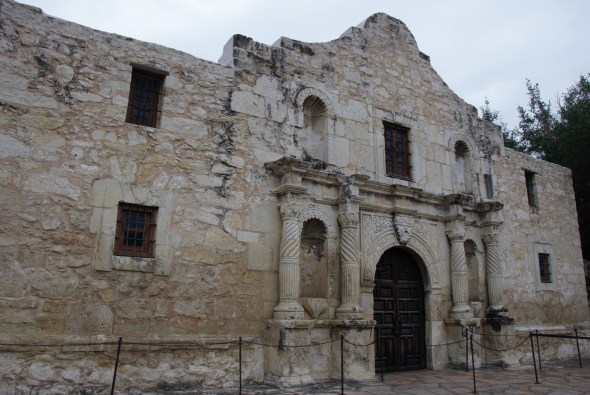
“Remember the Alamo!” became the rallying cry of the Texian Army. Later that year, Santa Anna was defeated and Texas won its independence. It remained that way until 1845 when it was annexed by the USA with popular approval from the Texians. Texas was formally incorporated as a state of the USA on February 19, 1846.
A stroll along the city’s River Walk is the most scenic way to reach the cathedral. This urban waterway, lined with trees and restaurants, is the social heart of San Antonio. Catastrophic flooding occurred on the San Antonio River in 1921, leading to calls to manage the river as it wound its way through the heart of the city. Casa Rio was the first restaurant to open in 1946, but I’d recommend you pay a visit to Cafe Ole where you should ask if their server Richard is rostered on – he’s excellent.


The cathedral is well worth a visit. Also known as the church of Nuestra Señora de la Candelaria y Guadalupe, it was originally built from 1738 to 1750 and some of those original walls still stand. The current structure largely dates from the 19th century. Each evening, a sound and light show tells the history of the city, the captivating graphics projected onto the cathedral’s façade and twin towers.


Though it can feel like it at times, the city’s not just the sum of its Mexican heritage. There’s actually a historic German district known as King William, located within an easy walk of downtown. In the 1790s, Mission San Antonio de Valero, one of the city’s five missions, sold off land to settlers. It wasn’t until the 1860s, however, that the district was sectioned off into plots and took on its present day layout. At that time, it attracted a sizeable population of German immigrants. The main street was named King Wilhelm 1, after the King of Prussia, though it garnered the derogatory nickname Sauerkraut Bend for a while too. Its wealthy residents competed to construct the most impressive mansions and a stroll along the street today is as much an exercise in real estate envy as it is regular sightseeing. A visit to the Edward Steves Homestead Museum affords the opportunity to see how such families might have lived.


There’s plenty more: a rich cultural heritage manifested in a number of excellent art museums and a plethora of shopping plazas including El Mercado, the largest Mexican market in the USA and La Villita, a concentration of arts and crafts stores showcasing some of the area’s finest artisan talent. And if you wish to get kitted out with your own stetson before continuing your Texan journey, then I’d recommend a visit to this place:

Paris Hatters celebrates a century of trading this year. It’s not much to look at, but the tiny store is packed with boxes stacked almost to the ceiling ensuring that whatever your style choice or your size, there’s something to fit. Its clientele boast a number of the rich and famous, among them former Presidents Lyndon B. Johnson, George Bush, Dwight Eisenhower and Harry Truman, Pope John Paul II, Matt Damon, Tommy Lee Jones, Bob Hope, Sammy Davis Jnr., Dean Martin, Luciano Pavarotti, B.B. King and Bob Dylan. You never know, as you look in the mirror, someone you recognise might be right behind you!
Why you should visit the Armenia Genocide Museum and Memorial
On Tsitsernakaberd Hill, overlooking the city of Yerevan, you’ll find a pilgrimage site dedicated to the 1.5 million victims of the Armenian Genocide. Their harrowing story cannot fail to move you, as it did me.

I sit, alone. The music haunts every inch of stone and every speck of dust. The sound of violins, melancholic yet soothing, permeates the soul. I feel it. It seeps into my heart and as I focus on the flickering flame, I raise a hand to my cheek, wiping a persistent tear. A few sorry bunches of carnations have wilted where they were placed. Tall slabs of basalt crush the sunlight. The sky is obstinately blue but in here, inside the stone circle, it’s a place of shadows and ghosts. I’m shocked at the strength of my feelings. Until yesterday, I hadn’t been aware an Armenian genocide had taken place. And I’m ashamed of that.
A cleaner arrives with her broom and sweeps, rhythmically, until my attention is forced out of its sad reverie. She busies herself collecting dead blooms and rearranging those that will stay. A young man follows her with a camera, framing and reframing his shots. He clicks repeatedly but then he too is still. A family of five arrive, speaking Armenian, and pose in endless configurations for snapshots beside the flame. The emotion I felt is lost and I glance at my watch. The museum is open. I head inside.
I read, missing nothing, trying to make sense of what happened. In the late 19th century, Armenia was a divided country. The Persians had ceded territories to the Russians, who occupied what was then known as Eastern Armenia. Strategically important Western Armenia had fallen to the Ottomans in 1555 and over four centuries later, they retained control. War between the Russian and Ottoman Empires had torn Armenia apart. Armenians living under Turkish rule looked to the Russians for protection but though the 1878 Treaty of Berlin set out basic rights for Armenians they were not honoured. Amidst growing calls for independence, Sultan Abdul Hamid, the leader of the Ottoman Empire, tightened his grip on the dissenters. Words were banned: Armenia, rights, freedom.
To ban the word freedom is an alien concept. From my privileged life in a stable democracy, how could I understand?
Compelled, I read on. In 1895, 300,000 protesters were massacred in Constantinople in an attempt by Hamid to shut down the Armenian Question for good. It didn’t work. Nine years later, there was another uprising. The stability of the Ottoman Empire was under threat. In 1908, a political party called the Young Turks seized power. Their policy of the “salvation of the Turkish homeland” could only be achieved, they held, by the liquidation of the Christian population. Under their watch, anti-Armenian atrocities continued unpunished. A further 30,000 were killed in a market in Adana in 1909. Their treatment was horrific. Many were set alight or stabbed repeatedly. The backs of children’s legs were gored with cotton hooks leaving gaping holes. A series of photographs documented the horror.

I’m struck by the eyes. They stare, vacantly, yet implore those watching to act. But it’s too late. I’m a century too late.
World War One was to provide cover for the vilest act of all. A secret treaty was signed, allying the Ottomans with the Germans. Needing the support of its largely Islamic population to survive, the Turks proclaimed Jihad in an attempt to demonstrate their religious credentials. In October 1914, 60,000 Armenians were called up to fight, joining others already conscripted. They fought, bravely, at Sarikamish on the Caucasian Front under Enver Pasha, but were no match for the wintry conditions. The Ottomans suffered huge losses and 70,000 lost their lives. A scapegoat was required. The Armenians were that scapegoat. Soldiers who had fought alongside Pasha were killed on his orders. Afterwards, the Young Turks turned their attention to civilians, murdering politicians, clergy, intellectuals and other eminent Armenians. Mass arrests followed, in Western Armenia and Constantinople.
The Armenian family I saw at the memorial see that I’m making notes. It’s diaspora season and they’re from LA, bringing their children to the home of their ancestors for the first time. They ask if I’m a writer and if I’m going to write about this. I promise them I will, emotion choking my words. The mother hugs me, an unspoken thank you.
Unarmed Armenians in Ottoman territory were rounded up to be sent to the deserts of Mesopotamia and Syria, their property looted as they left. Men were separated and stabbed. Women, children and the elderly were spared, but instead driven south. On the way, their police and army escorts stood by and did nothing as bands of Kurds and Turks kidnapped and murdered the helpless. Those who did complete the journey ended up in concentration camps. In Rakka, Bab, Deir Ez-Zor, Ras Ul-Ain and Meskene, 600,000 endured horrendous atrocities. They were subjected to medical experiments, pregnant women were used for target practice, bare feet were shod as if they were horses’ hooves, children were burned alive or dragged behind horses until they died from their injuries. Rape was common. An estimated 600,000 lost their lives.

It’s hard to reconcile what I’m reading with the gentle and welcoming Turks I’ve met on my travels. I’m shocked to find I’m upset, not because I think it’s not worth getting upset about, but because at Auschwitz and Bergen-Belsen and Dachau, I haven’t been. Sobered, desperately sad, but not upset like this. The tragedy that befell the Armenians feels worse, somehow, because I wasn’t aware it had happened. I feel that in some way that means I’ve betrayed them.
On May 24 1915 France, Britain and Russia issued a joint statement condemning and declaring the Turkish government responsible for a “crime against humanity and civilisation”. After the war, the Young Turks were brought to trial. The key perpetrators – Mehmed Talat, Ismail Enver and Ahmed Djemal – were brought to justice and punished for what they’d done. Yet today, the mass extermination of Armenians isn’t acknowledged by all countries. Britain views what happened as a war crime and doesn’t recognise it as genocide.

I climb, slowly, from the bowels of the museum back up into the sunshine of the plaza, legs and heart heavy. Another tear escapes from my eye but this time, I let it fall.
Practical matters
To visit the Armenian Genocide Museum and Memorial it’s easiest to take a taxi. From Republic Square I paid 700 drams, just over £1. The museum is free to enter. Leaving, the unofficial taxis in the car park were asking for 2000 drams for the same ride. I walked down the hill and across the footbridge to the Dalma Garden Mall, from where I caught the #27 marshrutka back to Mashtots Avenue for a 100 dram fare. The bus stops right outside the Blue Mosque, also worth a visit.
How to visit Abkhazia from Georgia
Why visit Abkhazia?
Country counters are always on the lookout for opportunities to add to their total, hence a visit to Abkhazia is on many a bucket list. It’s no longer an active conflict zone, though banditry at the border is reportedly still an issue, particularly after dark. Gal, the scruffy border town near the Enguri crossing, still bears the scars of war in the form of burnt out and abandoned homes, but though it does have something of a reputation, I didn’t feel unsafe as I travelled through. Sukhumi, the capital, is also only part way through reconstruction. The hulking Government Palace is the most noticeable landmark to await renovation, overgrown with weeds inside and riddled with concrete cancer. I visited a couple of hours after a summer thunderstorm and the sound of percolating rain water only added to the atmosphere.


But the Botanical Gardens were pleasant and down by the waterfront of this Black Sea resort, you’ll find pavement cafes and ice cream sellers with plenty of family-friendly attractions to keep the kids happy. Many of those who visit Sukhumi are Russians, coming across the border from nearby Sochi. Arriving from Georgia, I was the only visible tourist. Most of those crossing are local. Some are returning to Abkhazia with purchases from Zugdidi – I saw one rotund lady struggling in the heat pushing a trolley loaded with a refrigerator. Others cross daily for work.


Securing a visa
At least a week or so before your planned visit, you’ll need to apply for a visa. No payment will be necessary at this stage. It’s a simple form and can be downloaded from this website:
http://mfaapsny.org/en/council/visa.php
The only thing to be careful about is specifying exactly which dates you intend to travel as these will be fixed. You don’t get an open-ended month long visa for example. Email off the form together with a scan of your passport. In about a week, you should receive a letter of invitation. You may need to check your spam folder; the email that popped up into my inbox was headed simply “clearance” with the sender’s name in Russian and I almost deleted it. You’ll need to print off a copy of this letter and carry it with you. Some bloggers suggest you might require two copies but I needed only one.
The letter will have your date of birth next to your name plus your passport number
Getting to the border
The easiest route to the Enguri border is by taxi from Zugdidi which should cost you 10 GEL (Georgian Lari, about £3.30 at current exchange rates). It’s also possible to travel by marshrutka. I speak no Georgian or Russian and taxi drivers didn’t see to understand border or even Abkhazia. Drop into the tourist information office on Rustaveli Street and pick up a regional map; you can then point to the border if necessary.
Money
Before you set off, stop at one of the exchange places on Kostava Street to get some rubles. They don’t all stock rubles and again you might have trouble being understood; I ended up taking a photograph of a sign marked “Rub” and showing that. $100 was plenty to cover mid-range accommodation, food and transport for a couple of days. I didn’t see anyone obviously changing rubles at the border and you’ll need small notes (50s and 100s) to pay the marshrutka drivers once you arrive.
Sometimes you need to use your initiative!
At the border
I made the mistake of arriving early, figuring that as I had read online about lengthy waits at both ends of the bridge, I should give myself plenty of time. There was a flaw with this plan and that was that the Georgian police official who could authorise my transit didn’t arrive until 10am. From 8.20am when I arrived, I was given a frosty but polite welcome by the police manning the exit booth. I was held for around an hour and a half. Technically. In practice, what this meant was that they waved me in to sit and wait in their office where they were watching Ultraviolet, a really bad Milla Jojovich vampire movie. Fortunately, they also had unsecured WiFi so the time passed quickly. When the boss arrived, I was processed without a single question and pointing to the door, pronounced good to go.

Your ride across the bridge – should you need it
The walk across the bridge took around 15 minutes, as I had luggage, it was hot and I made frequent photo stops. Mostly no one seemed to mind that I was taking pictures. There are horse and carts which can be hired, but no one seemed to be that bothered about picking up a fare so shanks’ pony it was.


At the other side, a cheery official in army fatigues studied my passport and on learning I spoke no Russian, ushered me to sit down on what looked like it had once been a 1970s British bus seat. Lots of smiles, lots of “Hello, American? ensued” Ten minutes later, another soldier arrived, this time he knew some English. I was asked where I was from, my job, how long I planned to stay in Abkhazia and what I wanted to visit. I made sure I was very positive, smiled a lot and concentrated on the places rather than the politics. Satisfied with my answers, I was passed to the customs hut who processed me with a minimum of fuss.

Welcome to Abkhazia
It was then time to find a marshrutka heading for Sukhumi. I’d read that you could get a direct minibus but the only labelled marshrutka was for Gal. The name is easily recognisable in the Cyrillic: a back to front 7 followed by an A and a 3. The minibus was nearly full and left almost immediately, charging me 50 rubles theoretically but in practice, as I had no change, 100 rubles in practice. It took just half an hour or so, maybe less, to reach Gal and then circle around dropping people off, picking up flour and then, eventually, handing me over to a minibus driver bound for Sukhumi. The ride to the capital took under two hours, by which time the heavens had opened and I stepped out into torrential rain. That ride cost me 200 rubles. I was let out in the centre, saving me the fare from the train station where the marshrutkas terminate.
Inside the marshrutka
After the rain eased, and not before I was soaked to the skin waiting for my hotel owner to deign to come to the gate or answer the phone, I headed down to get my visa. For this, I needed to visit 33 Sakharov Street, an easy to find building set in a small but well maintained garden.
This is the building to look out for
Inside, there was a gloomy corridor with a sign for consular services which led to a poky office. I was seen right away. Not only could I process the letter here, but I could also pay. The official asked if I wished to pay with a credit card and the chip and pin machine accepted my British Visa card with no problems. My overnight visa cost 350 rubles, though I’m not sure if a longer stay would necessitate a higher price.
What your visa will look like
Having thoroughly explored, I caught a taxi to the train station (150 rubles) in time to get me there for 11am, about the time my Lonely Planet said the border-bound marshrutka would leave. In fact, it was scheduled for 12.30pm. A shared taxi took a group of about six of us to the border. The fares were the same, 250 rubles in total. Crossing the border was much quicker than before. A few questions from the Abkhazian authorities about where I’d been and much smiling as I said I’d very much enjoyed Sukhumi and I was on my way. Aside from being asked to turn back and use the pedestrian path rather than the road the other side of the wire fence, it went without a hitch and after a cursory inspection from the Georgian police, I was back in. Another 10 GEL taxi ride took me to the centre of Zugdidi from where I was to catch my overnight train to Tbilisi.
First class sleeper to Tbilisi: 8 hours for a bargain 30 GEL!
If you’re thinking of visiting Abkhazia yourself and have any questions, please feel free to leave a comment.
Monastery-hopping in Armenia
Armenia claims to be the oldest Christian nation on the planet so it’s hardly surprising that you’ll encounter plenty of monasteries. Most feature a “gavit” or entrance hall, where the floor is often spread with graves. A few steps will lead into the church proper. As a woman, covering your head isn’t required as it would be in Georgia. You will see the faithful reverse out of the church so as not to turn their back on God; even those who aren’t regular churchgoers sometimes do this out of respect. Here’s a brief guide to eight of its most commonly visited.
Haghpat

Located in the Debed Canyon, this is for many visitors their first monastery in Armenia as it lies on the way to Yerevan from the Georgian capital Tbilisi. This imposing mediaeval complex was built in the 9th century, a sprawling delight of building added on to building, the grey stone set off perfectly by the terracotta of the roof tiles. Inside, one of the rooms has a series of holes in the floor, once used for storing wine.
Why should you visit?
As it’s quite a distance from Tbilisi to Yerevan, this is a great way of breaking the journey.
Sanahin
Twinned with Haghpat, this one means “older than that one” though it’s not as attractive from the outside. The cavernous interior is fascinating, with plenty of tombstones on the floor. Step on them as it’s commonly held that if you do, you’re freeing the dead of their sins – and fortunately not taking them upon yourself as a burden in the meantime. And you’ll learn how to recognise whether a monastery is a functioning church or not – if it has a curtain that can be pulled across the altar, it still hosts regular services.
Why should you visit?
While you’re in the Debed Canyon, you may as well visit both the monasteries.
Geghard

A party of schoolchildren were visiting at the same time, so for me, this monastery lacked the serenity that some of the others offered. It was a good opportunity to watch the priest deliver a blessing and to hear the acoustics as the children sang inside the chapel. Look out for the hole in the floor which allows you to peep down into the church from above. There’s also a spring inside which is believed to be holy.
Why should you visit?
If you’re in Yerevan and your time is limited, this is an easy excursion from the city and together with nearby Garni temple, doable in just a few hours.
Sevanavank
To reach Sevanavank, located above the shoreline of Lake Sevan, you’ll need to climb a lot of steps: 243 to be precise. The reward, though, is a panoramic view of Armenia’s largest lake and its environs. Again it’s a double church site plus plenty of khatchkhars to admire in its cemetery. Those are the standing stones which you’ll see at all religious sites. The largest concentration can be found further along the lakeshore at Noratus cemetery. But it’s that vast expanse of blue that will draw your attention away time and time again.
Why should you visit?
It’s all about that spectacular view – and the satisfaction of making it up the steps without collapsing.
Hayravank
This monastery, built out of tufa, also lies on Lake Sevan, but this time occupies a less lofty position. Its alternative name is Aghavnavank, meaning “church of the human pigeons”. The connection refers to a legend associated with Tamerlane, whereby the local population were turned into pigeons to keep them safe from the invaders – a deal had been struck that anyone who could fit into the church would be spared and of course birds are smaller than people.
Why should you visit?
If they’ve gone to the trouble of coming up with such a fantastic legend, you’ve really got to see how big the church is from the inside.
Khor Virap

This one’s all about the setting, and what a setting. The road curves on approach offering the picture postcard image of the monastery perched to the right of a backdrop of Mount Ararat, the mountain where Noah’s ark came to rest. From the rear of the monastery, you can climb a small hill – look for the cross on top of it – and you’ll have a similar view, but this time the monastery will be on the left. Inside, you’ll see a steady stream of people descending a narrow stairwell at the doorway to the church – it’s a well, and it’s a dark and shaky climb down.
Why should you visit?
The setting is special, but pick a clear day so you get the panorama of Ararat at the same time; you’ll have a better chance of good visibility in the morning.
Noravank
Tucked away up a narrow canyon, Noravank is another site that feels special as a result of its location. There are some wonderful carvings, including one of Jesus with Peter and Paul. What you’ll remember, though, is the scarily steep and narrow stone block steps that lead up to the second storey of the church. Take it from me, it’s much worse coming down. But from the restored cupola to the view across to the other chapel from up high, it’s worth dealing with the fear. After all, you can always come down on your bum!
Why should you visit?
The vertiginous steps up to the second level of the church might be scary, by the view from the top is splendid.
Tatev
This one is reached by the world’s longest ropeway (that’s cable car to those of us who speak the Queen’s English). If you don’t believe them, there’s a sign which claims Guinness has officially recognised it as such for their Book of Records. The column allegedly predicts earthquakes and approaching enemy armies.
Why should you visit?
With such an awesome approach, this one’s a must-see.
The verdict
Of course, that’s not all. But even spreading these across a week, I was beginning to feel monasteried-out by the end of it. My advice would be not to feel like you ought to see every major monastery in the country, just pick a few and enjoy the view. If I had to pick a favourite, I’d probably say Sevanavank, as its lofty position represented not only an impressive feat of engineering but also felt remote despite the visiting tourists. Norovank, with those crazy steps and beautiful carvings, came a close second, though perhaps it was a little too perfectly restored to claim the top spot.
How tough is the hike to Chalaadi Glacier?
The older I get and the more my knees creak, the more I need to research possible hikes before setting on to ensure I don’t end up with aching muscles or worse, being stretchered out. But no one, least of all me, wants to find out that they’ve missed out on superb scenery on a hike that would have been perfectly within their capabilities. So when I found out about a glacier accessible from Mestia on foot, I set about reading up. The trouble is, many of those who post are young and fit. Their definition of an easy hike isn’t necessarily what I’d call easy. So here are the facts about hiking to the Chalaadi Glacier.

You don’t have to walk all the way
Technically, the Svans consider this hike a 25km round trip. The official tourist board literature states the duration of the hike as being eight hours. That’s beginning and ending in Mestia and walking up the road past the airport until it runs out. Well, 25km would take me more than eight hours including collapses, even if much of it is fairly flat.

Keen not to have to quit before the good bit, I hired a lovely driver called Nodani. I found him in the main square in his adapted Subaru – look for the Subaru sunshield and a disabled badge in his rear windscreen. He agreed to drive me to the suspension bridge that crosses the River Mestiachala. It costs a flat rate of 80 lari (about £26). It’s also possible to rent horses, but they looked pretty frisky and once you pay for the guide too, it’s not a cheap option.
Allow time to enjoy the hike
Most people book a two hour gap between rides; I made it three so as not to have to rush. I was keen to take the hike at a steady pace and allow enough time to appreciate my surroundings. I thought I’d make an afternoon of it but in actual fact got back thirty minutes ahead of schedule. No biggie: there’s a cafe at the bridge where I waited for Nodani to come and collect me.
You won’t get lost
A concern if you’re hiking solo, as I was, is getting lost. Most trails are marked but the frequency of such signs can be less than you need. Not so here, where they’ve helpfully painted red and white rectangles on assorted rocks and tree trunks. There was even an arrow cut into the tree trunks in some places. It was very clear which direction you needed to take, so you won’t get lost.
The uphill bits were a bit of a slog
Remember, I’m no athlete. If you are reasonably fit, then this will be a piece of cake. But the altitude at the river is around 1600 metres above sea level, rising to about 1920 up near the glacier. If like me you live at sea level, the thinner air won’t help either. But it’s shady amid the trees and where the route passes through the forest, you’ll see plenty of pretty flowers and lichen covered rocks.

The path wasn’t difficult to navigate as the stones formed a natural staircase. I took frequent rests and carried plenty of water. Further up, heavy rains a few days before my hike meant the water was running high and parts of the path had turned into a shallow stream. Luckily it wasn’t deep enough to leave me with wet feet.
You have to cross a boulder field
About halfway to the glacier, you reach an area where rockfalls have created a big obstacle. Boulders of various sizes lie piled up. Some are steady, others move disconcertingly beneath your feet. I fell foul of such a hazard when I hiked one of Sweden’s High Coast trails last year and ended up with a nasty cut and bruised elbow. There are also deep gaps between some of the stones, meaning a misstep would leave me with a twisted ankle or worse. This was the scariest part of the hike, more so on the way back down as higher up the slope I could hear rocks falling. Fortunately I managed to cross without incident and didn’t end up a casualty of a rock avalanche. You’ll need decent boots though.

You can cut out the very top part of the hike and still see the glacier
Once you’ve successfully negotiated the boulders, the path is an easy one and leads to a flower strewn meadow by the river. Here, you get a fabulous view of the glacier itself and in its mountain setting, it really is a spectacular view. Turn around, and you’ll see mountains behind you too. Unless you’re really dead set on touching the glacier, you’ll be scrambling over terminal moraine to get any higher. Personally, given the timing of my visit in early summer when the ice is melting and there’s a real possibility of being hit by falling ice or rocks, I didn’t continue. If you carry on, as many do, it’s advisable to use walking poles.
Is it worth it?
That’s a resounding yes! If the weather’s playing nicely as it was during my visit, it’s hard to imagine a better way of spending an afternoon. But to maximise your time spent at the scenic parts of the trail, I’d definitely advise hiring a driver for that dull airport road.
Travelling the Georgian Military Highway
It’s been a long journey involving an overnight train and a four hour ride in a marshrutka, but I’ve finally reached Svaneti. My base is in Mestia and I’m writing this holed up on the hotel balcony overlooking three of the famous towers that dot the village. The birds are chirruping and the neighbour’s dog is letting me know if anyone walks up the rutted and very steep road that joins us to the main drag. The sun is valiantly making an attempt to break through today’s persistent low cloud, but tomorrow’s forecast promises sunshine and blue skies.
I spent yesterday travelling along the Georgian Military Highway, the route linking Tbilisi to the Russian border. The epithet “military” conjures up all manner of images, but you won’t see tanks or soldiers, just great scenery. I travelled with Envoy Tours in the capable hands of their guide Beqa. He was great fun, doing everything he could to ensure my Singaporean travelling companion and I had a fun day. From tour guide to chef to toastmaster, there was nothing he couldn’t turn his hand to.
Our first stop was on the edge of the Zhinvali reservoir built in the 1980s to supply water to Tbilisi. It’s a picturesque addition to the landscape, though one that necessitated drowning several villages. The water level was high enough to conceal them yesterday, but when the water level is low, sometimes the tops of churches can be revealed.
We skirted the edge of the reservoir to reach the fortress complex of Ananuri, where they were selling these fabulous sheepskin hats. Once, there was just a tower here on a hillside; now there’s a cluster of buildings with defensive towers and a 17th century church featuring ornate carvings.
It was the first time I’d been asked to wear a skirt over my trousers as well as the headscarf I’d been expecting. Not the most elegant of looks, of course, but when you’re in someone else’s country you play by their rules. Inside the church walls bear a few faded but interesting frescoes. When Georgia was under Russian rule the frescoes were whitewashed and are slowly being restored.
While the tallest tower was off limits, it was possible to climb the smaller one. I’ve no head for heights, so the narrow, worn steps missing a handrail had my heart missing a beat. With plenty of encouragement, my two younger companions got me to the top. Inside, each level was surprisingly spacious, with a fireplace and plenty of room to live. These towers would have been hiding places when the area was under attack. The castle’s dungeon was quite claustrophobic in comparison.
Heading north from Ananuri, the road took us past the ski resort of Gudauri and over the 2379m Jvari Pass. Next stop was the Georgia-Russia Friendship Balcony.
Our guide, no fan of Russia, was quick to point out that it was built in 1983 when Russia was still in charge and Georgian independence was eight years off. Despite its name, the monument was very tastefully done and its multiple balconies were perfect for capturing a shot of the dramatic mountain scenery which formed its backdrop.
Our last port of call was right near the Russian border near the town of Kazbegi in a little place called Gergeti. Lunch had been arranged: my first experience of a Georgian stupa or feast. First, though, we had to make the local dumplings known as khinkali. Pastry had already been made and rolled; a spicy lamb filling had been preformed. All we had to do was assemble it, which involved lots of pinching of pastry and some rather dodgy looking shapes. Our hostess demonstrated a far higher level of skill, putting together a double decker khinkali quicker than we could pick up our cameras. They were delicious, though I resorted to using a fork instead of eating them the traditional way – bite off the top, drink the juice and then munch on what’s left. Beqa proved to be a good toastmaster too, ordering us to raise our glasses at regular intervals through the meal to God, peace, ancestors and women.
A hike had been planned. The Tsminda Sameba church, also referred to as Holy Trinity, is perched high on the mountain pastures above Kazbegi. Apparently there was once a cable car (those Russians again!) but the locals were none too impressed at having a sacred place defiled so they tore it down. A bumpy road led up to the church, but, said Beqa, it didn’t take much longer to walk up. Yeah right, if you were a goat maybe. The others walked, but told me later – as I’d suspected – that the path was pretty much straight up to the church and not an easy hike.
I took the minibus option, to my later relief, though that in itself was a hair-raising experience. Deep ruts characterised the gravel track for much of its length. In a couple of places the road had fallen away altogether. At the top, heavy rain made the pastures soft. I held my breath as we screamed across the grass, deep in some other vehicle’s tracks. How we didn’t get bogged down I don’t know. That fate was to befall someone else later, much to everyone else’s amusement.
The church was as impressive as its setting, though cloud obscured the 5047m Mount Kazbek which can be seen on a clear day. Inside simple candles stood in sand illuminated the icons and other works of art that adorn this simple church. Despite the constant tramping of tourists’ feet (including mine, of course) it had a spiritual feeling, perhaps not surprising as it is a working church to this day. The forecast rain that had held off all day materialised while we were at the church and so we all headed down by minibus. Come down on foot when it’s slippery like that and you may as well be on a toboggan.
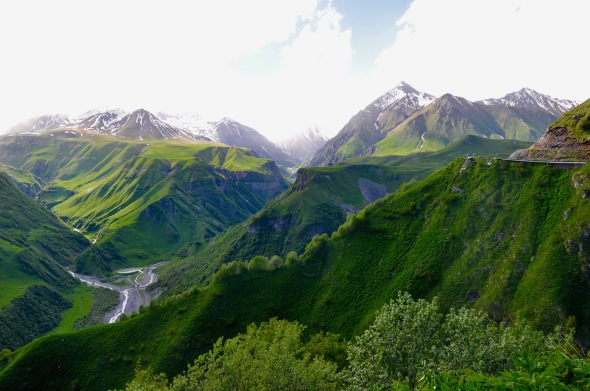
For more information on Envoy Tours and to book this Embracing Georgia tour, please visit their website:

 Julia's Travels