
A beginner’s guide to Alberobello
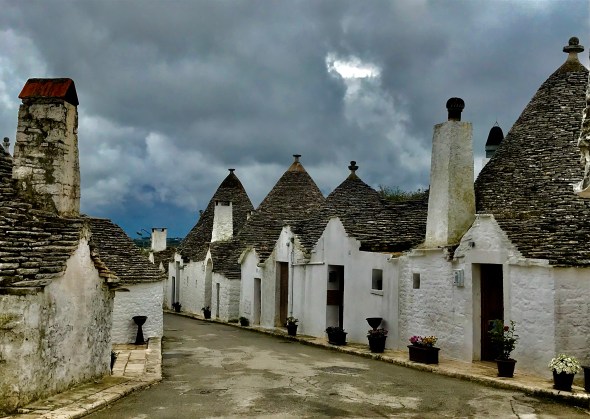
Puglia is Italy’s heel, where a karst landscape makes its presence felt in the form of caves and sinkholes. Somewhere in the middle of all that is Alberobello, a town known for one thing: trulli. These simple circular dwellings are built without mortar and take their name from the Greek word “troullos” meaning dome.
Getting there
The nearest airports to Alberobello are Brindisi and Bari. The latter’s the most convenient in terms of onward travel, served from London Gatwick, Stansted and Luton by easyJet, Ryanair and Wizz respectively. Flights can be had for a little under £50 return, excellent value for a flight that’s almost 3 hours long.
From Bari, a train takes you direct to Bari Centrale station, taking about 20 minutes. From there you can pick up the FSE train, tucked away on a far-flung platform – ask for assistance if you can’t find it. Even though it’s an FSE train, you can buy a ticket from the Trenitalia ticket machines (Trenitalia bought FSE in 2018). The fastest connection takes about 1 hour 15 minutes, but it’s more usually about an hour and a half. Tickets are cheap at just 5€ and can be used on any train without the need for a reservation. At the moment, until at least 2020, the stretch of track from Putignano to Martina Franca is being renovated, so there are no trains to Alberobello itself. Instead, you need to catch the connecting rail replacement bus – and fortunately it does connect, waiting for the train if the train is running late. It’s part of the same 5€ ticket, so just show the driver. The bus journey takes about half an hour.
On Sundays, things get a little more complicated. FSE trains don’t run at all. Instead there is a bus service that connects Alberobello to Bari Centrale. Though that might sound simple, the bus doesn’t start from the station. Instead, you’ll need to find the stop – tucked around the corner on Viale Bari near Hotel Astoria and the petrol station. Remember to buy your ticket online or at the petrol station; you can’t buy a ticket on the bus from the driver.

Getting around
To explore the surrounding countryside, it’s most sensible to hire a car. Though public transport does exist, it radiates from Bari and other large towns and there are few cross-country connections. To visit Matera by public transport, for instance, would require a trip from Alberobello to Bari and then out again to Matera – a long detour.

However, it is possible to catch the train (or Sunday bus) to some of the nearby villages. I enjoyed Locorotondo, the next village along, which is a pleasant outing for the afternoon. There aren’t many sights as such, but the hilltop location affords fantastic views across the surrounding countryside and the pretty old town is compact as a result.
Things to see
Rione Monti
The big draw when it comes to Alberobello is Rione Monti. This district is packed with trulli and straggles picturesquely up the hillside. One of the best views across from the town centre is at the Belvedere Santa Lucia. It’s also worth checking out the park beside the tourist information centre and, across in Rione Monti itself, several shops that offer free access to their upstairs terraces.
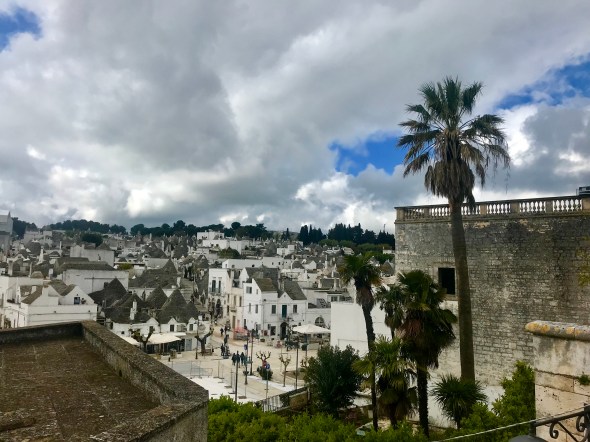
Close up, it’s not quite as quaint, largely because many of the trulli house souvenir shops – some of which is mass produced tat. A few stood out, including La Bottega dei Fischietti which sells not only the traditional ceramic whistles common to Puglia but also some rather lovely ceramic tableaux.


Nearby, Pasteca La Mandragora sells high quality linens and there’s also a store to delight art lovers called Forme e Colori di De Marco Vita crammed full of brightly painted pottery. Be warned, however, some places that purport to be museums house a minimum of exhibits which exist as a honey trap for unwary visitors.
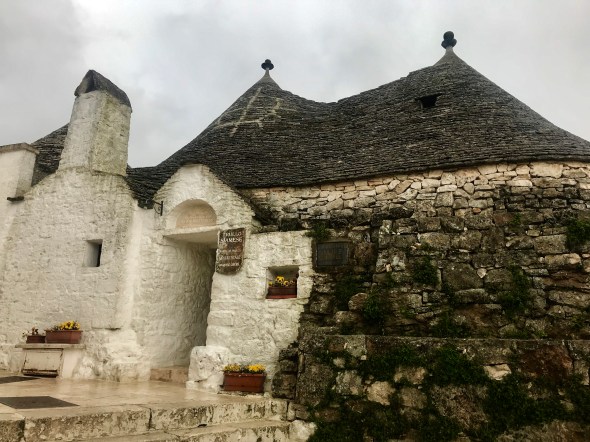
But it’s also in Rione Monti that you’ll find a 20th century trulli church and where you’ll find the curious Trulli Siamesi. This double trulli has one roof. Legend has it that two brothers fell out over a woman but neither would give up the home they had inherited. Instead of moving out, the spurned sibling bricked up the wall and knocked through to make a separate front door.

You’ll also see plenty of trulli with symbols painted on their roofs. Some people will tell you that these symbols have an ancient spiritual or religious meaning. That’s probably true, but I also read on an exhibit tucked away in a corner of the town’s museum that when Mussolini came to visit in 1927 many of the villagers were asked to paint those symbols on their trulli to add a touch of mystery. This seems to be glossed over now in favour of the more politically correct religious imagery line.

Rione Aia Piccola
The only district to rival Rione Monti in terms of the sheer number of trulli is Rione Aia Piccola, which faces off against its nemesis across Largo Martellotta. In contrast to its touristy neighbour, it’s quieter than you’d expect from somewhere on the tour guide route. Many of the trulli here are private dwellings, though a significant number are let to visitors. You’ll see just how many if you wander through in between check out and check in, when they’re marked by vacuum cleaners and mops on their thresholds.


A tourist map I had been given implied that there was a kind of open air museum here, but there was no evidence of that during my stay – perhaps because it was still early in the season? If you are in Alberobello in the height of summer it would be worth checking out just in case.


Trulli Sovrano
In the main part of town, there are also more than a scattering of trulli, one of which is worth seeking out as it is two-storey. This is rare: Alberobello’s trulli were originally modelled on the agricultural buildings found across the Puglian countryside and the dry stone wall construction wasn’t strong enough to support an upper floor.

Trulli Sovrano was built in the 17th century by the family of a priest, taking the name Corte di Papa Cataldo and is now a museum, its rooms recreated with antique furniture. In the front bedroom, a notice pinned to the wall states that the slit was useful for seeing who was at the door, or shooting them if they weren’t welcome. It was at one time a warehouse; if you climb the stairs, you’ll see a trapdoor in the floor used for passing goods down to the floor below. Over the years it’s had many uses, including a court, chapel, grocer’s, monastery and the HQ of the Brotherhood of the Holy Sacrament.


Museo del Territorio “Casa Pezzolla”
Much of the town’s history can be learned within the confines of this collection of fifteen or so trulli which now form a museum. It recounts the impact of the Prammatica De Baronibus, an edict of the 15th-century Kingdom of Naples. The Kings wished to impose a tax on permanent dwellings, so under the leadership of nobleman Gian Girolamo II, the residents of Alberobello were forced to live in trulli. Their dry stone construction made it easy to take them down if an inspection was imminent. The tax dodge worked, serving Alberobello well for many years but in the end, the political situation changed and thus these temporary structures became an enduring part of the urban landscape.


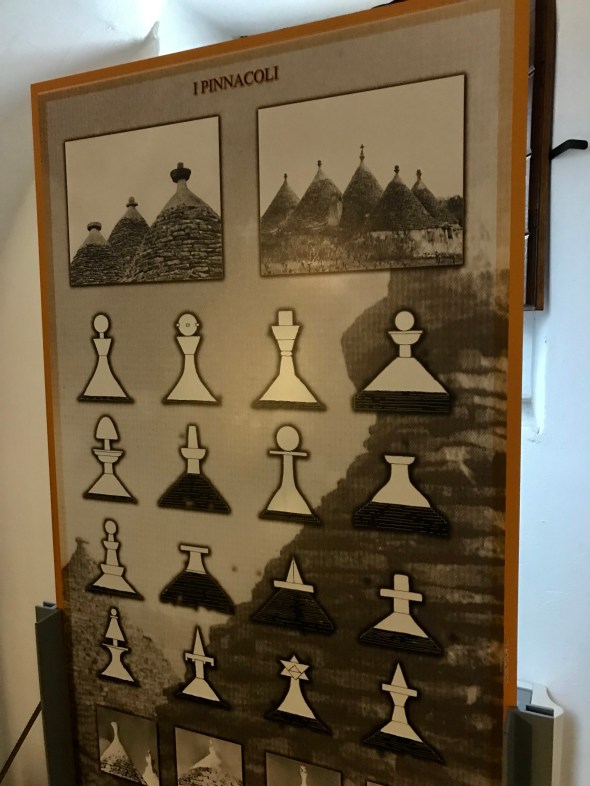
One of the sections of the museum explains the significance of the adornments on the roofs of the trulli. What’s called the “pinnacolo” is the only part of the trulli to be purely decorative, a kind of architect’s calling card. The more complex the design of this topper, the more talented was the master trullaro. It was also a good way of finding a particular trullo amongst so many similar constructions; think of it as the design equivalent of a postcode.
Where to stay
If you’re going to stay in Alberobello – and why wouldn’t you, since once the daytrippers have gone home it’s absolutely gorgeous – then I’d suggest you book Trulli Anti.


While there are plenty of trulli scattered across town that can be rented by visitors, many of them cluster in Rione Aia Piccola. Though that district isn’t as plagued by tour groups during the day as Rione Monti, it’s still on the tourist trail. Where Trulli Anti wins is that it’s close to the sights without being in the middle of them. Plus it’s on such a narrow road that it’s almost impossible for cars to drive past. I only saw one car try it and that was the local police.

That peace and quiet, coupled with its stylish and very contemporary design, gives it 10/10 in my books. If you’re thinking that I’m only saying that because I got a freebie, I didn’t. I paid my own way. It wasn’t cheap for a solo traveller, costing about 125€ a night – though it would be much better value if there are three of you. But oh was it worth it!


The trulli has been well thought out and owner Angelo is keen to ensure you have a great time. On a mezzanine, there’s a very inviting double bed under the domed roof. Lighting is good, and the stairs are pretty solid, which is reassuring as the bathroom is downstairs. That bathroom is chic – I especially loved the tiles and having a shower with some oomph to it. I also need to mention the comfortable sofa (so comfortable I fell asleep on it one evening) and that there’s a single room on the ground floor if you need a second bedroom or you’ve had so much vino you don’t trust yourself on the stairs.


If you plan to cook, there’s also a small but well-equipped kitchen with a dining table. When it comes to eating out, Angelo provides many recommendations and there are several excellent restaurants within staggering distance. Call ahead if you want to try La Cantina as it’s tiny and usually booked out. I had better luck geting into Trullo d’Oro and the food there was delicious. Make sure you try burata, a type of mozzarella that is moist and creamy. Breakfast comes in a box from a nearby cafe, with plenty of choice. You simply pick what you’d like off a menu, send it to Angelo via text message or What’s App and tell him what time you’d like it delivered. You can, if you prefer, eat at the same cafe, a ten minute stroll away.
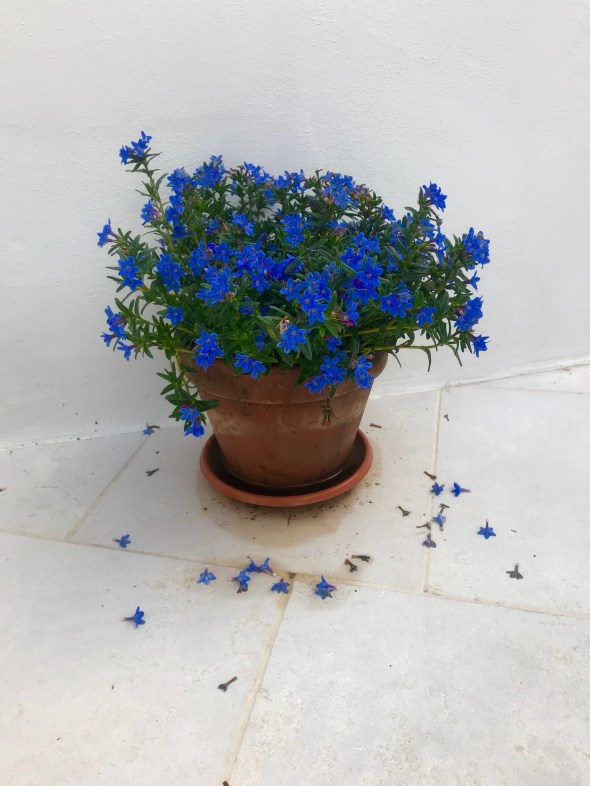
Out back there is a courtyard garden. During my stay the weather was rarely sunny, but if it hadn’t been wet I’d have loved sitting out there. Angelo supplies bikes too and there’s even an outdoor shower. Pots of flowers add colour to the whitewashed trulli and fairylights create a magical feel. I’m probably gushing, but it was just delightful. Trulli delightful, in fact. Sorry, couldn’t resist.
I booked Trulli Anti via booking.com – here is the link if you want to check prices and availability: https://www.booking.com/hotel/it/trulli-anti.en-gb.html
Why not take the train to Norwich?
Regular readers of this blog will know that I’ve worked with Greater Anglia on several occasions. They sponsor me to go to places in the Greater Anglia network and in return, I share my experiences. This weekend, I took the intercity train to Norwich.
Journey time is only an hour from Colchester station, typically around half an hour quicker than it would be by road, and with standard advance fares costing as little as £8 each way, surprisingly cheap. Factor in Greater Anglia’s offers – accompanied children go for just £2 (just turn up on the day and nab this fare for any off peak journey on the network) and 2for1 deals on many attractions – it’s a tempting prospect.

To be honest, the intercity trains that currently run on the Greater Anglia network look pretty dated from the outside. However, when you step inside, they’ve been refurbished as part of a £12m upgrade. What you get is a very comfortable ride. The seats are like armchairs and there’s plenty of legroom. There’s a choice as you’d expect of table seating, great for families or groups of friends, and airline-style seats. That upgrade has paid for new carpets, seat covers, improved lighting and upgraded toilets. Best of all are the at-seat powerpoints, which came in very handy on the return journey when I needed to use my phone which as always had a woefully low battery. It’s also convenient to have onboard WiFi. The only thing I didn’t like was having to lean out of the window to open the carriage door, but fortunately those waiting on the platform helped when I couldn’t quite reach. It reminded me of the slam door trains in the 1970s, though getting out wasn’t as impossible as it was with that horizontal squeeze – if you travelled by rail back then, you’ll know exactly what I mean.
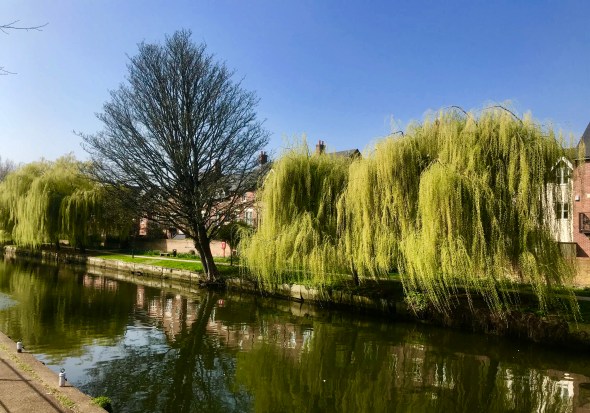
Anyway, I’d got so comfortable it was almost a pity to arrive in Norwich (and I promise I’m not just saying that because Greater Anglia paid my fare) But the sun was shining it was the first really mild day of the year, perfect for a stroll alongside the River Wensum which does a loop of the city centre. The river is almost right in front of the station. Within a couple of minutes, I was walking along a riverbank lined with willow trees. The first landmark I passed was Pull’s Ferry. This flint building was once a watergate and takes its name from John Pull, a ferryman, who ran the boats in the first part of the 19th century. Apparently, the stone that was used to construct Norwich Cathedral came in via this route, having been imported from Normandy.
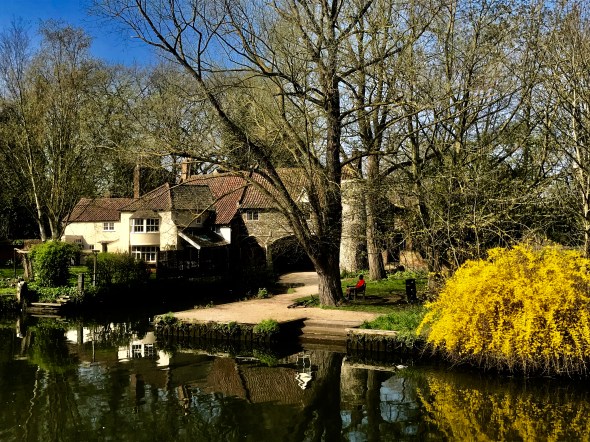
I strolled further along the river bank until I came to the Red Lion pub. On its slipway, a group of people were stepping into wooden Canadian-style kayaks. Chantal and Nick set up Pub and Paddle a few years ago – this year will be their fourth summer and the business is going from strength to strength. Chantal told me that one of their most popular excursions is also their shortest, suitable for anyone. This four hour rental takes paddlers past the cathedral, football ground and Colman’s mustard factory to the village of Thorpe St Andrew. Most people take a break at one of the riverside pubs before returning to the Red Lion. At only £20 per person, it’s good value. Chantal and Nick make their own kayaks and also have a couple of wooden rowing boats for hire for those wishing to stay in the city centre. I didn’t have time to do this, but it’s definitely a good excuse to return.


My next stop was Cow Tower, a 14th century artillery tower built as a response to the threat posed to Norwich not only by the French but also by local rebel forces. Contrary to what its name suggests, it wasn’t constructed to shelter cows, though this Eastern Daily Press article suggests that might have happened later. Instead, it was named after the surrounding meadow, which was called Cowholm. It was big enough to hold a garrison but now, it’s just a shell, the floors and roof long gone. As a consequence, you can’t go inside. Nevertheless it’s an imposing structure, standing almost 15 metres high, and very photogenic in the spring sunshine, particularly when the daffodils are in bloom. On the other side of the path from the Cow Tower there’s a rather lovely carved wooden seat, its smooth curves perfect for lying back to watch cotton wool clouds scud across a blue sky.


I was reluctant to leave my seat, but wanted to take a look at Norwich Cathedral. Construction began in 1096, using local flint and mortar faced with that limestone imported from Caen. It’s quite a large site – actually two churches and an Anglo-Saxon settlement were knocked down to make room for this new structure, such was its scale. The cathedral close is the largest in England. By 1145, the cathedral was pretty much completed. The same building you see today would have had a wooden spire clad with lead, added in the 1160s. It was struck by lightning in 1169, less than two years after it was finished, so today’s spire dates from 1480.


The cloisters of this very grand church bear a resemblance to the colleges of Oxford or Cambridge and are the second largest in the country after those of Salisbury Cathedral. A quadrangle is bounded by walkways featuring elaborate vaulted ceilings; inside, the cathedral itself is even more impressive.

One of the more interesting modern additions is the copper baptismal font. Formed from two bowls, one upturned, it was donated to the cathedral when it was repurposed from its previous use – making chocolate in the Rowntree’s factory until it closed in 1994. Though a donation is suggested, entry is free. Allow plenty of time as the building warrants more than a quick look.


It was time for lunch and over on Tombland, Cocina caught my eye, two white statues flanking its doorway. Samson and Hercules are Norwich icons, though the figures that you see today are replicas, installed when the originals became too fragile to leave in place. In 1657, the two figures, both symbols of strength, were placed outside the home Christopher Jay, then the Mayor of Norwich.

The statues were removed from their pedestals in 1789 and reinstalled in the rear courtyard of the building; a century later antique dealer George Cubitt moved them back again. At that point, Hercules was in such a bad way he had to be replaced. In the 20th century, the building housed a dance hall and later a nightclub. In 1993, one of Samson’s arms fell off and years of paint were revealed. The two figures you see today might only have been placed there just before the millennium but are a much treasured part of the city’s history.


Taking a circuitous route to take in cobbled Elm Hill, my next target was the Museum of Norwich at the Bridewell. Whether you know a lot about Norwich or like me, embarrasingly little, it’s a fascinating place to spend a few hours. The £5.95 ticket charge is a steal. Originally constructed as the home of a rich merchant in 1325, it became a prison for women and beggars in the late 16th century (that’s what a Bridewell means).


The first inmate was one John Flowers, banged up for being accused of having “a lewd life and to be a counterfeiter of begging licences”. But the most interesting story was that of Jane Sellers. She was the Bridewell’s most persistent offender, serving nine sentences in just eight years in the early 17th century. Her first stint was for “being found idle at Trowse”. Several times she returned, did her time and promised to leave town to find work. But she never did. Instead she was caught stealing numerous times. The burglary she committed at the end of 1631 would be her last. The authorities lost patience with her and she was hanged.


After a pit stop at Jarrold’s for tea, I set off for the Plantation Garden, pausing for a quick look at the city’s Roman Catholic cathedral along the way. The garden is the work of a dedicated team of volunteers. Occupying an abandoned chalk quarry, the garden is Victorian in origin, something you might guess from the many follies and statuary that litter the garden. There’s a gothic fountain, Italianate terrace and mock mediaeval terrace wall, plus delightful woodland walkways and vibrant flower beds. Judging by the many people who’d spread picnic blankets or settled into the benches for a natter, it’s well used by locals and visitors alike. A honesty box is located by the gate for your £2 entrance fee.

Back in the heart of the city, there was time for one last stop before I would catch my train. Norwich Castle occupies a hilltop site overlooking the shopping streets below. There’s a £9.50 entrance fee which is expensive, but I was told that for the final hour each day, you can get in for just £2. Inside, as well as an impressive keep, you’ll find a collection of exhibits, some temporary. Right now, there’s a Viking display which is worth a look, as well as a section telling the story of Boudicca, Queen of the Iceni. For me, the museum lacked the emotional connection I got with the Bridewell, but I’m a hard sell, much more interested in social and industrial history than that of early Britain. If you’re local and have kids, I think they might enjoy the castle’s Knight Club or some of the special Easter events that are planned.


Have your own rail adventure
If you’d like to have your own rail adventure, then why not take a look at Greater Anglia’s website? You could visit Norwich, but there are plenty more places that offer a great day out – read my previous blogs on Harwich or Wivenhoe, for instance. I’d also love it if you would answer the simple yes/no review on this survey – being purely selfish, if you’ve been inspired by my day out, I get to do another!
The end of the High Street travel agent – or is it?
News has broken today that Thomas Cook will close 21 of its High Street stores, one of which is my local branch in Colchester. It’s no surprise. Even Thomas Cook themselves admit that 64% of its UK bookings were made online last year. Their website is bright, colourful and most important of all, easy to navigate. Rationalising a business is the way to keep it afloat, and if you don’t move with the times you become a dinosaur. Thomas Cook led the way in 1841 with its pioneering railway excursions and is a respected player in the industry. Closing its stores isn’t a sign of failure, it’s a savvy move designed to help the company retain its market share.

I haven’t stepped foot inside a travel agency for over two decades. The last time I asked about flights, the assistant hadn’t heard of the place I wanted to fly to, so I left. The rise of budget airlines and the breadth of information available at the click of a mouse means I have no need to pick up the phone and speak to a specialist, much less go to the bother of visiting a High Street store. The rise of the internet made the travel agent the middle man. Online agencies such as Expedia, originally set up by Microsoft in 1996, do a more than satisfactory job. Use an online travel agent and you’re not tied to store opening hours, but you’ll still have the convenience of a one-stop shop for your travel package and the benefit of bulk buying discounts.

But just because I no longer use a travel agent, doesn’t mean I don’t advise others to use one. One of the benefits of the internet is also its biggest drawback – sometimes there’s just too much information. Sifting out what you need to know from the mountain of websites that Google presents can be hard. Travel’s my job – I take for granted that I know which sites will be useful and which are irrelevant to my needs. But for many, navigating through all that information is a minefield. How do you know what you’re reading isn’t misleading or downright inaccurate? Sadly there are many influencers out there who just don’t know as much as they claim to, like the blogger who presented a £1000 indirect flight from London to the US as a bargain, when direct fares are often half that amount or less. How do you whittle down which New York hotel to choose when Expedia presents almost two thousand search results?

In the light of that, it’s not surprising that some High Street travel agents are actually expanding the number of branches. Kuoni’s one of them. Paired with John Lewis, they offer a different experience to Thomas Cook, and aim at a different clientele including the lucrative luxury honeymoon market. Their customers, they say, value quality over cost. Between 2016 and 2017, they reported a 38% increase in the number of appointments made with their in-store experts. 59% of their customers, they reveal, come in with a blank sheet and ask the consultant to help them find their perfect trip. Visit Kuoni’s website, and though you’ll find plenty of tempting images and itineraries, you can’t book them online – instead you have to telephone or book in person. Hays Travel, the UK’s largest independent travel agent, are also expanding, so the trend’s not confined to Kuoni.

Millennials are particularly keen to utilise a travel agent, a trend that’s mirroring what’s going on across the Atlantic. FOMO – that’s the fear of missing out to those of us who are old enough to be their parents – means that they want to ensure that they book the very best when it comes to travel. According to ABTA, 59% of millennials say they’d pay extra for a holiday that’s tailormade to their preferences, good news for agents like Trailfinders with a High Street presence and a strong reputation for bespoke but affordable packages. In Kuoni’s latest worldwide trends report, it notes a rise in bookings of what’s termed “wow experiences”. From dining beside a waterfall in Thailand to staying in a vintage Airstream trailer on the Bolivian salt flats, bespoke just got interesting – and crucially, difficult to pull off without the right connections. ABTA’s annual report backs up this desire to leave the booking process to an expert. They state that 45% of those booking via a travel professional do so because of the confidence it gives them, while Google asserts that 69% of travellers return to companies offering a personalised approach.

While hardened low-budget, intrepidly independent travellers (like me!) will stubbornly continue to find their own way, the age of High Street travel agents isn’t yet over. After all, if you’d call out a plumber to fix a water leak, why not call upon a travel professional to find you the holiday that’s right for you? It will probably cost you more, but if you think it would be worth it, then it’s money well spent.
Gorillas lite: up close with the chimps of Kibale Forest
Bwindi Impenetrable Forest National Park in the south west of Uganda is one of the few places in the world that you can see mountain gorillas, the others being just across the border in DR Congo (currently on the FCO no-go list) and Rwanda. These aren’t the gorillas you’ll maybe have seen in zoos – those are lowland gorillas – as mountain gorillas can’t cope in such environments. Less than 800 of these magnificent creatures remain in the wild and about half of them are found in Uganda.
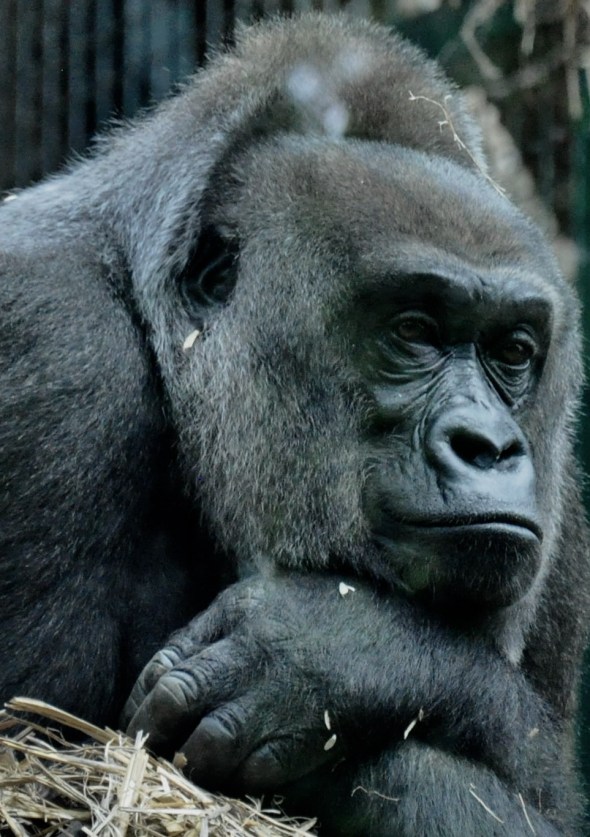
Lowland gorilla in Port Lympne safari park, Kent
I was really keen to include a primate tracking safari as part of my Uganda itinerary but knew from what I’d read online and from what others had told me that I just wasn’t physically fit enough to do a gorilla trek. Bwindi Impenetrable Forest truly lives up to its name (well, almost). The hike, which research indicated could take anything from one to seven hours depending on where the gorillas were that day, was likely to involve the thin air of high altitude, steep uphill climbs and trails wet and slippery with mud. Last April, a 63 year old French tourist lost his life after collapsing with a heart attack on the way back. Though Trip Advisor is full of gung-ho reports about porters and assistance, I decided that realistically, it wasn’t for me. Oh, and it would cost $600 in permits, though admittedly that’s a whole lot cheaper than the $1500 you’d pay across the border in Rwanda.
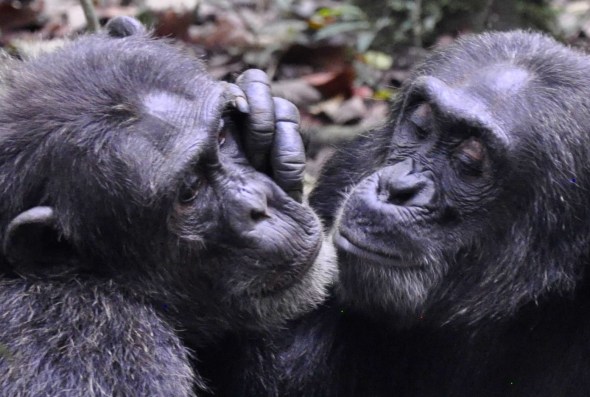
Grooming
Fortunately for me, Uganda’s primate tourism doesn’t begin and end with gorillas. While I was looking into a gorilla trek, I came across a chimpanzee tracking experience that seemed the perfect fit for me. I’d get to see primates up close but the trek, across the relatively flat forest floor of Kibale Forest, shouldn’t be anywhere near as tough. I put together a customised itinerary with car and driver provided by Roadtrip Uganda and they sourced a permit for me. It’s not wise to leave the purchase of permits until you arrive as they are strictly limited in number and you may be disappointed if they’ve sold out.
Tip: to further minimise the need for a long hike, opt for an afternoon tracking slot.

Chimps are exceptionally good climbers
As I had opted to stay overnight in Fort Portal and planned to spend the morning driving around the area’s crater lakes, I opted for an afternoon permit which would give us plenty of time to drive south to Kibale Forest. This turned out to be a wise idea. Groups go out in the morning and when the rangers come back to base, they report back on where the troops of chimps have been spotted. There’s no guarantee that they’ll have stayed put, of course, but I was told that there’s usually less walking involved in the afternoon excursions as a result. The downside is that temperatures do increase as the day wears on, though in the shade of the forest this isn’t as big an issue as you might first think.

Chimps share 98% of our DNA
Our group of six met at the park office for a short briefing before our own drivers took us to the part of the forest that had been chosen as the start point for our tracking experience. Accompanying us were a ranger and also an armed guard; in the event of elephants or buffalo encroaching too close to the group, the latter would fire warning shots in the air. Before we gave our drivers a few hours off, there was another briefing. No one would be allowed to trek if unwell, the group should remain at least 8 metres from the chimps at all times and most important of all, we were told to tuck our trousers into our socks to avoid being bitten by ants. Photography was encouraged but we were to turn off the flash to avoid startling the chimps.


Three whoops of chimps (that’s the collective noun!) in Kibale Forest were habituated, that is, they’re used to being close to humans. Others are left alone. We set off in search of one of them, Benson our ranger encouraging us to hurry so we could reach the spot before they moved deeper into the forest. The pace wasn’t actually too fast, largely because we were picking our way over buttress roots and ducking under forest vegetation. Benson told us that the “hoo hoo hoo” sound we could hear was chimps calling to each other and that they were close.
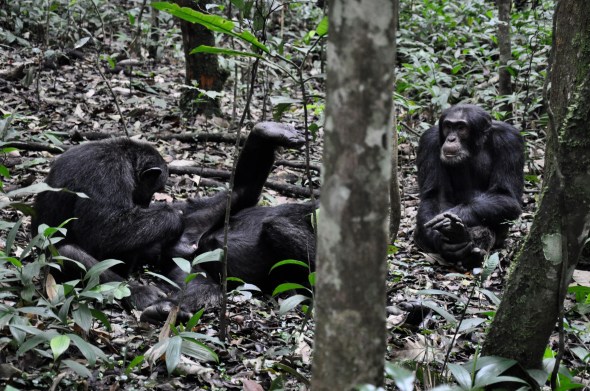
The initial group
I was thrilled when we came across the first group of four – three adults and a baby – after only about fifteen minutes of walking. Benson arranged us so that we’d have a clear line of sight to the chimps without getting too close. We were the only group at that point, so the six of us enjoyed an intimate encounter and it was truly a delight. Though the baby had climbed a tree, too unsure to remain on the ground so close to us, the three adults weren’t fazed at all. Two were too focused on grooming each other to acknowledge our existence while the other rolled onto his back and closed his eyes for a snooze.
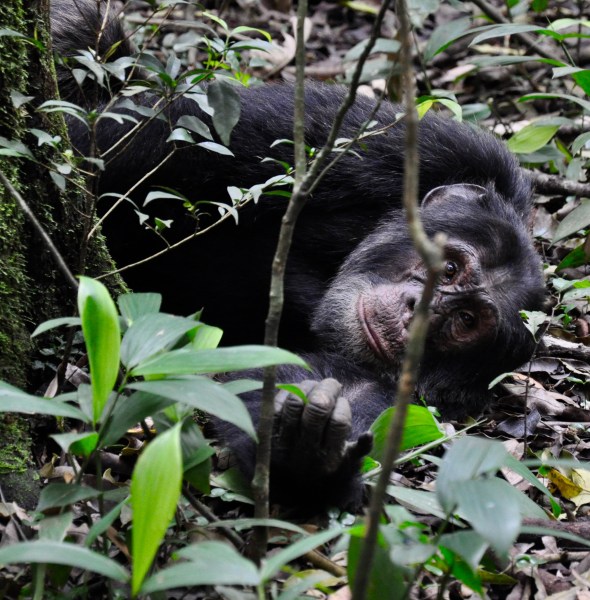
Time for a snooze
The chimpanzee tracking permit had cost $150, considerably less than that of the gorilla encounter, but still a significant amount of money. But at that point, it was worth every cent. About five to ten minutes later, another group caught us up. Benson asked us to move on so that the chimps would not be overwhelmed. We did so and and after a few minutes came across a larger group.
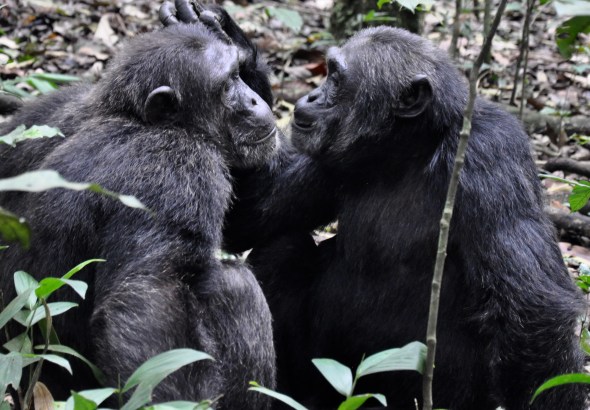
It’s a real privilege to be so close to the chimps
Once again, watching their behaviour was fascinating. These creatures share 98% of our DNA and many of the mannerisms are uncannily similar. We watched, transfixed, as they ate fruit, chased each other in play and swung from the canopy high above our heads. We saw their nests high in the canopy – the chimps overnight in these but prefer to hang out on the forest floor during the day. Generally speaking, it was a pleasure to be so close. The loud chatter and screams as they approached was a bit intimidating – as it was intended to be, I guessed. I think I’d watched too many Planet of the Apes films to have been entirely comfortable at this point, but Benson calmly explained what was happening and pointed out where they were which made me feel safer, particularly when they had us surrounded.
After the initial delight of seeing the chimps, I began to notice how different each were from the others. One was a proper porker – we were told he was vying for the alpha male spot and thought his extra weight might help. Some of the older chimps in the family were going grey, or balding. The youngsters, true to type, were mucking about and being put in their place by their elders. And the baby, well he was just too cute. We saw a female in oestrus, and then a bit of chimp sex up a tree after she parked her baby on the branch next to her while she got it on with her potential baby daddy. Sadly, light levels in the forest weren’t sufficient to get it on film but that’s probably just as well.
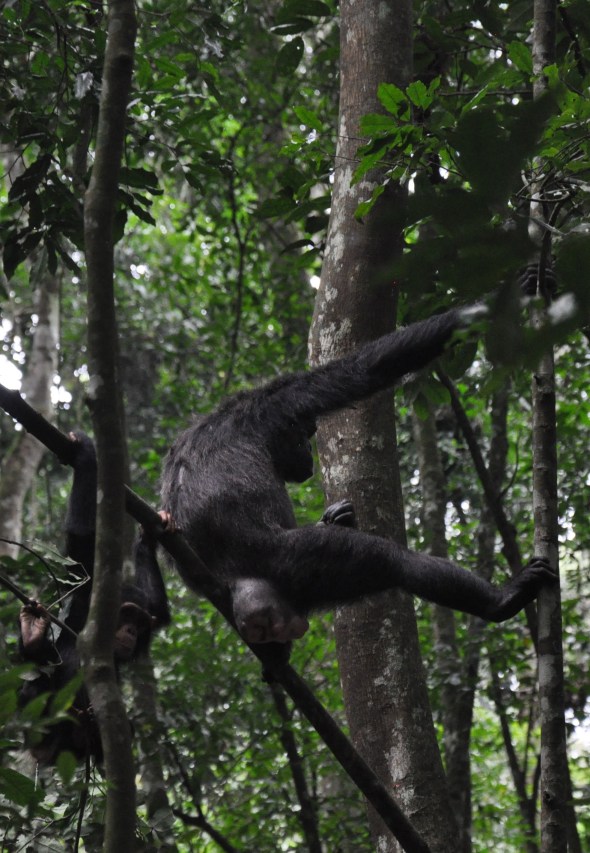
Letting it all hang out!
In all, we spent around an hour with the chimps before Benson led us on a trek out of the forest back to the ranger station. This was at a very leisurely pace, with plenty of stops to point out types of trees, birds, monkeys and butterflies. The tracking activity that I booked in Kibale Forest has about a 95% success rate of spotting chimps. This is nature, of course, and nothing is guaranteed. In all, we saw about 25 chimps. The permit cost me $150, which included entrance to Kibale National Park for 24 hours.

The adults were well habituated though the babies were a little unnerved by our presence
You can also try your luck spotting chimps at Budongo Forest Reserve in the northwest of the country, those living in the Kyambura Gorge at Queen Elizabeth National Park in te south and also at the Toro-Semliki Wildlife Reserve near the Congolese border. To spend longer, a chimpanzee habituation experience is offered, where visitors can spend all day in the forest shadowing researchers. This costs $200 for foreign visitors; on the Uganda Wildlife Authority website it does state half-day habituation experiences were available for $100 but I was told this was not the case. For a full price list, including prices for other areas, please use this link:
Review: Kampala’s backpackers compared
During my trip to Uganda I stayed at the three backpacker hostels in Kampala. Each was very different, so if you’re looking for cheap accommodation in the capital, my reviews might help you decide which is best for you.
Red Chilli Hideaway


The clue’s in the name with this one – it’s tucked away at the end of one of the roads leading south from Kampala’s city centre. It’s as much a resort as it is a hostel, with a sizeable swimming pool as well as two bars. Day guests can pay for the use of its facilities, but it retains a backpacker vibe nonetheless. Staff are helpful and efficient.
The location is both Red Chilli’s biggest plus and its worst drawback. Because it’s so far out of the centre – around 10km from downtown – it’s inconvenient if you intend to visit the city’s sights. Traffic is horrendous, so that 10km journey can easily take an hour or more of frustrating stop-start driving, more in rush hour. If you’re coming into the city on a tourist shuttle such as Pineapple Express, note that drop off will be at the Oasis Mall, still a considerable distance from Red Chilli.


That said, if you’re looking for a place to unwind as part of your Ugandan or East African trip, it’s the perfect spot. Security’s excellent – all cars entering the compound are checked thoroughly, with mirrors used to check the underside of the vehicle. Guards on the gate are also a reassuring presence in this relatively remote location. The views across the valley to the surrounding countryside further distance you from the hubbub of the city and it’s a surprisingly peaceful place. Sunrises are spectacular and well worth rising early for.
The multiple accommodation blocks contain a range of room types, from dorms to private ensuites. The latter are roomy and are equipped with fans and showers that actually deliver hot water. I slept well, cocooned from the noise of those socialising in the bar. The room was basic but clean.
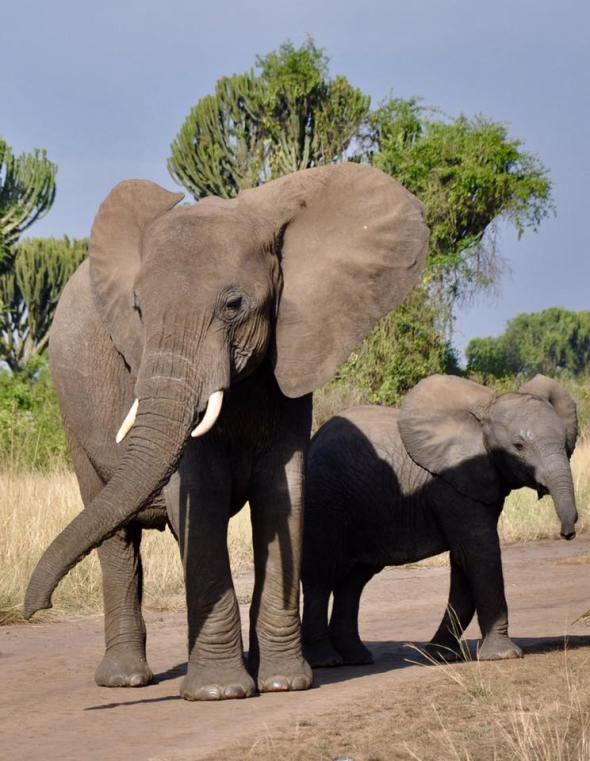
Red Chilli Hideaway is the sister property to Red Chilli Rest Camp up at Murchison Falls. I took the three day budget safari, which costs $320pp in shared tents and about $80 extra if you upgrade to a self contained banda. It was well organised and well thought out, and though the distance travelled was considerable, the two included game drives and boat trip made the package excellent value for money as well. The safari price includes a free dorm bed the evening before – it’s definitely a good idea to stay in order to avoid a ridiculously early start just to reach Red Chilli itself.
Would I stay there again?
Yes, if I was looking for a place to stay put rather than get around.
Cost of a single room with ensuite bathroom $45 with a discount for booking the safari – I paid $33 (note that prices have recently risen)
Bushpig
If you’re looking for a sociable backpackers then this is the pick of the bunch, but I also found it to be the noisiest of the three. Located on busy Acacia Avenue, there’s a constant buzz of traffic as well as considerable noise from the immediate vicinity – bells ringing when people asked to be let in and chatter for instance. My single room was tiny, the bed taking up the whole of the window side of the room, making it difficult to access the window. There was a small hole in the glass, so even with the window shut, it wasn’t remotely soundproof, though mesh and a mosquito net ensured I wasn’t bothered by the bugs.


The showers and toilets were in a room a few doors down the corridor. They were clean and the water was hot. I rented a towel for 4000 shillings (a little less than £1). However, there was no door to the bathroom itself and (unlike the rest of the rooms in my section) my room had mesh above the door rather than a solid wall. The noise from flushing toilets and running water was therefore bothersome. I managed about three hours sleep which wasn’t ideal.


Where Bushpig scored highly was in its food. There was an outdoor bar with tables. An extensive menu sold really tasty food at reasonable prices and it was a popular place to entertain friends as the number of visiting diners indicated. Staff were approachable and helpful. The manager went out of his way to get me connected to the WiFi when my devices were being uncooperative and it proved to be the speediest once I was online. Also, the reception staff helped me figure out the location of the relocated Post Bus service as well as sort me out with a reliable taxi.


Would I stay there again?
Probably not, on account of the noise, though it was a temptingly convenient location. However, I would definitely visit for the food and atmosphere in the bar garden.
Cost of a single room with shared bathroom $25, which represented the best value of the places I stayed
Fat Cat
Occupying a site in a quiet side street close to Acacia Mall, this backpackers had the most convenient location. It was the smallest of the three and felt the most basic. My single room was directly off the main dining room, which could have presented a noise issue had there been more guests, but in fact I got a good night’s rest. Staff were efficient, and my driver for the late night airport transfer was waiting for me outside Entebbe Airport. However, I didn’t get the sense that they were especially bothered if I was enjoying myself and came across as a bit bored by the whole customer service thing.


The shower room was very basic. The cubicles were fairly clean but the windows and walls were grubby and there wasn’t much space to hang clothes or a towel while you showered. The water was almost cold, adding to the monastic feel. Though it was dearer than Bushpig, the room was larger, but the facilities were definitely a lot more rundown and in need of modernisation. I only ate breakfast here, and that too was basic. There was a lounge and several traditional hostel noticeboards where you could post requests for shared rides and the like.


I did like the garden area, which was a tranquil spot to sit and enjoy a drink with plenty of shade. You could qualify for a free beer if you went litter picking in the vicinity of the backpackers. Just outside the gate, Uber bodas (motorcycle taxis) congregated and I had no difficulty organising an Uber car and driver when I needed to go into the centre of the city a short distance away.
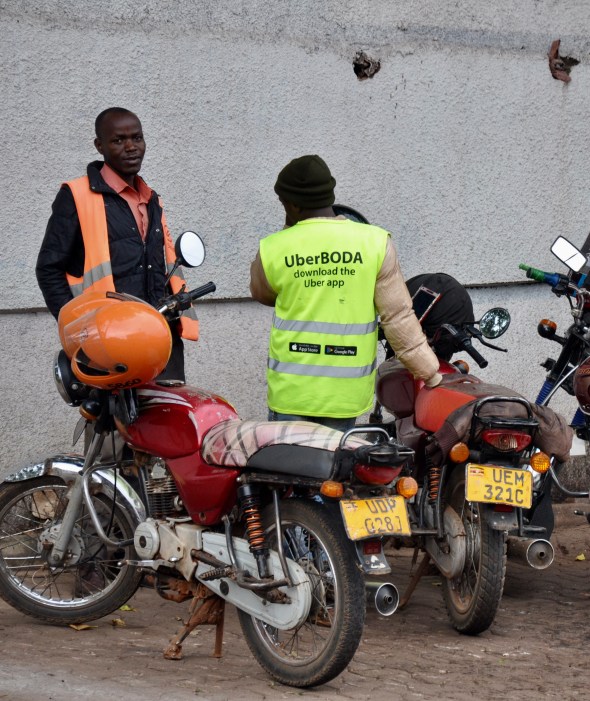
Would I stay there again?
Possibly. Despite it being the most basic, it functioned well and its proximity to the Acacia Mall and a number of cafes and restaurants helped.
Cost of a single room with shared bathroom $34, a little steep given the quality but admittedly reflecting that it was significantly larger than the room at Bushpig.
Review of Nile Horseback Safaris
“Oli otya!”
My greeting, freshly learned, typically resulted in a surprised face, followed by a torrent of incomprehensible words in Luganda, the language of Uganda. The villagers that responded could have been saying anything. It was as if I was participating in a kind of verbal line dance in which everyone knew the steps except me. I trusted they were repeating the familiar pattern of “hello, how are you?” that I’d been led to expect.
“Cale!” I replied, I’m fine.

Fortunately, passing astride a horse at a slow but steady pace, by the time I’d uttered the final response I was some way down the trail and thus unlikely to be troubled by a continuation of the conversation. Francis, my guide, was effusive in his praise, commenting on the accuracy of my pronunciation, though obviously not on the extent of my vocabulary. As he’d been the one who’d taught me earlier that morning, I echoed the compliment.
A couple of hours earlier, I’d made the short journey out of Jinja, a pleasant town famed for being at the source of the Nile. English explorer and army officer John Hanning Speke had made his way here in 1863, searching for the beginning of the world’s longest river. Noting a spring that rose from an outlet of Lake Victoria, he staked a claim, sending a telegram that said simply:
“The Nile is settled.”
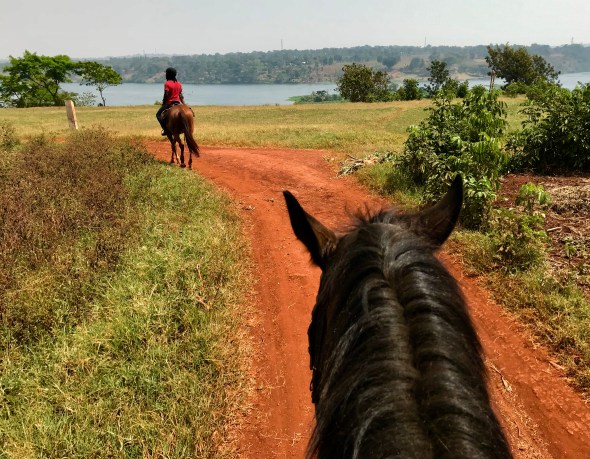
The claim was disputed, however, largely due to a lack of corroborating evidence and competing egos. Speke died in 1864, receiving posthumous recognition for his discovery in the latter part of the 1870s after Henry Stanley mounted his own expedition and proved Speke had been right all along. Things are considerably easier in the 21st century, with a memorial to Speke in the grounds of the Living Waters Resort and a blue and white marker located prominently (though inconveniently) in the middle of the river. Disputes over the source of the Nile continue, however, with many differing theories as to which bit of water lies furthest from the Nile Delta over four thousand miles to the north. The very visible spring bubbling up at the outlet from the lake at Jinja adds credibility to this particular claim.
Kitted out for my own, much more modest expedition in helmet and half chaps, I’d set off on a horseback trek. A series of mounting blocks at different heights made it easy to mount JD, a sturdy horse with a calm temperament that boss TJ had selected for me. The path we took soon led us through the village of Naminya. A succession of little children tottered about in the dust, their older siblings busy in the classroom. As we approached, they waved enthusiastically.

“How are you?” they trilled, giggling with delight at my response, “I’m fine, thank you. How are you?”
“I’m fine. I’m fine. I’m fine! I’m fine!!!” The singsong chorus was one that would become familiar wherever I went.
The sound of their voices faded to a whisper as the horses continued further along the dirt track. Such small children had much more freedom here. Passing bodas aside, there was little to trouble their safety. In any case, these motorcycle taxis hooted a warning as they passed and even at this tender age, the tots knew to stand back. We continued on, the horses’ hooves kicking up the compacted terracotta earth which passed for a road. The same mud held together by thin branches and topped with rusting sheets of corrugated iron provided rudimentary shelters. Those who could afford it upgraded to brick built dwellings, the uneven blocks fired in crudely constructed kilns that belched acrid smoke.
We passed the village well. Two women chatted idly as they pumped water into faded yellow plastic cans. Effortlessly, they swung the weighty loads onto their heads and strode off in the direction of home. They made it look deceptively easy. A man passed us, carrying a sizeable bunch of green plantains, the staple of the Ugandan dish matooke. What we call a bunch is merely a hand; this was a stalk crammed with the fruit and weighed a ton.

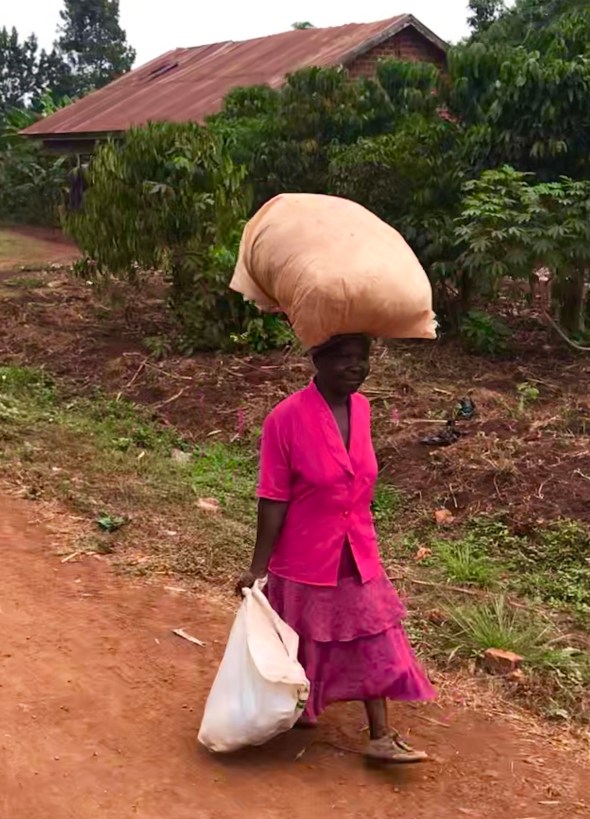
Soon afterwards, we encountered a woman in a fuchsia pink blouse and skirt making light work of an equally heavy sack on her head, and, more unusually, a lighter bag in her hand. Along the track, three sheep tugged at the ropes that tethered them in a yard shaded by banana trees. Next to them was a roughly constructed wood and rusted iron shelter that in no small measure resembled a bucking bronco.
The ride took us through plantations and lush countryside. Francis turned and said:
“Julia, if you’d like to pick up the pace tell me and we can trot.”
In the warm sun, though, I was content to walk, the lazy rhythm far too relaxing to interrupt. Out of practice – it had been a year since I was in the saddle – I wriggled uncomfortably in the saddle. The tightly zipped chaps gripped my chunky calves and numbed my feet. JD plodded on, patiently accepting the fidgety novice on his back without complaint. Every so often, I freed a foot from the stirrup and rotated my ankle. Francis continued to lead the way at a steady, manageable pace, glancing over his shoulder at regular intervals to make sure I was OK. I was. Even when his horse spooked a little at some cows beside the road, JD was reassuringly composed.
We looped round, passing verdant fields planted with crops. I was getting stiff, my body unused to the saddle. Ready to return, my interest suddenly piqued as the Nile came into view and all aches and stiffness was forgotten. Across the grass, in a gap between the trees, a glimpse of blue appeared. Francis led us to a clearing, from which the sliver opened up into a broad swathe of water.
“Would you like me to take a photo, Julia?” he asked.

I nodded, and manoeuvred the horse with some difficulty so that I faced the camera yet avoided coming a cropper down the steep river bank. Photo session concluded, we headed off along the trail following the river bank. So high above the river, one slip would send me tumbling down to the water, crashing through bushes and trees on the way. Once again I was relieved that JD’s calm disposition meant I could trust him not to stumble, leaving me free to enjoy the view from the saddle. Soon, the gate to the property came into view and it was time to dismount.
About Nile Horseback Safaris
Nile Horseback Safaris is an established riding business well run by TJ, an Aussie expat, and his Kiwi partner. A number of rides are offered, the most popular being the 1.5 and 2 hour rides that combine village trails with river views. These suit most riders as the pace is relatively gentle, but complete novices may prefer the one hour ride. Longer safaris are available for more experienced riders.
It’s a very professional set up and one which receives consistently positive reviews. Horses are well looked after, safety is paramount and helmets are provided. To ensure that the horses are as comfortable as their riders, a strict weight limit is enforced – check the website for details if like me, you are on the heavy side. The mounting blocks make it easy to get on and off the horses and TJ’s policy of sending out two guides with each group – one leading and one at the rear – ensures that if a rider was experiencing any difficulties, assistance could be given promptly.

I’d like to thank TJ for providing a complimentary ride but would hasten to point out that all views expressed are my own. I was very impressed, both with the set up and the scenery, and would happily recommend Nile Horseback Safaris to anyone looking for an alternative way of viewing the Nile and Ugandan countryside. This is slow travel at its best.
The risks of road transport – and how to avoid them
Independent travel brings many rewards, but travel using such means isn’t without its risks. The older I get, the more I factor safety into my plans. If as a traveller I have nine lives when it comes to near misses, I figure I used up a fair few of them when I was young, naive and imperturbable.

Rust buckets and fatigued drivers
In the UK, we take it for granted that vehicles are roadworthy but the same can’t be said for some parts of the world. Things have improved somewhat since, but on my first trip to Lima, the taxi that took us to the airport was an ancient Beetle. Its doors had rusted into a beautiful but deadly filigree mesh and were held shut by pieces of ragged string. Even the driver made reference to its poor condition, opting to leave us on the road outside rather than to risk being apprehended by the police or airport authorities in front of the airport terminal. Things are rather different now. Doing the same run on my last visit I had a functioning seat belt and a seat with complete upholstery, though the traffic in Callao was as bad as it had ever been.

Driver fatigue, particularly when it’s coupled with bad roads, can be lethal. In places where driver hours aren’t regulated and drivers aren’t routinely breathtested, you could find yourself in a whole heap of trouble. Sometimes, if it’s the only bus company running the route, you don’t have a choice. The bus I boarded to take me from Chachapoyas to Cajamarca wasn’t in the best of condition (though by no means the worst I’ve encountered) but it was that or a prohibitively expensive private transfer. Safety-wise, I should have opted for the latter. Instead I tried to sleep through a night of switchbacks and squealing brakes, saying a prayer of thanks that we made it one piece when we pulled up at our destination at daybreak. Travelling at night had one big advantage, however – it was easier on the nerves not to see how close we were to the edge of the ravines.
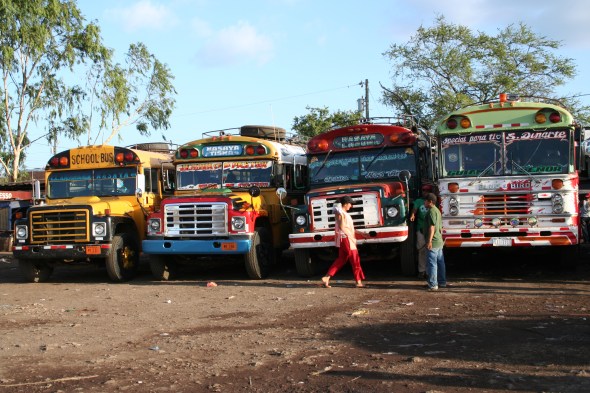
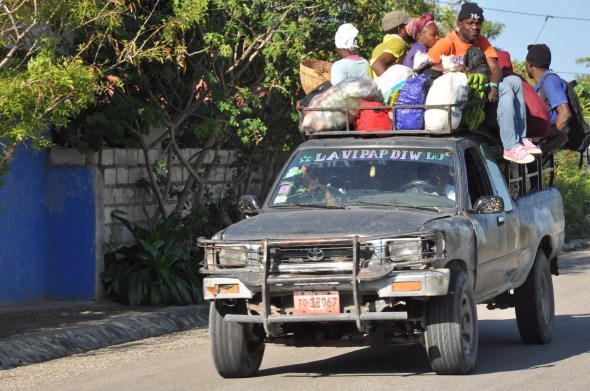
Often, I’ve taken local buses within cities or out into the surrounding countryside. In Latin America, they’re often repurposed American school buses. The bench seats are uncomfortable: sticky in the heat, the cracked leather slippery and uncomfortable on bare legs. In Haiti, though, I’d have given anything to be travelling in one of these Nicaraguan chicken buses. Instead, I took what was possibly the most uncomfortable ride of my life in an overloaded tap tap. The end justified the means, but you can read here about the journey from hell that took me to Port Salut:
These days I turn away vehicles, though, when I know there’s a choice, refusing a taxi without seat belts and doing some homework about which bus companies have the best safety record. It’s possible to find companies that run services with two drivers so that each can be well rested after a stint at the wheel. If a company states on their website that they routinely screeen for drugs that’s also a plus, though admittedly hard to corroborate. It’s particularly important to be cautious if the road you’re due to travel on is an accident blackspot. Hiring a car and a driver is often a smart choice, though check the condition of the vehicle before agreeing a price – no one wants to break down in the middle of nowhere, as happened to me out in the Senegalese countryside.

The dangers of walking
It can be tempting, especially in cities, to think that opting for two feet instead of a ride with a crazed minibus driver would be safer. Remember though, that this assumes the driver won’t opt for your bit of pavement. In Nairobi, I needed to get to the central railway station to catch a train to Mombasa. It departed right in the middle of rush hour; my journey took me from the suburbs to the thick of the action.

Drivers lent on horns to vent their frustration but in the melee, there were vehicles everywhere. Lane discipline was a forgotten art as cars, buses, vans and taxis tried everything they could to get ahead. Not every overtaking manouevre was a successful one. Consequently, some drivers found themselves stranded on the wrong side of the road. My driver was optimistic we would reach the station in time, following a full sized bus packed with commuters up the kerb and along the pavement (which incidentally wasn’t as wide as the car, let alone the bus). Pedestrians scattered and we returned to the carriageway when we reached the junction.

I’m not saying I was especially safe in the passenger seat, but I wouldn’t have wanted to be a pedestrian on those streets. In China and Vietnam, I’ve found that the solution to crossing roads where there is that much traffic – there, it’s likely to be bicycles and motorbikes – is to team up with other pedestrians and form a kind of Roman testudo, minus the shields. I’m not ashamed to say that I’ve put a local person between me and the oncoming traffic. I figure that they’re used to it, plus they speak the lingo should it become necessary to yell obscenities at any driver coming too close. I’ve also learnt that it’s imperative to maintain a steady pace and not to waiver from my course. If the driver or rider knows where you’re going to be, they can swerve to go round you.
It works – if you can hold your nerve. Have you got any other tips?
Five places I’d love to visit again
Reconnecting with a Japanese friend this weekend made me think about the trip I’d made to Honshu and Kyushu in 2007. It got me thinking about countries I’d love to visit again. I’m all for exploring new countries – Uganda and Kyrgyzstan will be new destinations for me this year – but it’s also good to revisit places that made an impression. I’m making another visit to Italy this year, this time to see the trulli of Alberobello in Puglia, which I’m really looking forward to. So which are my top five places I’d love to visit again?
Japan

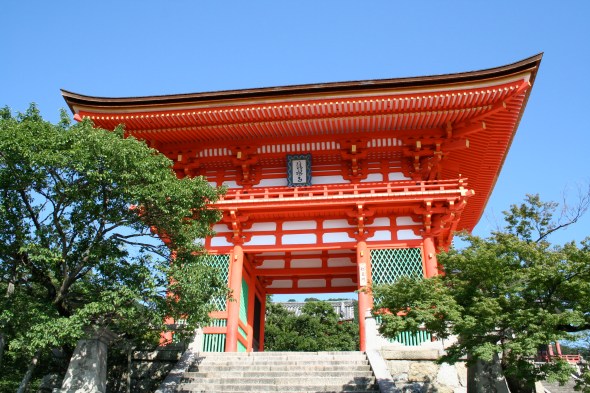
This Asian nation’s unique culture makes it special. Last time, I took a sand bath, soaked in an onsen and watched cormorant fishermen catch fish by firelight. In Kyoto I saw a geisha in Gion and in Tokyo, followed in Bill Murray’s footprints by staying at the hotel which featured in the movie Lost in Translation. Coping with the language barrier and different alphabet wasn’t as challenging as I’d expected thanks to video calls and picture menus. I loved how you could buy practically anything from a vending machine, including beer and hot chicken. Even the trains were a revelation, with slippers to wear and attendants that bowed when they served drinks. Next time, I’d like to head inland to the mountains and north to Hokkaido.
Austria
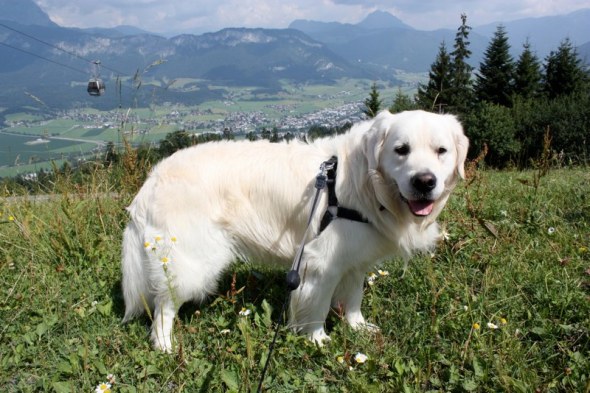
My visit to Nuremberg’s Christmas markets this year made me realise just how much I’d enjoyed my visit to Salzburg the year before. The markets themselves were much more handicraft oriented and in their mountain setting, a delight to explore. It would be hard to choose a season though – Austria’s just as beautiful in summer, if not more so. It’s been nine years since I took our elder dog to St Johann in the Tyrol and I’d love to go back with our younger one. We used to go to that part of Austria when I was a child and it’s a place I always feel a sense of calm. Something about the clean mountain air, perhaps, or the hearty, home-cooked food?
Nicaragua and Guatemala
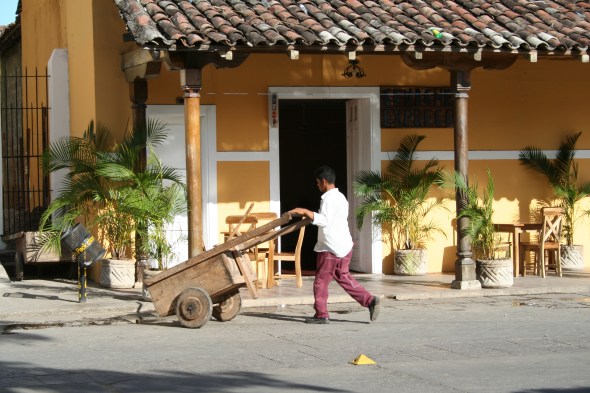
When I eventually reached Nicaragua, I had been delayed two days, detained by the “Weekend Whiteout” in New York City. Despite the shortened time, I very much enjoyed the city of Granada and its colourful colonial core. Nearby, I explored volcanoes and cloud forest, and took leisurely lunches beside tranquil lakes. I’ve always felt that the trip was a little rushed, though, so it would be great to go back and explore at a more leisurely pace. Guatemala was equally charming, but a disappointing hotel on the edge of Antigua took the edge off my stay there. It would be fun to revisit around the time of Day of the Dead and compare the experience to the wonderful trip I made to Oaxaca a few years back. In a better hotel, of course.
Australia

As a die-hard Neighbours fan, boarding the bright blue minibus back in 2005 was a rite of passage. But now, as well as paying a visit to Pin Oak Court, the sets themselves are included in the tour and regular pub nights offer a chance to meet cast members. That in itself is a reason to go back, but I’d also like to spend some time in the north west of the country which is blessed with some stunning scenery. Taking a road trip north from Broome to the Bungle Bungles and beyond would be quite the adventure. (Hey, if Helen Daniels painted it, count me in!) I’d also love to ride the Ghan, Australia’s iconic train linking Adelaide and Darwin, stopping off to see Brolga and his kangaroos in the red centre along the way.
Morocco
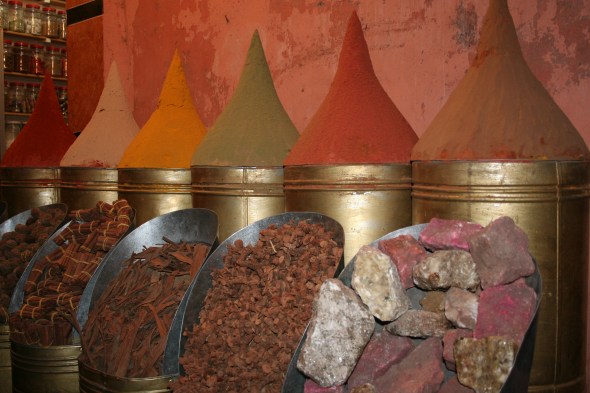
I’ve visited Morocco several times since my first visit in 1997 and there’s still plenty more I’d like to see. A new high speed train service would be a real treat to try out – on that first visit I chugged my way from Tangier to Marrakesh and back again at a snail’s pace. Last trip, I planned to visit the coastal town of Agadir for a day trip and would have done, had I not been laid low with a bout of food poisoning (don’t eat the salad!) The blue city of Chefchaouen looks so photogenic it would be irresistible, another for the wish list. I’m told its cobbled lanes lead to leather workers and weavers. I’m a big fan of Moroccan style when it comes to home furnishings – I know it would be hard to resist a bit of shopping.
Is there somewhere you’ve visited that you’d love to go back to? I’d love to hear about it.
A January daycay: just the thing to banish those winter blues
Do you suffer from the winter blues? If you do, this month’s hell. Without Christmas lights to lift the spirits – excepting the neighbour whose outdoor tree will be a beacon of defiant brightness until the temperatures rise in the spring – the long hours of darkness can seem endless. If there’s a rare blue sky to tempt us to take a walk (it’s free and healthy after all!) it’s accompanied by a merciless cold north wind that defies the toughest hat, gloves and winter coat combo. The Arctic has nothing on the damp, seeping cold that whips off the North Sea in January while I’m stood waiting for the dog to finish his interminable sniffing. The sales are on, but there’s no longer anything worth buying, and even if there were, we couldn’t be persuaded to drag ourselves off our sagging sofas to investigate, such is the pervasive lethargy that blights January. Yet throughout this, our TV screens are awash with adverts featuring smiling families in sun-drenched locations having the holiday of a lifetime. It’s like a parallel universe, designed to torment us while we wait for our January paychecks and lament how our less than perfect life fails to measure up to that depicted by TUI.
Yesterday I escaped from all that, just for the day.
Despite living out on the Essex coast, it’s an easy run into London thanks to the swift and reliable service from Greater Anglia trains. This time, in preparation for the day ahead, I made a point of stopping by the Kelvedon station book exchange to pick up some reading material. It’s not often I have the luxury of curling up with a book on a working day, so this would be a real treat.
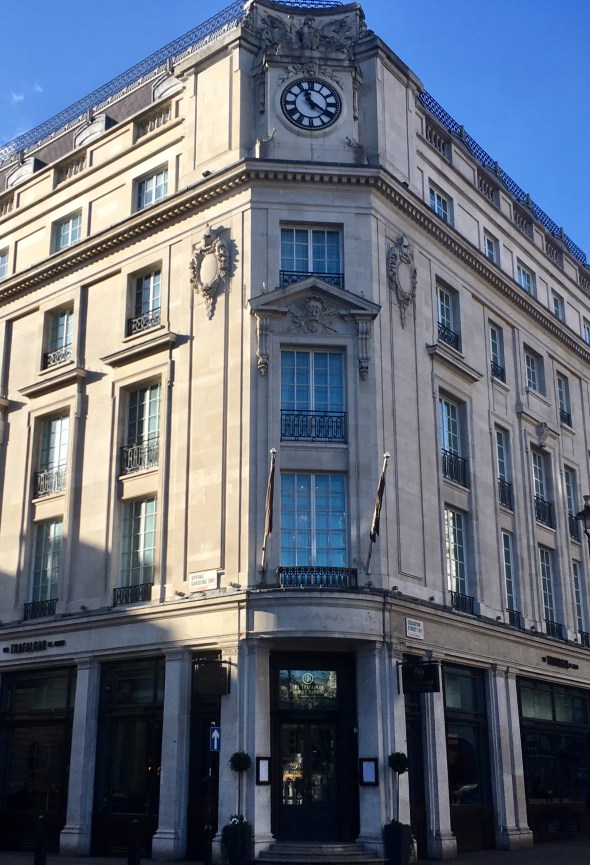
It was bliss. I spent the day trialling a new concept, a daycay, and it was just the thing to banish those winter blues. My day stay at the stylish Trafalgar St James in the heart of Central London had been arranged by DayBreak Hotels. They specialise in providing accommodation that would otherwise go to waste. Think about it: occupancy rates are lower than average in the UK at this time of year. Factor in that many people check out early and check in late, and you have hours and hours in between where those beautiful hotel rooms sit empty.
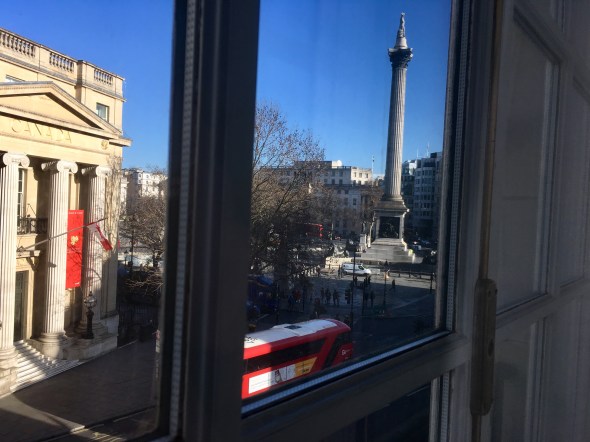
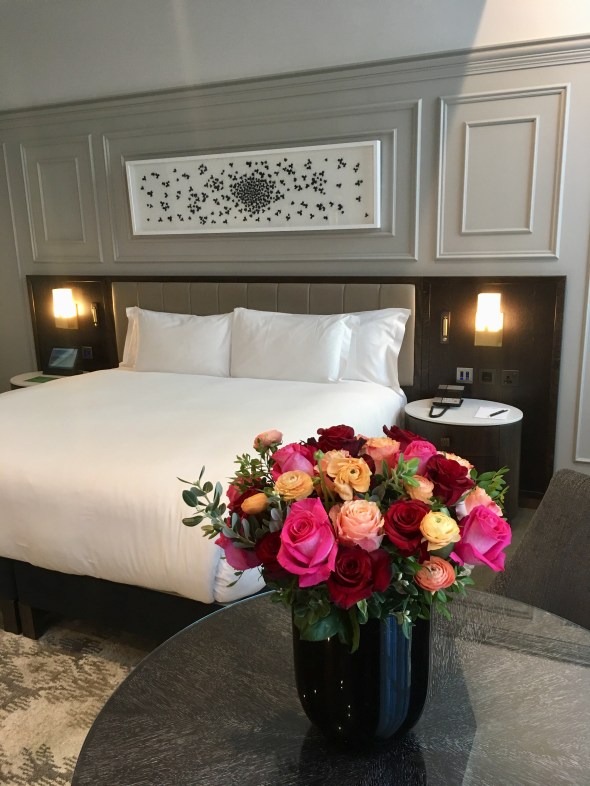
In the award-winning and recently refurbished Trafalgar St James, I was allocated a junior suite, complete with a comfy sofa looking out over a sunny Trafalgar Square and an even comfier bed promising to help rid my face of the grey skin and black circles that had settled in over Christmas. Watching from above the pillow was a black and white photograph of a youthful looking Mick Jagger, one of many in the hotel to be taken by acclaimed celeb photographer Dave Hogan.


The room was thoughtfully equipped, the attention to detail marking it as one of Hilton’s prestigious Curio Collection properties. Waiting for me, I found a Nespresso coffee machine, a book on London’s curiosities and a selection of glossy magazines, as well as a plate of melt-in-the-mouth macarons beside a welcome note.


There were a selection of Molton Brown toiletries lined up in the spotless bathroom and a couple of inviting dressing gowns hanging in the wardrobe. This was like a home away from home, but unlike home, I didn’t feel guilty that I wasn’t doing the hoovering or clearing away the dishes.


You might expect that as you’ve only checked in for six hours you might not be treated with the same respect as an overnight guest, but you’d be wrong. Every interaction I had with the hotel’s staff, from the receptionist to the restaurant servers, emphasised the close attention paid to customer service. I was offered a tour of the hotel, the highlight of which was enjoying the views from the rooftop terrace. The rooftop spaces make great entertainment venues; if I wasn’t a freelancer I’d already be bombarding my boss with emails about where to hold next year’s Christmas party.


I was also invited to see one of the suites that used to be one of Cunard’s corporate offices. The Landseer Suite was occupied, a minor disappointment as this was the boardroom where Cunard first received word of the sinking of the ill-fated Titanic. Next door, I did get to look around the Barry Suite, its original woodpanelling preserved under a coat of contemporary matt grey paint. It managed to be grand without being stuffy, the kind of place that makes you want to pop in to John Lewis on the way home to buy a few more cushions to spruce up your own place.
The hotel strives to be innovative – there’s not a hint of a bland, corporate hotel chain here. I found that also to be the case with afternoon tea. The dining room will shortly close for refurnishment, but the untrained eye would never guess. I was presented first with a menu of teas from the Tregothnan Estate in Cornwall. I had no idea that we even grew tea in this country and made a mental note to check that place out next time I was in the West Country. My question – was the rose tea better, or the red berry? – was met with the best possible answer – why not try both? (I did, and they were both a treat.)
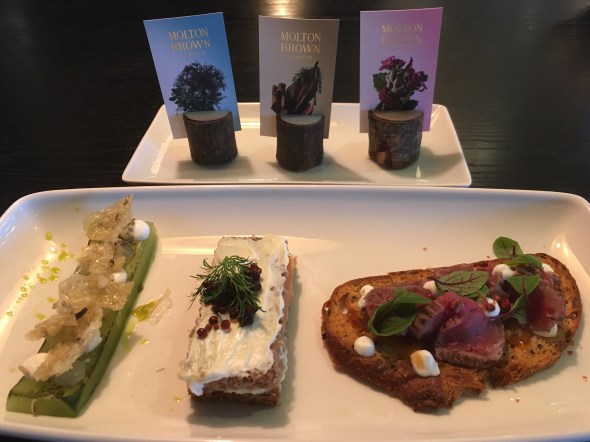
The savoury treats were presented next, each accompanied by the Molton Brown scent that had inspired them. Coastal Cypress & Sea Fennel was represented by a slice of compressed cucumber topped with pieces of fennel crisp. Carpaccio of Denham Vale beef with pink peppercorn gel on sourdough toast exemplified Fiery Red Pepper. Following this were scones with jam and clotted cream, pleasantly warm and surprisingly filling. The patisserie was equally as inventive. A rose and rhubarb pastille was bursting with flavour and a mouthwatering prosecco sabayon with watermelon and berries decidedly moreish. My favourite Molton Brown aroma, orange and bergamot, came in the form of a chocolate and Earl Grey eclair topped with tiny strips of candied orange.

There was barely a crumb left by the time I’d finished. Had I not been in public, I’d have been tempted to lick the plate. With an hour and a half left on the clock, I chose to return to my room for a profligate nap. London, with its galleries and museums and countless other attractions, would have to wait. After all, it’s not every day a girl can say she fell asleep under the watchful gaze of Mick Jagger, is it?


About DayBreak Hotels
Daybreak Hotels offer a range of properties in destinations across Europe, the Americas, the UAE and Australia. The daycay concept is a clever one, with daytime and evening slots available. Same day and advanced booking as well as special offers can be found on their website:
https://www.daybreakhotels.com/GB/en-GB
There are so many reasons why you might book a hotel for the day instead of the night – perhaps you’re looking for a comfortable place to shower and change before a posh night out on the town or somewhere to relax before an evening at the theatre. Perhaps like me, you’re tempted by the promise of an indulgent afternoon tea or need a winter pick-me-up without the expense of a full-on holiday. Some properties come with spa or pool access, making them a great choice if you’re in need of a little pampering.
Maybe you could make use of a convenient city centre base for a sleepy toddler to have a rest in between seeing the sights? Or how about a place to leave a grumpy husband in the ultimate man crèche while you potter the shops at a leisurely pace? Also, there are plenty of hotels on DayBreak’s books that are conveniently located on or very close to airports, ideal for a lengthy layover – and far nicer than hours spent in an airport lounge. Whatever your reason for booking, the daycay concept is one worth checking out.
Thank you
I was a guest of DayBreak Hotels and benefited from complimentary travel with Greater Anglia. To both: many thanks for your generosity.
Cirque du Soleil’s back in London
Bulging veins riddled the man’s substantial biceps, triceps and quiadriceps like a toddler had been let loose with a crayon and scribbling pad. Beads of sweat trickled into the furrows in his forehead. He was mirrored by another, equally intense, performer who lie supine beneath him. Together, they contorted into ever more fanciful positions, bearing each other’s weight and holding positions that required muscle strength and concentration far beyond that which ordinary mortals could summon. The sight, just a metre or so in front of me, was as hypnotic as it was impressive. I, like everyone around me, was rapt.

That was my first introduction to Cirque du Soleil, over twenty years ago. Was it Quidam or Alegria? I can’t remember. Nor can I remember whether it was in the Grand Chapiteau or the Royal Albert Hall. But that doesn’t matter. What’s important is the spectacle of it all, the mesmerising performances that truly deserve the overused and rarely accurate epithet breathtaking. That’s what has stuck with me for all these years and that’s what keeps me going back to see Cirque du Soleil time and time again.

Crystal from TOTEM
Picture credit: OSA Images via the Totem press kit
This week, Made and Greater Anglia supported a complimentary trip to see this year’s show, Totem. It was staged at the Royal Albert Hall – a treat in itself. As the lights dimmed, the compere revealed that it was a Royal premiere also, to raise money for Sentebale, a charity working with HIV-positive children in Lesotho and Botswana. Our seats would face those of Prince Harry and his wife Meghan, who wore a dazzling Roland Mouret gown. I felt underdressed in my wool sweater and scarf dampened by rain. Touching my make up free face, I resolved to make a bit more effort next time. But hey, who cares when the lights dim?

Diabolo from TOTEM
Picture credit: OSA Images via the Totem press kit
Totem wowed, just as the others had done before. From the moment the covers came off the skeletal turtle shell to the waves and bows of the finale, it was a showstopper. Acrobats, unicyclists, Russian bars and of course the almost obligatory Italian clowns – it had all the elements of the successful shows that I’ve come to love.
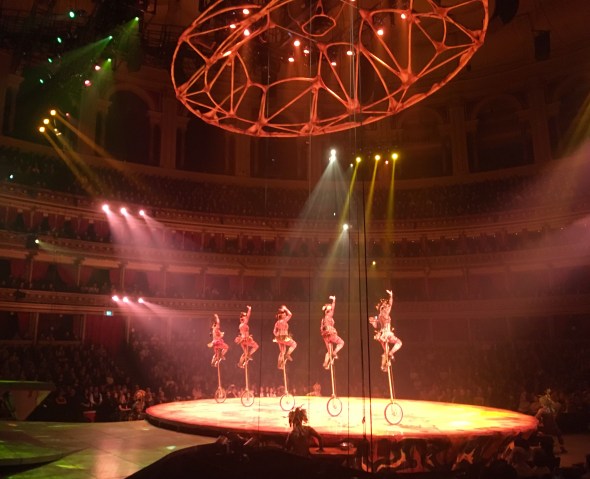
Stand out moments in the evolution-themed show included the flawless work of the Native American ring dancers and a wonderfully romantic rollerskate interlude conducted on a platform too small for any error. Clever choreography lent itself to a neat evolution of man set piece.


If I had one criticism, it would be that the music lacked the impact of, say, Alegria. As I’m writing this, the title song from what’s probably my favourite of all the Cirque du Soleil shows is playing in my head, although I’ve not heard it for years. Yet less than 48 hours after hearing Totem, I can’t recall a single tune. But don’t let that put you off. Whether you’re a die-hard fan or a Cirque du Soleil newbie, this is a show that you should definitely see. You’ve got until February 26th to catch it this time.

Thanks
Made provided two complimentary tickets to Totem, for which I’m very grateful. I also appreciated the free rail travel provided by Greater Anglia – driving to the Royal Albert Hall at rush hour wouldn’t have been a pleasant trip at all. The train was clean, comfortable and on time, leaving me plenty of time for a pre-show drink. For more on Cirque du Soleil including ticket booking for the current London run of Totem, please visit their website at:
https://www.cirquedusoleil.com/totem

Finale from TOTEM
Picture credit: OSA Images via Totem press kit
Expanding my FlagMate collection
In 2018 I became involved with Storyteller and was impressed by their FlagMate product. Founder Bhav Patel set up Storyteller for three reasons: to create high quality travel accessories, to inspire travellers and most important of all, to support projects around the world aimed at helping to fund education programmes for underprivileged kids. This is what you need to know about this worthy project:
Bhav kindly sent me a sample, and I chose three flags for my new keyring: Austria, Iceland and Peru. All three countries have a particular significance for me. I began a lifetime of travels visiting Austria at just 9 months old, married my husband in Iceland and fell in love with Peru and its ever-so-slightly loco people right from my first trip in 1995.

Now Bhav has sent me a gift of three new flags and I chose Australia, Cuba and the United States. Each, of course, has a story. Although, it was tricky whittling it down as so many of the places I’ve visited over the years have given me such fond memories.

Australia
Of all the countries I could ever see myself living in, it would be Australia (or maybe its neighbour New Zealand!) Though I’ve visited only once, Oz has been part of my daily life, on weekdays at least, since 1986. Guessed why yet? I’m an unashamed fan of Neighbours and though I acknowledge it’s not the most intellectual of viewing experiences, I’ve been following the adventures of Ramsay Street’s residents since I was a sixth-former. I visited the set in 2005 alongside some of the country’s other tourist destinations – Sydney, the Blue Mountains, Kakadu, Katherine Gorge, Port Douglas and Uluru. One day I shall go back – not least because the Neighbours tour has been improved to include an opportunity to meet the actors and a visit to the Lassiters Complex sets.
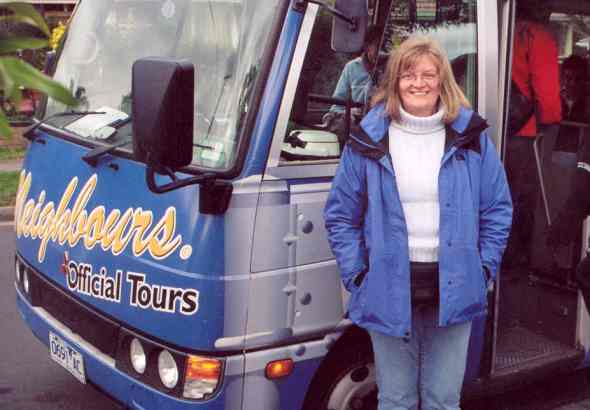
Doing the Neighbours Tour, 2005
Cuba
I visited Cuba in January 2018 after a fifteen year absence. Sometimes, when you return to a place, it’s changed immeasurably. Fortunately, though things had altered, I found that they had improved the traveller experience. It is now possible, in an especially convoluted Cuban way, to access the internet, provided you aren’t too bothered about queuing for scratchcards and then perching on a street kerb or park bench. The food is also much improved and I enjoyed some delicious meals in the privately run paladares, even managing to secure a coveted table at La Guarida. Tour highlights included finding out about Trinidad’s sugar industry. I also teamed up with Havana SuperTours for one of the most fascinating tours I’ve ever taken, with the enthusiastic Michael leading me into the seedy world of Mob-era Havana.

View over the Valle de los Ingenios, near Trinidad
USA
Some travellers look down on the USA as being too tame, others cite political reasons for not wishing to visit at this time. I disagree on both counts. My husband proposed to me at New York’s Top of the Rock and we honeymooned in Utah and Vegas. But what sets this country apart for me is sheer variety. New Orleans, like NYC, is a favourite city; post Katrina it rebuilt and regrouped. Beyond the cities, the scenery’s next level. Many of America’s national parks are breathtaking, particularly Acadia and Glacier. I also found a personal connection via the many tiny villages that bear my name. One day, I’ll find the time to finish writing “Hammond, Me“. Research trips have taken me to the Bronx, where I visited Abijah Hammond’s mansion, built with the proceeds of real estate deals in Greeenwich Village, and also to Wisconsin, where each September the bonkers “Running with the Llamas” festivities take place.
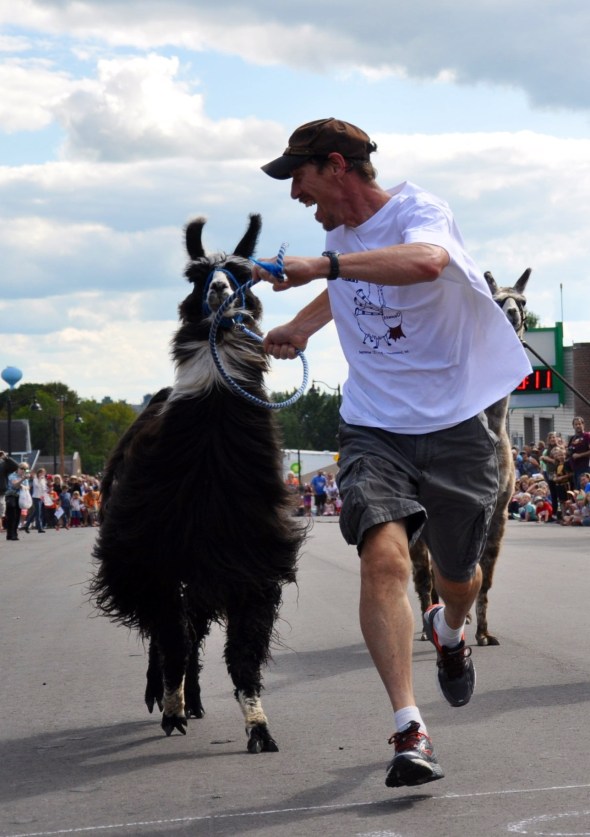
Running with the Llamas, Hammond WI
Where would you choose for your FlagMate flags? Why not take a look at Bhav’s site and tempt yourself?
How I choose my next destination
Happy New Year, fellow travellers. As we embark on 2019, thoughts inevitably turn to the year ahead and for me, that means thinking about where I’d like to travel in the coming year. One of the questions I’m inevitably asked is how I decide where to go. The answer’s not a simple one, but here’s how I choose my next destination.

Cheap flights
As an independent traveller who likes to pay her own way, the biggest outlay for many of my trips, particularly long haul ones, is the cost of my flights. I’m always on the lookout for a good deal, so I sign up for airline newsletters and that way, I’m the first to know of any special offers. That’s how, on Black Friday 2017, I snagged Air New Zealand’s £399 flight deal to Auckland via LAX. There were only 50 seats on offer at that price, so had I been surfing the net, I’d almost certainly have missed out. Similarly, to make the most of Ryanair’s flash sales it’s important to be ahead of the pack. But with a bit of creativity, it’s possible to save on flight costs by searching for error fares and utilise reward schemes as I did for my recent trip to Barbados.
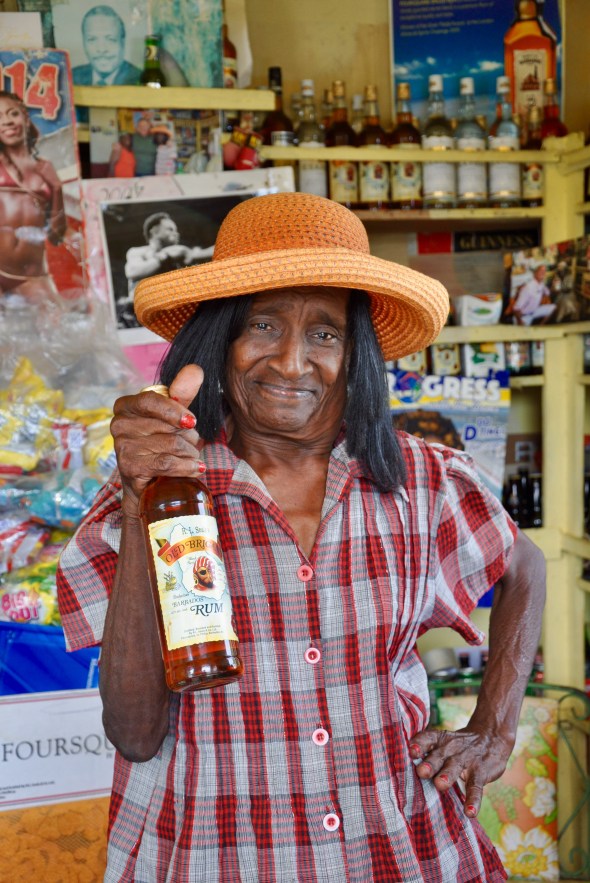
Social media
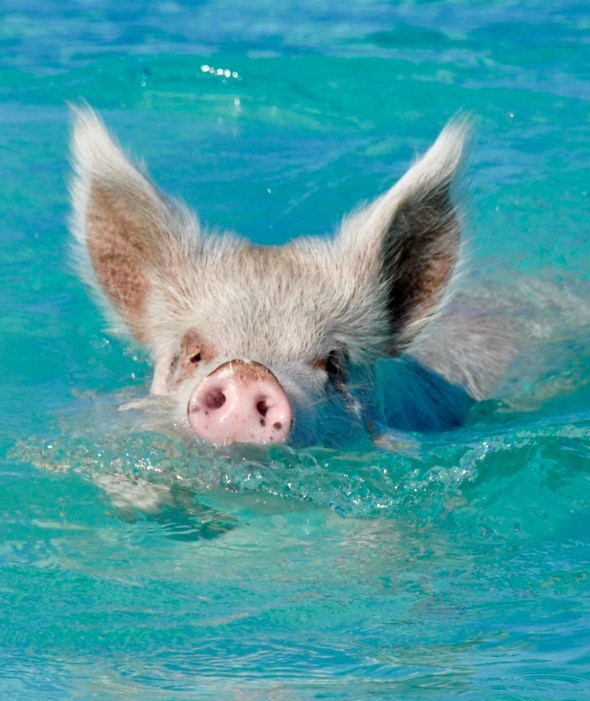
My Twitter feed is full of photographs of exotic locations and every now and again, something stands out from the pack. Georgia (the country) first entered my radar in this way, as did those cute swimming pigs in the Bahamas, and I wasn’t disappointed with either. On Facebook, members of the My Wanderlusters group provide inspiration for destinations through their own holidays snaps. Some are friends in real life and I have the double privilege of seeing their travels via their personal accounts too. I maintain a file of e-clippings (the old-fashioned way, in a folder, rather than via something more creative like Pinterest). This April, Brexit-permitting, I’m off to Alberobello in Italy to stay in a trullo after seeing it on someone’s timeline. I expect Santorini will also feature at some point for the same reason.
TV
I love watching TV documentaries and travelling without leaving the sofa. Joanna Lumley’s Japan series has been bookmarked for a return trip one day. It’s been over a decade since I visited but seeing the country through her eyes has made me yearn to go back. Levison Wood’s adventures also give me inspiration; I especially enjoyed his Nile walk though it’s way too energetic for this traveller. Chris Tarrant has, in the past, done some incredible rail trips, from the Trans-Sib to some distinctly more adventurous destinations. Sometimes, though, even a venerated presenter can’t entice me: Michael Palin’s recent foray into North Korea was a charm to watch, but the country itself doesn’t appeal to me.
Magazines and other tourist literature
Whether it’s via a magazine that plops through the letter box or a tourist leaflet picked up at a trade show, there’s always something to tempt me to investigate a place a bit further. During a visit to World Travel Market in autumn 2017, I got chatting to a lady manning the Uganda stall. I’d previously visited other parts of East Africa, notably Kenya and Tanzania, but Uganda is a new one for me. When I mentioned it in passing to a couple of fellow villagers here at home, I discovered they ran a school out there, so I’m now looking forward to a trip in February when I’ll combine a visit to their school with a couple of safaris. No gorillas, but look out for tree-climbing lions if I’m lucky enough to spot them.

Festivals and other special events
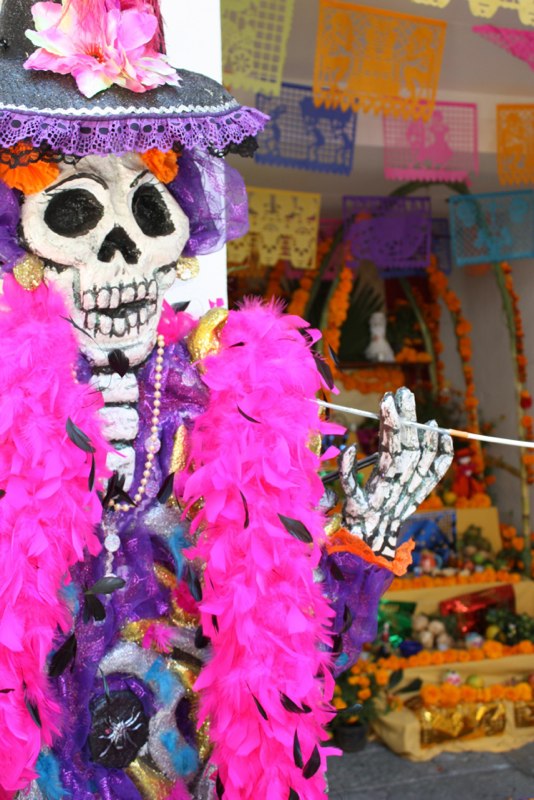
Sometimes it’s not only the destination that’s the attraction, but a particular event that requires a visit at a particular time of year. I visited Mexico long before I managed to schedule a trip to coincide with the Day of the Dead celebrations. That was several years ago now, but it remains one of my favourite trips of all times. Cusco’s Inti Raymi festival was also on my radar long before I was able to time a visit to Peru to experience it. The colourful costumes, dancers and theatrical spectacle made this a memorable holiday too. Most recently, I headed off to Moldova to join Chisinau’s residents for their National Wine Day, which was fun.
Press trips
As a relative newbie to travel writing with an expanding portfolio, I’ve yet to be inundated with press trips, though I do get offered one now and again. Every so often, an offer comes along that’s too good to resist and that’s how I found myself in the Faroe Islands in May 2018. It was a beautiful country and I’d love to return one day to explore a little further. Without wishing to sound ungrateful, I do struggle with a prescribed itinerary which can be a little stifling, as I’m so used to travelling solo and doing as I please. That said, I’m always delighted to be offered such visits even when I choose not to go.

How do you choose where to visit? Like me, do you have an ever-growing wish list? I’d love to hear what motivates your travel choices.
Looking back on 2018’s travels
It’s probably an age thing, but the year has flown by and once again it’s time to draw the curtains on another year of rewarding travels.
January: Cuba with a stopover in the Netherlands
It has been fifteen years since I followed the advice in the travel press to “get there before it changes”. Like many others, I was conned: the headlines still say pretty much the same thing today. Having found a £140 error fare with Aeromexico, the journey was a bit convoluted – though it did win me a day exploring Zaanse Schans and Delft on the way. Havana and Trinidad were as captivating as they were in 2003, though the food was considerably better. I had a front row seat at the Casa de la Trova and scored an invitation to kick on with the trumpet player – if only his intentions had been honourable I might have been tempted. If you’re off tho Cuba, book a Mob Tour with Havana Supertours – guide Michael was excellent. I felt like I’d stepped onto the set of Mad Men when we walked into the Riviera Hotel, once a gangster favourite.
March: Key West and the Bahamas
With two weeks to kill while the builders demolished the kitchen and rebuilt it into a finished shell, we decamped to the sunshine of Key West and the Bahamas. I especially enjoyed a visit to the Tennessee Williams Exhibit and some of Key West’s other historic attractions, and let’s face it, the margarita culture helped. But it was the Bahamas that won out. Husband is a big fan of cute little piggies – he married one, after all – so we booked a trip to see Big Major Cay’s swimming pigs. They were feisty little (and not so little) creatures, particularly when the food came out and we were warned to steer clear of one fat mama who had a thing for biting tourists’ bums. Fortunately, no one got bitten and it was the highlight of the holiday.
May: Faroe Islands
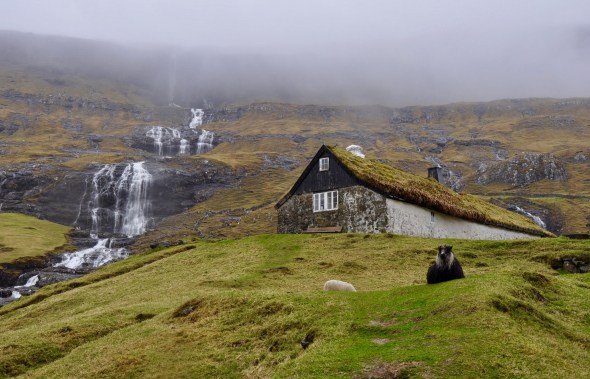
I had the opportunity to join a press trip to the Faroes in May which was a chance to explore this northerly Iceland-alternative. A meal at Michelin-starred KOKS was unforgettable thanks to wriggly barnacles, but the home hospitality we enjoyed was just as welcome. The weather was challenging, particularly during our hike at Saksun, but fortunately the sun came out over colourful Torshavn. It doesn’t quite have the scenery to compete with Iceland, but I’d like to go back on my own one day. Being so used to independent travel, I’m not sure if I’m cut out for press trips, but nevertheless it was a fascinating insight into how the world of travel journalism operates.
May: New Zealand and Tonga
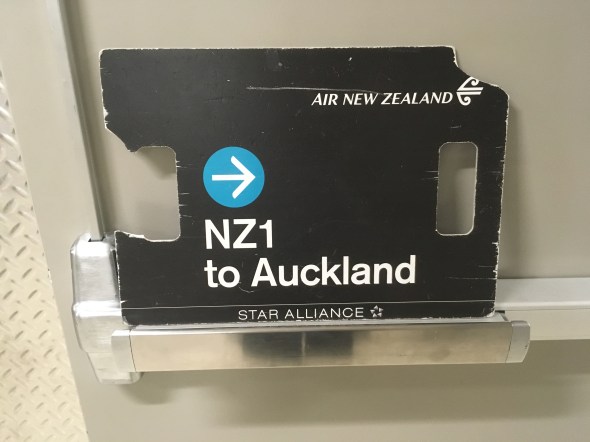
A too good to resist Black Friday deal saw me travel all the way to NZ for under £400, a chance to visit family and see a bit more of North Island. A dawn hike to a deserted Cathedral Cove was delightful and experiencing the hand dug hot tubs of Hot Water Beach was fun. Windy Welly lived up to its name but the gales subsided in time for my flight out. Last time, my South Pacific add-on was Vanuatu, but this time I opted for Tonga. So far it’s not embraced tourism in quite the same way as some of its neighbours. I got lucky with a knowledgable Fijian guide who showed me the highlights of Tongatapu, most memorably dramatic blowholes and fire dancers.
June: Port Lympne
For husband’s big birthday we were treated to a weekender at Port Lympne with family. Going on safari without leaving the Home Counties seemed a bit bonkers but the place was exceptionally well run and our guide was as good as any I’d had in Africa. Our game drives became a little more interactive than planned when one of the giraffes took a liking to a skip that should have been off limits, though luckily it responded to our treats of hastily grabbed branches full of tasty leaves. The most surreal moment of my travel year was waking up and looking out of the bathroom window to see a rhino pottering about in the back field. In Kent, of all places!
September: New York
It had been a while since I’d been to New York so I piggybacked off my husband’s business trip to join him for a week in the Big Apple. While the city broiled in an extended heatwave, we sought out the air-con of the Freedom Tower as he’d never been. I had a surprise at the top as the skyline was revealed, a part of the experience that hadn’t been open when I first visited. But it was the Lower East Side and East Village that, once again, I enjoyed the most, with a fascinating LES a food tour with Free Tours By Foot, a one to one tour of the Museum of the American Gangster, a chance meeting with Michael Quinn of Feltman’s of Coney Island and cocktails at PDT. Please don’t tell.
October: Moldova and Transnistria
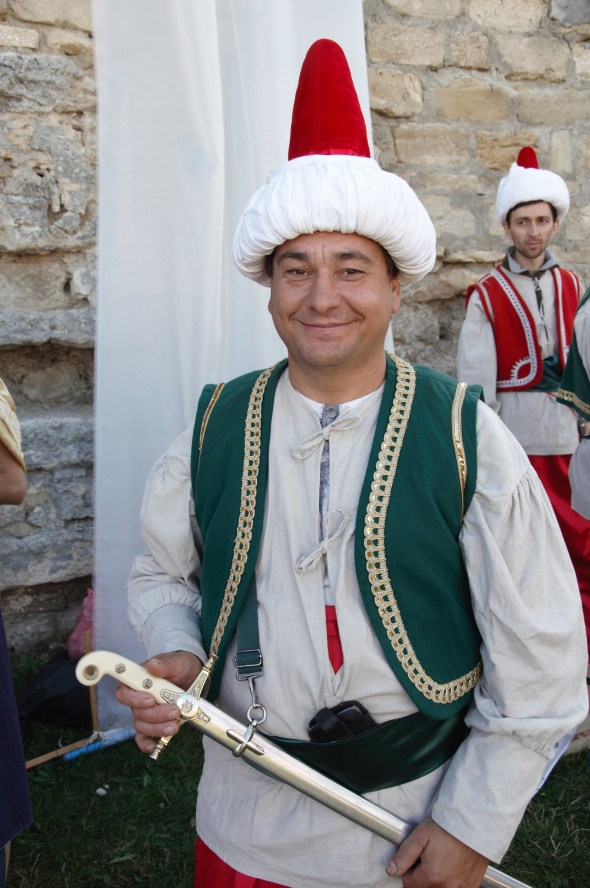
I’ve never been much of a wine drinker, but nevertheless headed for the Moldovan capital Chisinau for their National Wine Day celebrations. Twelve samples later, I had rose tinted spectacles when it came to appreciating the city’s other attractions, including a teeny tiny statue that took an age to find. Fortunately this lightweight doesn’t get hangovers which was good news when it came to catching the early morning train for a day out in the breakaway republic of Transnistria the next day. Though Tiraspol was a bit soulless, the border town of Bender with its riverside fortress was not, thanks to a mediaeval fair in the grounds complete with rifle range, dress ups and a liberal scattering of plastic ducks.
November: Barbados

BA offered a sweet deal whereby its air miles were worth double their usual value – and sweeter still as I’d collected most of them on that sub £400 business class error fare to New York I found a few years back. So I redeemed them to do “Barbados on a Budget” and thanks to a steal of an Airbnb deal, brought in a week’s holiday for under £800 including food. Good job the rum was cheap. I loved chatting all afternoon with Nigel Benn’s Aunty Lucille who not only poured a generous measure but told a tall tale and sorted out the bus timetable as well. Beautiful gardens, plantation houses and a countryside hike with incredible views of the east coast and a working windmill completed the picture.
December: Nuremberg’s Christmas markets
I’ve been working my way through some of Europe’s finest Christmas markets, clocking up trips to Salzburg, Regensburg and Copenhagen. This year, I opted to fly back to Nuremberg and although the fare didn’t match the previous £4.08 deal (sadly I think that was a one off) it was still sufficiently good value to make a day trip viable. I began the day in Bamberg, whose mediaeval heart was delightful. I hopped on and off the train back to Nuremberg, calling in at the markets at Forchheim and Erlangen on the way. The main event was pretty, decorated with twinkly lights for evening, with plenty of Christmas decorations and foodie treats to round off the day.
Where have your travels taken you in 2018? Share your stories, I’d love to read them.
Barbados on a budget
Thanks to celeb haunt Sandy Lanes and the other luxury hotels that line the aptly named Platinum Coast, Barbados is firmly associated with the high end travel market. But what if you can’t afford the eye-wateringly expensive prices of these places? I was determined to visit Barbados but needed to bring the cost of my trip in at a much smaller budget. Here’s how to save money on your holiday and enjoy Barbados on a budget.

Flights
As with all long haul trips, flight costs make up a large percentage of the total cost. Both BA and Virgin Atlantic fly direct to Barbados, but neither of them are budget airlines. Saving money on the cost of a ticket takes a bit of forward planning. I’d saved a bunch of air miles with BA – what used to be Avios and are now points on their Executive Club scheme. However, these were not sufficient for a return fare to the Caribbean. Fortunately, BA announced a promotion, whereby the number of miles required for a seat halved. Availability was good and I snagged a fare for the last week of November for the price of the taxes, around £270. Virgin, of course, have a similar loyalty scheme.
If you don’t fly regularly, that doesn’t have to be a deal breaker. I save points regularly with my Nectar card on groceries, petrol and even car servicing. It’s possible to redeem those points with Expedia and as with the airline loyalty schemes, all you need to pay is the taxes. Without points of some kind, full price fares in high season, that’s December through until spring, can be horrendously expensive. Though they’ll be much cheaper in September and October, it’s hurricane season and you run the risk of your vacation being memorable for all the wrong reasons. At best, you’re likely to have a rain shower most days and at worst, a total washout. Instead, look for a seat in the shoulder seasons, with late November and early May more reliable in terms of weather.
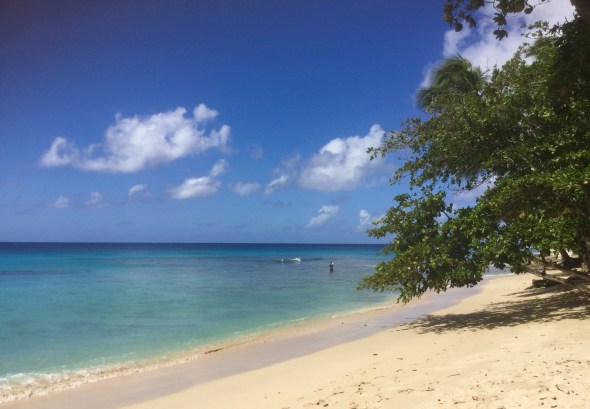
Accommodation
How much will you pay for your accommodation in Barbados? How long is a piece of string?! Many of the resorts here are prohibitively expensive, especially for a solo or budget traveller. Much as I’d have liked to stay at one of the fancy resorts, I’d have hated the huge bill at the end of it. I wanted to keep my accommodation costs as low as possible, but without sacrificing some of the holiday comforts that can make a trip so much easier. I wanted reliable WiFi – needed, even – and hoped to be able to get a pool too. I’m not a sea person when it comes to swimming, but I do enjoy a relaxing dip in the pool. Most important of all, I needed to be well connected in a convenient location without being right in the city.


Fortunately, Airbnb came up with the answer: a studio apartment at Rockley Golf Club. Once fees were factored in, the place cost just under £400 for my seven night stay. Though I had it to myself, it would easily have slept two, and two more on the sofa bed downstairs. The clever layout, with downstairs sitting room and the bed on a mezzanine, meant that it felt much more spacious than the label studio might suggest. The ladder stairs up were a little steep, but manageable, and regardless, the listing made it very clear that’s how they were. The sofa in the living room converted into a bed which was a reassuring back up, had I been too stiff (or too drunk) to get up the ladder. This is the listing, should you wish to have a look:
https://www.airbnb.co.uk/rooms/22558128


I had a small kitchen, bathroom and living room, with hairdryer, cable TV, phone for local calls, beach towels and even a cooler. The hosts, Karen and Mark, were helpfully available at the end of a phone and left me a comprehensive booklet of advice covering everything from which beaches were best to how to do a food shop. Their attention to detail was legendary – there was nothing they hadn’t thought of. The resort itself had a laundry and clubhouse and of course that all important pool. It was safe too, not an insignificant consideration for a single female. Would I recommend the place? Absolutely.
Food and drink
First, the good news: drinking is cheap in Barbados. I drank Banks beer from the characterful John Moore beach bar at Weston for about £1.20 a bottle, rum and Coke with Nigel Benn’s Aunty Lucille in Shorey Village for £2 a pop. Cocktails down at the local Tiki Bar at Rockley Beach were a little over £6, not bad for a tourist joint. Lots of places served up happy hour for more than 60 minutes a day. But actually the nicest drink I had was non-alcoholic, a yummy mango and peach smoothie at the cafe at Holetown’s Chattel Village.
Food was another matter. Barbados is the kind of place where if you’re on a budget, you need to think about where, and what, you eat. Though it was possible to find affordable restaurants, particularly those aimed at the local market, in general Barbados doesn’t offer good value for money when it comes to eating out, though neither does it pretend to. Of course, being an island means some foods are imported, which adds to the cost. Nevertheless, Oistins’ famous fish fry is a memorable night out for tourists and locals alike and there were plenty of local haunts where a meal didn’t break the bank.
I decided to make the most of having a kitchen and self-catered for some of my meals. I spent about 100 Barbados dollars, roughly £40, stocking up on supplies that sorted me out for breakfast and lunches for the week, plus the makings of a couple of night’s dinners. Massy’s, the island’s biggest supermarket chain, even stocked Waitrose products, though at a premium.
Getting around
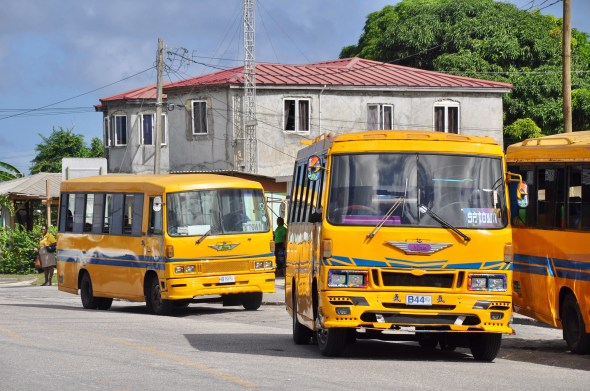
Tours on the island aren’t cheap, a by-product of this being a cruise-ship destination where travellers are cash-rich and time-poor. With more time on my hands, I was able to take advantage of Barbados’ extensive (though Bridgetown-focused) bus network. Plenty of minivans plied their trade along the coast, and it was easy to hail a yellow bus to Bridgetown or Speightstown. The journey times were surprisingly long for such a small island, but a ride afforded a glimpse into local life as well as interesting sightseeing out of the window. If you don’t mind stopping everywhere, it’s a great way to get around. People were happy to chat and travelling this way was a real pleasure.
The official buses of Barbados Transport Board, identified by their blue livery, were fine off peak. At peak times, however, they double as school buses. If you were lucky enough to persuade a driver to let you take up a valuable space – and I was – riding with a bunch of noisy schoolchildren didn’t make for a relaxing holiday experience. The BTB’s website has a useful timetable finder, but note that some buses are likely to be cancelled to act as school buses instead, such as the Boscobelle service that I was told by a driver was “hard to come by”. You can find the timetables here:
I found the Moovit site helpful as a planning tool as well:
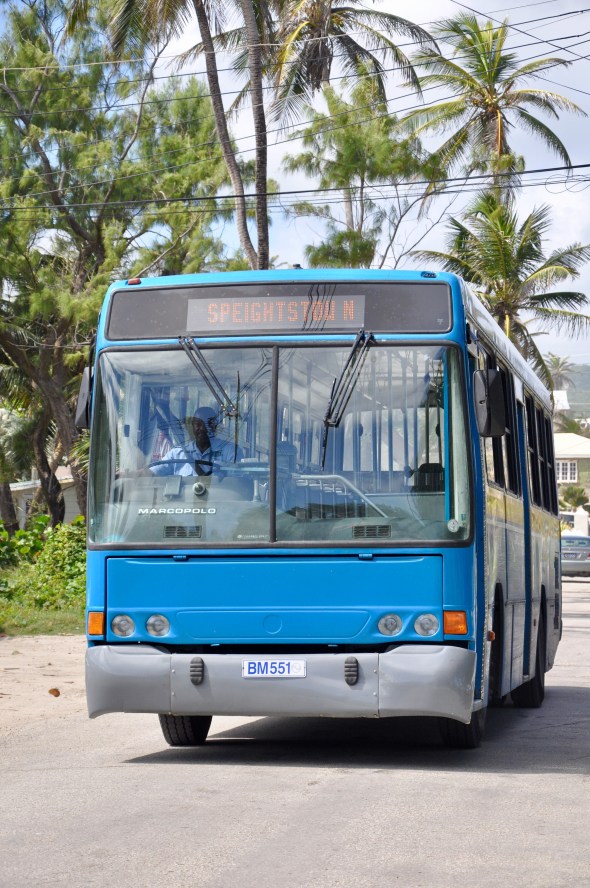
Whichever you choose, a flat fare of 2 Barbados dollars (about 80p) means that getting around is cheap and straightforward. While minivans and yellow buses would change small notes, for blue buses you require the exact fare in coins which you simply chuck into the slot in front of the driver and wait for him to give you a ticket. On the yellow buses and minivans, you pay the driver on exit, unless a conductor is on board – if so, he or she will ask you for your fare at some point during your journey. To get off, press the bell, pull the cord or if neither is present, call out “bus, stop”. Most will continue on until the next official bus stop. These too are user-friendly: marked “to city” or “out of city” which usually refers to Bridgetown.
Sightseeing
It doesn’t have to cost a lot to see a lot, if you’re prepared to bus it. The highest entrance fee I paid was at St Nicholas Abbey, but for 45 Barbados dollars the ticket included a tour of the historic house (never an abbey), mill and distillery, plus a rum tasting. The family’s movie footage of 1930s Bridgetown was fascinating, though at times it was hard to concentrate as Twinx the cat decided my lap was a lovely warm spot for a nap and a cuddle. I tried to tell him I was a dog person, but he wasn’t at all put out. In the end I had to lift him down or I’d have missed out on the rum.
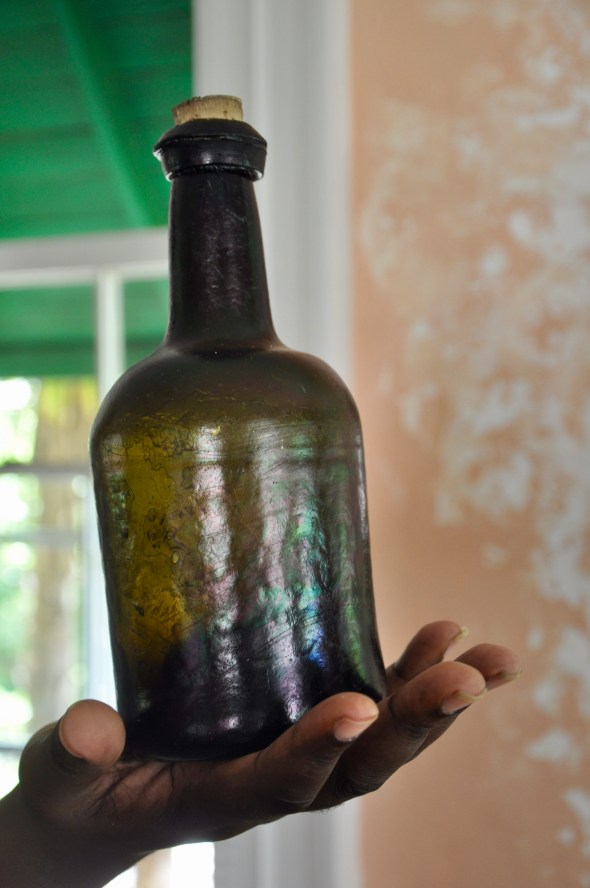
For a little less, a tour of Arlington House in Speightstown is well worth the outlay. One of the rooms was themed as a sugar cane field and told the story of the slaves that made Barbados’ plantation owners wealthy. The house itself was made from coral stone and the traditional louvred shutters were hung to good effect in another of its displays. Entrance costs just 25 Barbados dollars for overseas visitors and I thought it helped me gain a better understanding of what shaped Barbados in the past.


Other entrance fees were equally good value: 30 Barbados dollars to visit either Hunte’s Gardens or Andromeda Botanic Garden. The former definitely had the wow factor, the kind of place that inspires you to go home and plant something. The owner, a talented horticulturalist, had turned a natural sinkhole into a verdant muddle of hidden nooks dotted with quirky statuary.


Andromeda, by contrast, was a botanist’s dream, the life’s work of the late Iris Bannochie and a rival of Hunte’s. Managed by the enthusiastic and passionate Sharon Cooke, it was a real pleasure to see someone work so hard to make such a place accessible to all. For a week, Barbadians can enter free of charge. And throughout the year, the entry ticket is valid for three weeks – go early in your stay and you can go back for free.
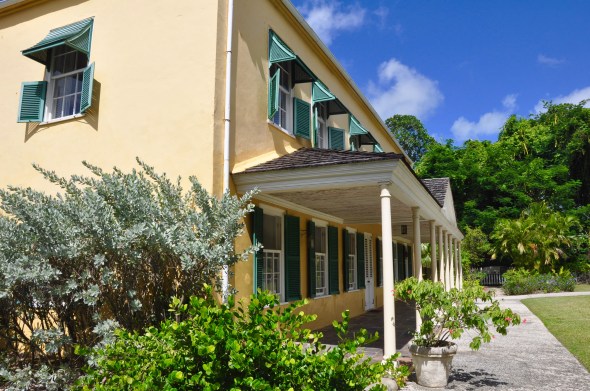
I paid the same for a combo of the delightful George Washington House and the Garrison tunnels and as with the gardens, the tour was well worth the outlay. The guide, Martin, was extremely knowledgable and not at all perturbed when one of the country’s senators – and a Sir to boot – delayed us for a long chat about writing, editors and publishing in general. I’m not sure what he was doing in George Washington’s House but thought it impolite to ask. The tunnels were almost a no go thanks to a loss of power, but guide Wilbur was keen to show us anyway so our small group descended by torchlight.
Some of the best attractions turned out to be free, and I don’t just mean the afternoon I spent with Aunty Lucille. The beaches cost nothing, providing you don’t need a lounger. Watching the jockeys practise at the Garrison racetrack is also free, though you need to be up early as they ride out before the sun gets too hot. Morgan Lewis sugar mill is the only intact windmill in this part of the Caribbean, though it doesn’t actually work – it was struck by lightning a decade or so ago and no one’s got around to fixing it yet. I reached it on foot, taking a gentle half an hour hike downhill enjoying far-reaching views along the east coast on a quiet backroad.
The verdict

It’s certainly possible to visit Barbados on a budget, though other Caribbean destinations offer better value for money. Would I go back? Not just yet, but if the UK exchange rate improves, then I might just go back for more.
Prices correct November 2018; check the current situation before finalising your travel plans.
What’s it like to visit Oaxaca for Day of the Dead?

This October I’m teaming up with Lauren of Diary of a Spanglish Girl for a feature on Day of the Dead. It’s one of my favourite festivals so when Lauren posted a shout out on her Twitter feed asking if anyone had been to Mexico for Day of the Dead and would like to share their experience with her, I jumped at the chance. You can read the interview here. By the way, Lauren’s also the person behind an excellent Facebook group for travel bloggers called Share Your Travel Blog Post And Connect With The World. If you have a travel blog, it’s well worth signing up as there are plenty of tips and experiences to inspire your future travels. She also has her own Facebook page which is a helpful resource if you love to visit Spain.


The Day of the Dead, or Día de Muertos as it’s known locally, is a big deal in Mexico, nowhere more so than in the southern city of Oaxaca. Celebrated at the end of October and beginning of November each year, the festival focuses on the dead, and the whole town gets involved in some way. What I didn’t bargain for was how involved I’d get as well.

Arriving a few days before the main celebrations, work was beginning to get underway on the altars. Each family creates an altar to tempt their ancestors’ spirits back to earth. I’d been in touch with Mariana from a small hotel called Las Bugambilias and she’d invited me to join them. In the courtyard, stood a life-sized model of Catrina, the mascot of the Day of the Dead. For a century or so, La Calavera Catrina has been associated with Día de Muertos, thanks to a cartoonist by the name of Jose Guadalupe Posada. He was known for satire and drew the rich in fancy hats and feather boas, ridiculing them by implying death was only for the poor.
Catrina takes the form of a skeleton dressed in elegant clothing, dripping in furs or, in this case, feather boas, strings of beads draped around her neck and an elegant cigarette holder in her hand. She was comical rather than creepy, my first hint that this festival has fun as well as respect at its heart.

With a small group of fellow tourists and under Mariana’s expert guidance, we set about creating an altar called an ofrenda. Each of us had been allocated a specific task: some threaded marigold blooms onto strings; others dusted icing sugar skulls in the yard to form a pathway to the altar. My job was to create a centrepiece cross of white carnations and dot it with tiny purple buds. It was harder than it looked to get the blooms just right. Mariana was a perfectionist, but after her intervention, the cross really did look the business. After several hours of preparation, the ofrenda began to take shape. Loose marigold petals defined the path, their pungent aroma pervading the tiny courtyard. The altar itself was decorated with candles, fruit, nuts, incense and brightly coloured bunting. Sepia photographs of family ancestors peeked out from behind yet more marigolds.
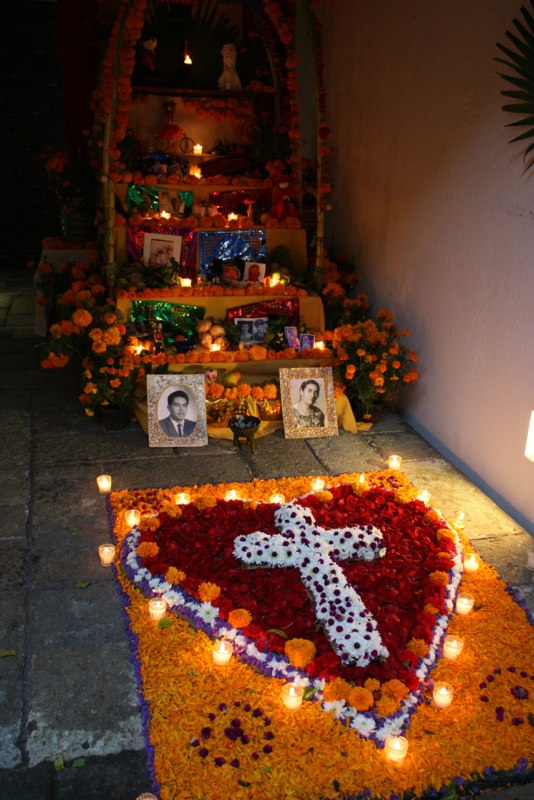
Finally, we’d finished, and to celebrate, out came a bottle of Mezcal for a toast, to our efforts and to the ancestors we’d honoured. I’d been asked to bring along family photos and raised a glass to my sorely missed grandparents, their picture wedged between a bicycle candleholder and a lime. I pledged to myself and to them that I would make an effort this time next year to recreate this feeling with my own ofrenda.


The following evening, a group of us headed for the cemetery. On the night of 31st October, residents and visitors alike flock to the old and new cemeteries in Xoxocotlan, on the outskirts of Oaxaca. They were busy with people tending graves, laying marigolds and other offerings and lighting candles in memory of their deceased relatives. Many families would stay all night. I wandered amongst the weathered graves in the packed old cemetery, taking care not to trip over tree roots in the gloom of the candlelight.


Vibrant scarlet gladioli added a splash of colour to the warm amber tones lent by the flickering flames. White canna lilies added grandeur. Vivid orange cempasuchil dominated the scene through sheer weight of numbers. Some graves were a hive of activity; at others, the mood of the relatives was more reflective. Once or twice, a lone mourner wept softly at a graveside, their grief recent and still raw. It was hard not to feel emotional. Yet, I was warmly welcomed, invited to share a spot at several gravesides.

At the new cemetery, there was a party atmosphere. The floral colour palette was enhanced by fluorescent wands that poked out of pushchairs. Lovestruck teenagers sneaked a kiss behind their parents’ backs. Small children munched on sugar skulls and sucked skull lollipops. The sounds of Michael Jackson’s Thriller boomed from a loudspeaker, almost masking the cries of the many hawkers selling snacks and party treats. At the edge of the cemetery, a funfair had been set up with the usual stalls and rides. If it hadn’t been for the tombstones, it would have been easy to forget you were in a cemetery at all.


Comparsas (local groups) parade all night through the streets in costume, celebrating the return of the ancestors with music and dancing. The following evening, the Las Bugambilias team took us out of town to the village of San Agustin Etla, where I’d heard their Muerteada parade was second to none. Anticipation mounted as a crowd gathered in the narrow lane. Eventually the procession reached the village, an eclectic band of ogres, devils and monsters, each with a costume more fantastic than the last. There were ghouls with terrifyingly realistic make up alongside drag queens with pink hair.


The devil carried his scythe, passing a ‘Panteonero’, someone from the pantheon, whose eyeball was missing. Somehow because of the crowds, most were freakish rather than scary, but they were all to be commended for their efforts. As the final performer arrived, in one corner of the village square, a play was being re-enacted. Many of those in the parade weren’t needed, however, and had planted themselves against walls and on kerbstones to have a much-needed drink. I wandered amongst them exchanging pleasantries as far as my limited Spanish would permit, posing for photos and trying on some of the costumes. I was glad I wasn’t wearing one; the weight was impressively heavy. No wonder they’d sat down!
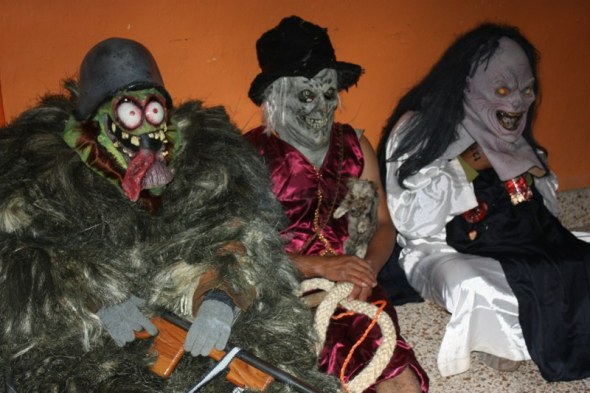
As the evening wore on, a chill settled on the air and the Mezcal came out again. Passing the bottle round, glasses were raised.
“Salud!” Compared to the sombre way we remembered our deceased back home, the Mexicans embraced their spirits, celebrating with them and having fun in the same way they would have done when they were alive. I decided my grandparents, gregarious even in old age, would have given it the thumbs up.
If you’d like to find out more about my experience of Day of the Dead, make sure you check out Lauren’s blog post. For my take on why I prefer Day of the Dead to Halloween, have a read of an earlier post of mine.
Moldova’s National Wine Day
Moldova celebrates its National Wine Day over the first weekend in October. If you want to sample wines from the country’s many wineries without putting in the legwork, this is your chance. Representatives from the major labels come to the capital Chișinău and set up beside Cathedral Park. The organisers even offer a wine tasting passport with tour guide to provide key background information should you wish to know a little more about what you’re drinking.
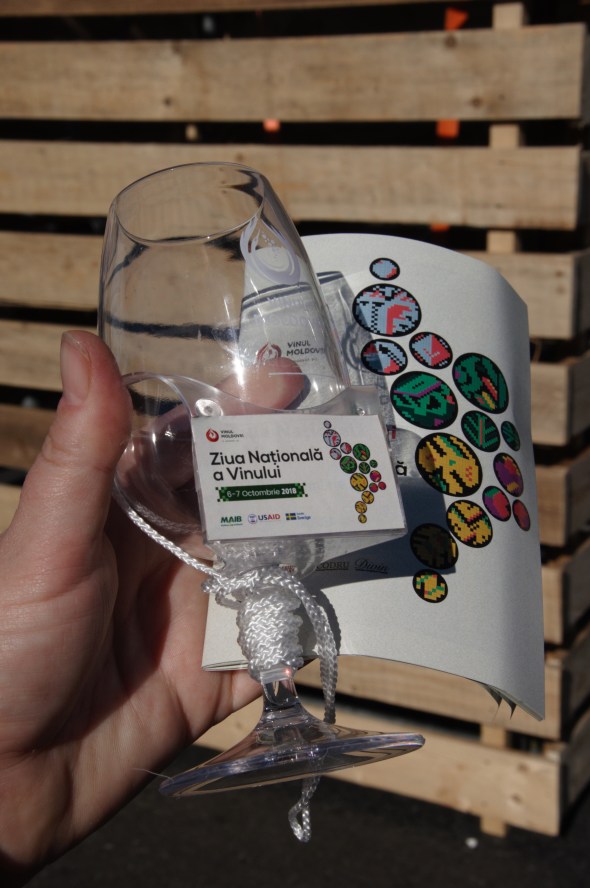
Getting there
From the UK, there are pretty much two direct options: Air Moldova from Stansted and Wizz Air from Luton. (I also found an airline called FlyOne, but it didn’t seem to be operating flights at this time of year.) When I booked, the Wizz Air option was significantly cheaper but did have the disadvantage of flying overnight on the outbound leg. If you’re going to do this one, hope that your hotel will allow you to check in early or prepare to take an afternoon nap. That’s of course if like me you’ve reached the age where staying up all night is no longer a good thing.

Getting around
There’s a convenient trolley bus which departs from right outside the arrivals terminal door. It takes about half an hour to get into the city centre and costs just 2 lei, about 10p. Look for the number 30 and pay the conductor on the bus. If you need to find change, there are exchange facilities that open early in the morning landside; I bought a cup of coffee which gave me somewhere warm to wait for the bus and the right money to buy a ticket. It was a little disconcerting when the bus stopped and the driver got out; I’d forgotten that trolley buses are a lot of effort when the wires don’t extend the length of the route. What was good, though, was that the buses ran from very early in the morning until late at night, even on Sunday.
Getting a room
I opted for the almost brand new City Center Hostel. It was located just across the road from Cathedral Park and around the corner from the bus stop. My room had twin bunks and for single occupancy cost just £27 for the night. The shared bathrooms were down the hall but were spotless. If you can’t bring yourself to stay in a hostel, next door is the conveniently located Bristol Central Park Hotel and opposite is the Radisson Blu. Both I’m sure are very nice but would set you back a whole lot more.
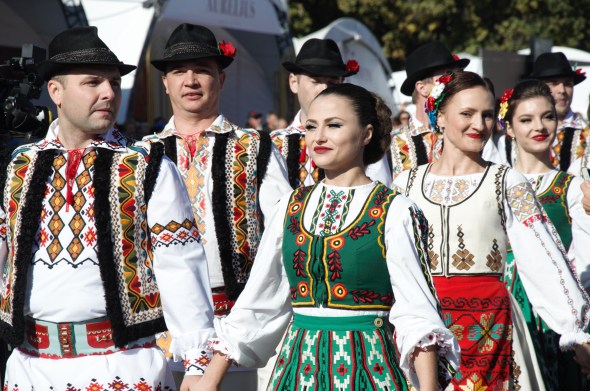
Getting your culture fix
I’d read that there was a parade and early signs were promising. There were plenty of people in national costume and in front of the big sound stage, rehearsals were still in full swing just minutes before the action was supposed to kick off. I was able to get close enough to see the dancers, which was fortunate as once the formal proceedings began, some rather surly security personnel did a very good job of keeping everyone right back out of the way. The view was further obstructed by press photographers and cameramen. There were no programmes in English, but this lady had brought her own from the local newspaper – no help to me, alas:

Though I did manage to see some of the winery representatives presenting their baskets of grapes, this part of the proceedings was something of a let down. However, later, once all the dignitaries had said their piece, the bands came on and the dancing started – fun to watch and even more fun to join in. The event’s free too, which was even better.

Getting drunk
With a tasting passport costing just 200 lei (£10), it’s hard to resist the chance to try as many of the wines on offer as you can. I made my way to one of the information kiosks (they’re located at either end of the main drag) and grabbed a place for one of the English speaking tours.
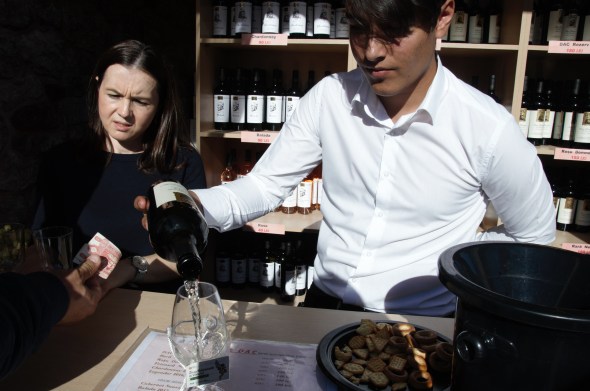
Our guide was as hipster as they come, but explained the different characteristics of the wine well at first. As the afternoon wore on, he became progressively more tipsy (like the rest of us) and at one point dropped a bottle of wine on the floor in front of him.

Some of the wines were too dry for my taste but I did enjoy the Cricova sparkling wines. I’m no connoisseur – the sweeter and fizzier the wine, the more I like it. Fortunately, the passport contained an extra token for “your favourite” wine so I had a second glass. It was a pity there are such stringent regulations at airports these days as I’d have liked to buy some to bring back.
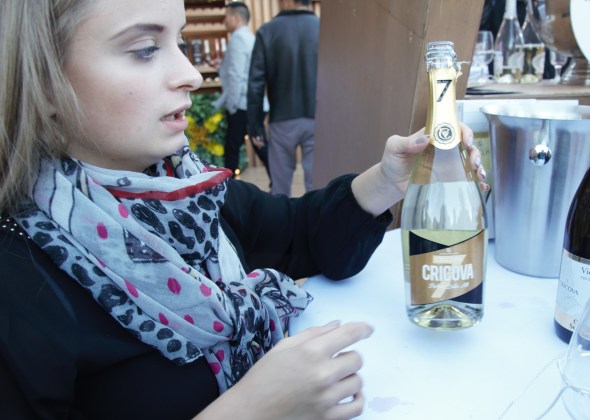
By the way, if you are going to visit one of the wineries outside Chișinău, I’d recommend Mileștii Mici. Its huge underground vault can hold almost 2 million bottles of wine and its subterranean rooms and passageways extend for around 120 miles. They run organised tours so there’s no need to worry about getting lost down there forever.
Getting food
Fortunately, there was plenty of opportunity to taste the local food as well, which helped to soak up a little of the alcohol I’d consumed. Adjacent to the wine stands are the food stalls. Many sold similar fare: succulent pork, tasty sausage, cabbage and potatoes. A lot of the stalls sold by weight; you indicated roughly how much they should pile on your plate and they told you how much you owed them. I had a heaped plate for about 75 lei, which worked out to under £4, and it was delicious. Communal tables mean it’s easy to make friends while you eat.


Getting to see more of the city
As I was visiting Transnistria, my time in Chișinău was limited. I did get to see the city’s smallest statue. Representing the Little Prince in Antoine de Saint-Exupéry’s novella, it took a while to locate, not least because someone I asked for directions Googled it and found an old article which said it was yet to be installed. It’s on the railings lining the lake in Valea Morilor Park – persevere and you’ll find it.
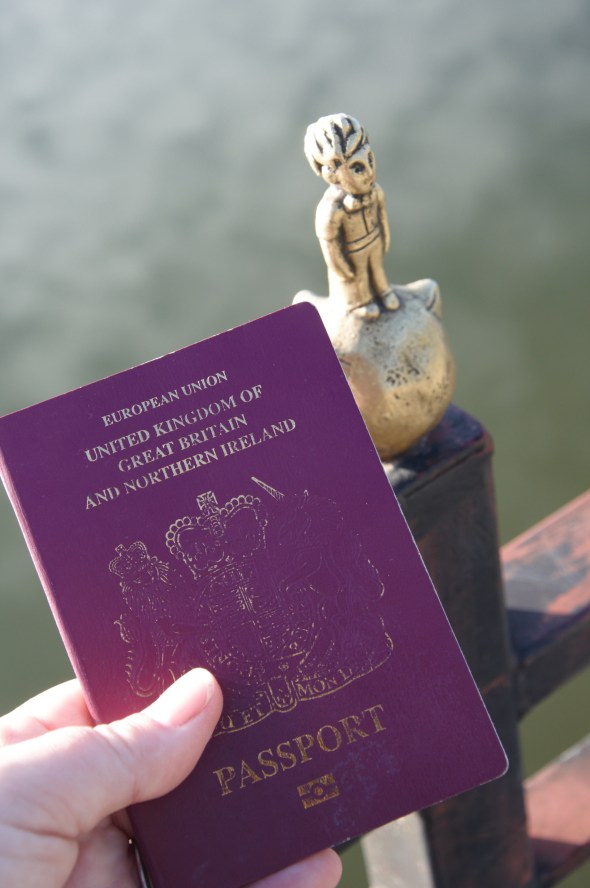
I also had a wander around an open air museum outside the city centre on the airport road; there was a wedding taking place so I didn’t have the chance to go in the wooden church. I finished up at the Ciuflea Monastery. Despite being close to the main road, it was remarkably peaceful.


How to visit Transnistria from Chisinau
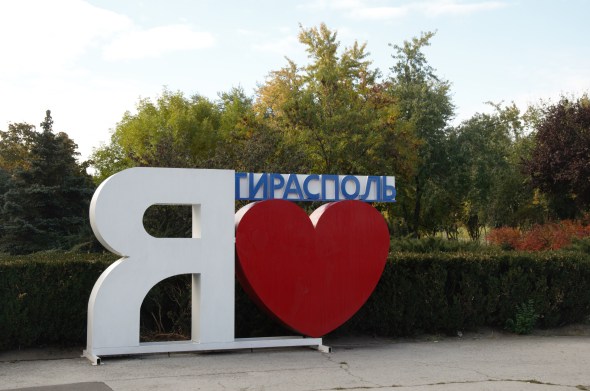


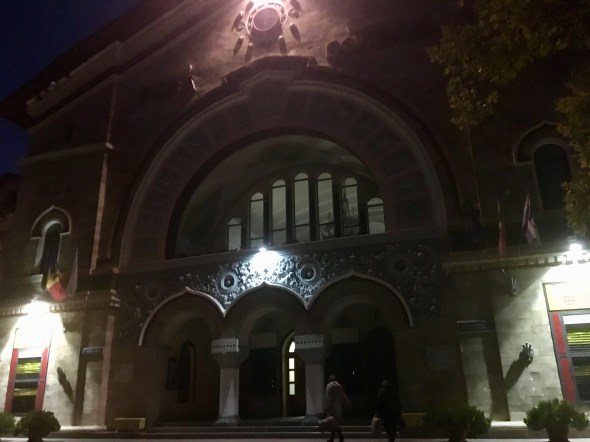




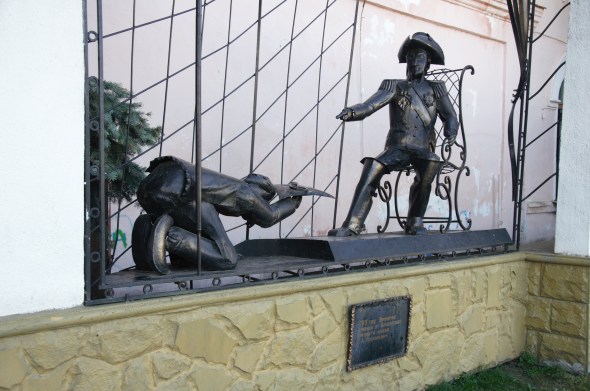


Why it’s hard for me to choose the best places for solo travel
It’s a popular topic, and one editors are keen to publish. You’ll find a glut of listicles all over the internet touting the places you “must go” if you’re a solo traveller, and a whole bunch more specifically aimed at females missing a plus one. I’ve been travelling on my own for over thirty years and if I’ve learned one thing, it’s that solo travel, by its very nature, is a personal thing. What’s perfect for me is unlikely to be right for someone else. When it comes to choosing a destination, perhaps it’s better to think first about the kind of person you are, where you’re likely to be happiest and what you hope to get from the trip. The decision about where to go will follow on naturally from that.

Are you truly seeking solitude?
It’s not a smart idea to find yourself on the established tourist trail if what you’re really after is some time out to gather your thoughts. But equally, it can be daunting to be completely on your own. Isolation can bring on acute loneliness very quickly. When I first visited Cuba fifteen years ago, I travelled west from Havana. I had no phone signal and no internet. At the time, I wasn’t ready to be that cut off. I was probably more homesick than I’d ever been before or since. I learnt that although I can quite happily go for days without speaking to people, I draw comfort from the knowledge I can talk to friends and family back at home if I feel like it. If anything, with the increased role social media plays in our lives, that’s even more the case for me today. I enjoy spending time on my own, but I also enjoy posting status updates and sending texts (hey – phoning’s expensive!) which allow me to share photographs and experiences with friends and family. Know yourself, and your limits, and you’ll have a much better trip for it.
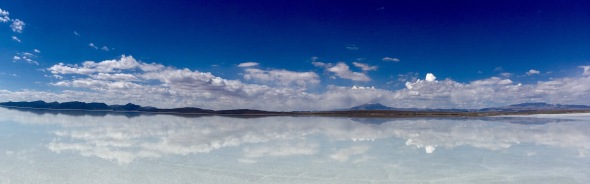
Is it about the company?
I enjoy taking holidays with my husband (and I’m not just saying that because he’ll read this blog). But he’s not an adventurous traveller and there are places that I want to visit that I know will be so far out of his comfort zone that he just won’t be happy. I have no wish to force him to waste his precious annual leave on something or somewhere he’s going to hate, so going it alone is my preference. I could opt to travel with a friend instead, of course. But years of solo travel has, if I’m totally honest, made me quite selfish when it comes to travelling. I have become used to doing whatever I want, whenever I want. It’s the exact opposite of home, where family commitments mean there’s plenty of give and take. So this becomes my reward: a few days of doing whatever I please, whenever I like. I’d describe it as a kind of adult time out. I recharge my “me” batteries and come back to the real world refreshed and ready to join in again.

Solo travel isn’t the same as a singles holiday
When I talk about travelling solo, I mean just that. I mean jumping on a plane, booking a single room and spending my days and nights largely by myself. I’m not single, and I’m not travelling in the hope of finding a life partner. I already have one, and I’m extremely fortunate that he’s very tolerant of my desire to wander. I like being on my own and I’m comfortable being by myself. I don’t care one iota if I don’t have a meaningful conversation with someone for days on end. I guess that makes me unsociable, but even at home, I often take myself out for the afternoon without asking someone if they’d like to join me. But home or away, if I want to, it’s easy to call a friend or join a group excursion. And that’s pretty nice too.
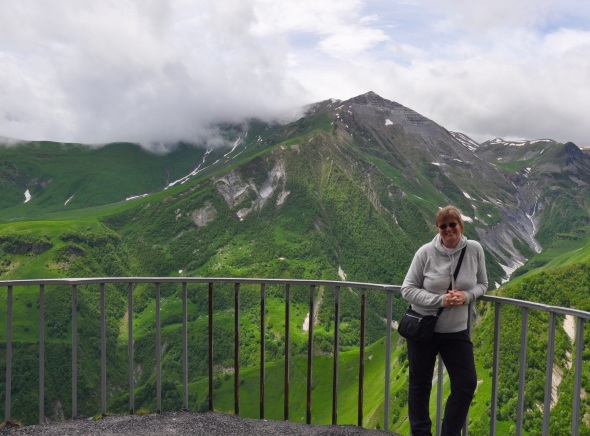
How do you know you’re not missing out?
The main drawback for me of not taking a group tour is losing the opportunity to tap into the specialist knowledge of a guide. But being saddled with a tour leader that knows less about the place than I do has frustratingly been a reality on more than one occasion. Researching a destination is as much a delight as seeing the places in real life. I relish the chance to choose the perfect hotel and tailor the itinerary to my needs without the hefty price tag that comes with bespoke travel. Instead of a packaged tour, I tend to book day excursions, particularly if I think I’d get more out of a place if I tap into someone else’s specialist knowledge or when, logistically, it’s the smart thing to do. Booking Envoy Tours’ Enlinking Caucasus tour facilitated sightseeing between Tbilisi and Yerevan without the need to backtrack. And on my most recent visit to New York, I joined the excellent Free Tours by Foot food tour of the Lower East Side – proving that no matter how many times you visit a place, there’s always something new to learn.
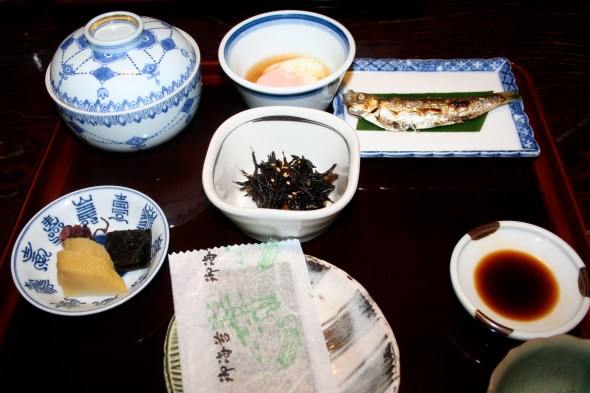
Would you feel constrained on a group tour?
A few years back I won a trip to America’s Deep South. By and large it was a good trip, but going off piste made it better. When it came to spending the alloted five hours at Graceland, I cut it to two and caught a bus back downtown to watch the duck parade at Memphis’ famous Peabody Hotel. There had been some teething problems at the start of the trip in New Orleans as the tour leader was understandably reluctant to let her precious charges out of her sight. Her protests were cut short when I told her that I’d not long returned from El Salvador – on my own of course – and come out unscathed. Let me emphasise at this point, I’ve nothing against group tours. but I do appreciate it when the tour leaders realise that there’s no “one size fits all” when it comes to their clients’ travel experience.

So where’s good for solo travel?
The honest answer: everywhere and nowhere. In the same way that being confined to a trans-Atlantic cruise for days on end would be my idea of holiday hell, solo travel isn’t holiday heaven for everyone. If that’s you, then you’re potentially going to feel uncomfortable wherever you book. Not sure? Challenge yourself. Try a short break and test the water. Fill your days during that first trip with lots of sightseeing, minimising your downtime so that you don’t have time to stop and think that you’re on your own. When you get home, take stock. Be honest about what worked and what didn’t. If you enjoy your new-found freedom, make your next solo trip a longer one. And if you didn’t, there’s no shame at all in accepting that you’re more suited to a group tour or travel with friends or family.

That said, it’s wise to mitigate against loneliness. It’s easier to meet fellow travellers if you stay in hostels rather than all-inclusives which tend to attract couples and families. Also, pick somewhere where there’s likely to be a lot of singles: the Antipodes, for example, South America’s traveller circuit, the South East Asia backpacker trail or Europe’s big cities. If you’re keen to visit somewhere off the beaten track but don’t know if you can handle being alone, sandwich it in between two places you know you’ll find company or can book excursions. But be prepared to put yourself out there: no one’s going to come knocking at your door if they don’t know you’re there.

A day with the steppe nomads
My back jarred with every rut. The small Japanese saloon was poorly suited to Ulan Bator’s potholes, let alone the enormous bumps and holes over which we creaked in the Mongolian countryside. It was clear that at some point, the arid steppe climate had experienced some rain, and the trucks and 4x4s that had come before us had churned the mud into deep and now rock solid furrows. Having spent two nights tossing and turning on the train from Irkutsk, and a good nine hours hanging around at the border, I was beginning to wish I’d taken my chances with the pickpockets of UB (the guide book’s judgement, not mine!) and not been in such a hurry to get out of the city. It had its advantages though.
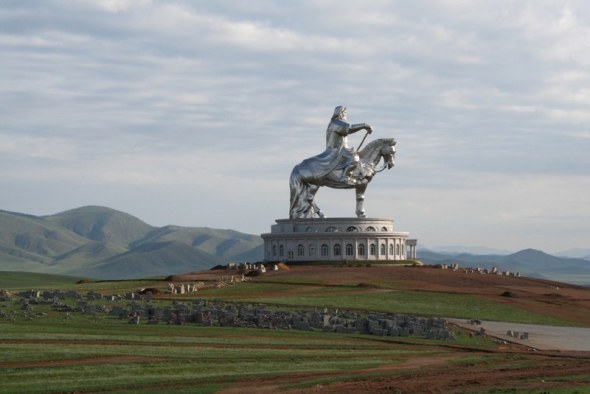
A 40-metre high statue of Chinggis Khan an hour or so out of the city posed serenely in the early morning dawn, awaiting its hordes of visitors once they had prepared their picnic lunches. We paused briefly to admire it by the roadside before moving onwards to tangle with a stray herd of cattle. After two hours, we reached the Steppe Nomads ger camp, where my Italian travelling companions alighted. For me, a half an hour jaunt across the fields would take me, jolt by painful jolt, to my nomad hosts, with whom I would stay the night.
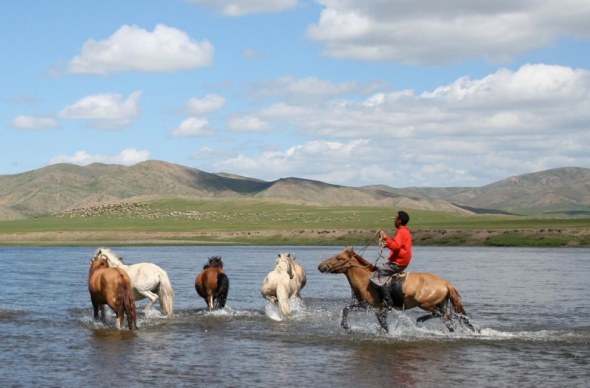
The setting was idyllic. Enormous blue skies dwarfed the gers, the traditional Mongolian felt tents, perched halfway up the field; scrubby meadows led enticingly to deceptively distant mountains. I took in my immediate surroundings. Four gers, a 4×4 and, underneath the latter, three dogs snoozing in the early morning calm. A short way up the hill was a rustic corral containing a few horses, downhill, a couple of small paddocks for sheep and goats. In the distance, cows and horses roamed free, down by the River Khergen. A couple of other gers and a truck back the way I’d come completed the picture. It seemed wonderfully simple compared to the complicated life I lead back in the west.


The guest ger was beautifully decorated. Intricately painted designs on orange woodwork contrasted with the faded cream canvas of the ger’s exterior. Hot pink beds with carpet mattresses were pushed to the edge and a matching dressing table was festooned with family photos and mementoes. It seemed to me a fairly comfortable introduction to camping! My driver indicated that the small structure across the field that looked like a British Telecom workmen’s cocoon was actually the toilet.

On closer inspection, the structure was tall enough to provide sufficient privacy, the boards firm enough to avoid any hapless falls and there was even a shovel and some loose dirt by the side for me to cover my tracks. Having a wash was going to involve several kilometres of trekking down to the river, but I figured I’d already had two shower-free nights on the train, and, let’s face it, the horses weren’t likely to complain. I felt very smug.
And then I was served breakfast.
I struggle with a piece of toast some mornings, so my traditional Mongolian breakfast of sick on a plate was hard to stomach. In actual fact it was some kind of curd cheese, and to some palates, delicious I’m sure, but, for me, that morning, it was sick on a plate, served with small finger shaped pieces of lardy bread. The cinnamon tea was lovely though, so I drank plenty of that, forced down some bread and sick and finished off with a caramel flavoured boiled sweet which had been thoughtfully provided in a small dish. I felt terribly guilty for struggling with the food, as it was served by a delightful nomad lady with a squeaky voice and a smile as broad as the Gun Galuut horizon.


After breakfast, I grabbed my camera and headed up to the corral to watch the horses. I envisaged lounging by the fence, channelling Kristin Scott Thomas in the Horse Whisperer. Unfortunately, unlike in the States, these poles were not fixed and periodically they would be charged by the horses before they made a break for freedom and hurtled down the field. Not wishing to be trampled, but still wishing to be close enough to secure some decent shots, I kept one eye on the action and the other on the camera, as poles cascaded down around me. The young men of the nomad group had the difficult task of roping the horses and fitting their bridles ready for the tourists at Steppe Nomads to ride them later in the day. It was certainly no easy task. Even with their dexterity, lassoing the only semi-tame creatures was no easy task, and the animals’ mad eyes and toothy grins only served to add to the humour of it all from the bystander’s point of view. Many times I watched as the horses bolted and their would-be captors rode expertly after them to herd them back up the field. I’m not sure I would have neither such patience nor the perseverance, especially whilst being watched. I was reassured to see that the young girls at the nomad camp thought it was as funny as I did, much to the lads’ embarrassment. Eventually, to the relief of all those involved, sufficient horses were roped and galloped down the field at an impressively fast pace to meet their excited riders.


Watching the action is all very well, but I felt a bit uncomfortable being the outsider, and so came ten year old Tilly to the rescue. Her name was something much longer and infinitely more unpronounceable, so Tilly was settled on as a name we both could manage. Tilly set about making it her mission to teach me to play volleyball. “Gee-oo-lee-aah!” she would cry, lengthening my name so much that it seemed I had been re-christened especially for Mongolia. At regular intervals throughout the afternoon, she would call for me, and we would continue with her attempts to refine my awkward technique. “Yee-ess. Verrry good!” was the response I hoped for, though more often than not, she just collapsed in a fit of giggles and ran down the field after the stray ball. It was an ice-breaker, nevertheless, and I was soon adopted as the new friend, someone to show off to (but not to share with!) her younger brothers. Before I knew what was happening, I was carted off the field to help milk the cows. The nomad women (and tiny infant children!) made it look simple, but for me, the hardest part was balancing on the tiny wooden milking stool without toppling over and falling into the freshly dropped manure. Once I’d mastered that, milking was easy – if a little messy. Much the reverse of volleyball, it seemed.
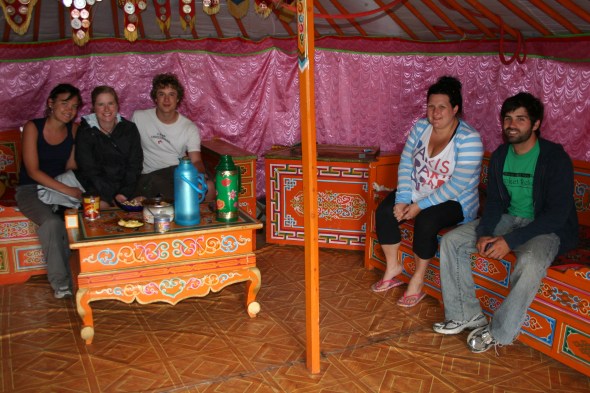
By the time the tourists came up to visit on their horses, the latter looking much tamer than they had that morning. The Italians looked a little uncomfortable and slightly saddle sore. It seemed like forever since I had left them this morning and I was surprised at how easily I’d settled in to such an alien environment. Dinner was brought out – a watery but delicious mutton stew – and I savoured every mouthful. I helped to unload two horses from the nomad’s truck and watched, toddler on hip, as the farmer administered some medication.

Later we sat, watching the sun set and the stars brighten in the blackening sky, smiling contentedly and watching the animals settle in the paddock for the evening. It was clear to see that this was a tough life, but the community was close-knit, the scenery was world-class and I had laughed more than I had for a long time. Shower aside, did I really need any more than this?
Domino Park – New York’s next High Line?
It was once a neglected and semi-derelict disused railway blighting the landscape of block after block that stretched from the Meatpackers District to Chelsea. Rudy Guiliani had signed an order for its demolition, but a determined local community fought to turn that elevated railway into the High Line Park, now one of New York City’s most popular public spaces. Since opening in 2009, visitors and locals alike have flocked to this verdant park. In summer, it’s a victim of its own success, with crowds of people walking through an architecturally rich landscape. In winter, you can still find space to yourself, for now at least.
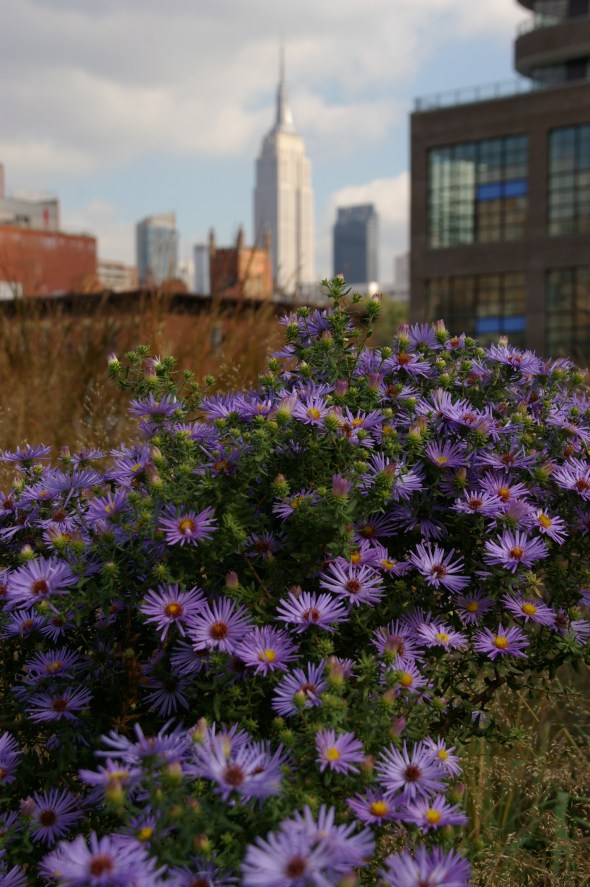
But if like me, you find yourself in the city when the temperature’s hot, you’ll be pleased to learn that the team behind the High Line opened a new space this June which looks set to rival its elder brother. That space is called Domino Park, and you’ll find it across the East River in Brooklyn.


Domino Park extends along five blocks of the Williamsburg waterfront. The hulking silhouette of the Williamsburg Bridge looms over its southern edge. Across the East River, Manhattan’s skyscrapers flank the residential towerblocks of the Lower East Side.

Watching from the back is what’s left of the Domino Sugar Refinery. The brick factory that stands today was constructed in 1882 to replace an earlier building destroyed by fire.

In the latter years of the 19th century, sugar cane was shipped in from across the globe. The American Sugar Refinery Company was so successful, it was one of the original companies to comprise the Dow Jones index. Other factories followed suit and Brooklyn at that time handled over half of America’s sugar as a result. Prior to using sugar, food had been sweetened with honey or molasses. Refining sugar from cane or beet was difficult and time consuming, but companies like American Sugar Refinery brought it to the masses, A century later, though, demand for cane sugar had fallen dramatically in the face of competition from high-fructose corn syrup and sweeteners.

It was almost inevitable that the Domino factory would close, just as so many of Brooklyn’s other industrial buildings have. But many of the industrial artefacts, such as the four syrup towers and crane tracks from the original factory, have been repurposed as props in this cleverly designed park.


An elevated walkway maximises the views across to the Empire State Building and down over the park itself. There are fountains, hardwood loungers and bench seating. The wood has been upcycled, taken from the factory which itself will be redeveloped. Planting is yet to become established, but as with the High Line a decade ago, a vibrant show of yellow and green grasses and other structural planting forms the bones of what will become.


This is a park which has its eye firmly on the local population. The playground was popular while I was visiting, as were the fountains. It would seem this is the place to bring your toddlers – or send your nanny. Even the playground’s a nod to the past, designed to resemble the process of sugar refining.
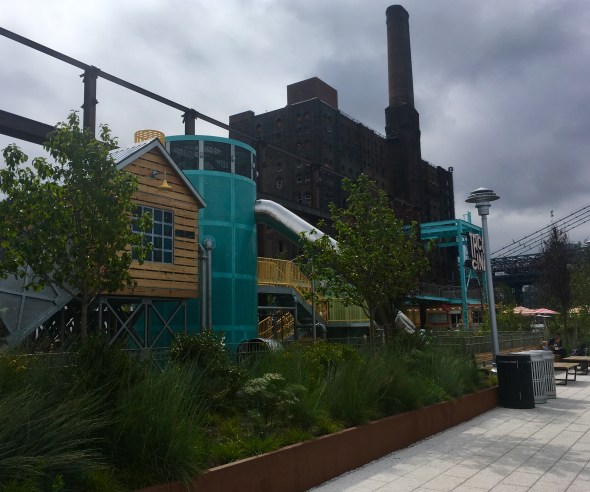
A lot of thought has gone into this park, and as the rest of the project launches, this is set to become one of Willamsburg’s most popular spaces for visitors as well as locals. It’s just a fifteen minute stroll from trendy Bedford Avenue, itself only a short subway ride from Manhattan’s Union Square. If you’re looking for somewhere to escape the High Line’s crowds without skimping on its achingly-cool design, this could well be it.
Have you visited London’s Postal Museum?
Piccadilly, Central, Circle – most of us are very familiar with the London Underground. But there’s another subterranean railway and it links Whitechapel in the east to Paddington in the west. Long before the DLR was operational, it ran without drivers and guards. It carried freight beneath the streets of London and kept an industry efficient despite the capital’s heavily congested streets.

That railway is MailRail and though it was closed by the Royal Mail in 2003, the good news is that last year, specially adapted, it opened for visitors as part of the new Postal Museum. If you haven’t been, I’d urge you to go. From small children to the elderly, this is a true family attraction with something to interest everyone. Last week I was lucky enough to be offered a complimentary visit courtesy of Made and enjoyed a fun afternoon at the Postal Museum as their guest.

We began at the Postal Museum Exhibition. I expected to want to rush this part of the visit in my excitement at having the opportunity to ride MailRail. In fact, the exhibits have been very well thought out and I was soon engrossed. Many of us don’t realise that the postal service in Britain began as a private service for Henry VIII. The term “the post” referred to the horses that were used as transport. But the King’s couriers took on covert work to supplement their income and soon the notion of sending something through the post was commonplace – amongst the wealthy at least. Ironically, most of the post boys couldn’t read and letters bore the symbol of a hanged man as a stark warning not to steal the letters’ contents. The advent of the mail coach reduced the risk of robbery and increased reliability.


In the Victorian era, the Royal Mail as we know it was born. Rowland Hill submitted his proposal for postal reform in the 1830s. He suggested the introduction of uniformly low prices based on weights rather than distance, as well as the system of prepayment which we take for granted today. His ideas met with a favourable response. In 1840, the Penny Black was introduced and for weightier letters, the Twopenny Blue.

The museum features plenty of interactive exhibits. You can dress up in vintage mail uniforms and create your own stamp with your picture on it. There were also plenty of surprises. I learnt that pillar boxes were originally green. They were road tested in the Channel Islands in the 1850s before being rolled out across the UK soon after. But the colour was thought dull and dreary, so red paint was introduced a couple of decades later.

Blue airmail boxes also existed and on them were lists of last posting times for key cities around the world. The inclusion of Algiers is a reminder that places become more and less important to others as times change. Colonial names like Tanganyika, Persia, Siam and Ceylon can still be seen on this 1930s box. If you’d have wished to send a letter from London to Brisbane at this time, it would have taken 12 days to arrive. With a journey length of 12700 miles (when you take into account the many stops), it was the world’s longest air route at the time it was launched, in 1935.

Engaging though the museum was, the highlight of the afternoon was to be found across the street: MailRail. The Post Office Railway was rebranded on the occasion of its 60th birthday in 1987 to this catchier brand name, but in actual fact, the idea of a railway for the postal service had been mooted as early as 1909. The route linked the six big sorting offices with two mainline train stations over 6.5 miles of track.

Sacks of mail were transported on these trains and an army of employees manned the platforms unloading the precious cargo. The trains ran for 22 hours a day, six days a week. An estimated 4 million letters passed through the system every day. A series of lifts, chutes, conveyors and elevators were used to avoid “laborious man-handling of bags” which would slow the whole process down. Automatic train control was in operation, leading some employees to comment that it was like having their “own giant train set to run”. With as many as eighteen mail cars speeding around the system at any one time, they needed to keep their wits about them.
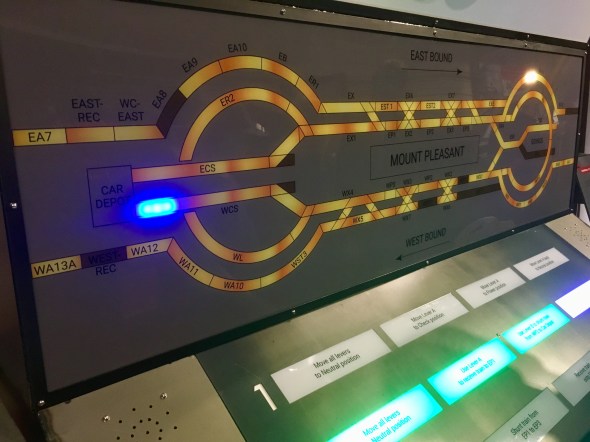
The mail was sent by overground train to the different parts of the UK and postal workers sorted it by destination while on the move in what was called a Travelling Post Office. This part of the museum has a mock up of such an onboard sorting office which you can use to file “mail” – as the carriage rocks it’s not easy to keep your balance if you’re not used to the motion.
The ride itself lasted about fifteen minutes, completing a loop under the Mount Pleasant section of the railway beginning and ending at what was once the maintenance depot. When operational, express trains would have taken the same amount of time to run between Liverpool Street and Paddington – try doing that on the Tube now! It was well done – from the cramped compartments we listened to an informative commentary and enjoyed some interesting audio-visual projections along the route.


Though you might struggle if you’re claustrophobic, spare a thought for my father. A retired engineer, he once carried out a survey of some of London’s sorting offices and was sent with his bags via MailRail. That would have been a very tight squeeze. At least now you get to leave your stuff in the lockers provided!


Practical information
The Postal Museum and MailRail are open all year except for 24-26th December. Opening hours are 10am to 5pm with the last train departing at 4.35pm. Allow at least a couple of hours for your visit. As you need a timed ticket to ride the railway, it’s best to buy your tickets in advance. Details of ticket prices and other information can be found on the Postal Museum’s website here:
How to travel solo without the hefty price tag
An email popped up into my inbox the other day touting an article that promised a selection of holidays this summer for under £600 per person. Intrigued, I clicked – the dreaded click bait! Though there were a couple of holidays that fell within the price range, most required a group of six people to share a villa to achieve the deal. I prefer to travel alone – yes, it’s a choice! – so the thought of spending a week with five other people is not my bag. But it got me thinking and here’s the result – how to travel solo without the hefty price tag.
Be independent
Singles holidays are often a no when it comes to budget solo travel as they usually slap on a significant single supplement. Even when they don’t, the price of that single supplement has usually been absorbed into the package cost which bumps the price up. Ditch the tour operator (but not the insurance!) and go it alone. You’ll be more in control of what you pay and who you pay it to. If you’re a bit worried about travelling solo, why not read my post about travel hacks for solo travellers which contains tips and tricks learned from years of going it alone.
Consider a hostel


The cheapest option for a solo traveller is a bed in a dorm room, but that’s not going to cut it if you need quiet to sleep and you like to shut the door on the world when you turn in. Instead, consider a private room in a hostel. Check out the cleanliness ratings on a reliable website and if it scores well, don’t rule out a shared bathroom. Try the Acco Hostel in Stockholm’s Södermalm district. £18 will get you a bed in a four-person dorm room but double the budget to £39 and you can have a room of your own. I can also recommend the excellent Adventure Queenstown Hostel in New Zealand. They only have one private double (book well ahead!) but it has a balcony and starts at a budget friendly £59 a night. If that’s too dear, their 6 bed dorm rooms will cost you £17.50 per night.
Seek out accommodation that’s designed for one

The best way to avoid a single supplement is to find somewhere that isn’t big enough for two. There’s plenty of budget accommodation out there that will keep your costs down. I stayed in the central but basic Pension Vergara in the heart of Seville’s old town for £18 a night. If you think you have to travel off season, you don’t – that price is available this August. It wasn’t a room I intended to use other than to sleep, so the lack of space didn’t bother me, and I really couldn’t have found a more convenient location. Turkey’s also a good option. I travelled to Cappadocia and stayed at the Kelebek Cave Hotel. Their most expensive suites come in at 180 euros per night but stay in one of their atmospheric cave rooms to keep the cost down. The cheapest double is currently £39 per night, including a 20% discount for single occupancy. Yes – you read that right – a discount, not a supplement.
Save money by self-catering

Renting an apartment doesn’t have to break the bank and if you can find one with a kitchen, you can save money on eating out too. I’m off to Barbados as soon as rainy season ends and have found a studio apartment for just £45 a night by using Airbnb. It’s part of a complex on a golf course near the beach which means I have access to a shared pool too, and the apartment is configured so that the bed is on a mezzanine, leaving the ground floor free for a living room and kitchen. It’s a short stroll to the bus stop so I can get around easily and just 15 minutes’ walk from the beach. On paper it sounds perfect: check back later in the year to read my review.
Grab a flight deal while it lasts
Unless you’re holidaying close to home, it’s often the cost of travel that represents the biggest outlay. I try to keep an open mind about where I might travel to next and keep my dates flexible. If you’re tied to school holidays, plan well in advance and take full advantage of February and October half terms as they often throw up the best deals. Sign up for email alerts from airlines so you don’t miss out on any flash sales and also from deal spotters such as Secret Flying as they will hunt out the bargains for you. If a bargain flight crops up, grab it while it’s available and worry about booking accommodation later. But don’t believe all you read: I once saw a post from a respected blogger promoting a fare of almost £1000 as a cheap flight to Seattle yet a couple of weeks ago, Secret Flying advertised the same route for £290. Both were on scheduled airlines. Keep an eye on these comparison sites and you’ll soon learn what’s a good price.
Do you have tips for saving money as a solo traveller? Why not share them by leaving a comment?
Is it time you visited Colchester?
Colchester’s been busy – a new advert using the tagline #ifthesewallscouldtalk has popped up on our television screens and sets out to promote the town’s many historic attractions. As England’s oldest recorded town and also its first Roman city, there’s a lot of history to uncover. But while most of us in the region know about Colchester’s castle, some of its more recent history can get overlooked.


As part of Greater Anglia’s summer #railadventure campaign, I set out to rediscover Colchester. The first decision I had to make was which station to use: Colchester has three railway stations. I opted to alight at Colchester Town (formerly known as St Botolph’s) as it is closer to the town centre than Colchester (also known as Colchester North) and Hythe. From there it was a six minute stroll to my first stop.


Tymperleys is a Tudor mansion tucked away in a courtyard off historic Trinity Street. Building began in the 1490s and over time it was added to and altered as the place changed hands. Among its illustrious owners was William Gilberd, an Elizabethan scientist who, it’s said, came up with the term “electricity”. Later, Colchester businessman Bernard Mason, who owned a successful printing firm, bought the place. His passion was clocks and amassed a collection of over 200 timepieces, one of the largest in Britain. This is what Wikipedia has to say about him:
Mason was a Freeman of the Worshipful Company of Clockmakers and the author of “Clock and Watchmaking in Colchester” (1969) which originally cost four guineas (£4 4s 0d £4.20). He was made an OBE in 1959. Mason claimed that there are 375 known examples of Colchester clocks and he managed to collect 216 of them in his lifetime, travelling far and wide to bring them back “home”.
After Mason’s death, he bequeathed his collection – and the house – to the people of Colchester. In 1987, the Tymperleys Clock Museum opened and would remain a popular attraction until 2011. But I had another reason to visit. These days, Tymperleys is perhaps (despite stiff competition!) the best cafe in the town centre and it’s especially lovely in the summer when you can eat al fresco in the delightful walled garden. No surprise, therefore, that most customers were sitting outside. With a fierce July sun beating down, I was glad of the shade of a garden umbrella as I enjoyed a tasty lunch surrounded by the pretty floral displays.


These days, not a single clock from Bernard’s collection – I asked – is left in Tymperleys. Before you fret, however, they have been moved. A short stroll across the town centre you’ll find them in the excellent Hollytrees Museum. It’s free to look around and learn something of the Colchester clockmaking industry which, it turns out, was quite something back in the day. Once a centre for baymaking (the manufacture of a felted woollen cloth), Colchester’s industry diversified in the Georgian era and it was then that the town became a centre for clock making.
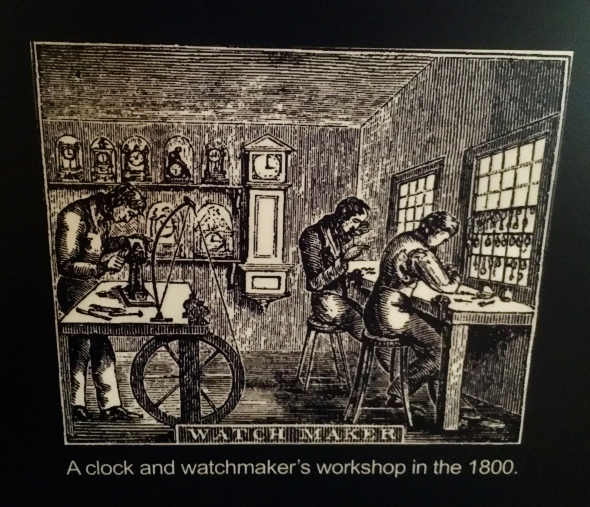
Perhaps most productive of these craftsmen was Nathaniel Hedge. The Hedge family set up in business in 1739, running a factory from 1745 until the late 1780s. Other names to look out for include John Smorthwait, who trained up the young Nathaniel. One of the oldest clocks on display is a Thirty Hour Longcase clock made in 1698 by Jeremy Spurgin out of oak. Many of the pendulum clocks on display feature adornment in a style known as Japanning, a lacquered decorative finish involving paint and varnish. It’s an intricate style, a reminder that fashion was as important as function when it came to clockmaking.


By 1800, however, the industry had peaked and went into a steep decline as clocks could be made elsewhere much more cheaply. The industry and its contribution to Colchester’s history would be all but forgotten if it wasn’t for Bernard Mason. Whether you’re local or visiting from outside the region, it’s well worth the detour to take a look at this fascinating collection.
The visitor information centre is housed on the ground floor of Hollytrees Museum; their walking tours of the town provide an insight into the town’s past that you’d be hard pressed to achieve without their knowledgeable guide. For this and more on the town’s historic attractions, check out my previous blog.


The lowdown
Greater Anglia offered me a free train ticket in exchange for writing this review of my #railadventure. Travelling by train is an inexpensive way to travel, particularly off peak. For instance, if booked in advance, tickets from Norwich to London cost just £10, Cambridge to London can be had for £7 and Southend to London only £5 (all fares quoted are one way). Accompanied children travel for just £2 return and you don’t even have to pre-book their ticket – this fare is valid on all off peak trains within the Greater Anglia network. On top of this, GA are offering a 2FOR1 deal on top London attractions; with the summer holidays fast approaching this is great news for families. And don’t forget, the excellent Hollytrees Museum is free. It even has a kid-friendly display of vintage toys and a couple of nursery rhyme surprises, though I’ll leave you to discover those for yourself.
Colchester Town station had one last treat as I was waiting to board my train home. This poem, written by C. E. Benham in 1890 is entitled “A ballad of the Tendring Hundred” and you’ll find it on the station wall. Best read out loud – see how well your North Essex accent turns out!
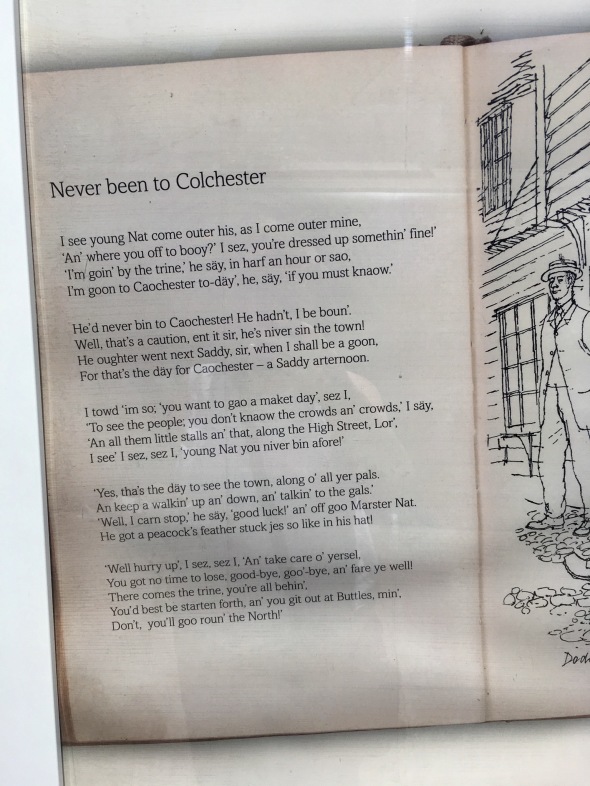
Discover destinations and ticket prices at www.greateranglia.co.uk and plan your journey at www.nationalrail.co.uk.
Did you feel inspired to plan your own rail adventure after reading this blog? Why not complete Greater Anglia’s survey using this link:
On safari in Kent: review of Port Lympne
The thrill of seeing animals in the wild in Africa’s national parks is one of life’s great travel adventures. But sometimes you can’t wait for Africa to get your travel fix. A visit to Port Lympne Reserve in Kent, owned and managed by the Aspinall Foundation, provides an opportunity to go on safari without leaving the UK, but how does it compare to the real thing?
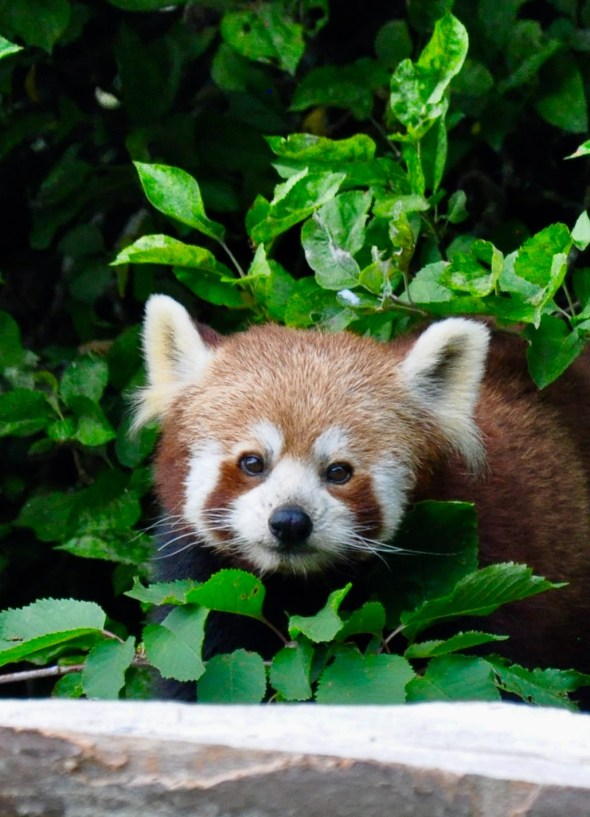
The organisation’s credentials are good: known for its work breeding rare and endangered species, the park is home to 25 painted dogs, 17 Western lowland gorillas, 15 Eastern black rhinoceros and 5 Rothschild giraffes. The park’s animals are housed in a variety of ways, with some roaming freely across acres of rolling fields and others in purpose built enclosures.


It’s possible to visit for the day but for a special occasion, Port Lympne has a range of overnight accommodation. We chose to rent a cottage, but could equally have spent the night in a glamping tent, hotel or even a treehouse suite. Further accommodation is planned, as is a spa, expected in around 18 months time.


Our cottage slept eight and was very comfortable for our party of six. Each of the four bedrooms was a generous size, in particular the master suite, which had a huge bathroom attached. Attention to detail was evident throughout, such as finding cute little elephant hooks for the bathroom robes. We enjoyed the services of a personal chef who cooked us a three course dinner and came back to serve up a full English the following morning. It was an impressive set up which pleased everyone.


From the windows, we looked down over fields grazed by some of the park’s animals, though admittedly from a distance. If you’re serious about wildlife spotting from your bedroom, you’re going to need to bring binoculars. There was something almost surreal about hearing the shout of “Quick! I can see a rhino from the bathroom window!” when your brain is protesting you are so close to home. Less fun was finding the nieces had hidden the resident oversized gorilla plushy with the spooky eyes in our bath as a joke, though they found my screams hilarious.

But it was the safari experience that set the trip apart. Our guide, Rebecca, was knowledgable without being preachy and supplied enough anecdotes to prevent the whole thing turning into a Biology field trip. She explained about conservation and environmental pressures on creatures in the wild in the context of the animals’ own personal histories. We didn’t see the new born giraffe that was resolutely hiding inside, but we did meet the extended family from our Land Rover vantage point.

Larger safari trucks ferry passengers around Port Lympne’s extensive site, but the advantage of being in a smaller vehicle was that we could go off road from time to time to get a closer look at some of the grazing herds.
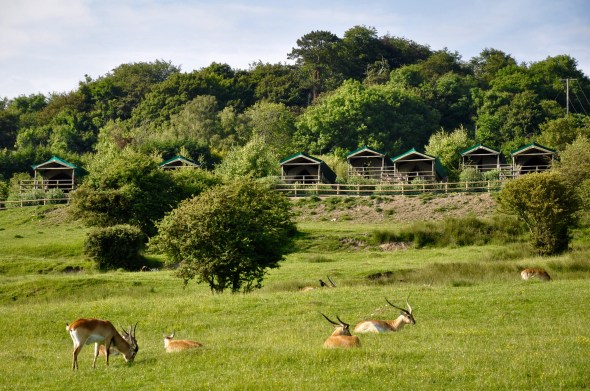
The Bactrian camels looked somewhat scruffy as they were blowing their fur coats, and somehow wildebeest always do, but the small herd of Chapman zebra looked to be in fine condition. Save for the distant view of the English Channel, we could have been on that African safari.The morning safari was shorter, but took us to different parts of the park to see ostrich, eland, baboons and more.


Afterwards, we spent a few more hours wandering the pedestrian paths that looped the animal enclosures, timing our visit to the gorillas to coincide with feeding time and watching a Siberian tiger hunt out meat that had been hidden in her patch.


It felt slightly odd to be seeing primates in cages after our safari, but obviously it wasn’t going to be safe, practical or possible for a silverback to be mingling with the crowd.


How did I feel about the trip? Well I came home and booked a flight to Uganda. I’m going to be taking my third African safari in early 2019.

 Julia's Travels
