
What’s it like to visit Oaxaca for Day of the Dead?

This October I’m teaming up with Lauren of Diary of a Spanglish Girl for a feature on Day of the Dead. It’s one of my favourite festivals so when Lauren posted a shout out on her Twitter feed asking if anyone had been to Mexico for Day of the Dead and would like to share their experience with her, I jumped at the chance. You can read the interview here. By the way, Lauren’s also the person behind an excellent Facebook group for travel bloggers called Share Your Travel Blog Post And Connect With The World. If you have a travel blog, it’s well worth signing up as there are plenty of tips and experiences to inspire your future travels. She also has her own Facebook page which is a helpful resource if you love to visit Spain.


The Day of the Dead, or Día de Muertos as it’s known locally, is a big deal in Mexico, nowhere more so than in the southern city of Oaxaca. Celebrated at the end of October and beginning of November each year, the festival focuses on the dead, and the whole town gets involved in some way. What I didn’t bargain for was how involved I’d get as well.

Arriving a few days before the main celebrations, work was beginning to get underway on the altars. Each family creates an altar to tempt their ancestors’ spirits back to earth. I’d been in touch with Mariana from a small hotel called Las Bugambilias and she’d invited me to join them. In the courtyard, stood a life-sized model of Catrina, the mascot of the Day of the Dead. For a century or so, La Calavera Catrina has been associated with Día de Muertos, thanks to a cartoonist by the name of Jose Guadalupe Posada. He was known for satire and drew the rich in fancy hats and feather boas, ridiculing them by implying death was only for the poor.
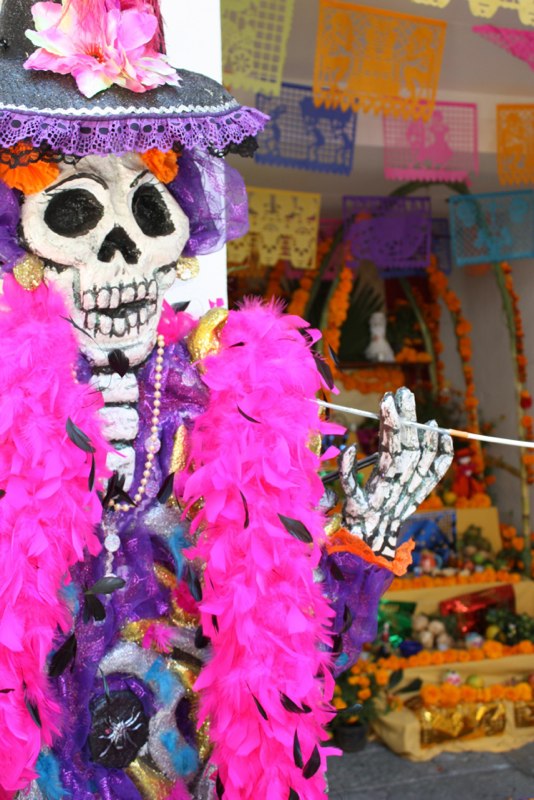
Catrina takes the form of a skeleton dressed in elegant clothing, dripping in furs or, in this case, feather boas, strings of beads draped around her neck and an elegant cigarette holder in her hand. She was comical rather than creepy, my first hint that this festival has fun as well as respect at its heart.

With a small group of fellow tourists and under Mariana’s expert guidance, we set about creating an altar called an ofrenda. Each of us had been allocated a specific task: some threaded marigold blooms onto strings; others dusted icing sugar skulls in the yard to form a pathway to the altar. My job was to create a centrepiece cross of white carnations and dot it with tiny purple buds. It was harder than it looked to get the blooms just right. Mariana was a perfectionist, but after her intervention, the cross really did look the business. After several hours of preparation, the ofrenda began to take shape. Loose marigold petals defined the path, their pungent aroma pervading the tiny courtyard. The altar itself was decorated with candles, fruit, nuts, incense and brightly coloured bunting. Sepia photographs of family ancestors peeked out from behind yet more marigolds.
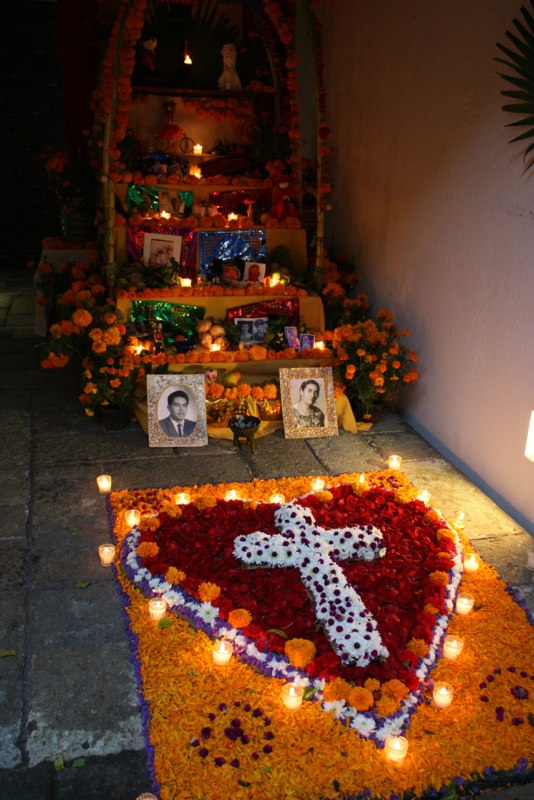
Finally, we’d finished, and to celebrate, out came a bottle of Mezcal for a toast, to our efforts and to the ancestors we’d honoured. I’d been asked to bring along family photos and raised a glass to my sorely missed grandparents, their picture wedged between a bicycle candleholder and a lime. I pledged to myself and to them that I would make an effort this time next year to recreate this feeling with my own ofrenda.


The following evening, a group of us headed for the cemetery. On the night of 31st October, residents and visitors alike flock to the old and new cemeteries in Xoxocotlan, on the outskirts of Oaxaca. They were busy with people tending graves, laying marigolds and other offerings and lighting candles in memory of their deceased relatives. Many families would stay all night. I wandered amongst the weathered graves in the packed old cemetery, taking care not to trip over tree roots in the gloom of the candlelight.


Vibrant scarlet gladioli added a splash of colour to the warm amber tones lent by the flickering flames. White canna lilies added grandeur. Vivid orange cempasuchil dominated the scene through sheer weight of numbers. Some graves were a hive of activity; at others, the mood of the relatives was more reflective. Once or twice, a lone mourner wept softly at a graveside, their grief recent and still raw. It was hard not to feel emotional. Yet, I was warmly welcomed, invited to share a spot at several gravesides.

At the new cemetery, there was a party atmosphere. The floral colour palette was enhanced by fluorescent wands that poked out of pushchairs. Lovestruck teenagers sneaked a kiss behind their parents’ backs. Small children munched on sugar skulls and sucked skull lollipops. The sounds of Michael Jackson’s Thriller boomed from a loudspeaker, almost masking the cries of the many hawkers selling snacks and party treats. At the edge of the cemetery, a funfair had been set up with the usual stalls and rides. If it hadn’t been for the tombstones, it would have been easy to forget you were in a cemetery at all.


Comparsas (local groups) parade all night through the streets in costume, celebrating the return of the ancestors with music and dancing. The following evening, the Las Bugambilias team took us out of town to the village of San Agustin Etla, where I’d heard their Muerteada parade was second to none. Anticipation mounted as a crowd gathered in the narrow lane. Eventually the procession reached the village, an eclectic band of ogres, devils and monsters, each with a costume more fantastic than the last. There were ghouls with terrifyingly realistic make up alongside drag queens with pink hair.


The devil carried his scythe, passing a ‘Panteonero’, someone from the pantheon, whose eyeball was missing. Somehow because of the crowds, most were freakish rather than scary, but they were all to be commended for their efforts. As the final performer arrived, in one corner of the village square, a play was being re-enacted. Many of those in the parade weren’t needed, however, and had planted themselves against walls and on kerbstones to have a much-needed drink. I wandered amongst them exchanging pleasantries as far as my limited Spanish would permit, posing for photos and trying on some of the costumes. I was glad I wasn’t wearing one; the weight was impressively heavy. No wonder they’d sat down!
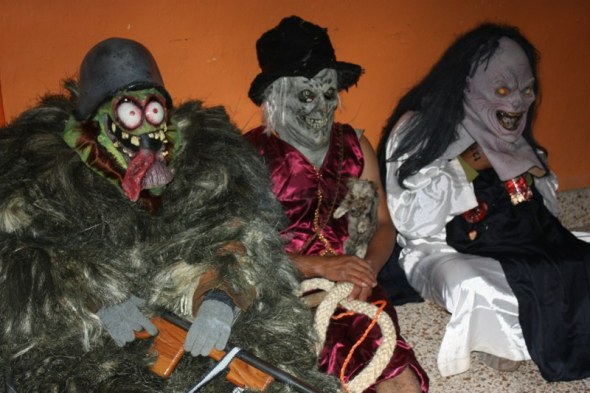
As the evening wore on, a chill settled on the air and the Mezcal came out again. Passing the bottle round, glasses were raised.
“Salud!” Compared to the sombre way we remembered our deceased back home, the Mexicans embraced their spirits, celebrating with them and having fun in the same way they would have done when they were alive. I decided my grandparents, gregarious even in old age, would have given it the thumbs up.
If you’d like to find out more about my experience of Day of the Dead, make sure you check out Lauren’s blog post. For my take on why I prefer Day of the Dead to Halloween, have a read of an earlier post of mine.
Feliz Dia de Muertos! How to plan a Day of the Dead trip to Mexico
Dia de Muertos, known in English-speaking countries as the Day of the Dead, is best known as a Mexican festival that commemorates a family’s ancestors. The festivities stretch across three days, though the preparations begin in earnest in the last week of October. The Day of the Dead officially begins on October 31st. On November 1st, people focus on the souls of departed children and on the 2nd, it’s the turn of adult family members.
Here’s my guide to getting the best out of a Day of the Dead trip.
Choose where to go
Dia de Muertos is celebrated everywhere in Mexico, but some places have a wider range of events in which to participate than others. I’d recommend heading for Oaxaca, a day’s bus ride or a one hour flight out of Mexico City. The city plays host to a packed programme of things to experience and also has a lot of accommodation options. Another popular option is the island of Janitzio on Lake Pátzcuaro, where the Purépecha indigenous community share their traditional rituals and customs with those respectful enough to listen and observe. Boats ferry visitors out to the lake and the island’s cemetery is the focus for candlelit vigils.
Plan well ahead
It’s possible to get a room pretty much up to the last minute and of course, wandering down to the parades takes no planning at all. There are a lot of organised packages to experience Day of the Dead but these tend to be very expensive. Book early to stay somewhere intimate that will offer you the opportunity to participate rather than spectate: I chose Las Bugambilias right in the centre of town. They can be found online at http://lasbugambilias.com/ This wonderful boutique hotel books up fast but don’t worry if you are too late to get a room; contact them well in advance and discuss your needs for a custom tour.

Catrina
Decorate an altar
Preparations for Day of the Dead begin a few days ahead of the main festival. Each family decorates an altar (known as an ofrenda) in the hope of attracting their ancestors back to earth for a party. Garlands of marigolds are strung, crosses of flowers are painstakingly created and decorative bunting is hung. On the altar, gifts are laid out for the deceased: their favourite fruits, perhaps, and definitely a bottle or toast of Mezcal. This aspect of the festivities is the easiest to recreate at home. You can set up your own ofrenda; if it isn’t possible to get suitable flowers where you love at this time of year, use artificial ones instead.
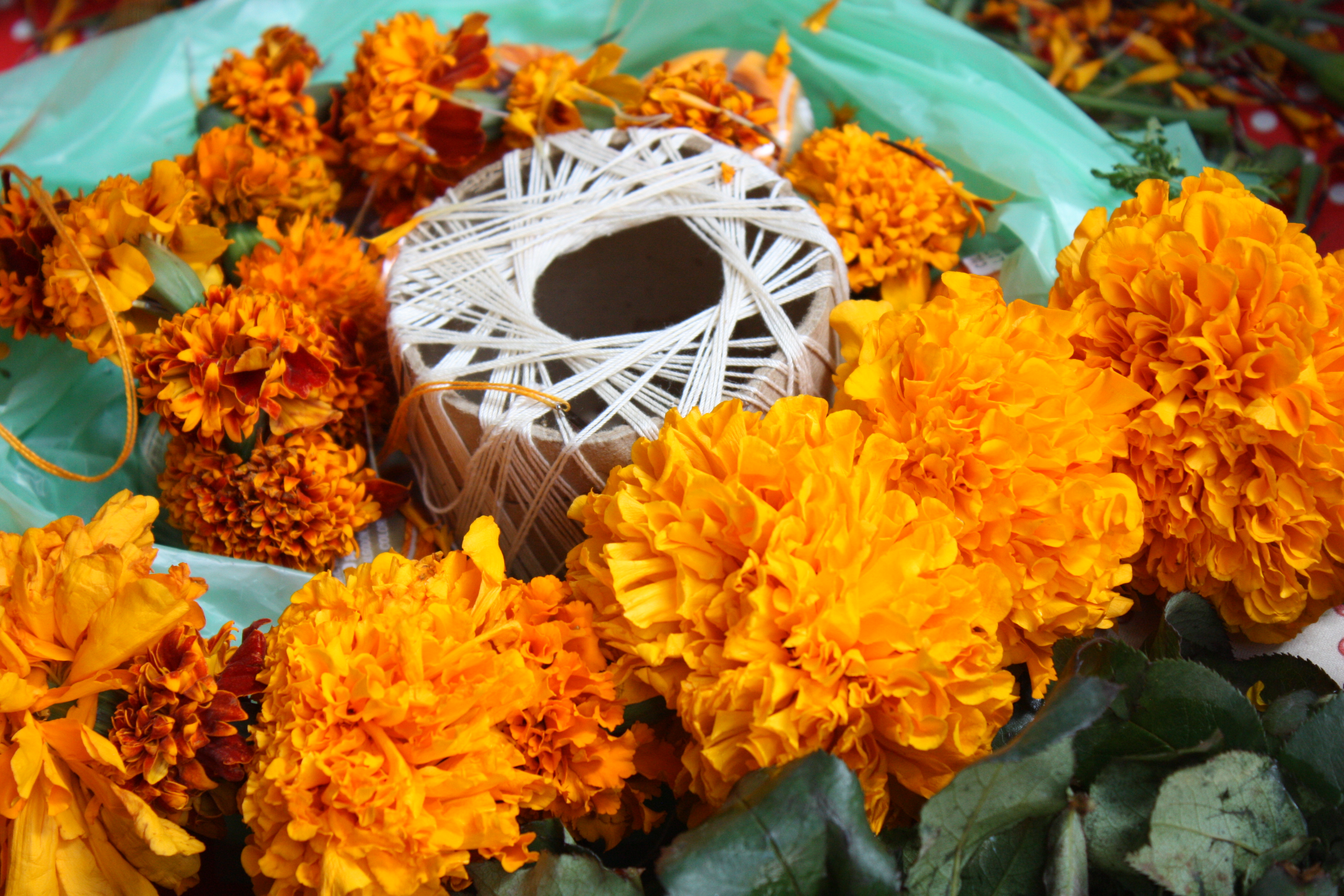
Preparing strings of marigolds
Visit a cemetery
Cemetery visits are an integral part of the Dia de Muertos experience. If that sounds a little morbid, or maudlin, don’t be alarmed. While some locals will be sat next to the graves of their ancestors in quiet reflection, others will be hosting the mother of all parties, with music, eating and drinking all playing a big part. Tourists are welcome, so take your cue and join in if you’re asked. If you’re in Oaxaca on October 31st, head for Xoxocotlan old cemetery first, where stems of red gladioli and vases of pungent marigolds are lit up by white church candles before heading to the sound stage and buzz of the new cemetery next door where the party will be in full swing.
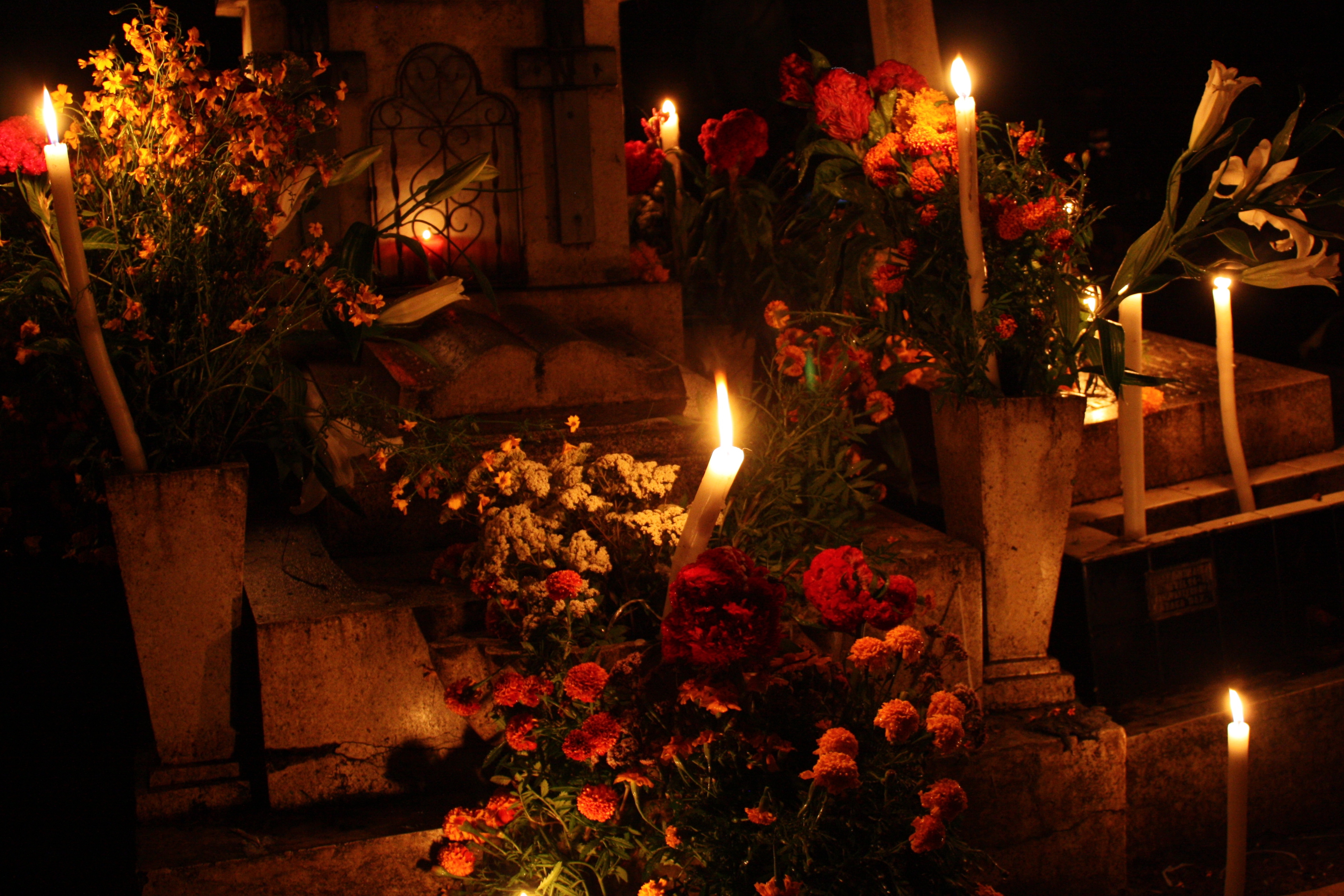
The old cemetery at Xoxocotlan
The after party
Comparsas, or parades, are at times raucous and always entertaining. Participants clad themselves in wildly extravagant costumes and parade through the streets of Oaxaca and neighbouring villages such as San Agustin Etla. Some are dressed as the grim reaper, others panteoneros. These are the living dead – missing eyes or wearing terrible wounds, they are a scary sight as they mingle with the crowd afterwards. The parade becomes a party as everyone drinks and dances into the small hours. It’s worth going on an organised tour if you choose the November 1st San Agustin Etla parade as arranging transport back to Oaxaca can be tricky.

A panteonero

San Agustin Etla parade
Don’t rush off
Allow at least another few days to get to know Oaxaca. As well as the many souvenir shops and markets selling Dia de Muertos themed sweets – think candy skulls and lollipops – the city has a beautiful historic core packed with pretty colonial era buildings and interesting museums. It’s also a foodie’s dream: try exotic dishes like deep fried grasshoppers or delicate courgette flowers or hang out in one of the many cafes watching the world go by.
Experiencing Dia de Muertos in Mexico is a must-do activity and though everywhere is very busy, there’s a buzz and energy about the place that you’ll feed off. While you shouldn’t expect to be turned away from events and activities, you need to remember that this isn’t as commercial as Halloween. Showing respect is essential, particularly in the cemeteries and when interacting with those who are recently bereaved. Be tactful, show a genuine interest in what’s going on around you and be flexible enough to be open to spontaneous connections and opportunities.
Updated April 2026


