
A beginner’s guide to Sri Lankan railways
One of the unquestionable highlights of touring Sri Lanka is a journey by rail. The network is extensive and links many of the country’s must-see destinations. There are many tour companies who offer itineraries based around train travel, but these can be expensive and prescriptive. If you prefer to go it alone, here’s my guide to getting around by train.
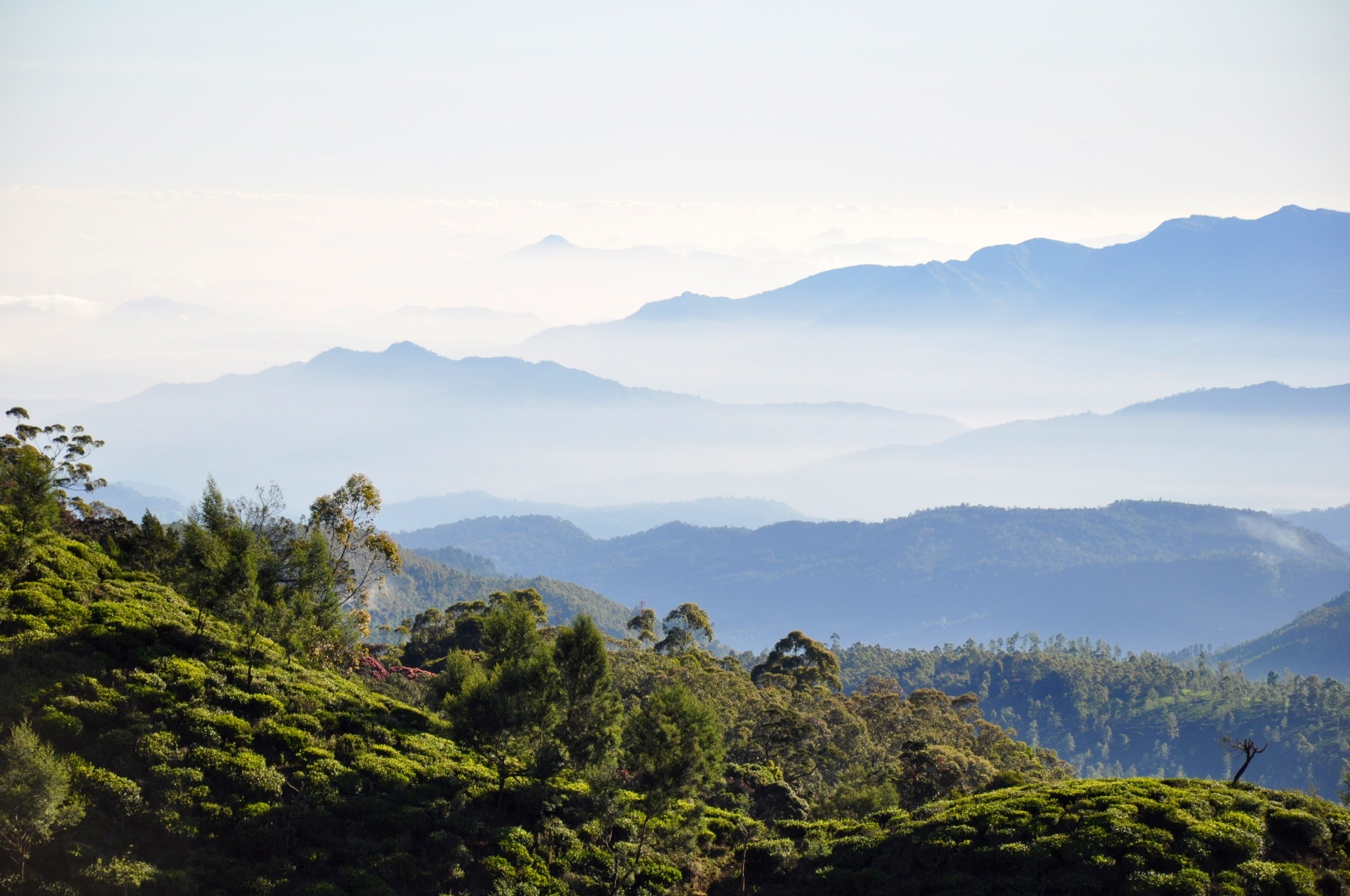
Sri Lanka’s hill country is easily explored by train
Planning is everything
Although trains link many of the country’s cities and towns, there are gaps. I planned a circular route beginning at Colombo Fort station, heading inland to Kandy, then up into the highlands to Nanu Oya (for Nuwara Eliya) and then on to Ella. Separately, I rode the stretch of track from Weligama to Galle from where you can catch a train back up to Colombo.
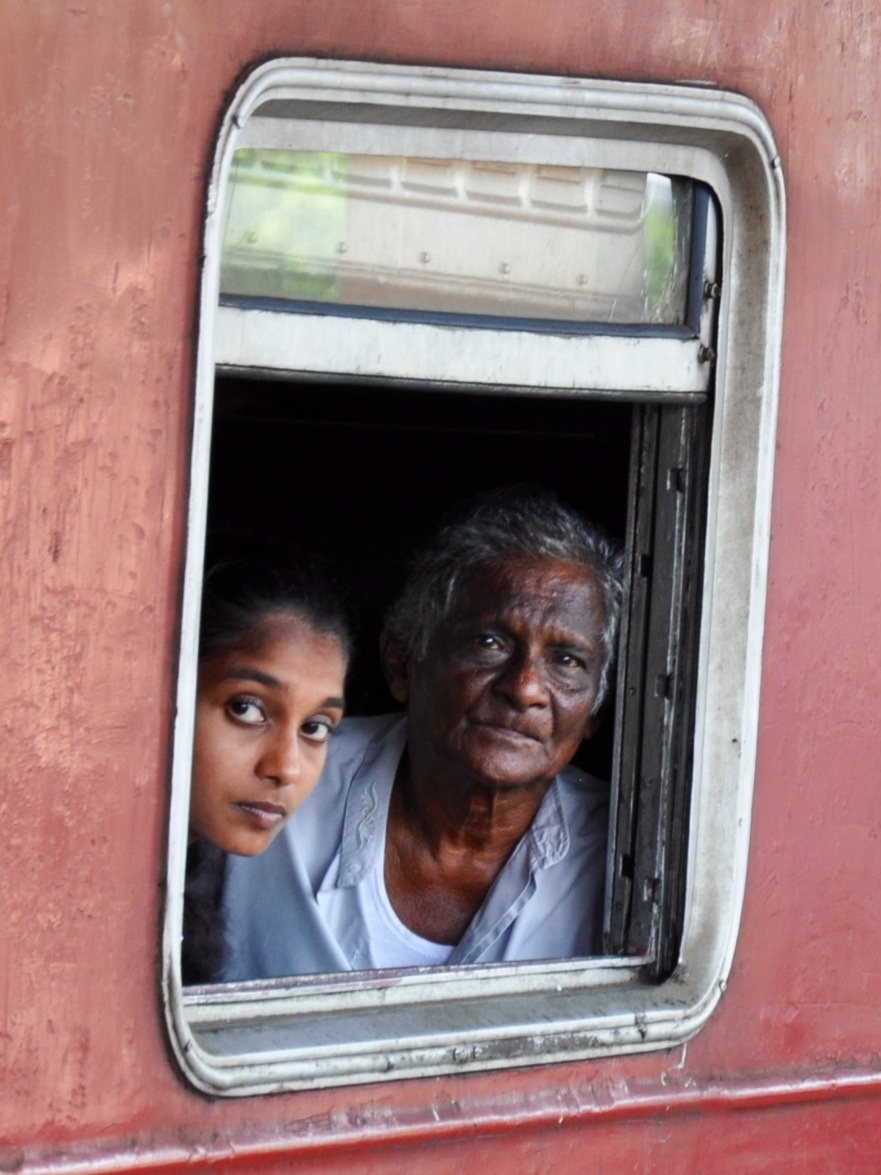
Some of the faces I saw while waiting to board
Arranging a driver for the gaps
To visit the lofty palace at Sigiriya, I hired a car and driver for the day, stopping off on the way back at an elephant sanctuary. There’s no rail link between Ella and the south coast either, so again, I hired a car and driver. This time I stopped off half way to take an elephant safari at Uda Walawe. Although I could have picked up a train at Matara, I chose to book the driver to Galle so I wouldn’t have to clock watch all day. Drivers were arranged as I went along, either through the hotel or via a taxi driver at a station. Costs aren’t excessive by UK standards. To travel from Galle to the airport via the fast expressway costs around 11000 rupees including tolls (about £55).
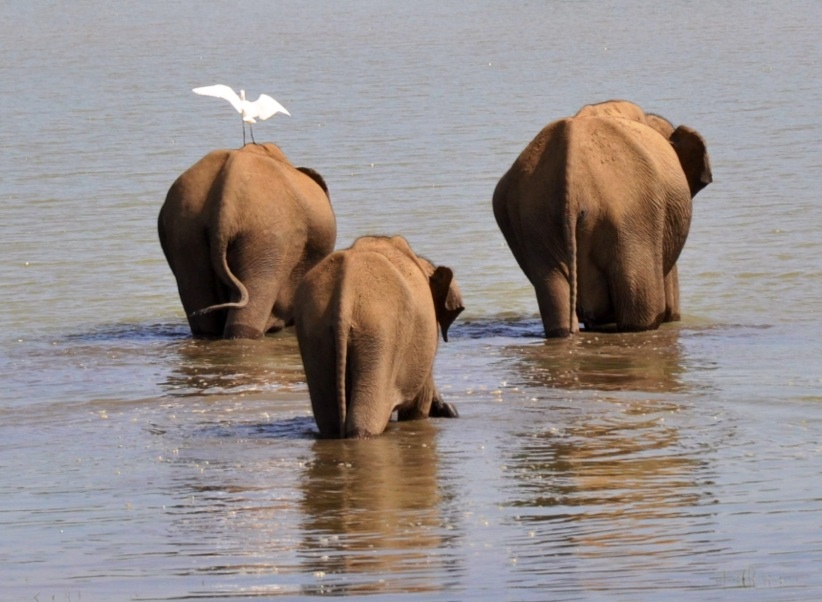
Seeing the elephants at Uda Walawe requires a car as the rail network doesn’t extend to that part of the country
To book or not to book?
Some trains can be reserved online and you may wish to book these trains for the beginning and end of your trip if you want to be sure of making connections. Depending on how long you allow at each stop, you should be fine to just purchase your other tickets as you go along, unless you’re travelling in a large group or at a holiday time.
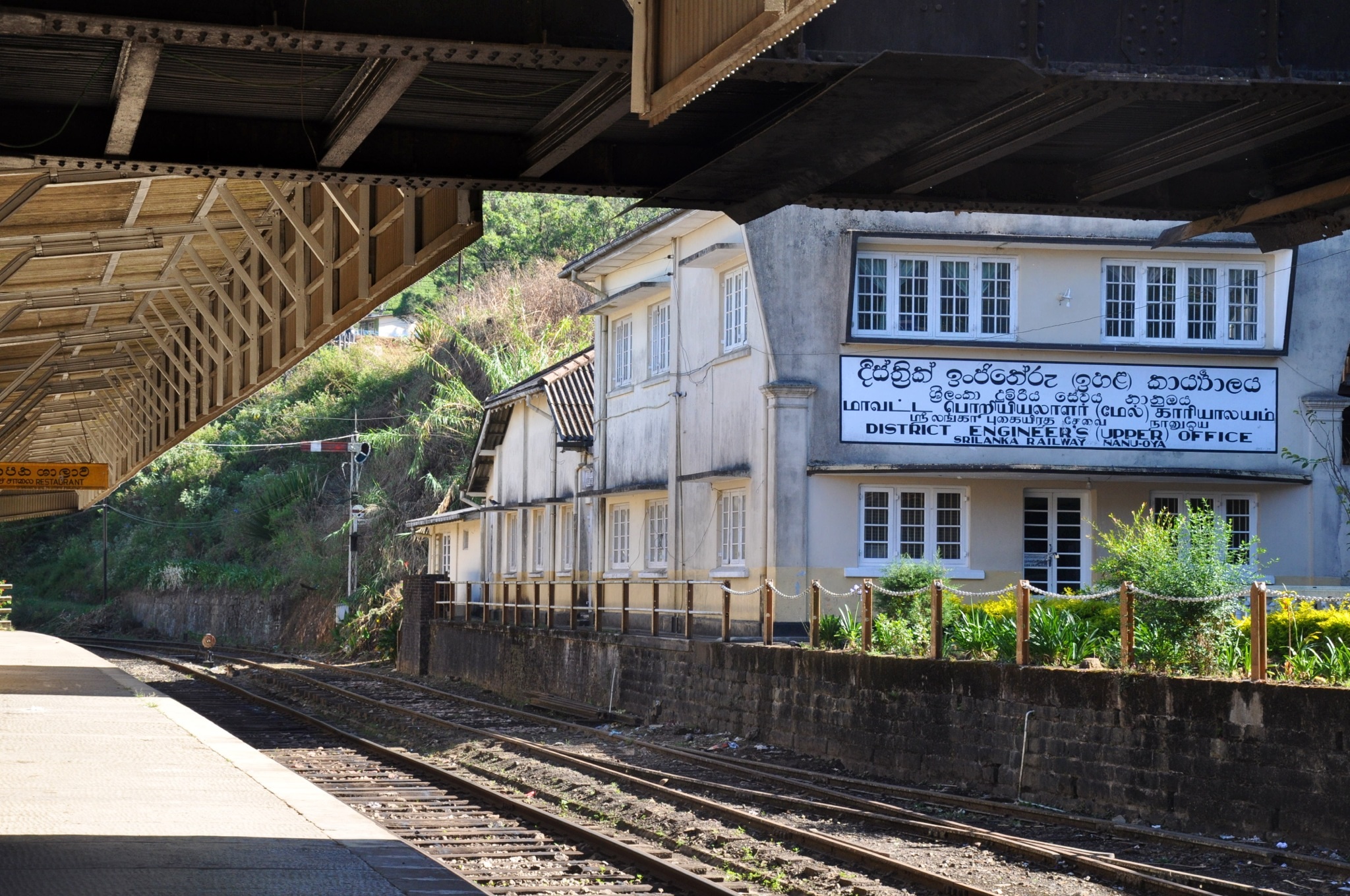
Tickets are easily purchased on the way; my advice is to call in at the station a few days ahead of travel
Where did I get my tickets?
I caught the Rajhadani Express from Colombo Fort to Kandy; a reserved seat in air-conditioned first class cost 1100 rupees (less than £6). It was straightforward to book online. Seats become available two weeks prior to departure and you just need to make a note of your reservation number. On arrival at Colombo airport, as you exit into the tour and taxi desk hall, you’ll see a Mobitel counter right by the door. They will print your ticket for you on production of your reservation number and passport. Alternatively, you can do this when you get to the station.

The Rajhadani Express
It wasn’t what you’d call luxury by European standards but the fat leather seats and padded arm rests were comfortable. The train lurches around a lot so whichever carriage you opt for it’s not going to be a relaxing ride, however. Expo Rail bookings work in a similar way to the Rajhadani Express with their own dedicated website. However, departures with these two companies are limited and may not fit in with your plans. You can check the online schedule on the Sri Lanka Railways website for a full list of trains operating on the days you wish to travel.
Booking regular trains
Whether or not you can book other trains in advance depends on whether the train has any reserved seat carriages or not. Following up on a recommendation from the Man in Seat 61’s excellent website, I booked the Kandy to Nanu Oya leg with Visit Sri Lanka Tours, a UK based travel agent. They were efficient and most importantly, the reservation number they sent me was recognised at Kandy station when I went to collect the ticket. Obviously they charge a premium for this service, but their rates were not exorbitant.

If a web connection eludes you, use the station timetables
Reserved carriages can be first, second or third class. First class isn’t necessarily air-conditioned but can be. Don’t expect luxury; it’s more about space than quality. Second class usually has four seats per row, overhead fans and windows that fully open, while third class is more crowded with six seats per row.
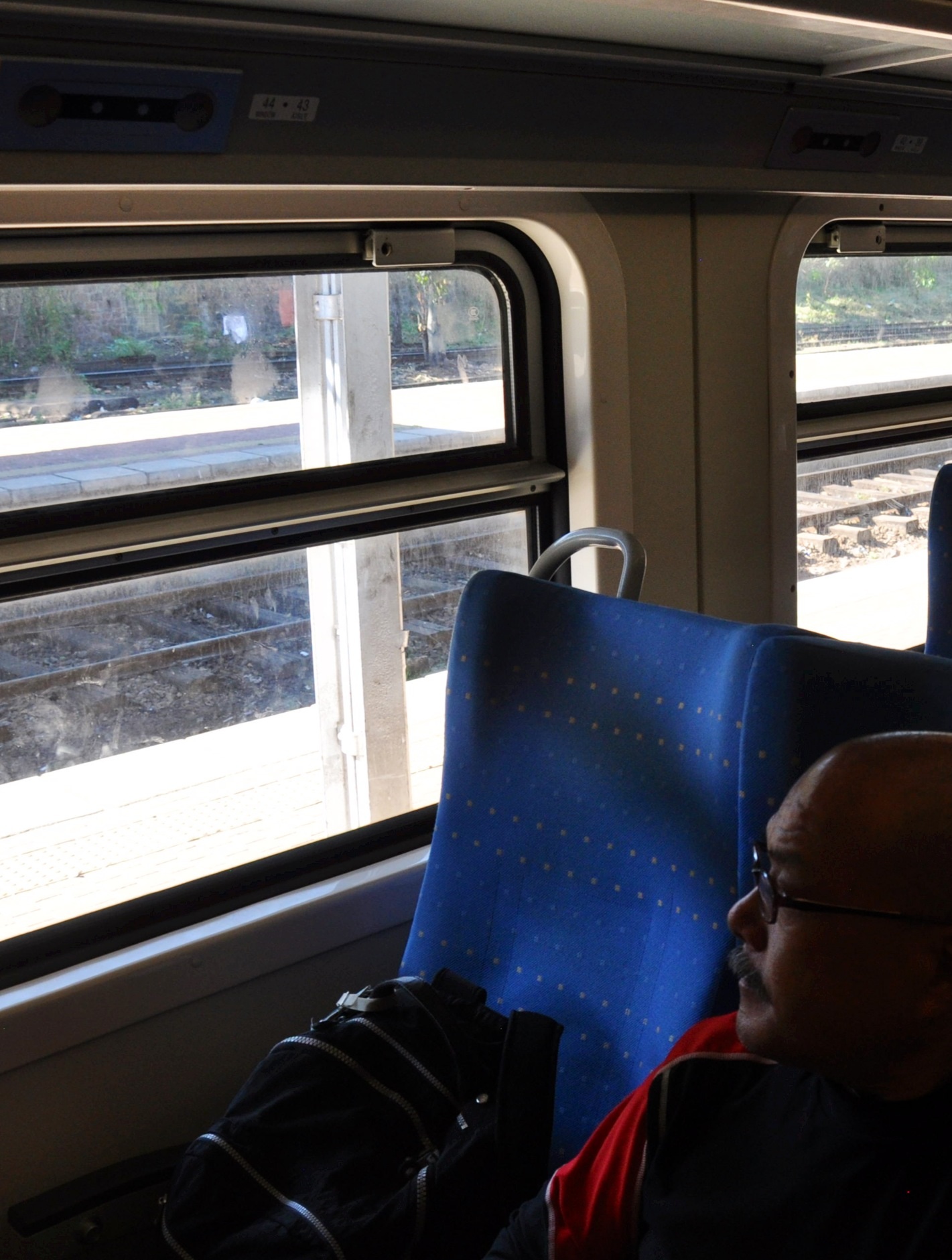
First class carriage
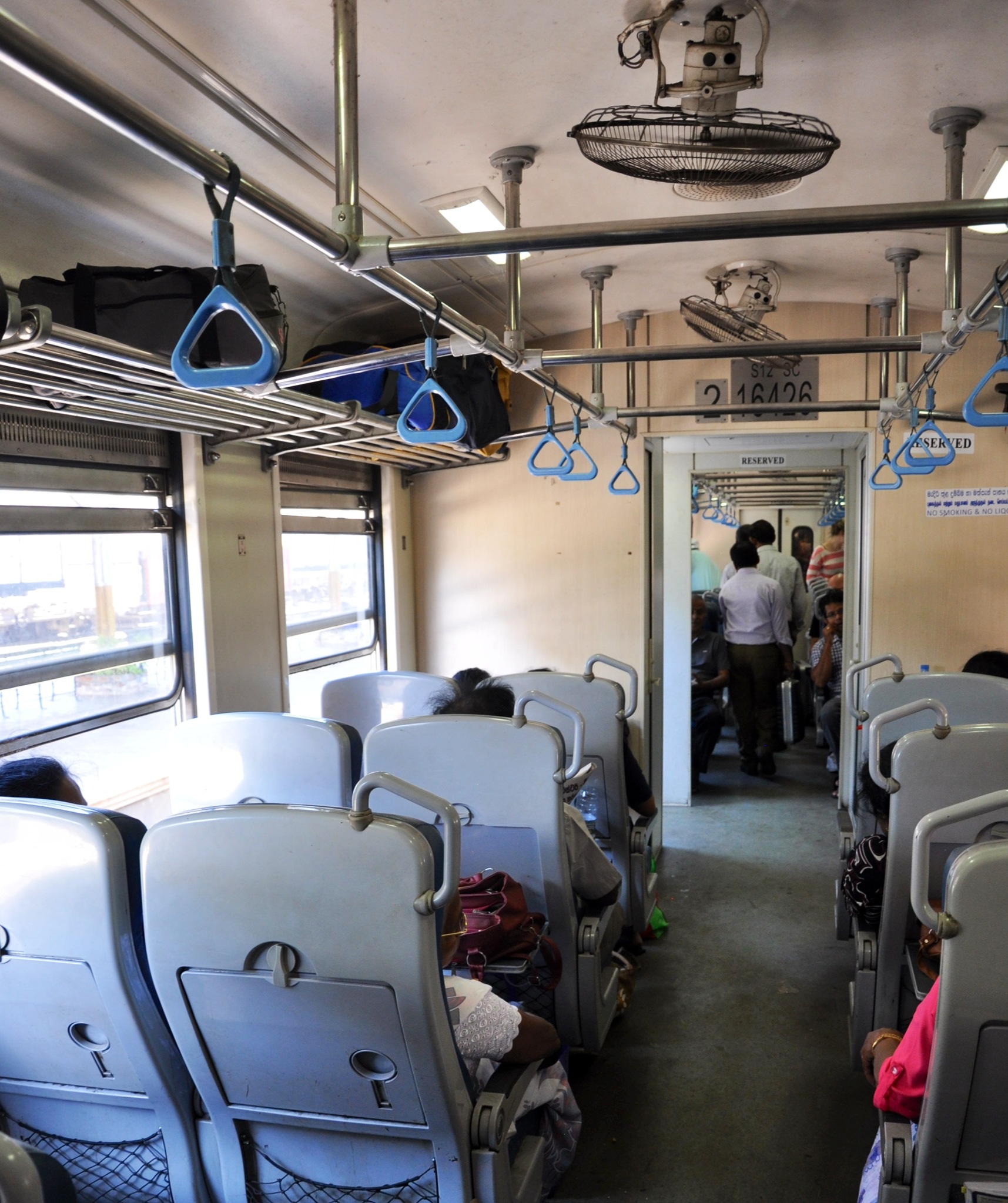
Second class carriage
When I booked the train from Kandy to Nanu Oya second class was full so I bought a first class ticket for 1000 rupees (about £5). I was told that sometimes additional reserved seating is released at the last minute at a premium price. If at first you’re told the train is full, it might therefore be worth asking again the day before. This strategy worked for a London couple I met on the train whose driver procured second class reserved tickets at the last minute.

Or ride at the door…
For at least half the journey I rode by the door as it was more social and I could take better photographs from the open doorway. I tried not to think about health and safety too much, but definitely held on tight. One jolt and I could have been offering myself as extra labour in a trackside tea plantation.

Great views from the open doors for photographers
From Nanu Oya to Ella a first-class observation car had been attached to the back of a train mostly hauling freight but with a couple of unreserved passenger cars also. I wouldn’t say the view out of the dirty observation window was much to write home about, for photographers at least, but the windows did open fully making for some fantastic scenic shots from my seat and a welcome breeze too.
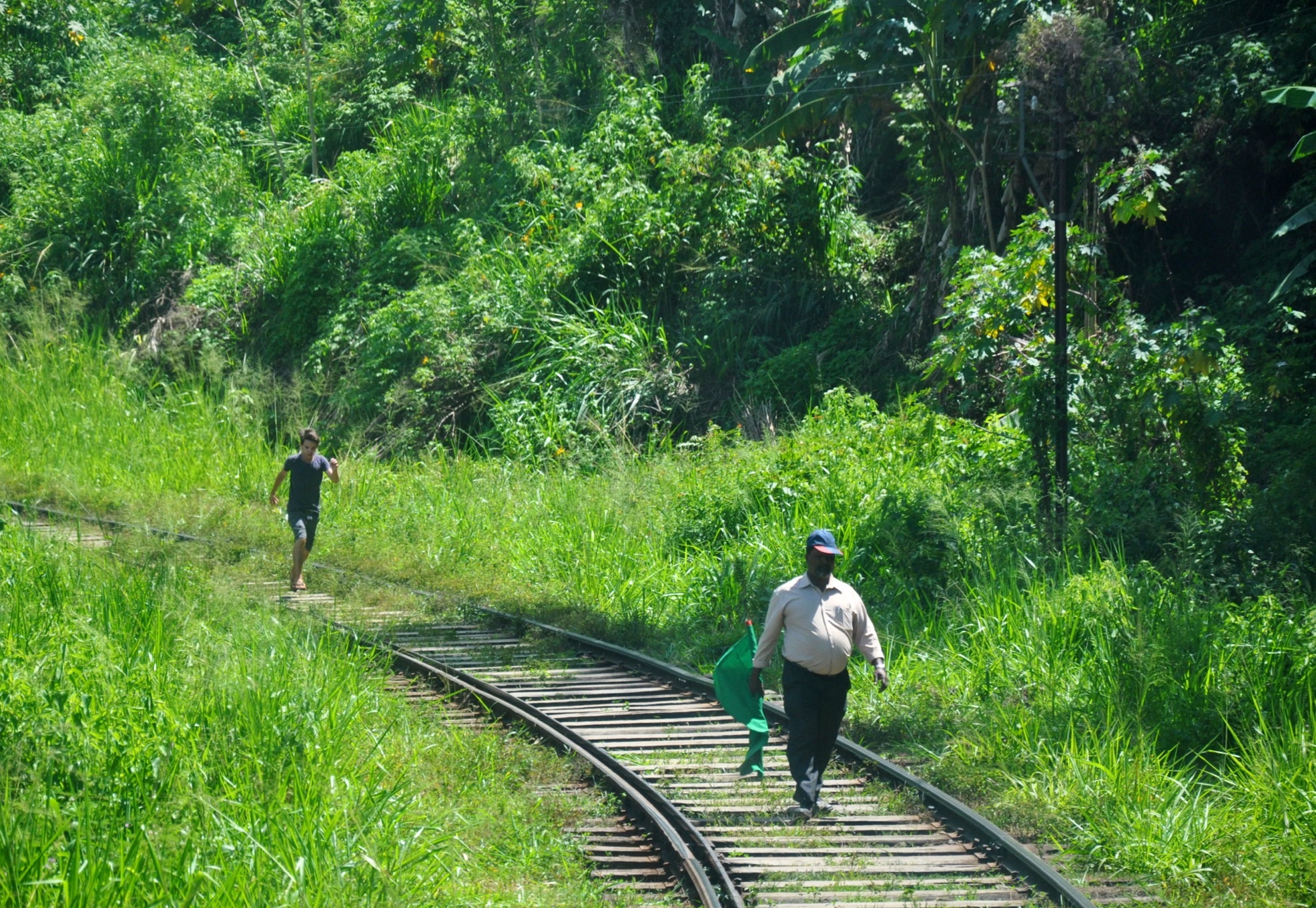
Station master just outside Ella station
On the Weligama to Galle hop, I just bought a ticket on the day as there was no allocated seating on that local train. It cost 60 rupees (about 30p) and I just found a seat when the train pulled in.
As it was a middle of the day departure, it wasn’t crowded, but on some peak time services the advice from the station master was that to get a seat, you may have to fight. I didn’t like the sound of that for the Galle to Colombo leg of my trip which I would have had to make at rush hour with luggage, so I opted to hire a car and driver instead. Had my schedule permitted, I could however have pre-booked an afternoon train with a reserved seat, just not a morning one.
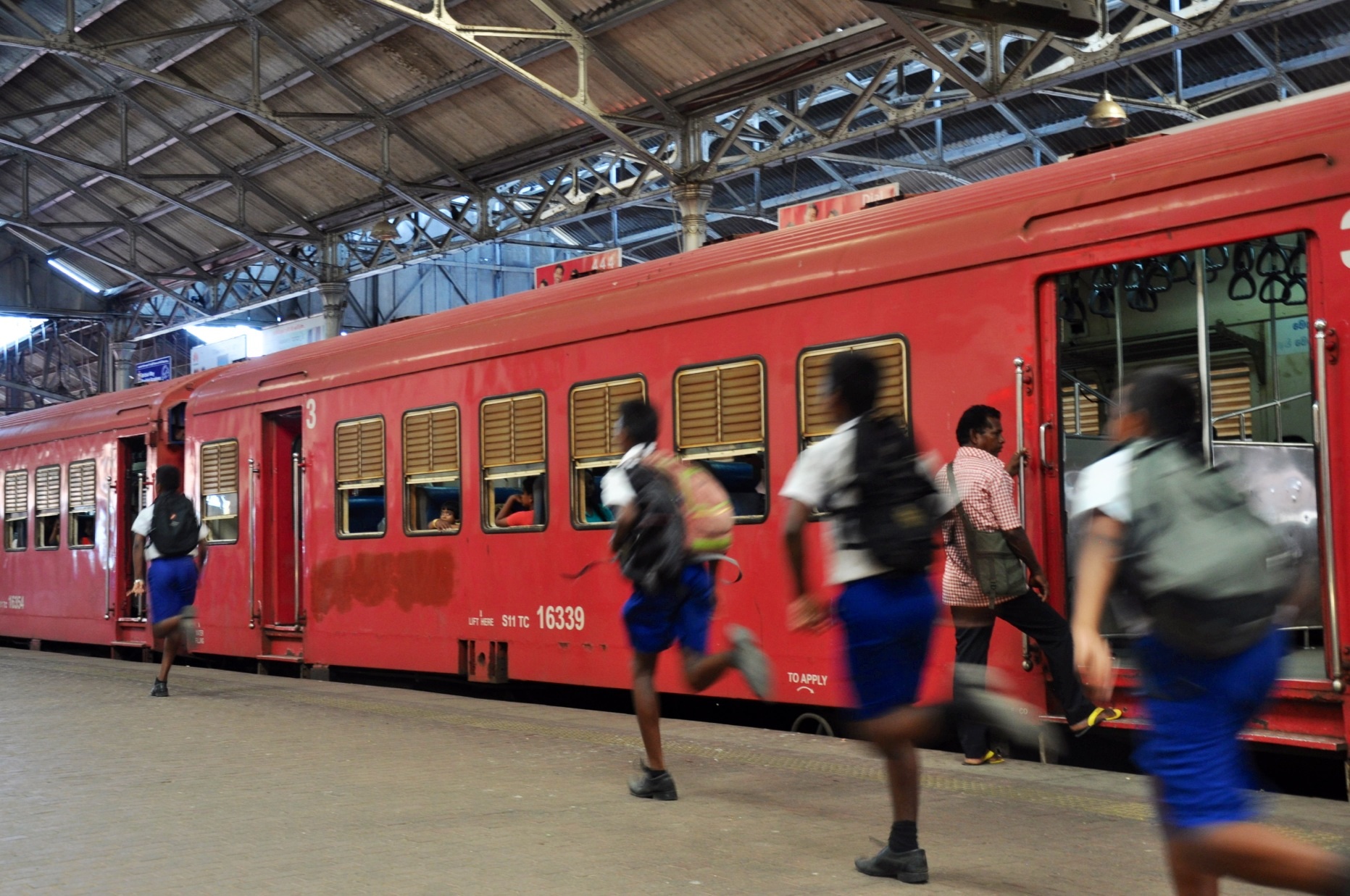
Boys running for their train at Colombo Fort station
And one last piece of advice…
All tickets are collected on exit so make sure you keep your print out (reserved seating) or little cardboard ticket (regular seating) safe throughout the journey. My ticket was checked en route by an inspector on the Rajhadani Express but not on subsequent trains.
Elephant spotting in Uda Walawe
Uda Walawe National Park is home to the largest concentration of elephants in Sri Lanka. It was created in 1972 and centres on the Uda Walawe reservoir. Although in March there was quite dense vegetation on the way in to the park, it thinned by the lake shore and thus made it easier to see wildlife. At first, sightings were limited to a few monitor lizards and birds, neither of which excited me much. But at the lake, a couple of herons were pottering about in the shadows seemingly oblivious to the crocodile skulking behind them. In the middle distance, some water buffalo wallowed.

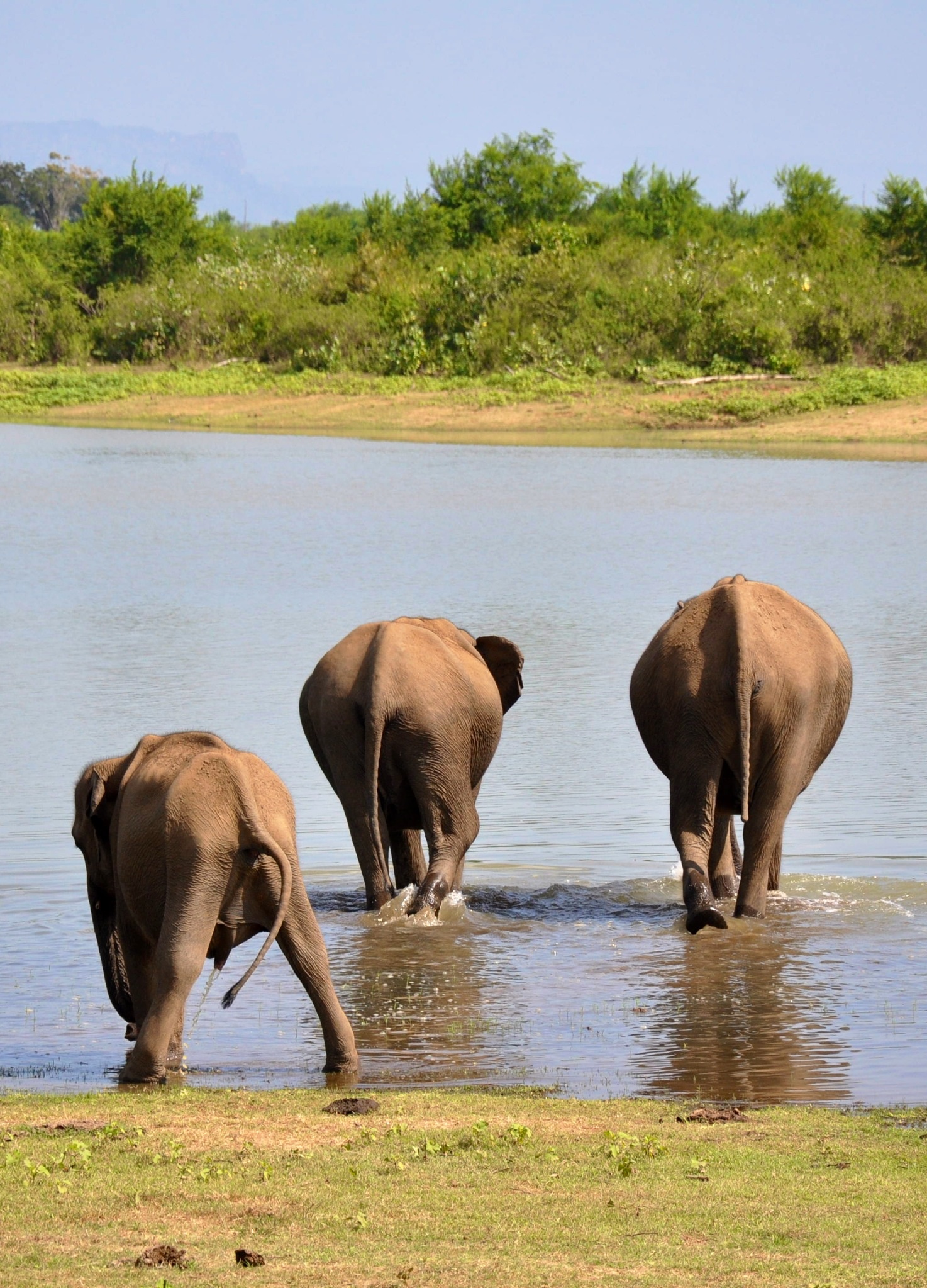
But I’d come to see the elephants, said to number around six hundred, making it the best place to view them in the country. Easily seen year-round, herds can number over fifty but the largest family group I saw was eleven, still impressive. Our first sighting, a mother with two juveniles, was entertaining. They took a stroll down to the lake where the youngest couldn’t wait to relieve himself in the water. Toilet taken care of, it could bathe happily before the trio wandered back into the bush.
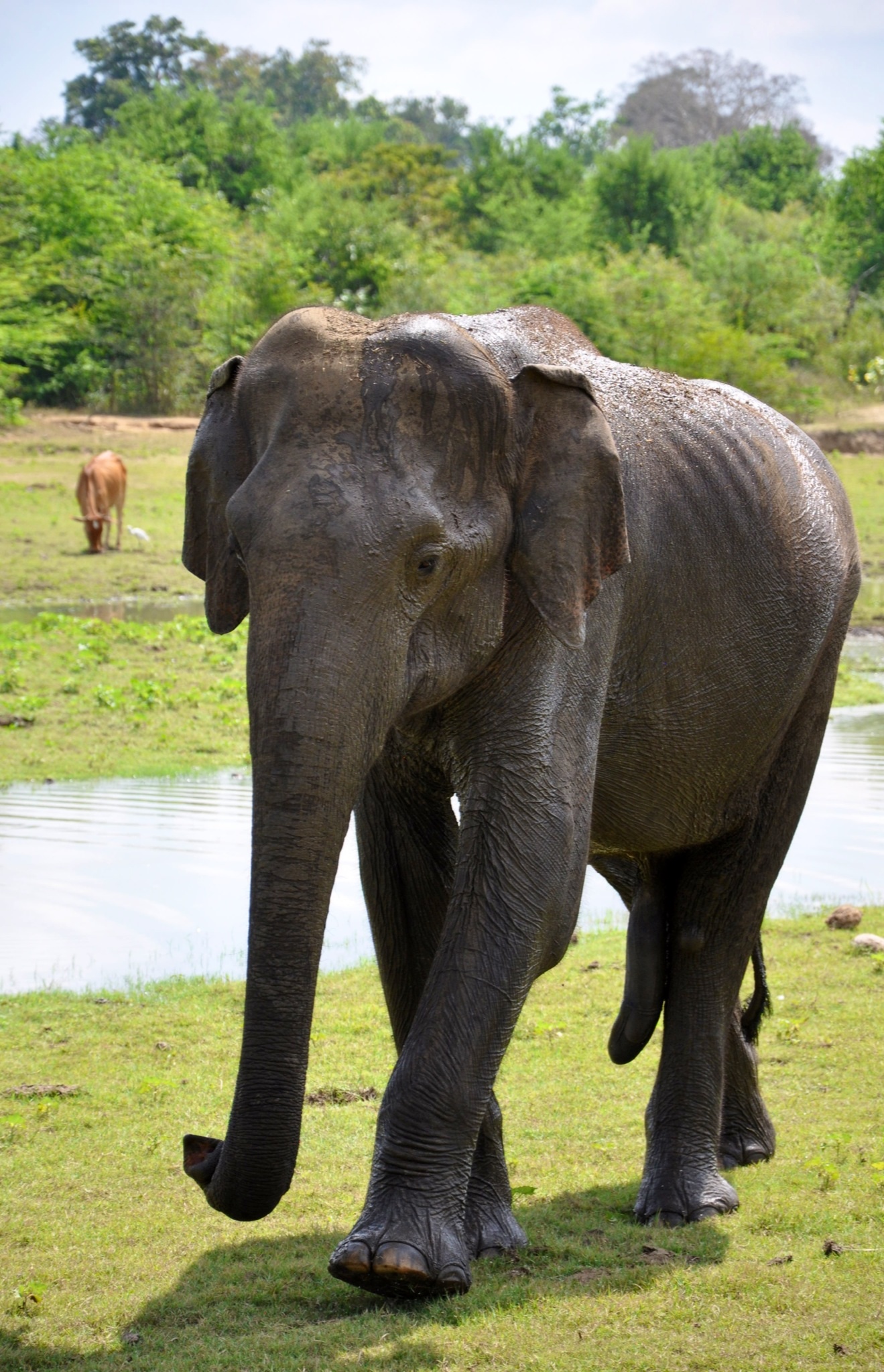
As we drove along the lake shore dirt track, a lone adolescent passed us at close range, near enough to leave us in no doubt that he was a male. Unperturbed by the camera clicking, he ambled past towards the lake.
In the vegetation, the thick leaves can provide excellent camouflage, but the guide was equally skilled in locating the wildlife. This was our closest encounter, though fortunately the creature was very docile and didn’t warn us off.

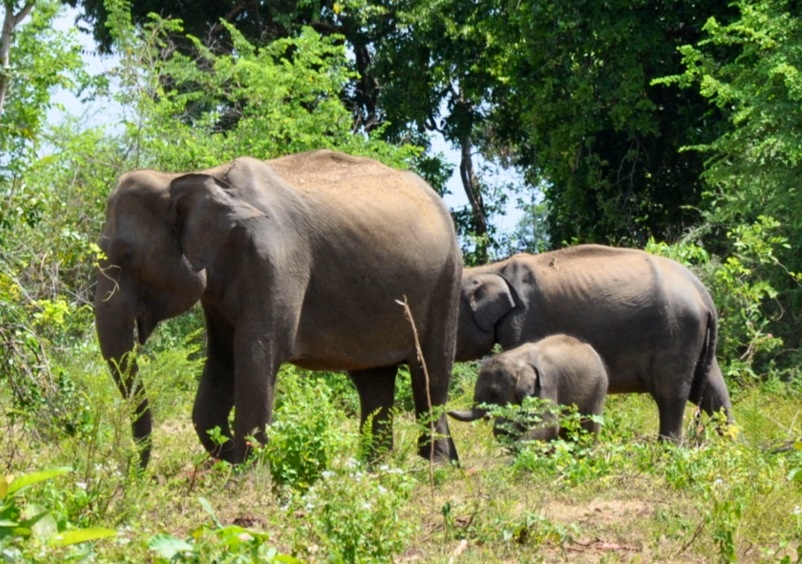
A herd of eleven including two babies was the highlight of the drive. One infant looked to be just three months old or thereabouts, with the other perhaps six months. It’s always delightful to see how the older members of the family protect the youngest when they’re on the move, keeping the babies close by but placing themselves between infant and safari vehicle just in case.


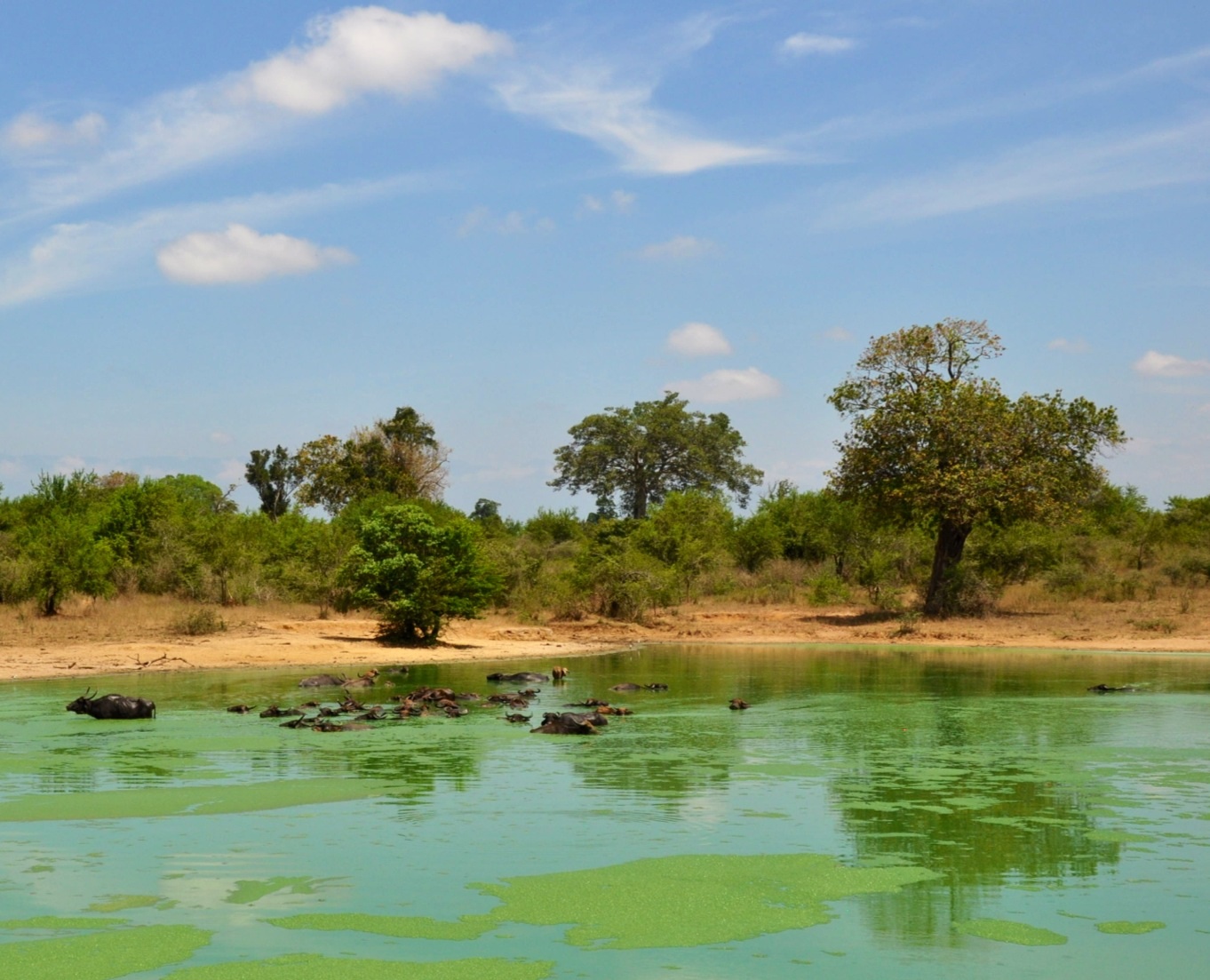
There are other species to keep the elephants company, and I saw plenty of water buffalo and in the distance, a couple of spotted deer. A family of monkeys swung in the branches of a tree and amongst the birds I recognised were a grey heron and a kingfisher by a lake so full of green algae it was hard to decide which was the most vibrant in colour. Leopards are said to be present in small numbers though I wasn’t lucky enough to encounter one.
While some people stay at one of the nearby hotels or guesthouses, I took a game drive en route from Ella to Galle. The three hour stop was a welcome diversion from sitting in the car. My driver arranged a safari jeep within minutes and it cost about £45 for a private excursion with Wild Safari Service including all entrance fees. Be prepared to haggle.
Tea time in the Hill Country
I expected tea picking to be difficult. Working in the sun on scarily steep slopes for eight hours wouldn’t be my choice of job and certainly not for the 600 rupee (£3) daily wage that these industrious women earn.
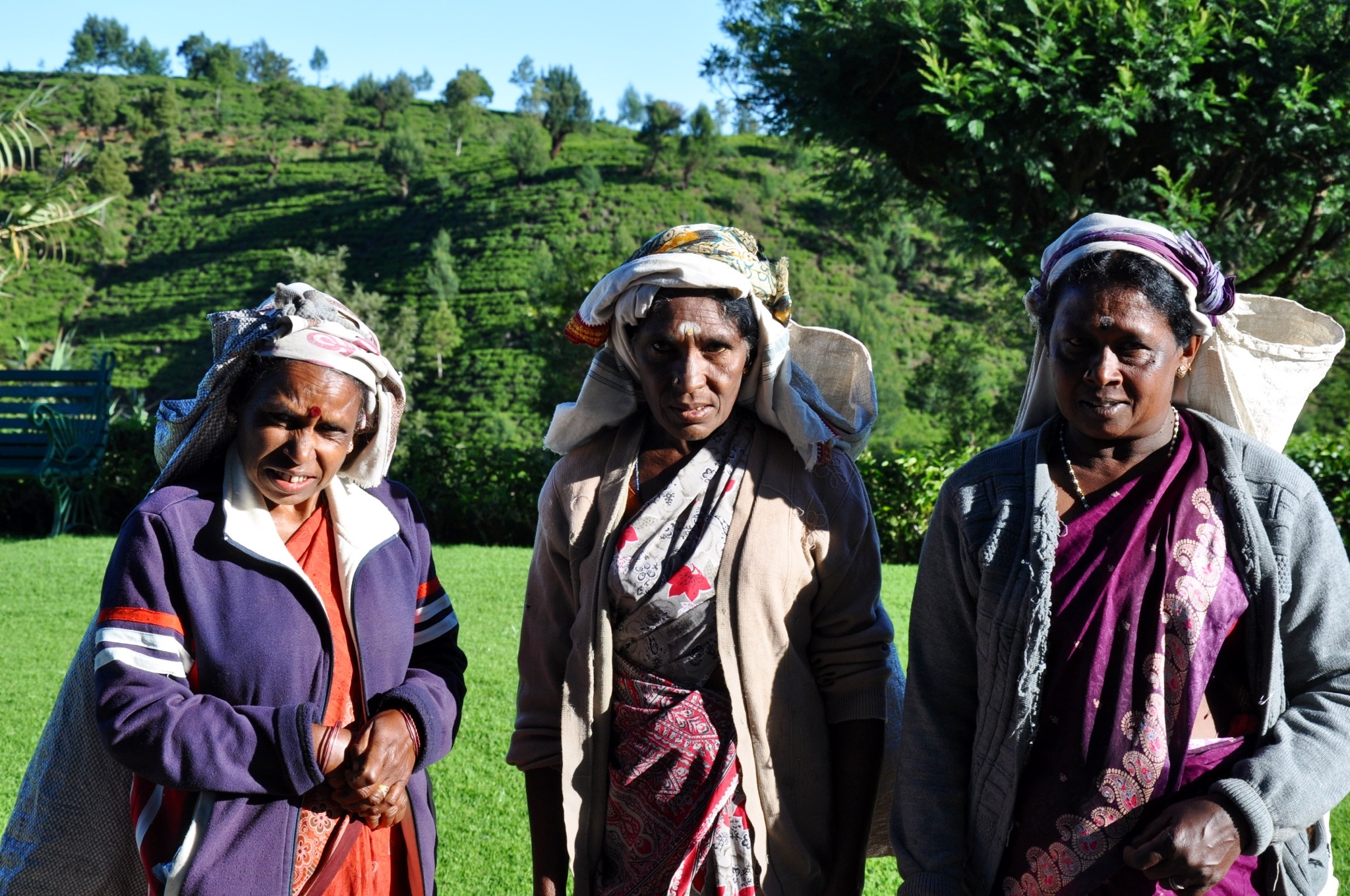
Tea pickers off to work
Learning that the Heritance Tea Factory offered a tea plucking and tasting activity, I jumped at the chance to try my hand. The slopes carpeted with squat tea bushes were relatively gentle compared to those I’d seen from the train on the way in and thickening cloud promised to deal with the heat issue.
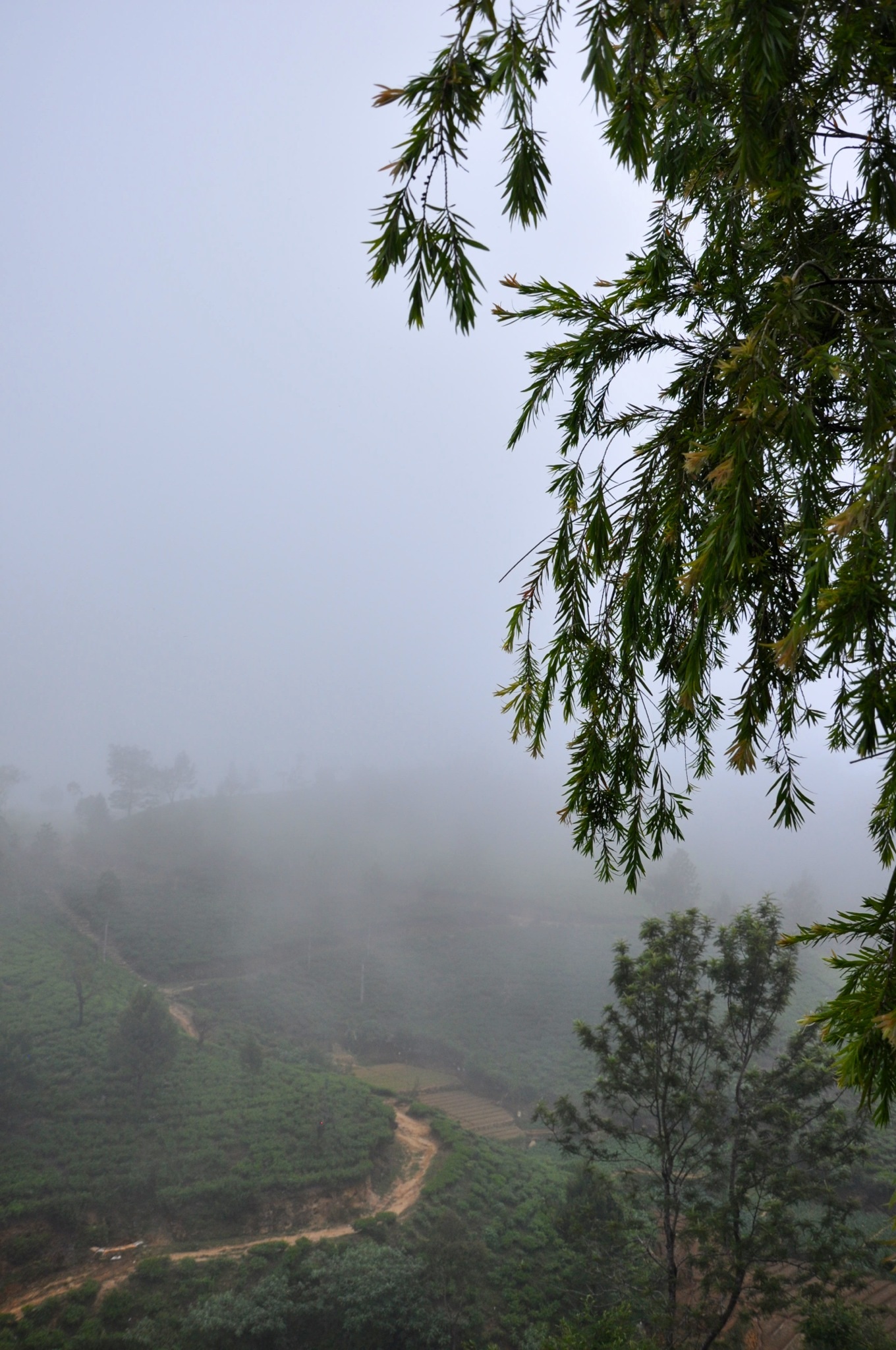
Weather changes fast in the hills
The staff at the Heritance kitted out their small but enthusiastic team of volunteers in suitable attire: saris for the women and sarongs for the men. Raising my arms, my dresser tied a string snugly around my waist, into which she tucked a carefully pleated sari. Six metres of fabric is expertly tied to create an elegantly flowing dress, pinned across one shoulder to ensure modesty isn’t neglected.

The basket for collecting leaves
Elegant, that is, until I moved. Sadly walking in a long dress without tripping had never been a skill I’d mastered and squeezing my way through the tiniest of gaps between tea bushes only compounded my clumsiness. Unhooking me from a stray piece of barbed wire, our guide led me to the plucking area and demonstrated which leaves to pick.

The guide showed us which leaves to pluck
Get it wrong and the tea will be useless.

Tea, glorious tea!
As I started to pick what I hoped were the softer, greener leaves I wished I’d paid closer attention to those deftly thrown into the basket by the expert. My basket, with an optimistic capacity of 3kg given we were only out here for half an hour, looked pathetically empty, despite the guide’s surreptitious efforts to sneak a few handfuls of her leaves in when my attention was diverted.

Not much to show for my efforts

No shortage of tea bushes
The bag attached with a wide canvas strap across my forehead. As I bent over to pick, it swung a little, needing the weight of some leaves to hold it steady. That strap seemed to have a mind of its own, alternating between slipping down onto my glasses and wriggling up to form a Sixties’ style beehive. Eventually, I gave up and balanced the basket on the ground. It wasn’t quite what was expected but at least I could fling in a few more leaves before my shift ended to save face.
The area surrounding Heritance is stunning
It was hard to concentrate given the beauty of the landscape surrounding the hotel – and indeed, it’s own well-tended gardens. The Heritance Tea Factory has a long history. Its original owner was a man called William Flowerdew who bought the land in 1879, only a decade or so after tea bushes were introduced to Sri Lanka by Scot James Taylor.

Heritance Tea Factory
Flowerdew named his factory Hethersett, producing around half a million kilos of tea each year for decades.

Machinery from the factory still in place
The factory buildings were modernised in 1937 but the factory closed, no longer economic, in 1973. Fortunately, it soon underwent a sympathetic restoration: much of the factory machinery remains in situ to make this what surely must be a unique hotel and, with attentive staff, a delight in which to stay.

The hotel has its own tea bar; flavour and strength are determined only by how small the leaves have been ground
The fact that they serve a decent cuppa – well, that’s just a bonus.

Hands off the Flowery Pekoe!
Sigiriya
Sigiriya, or Lion Rock, has been on my travel radar for over three decades.
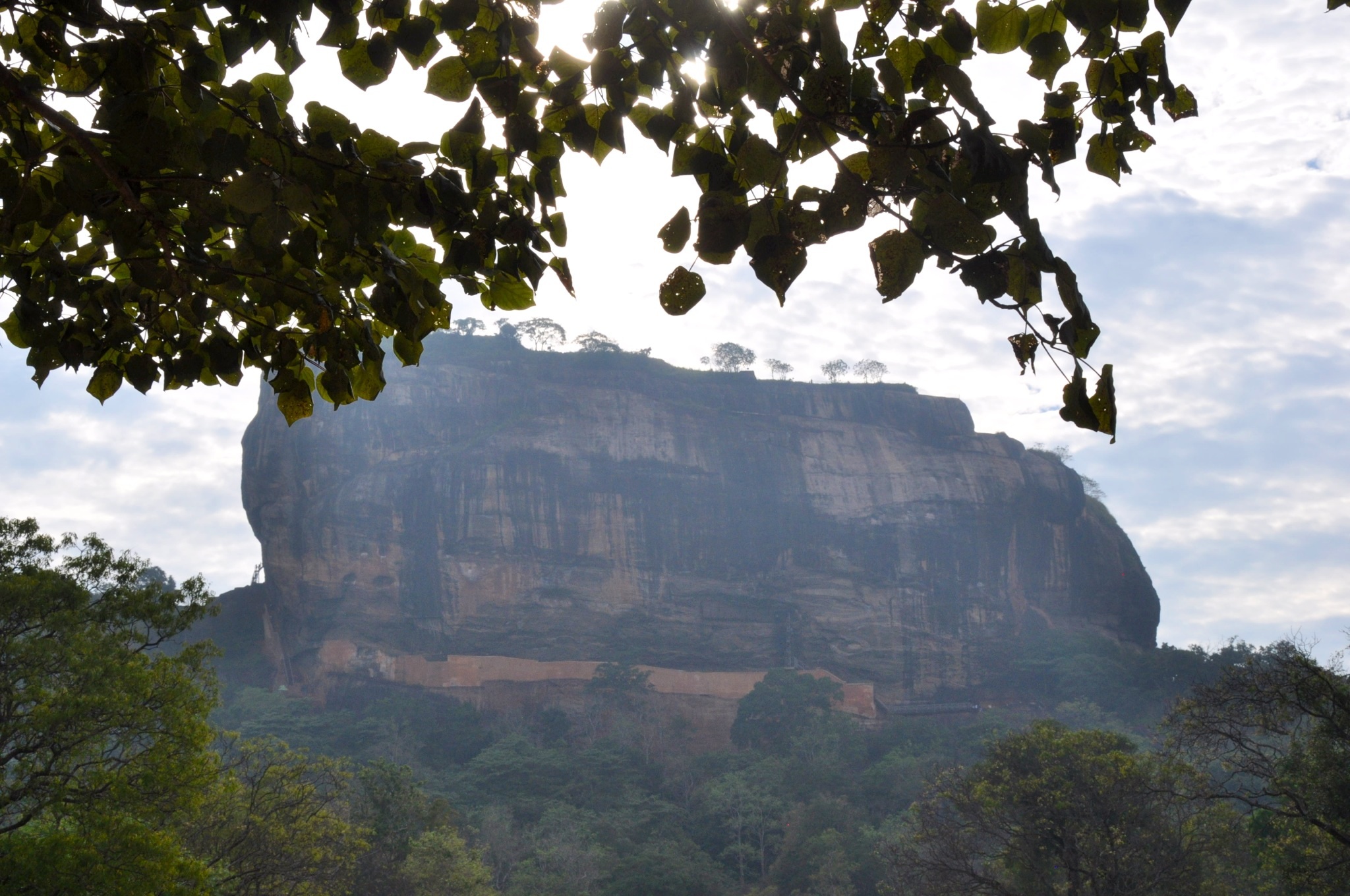
Sigiriya from below
In those days, there were no travel magazines littering my desk, nor could I surf the web to take me to exotic destinations over a cuppa. (How did I manage?) What I did have, however, was a passion for Duran Duran and in 1982, the band released the video for Save A Prayer. Watch it here:
It was shot on location in various parts of Sri Lanka, among them Sigiriya, which that same year was designated a UNESCO World Heritage site. As the camera panned, I remember watching and wondering how they got up there as the rock face looked impossibly steep.
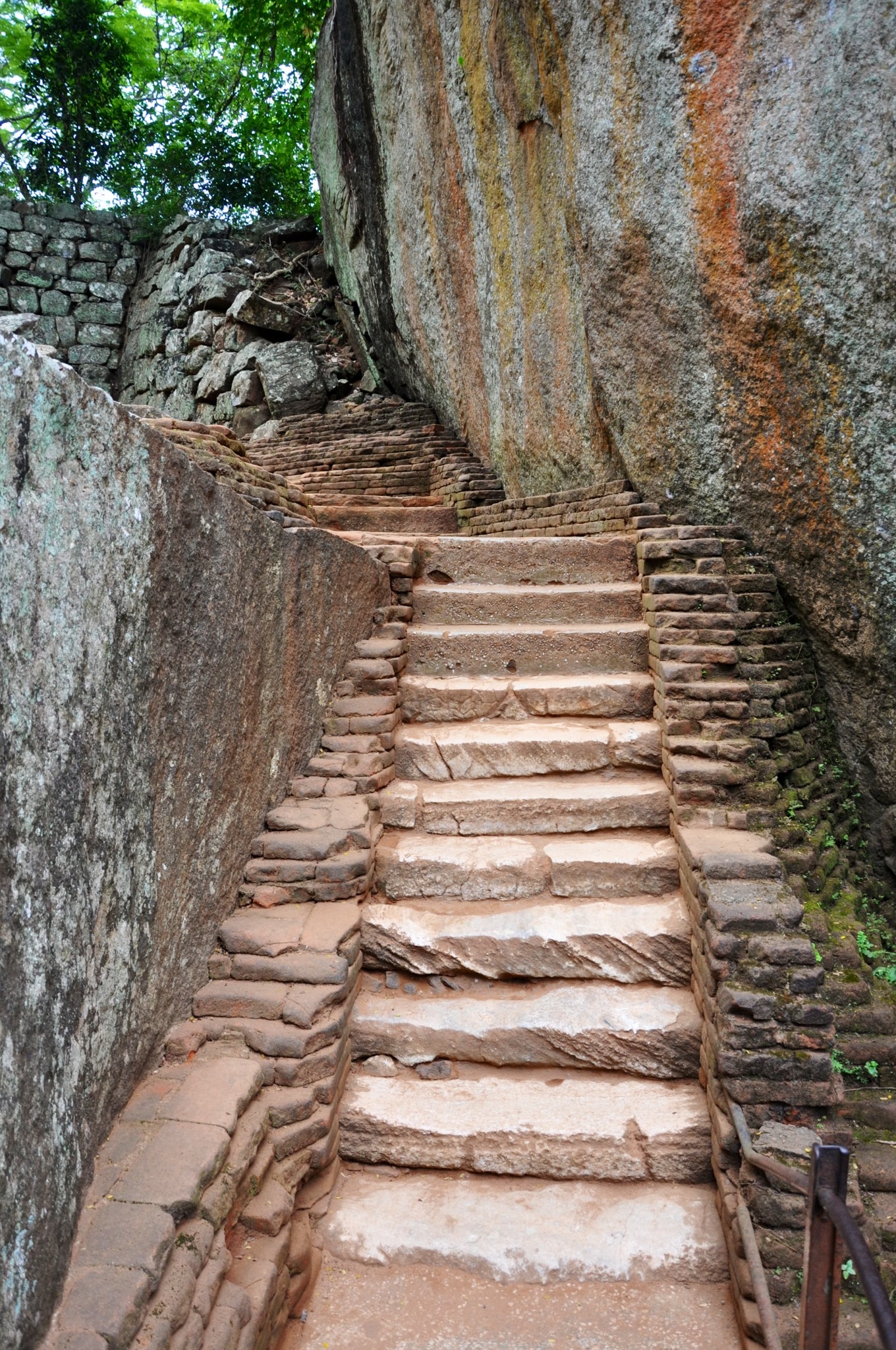
The start of a long climb

Sweeping the sand off helped a little with grip on the smooth stone but wouldn’t want to do this climb in the rain
It is. And unfortunately for me, so too were the steps leading to the top. Slippery stone gives way to spiral metal staircases, the gateway to some impressive frescoes of bare-chested maidens. To my horror, I then had to descend a spiral staircase before climbing again. That’s fifty steps up and the same back just to reach the same height!
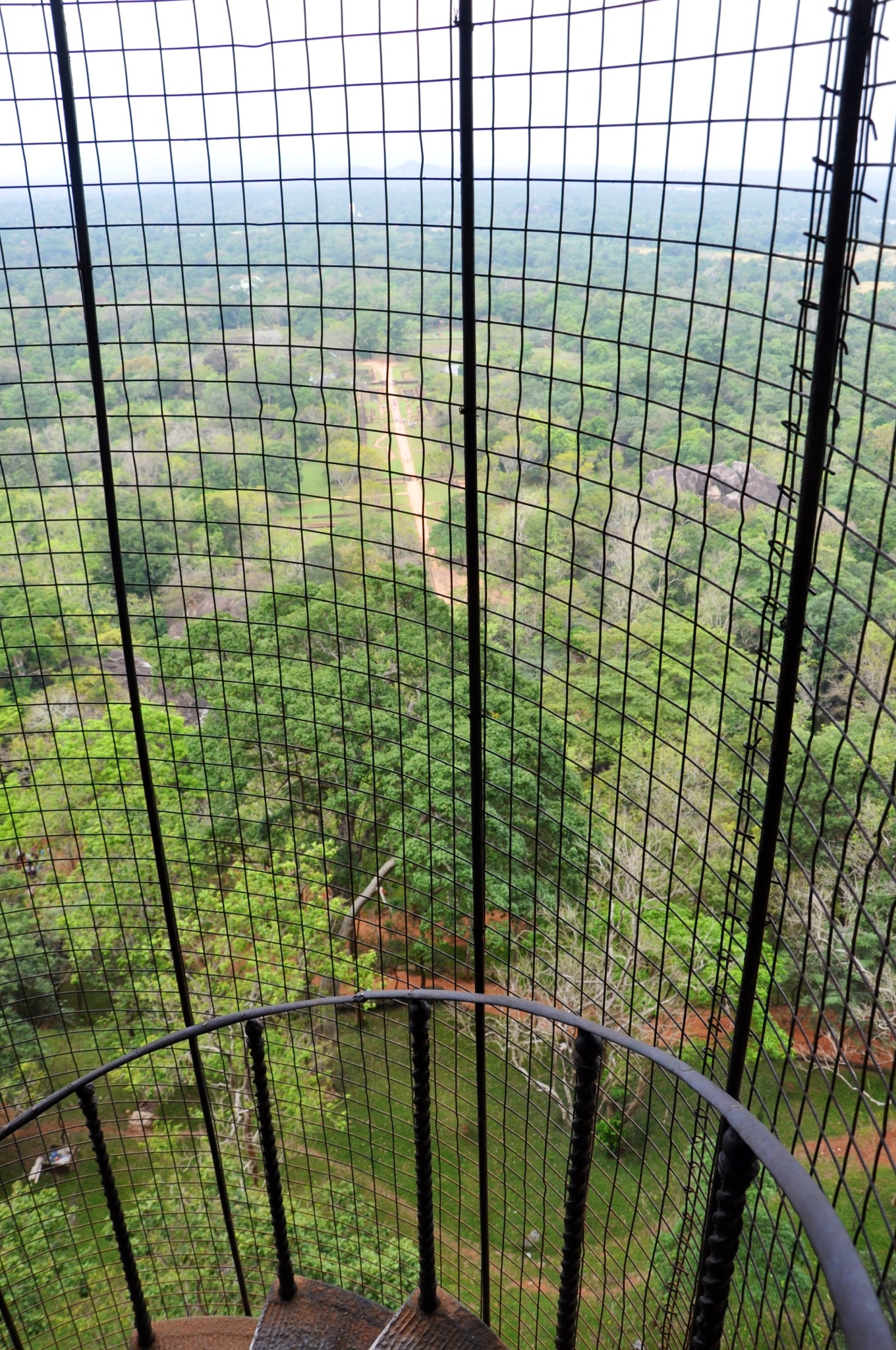
The scariest part – hard to know where to look
Spurred on by teenage dreams, and determined not to be put off by internet-induced nightmares, I made the climb this morning. With several terraces on which to recover my breath, my knees didn’t ache anywhere near as much as I feared.
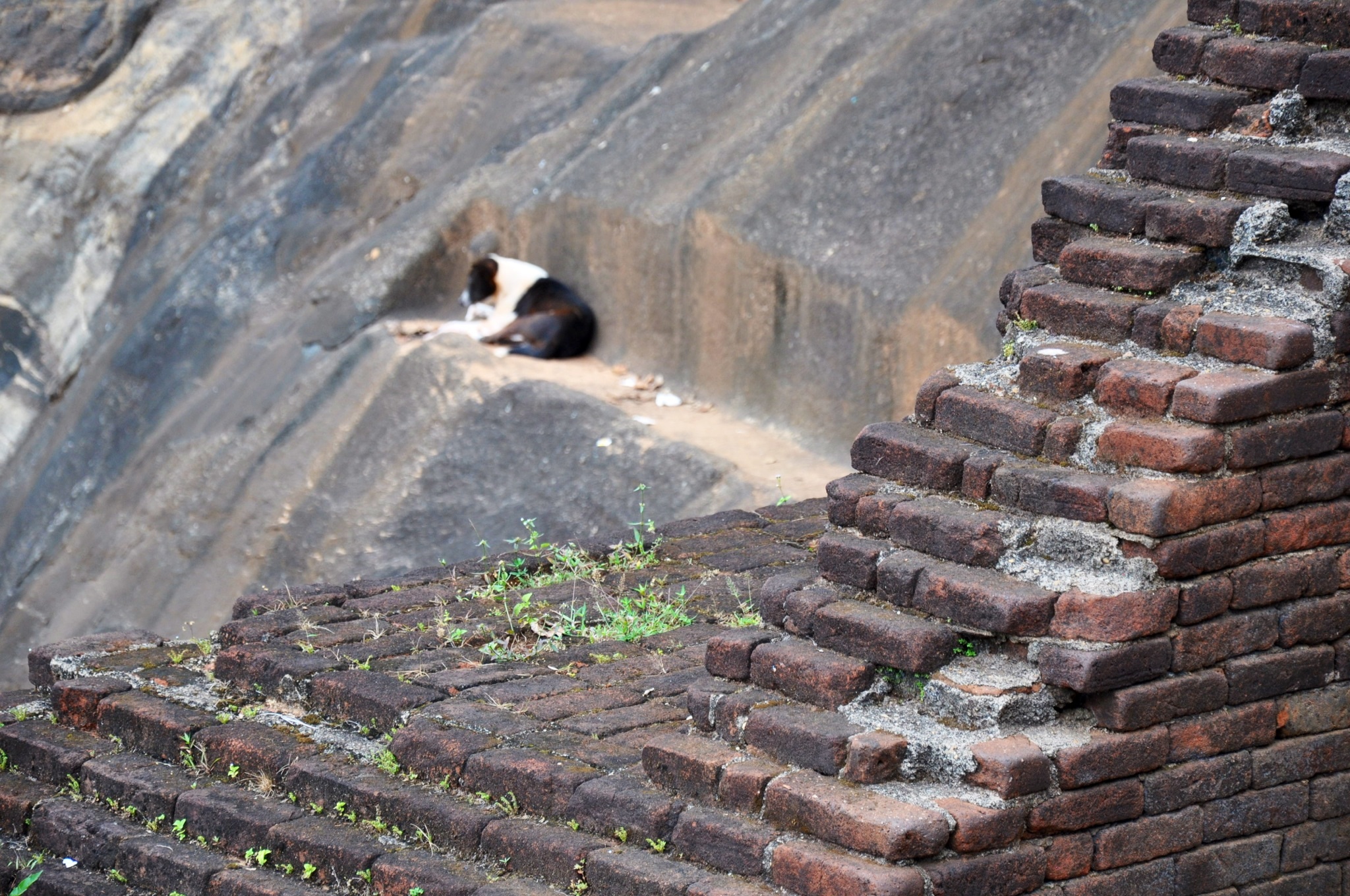
That’s just rubbing my face in it, Mr Dog
But despite an early start, I was sweating profusely as the temperatures flung themselves ever higher and the humidity permeated like a warlike invader. By the time I got to the top I was in no state for a selfie, though I promise you the photos you’ll see here are all mine.

One of the paws at marking the start of the final metal staircase
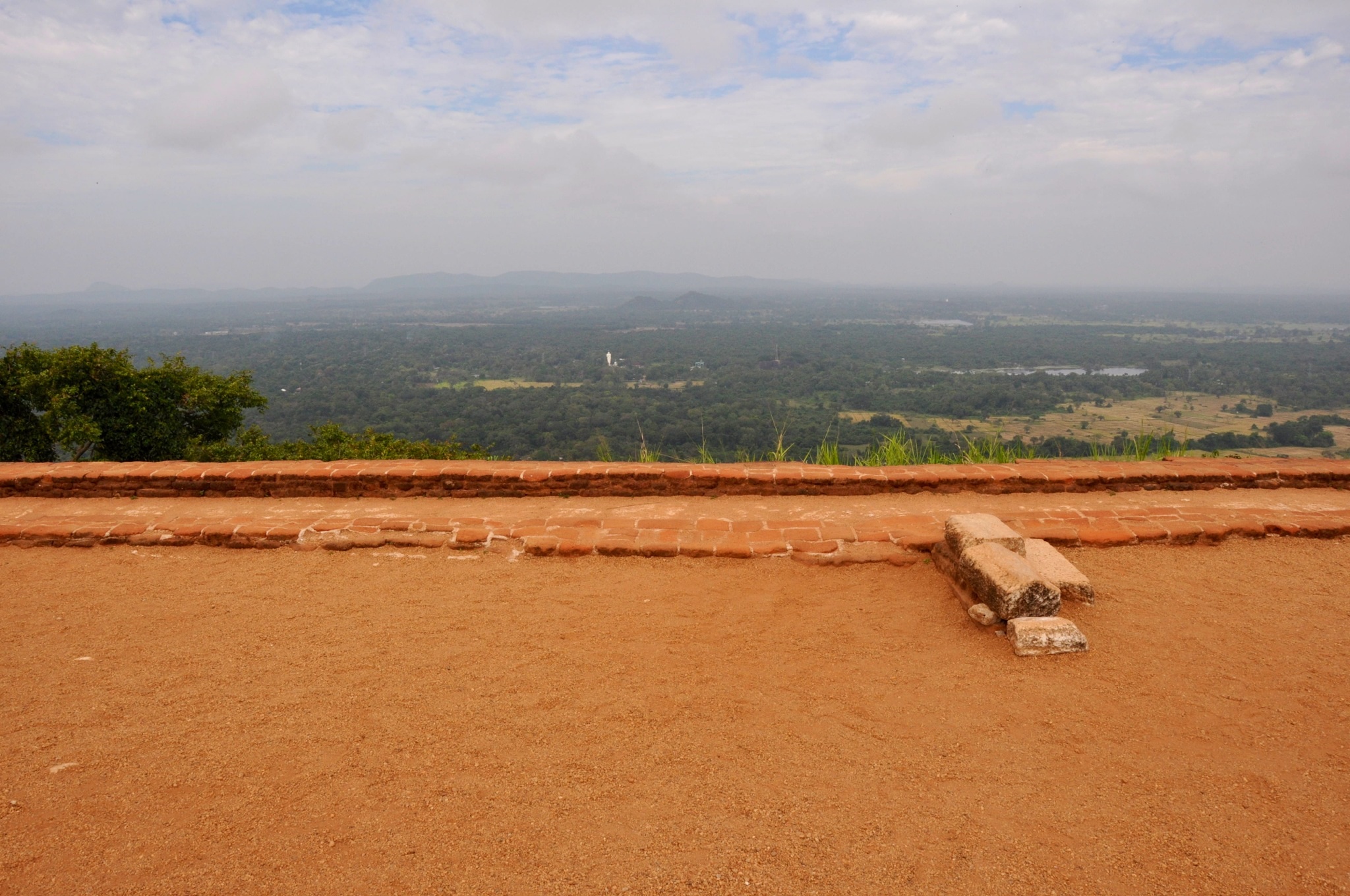
Duran Duran stood right here (well, two of them anyway!)
This lofty archaeological site is thought to be the ruins of the kingdom of Kassapa dating from the 5th Century. Those topless women could well have been his concubines. At the summit, his palace is all but gone, a few tumbledown walls and a pond full of water are the only surviving remnants of a once grand structure.

The water tank at the top
But it’s the view that takes your breath away, not the strenuous climb. See for yourself.

View from the top
I overheard someone near the bottom saying the descent was harder, and this sign at the top didn’t help my confidence. Actually it was fine, and a whole lot less hard work than the ascent.
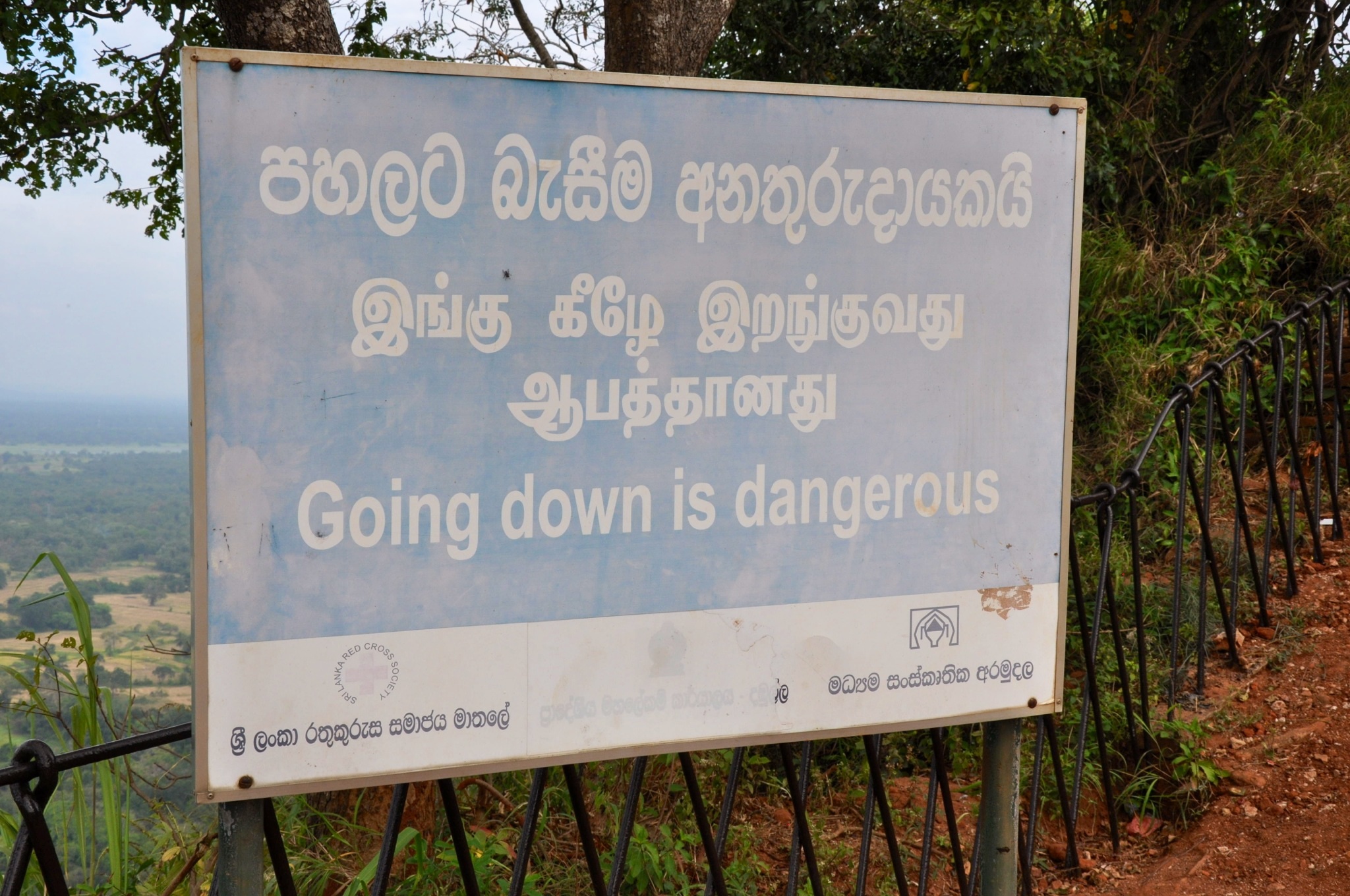
Sign at the top

Fortunately no hornet issues either
Looking at the crowds building, it was definitely a good idea to climb early. The site opened at 7am, not 8.30am as stated in my Lonely Planet.
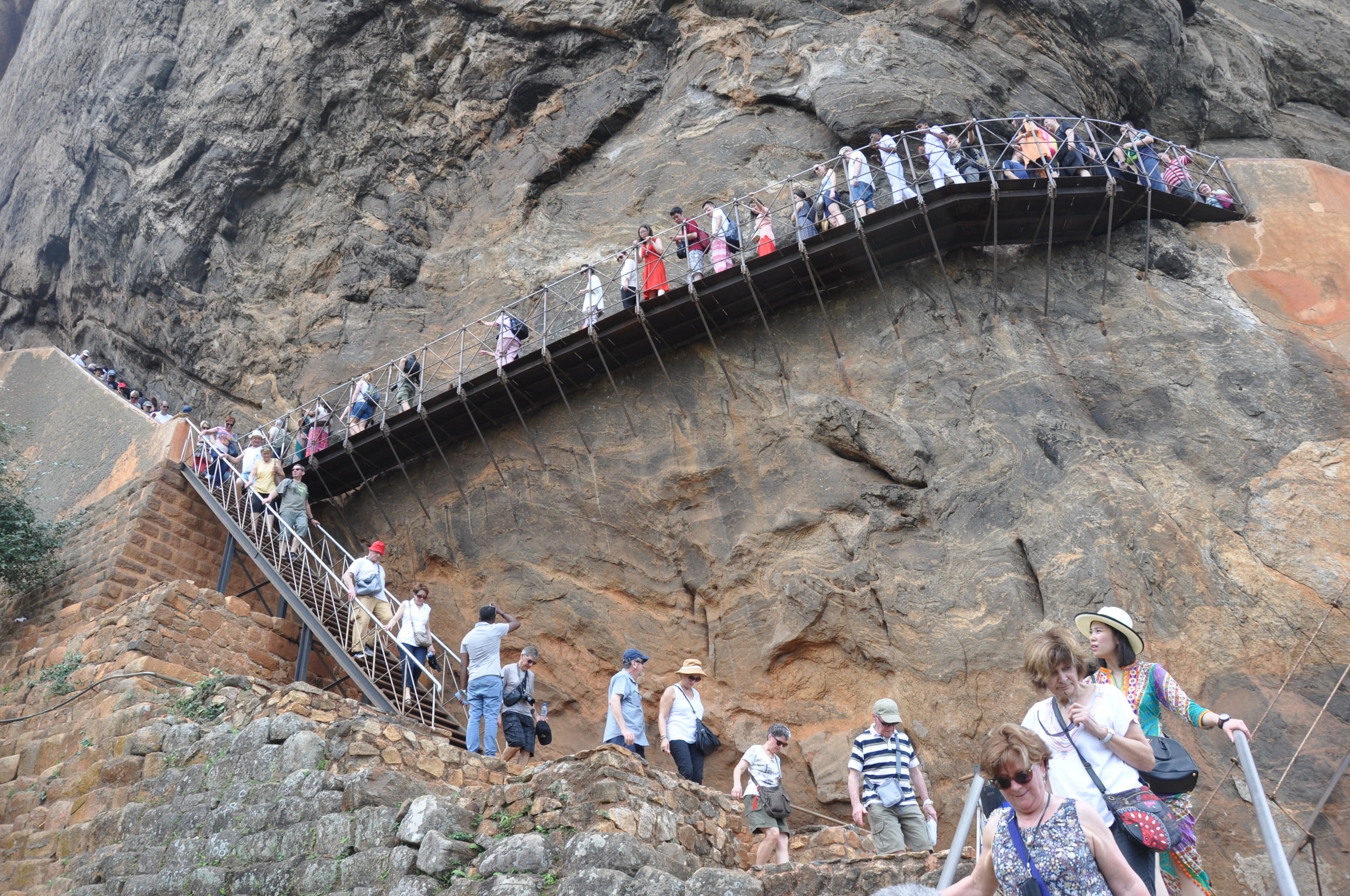
The queue for the top as I made my way back down

Monkeys make their home at the foot, near Cobra Rock
Travel outside your comfort zone
American intellectual Clifton Fadiman is quoted as saying:
When you travel, remember that a foreign country is not designed to make you comfortable. It is designed to make its own people comfortable.
They’re wise words. On the road, it’s all too easy to become indignant when things aren’t going your way. Two decades ago, I got somewhat cross when barred entry to what I hazily remember as a fort in Old Delhi (though it could well have been a mosque). I wanted to climb a tower to take in a view, arguing that my gender shouldn’t influence where I could and couldn’t go. Did I have the right to do that, if it wasn’t my country? Probably not, though such misogynistic attitudes have put me off returning.
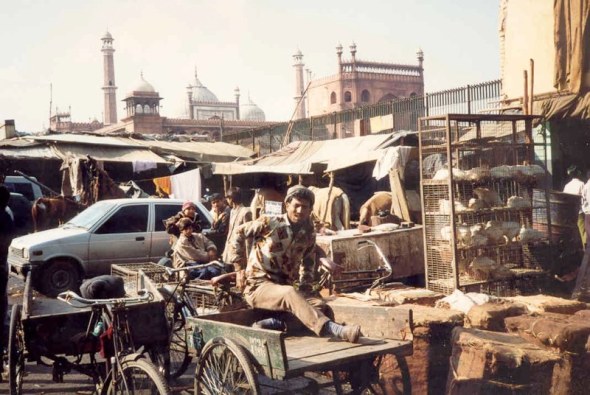
Old Delhi
Despite such a poor experience travelling around India as a solo traveller, I’ve tried to challenge myself as I’ve ventured further afield. Weaning myself off package tours was as much a case of economic necessity as anything else, but choosing countries and regions off the beaten track where tourists are as rare as a white moose has kept me on my toes. Buying a train ticket in Ukraine via sign language? Check. Getting to grips with riots and a transport strike in Haiti? Check. Overnighting in the world’s most dangerous city without being shot? Check. That’s San Pedro Sula in Honduras if you’re wondering and yes, the barbed wire barricade at the end of the street was a little off putting when it came to sleeping soundly in my bed.

Port au Prince bus station
I’m soon off to Sri Lanka. Everyone I know who’s been says it’s wonderful and the pictures of the hill country through which I hope to journey by train look idyllic. But someone reviewing a train trip on a web forum was complaining that a Sri Lankan man ignored her reservation and threw her bag off the seat, forcing her to stand for the entire journey. If that story is true, Clifton Fadiman’s words take on a whole new truth. And there’s just that nagging voice in my head that reminds me that we just wouldn’t stand for that kind of treatment in Britain. Wish me luck!
Packing tips from someone who learnt the hard way
1995. The end of a six week holiday in Peru, my first big trip. I’d been completely clueless when it came to packing, wondering how I’d fit six weeks’ worth of clothes into my suitcase (did I even have six weeks’ worth of clothes?) and trying to check in at the airport with the entire stock of Arequipa’s souvenir vendors. It took a lot of begging but I somehow managed to avoid excess baggage charges despite the fact that I couldn’t even lift my suitcase onto the weighing scales. I was then the kind of traveller I laugh at now. How easy it is to forget.

Cusco 1995
1997. I’d downsized my suitcase, though not by much, and figured a lightweight trolley would help me drag it around Morocco. The dust, potholes and uneven surfaces took their toll and once again I was heaving half my worldly goods on and off trains in the August heat. It was uncomfortable, ineffective and something had to change. A backpack was out as I could never trust my dodgy back to cope, and a little hard-sided wheelie became my saviour and trusty travelling companion for over a decade, only to be replaced when its lightweight sibling hit the market. I’ve never looked back.

Marrakesh 1997
Fitting my stuff into a tiny wheelie has taken practice, but I reckon now I’ve got it down to a fine art. Here’s my top tips.
Take as few clothes as you can get away with
It’s never very far to a laundry. Look for one that operates by weight rather than by individual item and avoid hotel laundries like the plague. Alternatively, pack a couple of washing capsules in a small plastic tub and do it yourself in a self-service laundrette. You’ll meet local people and who knows where that might lead?
Pack things that work together
Take clothes that don’t need ironing and roll them as you pack them to avoid any creases. Make sure everything goes together and never take something just in case you might need it – you won’t. Don’t forget a swimsuit and flip flops. Forget about a hair drier or straighteners. You’re on holiday, who cares?
Wear the heavy stuff
Hiking boots are bulky and heavy. They’ll take up way too much space in your suitcase so if you need them, travel in them. Ditto a thick fleece or coat; if you don’t need it in your plane/train/automobile you can fold it up and use it as a pillow. Ignore anyone who says you can do that with a sarong. They’re just not thick enough to be any good.
Decant toiletries to travel sized containers
In terms of shampoo and the like, you’re really only taking emergency rations. Reasonable hotels and guest houses will provide toiletries anyway. If they don’t, you’re never far from a supermarket to go and buy some.
Take wipes instead of bottles
When it comes to insect repellent, take plenty. It’s not always possible to buy it and there’s nothing that spoils a good holiday faster than a leg full of itchy bites. Sprays are messy. Take individually-wrapped wipes instead and as your travels progress, you are making space for shopping. Don’t forget some wet wipes too to clean your hands afterwards, but again, choose the flat plastic packs not the rigid tubs.
Consider posting things home
A word of caution needed here, obviously. Don’t post anything you’d be devastated to lose and be prepared for things to take months to get home. I’ve successfully sent books from Cuba, a bulky throw from Turkey and even dirty laundry! No matter what the vendors say, though, breakable stuff will rarely be packed well enough to make the journey back unscathed.
Have you got a tip you’d like to share? I’d love to hear from you!
Are these the world’s best railway journeys?
This week, in preparation for my upcoming trip to Sri Lanka, I’ve been booking train tickets to explore the country’s beautiful hill country. The Man in Seat 61 has, of course, been an invaluable tool as ever, and I’ve been very impressed with the service provided by Visit Sri Lanka Tours, a recommendation gleaned from Seat 61. It’s got me thinking about previous rail journeys I’ve taken. These are my favourites, but are they yours?
Peru: Cusco to Machu Picchu
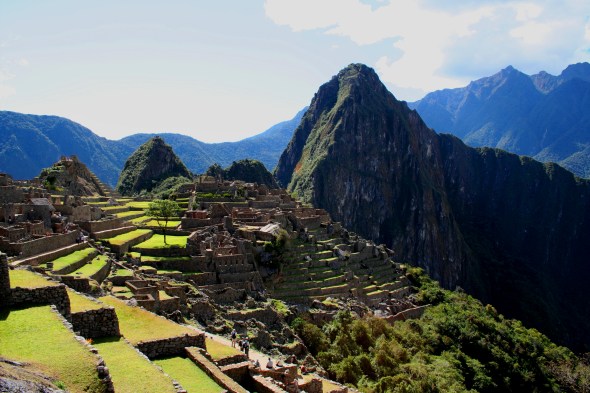
Machu Picchu, Peru’s mighty Inca citadel
Before tourist numbers reached epic proportions, to reach Machu Picchu by train you used to have to crawl out of bed in the dark to catch the early morning local train from central Cusco’s gloomy station, travel for five hours as the wooden bench seating slowly petrified your buttocks and emerge blinking into the middle of the market at Aguas Calientes to find your diesel-belching ride to the famous mountaintop Inca ruins. Periodically, the train halted in the dark to facilitate trade. Hands used to appear through the tiny windows to offer roasted corn and alpaca wool hats. It was one of those iconic travel journeys that is better relived from the comfort of your armchair several months later. Taking the journey again years later, this time in a glass-roofed backpacker train (boy, hadn’t backpacker expectations grown?!) I was delighted to see that snow-capped peaks lined the route and that the PeruRail authorities had built a fancy new station. The increase in comfort was worth the hike in the fare and best of all, the switchbacks to enable the train to haul the train out of Cusco’s bowl-shaped valley were still the most fascinating stretch of the journey. Then, in 2010, flooding and landslides caused severe damage to the track and when repairs were completed, the train began from Poroy, just outside the city, rather than from Cusco’s Wanchaq station. Despite the changes, it remains one of the best railway journeys in the world.
Switzerland: the Bernina Express
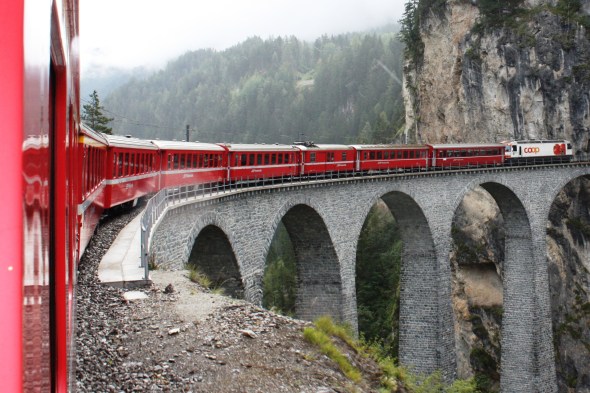
The Landwasser viaduct from the Bernina Express
It’s hard to pick a favourite amongst so many standout lines, but if forced to choose, then the Bernina Express gets my vote. Run by the Rhaetian Railway, the Bernina Express covers two lines which together comprise a UNESCO World Heritage site – Albula and Bernina. During its 122km run from Chur to the Italian town of Tirano, the train passes through 55 tunnels and over 196 bridges and viaducts including the spectacular Landwasser Viaduct pictured here. To fully appreciate this engineering marvel, take a local train (the panoramic picture windows don’t open), head to the back and lean out of a right hand side window. The train loops and glides over the Bernina Pass, with the Morteratsch and Palü glaciers and alpine Lago Bianco darker Lej Nair lakes providing the glamour in terms of scenery. With no cogwheels aiding its descent, this impressive adhesion railway has one final wow up its sleeve: the 360° spiral that encompasses the nine arches of the century-old Brusio Viaduct.
Kenya: the Lunatic Express

Mombasa’s beach, the prize for those surviving the Lunatic Express
I first read about this railway in Bill Bryson’s African Diary. His descriptions of being flung around as if being tumbled in a washing machine were as compelling as you’d expect from the undisputed king of humourous travel writing and I decided there and then I’d make the same journey. This narrow gauge railway runs from Nairobi to the coast at Mombasa, cutting through Tsavo National Park on its way. It gained its unusual nickname as several workers involved in its construction ended up as dinner for the hungry lions, dragged from their tents as they slept exhausted from the day’s hard labour. I didn’t see any lions, just a beautiful sunset over the savannah plains, though I was plagued by hungry mosquitoes and arrived in Mombasa covered in bites.
The best of the rest!
Russia: Trans-Mongolian
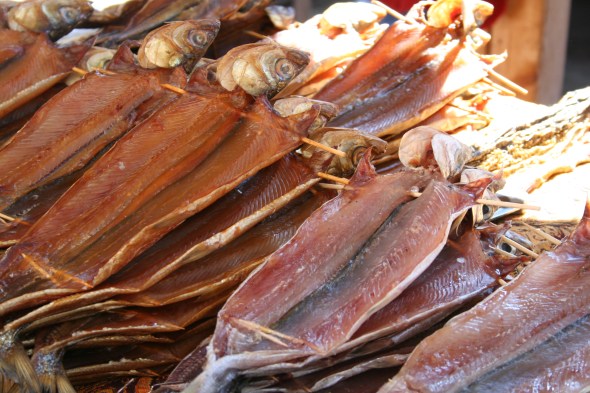
Omul on sale at Listvyanka, on the shores of Lake Baikal
The longest rail trip I’ve done, with a trip that took me from Moscow to the Mongolian capital Ulan Bator by train. I saw a lot of trees, but I also learned first hand what a warm and welcoming bunch of people the Russians are: a special mention here for Aleksander the army officer who fed me smoked omul and showed me his family photos.
New Zealand: Tranz-Alpine
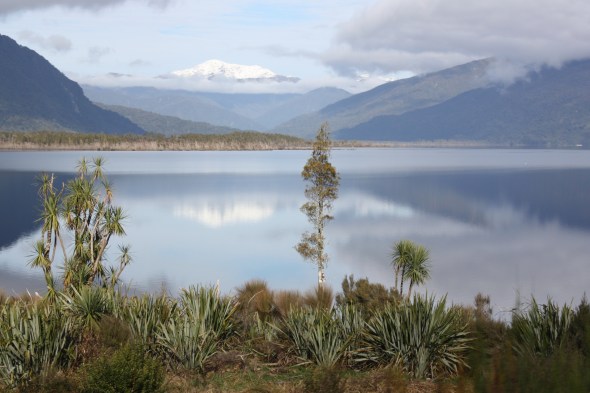
Serene Lake Brunner
Not the Alps in Europe, but instead, New Zealand’s South Island. Crossing from Christchurch to Greymouth, this scenic ride crossed Arthur’s Pass and chugged alongside pretty Lake Brunner. Wrap up warm if you’re going to ride the open air viewing car in winter as I did – it’s freezing!
Update: I’ve just booked a ride on the Northern Explorer to see more of North Island out of a Kiwi Rail train window. Watch out in 2018 to see how I got on.
Intercourse is only three miles from Paradise
It might not always seem like it, but Paradise is within reach. Film fans might recognise it as the setting for the 1994 Christmas crime caper, “Trapped in Paradise” starring Nicolas Cage. It was filmed in Ontario, Canada and has terrible reviews, so don’t rush to see it if you haven’t already. The real Paradise is a pleasant place, with an old mill and farming country surrounding it favoured by Amish settlers.
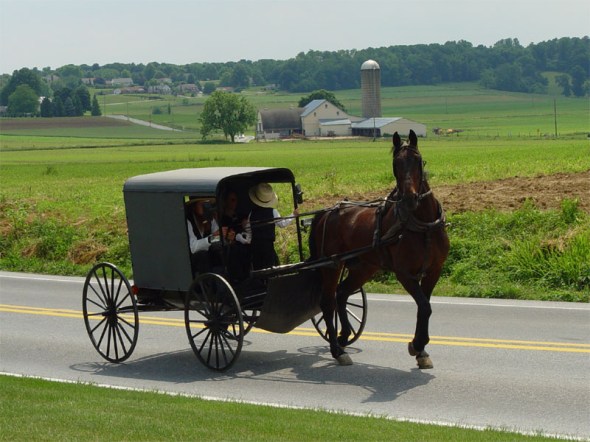
Lancaster County Amish by Utente CC-BY-SA-3.0 via Wikimedia
Paradise isn’t one of those places that’s packed full of sights, but you’ll find a few worthy visitor attractions in and around the place, including a bakery at nearby Dutch Haven which has been making Shoo-Fly Pie since 1946. Similar to a treacle tart, it’s made with molasses and is thought to have got its name because the sweet smell attracted flies which needed to be shooed away.

Shoo-Fly pie by Syounan Taji CC-BY-SA-3.0 via Wikipedia
Nearby Intercourse lies about three miles to the north, in the heart of Amish country. It’s another filming location, this time the setting for the Harrison Ford movie “Witness” and unlike in the case of Paradise, the scenes were actually shot in town. Its name dates from 1814, the time when villagers ditched the moniker “Cross Keys” in favour of Intercourse.

Intercourse keystone marker by Doug Kerr CC BY-SA 2.0 via Wikimedia
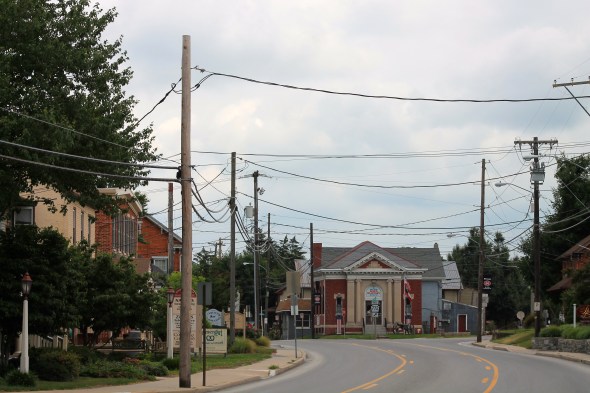
Intercourse, PA by Jon Dawson via Flickr CC BY-ND 2.0
Why you should ride Amtrak at least once
There’s still a certain romance about train travel and especially overnight rail journeys. Tonight, after his successful programmes in the UK and Europe featuring Bradshaw’s guide, Michael Portillo begins a new series and this time he’s heading Stateside. I’ve ridden a few Amtrak trains, mostly on short hops such as New York to Philadelphia, but last summer did a few longer legs, making the journey from New York to New Orleans with stops in Syracuse, Chicago and Champaign-Urbana. Here’s what I learnt.
Don’t rush
The biggest cause of complaint from my fellow passengers was the slow speed of the train. Freight takes priority so it’s common to crawl along or sit for ages in a siding until a long line of containers rumbles past. Go with it. Don’t book any tight connections, pack a book or something to pass the time and make sure you have plenty of snacks and drinks in case the station café is closed. Break your journey and savour your surroundings.

Chicago is a good choice for a stopover
It’s worth stopping off en route
I had some work to do on my book Hammond, Me which took me to Hammond NY (nearest station Syracuse), Hammond IL (nearest station Champaign-Urbana) and Hammond LA (which actually had its own station!) Of these, I really enjoyed Hammond LA which had a sleepy charm and a café selling the best iced lemonade I’ve found in a long time. Many people think that you can’t see America without a car, but that’s not true of everywhere. Do your homework (and check where the station is located) and you’ll find you can do a rail trip without needing to drive.
It’s worth paying for a bed
In terms of cost per hour, the price of overnight travel using Amtrak is more expensive than comparable journeys in Europe, especially if you book sleeper accommodation. Needing to take two overnight trains, I decided to break my journey in Chicago, opting for a seat on the first leg and the quaintly named Roomette on the second leg down to Louisiana. The overnight part with a seat from Syracuse to Chicago cost about £51 while the overnight Roomette from Champaign-Urbana to Hammond Louisiana cost £156.

The cosy Roomette: great for one, cramped for two
That’s steep. Are you sure it’s worth the upgrade?
For the extra money, I had a Roomette for single occupancy, whereas the reclining seat was in a full carriage. Travelling with a lockable wheelie, I wasn’t worried about the security aspects; in such a busy carriage, it would have been hard for a thief to operate. But many people, despite the late hour, were glued to smart phones or tablets and my allocated seat was next to a young man playing video games. Even with the sound off, the flicker and movement of the screen wasn’t conducive to a good night’s rest. I managed to move, but didn’t really arrive rested. In contrast, I had a solid seven hours’ sleep on the comfortable bed in my snug Roomette (think cupboard with a door) and enjoyed an included breakfast. Service was attentive and all in all it was a pleasant experience. But yes, it was expensive for what you got. For less than a third of that price, I travelled from Munich to Berlin in a luxury private compartment, en-suite toilet and shower and breakfast delivered to my room.

Make friends with the train staff
Any tips?
Befriend the onboard staff as they can help make your journey extra comfortable, supplying extra pillows, making your room up first and ensuring you get the meal sitting of your choice. Also, book early, as prices do go up considerably and sleeper compartments sell out. Make sure you’ve worked out how to get to the rail station as they aren’t always central as they are in Europe. Transport connections can be limited and you’ll either have to take a taxi or walk. But above all, do it. This is one American adventure that should be on everyone’s bucket list.
The Devil reads Pravda?
Putin’s “Don’t mess with me” attitude and his questionable actions and policies have given Russia back its bad name. But don’t let that put you off visiting: Russia’s an absorbing and diverse country which deserves your attention. The reality of a holiday in Russia is is as far removed from the country’s political reputation as it gets: http://travelexperts.justgorussia.co.uk/2015/10/13/whats-it-really-like-to-holiday-in-russia-nowadays/

Steve Sack, Star Tribune
When I took a rail holiday following the Trans-Mongolian route, I had no idea what to expect, but my most enduring memory from that fortnight is of the warmth of the Russian people. From the army officer who shared his food and photos of his wife to the little old lady who made sure I got the right bus back to Irkutsk from Lake Baikal, I experienced a welcome that, if I’m honest, I didn’t expect. You can read more about it here: http://travelexperts.justgorussia.co.uk/2015/11/03/russia-by-rail/

Family time by Lake Baikal
Really, the only gruffness came from the guards at Lenin’s Mausoleum who shooed me on when I paused just a little too long to look at that waxy body. The provodnitsas on my trains ran a tight ship, for sure, but they needed to make sure everything ran smoothly – who wants to witness an altercation from a sleeping compartment when you didn’t plan to get off the train for three days?
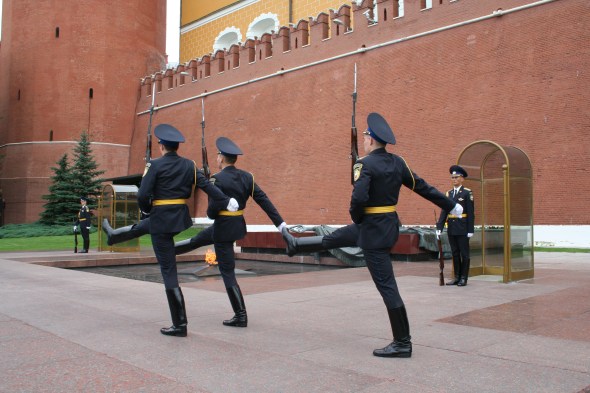
High kicks of which a dancer would be proud
For me, Russia was a country of immense beauty; from Suzdal’s magical churches to the tumbledown wooden shacks of rural Siberia, the country presented photo opportunity after photo opportunity.

Suzdal is packed full of historic churches
Moscow was fascinating, and aside from rather wet walk through flooded streets on arrival, a city I enjoyed immensely. The language and alphabet are different, but didn’t prove an insurmountable problem, and there are plenty of companies out there to assist with booking train tickets and securing visas.
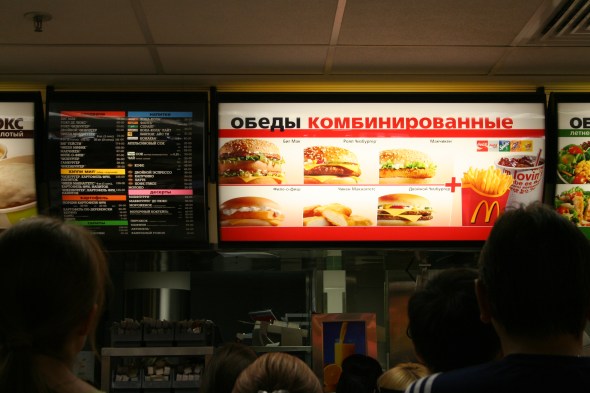
If all else fails, look for somewhere with a picture menu

Or an English menu!
My advice is to go. You’re hardly likely to bump into Putin in a country that size. Why not read some more of my blogs for Just Go Russia and see what you’d be missing. Here are just a few:
A diverse country http://travelexperts.justgorussia.co.uk/2015/10/12/dobry-den-welcome/
Northern Lights http://travelexperts.justgorussia.co.uk/2015/12/10/see-the-northern-lights-in-russia-this-year/
Historic treasures http://travelexperts.justgorussia.co.uk/2015/10/30/the-kremlins-hidden-treasures/
Enjoy your trip!
If it’s geysers you’re after…
If it’s geysers you’re after, then here’s where you need to be heading.
Iceland
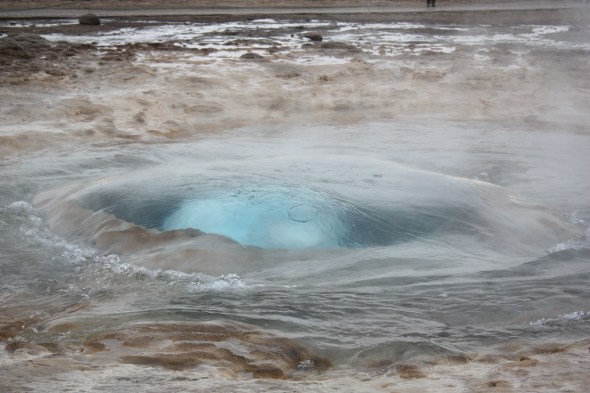
Strokkur on the verge of blowing
The original, in name at least, can be found a short distance from the country’s capital Reykjavik. The original geyser, Geysir, has decided it’s had enough, but Strokkur puts on a show every few minutes delighting those who visit. It’s easily accessible as part of the Golden Circle tour, or if you prefer to go it alone, then download my Unanchor Kindle guide from the UK Amazon site here: http://www.amazon.co.uk/Iceland-Unanchor-Travel-Guide-self-drive-ebook/dp/B017SDBNE8/ref=sr_1_8?s=books&ie=UTF8&qid=1452095658&sr=1-8.
It’s also available on the US site here: http://www.amazon.com/gp/product/B017SDBNE8/ref=s9_simh_gw_p351_d0_i1?pf_rd_m=ATVPDKIKX0DER&pf_rd_s=desktop-1&pf_rd_r=152KPS2974X3G9P0D5RQ&pf_rd_t=36701&pf_rd_p=2079475242&pf_rd_i=desktop
New Zealand

Pohutu, Rotorua
For a small country, New Zealand packs in a lot of geothermal sights, from other-worldly Craters of the Moon to photogenic Orakei Korako. But for sheer wow factor, then join the crowds watching Pohutu, located in the Te Whakarewarewa Thermal Valley on the outskirts of Rotorua to see the jet of boiling water shoot high into the sky.
Chile

Atmospheric El Tatio
El Tatio geyser field might not have the dramatic gushers of Iceland or New Zealand, but it has atmosphere in spades. It’s essential to crawl out of bed in the middle of the night (don’t overdo it on the pisco the night before like I did) but watching the sunrise illuminate the steaming geysers is well worth the effort.
USA
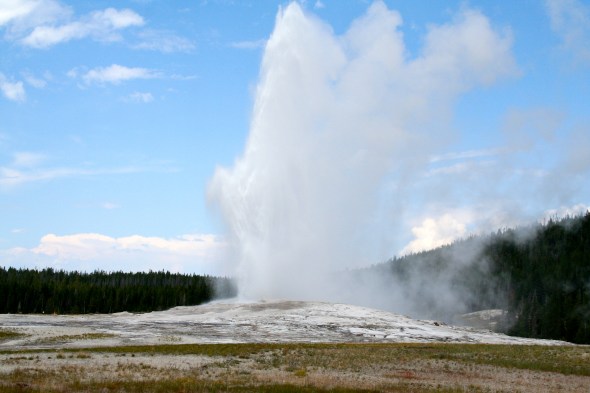
Old Faithful
I couldn’t blog about geysers and leave out Old Faithful. It’s been drawing the crowds at Yellowstone National Park for as long as the park’s been in existence and has had its name since 1870. It erupts on average 50 metres into the air about every 90 minutes or so; check the ranger’s board on arrival to see when the next show is expected.
And finally, one on the wish list…
Russia

Kamchatka by Einar Fredriksen via Flickr CC BY-SA 2.0
Kamchatka’s Valley of Geysers has the second largest concentration of geysers in the world after Yellowstone, packing over ninety of them into a 6km long valley. It’s difficult to reach, and therefore expensive, but it’s a trip that’s on my ever-growing bucket list. You too?
Don’t believe the hype – the truth behind the travel industry’s predictions
Every travel magazine and major publisher is full of persuasive suggestions at this time of year about places you must not miss if you are to keep up with the in crowd. But which recommendations should you ignore? Here’s my pick of places and attractions that don’t live up to the buzz that surrounds them.
New York’s Freedom Tower
New York’s my favourite city, but even the best of us has a few flaws. Don’t bother with the New Year’s Eve ball drop in Times Square; you won’t see much unless you watch it on TV and the weather’s often so cold everyone rushes indoors straight after midnight. Its latest high rise has been open a while now, but is still being touted as a must visit attraction for 2016. The elevator ride to the top, speeding through centuries of the city’s development in under a minute, is impressive, but the reflections and fingerprints on the glass windows of the observation deck aren’t. Ascend the Top of the Rock instead for the best views of the city, putting the Empire State Building in pride of place in what’s arguably the world’s most iconic skyline. Read my comparison of the two towers and how they stack up to the Empire State here:
https://juliamhammond.wordpress.com/2015/06/17/the-best-view-in-town-2/
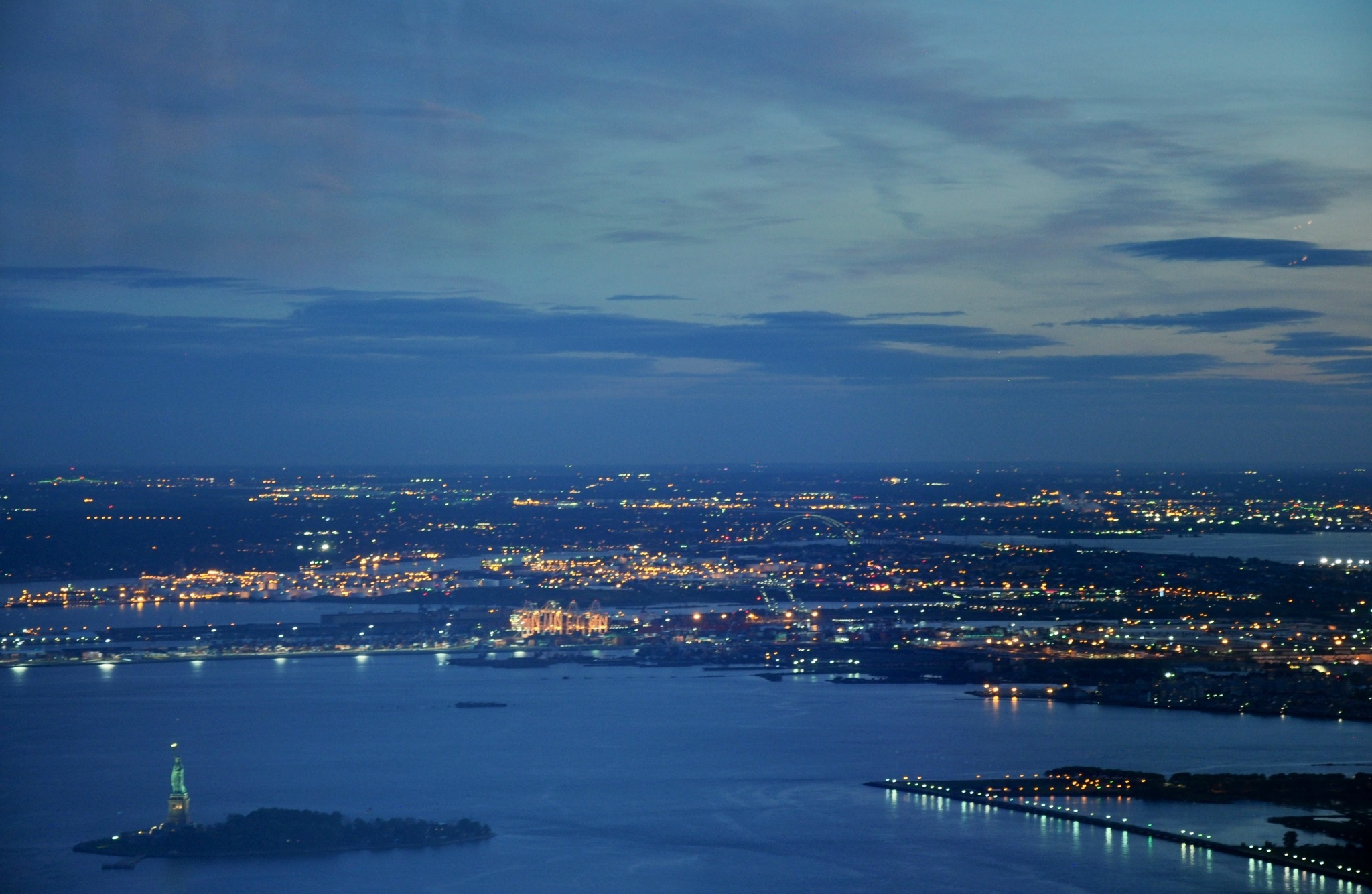
View from the Freedom Tower
Haiti
I don’t have anything against Haiti, per se, more the marketing surrounding this impoverished Caribbean nation. 2015’s lists were full of how this was the next up and coming destination, but when I visited in February, I quickly learned that infrastructure lags way behind potential. We’re not just talking about punctuality here: there were tyres being set alight in the capital’s streets in protest about rising fuel prices, a luxury bus set alight and a terrible tragedy caused by a live cable at carnival. Give it a few years more for the country to recover from the 2010 earthquake and preceding flood damage, but don’t put it out of your mind entirely – this is one to watch.
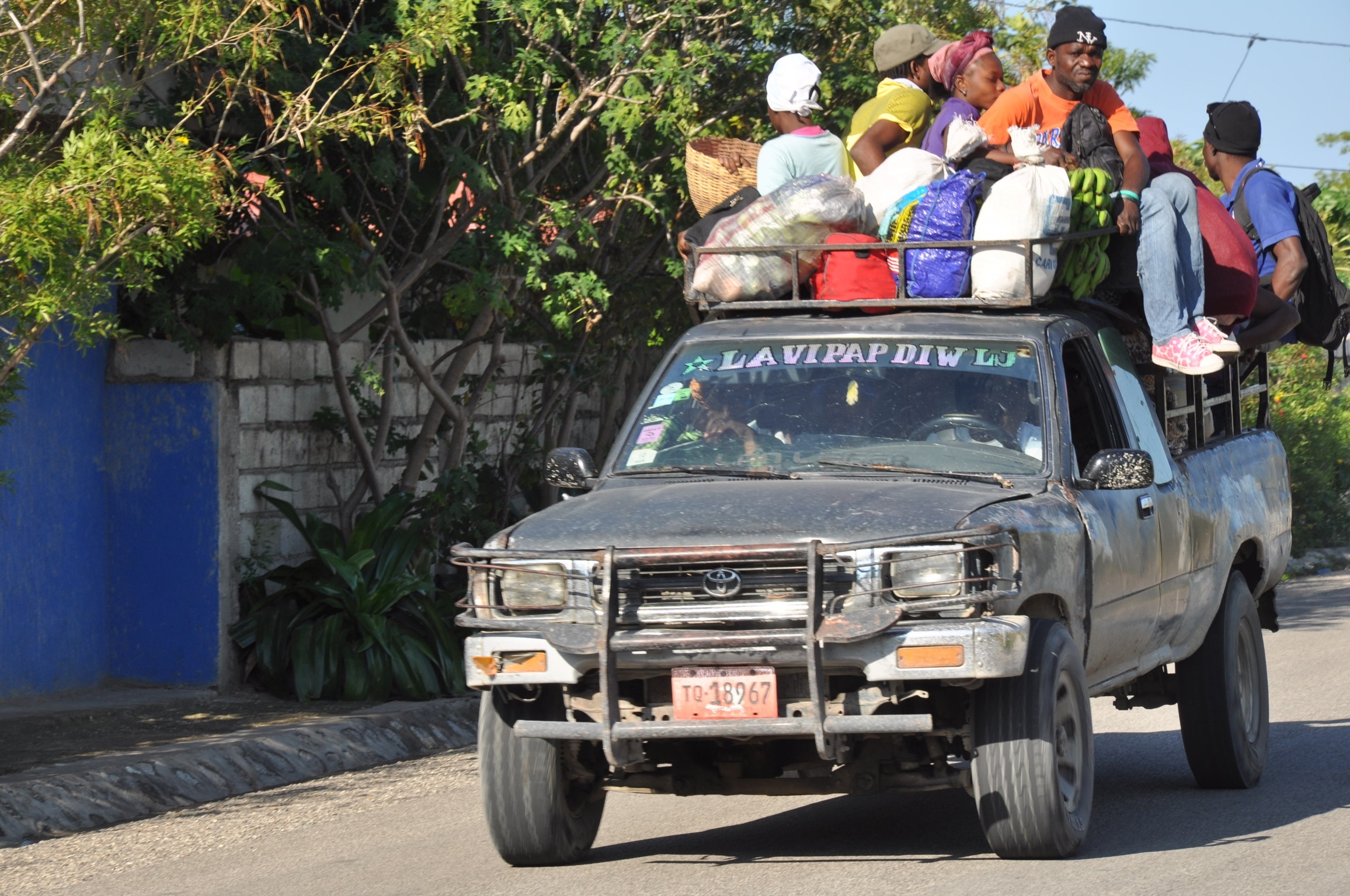
Overloaded tap taps are the only public transport to Port Salut
Cuba
Now this one’s a tricky one. I visited this fascinating country in 2003, a year in which the travel experts suggested you “go before it changes”. For perhaps every year since, that same advice has been trotted out, with thousands of tourists dutifully doing as asked. Go, by all means, but go because you want to, not because you are worried this charming country won’t wait for you.
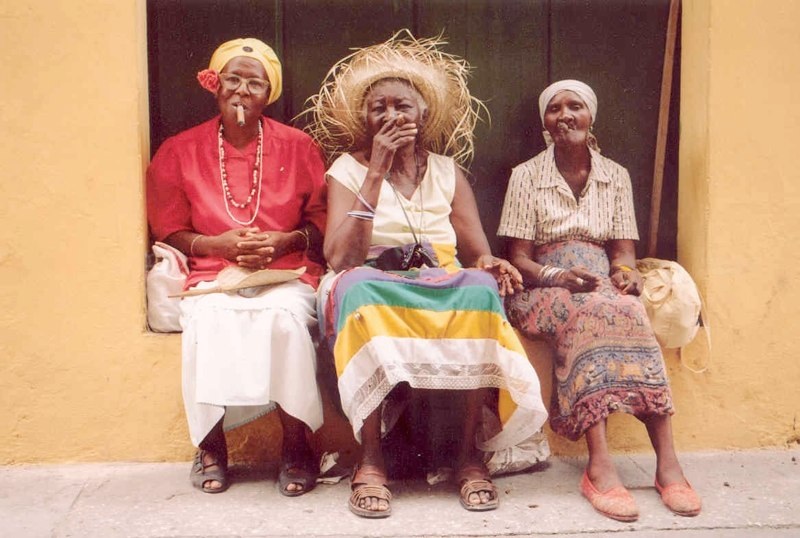
Memories from a trip to Cuba in 2003
Northern Lights in Iceland
Iceland is one of my most favourite destinations on the planet; I loved it so much when I first visited I went back to get married there. A multitude of incredible sights awaits, from the iceberg-strewn Jokulsarlon beach to the gushing geysers and impossibly scenic waterfalls of the Golden Circle. But the one thing you can guarantee with Iceland is that you can’t guarantee the weather and there’s nothing like a cloudy sky to ruin your chances of spotting the Aurora Borealis. If you want to see the Northern Lights, try Norway instead.
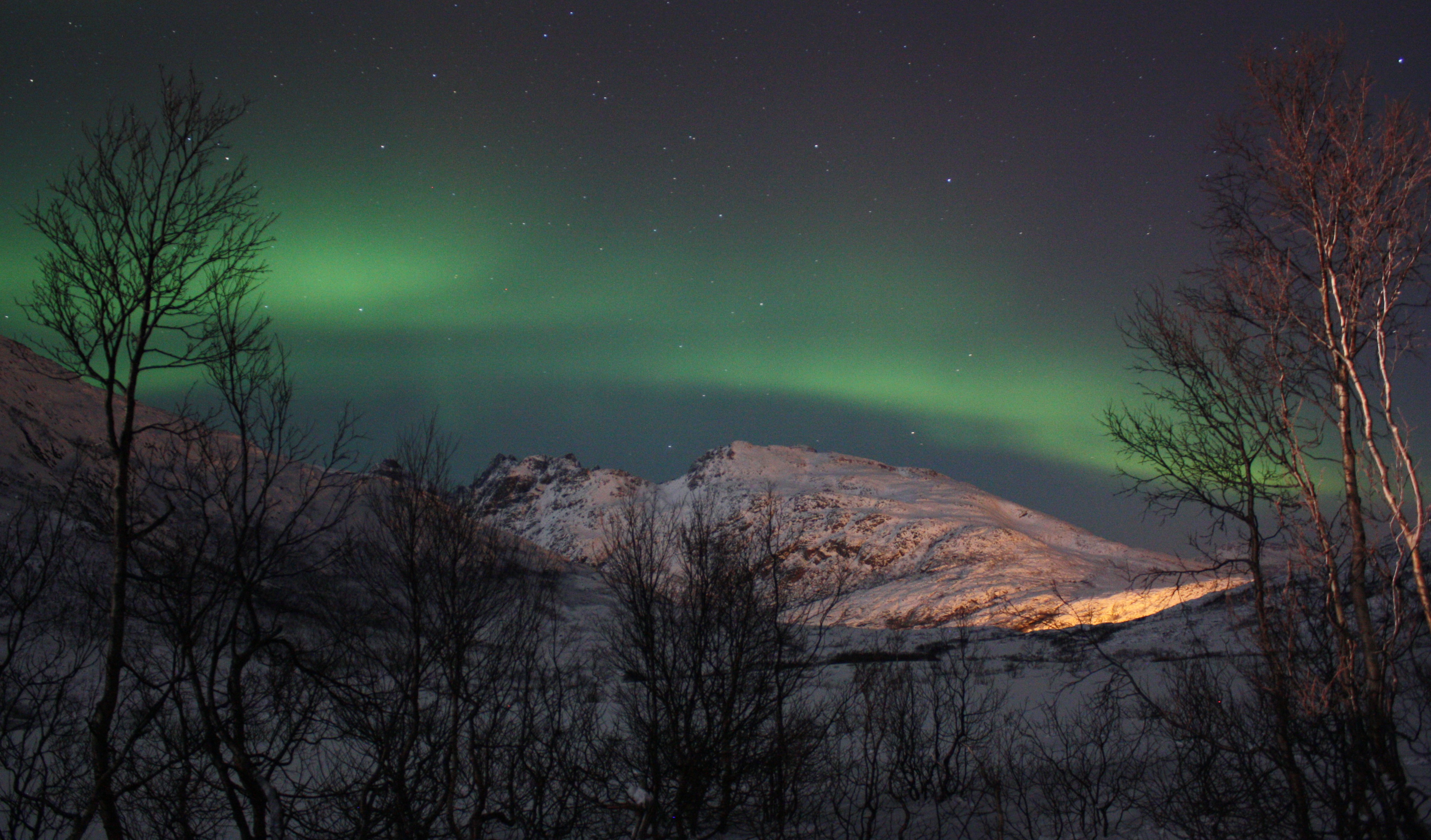
Northern Lights over the hills surrounding Tromso
The new cable car to Kuelap, Peru
2016 looks like a good year for Peru, especially seeing as British Airways are introducing direct flights after what seems an interminable wait. Machu Picchu is getting more and more crowded, so in an effort to entice people away, the northern fortress of Kuelap is being pushed as an alternative. A cable car is set to open later in 2016, but some reports are incorrectly suggesting it will shave four hours off the hike to get there. It won’t. The current hike from the main visitor centre car park is an easy one; what the cable car cuts short is the drive there along some so-so roads. Be aware that Kuelap’s no match for Machu Picchu, but the area has many as yet unspoilt attractions for intrepid visitors. Don’t believe the hype and wait. Go now, before the cable car opens and the hordes arrive.
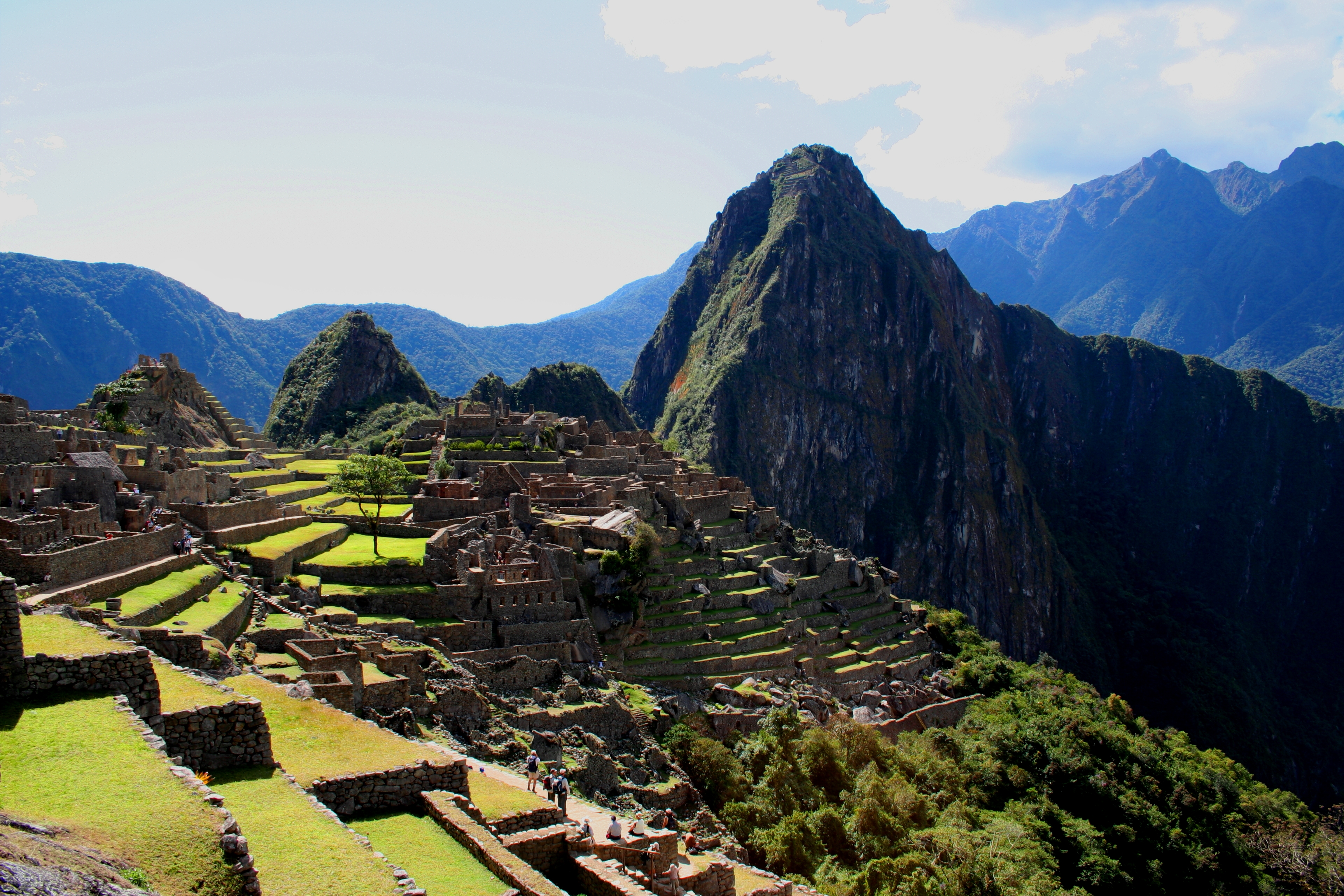
Machu Picchu
Six of the best from 2015: countryside
Yesterday I posted about my six best city experiences of 2015; if you didn’t catch it, read it here: https://juliamhammond.wordpress.com/2015/12/30/six-of-the-best-from-2015-cities/.
But what about out in the countryside?
Torres del Paine

Guanacos in the north of the park
Visiting the south of Chile as late in the season as April was a risky choice in terms of the weather, but luck was on my side. Getting up close to the blue crevasses of Glaciar Grey and watching the clouds pull aside to reveal the Torres del Paine in all their splendour were just two of the highlights of this very special place. Staying in a luxurious ger at Patagonia Camp and waking to a pink sunrise over Lago de Toro made this one of the most incredible places I’ve ever stayed.
Pointe Sable
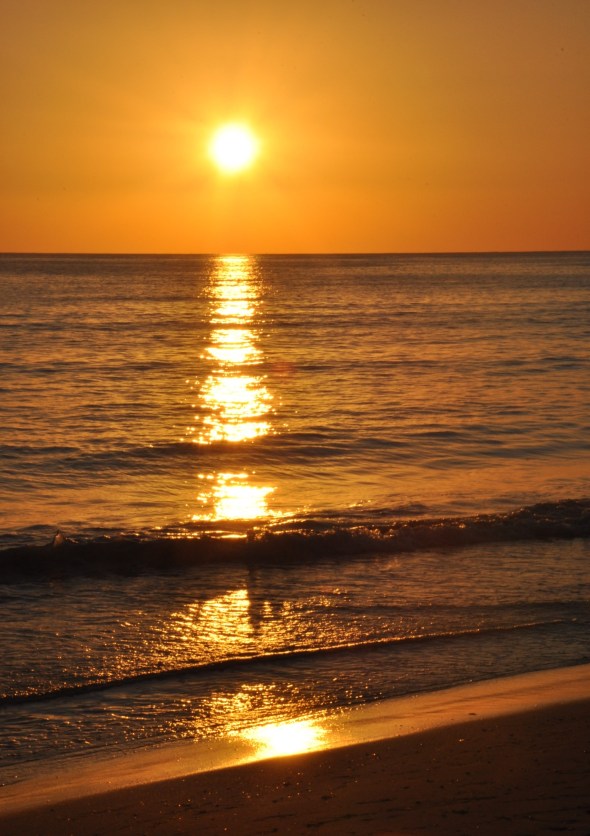
Sunset at Pointe Sable
Haiti was hard work, a trip fraught with worry. Despite arriving several days later than planned after being stranded in Jacmel because of a transport strike, the beautiful beach and turquoise waters of Pointe Sable at Port Salut were worth the wait. Staying mid-week, I had the sand almost to myself, save for a few upturned fishing boats and a stray hawker or two. Who needs beach bars and banana boats when you can enjoy such solitude with only a few tiny burrowing crabs for company?
Acadia National Park

Little Hunter’s Beach
I’ve been fortunate to visit many of America’s National Parks, but Maine’s star attraction felt more manageable in size. From the drama of the granite cliffs and blowholes to the serenity of unsigned and overlooked beaches, this was a real treat. The addition of a clutch of Model A Fords chugging around Park Loop Road on a weekender only added to the spectacle. Feasting on freshly caught lobster down the road at Bar Harbor was the icing on the cake.
Easter Island
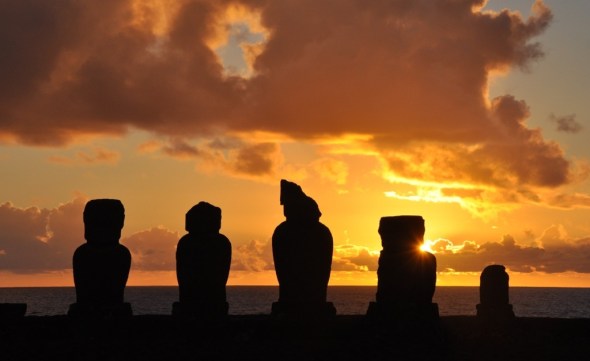
Sunset at Ahu Vai Uri, Tahai, Easter Island
Five hours from the Chilean mainland, Easter Island is one of those places that promises to blow your mind. Fortunately, it lived up to expectations. Waking before dawn to watch the sunrise behind the fifteen moai at Tongariki was a very special experience but the real surprise was of how much the island had to offer beyond its famous stones. The vivid colours of the volcanic crater lake at Rano Kau and the sight of wild horses thundering down the road towards the car made a lasting impression.
Hammond
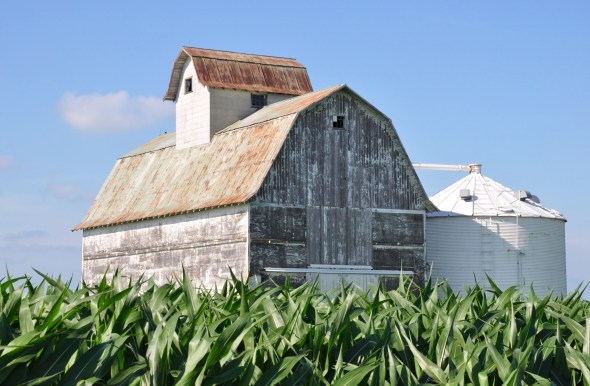
Cornfields surround Hammond, IL
Having visited seven Hammonds on my US travels this year in preparation for my book “Hammond, Me”, it seems only fitting that one makes the list. Most fun had to be the llama racing in Hammond, Wisconsin but in terms of getting out into the countryside, it’s Hammond, Illinois that stood out – classic barns surrounded by fields of corn and an Amish community down the road.
Rothenburg ob der Tauber

The view from the top of Rodertor
Strictly speaking, a view of the countryside rather than a visit to the countryside itself, but looking across the valley from the mediaeval walls of this impossibly quaint German town just can’t be missed off this list. Visiting in early autumn, I missed the crowds, caught the weather and fell in love with the place.
Now over to you. What are your favourites from 2015? And what are you looking forward to for 2016? I’m currently busy working as a researcher for a book on Essex dog walks. Overseas, my travel plans for the first half of the year include riding Sri Lanka’s trains, visiting the Seychelles on a budget, trialling an error fare to New York City and exploring Oslo and Stockholm. Practising ABBA songs as we speak…
Six of the best from 2015: cities
The end of 2015 is fast approaching, so it’s time to look back at the best of this year’s travels.
Glasgow

The Armadillo as seen from Bell’s Bridge
Blessed with clear blue skies and a touch of snow underfoot, a trip to Glasgow in January was my first stay in Scotland’s largest city. Architecturally splendid, the highlight was a trip to the Merchant Quarter for a chance to taste haggis, neeps and tatties in the wood panelled setting of the Cafe Gandolfi. A timely reminder, should I need it, that I don’t have to travel abroad for a memorable travel experience.
Jacmel

Carnaval, Jacmel-style
The old coffee town of Jacmel on Haiti’s southern coast has a languid charm for most of the year. For a few frenetic days in February, all that changes as Carnaval comes to town and the city pulses to the soundtrack of a throbbing bass. Clad in sequins, feathers and masks, everyone’s invited. The people of Jacmel prove to the capital Port au Prince that they might be a sleepy backwater, but they know how to throw a party.
Bremen
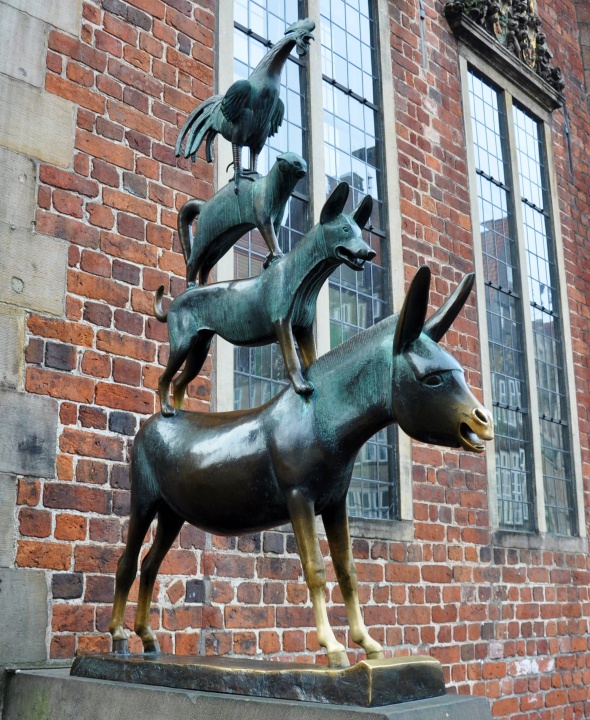
The four budding musicians
This northern German city is anything but grim, yet walking Bremen’s streets, Grimm was never far from my mind thanks to the brothers’ famous fairytale. The four sad old creatures who set off to seek a better life in retirement ironically never made it to the city that adopted them as its mascot. Nevertheless it’s a beautiful city to wander around looking for the sculptures that commemorate this heartwarming story. Definitely one I’d like to revisit.
Salzburg
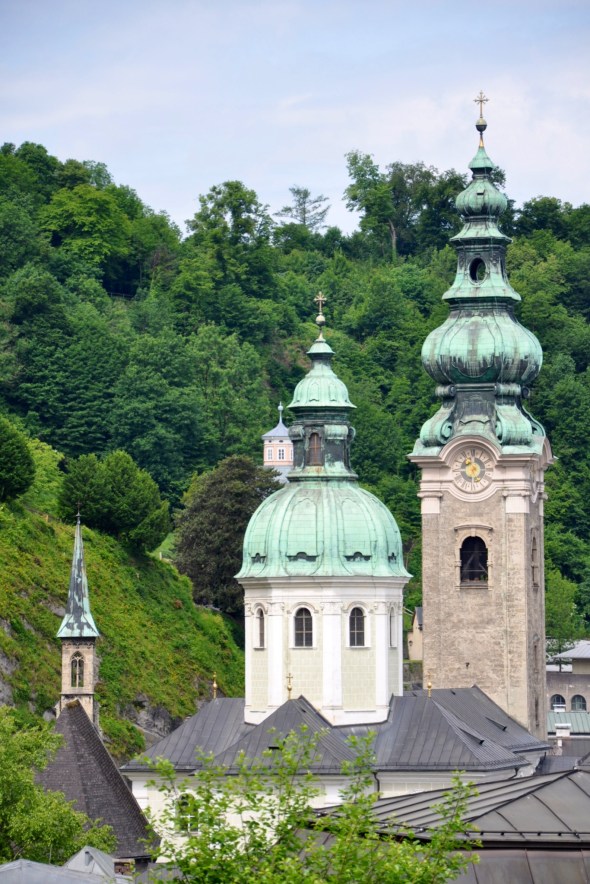
Rooftop views of Salzburg’s many churches made the climb worthwhile
Going back to Salzburg was like visiting an old friend. Decades had passed since my previous visit, but passing through the beautiful Old Town, I wondered on numerous occasions why I’d left it so long to go back. Fräulein Maria’s cycling tour gave me the opportunity to cover a lot of ground and belt out some Sound of Music classics along the way. Sing it with me: High on a hill was a lonely goatherd; Lay ee odl lay ee odl lay hee hoo…
Bologna
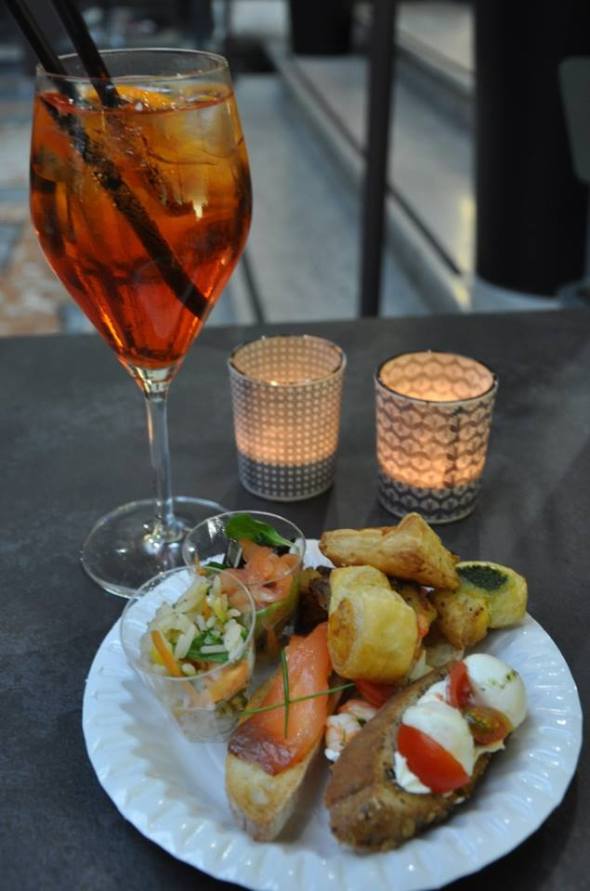
Aperol Spritz? Don’t mind if I do.
Many of the Italian cities I visited for a work trip in 2015 were old favourites, but the city of Bologna was a new one on me. I’d heard it was renowned for its towers and its food, so chose to climb its tallest to ease the guilt of that calorie overload. The exertion of climbing the 498 steps to the top of Torre Asinelli meant I could indulge in the evening buffet which accompanied my Aperol Spritz without a second thought.
New Orleans

Lafayette cemetery
June gave me a second chance to visit New Orleans, albeit in temperatures considerably more sultry than for my first visit a few autumns ago. Despite thunder, lightning and heavy rain, I enjoyed a self-guided walking tour of the Garden District, met up with guide Sandy again for a cemetery tour and, of course, enjoyed plenty of ice cream cocktails to keep me cool. Love, love, love this city!
So what city impressed you in 2015? Please share, I’d love to hear.
Weather to travel: London
Mention weather and Britain in the same breath and cue much eye rolling and sighing. You don’t go to the UK for the weather, sure, but it’s not as bad as the naysayers would have you believe, and you certainly shouldn’t be put off visiting.

Winter in Regent’s Park
The UK is influenced by a maritime rather than a continental climate and when it comes to the rain, that means our hills give a north west/south east split. So don’t panic if you’re headed to the UK capital and your news feed is full of flood pictures. Whilst the disruption is dreadful for those affected, London, in the drier half of the country, has had an average rainfall over the last three decades of just 557mm. 400mm or below would qualify it as a desert. If we compare that rainfall total to some of the major US cities, it’s less than half that which falls on Boston or New York City, and only a couple of hundred millimetres more than Los Angeles.
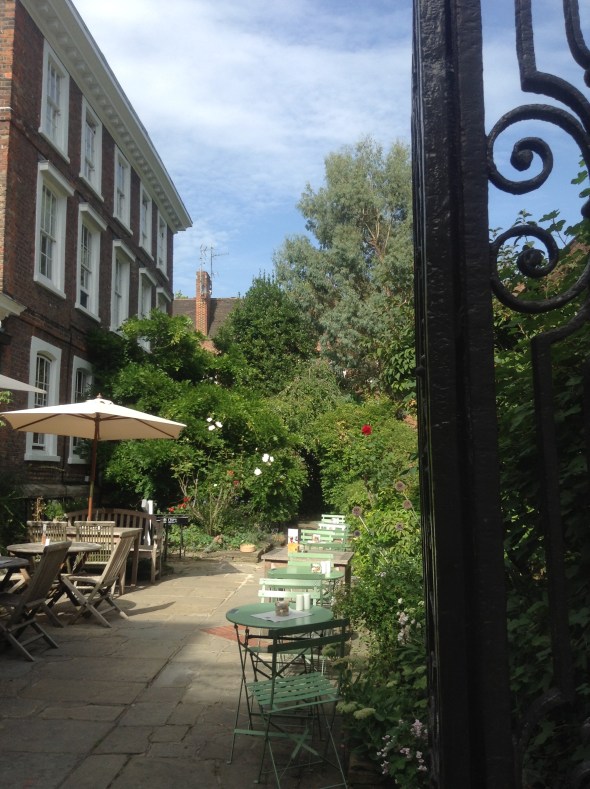
A summer morning in Hampstead
London’s rainfall is spread throughout the year, with the lowest totals seen in July. Typically, most months see rain about one in three days, but often that’s only a light drizzle and confined to short periods. Even in the autumn and winter, statistically the wettest, pack a brolly or a waterproof coat and you’re good to go. It’s not like there’s a dearth of indoor attractions to check out during a shower.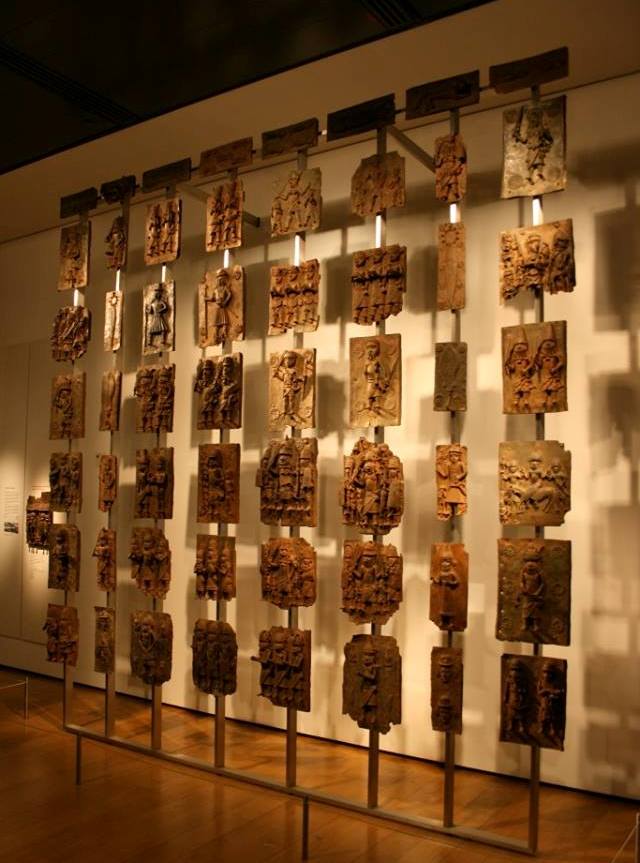 Masks from Benin on display at the British Museum
Clearly, at 50°N of the Equator, no one’s going to come to Britain in search of the scorching temperatures you’ll find in the Med, but sightseeing in big cities is no fun in sweltering heat. Here in the UK, we don’t see really hot temperatures often enough to warrant the expense of air conditioning, so if the mercury rises, London isn’t the best. If you do find yourself here in those circumstances (and you’ll know about it, believe me, because the newspapers will splash it all over the front pages), then avoid the Tube, grab a couple of cold drinks and head for one of London’s many green spaces.
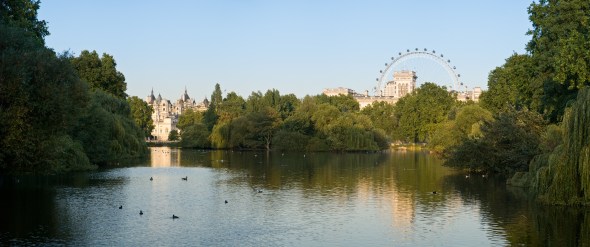
September in St James’ Park: photo by David Iliff CC-BY-SA 3.0
Fortunately, average temperatures even in the warmest month, July, rise only to about the mid-twenties (that’s Celsius and not Fahrenheit!). In the shoulder seasons of spring and autumn, it’s a comfortable 15-18°C and even in winter, the temperature rarely dips below about 5°C. Not for us those biting Arctic winds or toe-numbing blizzards. This year, it was a balmy 19°C the week before Christmas – exceptional but not a record.
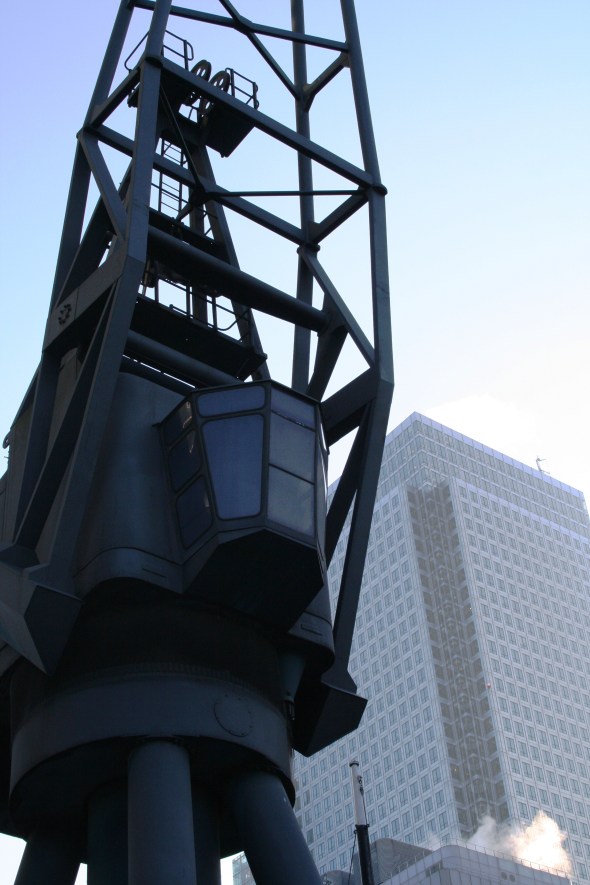
Docklands in the sunshine
So, remember what they say: there’s no such thing as bad weather, only bad preparation. Timing your London visit to miss the summer season gives you a chance of avoiding the worst of the crowds, so why not take a chance on the weather and come out of season. Enjoy your stay!
Changes to the US visa waiver program
A headline on the news section of the BBC’s website caught my eye this morning. It read: “Iranian dual citizens fight new US visa rules”. I’ve never been to Iran but reading on, this article could have directly affected me, but for a few months. The article explained that any British citizen that had been to Syria in the last five years would no longer qualify for the visa waiver program; in other words, they couldn’t travel on an ESTA and would now have to apply for a visa.
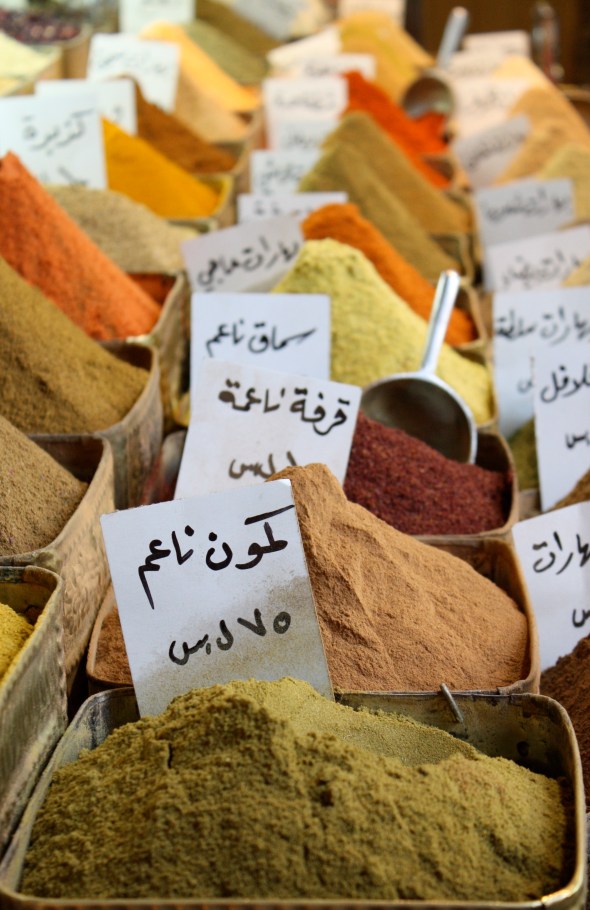
Spices for sale, Damascus 2010
I’ve checked my travel diary, in which I keep a list of the places I’ve been and the dates I visited. One of those is Syria. Now, the country is a no-go zone, but just a few short years ago, it was a different place, largely undiscovered by tourists. I wandered the souks of Aleppo and Damascus, travelling between them across the beautiful countryside on a modern train. I enjoyed a wonderful walk through Hama to a soundtrack of creaking norias. You can find out more about them here:
http://www.juliahammond.co.uk/Travel/Hama_time.html

Noria by the river in Hama 2010
I went to Syria and neighbouring Jordan in Spring 2010 and the new regulations stipulate a cut off date of March 2011. That means I’m still good to go to one of my most favourite cities, New York, next May. I was worried, though I don’t regret visiting Syria back then for a moment. Nor do I condemn the US government for passing such legislation; countries have a right to determine their own security and their own rules.
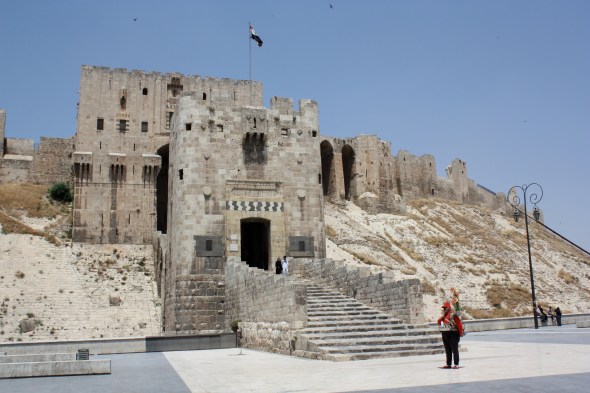
Citadel of Aleppo 2010
It’s not just Brits and it’s not just Syria. The Wall Street Journal wrote: “Coming up with a comprehensive plan has been challenging. Instead, a piece-by-piece approach appears to be emerging. The initial step was legislation to put some restrictions on the visa-waiver program, which allows travelers from the 38 mostly European and Asian nations to enter the U.S. without obtaining a visa. The measure would ban people from those nations who had traveled to places including Iraq or Syria since March 2011 without first getting a visa. The bill, which passed 407-19, is supported by the White House and is expected to be wrapped into a must-pass spending bill and become law by year’s end.”
You can read the exact wording of the bill here:
https://www.congress.gov/bill/114th-congress/house-bill/158/text
A list of visa waiver countries can be found here:
http://travel.state.gov/content/visas/en/visit/visa-waiver-program.html
Currently, the restrictions affect those who have travelled since 1 March 2011 to Iraq, Syria and “any other country or area of concern designated by the Secretary of Homeland Security” (to be determined within 60 days). If, like me, you’re a fan of visiting unusual destinations, it looks like it’s going to be important to double check you still qualify to travel on an ESTA if you wish to visit the USA.
Blog roundup
See the Northern Lights in Russia this year

Northern Lights over the hills surrounding Tromso
Seeing the Northern Lights was one of the most incredible sights I’ve ever seen. Like many, I opted for Scandinavia, being lucky enough to see them four nights running in Norway a few years ago and then once more in Iceland on the eve of my wedding. What few people realise, however, is that it’s also possible to view them in Russia, so here’s my post for Just Go Russia which has all the details:
Visit Arrowtown’s Chinese Settlement
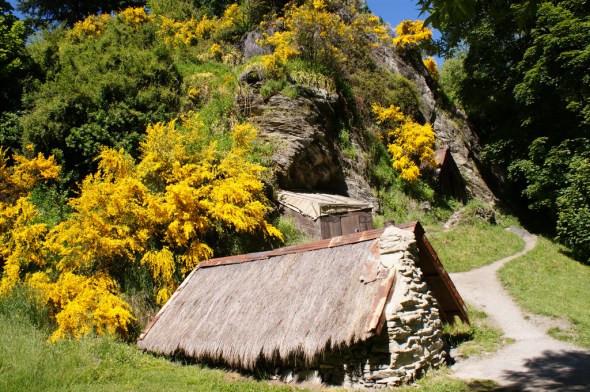
Arrowtown’s Chinese settlement by Michael Button via Flickr CC-BY-2.0
Migrants have often had it tough, and the Cantonese immigrants trying to scratch a living gold panning in New Zealand were no exception. These men suffered great hardship and intolerance from many of the existing community; you’ll be shocked to find out what a former Prime Minister once said about them. Today, though, the Chinese settlement in Arrowtown is a fascinating place for an excursion and you can even pan for gold yourself afterwards. Find out more here in my post for Go4Travel:
http://www.go4travelblog.com/arrowtown-chinese-settlement-nz/
Exploring Bangkok using the Chao Phraya River ferries

The Bangkok cityscape
I’ve been fortunate to have visited Thailand’s capital several times and I have to be honest, the ferries are what keeps me sane in all that horrendous traffic. It’s so straightforward to hop on and hop off, and lots of the city’s major tourist attractions are within a short stroll of the piers. My guide for Flight of the Gibbon contains everything you need to know. You can read it here:
https://www.treetopasia.com/exploring-bangkok-using-the-chao-phraya-river-ferries
How to get the best out of a Heathrow layover (Part 2)
In my first blog on Heathrow layovers, I dealt with how you should go about getting into Central London.
Depending on how much time you have, there’s lots to do between flights – it’s London, after all – and you won’t be encumbered by heavy bags. If you have something in mind but aren’t sure if it’s feasible, and it’s not featured here, drop me a line via Facebook (Julia Hammond Travel Writing) and I’ll give you some ideas. Note: the time available is measured from when you emerge landside after landing to when you need to be back at the airport for your next flight. Allow at least 60 minutes to get through security and to your gate; you don’t want to miss that onward flight!
Time available 4 hours: NOTTING HILL
You’ll need to keep a close eye on your time with this amount of time. With this short a layover, you need to restrict yourself to the west of the capital.

Portobello Road Market
My suggestion is a quick visit to Notting Hill, a vibrant neighbourhood where Julia Roberts once filmed, Jimi Hendrix died and The Clash called home. Take the District or Circle lines two stops from Paddington to Notting Hill Gate and walk via Portobello Road, where you’ll find the famous market (stalls can be found in the area most days but it’s best to visit on Friday or Saturday) and there are some great eateries including the Hummingbird Bakery. If you have time, the excellent Museum of Brands on Lancaster Road is worth a stop.
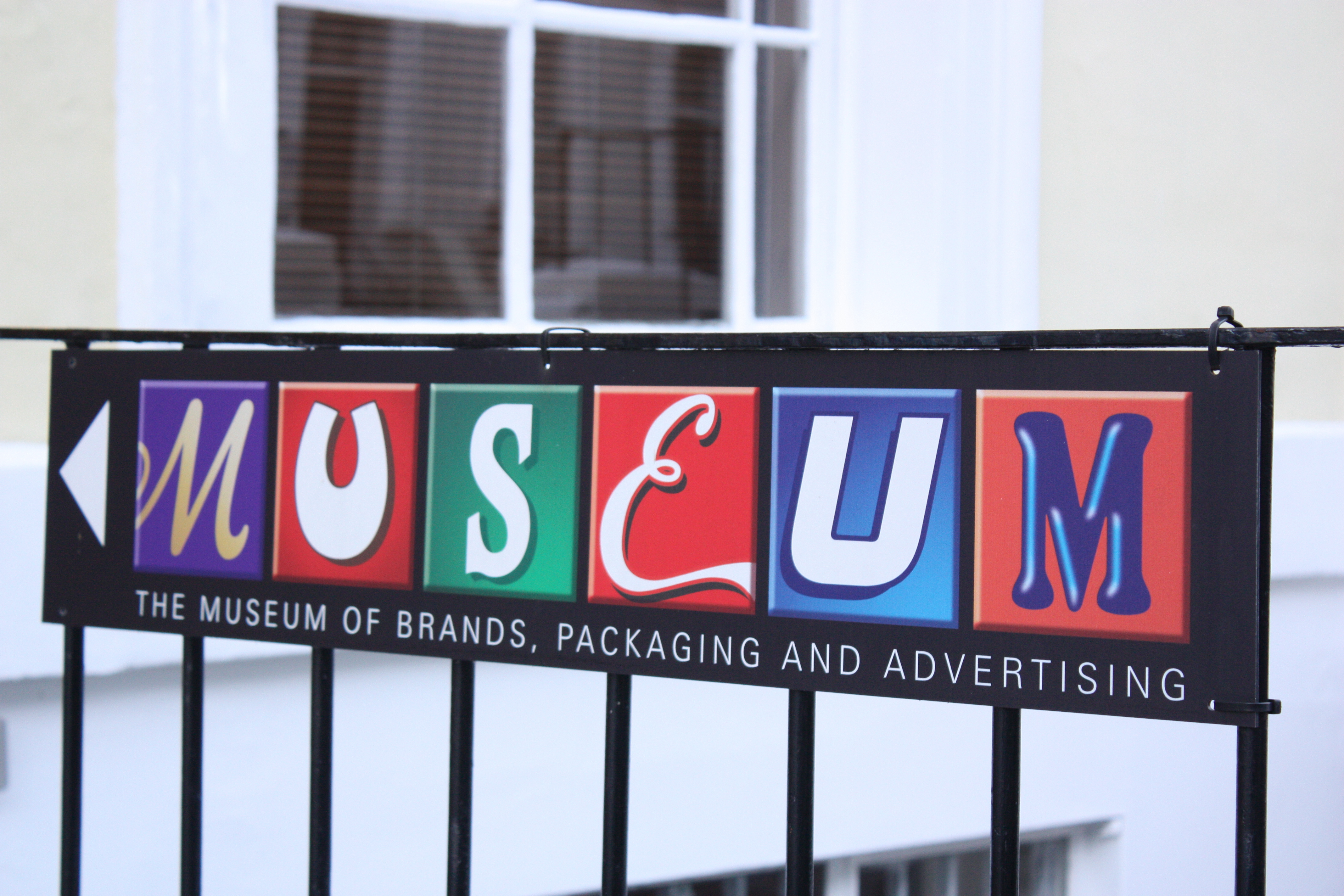
The Museum of Brands, Packaging and Advertising
When you’re done, there’s no need to walk back to Notting Hill Gate. Head back to Paddington from Ladbroke Grove tube station via the Circle or Hammersmith & City lines.
Time available 5 hours: MARYLEBONE
Marylebone, a neighbourhood squeezed between the West End’s shopping streets and beautiful Regent’s Park, is fast becoming the fashionable place to be seen in London. With an extra hour for your layover, you should have time to pay a visit to Sherlock Holmes at 221B Baker Street. Located between 237 and 241 Baker Street, it’s just a three minute walk from Baker Street Tube, linked to Paddington via the Bakerloo Line.

The Sherlock Holmes Museum
You’ll most likely see a policeman in a cape on the door, but be warned there’s often a queue to get in. It’s open from 9.30am to 6pm. Walk north from the museum and it’s only a few minutes to London’s beautiful Regent’s Park. With its elegant Georgian mansions framing the park and a mixture of manicured lawns and open space, this is one of the capital’s most beloved green lungs.

Regent’s Park
Cross over York Bridge, keeping an eye out for the herons sometimes seen here, and skirt the southern part of the park. When you’re ready to leave, use Regent’s Park station, one stop along from Baker Street on the Bakerloo Line. From there, it’s four stops back to Paddington or, if you have time, one stop down to Oxford Circus, still London’s main shopping artery and home to Selfridges & Co. department store, west of the tube station just past Bond Street. Alternatively, Marylebone High Street and its neighbouring streets have plenty to offer in terms of quirky boutiques and historic landmarks.
Time available 6 hours or more: HAMPSTEAD
With longer between flights, the whole of London is at your fingertips, so why not try somewhere that’s a bit off the beaten tourist track? Hampstead requires a change of Tube trains but is well worth the effort; take the Hammersmith & City or Circle Line as far as Kings Cross or the Bakerloo Line to Embankment, and then change to the Edgware Road branch of the Northern Line to travel to Hampstead station. Total journey time is about 35 minutes, so don’t be put off.

Hampstead “village”, packed with grand mansions and town houses
Hampstead feels more like a village in parts, but with phenomenal views from its vantage points across London, you can tick off the capital’s landmarks all at once. Try the view from Holly Mount, just down the road from the excellent Holly Bush pub or continue up to the Heath.
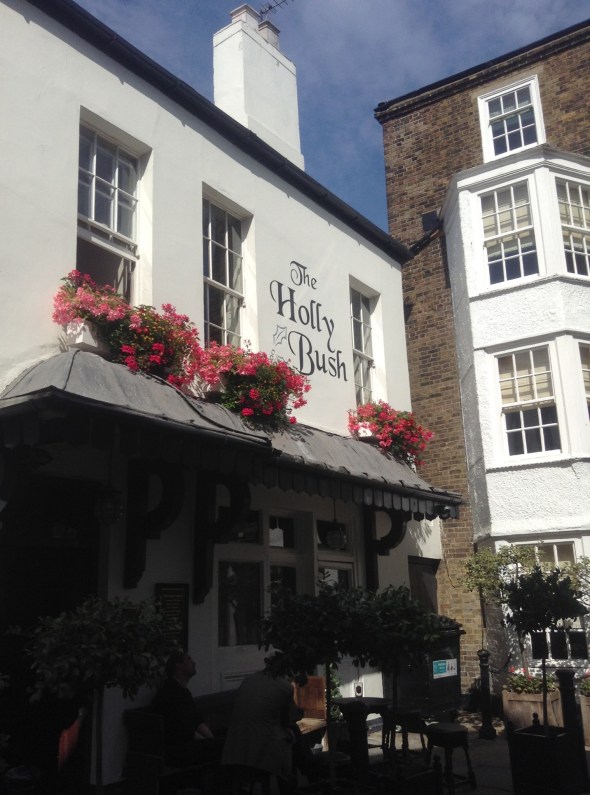
The charming Holly Bush pub
Hampstead Heath is well worth the trek up the hill. Walking across this huge open space will make you forget you’re in one of the world’s largest cities and help you realise why it’s also one of the world’s most liveable cities. On your way, take a detour along Hampstead Grove and you’ll pass a small observatory run by the Hampstead Scientific Society. Inside is a 6″ Cooke refracting telescope dating from the turn of the 20th Century.
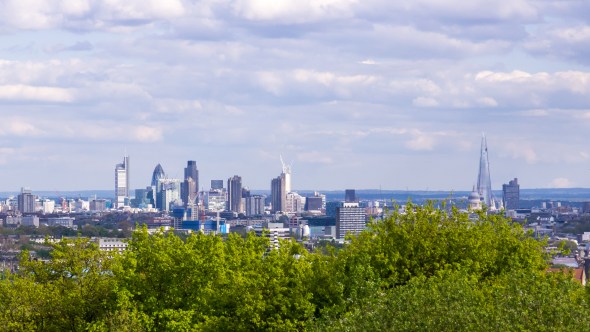
View of London from Parliament Hill, Hampstead Heath by Ed Webster via Flickr CC BY 2.0
On your way back to the High Street, stop to take a look at the house once inhabited by Ernő Goldfinger of Trellick Tower fame, who lived at Number 2 Willow Road. Local resident Ian Fleming, creator of James Bond, hated the modernist structure and allegedly took his revenge by naming one of his Bond villains after the man responsible for the eyesore.
Of course, if you don’t fancy Notting Hill, or Marylebone, or Hampstead, then there’s always St Paul’s Cathedral, Buckingham Palace or Big Ben. One short layover just isn’t going to be enough, of course, but these ideas surely beat staying in an airport lounge drinking coffee and browsing duty free shops.
And if you are tempted to come back, then why not try my Unanchor guide to London’s Villages, which consists of three day-long walking tours, one in each of the three locations featured above. Packed with ideas and information, it’s available on Amazon as well as direct from Unanchor.com and can be downloaded as a PDF or straight to your Kindle. Here are the links:
How to get the best out of a Heathrow layover (Part 1)
Flying via Heathrow? There’s no need to stay at the airport. Instead, take a trip into London and have a taste of what the British capital has to offer.
Part One: Getting to Central London

Notting Hill is comfortably doable on a layover
Take the train. Don’t be tempted with taxi or bus transfers; London’s traffic is too unreliable for you to risk wasting valuable layover time stuck in traffic. Instead, you have several options.
Most expensive, but fast, is the Heathrow Express. It takes 15 minutes to get from LHR to London Paddington station, from where you’re well connected by Tube to the centre and its attractions. Machines (and conductors) accept cash as well as credit and debit cards, but you’ll save a lot if you don’t use it.

Heathrow Express ticket machines

Heathrow Express Second Class

Heathrow Express First Class
However, there’s now a better way, which is almost as fast (quickest journey time to Paddington is 24 minutes) but significantly cheaper. The Elizabeth Line crosses London. Along the way it handily links Heathrow with key central London stations such as Paddington, Bond Street, Tottenham Court Road and Liverpool Street.
Cheaper still is the Tube, but it stops more frequently so your journey will take longer. The Piccadilly line connects Heathrow to popular tourist destinations such as Piccadilly Circus, Covent Garden, Hyde Park and Leicester Square. Journey times can feel tediously slow as the numerous stations aren’t far apart, but on average you’re looking at around 45 to 50 minutes to get into Central London. Fares vary according to the time of day and whether you have an Oyster card/tap in and out with a credit or debit card.
Useful links
Heathrow Express: https://www.heathrowexpress.com/
London Underground including information about the Elizabeth Line: https://tfl.gov.uk/
Tube and rail map: https://tfl.gov.uk/maps/track
Fares: https://tfl.gov.uk/campaign/new-fares
Heathrow transport information: http://www.heathrow.com/transport-and-directions#
For some well-known and more unusual suggestions for what to do once you’ve reached Central London, read my next blog: https://juliamhammond.wordpress.com/2015/12/09/how-to-get-the-best-out-of-a-heathrow-layover-part-2/
To stopover, or not to stopover?
One decision to be made when working out a long haul itinerary is whether or not to plan a stopover when booking flights. Here are a few issues to consider which might help you decide.
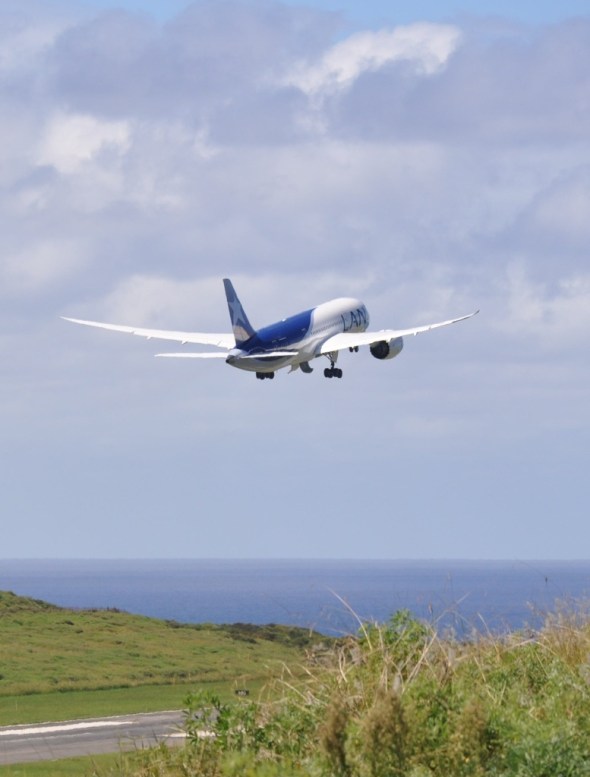
Boeing Dreamliner takes off
What’s it going to do to the flight cost?
Before making a decision to stopover, check out flight combinations and prices. A stopover including a few nights’ accommodation sometimes makes very little difference to the total flight cost compared to a direct flight. A stopover is classed as a stay of more than 24 hours whereas a layover might be just an hour or two. Layovers can also give you the chance to do a bit of sightseeing during your journey. See if you can extend your layover by taking a later flight to your final destination with that same airline. If the city is relatively close to the airport and if transportation is good, you can see a little of the layover city without it increasing the budget at all. Your luggage will usually be checked through to your final destination leaving you with just hand luggage. This has worked for me several times, most recently in Chicago and in Istanbul.
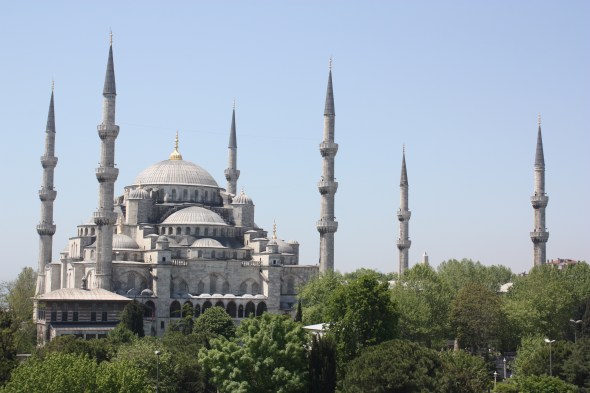
Istanbul
How much of the world do you want to see?
On both occasions I’ve been to the Antipodes, the best flight deals hubbed through places I’d already visited, Kuala Lumpur and Singapore. Eschewing the stopover didn’t leave me feeling like I’d missed out , but I may have felt differently if I’d never been to the stopover city before. A trip to Tanzania with Qatar Airways gave me the opportunity for a two-day stopover in the Qatari capital Doha, somewhere I’d not have chosen to visit in itself, but a pleasant stopover nevertheless. Next year, I’m stopping off in Sri Lanka en route to the Seychelles, a little out of the way but a great opportunity to see more places without vastly inflating my budget.
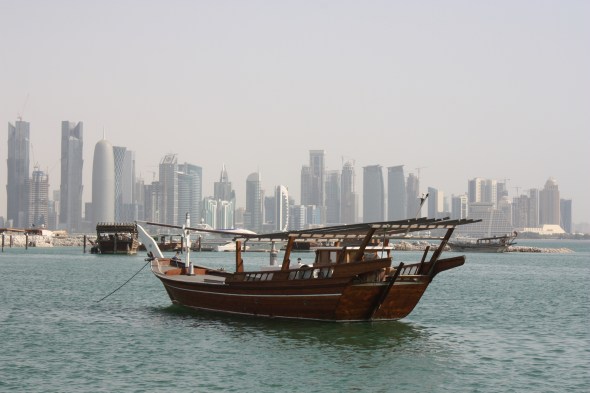
Doha
How will you cope with double jet lag?
If you are travelling east over any distance then you’re going to be hit by jet lag. There are things you can do to help alleviate symptoms, including trying to eat and sleep according to the new time zone before you arrive and keeping hydrated during the journey with plenty of water, but the fact remains, jet lag is a very real possibility. On my trips to Australia and New Zealand, I’ve opted for a quick change of flights rather than a few days’ stopover. Why? So I suffer the dreaded jet lag once rather than twice. Admittedly by 4pm on my first day in Sydney I was punch-drunk with fatigue but after a good sleep I was raring to go the next day. In Auckland a few years later, prepared for the same thing, I enjoyed a pleasant day exploring Ponsonby before hitting the hay at 7pm for a decent night’s rest. Again, the following morning, I was fully refreshed and ready to tackle the city instead of facing another long flight. Choose a layover airport with plenty of facilities, such as Singapore’s Changi or Kuala Lumpur International, both of which have airside hotels. You can book a bed or take a shower while you wait for the second flight, and get that horrible journey out of the way in one hit.
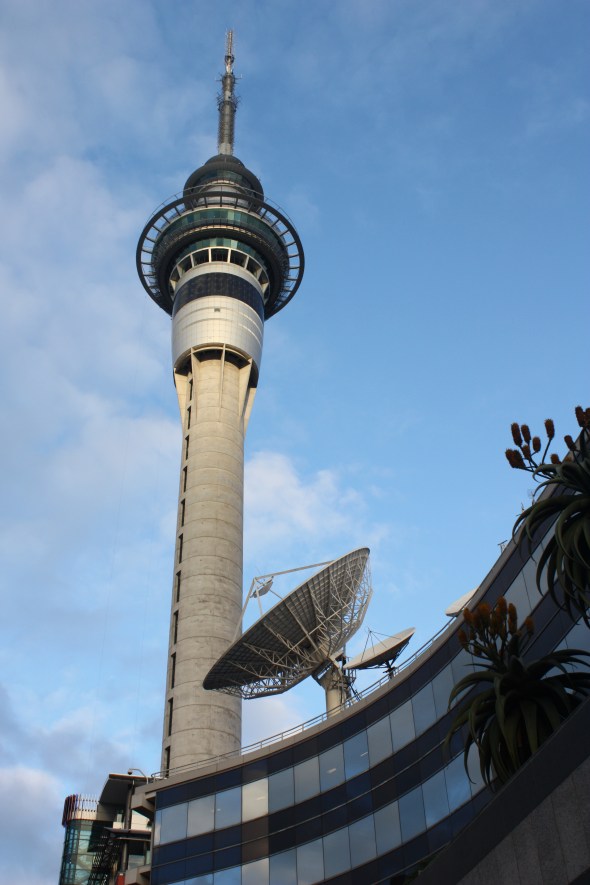
Auckland’s Sky Tower
How much time do you have for your holiday?
If you’re heading long haul for a long stay holiday such as a gap year, then a few weeks exploring somewhere on the way doesn’t make a big dent in the time you’re going to get at your destination. But if that holiday is restricted to the two or three weeks you’re going to be able to get off work, then you need to think about where you really want to spend it. Ask yourself whether your stopover days will prevent you seeing something amazing at your main destination, or give you the chance to see something equally amazing en route that you’d otherwise have missed.

Sydney’s iconic Opera House
Are you likely to get the opportunity to go back?
For some, a long haul trip will be the adventure of a lifetime, and likely to happen only once. If that’s the case, then stopping on the way to your main destination might be the only chance you’ll have to explore that part of the world and as such, you might be foolish to pass up the chance. If it’s somewhere that frequently shows up on flight deals websites or is a popular package holiday destination and thus relatively cheap, you might be tempted to ditch the place as a stopover for now and go there later on for a longer holiday.
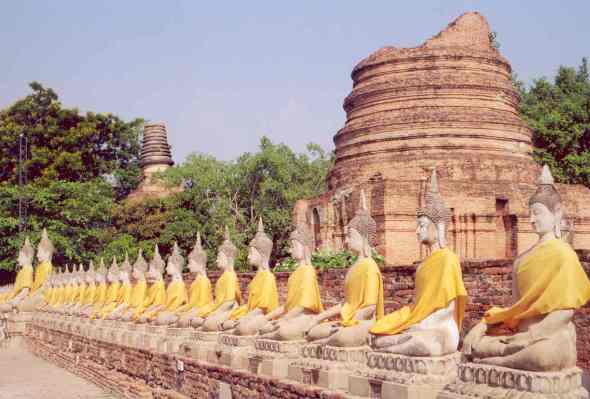
Ayuttahaya, Thailand
Are you unsure about whether you’d like the place or not?
Taking the opportunity to make a stopover in a city is a good way to find out if you like the place enough to book a longer holiday or not. Sometimes, this might be clear beforehand; it’s possible to stop in Reykjavik, the Icelandic capital, on the way to certain North American destinations, but in my opinion, this incredible country warrants more than a couple of days. But if you’re unsure, then staying just a night or two in a place gives you a taster, enough to help you decide whether to tick it off the list or to go back for a more leisurely visit.

The Sun Voyager statue, Reykjavik
Off to New York? Here’s my free guide.
New York, New York, as Gerard Kenny sang, the city so good they named it twice and, you’ll find, so enthralling you won’t want to visit just once.
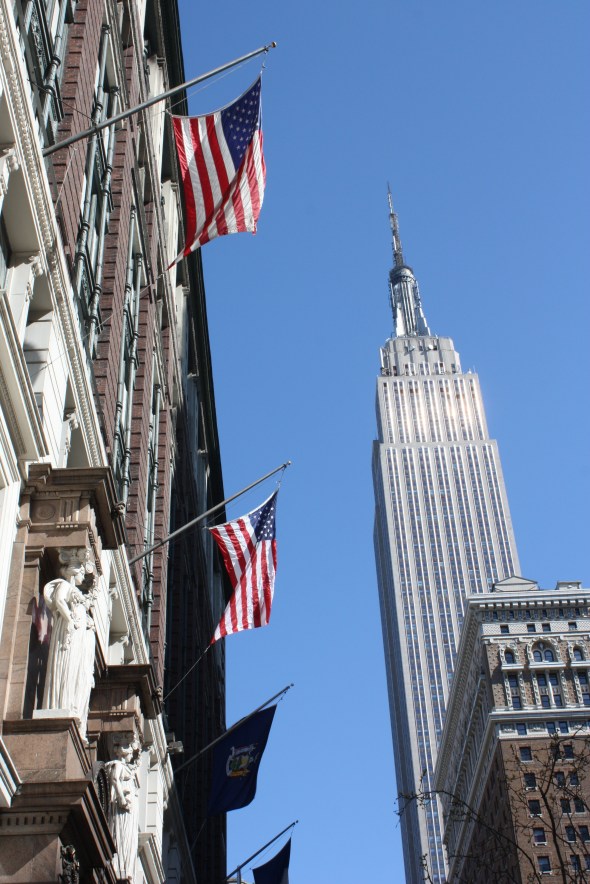
The Empire State Building
But where to start? There’s just so much to see and do that the city can be daunting for the first-time visitor. Don’t worry, help is at hand. I’ve put together several online guides. They’re free and they should help ensure that you won’t miss something major. Here are the links you need to make your New York city break a success.
First, here are my tips for getting the best out of your trip to New York City:
https://juliamhammond.wordpress.com/2015/01/24/tips-for-getting-the-best-out-of-a-trip-to-new-york-city/
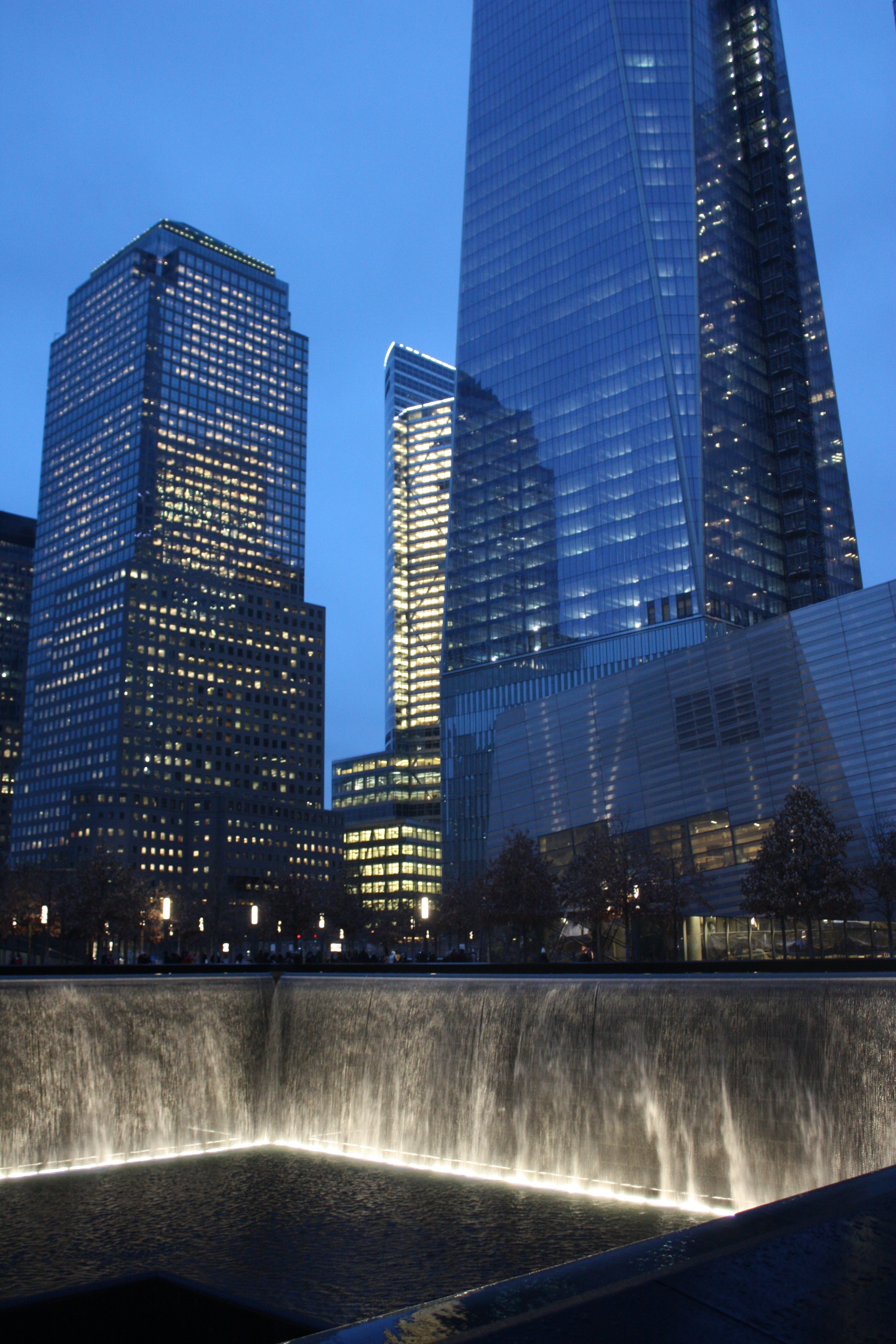
9/11 Memorial at dusk
Next, how do you choose which tower to climb for the view of a lifetime?
https://juliamhammond.wordpress.com/2015/06/17/the-best-view-in-town-2/

Sunset at the Top of the Rock looking south to the Empire State Building
Lower Manhattan
From the Statue of Liberty to the 9/11 Memorial, Lower Manhattan is packed with must-see attractions. Read this for some less well known tourist spots as well as some great money-saving tips.
https://juliamhammond.wordpress.com/2015/01/06/julias-guide-to-new-york-part-1-lower-manhattan/
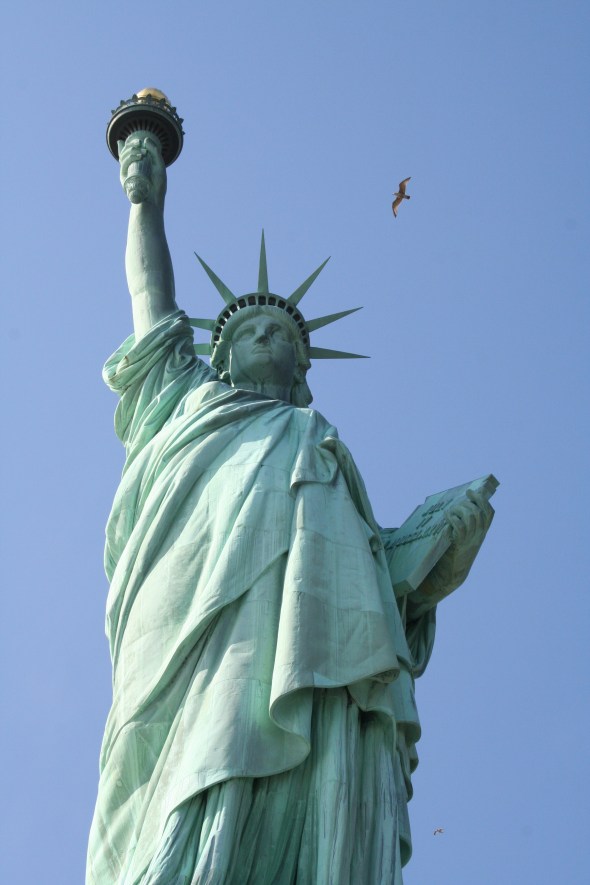
The Statue of Liberty
Manhattan West
With gems like the High Line, the cafes and bakeries of Greenwich Village and fabulous views from both the Top of the Rock and the Empire State Building, it’s hard to beat this side of the city.
https://juliamhammond.wordpress.com/2015/01/06/julias-guide-to-new-york-part-2-manhattan-west/

Central Park
Manhattan East
The Upper East Side with its mansions facing Central Park is the polar opposite of the edgy Lower East Side but both are essentials for your trip. From Chinatown to the Chrysler Building, here’s what to see.
https://juliamhammond.wordpress.com/2015/01/07/julias-guide-to-new-york-part-3-manhattan-east/
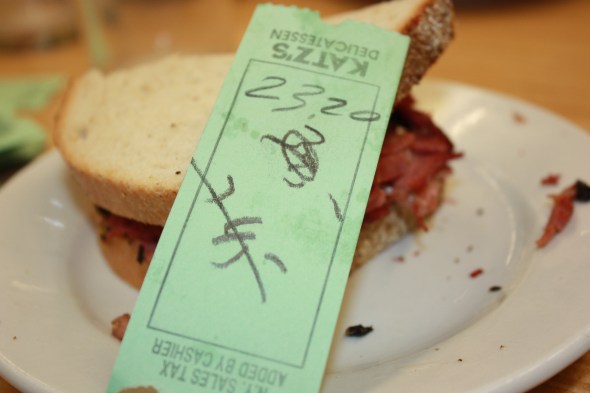
“I’ll have what she’s having!”
And lastly, for something a little different, get out into one of the other boroughs; Brooklyn is most convenient, Queens has some great food, Staten Island is reached by that free ferry with the views of the Statue of Liberty and the financial district’s skyscrapers, but my favourite is the Bronx. Find out why here:
https://juliamhammond.wordpress.com/2015/06/16/on-the-ancestor-trail-in-nyc/
My favourite travel spots
The trouble with not travelling when you’re obsessed with travel? You still eat, sleep, breathe it. My inbox and news feeds constantly offer suggestions on where I should go next. As my travel magazine subscriptions plop through the letterbox, there’s more. I’m really, really, struggling to resist Norwegian’s amazing fare deals to Puerto Rico. So what’s a girl to do? Reminisce, of course! Here are ten of my favourite places and the reasons why I chose them.
Favourite city: New York
This one’s a no-brainer. I love that iconic skyline, the variety within its neighbourhoods and the sheer energy of the place. Every time I go there’s something new to discover, from the hidden gems of the Bronx to ethnic eateries in Harlem and beyond. I could never get enough of the place.
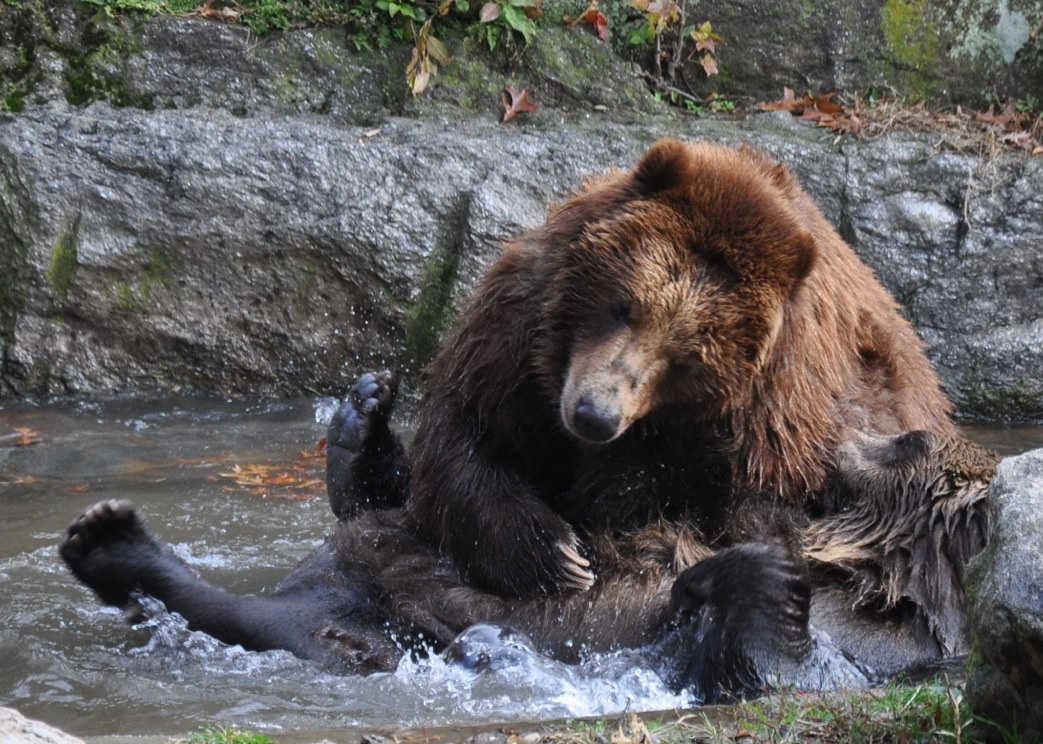
Bears playing in the Bronx Zoo
Favourite beach: Port Salut
I travelled to Haiti with certain expectations, but despite its location in the middle of the Caribbean, that didn’t include great beaches. I was wrong. Port Salut beach had it all: glorious turquoise seas, white sand beaches and fabulous sunsets framed with palm trees. Best of all, most people don’t know about it yet.

The perfect place for doing nothing
Favourite wildlife experience: lions in Zambia
It’s not every day that when asked what you did that day you can say, “I took a lion for a walk”, but that’s exactly what I did in Zambia a couple of years ago. It was a surreal experience. I found myself forgetting that it was a lion and reverting to dog-walking mode, but fortunately lived to tell the tale.
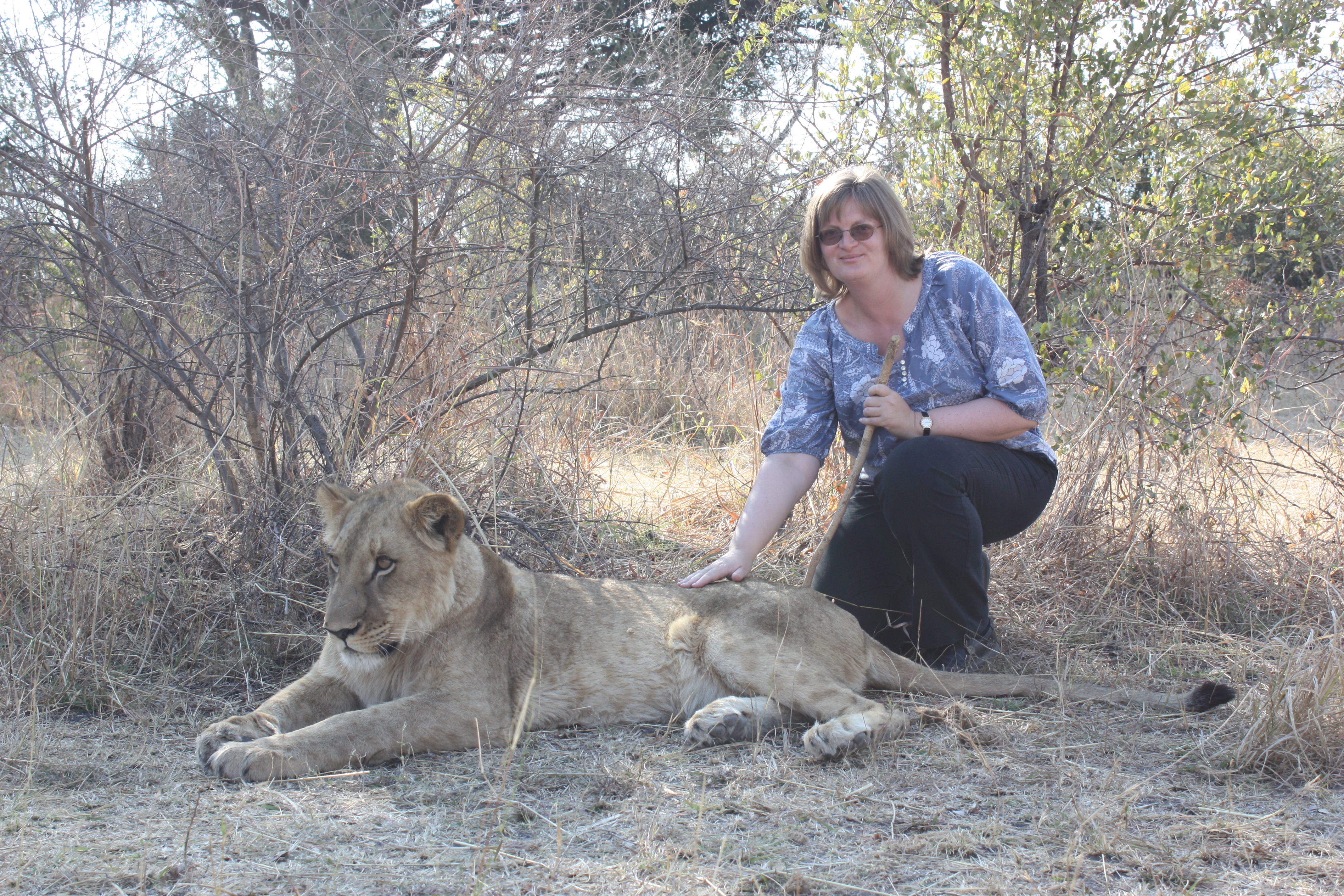
Walking with lions, Zambia
Favourite natural phenomenon: watching the Northern Lights
Nature knows how to wow us and for me, the stand out show is to be found up beyond the Arctic Circle in a dark night sky. On a December trip to Tromso, Norway, we encountered cold like you’d never believe, but frozen feet were instantly forgotten when the sky dazzled us with shades of purple and green.
Northern Lights over the hills surrounding Tromso
Favourite adrenaline rush activity: watching a volcano erupt
I do like volcanoes. I’ve been up close to the ash and smoke of a number of them in Ecuador, Nicaragua and Japan. But by far and away the best was ascending Mt Yasur on the Vanuatu island of Tanna. It was by far the most frightening experience I’ve ever had, but also the most awesome too – and for once that word’s the right one.

Mount Yasur erupts at dusk
Favourite festival: Day of the Dead
It features in the latest Bond film, Spectre, and Mexico’s Day of the Dead is one of those festivals that becomes an immersive experience. I chose to participate in Oaxaca’s celebrations, and from helping to assemble an altar to visiting the atmospheric cemeteries, Dia de Muertos was an emotional and engaging event, as well as lots of fun.
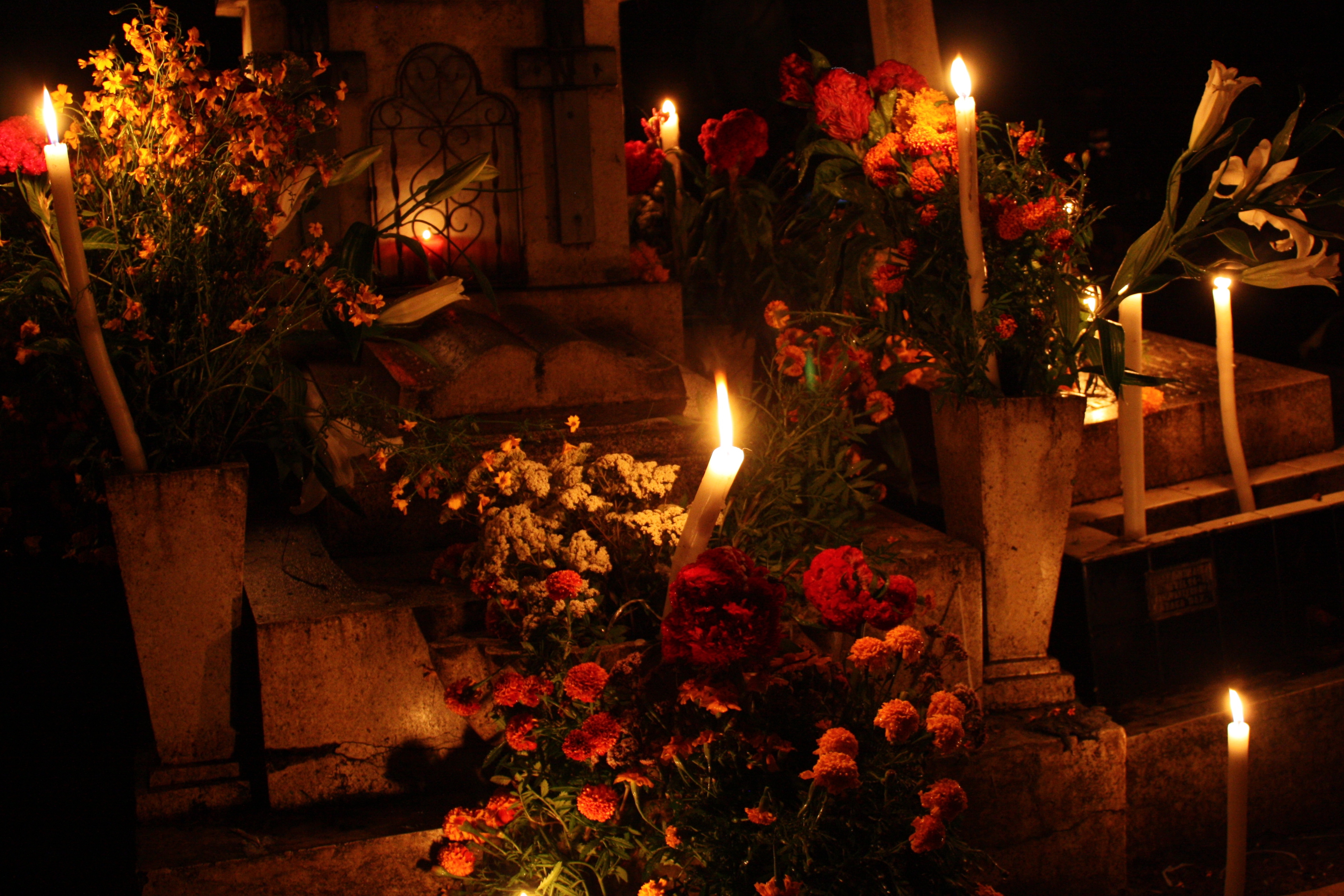
The old cemetery at Xoxocotlan
Favourite place to wake up: Patagonia Camp
Last year we splurged on a lakefront ger in the Torres del Paine’s Patagonia Camp to celebrate our wedding anniversary. The weather forecasts depressed us with predictions of grey skies, but when it came to it, we were rewarded with stars visible through the roof’s circular window and pink skies at dawn.

Sunrise over Lago Toro
Favourite people: Peruvians
Neighbouring Chile has scenery to die for, but it doesn’t have that killer-combination. You see, for me, it’s all about the people and Peruvians don’t just offer you a polite welcome, they embrace you in an enveloping hug. They’re more than a little potty, which just adds to the fun.
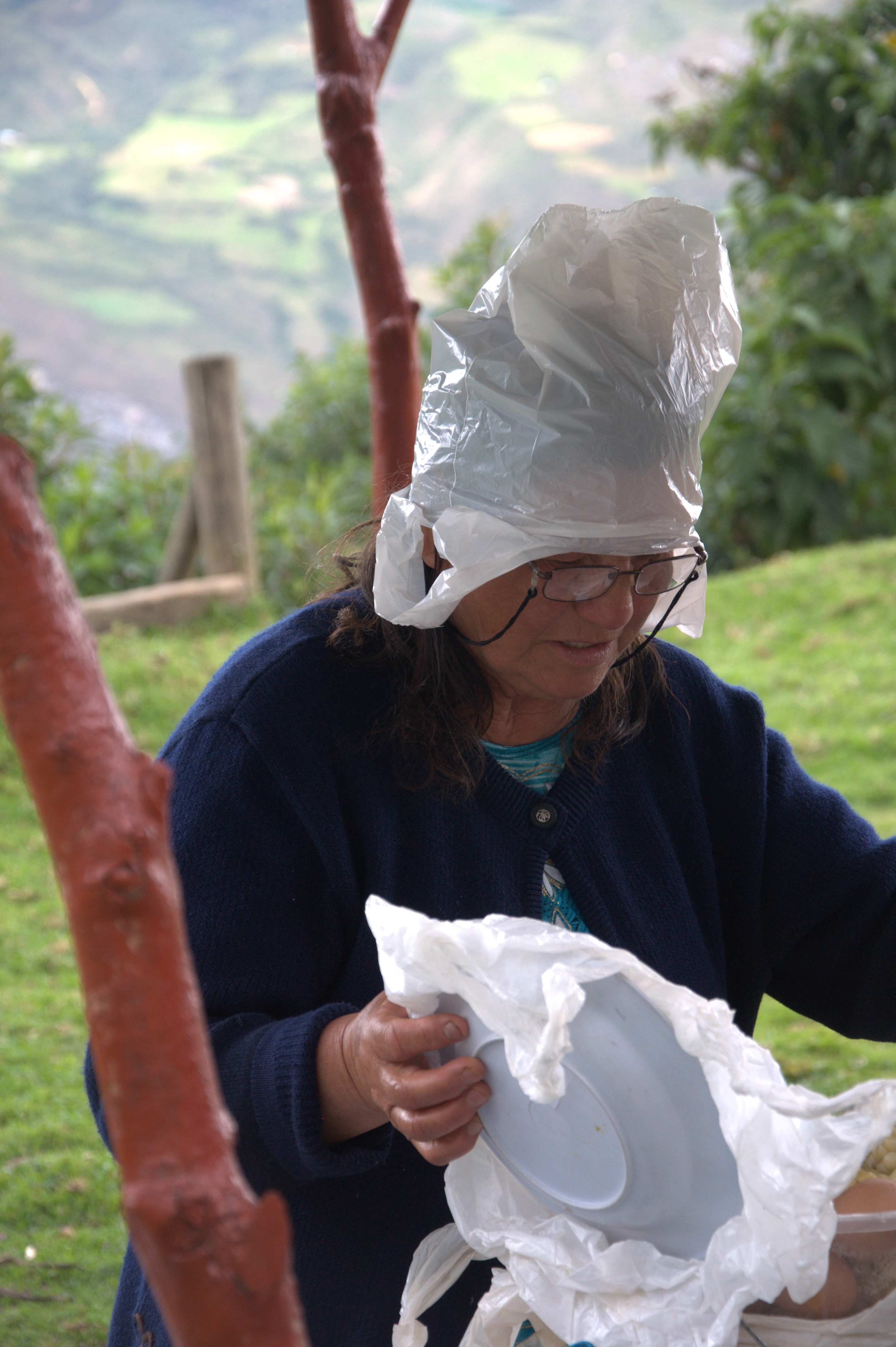
The bag hat lady at Kuelap
Favourite for culture: Japan
I’ve only been to this fascinating country once, but would love to go again. It’s a place where weird is normal: a place where you can buy square melons, get hot chicken and chips from a station vending machine and have to take a shower before you can get in the bath.

Gion matsuri
Favourite place to go walking: Austrian Tyrol
I first visited Austria at 9 months old, making several other trips as a child. Since then, as an adult I’ve found myself in the Tyrol several times. There’s just something about the place that I love: a combination of the fresh air, craggy mountain backdrops, geranium-adorned wooden chalets and excellent walking paths. Last time, I took the dog, and aside from getting him into the gondola, he loved it too.
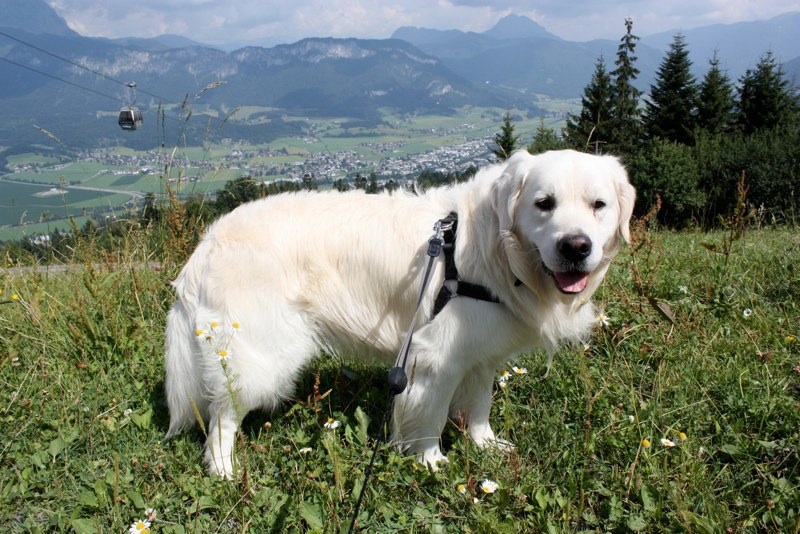
My walking companion, Einstein
A spin off blog: essexology.com
My last blog post, Travels closer to home, sowed a seed of an idea. I’ve lived in Essex for decades, but there are plenty of places I’ve never visited, and some attractions I’d never heard of. Last week, I spent an afternoon walking the myriad paths of beautiful Marks Hall Arboretum in glorious autumn sunshine, yet the day before I didn’t even know it was there.

A spin-off blog, essexology, was born and I’ve been having fun uploading photos and information about some of my favourite places in my home county. If you think Essex is just what you see on TOWIE, then think again. You’ll be surprised at the variety, history and natural beauty of what many write off as merely a commuter belt for London.
If you have a suggestion for a place or a visitor attraction that I should feature, then please leave me a comment and I’ll check it out. And please do visit http://www.essexology.com and tell me what you think.
Travels closer to home
With no foreign trips planned until 2016, I’ve decided to focus on exploring the county that’s been my home for over four decades: Essex. In the beautiful October sunshine, this week I headed to Paper Mill Lock, a tranquil spot yet an easy drive from the county town of Chelmsford. It’s times like these that I’m glad to live in the driest part of the UK. In this sheltered spot, I had an al-fresco sandwich filled with thick butcher’s sausages and tangy onion chutney while watching a pair of ducks glide up and down alongside the boats.
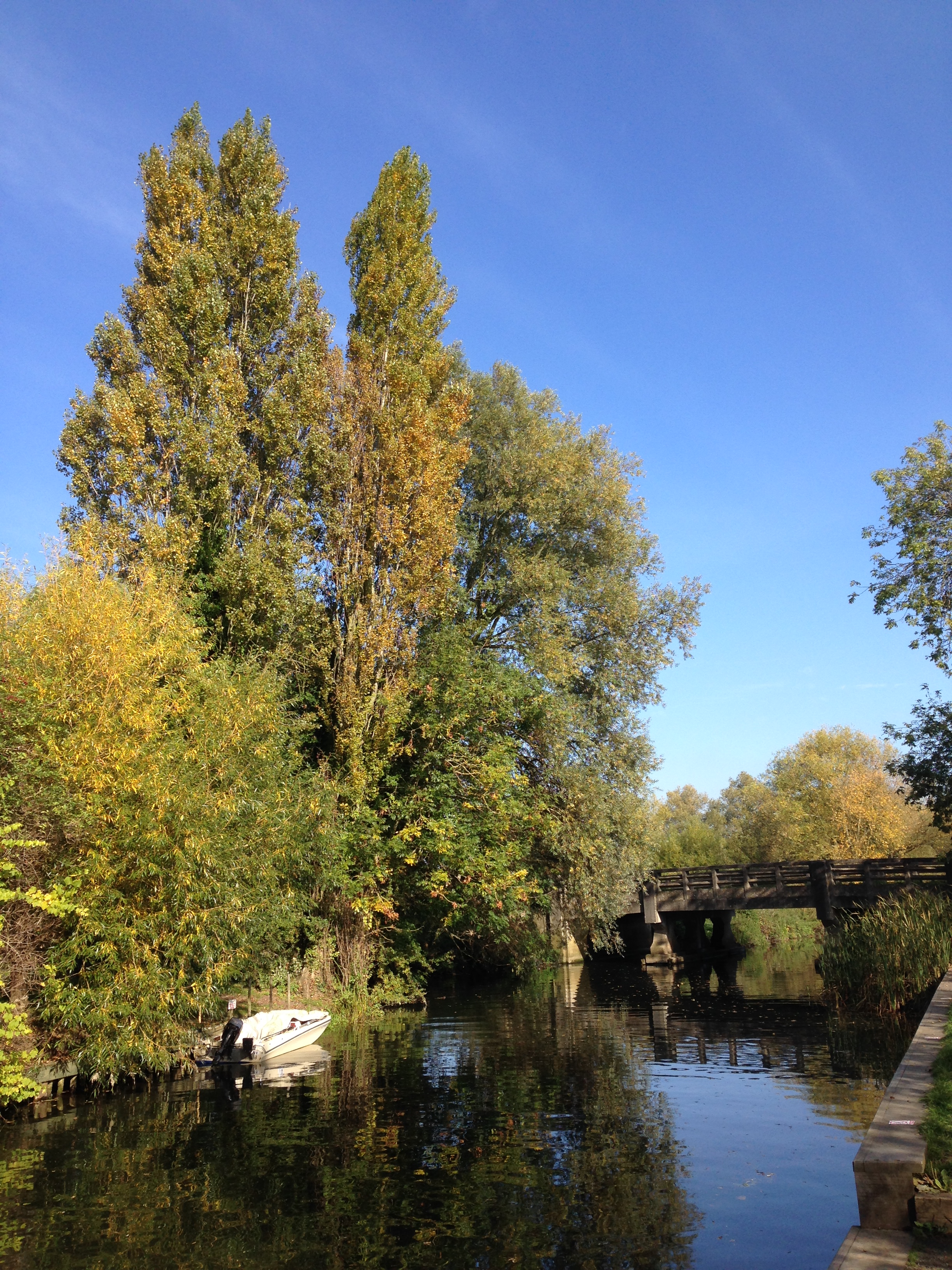
The Chelmer and Blackwater Navigation dates from the 1790s, linking Chelmsford to the coast near Maldon. In the early days, its cargo was mostly coal, bricks and timber heading inland; these days it’s a leisure and pleasure canal. The lock’s one of twelve; it takes its name from the paper mill that stood next to another grinding corn as far back as 1792. It’s possible to walk the length of the canal. At the coast, you’ll end up at Heybridge Basin where you’ll find a couple of decent pubs including the dog-friendly Jolly Sailor.


 Julia's Travels