
How to see the Bahamas’ famous swimming pigs
The Bahamas consists of around 700 islands, cays and islets strung out like jewels on a necklace in some of the shallowest, most turquoise waters of the Atlantic Ocean. Most of these islands are uninhabited. Those further from Nassau, the country’s capital, are known as the Family Islands or Out Islands. The Exumas draw visitors for snorkelling and watersports as well as film makers – James Bond’s Thunderball was filmed near Staniel Cay and Pirates of the Caribbean on Sandy Cay. Johnny Depp liked the place so much he even bought his own private island nearby. He’s not alone. The Bahamas has a higher number of privately owned islands than anywhere else on the planet.

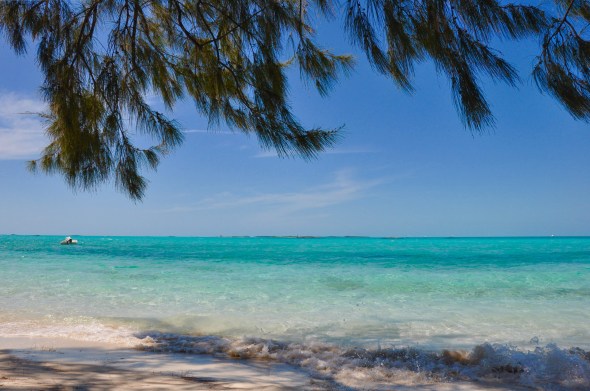
But when it comes to celebrity residents, even Hollywood stars are eclipsed by the Exumas’ famous porcine residents. No one knows for sure how pigs got to Big Major Cay, but these days they are the Exumas’ biggest draw. Around twenty or so pigs live on the beach, charming the pants off the steady stream of tourists who come here to swim with them. The proximity of Big Major Cay to Nassau makes it possible to visit for the day, even if you’re stopping off as part of a cruise.


It’s a popular trip but doesn’t come cheap. Many operators offer excursions. A flyer from Exuma Escapes in our hotel room offered a day out by boat for a special price of $359 per person, which included a 150 nautical mile round trip by speedboat, plus stops to see not only the pigs but also iguanas and to snorkel with nurse sharks. We ruled this out as it was billed as a bumpy ride and not suitable for those with bad backs. To take a smiliar package by air would have cost $550 per person which pushed it well out of our price range. Though you’d have an hour with the pigs and another with the sharks, the return flight would be at 3pm and so with check-in advised over an hour before, that would cut into the day considerably.


Fortunately, I read about a company that would unpackage the trip. We contacted Staniel Cay Vacations whose website http://www.stanielcayvacations.com/tours/ lists a number of options including a pigs only boat trip for $50 per person (minimum 2 people). Booking flights separately with Flamingo Air at http://flamingoairbah.com/ cost us $240 per person. We flew out of Nassau on the 0800 flight, arriving before 0900 and departed at 1700, with check-in required by 1530. We needed to fund our own transport to the airport and lunch at Staniel Cay, but still didn’t pay what we’d have needed to shell out for a tour.

Our boatman, Mr George, was waiting for us at the airport and pointed out Thunderball Cave as we passed. We didn’t see the iguanas like the tour groups do, of course, but while we were enjoying an al fresco lunch at the Staniel Cay Yacht Club a frenzy of nurse sharks clustered around the boat dock. We ended up with plenty of relaxation time at Staniel Cay – spent lazing under a shady tree on the beach and watching the boats come and go from the marina.

Best of all, we were ahead of the tour groups at Big Major Cay and had the pigs to ourselves for a while before another couple of boats arrived. This in itself made the day. Mr George had brought food along so we were able to feed the pigs while in the water.
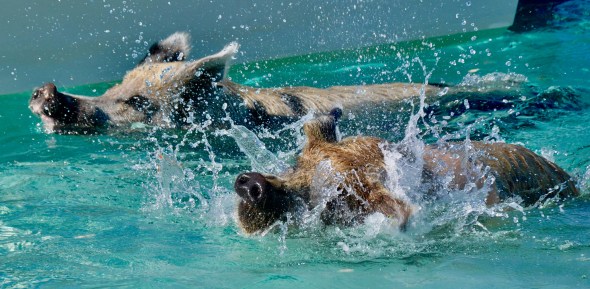
Of course, we took a small risk unpackaging the tour but were fortunate that the flights were pretty much on schedule. Monique was responsive and helpful, answering emails promptly and making sure we were all set. Feeding the pigs was fun and watching them swim was a memorable experience. Mr George kept a close eye on us and made sure we gave pregnant mama pig, who had a tendency to bite people’s bums, a wide berth. And the piglets were cute too, the youngest just a couple of weeks old.


Would I recommend the trip? Definitely. It didn’t come cheap, but was an unforgettable experience and worth evey cent.
Heading to Nassau? Don’t miss this excellent food tour!
Ask anyone who’s visited the Bahamas what is the food that epitomises the islands and chances are, they’re going to say conch. Pronounced ‘conk’ this ubiquitous marine mollusc is served in all manner of ways, the most popular being deep fried fritters with just the right amount of spice to give them a kick. There’s also delicious cracked conch, which can best be described as the Bahamian version of fish and chips. Every restaurant has it on the menu, so finding it is easy. Knowing which serves the best is a whole lot harder, however.


I believe there’s no better way to get to know the heart and soul of a country than through its stomach. Though the enduring image of the Bahamas is of glistening turquoise waters surrounding necklaces of cays, there’s a lot to be said for getting out of the water and into Nassau’s historic downtown district. But the capital’s streets are packed with eateries and it’s hard to know where to start. I figure it’s always best to enlist the help of a local when it comes to food. I’d been tipped off by Cecilia fom Hong Kong Foodie Tasting Tours that in Nassau, I should get in touch with Tru Bahamian Food Tours.
Alanna Rogers set up the company in 2012, describing herself as a passionate foodie whose own travels inspired her to showcase the cuisine of her own country. The Bites of Nassau food tour is popular with cruise ship passengers looking for a memorable experience when their ship’s in dock, as well as with those who are staying on the island. It even attracts locals, which in my opinion is another measure of how good it is. Something like 5000 people take the tour each year, and the company is going from strength to strength.
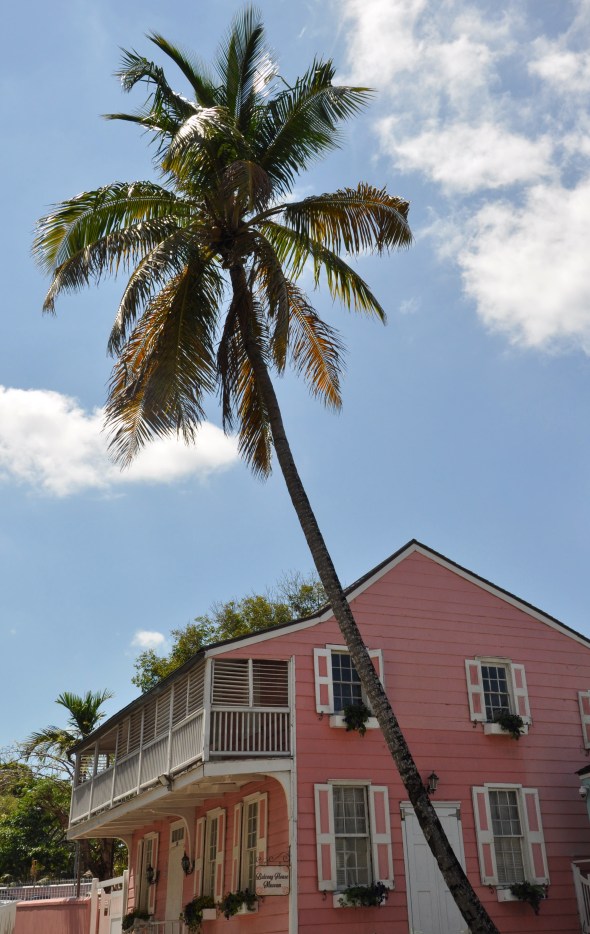
My husband and I took the tour this March as part of a week-long holiday in the Bahamas. From our base at Cable Beach it was an easy ride into Nassau. Guide and operations manager Murray was easy to find on the steps of the cathedral, built in 1841 as the first official place of worship in the country. Our small group strolled around the corner to Market Street for a look at the pastel pink Balcony House. The oldest wooden structure in the city, it hosted Ian Fleming when he came to the Bahamas when Thunderball was filmed in 1965.
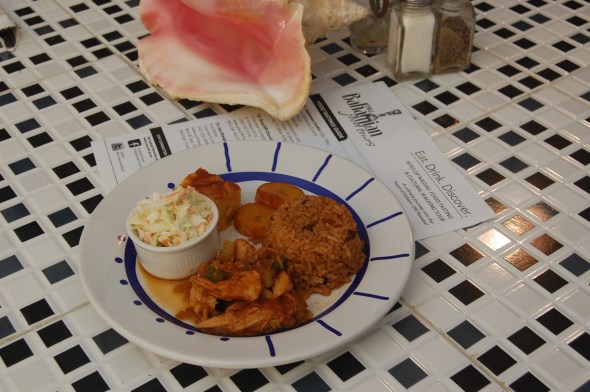
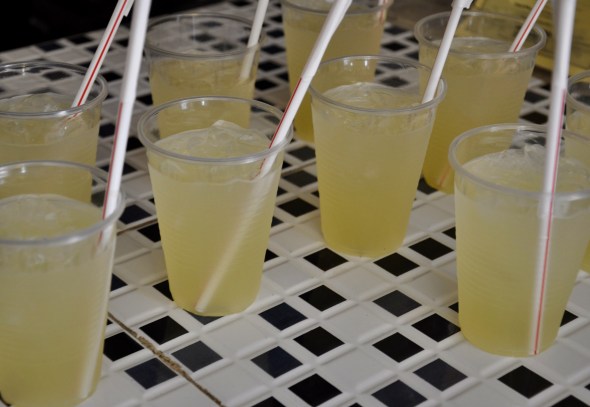
Across the street was Bahamian Cookin’. Murray warned us that this would be the largest of our tasting plates, and it was here we had our introduction to the Bahamian staples: conch fritters, fall off the bone chicken, baked mac and cheese and of course peas and rice. I hate peas. But peas here are beans, fortunately, and this was so tasty I confess to stealing some of my husband’s while his attention was distracted. On the way out, we had a refreshing glass of switcha, a kind of Bahamian limeade. Apparently, spellings of switcha vary considerably so if you’re reading this and spelling it differently, I’d love to know how you write it.
Next up we got to meet one of Nassau’s most colourful characters. In the Towne Hotel, we were served a potent Planter’s Punch while enjoying the company of Max, who’s the hotel’s resident blue macaw. The artwork in the hotel was fabulously diverse and a big talking point as we sipped our rum cocktails. The chatter continued as we reached Graycliff.

Now a hotel, it was built in 1700 by privateer John Howard Graysmith. An inn from 1844, it was also once the private home of wealthy Canadian Izaak Killam and later Lord Dudley. The latter played host to the likes of Edward and Mrs Simpson, Churchill and Lord Mountbatten. It’s also seen Al Capone, the Beatles, Jay-Z and Beyoncé.
We learned that some of the bottles of wine in its cellar would cost the average tourist a year’s wages. Passing on that, instead we got to try some of the chocolates in the on-site factory. The first, labelled “white chocolate twice as hot as goat pepper” was a truly Marmite experience – some of us (me included!) spat it out half-eaten while others would have been delighted to eat the whole tray. That’s half the fun of taking a food tour, of course, to experiment with flavours you wouldn’t otherwise have tried.
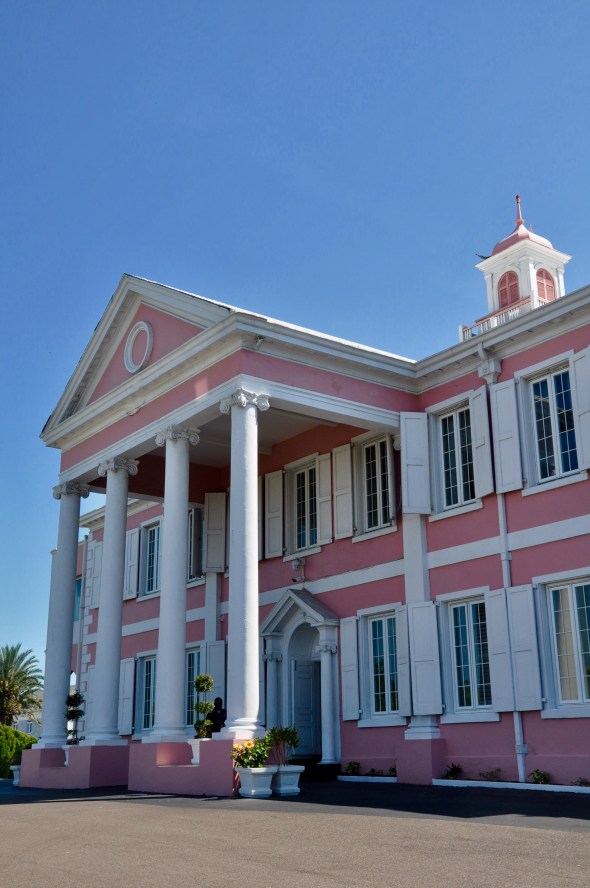
Nearby is Government House. Our Queen is Head of State in the Bahamas but of course her representative the Governor General takes care of things for her and these are his digs. The building actually stands on the highest point of downtown Nassau affording a fabulous view of the cruise ships in dock. We walked down a flight of steps – not those steps – to visit Biggity in Bay Street. Amanda’s creative take on pigeon pea hummus, rosemary and thyme infused olive oil, and garlic Johnny cake crostini was a big hit with everyone, as was the bush tea we washed it down with.

Murray explained that Bahamians consider bush medicine important. A nod to the country’s African heritage, native spices, leaves, flowers and tree bark are artfully combined to cure all manner of ills. Apparently it’s also quite common to consume a medicinal tot of rum to avoid having to visit the doctor. I’ve bookmarked this interesting blog from the Tru Bahamian Food Tours website just in case I feel under the weather:
https://www.trubahamianfoodtours.com/tru-bahamian-must-eats/bush-teas/.
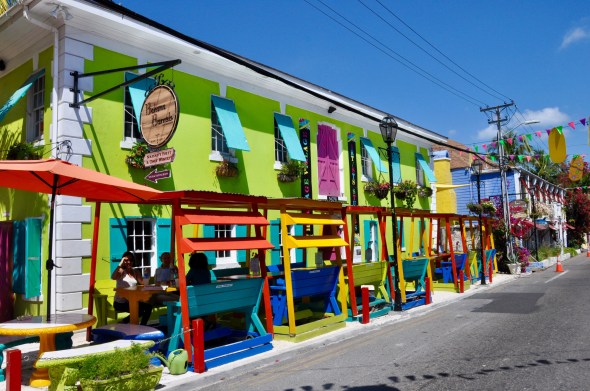
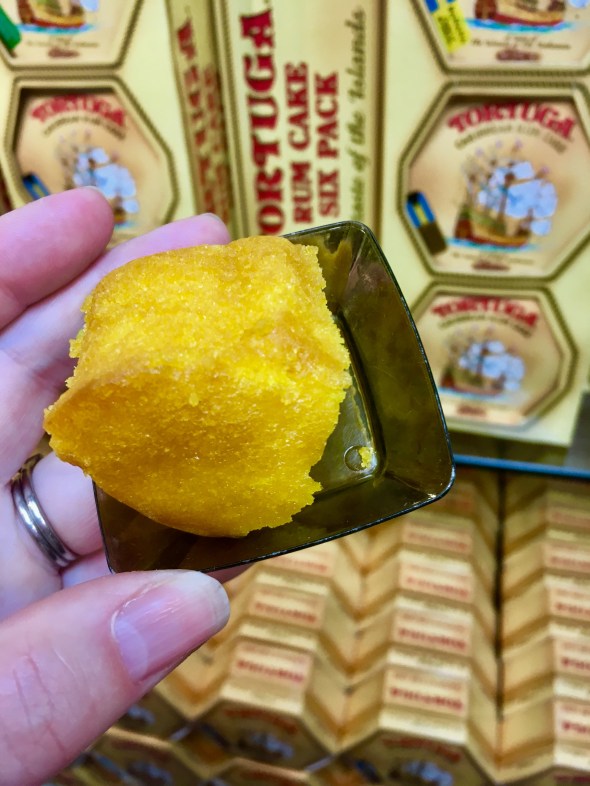
Our penultimate stop was at Athena Cafe. Many of the Greek community in Nassau can trace ancestors who came to participate in the trade of sea sponges back in the 19th century. They stayed on, blending typical Greek dishes with local ingredients – we had a tasty chowder. Rounding off the tour was a sweet treat from the Tortuga Rum Cake Company. The group enjoyed rum cake with walnuts but as I’m not a fan, my rum cake came nut-free with pineapple instead. It was delicious.
Tru Bahamian Food Tours promote Bahamian cuisine as “the islands’ most unexplored cultural treasure”. After a few hours in Murray’s company, I think they’ve got that just about right. What sets this tour apart from other food tours is the emphasis it places on history, culture and the pivotal role of immigrants to the Bahamas. When asked what they enjoyed best about the tour, most people commended the contextual information that Murray had provided.
However, compared to other food tours I’ve taken there were fewer opportunities to chat to fellow participants about the food, which has in the past been an enjoyable way of processing what I’ve learnt. Also, towards the end, the tour felt a little rushed; several of the other tours I’ve done have been around five hours long. By lengthening the tour from its current three hours, both these points could be addressed. I guess when something’s good, you don’t want it to end.
But those are minor criticisms of what’s an excellent tour. If you’re planning to visit Nassau any time soon, and if you want to understand what makes the country tick, this is a must for your itinerary. But take my advice: arrange the tour at the start of your trip. Once you’ve tasted what’s on offer, you’re going to want to go back for more.
The lowdown
You can find out more about Tru Bahamian Food Tours on their website and social media feeds – the links are at the foot of this post. The excellent Bites of Nassau tour is a great way to experience the islands’ capital Nassau. It runs several times a day from Monday to Saturday and lasts about 3 hours; you can book online. The company has also just launched a Sunday cocktail tour, which should prove to be just as popular as the original Bites tour. If you’re feeling really inspired, they can also arrange cooking classes giving you the skills to recreate the dishes you’ve enjoyed once you get home.
The Bites of Nassau costs $69 per person. My husband and I enjoyed the tour free of charge in exchange for promoting the tour via this blog. The photos which illustrate my blog are a mixture of mine and those supplied by Tru Bahamian Food Tours, but the opinions are entirely my own.

Facebook/trubahamianfoodtours
Twitter: @trubahamianfood
Instagram: @trubahamianfoodtours
A visit to Bury St Edmunds Christmas Fayre
Regular readers of this blog will perhaps remember how I enjoyed a trip to the Christmas markets in Regensburg, Germany last year. If you’re looking for a German Christmas market destination, then I’d recommend this small city near to Nuremberg as the markets are compact yet very atmospheric, with one located in the grounds of the delightful Thurn und Taxis Palace. I snagged flights with Ryanair for less than a fiver, making it viable both in terms of time and cost for a day out.
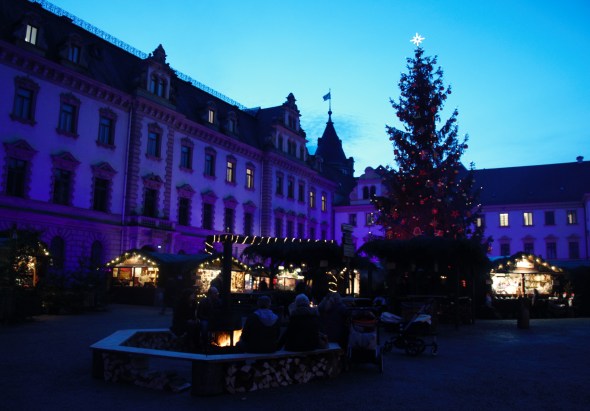
Copenhagen’s Christmas markets were also well worth the trip, with the Danish capital adding some Scandi style to the proceedings. This year, I’ll soon be spending the weekend in charming Salzburg, Austria to see how they compare. In the meantime, you can read more about Regensburg and Copenhagen’s markets here:
https://juliamhammond.wordpress.com/2016/11/25/just-back-from-a-day-trip-to-regensburg/

But what about the markets closer to home? Can the UK compete? A news feature on BBC Look East about increased security at Bury St Edmunds Christmas Fayre was not only reassuring but perhaps more importantly, brought the event onto my radar. It took about an hour and a half to drive through some of North Essex and Suffolk’s most scenic countryside to reach the town. At midday on the Friday of the Fayre, the Park & Ride was full, as were the town’s long stay car parks. I began to wonder whether I should have taken the train, though it would have involved two changes and an extra hour on the return journey. Finally, we were given permission to tuck the car into the exhibitors’ car park. Was it worth the trip?

The Fayre
With around 300 stalls spread across several locations in the town, there was plenty to hold our attention. In total, we spent around 5 hours at the Fayre, beginning in the pedestrian streets spanning Cornhill and Buttermarket. Moyse’s Hall Museum, which focuses on local and social history, is worth making the time for.
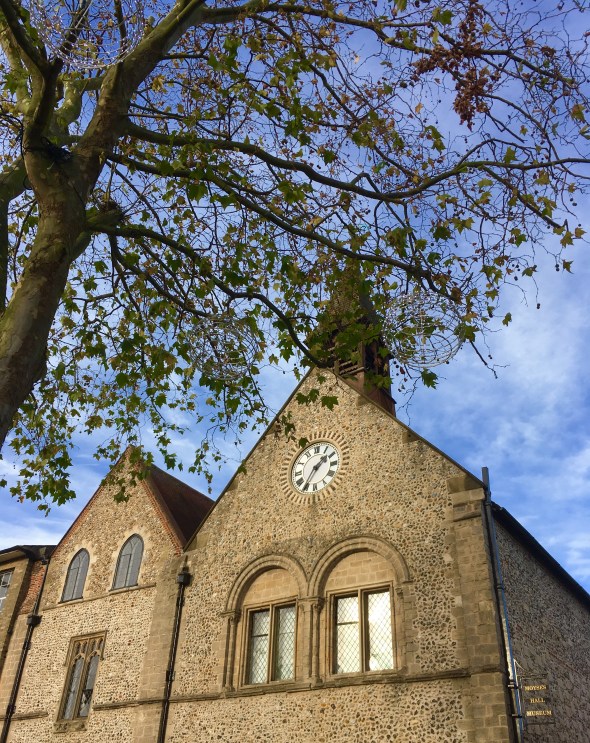
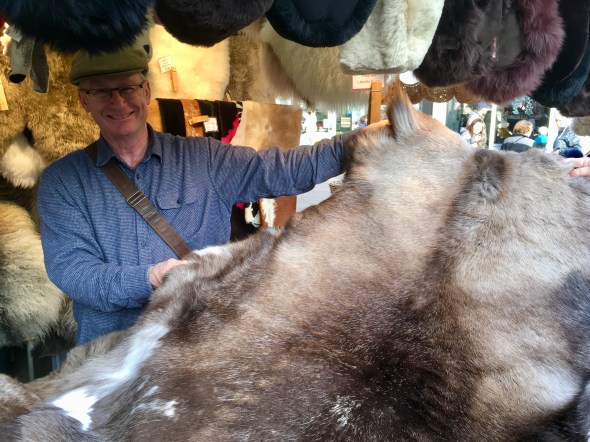
Outside the museum, we found several enticing food stalls, the best of which specialised in salami and sausage. Purchase one in the bag. Not far away, Just Our Stall, which has a permanent base in the town on St John’s Street, had a wide selection of sheepskins and farmed reindeer hides. Prices were very competitive and quality was high.
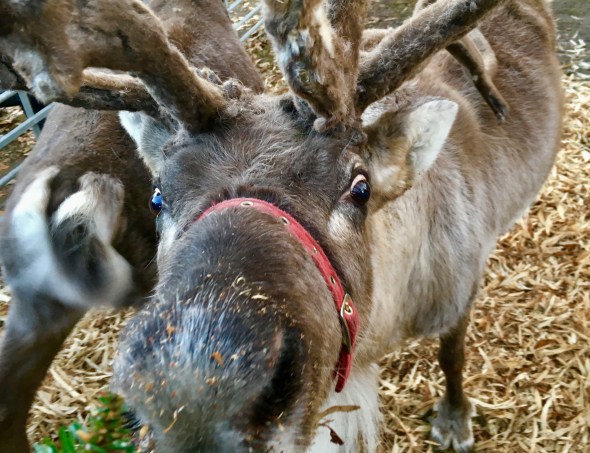
From there, a stroll down Abbeygate Street led us via shops and cafes towards the Abbey itself. Fairground rides and Santa’s Grotto would keep the kids happy. Inside, we were disappointed at first to find that there weren’t as many seasonally-themed traders as we’d imagined, though once we got to the reindeer pen, things got a lot more Christmassy. One of the two reindeer wasn’t too keen on remaining in the pen, attempting to climb out when someone produced a carrot. He was a real character.
Through the Abbey gate, the concentration of stalls selling Christmas gifts and decorations was higher, making this our favourite part of the Fayre. Stand out traders, for their sense of humour as well as their product range, included HaGA Lifestyle which enthusiastically embraced the Danish concept of hygge. Locals will be aware that their regular base in Eastgate Street has an excellent cafe, a deli and also offers dog grooming.


The Once I Was stall also brought to mind the recycling theme I’d seen in action in Copenhagen. Each of the products had previously been something else before being repurposed for use in the home. Tealight holders, chopping boards and Christmas decorations had been fashioned from drawer fronts, fence posts and sheets of plywood. Also worthy of a mention is The Crafty Foxes. Based in Queens Road, they offer craft workshops. Here at the Fayre, they had a range of gift bags for sale which made excellent stocking fillers, as well as some rather unique Christmas tree decorations.


Food stalls were in abundance and there were some tempting and very festive offerings from which to choose. In contrast to the European markets, however, there was a lack of seating nearby, which meant either standing around or walking around with food and drink. Hopefully, that’s something which St Edmundsbury Council might consider for next year.


As the sun set, the festive atmosphere ramped up a notch. There hadn’t been time to duck inside the Athenaeum for the indoor stalls or catch one of the cookery demonstrations in the Cathedral Courtyard. Walking back to the car, we reflected on what an enjoyable afternoon it had been and well worth a return visit.

Just back from: a day trip to Venice
Regular readers of this blog will know how I’ve made a number of day trips by air to some of Europe’s most captivating cities. Yesterday saw me jet off to Venice, in perhaps my most ambitious trip yet.

You’ll find a full list of the others at the bottom of this post or on my Index page here:
https://juliamhammond.wordpress.com/index/
While I’m not suggesting for a minute you’re going to truly get under the skin of your chosen destination in such a short space of time, it is great when you have little or no holiday left but still have that pressing need to travel. Or in my case, a desire to keep two dogs out of kennels and into Daddy Day Care which is always a priority. If you believe those predicting Brexit will put an end to cheap European flights from the UK, time could be running out to snap up a bargain. Here’s the how, where, when and what of Venice in a day.
Getting there
My local airport is Stansted, the main UK base of Ryanair, and once again it was to the controversial budget carrier that I looked for my cheap fare. Normally, Ryanair flies in to Treviso airport, but while the airport has been closed for essential runway maintenance, flights are being rerouted to Marco Polo instead. Marco Polo also has the advantage of being closer to the city and well connected by both boat and bus. The current closure lasts until 18 October, but it’s worth keeping an eye out as it’s not the first time I’ve read flights have been diverted. My flight departed on time from Stansted at 0620 and touched down ten minutes ahead of schedule at 0910. The return left a few minutes after its scheduled departure time of 2230 and taxied to the terminal to unload us at 2355, about 15 minutes late. Total ticket cost this time was £34 return. I should also add, as per usual I didn’t bother with a seat reservation and got a randomly allocated window seat on the outbound flight and an aisle on the return leg.

To reach Venice from Marco Polo it’s possible to catch a bus. An express service takes around 20 minutes to make the journey to Piazzale Roma, near the top end of the Grand Canal and the city’s Santa Lucia station. Return tickets cost 15 euros. But to arrive in style, I figured I needed to arrive by boat, though my budget most certainly doesn’t stretch to water taxis. There are, however, direct transfers from the airport with Alilaguna who offer a reliable service on one of three routes. This is double the price of the bus at 30 euros for a return, but in my mind well worth the cost. However, I should mention you do sit low in the boat, which isn’t great for sightseeing if you aren’t tall.

I opted for the orange route as it takes you via Cannaregio and then down the Grand Canal. Journey time to the Rialto Bridge was just under an hour. From there, the boat continues down to Santa Maria del Giglio, just short of St Mark’s. It was busy, and I had to wait for one boat to leave before getting on the second one, which added about a 30 minute delay to my journey. However, the boats serving the blue route were bigger and there wasn’t a wait. They loop via Murano and Giudecca instead, and calling at San Marco on the way. This is a really convenient option if seeing Murano’s famous glass is on your wishlist. However, it does take about 90 minutes to get to San Marco and it doesn’t transit the Grand Canal. The way I see it is that this transfer is part of your day out rather than just transport, but if time is the priority then the bus is a no-brainer.

Note: From Treviso, an airport bus scheduled to coincide with arrivals takes around 70 minutes to reach Piazzale Roma. Make sure that you’re on the ATVO bus and not the Barzi bus as the latter calls at Mestre station rather than Santa Lucia (requiring a second train journey to get to the city) and also Tronchetto Island which is again inconvenient for Venice’s top attractions.
The links you’ll need (including timetables, fares and maps):
ACTV bus and city boats: http://actv.avmspa.it/en
Ailaguna boat: http://www.alilaguna.it/en

Getting around
Venice is time-consuming to get around, which is why I refer to this as my most ambitious day trip to date. Because of the lack of roads, you either have to walk or take to the city’s canals. It’s a pleasure to wander on foot, but the downside is that many alleyways are dead ends leading to canals or courtyards. Without a good map (or even with one) you’re likely to get lost. I relied on a combination of paper map, Google map navigation on my phone and a general sense of direction.

Those of you who know me will realise the latter is pretty much non-existent. Narrow streets and a maze of densely packed buildings mean that sometimes Google maps don’t quite have your location right. I also struggled with night mode, as the canals and alleys have almost no contrast – the waterways are such an essential aid to navigation that I switched it back to day mode. Fortunately even with very limited Italian, people were helpful to my pitiful “Scusi, dove Rialto Bridge?” attempts at conversation and pointed me in the right direction with a smile.
There has been a lot in the press about how residents are fed up with the city being overrun by tourists; the historic centre’s residential population numbers only 55,000 now, compared to an estimated 28 million visitors annually. Do the maths: that’s more tourists per day than the number who actually live there. Whether it was because I visited in the quieter shoulder season or whether such irritation has been exaggerated in the press, I didn’t see any indication of frustration with tourists invading locals’ space. But it’s certainly not an issue to brush under the carpet.

Due to the unhappy marriage of being time-poor and totally incompetent at map reading, I decided to splurge on a day pass for the city’s ACTV boats. This cost 20 euros and can be purchased at the many ticket booths near the jetties. (The jetties themselves are easy to spot being a) near the bigger canals and b) on account of their bright yellow livery as in the photo below.) You do have to validate the pass before you step onto a floating jetty, or risk a hefty fine. Look for a white oval terminal as you step off dry land and tap the card against it. I got my money’s worth hopping on and off, but you’ll need to make several journeys to cover your outlay.

Things to do
With so many sights to choose from, whittling down what’s easily a month’s worth of sightseeing into the nine hours I had in central Venice was tricky to say the least. It helped that this was my third trip to Venice, so I’d already seen the main attractions and (fortunately for me) years ago, well before selfie sticks had been invented. I was also keen to test out the new policy of the Venice authorities which is to encourage people to explore off the beaten track. You’ll find a wide choice of suggestions here (when they first pop up, you might think they’re written only in Italian but they’re actually dual language with English too):
http://www.veneziaunica.it/en/content/itineraries


I began my day by alighting at the Rialto Bridge boat jetty and crossing the bridge itself to the adjacent market. Originally the market moved to this location in 1097, but a 16th century fire destroyed almost everything in the vicinity. The market was rebuilt and despite being a stone’s throw from the tourist crap which lines the bridge and its environs, manages to retain more than a little of its charm. There’s plenty to see, including more varieties of mushrooms than you could ever expect to see back home, capsicums done up like posies of flowers plus of course a pungent but vibrant fish market.

There’s a treat tucked around the back of the market in a hard to find alley (even with the address, Sestiere San Polo 429, it was concealed so well it took me a while to find either of its two doors) What I’m referring to is Cantina do Mori, the bacaro which claims to be the oldest in Venice. This tiny bar whose ceiling is hung with dozens of copper pots still retains a customer base who are happy to share their local with tourists like me. It’s been around since 1462 and once counted the infamous lothario Casanova among its clientele. Today, it’s still a popular place to go and have an ombra (Venetian slang for glass of wine) and soak up the alcohol with some cicheti (or in English, cicchetti), the Venetian equivalent to Spanish tapas.


Eventually, I prised myself away from the bar and its surroundings. I decided first to take a stroll in search of Venice’s narrowest street. Calle Varisco is just 53cm at the little end, though mercifully for pedestrian flow, it widens as you walk down. If I’m honest, I was a little underwhelmed; several properties off the street were having work done and there was a fair bit of rubbish around as a result. Forget what you’ve read: it’s not the narrowest street in the world (that’s a German one) and it’s not even close to being the slimmest in Italy.

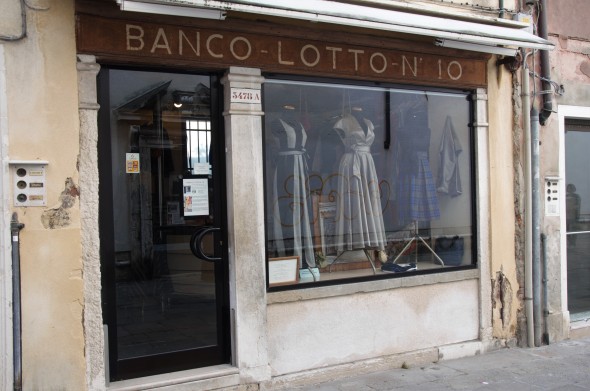
Moving on, I headed north and picked up a boat which looped around the Castello district to bring me to the San Zaccaria stop. I was hoping to see if the church’s flooded crypt was underwater, but it closes from 12 noon until 4pm each afternoon so was out of luck. Nearby though, I passed Banco-Lotto No. 10 which sells clothing made by inmates at the women’s penitentiary on Giudecca Island. Sadly, that too was closed, though it shouldn’t have been according to the sign on its doorway. The clothes looked fabulous, even for someone with my limited fashionista skills.
Next up was a bookstore, and one which proves that Amazon can’t provide everything. The Libreria Alta Acqua is a treasure. Books stacked in precarious piles fill every inch of available space. Balanced on shelves, filling redundant gondolas and bath tubs, they represent what a bookstore should be.


This is a place to be savoured, to potter and to forget the time or anything else on your mind. The store owner wandered about, leaving the rather scary looking cat to mind the till while he wheezed and tutted to himself looking for items unspecified but clearly important. I think I could have watched him all day too. Out back was the tinest of courtyards with a sign imploring people to climb up some wobbly stairs made of old books to see the view over the canal.


I couldn’t resist walking south via St Mark’s Square. This might sound odd as I really hate the crowds and the tourist paraphernalia but I think I wanted to see just how bad it was. On the way, in Calle del Mondo Novo, my nose caught the aroma of a cheese and ham store as my eye was drawn to a pig in the pizza shop window opposite. Incidentally, I read that you should never eat pizza in Venice as wood-fired ovens are banned with just a tiny handful of exceptions. The store, Prosciutto e Parmigiano, is known locally as Latteria Senigaglia (that was the name of the original family-run dairy produce store which was set up in 1940).


In St Mark’s Square, I navigated a sea of people who couldn’t have been more synchronised in pointing their mobile phones towards whatever their guide was pointing out had a musical soundtrack been in place. Pausing only to recreate the famous shot of the gondolas lined up facing out across the lagoon, I hopped on another vaporetto. This one was bound for the church of San Giorgio Maggiore. From the top of its belltower, or campanile as they’re called, the views across the city are splendid and of course you look out over the campanile in St Mark’s Square rather than from it. It costs 6 euros to ascend, but for that they provide a lift, and free entertainment when the bells chime the hour, frightening unsuspecting visitors. Best of all – no queues.

It was mid-afternoon and I wanted to explore a little more before I left, so I took a boat a short way up Canale della Giudecca, jumping off at Spirito Santo church to cut back through to the Grand Canal near the Peggy Guggenheim art collection. Another vaporetto took me to Venice Casino from where I could cut through to the district of Cannaregio. This is on the Venice authorities’ recommendations list and is where you’ll find the Jewish Ghetto. It lacked the crowds of St Mark’s and it’s probably very uncharitable of me to hope that the city’s campaign is unsuccessful and it stays that way.


I had planned to have an early dinner in Osteria al Bacco, which is one of the area’s most highly rated restaurants, but got sidetracked by the wonderful Al Timon instead. You do need to book ahead for dinner reservations, though they don’t always serve what they display in the window. Get there right on the dot of six when they open to grab a table for cicheti and a Spritz – for something classically Venetian, swap the fashionable Aperol for Campari.


Time was ticking on so I took a last vaporetto ride along the Grand Canal and then bought a ticket for the boat back to the airport. I’d definitely recommend a visit outside of summer and most importantly, away from the crowd. Venice is never going to be one of my favourite cities, but it’s growing on me.
The other day trips by air:
Ibiza
https://juliamhammond.wordpress.com/2017/05/13/just-back-from-a-day-in-ibiza/
Copenhagen Christmas markets
https://juliamhammond.wordpress.com/2016/12/05/just-back-from-a-day-at-copenhagens-christmas-markets/
Regensburg
https://juliamhammond.wordpress.com/2016/11/25/just-back-from-a-day-trip-to-regensburg/
Belfast
https://juliamhammond.wordpress.com/2016/10/17/just-back-from-a-day-trip-to-belfast/
Budapest
https://juliamhammond.wordpress.com/2016/10/07/just-back-from-a-day-in-budapest/
Bremen
https://juliamhammond.wordpress.com/2016/06/07/just-back-from-a-day-trip-to-bremen/
Lisbon
https://juliamhammond.wordpress.com/2014/10/20/just-back-from-a-day-trip-to-lisbon/
Amsterdam
https://juliamhammond.wordpress.com/2015/01/26/just-back-from-a-day-trip-to-amsterdam/
Welcome to the Wiviera!
Fresh air and water are always a good combination. With excellent rail links as well, it made the riverside town of Wivenhoe a good choice for my third outing with Greater Anglia this summer. There’s an easy but very pleasant 4km walk that takes you along the banks of the River Colne from Hythe to Wivenhoe. The really good news is that if you don’t wish to walk it in both directions, the path is easily accessible from Hythe station and leads you straight into the station car park at Wivenhoe. Both the path and the railway line follow the banks of the Colne Estuary, offering splendid views. As a walk, it couldn’t be more convenient if it tried!

If you’ve been following my previous blogs, you’ll know that I’ve enjoyed days out by train to Harwich and to the East Anglian Railway Museum. Greater Anglia have some very affordable advance fares across their network as well as £2 child fares and many other offers. It’s well worth checking out their website if you’re at a loose end this summer.
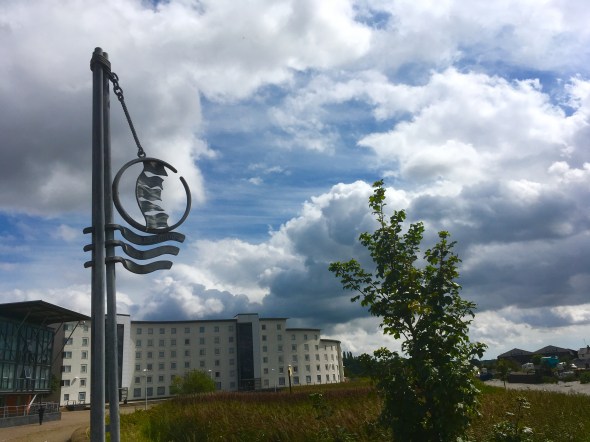
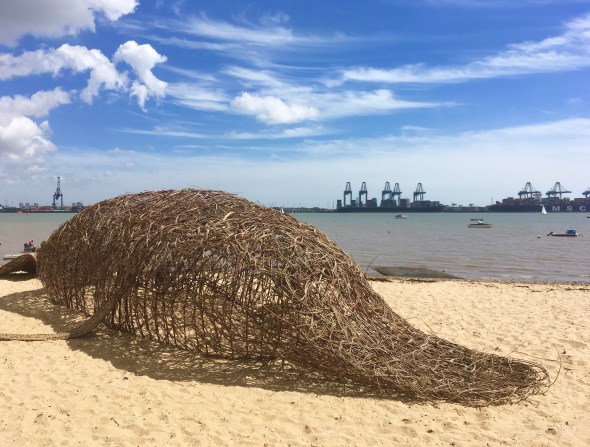
I set off from Hythe station just before lunchtime and walked along the riverbank towards the University buildings and on towards the new apartments that are springing up. I’d come this route a thousand times – it’s on the way to B&Q and Tesco – but from the car, you just don’t see what’s under your nose. There’s some fantastic artwork to be seen.


Information boards telling a little of the area’s history help provide context. In parts, they form trail markers. You can’t miss them in their steel cages.
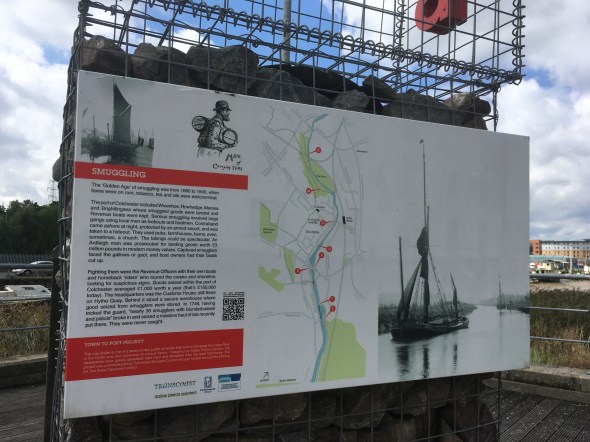
Following the river, I passed the iconic lightship and headed off in the direction of Wivenhoe. Urban becomes rural pretty quickly and it’s a pleasant and flat walk past riverside meadows, reed beds and woodland. Even on a weekday, there were plenty of joggers and cyclists using the trail, as well as a man in a wheelchair walking his dog. This is a trail for everyone to share.

Towards Wivenhoe, there’s a board marking the entrance to the Ferry Marsh Colne Local Nature Reserve; the name’s a bit of a mouthful but it’s well worth the diversion. There’s plenty of seating along the river banks on which to sit and watch the birdlife and see what the ebb and flow of the tide reveals. If you’re lucky you could even see otters or water voles.

But it was Wivenhoe that I’d come to see. From its railway station, I found myself on the charming quayside in just a few minutes. Wivenhoe Quay is packed with buildings of historic interest, among them The Nottage, open on weekends, housing a museum with an eclectic collection of nautical items. Every Saturday and Sunday afternoon until September 3rd you can visit to learn more about Captain Nottage, the Victorian army officer and keen yachtsman whose name is on the door.


Next door to The Nottage is the excellent Rose and Crown pub. Its outside tables are perfectly placed to watch the comings and goings along the Quay and the food’s not too shabby either. In the sunshine, there are few places in Essex more attractive for an al-fresco lunch.


I wanted to see something of Wivenhoe and began to explore its quiet streets. Just along Rose Lane, I noticed a blue plaque commemorating the great Miss Marple actress Joan Hickson, who once made her home here. Around the corner, I couldn’t resist browsing the produce on offer in the Village Deli. Owner Mike had an interesting take on the calorie issue presented by the ice cream on sale. According to him, if you use the attached spoon correctly, the calories can be neutralised and thus don’t count. That’ll be a salted caramel tub for me, then, and…

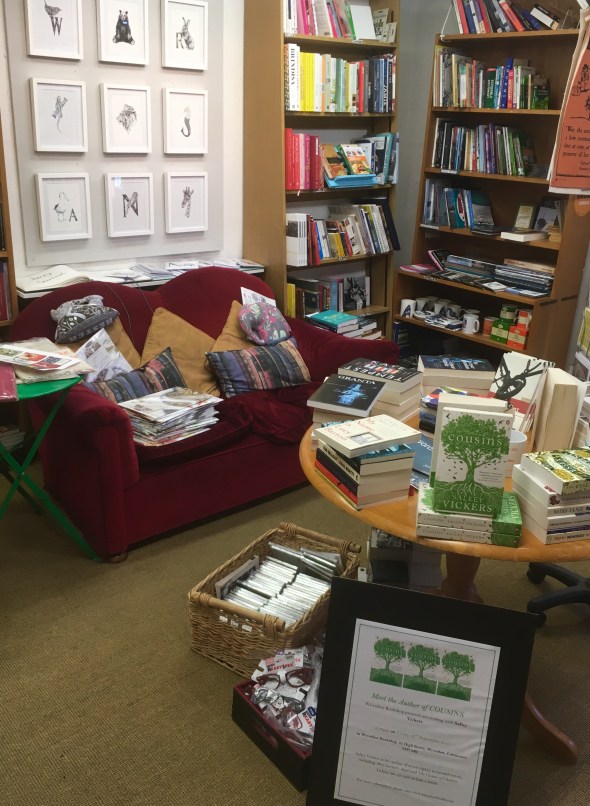
Along the High Street I found the Wivenhoe Bookshop, the kind of place that almost doesn’t exist anymore. Staff member Sue told me they’ve worked hard to create a space that works as a community cultural hub as well as a bookstore. Coming up there are writers’ workshops, book signings, a knitting group and even a philosophy breakfast, reflecting the University of Essex presence on the edge of town. You don’t have to be a local to get a warm welcome. The place has a homely feel – the sofa in the back room was just the kind of sofa you’d want to sink into on a rainy afternoon. I was blessed with blue skies so it was time to move on.
My final port of call was to The Sentinel Gallery, run by the delightful Pru Green whose enthusiasm for art is catching. Inside, work from some of East Anglia’s most talented artists was on display as well as some of the most colourful pottery you’ll find in the county. The modern structure features angular lines and huge panes of glass. It stands in stark contrast with the very traditional buildings that surround it, but it doesn’t jar. And the light which floods into the exhibition space is incredible. Even if you’re no art expert, this place is worth a visit, though don’t come on a Monday or a Tuesday as they’re closed.


Wivenhoe, I decided, had much to recommend it and if you want to see for yourself, there’s a ton of special events still to come this summer. The Sunday, August 20th, sees the Wivenhoe Crabbing Competition, great fun for all the family; register on the Quay from 10.30am. The town hosts its Beer Festival from September 1st to 3rd with the Art Sea Music Festival following close behind on September 9th. Throughout the summer season, a weekend foot ferry links Wivenhoe to Rowhedge and Fingringhoe so long as the tide is high enough. With limited parking in Wivenhoe, it’s a really good idea to take the train.

With thanks to Greater Anglia for providing transport to and from Wivenhoe.
Links
Rail tickets and offers from Greater Anglia
https://www.greateranglia.co.uk/
The Nottage Maritime Institute
http://www.nottagemaritimeinstitute.org.uk/
Rose and Crown pub
https://www.facebook.com/Rose-Crown-Wivenhoe-173216156080059/
Village Deli
Wivenhoe Bookshop
The Sentinel Gallery
Stepping back in time at the East Anglian Railway Museum
“Time flies by when I’m the driver of a train, and I ride on the footplate, there and back again.” Chances are, if you’ve just sung this rather than read those words, you grew up on a diet of Chigley and you remember as fondly as I do Lord Belborough and his steam engine Bessie.
But until yesterday, though I’d been on many a steam train, I’d never experienced what it’s like to ride on the footplate. Thanks to train driver Michael and his sidekick Kim, whose role is that of fireman, I got to tick it off my bucket list. Stood between Michael and Kim, I tried to keep my balance and time my barrage of questions to avoid interfering with their safety checks and operational duties. With a carriage-load of passengers on board, even on such a short demonstration trip, it was important that things were done properly.


Teamwork was key, with both volunteers working together to ensure everything ran smoothly. It was hot work. As Kim stoked the firebox with coal, the blast of heat coming from inside was palpable. Kim wiped a smear of coal dust from his nose and grinned as I wiped the sweat from my own forehead. I was glad this was the museum’s 1905 vintage engine when Michael mentioned that had I ridden on the footplate of one of the other two working engines I’d have been much hotter, as the furnace would have been level with our faces instead of by our feet.


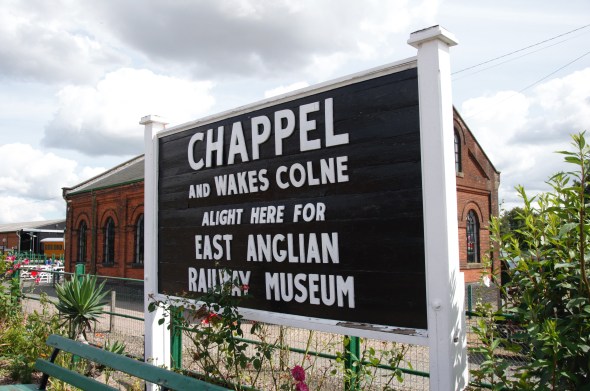
Whatever your age, there’s something special about a trip to a railway museum and the chance to see a working steam engine. If you’re reading this and nodding your head in agreement, then I’d recommend you visit the East Anglian Railway Museum at Chappel and Wakes Colne. While riding on the footplate was a special treat, visitors will sometimes be able to take advantage of the museum’s “Taster for a Tenner” promotion where you can learn how to drive a diesel loco for just £10.

This summer, Greater Anglia are making it better than ever to travel by train. For a number of attractions across East Anglia and London, the East Anglian Railway Museum being one of them, presenting your rail ticket gets you 2FOR1 admission. If there’s just two of you, Greater Anglia’s advance fares will also keep your costs down. For larger groups, check out the Group Save tickets, a good deal for families and groups of friends looking for an affordable day out. Even better, Group Save can be used in conjunction with the 2FOR1 offer. With rail tickets for children costing from just £2, arriving at the EARM by train makes a lot of sense. Chappel and Wakes Colne station lies between Sudbury and Marks Tey on the pretty Gainsborough Line. From Marks Tey there are frequent connections to London’s Liverpool Street as well as Ipswich and beyond.

I chose to time my visit to coincide with one of the EARM’s regular special events. The 1940s Vintage Tea Dance marries our nostalgia for the age of steam with a love of music, dance and reminiscing about the war. Headlining the event were the fabulous Fox, Wiggle and Sass. Perfectly co-ordinated in red polka dot dresses, hair coiffed in immaculate victory rolls and lips painted a perfect scarlet, the girls had the Forties look down pat.


Aimee (Fox), Amy (Wiggle) and Gemma (Sass) hail from what they term the Bermuda Triangle of Essex: Layer de la Haye, Finchingfield and Witham. Over the last four years, they’ve been hired for countless weddings and private parties, but coming back to the EARM is special as it was the first gig they ever played. This talented trio made performing the harmonies and melodies of iconic Forties classics like “Ac-Cent-Tchu-Ate the Positive” and “It’s a Good Day” as well as swing hits like “Sing Sing Sing” look simple.


Watching them perform was a full house – or rather goods shed – of people, many in 1940s costume themselves. Servicemen danced with WVS volunteers while onlookers sipped tea from vintage china and ate cream teas. Sharon from Swing Jive Sudbury was on hand to teach everyone the basics so even complete beginners could join in the fun.


Also in the goods shed, Bunty Bowring had laid out a fascinating collection of 1940s vintage clothing, showing how in times of rationing, make do and mend were of vital importance. Together with husband Richard, who was dressed as one of the Home Guard, she shares her passion for all things wartime by giving regular talks to various local organisations. Outside the goods shed, meanwhile, members of the Suffolk Regiment Living History Society had brought their rifles, kit bags and even their trucks and The Viaduct mini-pub was open for those wishing to sample the local beer.


The event had been fun, but to leave without exploring the museum’s regular exhibits would have been a travesty. I began at the signal box where a series of colour-coded levers ensured a train couldn’t enter a stretch of track while another was in the way. The blue one shown in use here is pulled to activate a points lock, making sure the points don’t move as the train’s wheels pass over the top. Young kids will love pulling the levers so much it will be hard to drag them away.

Across the footbridge, the restoration shed gives you the chance to see some of the museum’s many engines and carriages being brought back to their former glory. Many of the volunteers work on these projects on Wednesdays, making this a good day to find out about what’s going on. There’s plenty of restored rolling stock to have a look at, including some vintage wooden carriages and recreations of station buildings and platforms.


The exhibitions in the on-site heritage centre explain the impact of Beeching’s cuts on the Gainsborough Line, which once would have continued on to Cambridge. Sudbury’s population grew sufficiently to save the Marks Tey to Sudbury stretch from the same fate. But other long-lost lines are covered too, including the Crab and Winkle Line which ran from nearby Kelvedon to the coast at Tollesbury. Take a walk around Tollesbury Wick and at low tide, you can still see the railway’s wooden sleepers disappearing into the mud.

EARM staff say that visitors often remark on how much there is to see at the museum and I’d have to agree. I made it through the level crossing gates back to the regular platform just in time to catch my train. Whether you time your own visit for an event day or not, you’re sure to have a rewarding and enjoyable day out. The volunteers were without exception keen to share their knowledge and enthusiasm. Best of all, taking the train instead of the car gave me the chance to mull over what I’d seen and done. My verdict: I’m going back – and next time I’m taking a 2FOR1 friend.
With thanks to Greater Anglia for courtesy train travel to and from the museum and to the East Anglian Railway Museum for a great day out.
Links
Greater Anglia’s offers
https://www.greateranglia.co.uk/offers/offers-in-east-anglia
East Anglian Railway Museum
Fox, Wiggle and Sass
https://www.facebook.com/foxwiggleandsass/
Swing-jive Sudbury
http://www.swingjive-sudbury.co.uk/
Richard and Bunty Bowring
Email: bowring40s_talks@hotmail.co.uk
Suffolk Regiment Living History Society
Harwich: the town that rocked
It’s the people that make a place special. How often have you read that? It’s been written so often it’s a travel cliché. But sometimes it’s also true.
Greater Anglia have a range of offers on rail journeys across the network this summer. To find out more, look at the #lettheadventurebegin video on their website; the address is at the bottom of this blog. They invited me to pick somewhere in the network and in return for a rail ticket, they asked me to blog about my trip. I chose Harwich. I’ll admit that having consulted the timetable, I was a little concerned. To reach Harwich from my starting point necessitated two changes of train and with just a few minutes between each, I anticipated spending half the morning in Manningtree. After all, this wasn’t Switzerland, was it? I needn’t have worried. The trains were punctual, the connections made without even having to power walk and the carriages clean and comfortable. The views as we made our way on the Mayflower Line along the River Stour were the icing on the cake, and I thought what a refreshing change it was not to have to focus on the road and be able to enjoy them.


A ten minute stroll from Harwich Town station and I was already beginning to appreciate the town’s long maritime history. Using a walking trail map I’d found online, I ticked off both the High and Low Lighthouses, the second of three pairs of lighthouses that had been built around here to aid ships’ navigation along the North Sea coast. To ensure they maintained the correct course, the two lights needed to line up, one above the other.
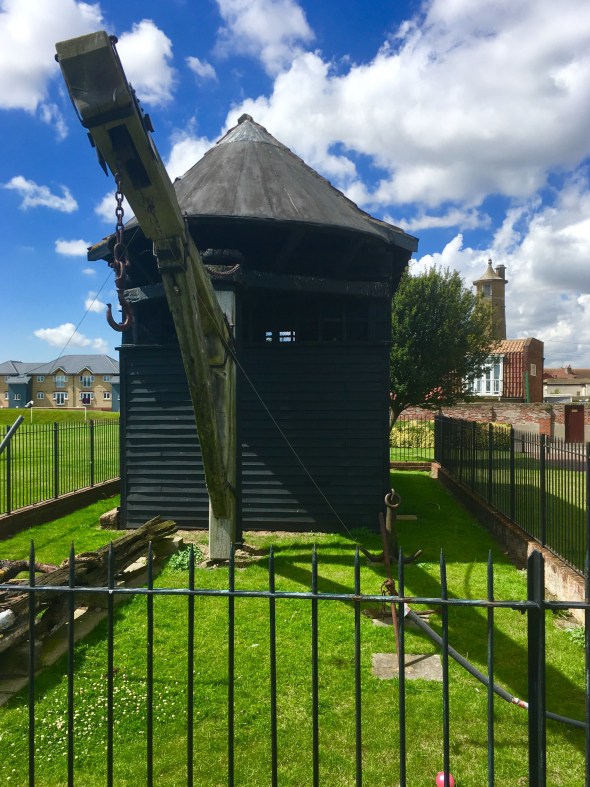
The Treadwell Crane was fascinating too, operated by men walking on the inside of the wheels. I was grateful for the Harwich Society’s comprehensive website, for though an informative sign had been placed near the crane, it had been positioned at the foot of a steep grassy bank. To read it, I’d probably have been best off lying flat on the turf.
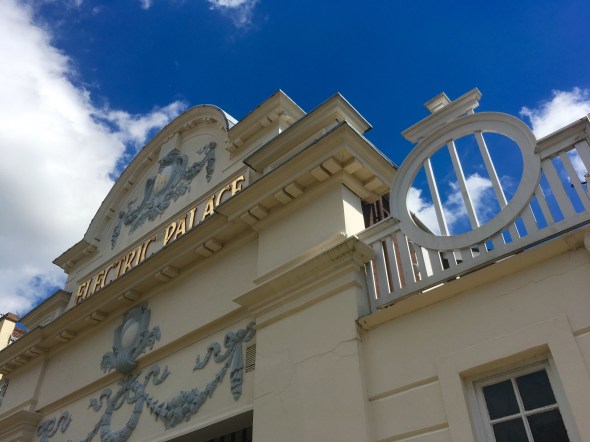
Heading along the estuary, I walked past the impressive murals on Wellington Road and doubled back to take a look at the Electric Palace. Built in 1911, there were two entrances, one to access seats costing a shilling, the other a more affordable sixpence. The cinema still holds regular screenings today, though the reminder to patrons to turn off mobile phones is a more recent addition to the signage.
Update July 2019: the Electric Palace is closed for extensive renovations and is currently scheduled to open in late spring 2020.
It was time to pop in to The Pier Hotel, right on the quayside. Looking like a little piece of Shoreditch, the hotel was slick, contemporary and on-trend, its staff welcoming. Manager Chris told me that I could find 113 different gins on the NAVYÄRD bar’s drinks menu, and I wondered how long you’d have to stay to work your way through them at what the government would deem an acceptable rate. With the view over the confluence of the Stour and Orwell right in front of the hotel’s terrace, it would be an absolute pleasure, though one which would have to wait for another time. I had a boat to catch, and it wasn’t going to wait.


A foot ferry had connected Harwich to Felixstowe for over a century, but it was under threat of closing for good when Austrian Christian Zemann spotted it was up for sale. Seeing the potential – it’s easily an hour’s drive from Harwich to Felixstowe – he bought the business. Though he’d always dreamed of making his living on the water, he didn’t know Harwich, nor the area which surrounded it. It was a gamble, but one that paid off.


With hard work and a nose for opportunity, Christian has expanded the business, running not only the foot ferry but evening cruises, bicycle rental and seal boat trips as well. In fact, he’s already bought a larger boat, increasing the capacity of the ferry from 12 passengers to 58. The level of commitment Christian has shown is extraordinary. Troubled by the drenching some of his passengers were getting out on deck, he invested £15000 in stabilisers to stop the new boat from tossing and pitching. I’m pleased to report it worked.


Christian’s latest venture, the boat trips to the grey and harbour seals that make their home at nearby Hamford Water, have already proved to be a gold mine. Once down to only a handful in number, there’s now a small but thriving colony of around 70 seals at the reserve. I asked Christian how close he got. “Well, the channel’s pretty narrow, so if I kill the engine, then you can hear them breathe,” he said. That sounded close enough to me.


Back on shore, there was one vessel on the quayside that just couldn’t be ignored, not least because of its scarlet livery. Built in 1958, LV18 was Trinity House’s last manned light vessel before it was retired from service in 1994. But as with the Harbour Ferry, this was a boat that wasn’t going to go quietly, thanks to one man – the ebullient and utterly charming Tony O’Neil. He bought the vessel for a nominal £1 and the Pharos Trust was set up to oversee its restoration. It opened in 2011 as Harwich’s quirkiest visitor attraction.
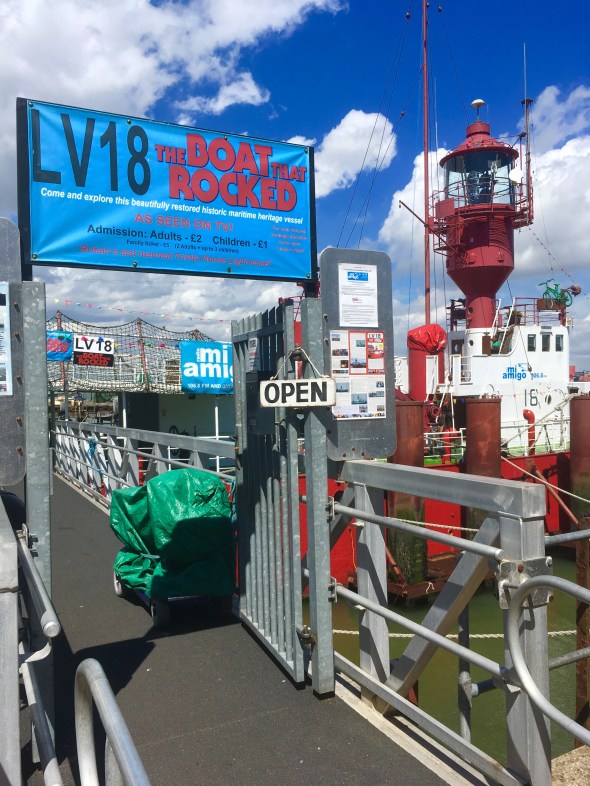
Update July 2019: since I took this photo, the cost of admission has risen to £4 for adults and £2 for children. Family tickets (2 adults and 4 children) are £10.
A musician by trade, Tony has a passion for radio. Visitors to the ship can see some of his extensive collection of antique and vintage radios on board, but with an estimated 1600 in his collection, some remain in storage in the hold. That passion for radio also manifests itself in broadcasting. Tony once worked for Radio Caroline and his enthusiasm for pirate radio is undimmed. The likes of John Peel, Tony Blackburn, Emperor Rosko and Johnnie Walker all broadcast from radio ships anchored just outside UK territorial waters and the tenders that facilitated their commute came from Harwich.


Even the beautiful garden that you see on deck has a musical connection. The scented plants that form part of it are there in homage to John Peel. His 1967 show for pirate station Radio London was named “The Perfumed Garden.” Johnnie Walker is still involved. He’s a patron of the Pharos Trust and will broadcast from LV18 this August.

For anyone keen on maritime history, Tony has preserved some of the cabins on board just as they would have been when the vessel was in use as a lightship. There’s also a chance to see what a pirate radio station would have been like. There’s so much in the way of nautical and radio memorabilia that some have dubbed it a “floating prop shop”. Unsurprisingly, it caught the eye of the production team working on the 2008 movie “The Boat that Rocked” and with a splash of yellow paint for the occasion, doubled as Radio Sunshine.
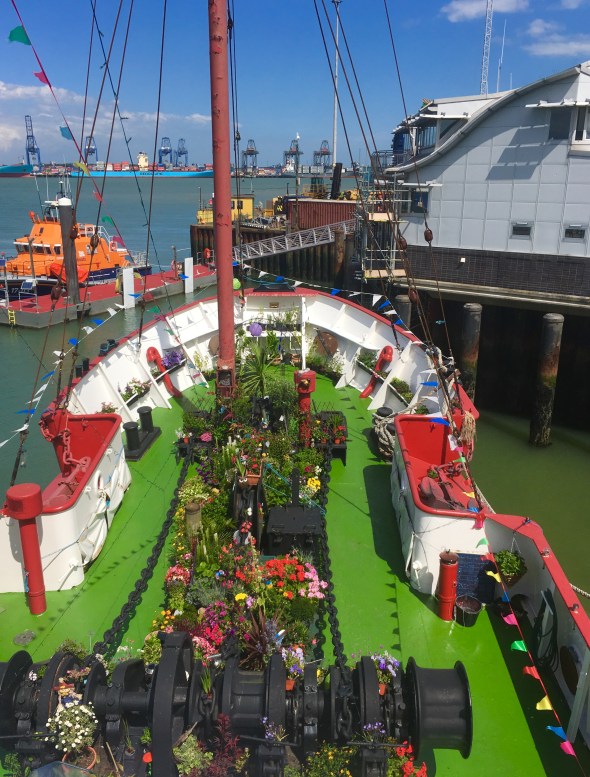
It is individuals like Christian and Tony that are breathing life into a town that once lay forgotten at the end of the line. Their energy and commitment to this corner of Essex is helping to make Harwich the town that rocks.
Links
Greater Anglia trains:
https://www.greateranglia.co.uk/
Harwich Harbour Ferry:
http://www.harwichharbourferry.com/
Seal boat trips:
LV18:
Harwich Society:
The Pier Hotel:
Just back from: a day in Ibiza
This, perhaps, wasn’t going to be one of my usual days out. A few days before I was due to fly – out of Stansted at 7am on a Tuesday – an email arrived from Ryanair announcing certain restrictions on the flight.

Amongst other words of caution, it said:
• Customers will not be allowed to carry alcohol on board and all cabin baggage will be searched at the boarding gates.
• Boarding gates will be carefully monitored and customers showing any signs of anti-social behavior or attempting to conceal alcohol will be denied travel without refund or compensation.
For a moment I wondered what I had let myself in for. In the event, though we did have a stag party on board, they were very well behaved and remarkably quiet. The plane was too, empty seats an indication that some of our passengers had fallen victim to one of Stansted’s worst mornings for queues at security I’d ever seen. I’d made the flight in good time and jetted off on time to the hippy isle with a row of three seats to myself.

Arriving slightly ahead of schedule, I picked up a hire car and set off on an itinerary I’d found on the Ibiza Spotlight website. As my main focus of the day was to be a trial of a Sunwise kaftan, I’d originally planned to hole up at one of Ibiza’s stylish beach clubs and chill out all day. In the event, my geographer’s curiosity got in the way and I just couldn’t resist the chance to go exploring, especially up in the north of the island where the agricultural landscape was more verdant and prettier than the south. That said, I needed to be in the sun, so there were going to be plenty of stops.

The first was supposed to be in Santa Eulària des Riu, Ibiza’s third largest resort. Incidentally, road signs are in Catalan, though my map was in Spanish, with this particular resort being Santa Eulalia – mostly the names were similar enough for this not to be confusing. I’d read about an excellent ice cream parlour called Mirreti’s. Reaching the town, I decided it just wasn’t my kind of place: too busy and lacking charm. I drove straight through, headed for Sant Carles de Peralta.

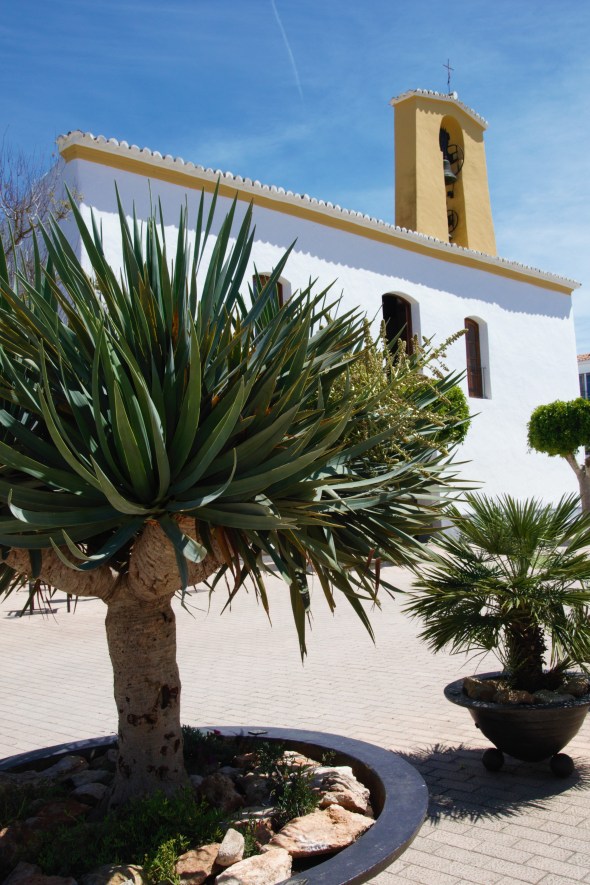
This small village, dominated by a delightful whitewashed church, was the perfect spot for a stroll in the sunshine. There wasn’t much to see, but I’d been tipped off about a cafe called Bar Anita across the road. I spent a pleasant half an hour sipping a cold drink in the warm sunshine, watching the world go by.

Onwards and northwards, as the hire car wound its way around the back lanes following the Cala de Sant Vicenç coast road for a few kilometres before ducking inland across the Serra de la Mala Costa. Turning north at Sant Joan de Labritja, I snaked across country on a tiny lane which led to the resort of Portinatx on the island’s rugged north coast. Smaller than Santa Eulària des Riu but nevertheless a resort, it was more my scene and I had a wander to explore.

Back in the car, I drove back to Sant Joan, this time via the main road and on to my next stop, another village dominated by a magnificent church, Sant Miquel de Balansat. Sited on top of the hill, this whitewashed church is impossible to miss. It’s the second oldest on the island, after the cathedral and like the one in Sant Carles, had three crosses on the front wall, something you’ll see on all the churches on the island, the symbol of Golgotha. The painted chapel walls are very special. This bronze sculpture outside also caught my eye.

But by now, I was getting hungry and so drove the few kilometres to Santa Gertrudis de Fruitera. This was my favourite of all the villages I stopped at, and I feasted on jamon serrano and queso manchego in the sunshine, choosing a spot opposite the church.

Somehow the village managed to hang onto its character despite its popularity with day trippers. I had time to browse in a few boutiques before they closed for a siesta and I hit the road again.
This part of Ibiza is greener than the scrubby south and I drove across the countryside towards Santa Agnès de Corona, known as Santa Ines in Spanish. I passed olive groves, almond trees and orange trees laden with fruit. Ruined windmills completed the agricultural scene.

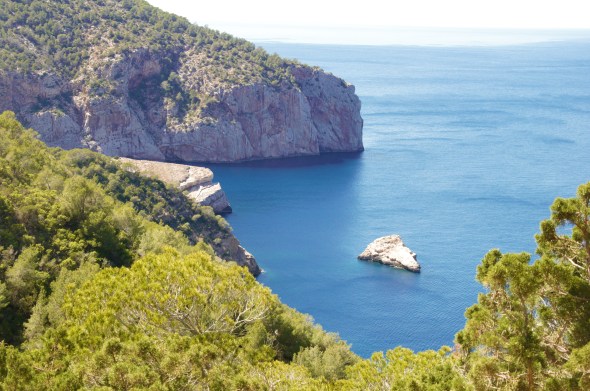
The road layout here forms a circle, so it as it was such a fine day, I decided to backtrack a bit and go for a short hike. My target was the hidden fishermen’s cove of Es Portitxol, said to be one of the prettiest spots on the island.
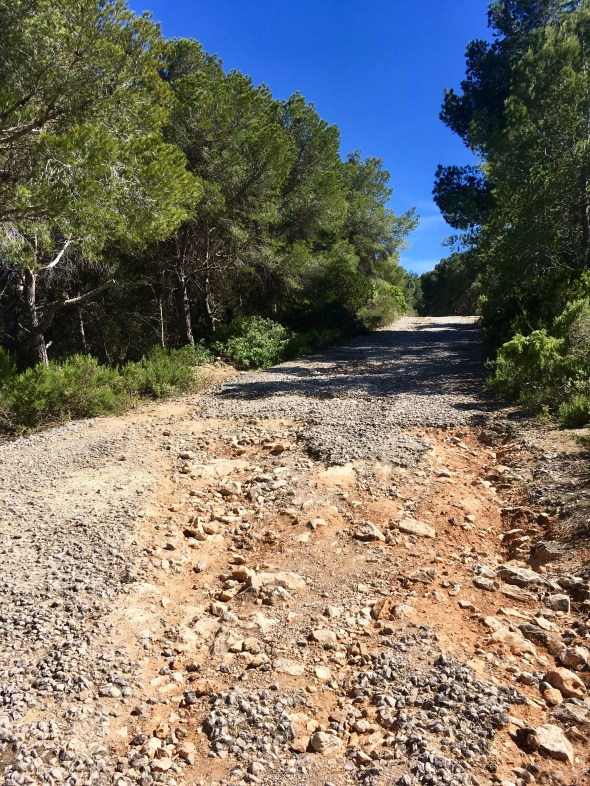
The road was in pretty poor shape, so I parked up and picked my way down the lane on foot. When I saw poor shape, it looked like a digger had gone rogue and there were great rifts gouged out of the stones. I wished at that point I’d had on walking boots rather than sandals, as it was hard going. The path did level out for a while and led through a shady forest; alongside were sweeping views over the ocean and towards the cove. Improperly clad, I decided to bail before I ripped my sandal straps, but had I continued, I’d have been rewarded with one of Ibiza’s hidden gems. Ah, next time.
It was time to head into Eivissa, the island’s capital. I’d seen the cathedral and fortifications of its Dalt Vila or old town as I’d passed earlier, and now it was time to explore on foot. Luck was on my side when it came to finding a parking space; yellow spaces reserved for workers become free for anyone who finds them empty after 4pm.

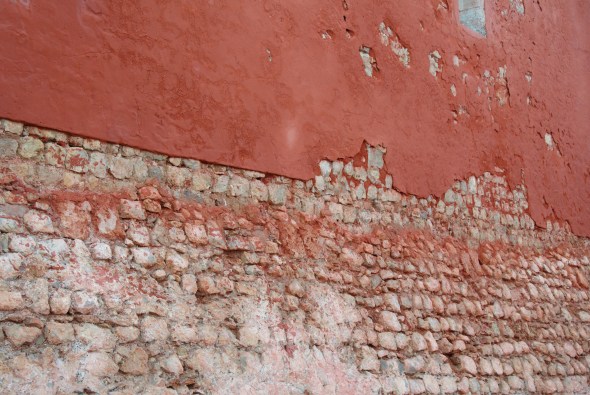
For anyone whose experience of Ibiza is solely the lively mass tourism resorts and club scene, Dalt Vila is the very antithesis: elegant, ancient and impressive. The thick wall and fortifications once protected Eivissa from marauding pirates; now they provide lofty vantage points from which you can admire the Mediterranean and watch the fishing boats bring their catch in, trailing clouds of seagulls in their wake. This defensive settlement dates from the 7th century BC when the Phoenicians founded the city, though the walls themselves are even older.

Today, Dalt Vila is threaded with alleyways and tunnels which, unsigned, invite you to partake of a lucky dip; when you step through the doorway, you might have no idea where you’ll emerge. I popped up in the Plaça d’Espanya for a time. One of the tunnels here was a Civil War refuge; Ibiza was Republican for a time before Franco stepped up his campaign and occupied the island, forcing the Republicans to flee.

In the Plaça d’Espanya traders were setting up a mediaeval fayre which should, according to the road signs, have opened three hours earlier but looked like it was still a while off. From there, I climbed a little further to the cathedral, its fussy architectural details contrasting with the simplicity of the whitewashed churches I’d seen in the villages.

Overlooking the marina, it was a good place to perch on a wall and soak up both the sun and the view. Refreshed, I wandered the streets of the old town for a while before ducking randomly into a tunnel and emerging some considerable way beneath them. I took it as a sign and headed back to the airport.
The details
Outbound: Ryanair STN to IBZ departing 0700 with a scheduled arrival time of 1040 (we were about 20 minutes early)
Inbound: Ryanair IBZ to STN departing 2140 and arriving at 2320 (also early)
Flights available from £19.99 each way.
Car hire with Alamo purchased through the Ryanair website was a little over £30 for the day; airport buses into Eivissa cost 3,50 euros each way.
Have you seen my other blogs on days out by plane? They’re perfect if you are desperate to travel but can’t get the time off you need for a longer trip. You’ll be surprised at how much you can do in a single day. For how to visit Amsterdam, Belfast, Bremen, Budapest, Lisbon, Regensburg and Copenhagen for the day from London, please follow this link:
http://juliahammond.co.uk/Travel/BLOG.html
Salt flat tours: Argentina vs Bolivia
One of South America’s iconic bucket list activities is to visit the vast Salar de Uyuni. It’s been on my wish list for a while:
https://juliamhammond.wordpress.com/2015/03/18/after-104-countries-can-i-still-have-a-bucket-list/

Salar de Uyuni
This March I finally made it to Uyuni, 22 years after my first trip to Bolivia. On the way, I travelled from Salta along the Quebrada de Humahuaca, one of Argentina’s most attractive areas. A side trip from Tilcara took me to Salinas Grandes, Argentina’s largest salt flat. The two tours were as different as they come, so which was best? Here is my review.
The salt flats
The Salar de Uyuni is the world’s largest salt flat. It covers an area over 4000 square miles and sits at an altitude of over 3600 metres above sea level. The crust of what were once prehistoric lakes dries to a thick layer of salt, and the brine which lies underneath it is rich in lithium with something like 50-70% of the world’s known reserves. Even on a day trip, it’s not long before you’ve driven far enough out onto the salt flat to be totally surrounded by a sea of white. Losing your bearings is entirely possible though the position on the horizon of distinctive volcanoes such as Tunupa makes things a little easier.

Argentina’s Salinas Grandes
In contrast, Argentina’s biggest offering is paltry by comparison, though still the second largest in the world. Measuring a little over half the area of its Bolivian neighbour at 2300 square miles, it’s still enormous of course. Like the Salar de Uyuni, it’s a high altitude location, coming in a few hundred metres lower. Salt mining is also a feature of the landscape here and as in Bolivia, you’ll see piles of salt, blocks of dust-striped salt for construction and other industrial activity.
Choosing the tour
Salar de Uyuni tours are big business. It’s firmly on the backpacker trail and the scruffy, dusty town of Uyuni is rammed with operators selling one-day and three-day tours to the flats. I opted for a one-day tour. Having been just across the border in Chile and seen some of the most spectacular scenery in the world, I didn’t feel the need to spend hours in a cramped 4X4 to do the same in Bolivia. Three-day tours offer basic accommodation and rudimentary facilities; the days of cold showers and BYO sleeping bags are long behind me. I opted for a mid-range tour with a respectable outfit called Red Planet Expeditions, booking online via Kanoo Tours at a cost of $83. (It is cheaper to book when you arrive but I didn’t want to have to hang around so was prepared to pay the extra few dollars to arrange my tour in advance.) Even this, one of the better companies, had mixed reviews, so I figured if I had a poor experience for a day I’d be happier than if I’d opted for the longer tour.
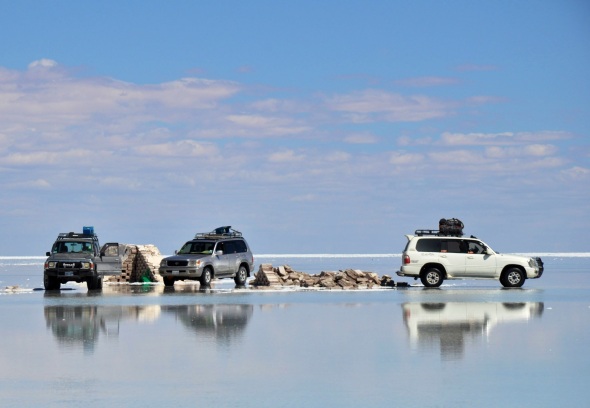
Wet season reflections, Bolivia
The nearest tourist base to the Salinas Grandes is at Tilcara, the other side of a mountain from the salt flats. I found a highly regarded tour operator called Caravana de Llamas which offer a range of llama trekking tours, opting for a tour that spent a few hours walking out to the salt flats. The tour itself was excellent value at $65 per person, minimum two people. However, this doesn’t include transport. You’ll either need a rental car to cross the mountain pass (it’s a good road) or a car with driver. Caravana de Llamas can arrange this for you for 1500 Argentinian pesos per car (rates correct as at March 2017) which is reasonable for a car load but expensive for a solo traveller.
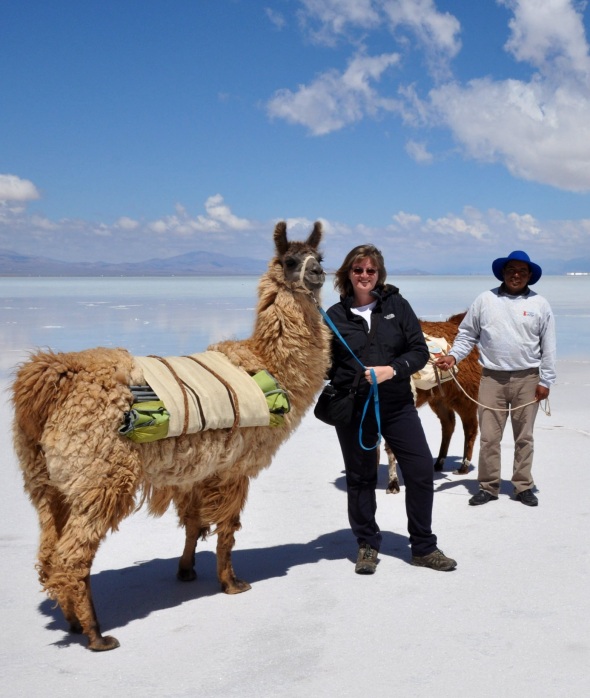
On the salt flats with Oso, Paco and their handler Santiago
The tour: Bolivia
Choosing to visit in wet season, the Bolivian tours cannot reach Incahuasi Island which is a fair distance across the salt flats (and home to giant cacti). I’d been sent information requesting that I check in to the Red Planet office at 9am for a departure by 10am. On arrival, I was told we’d actually be leaving at 11am. On departure we were a convoy of three vehicles with one guide between us. The car was in good condition; judging from the reviews this isn’t always the case. The driver was pleasant enough, though he spoke no English which may be a problem for some. There were five travellers per car, but this can be six or seven which would have been cramped. Two at least have to sit on the back seat and there, the windows do not open. My fellow travellers were a pleasant bunch, though much younger than me. I wasn’t as keen as the others on having the music turned right up, making it very hard to talk, but everyone else seemed happy. The guide, Carlos, split his time between the three vehicles. I didn’t take to him, finding him obnoxious and arrogant, so I was pleased we didn’t have to have him in the car very much. I had several concerns about his attitude and behaviour (some shared with other members of the group). I contacted Red Planet for their comment but have yet to receive a reply two weeks later. It’s not appropriate to go into details here but I would hesitate to book with this company again if they couldn’t guarantee the guide would be different.

Tunupa Volcano
The tour allocated a great deal of time to the train cemetery – which had the potential to be a fantastic place to visit if you don’t time it to coincide with the 30+ 4X4s which stop there on the way to the salt flats each morning. Having woken to clear skies, the clouds had rolled in by the time we arrived which was frustrating given how close the site was to the town. There was also a lengthy stop in the village of Colchani where we visited a salt factory (just a room where not much was going on except for attempts to flog us bags of salt) and where we were given lunch of lukewarm chicken, stone-cold rice or cold potatoes plus a delicious apple pie. Eventually we reached the salt flat itself and the scenery at that point took over. In wet season the reflections in the water are a crowd-pleaser and it wasn’t a disappointment. What was a pity was the lack of thought given to pre-departure information. As requested I’d come prepared with sun cream, but no one had thought to tell us we’d need flip-flops for the salt flats. It wasn’t just a case of getting our feet wet, more that the crust is sharp and uncomfortable to walk on. I ended up in socks which was better than going barefoot but still unpleasant.
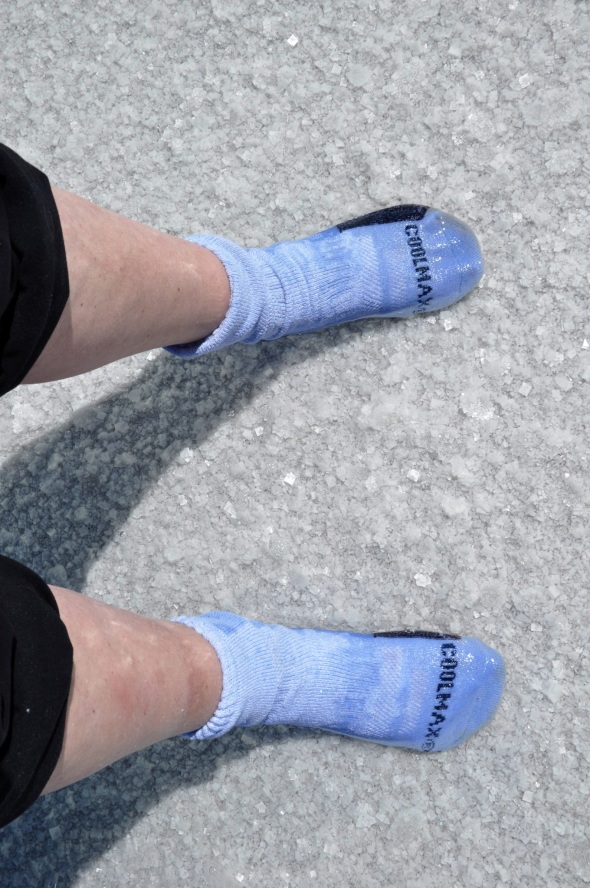
Ouch! Bring flip flops!
Later, we drove to a drier part of the salt flats for the famous perspective photos. These were cheesy, clearly well rehearsed (we did the same poses as every group I’m sure) but a fun souvenir. The guide did take the photos, which was kind of him, so those on their own could participate. Afterwards we had an enforced and quite lengthy stop near a monument. I think it was included to enable us to arrive at the edge of the salt flats in time for sunset, though it felt like time-wasting. Six out of the fifteen travellers in our cars had overnight buses to catch and were very worried they’d miss them. Given we were all filthy dirty and covered in salt, they’d have needed time to clean themselves up before boarding. The rest of us had what turned out to be quite a rushed sunset photo stop. However, we were dropped off at the Colchani salt hotels on the edge of the salt flat. This was a bonus; if we’d have had to return to Uyuni and then take a taxi, this would have added an hour at least as well as the additional cost of transport.

Sunset on the Salar de Uyuni, a beautiful thing to behold
Conclusion: Bolivia
All in all I felt that the wow-factor of the salt flats themselves redeemed the day. The guide was a big negative, but I was told it wasn’t possible to go deep into the salt flat without one. Walking from the salt hotels to the edge of the salt flats wouldn’t have given me the same experience, so although this was one of the worst tours I’ve taken in years, I’m still glad I did it. But even more relieved I didn’t opt for the three-day tour.
The tour: Argentina
I was sent a reconfirmation email the day before my tour to ensure I knew that the driver would be on time; in fact he was early when he arrived at my hotel in Tilcara. The car was almost brand new and spotlessly clean. Another traveller had cancelled so I had a private tour. Jose Luis the driver was friendly, courteous and knowledgeable, as well as being safe over the mountain pass. I was offered several stops at viewpoints to enable me to take some great scenery shots as we climbed above the clouds. Arriving at the tiny village of Pozo Colorado, llama handler and guide Santiago was ready, welcoming and cheerful. Jose Luis joined us for the first part of the trek to ensure I was comfortable leading a llama and then joined us later at the salt flats.
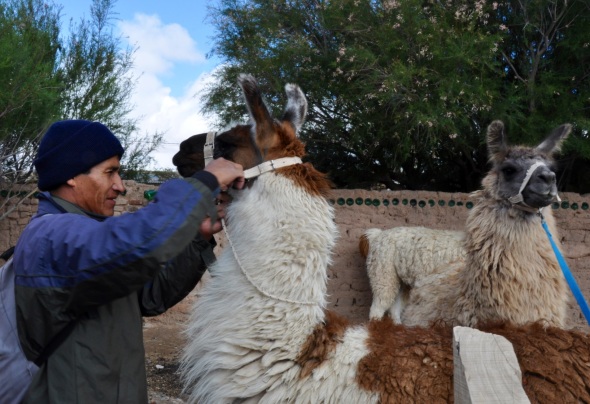
Santiago getting Paco ready
Walking with the llamas was fun. Oso and Paco were well behaved and to my relief didn’t spit. From time to time Santiago told me a bit about the llamas, the scenery and the way of life up there on the Argentine Puna, but he also knew when to let me enjoy the silence and serenity of the place. The trek was easy, over flat terrain, and when we arrived at the edge of the salt flats, there was time for me to wander off and take photos while lunch was prepared. A picnic table had been set up loaded with delicious food: local goats’ cheese, llama meat, ham sandwiches, salad and more. There was plenty to go around. Jose Luis joined us for lunch and the inclusion of a third person made chatting easier as he was bilingual.
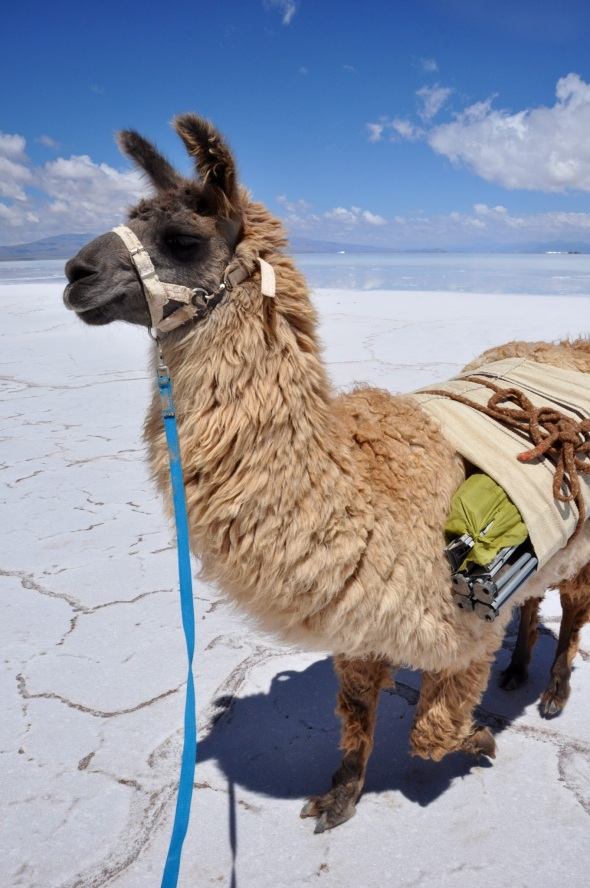
Oso carrying the lunch table
After lunch, the llamas had rested and we walked onto the salt flats for some souvenir photos. Afterwards, Jose Luis drove me to some of the industrial workings a short distance away. There wasn’t a lot of activity going on, though as with Bolivia, I did see the piles of salt “bricks” and also heaps of mined salt. By the time we’d driven back over the mountain the tour was a similar length to that taken in Bolivia, arriving in Tilcara late afternoon.

Paco having a siesta on the lakeshore
Conclusion: Argentina
If I’d have visited Bolivia before Argentina, I’d have probably been disappointed with this tour. The scenery just didn’t have that sense of scale that gave it the bucket list wow. However, as an activity, walking with llamas was a lot of fun and I felt that Santiago had gone to a lot of trouble to make me feel comfortable and, despite his basic English, to put the scenery in context. I was left wanting more and would definitely book with Caravana de Llamas again if I returned to the area.
Overall conclusion
Both tours were worth doing but very different. The Argentinian tour was very civilised and the llamas incredibly cute. Regular readers of this blog will know how much I adore these fluffy creatures. The people involved worked hard to ensure I was well-looked after. In contrast, the Bolivian tour encompassed my worst nightmares with a bossy, inflexible guide and yet – the scenery was so incredible that I’d still do it again.
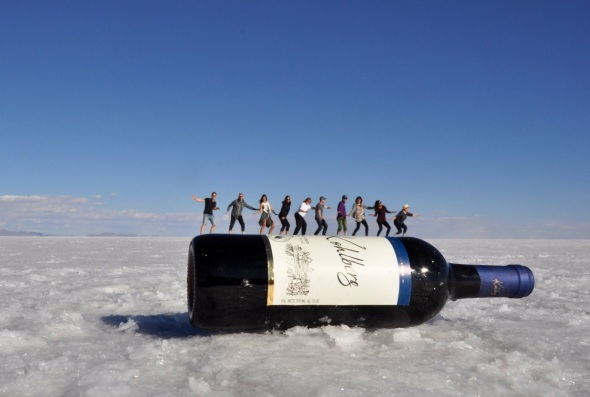
Expectations are key. In Uyuni, there doesn’t seem to be a single operator winning consistently excellent reviews. In this respect, having a horrible guide but a good driver and a vehicle that didn’t break down was the best option – if there’s a weak link, at least your safety isn’t compromised. It’s been a long time since I’ve had to take a backpacker-style tour, so perhaps I’m out of the habit of being herded around – and it’s no surprise to those readers who know me to hear that I don’t like being told what to do.
Perhaps taking a budget option in Bolivia would have been the way to go: there were day trips for under $40, half the price I paid, and given how poor the guiding and the lunch were, maybe it would make the tour seem better value. However, I certainly wouldn’t recommend taking a basic tour for the three-day option as the mileage covered is considerable and the area remote. I heard good reports about the scenery from a private Dutch group, but having seen similar (better?) in the more accessible Chile a couple of years ago, I don’t regret my choice to cut out the mountain lakes and volcanoes.
So – which tour? Tough decision: I’ll call it a draw! Have you taken either tour? What were your impressions?

Footnote: I paid for both tours myself; all opinions expressed are my own.
Just back from – a day at Copenhagen’s Christmas markets
What next after the German Christmas markets? Germany’s legendary Christmas markets draw the crowds each winter and rightly so. As I found out when I visited the Bavarian city of Regensburg a couple of weeks ago, they’re atmospheric, colourful and every bit as good as people say they are. You can read about the trip here:
https://juliamhammond.wordpress.com/2016/11/25/just-back-from-a-day-trip-to-regensburg/
So how do you top that? With a visit to Copenhagen: take the German Christmas market model, swap the Glühwein for a glass of gløgg and add a healthy dash of hygge.

Best of all, if you haven’t the time or the cash to go for longer, it’s possible to visit the Danish capital for the day. It was my second trip to the city. The first was back in the days when the cheapest way to reach Copenhagen was to fly to another country. That wasn’t quite as daft as it sounds, as the airport in question was Malmö’s in nearby Sweden, a fast train ride across the Øresund Bridge. This time, I flew direct to CPH, leaving Luton after watching the sunrise on the 8.40am flight. Ryanair uses satellite terminal F which is a long walk from the main terminals. Factor in a five to ten minute walk just to get across the airport and don’t expect a travelator.

From the airport it’s about a fifteen minute train ride into central station, with plenty of English speaking staff at the airport to help out at the ticket machines. I opted for a 24 hour travelcard (not to be confused with the expensive Copenhagen Card) which cost 80 DKK. As it turned out, I walked more than I’d intended, but had I chosen to cover more ground, the card would have been valid for unlimited journeys in the city centre by train, metro and bus. By just after midday, I was in the city.

Now like I said, I’ve been to Copenhagen before, so this blog isn’t going to be reviewing the Amelienborg Palace or the Little Mermaid. This time, I was focused solely on Christmas. Emerging from the station coffee in hand, the Tivoli theme park was right across the street and impossible to miss. I decided to save it until the end of the day and instead walked the short distance to Axeltorv Square. My first Julemarked of the day was a small affair, a cluster of stalls all bearing the names of Hans Christian Andersen’s stories. It was a little underwhelming, just a few stalls selling items like sheepskin rugs, warm hats and Christmas decorations.

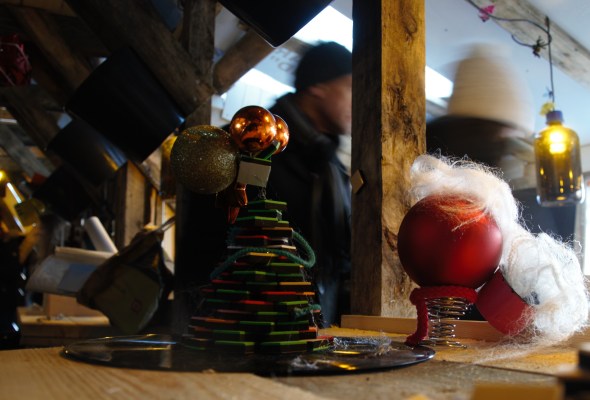
A few minutes from Axeltorv Square, a rather large wooden pig caught my eye. Behind it was a wooden Christmas tree which looked to be made out of broken up pallets or something like that. A few huts made out of the same material formed a crescent around them. This was a Julemarked with a difference, focused on recycling, a statement about the excesses of this festive holiday. But it wasn’t preachy: instead it embraced the spirit of Christmas on the cheap.

The huts all offered a way to help out with the expense of present-buying. There was a Swap Shop where you could leave an unwanted gift and in return got to choose something for yourself. A woodworker’s hut provided tools and off cuts for those who wished to be creative and make a gift. The lady running the plant hut gave me a small packet of tomato seeds which I shall plant when I work out when’s the best time. The largest hut of all was a recycling “factory”. Inside, piles of yarn, card and other craft materials were piled alongside glue guns. Several people were making table top Christmas trees, but what made this unusual was that most of them were adults rather than children. What a great idea!
Next up was a stroll along Strøget to the wonderful department store Illums Bolighus. This amazing store is a mecca for any devotee of Scandi-style and its products, though expensive, are the stuff of envy. Every display could have held its own in a fancy homes and interiors magazine. The question was not whether to buy, but what to leave behind. Illums Bolighus, if you’re reading this, open a store in London won’t you? I promise I’d keep you in profit.

A few doors down from paradise at the end of the street, was another Christmas market. The entrance was marked by a wall of Christmas trees ready to go home and the market itself housed more food and drink stalls than any other market. At the sausage stall, a man munched on a hot sausage in a roll. At his feet was a dog. It sat, as motionless as if it was doing the Mannequin Challenge, eyes fixed on his master’s hand. Tiny drops of saliva dripped from the wet fur around his mouth and puddled on the floor. Finally, the man was finished, save for the last half inch of sausage, which of course the dog had as a reward for his patience.
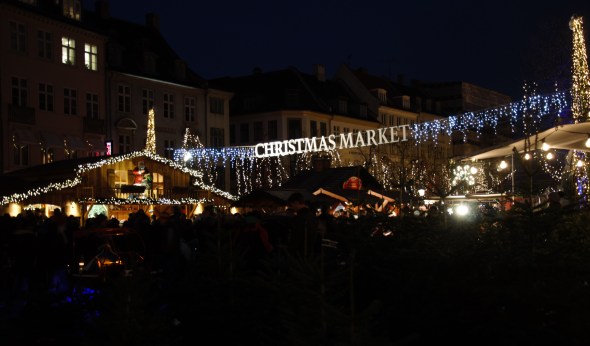
There was still more to come. Straddling a pathway opposite the beautifully decorated Hotel D’Angleterre, the Kongens Nytorv market was probably the busiest of those I visited. Located between Nyhavn and Strøget, a fat queue of tourists wound its way between stalls selling everything from churros to ham hocks, night lights to sheepskin slippers. There were craft stalls and of course, many more gløgg huts. The crowds were frustrating and as it was still daylight, the life size polar bear models looked tacky. I would return that way after dark, when they were illuminated and looked better for it.
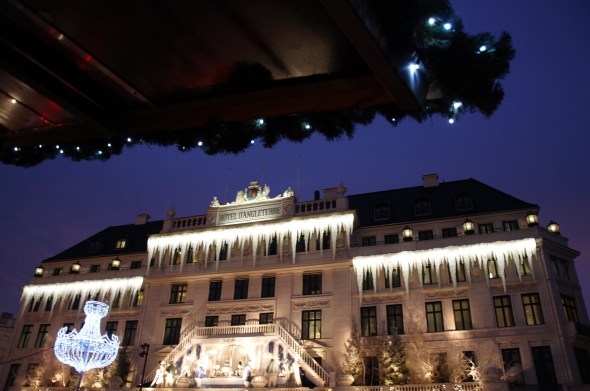
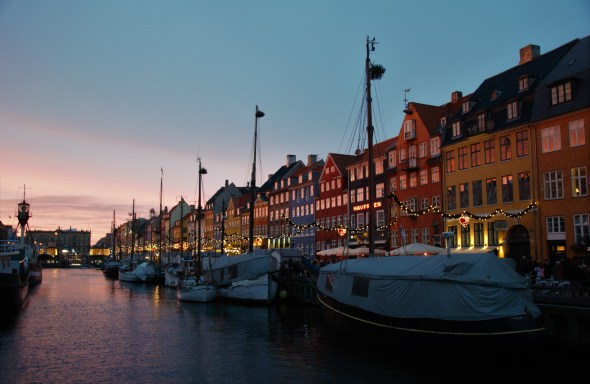
Through Kongens Nytorv and out the other side I breathed a sigh of relief to have wriggled free of the crowd. Fortunately, I was only a stone’s throw from Nyhavn and yet another market. I sat on the quayside enjoying a glass of gløgg – not too fussed on the addition of blanched almonds but the raisins were a welcome find at the bottom of the glass. If you’re not sure if you’ll like it, ask for a free taste.

This time I decided to have a bit of food before exploring the market. I found that the further down the quay I walked, the lower the prices were for comparable dishes. A huge plate of roast pork with crackling with red cabbage and potatoes later, I had a browse round the stalls. Hopefully my husband isn’t reading this but I did come home with a very soft and fluffy cushion cover. (I am kind of banned from buying more cushion covers. It’s become a bit of a thing.) Sunset was spectacular, casting a pretty pink glow over the harbour side buildings.
As night fell, there was one more Julemarked that I wanted to see before I left and one that was worthy of the long queue outside. Yes, the queue was round the block. What did I expect on a Saturday night? Tivoli opened in 1843, making it the world’s second oldest theme park (the other is in Denmark too, but much less famous). Tivoli is expensive, with a hefty entrance fee of around £15 just to get in (the rides are extra) but it is such a charming place during the run up to Christmas that it’s worth it.

There was plenty to see, both in terms of the theme park itself – I loved the carousel – but also in terms of independent retailers and the range of food stalls. The temperature had slumped well below freezing though by this point and with so many people packed into the huts and restaurants, there were very few places where I could escape that intense cold. The lights and decorations kept me going for a while – they were superb – but by 8pm I was really feeling it despite being properly kitted out in thick padded jacket, scarf and gloves. It was time to grab a cup of cocoa from the station cafe and return to the airport in plenty of time for my 10pm flight home.

I ♥ Copenhagen
Just back from – a day trip to Regensburg
I’ve washed the smell of wood smoke out of my hair and a couple of Ibuprofen have sorted out the backache, for now at least. My latest day trip was the longest yet, but proof yet again that you don’t need to overnight to enjoy a rewarding experience over in continental Europe. This time, I had my sights set on Germany’s famous Christmas markets.
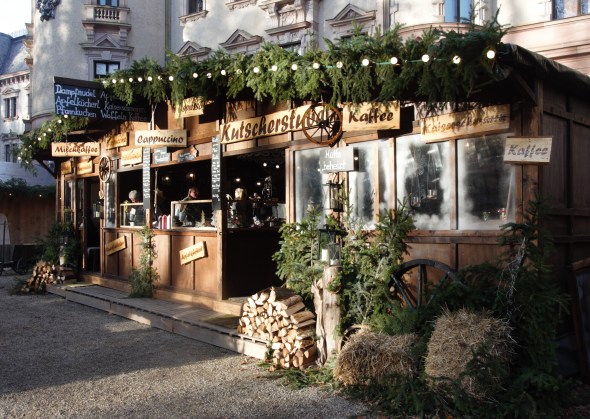
This month’s destination, hot on the heels of Budapest, Bremen, Belfast, Lisbon and Amsterdam which have previously featured on this blog, took me to Nuremberg. A flash sale on Ryanair’s website netted me return flights to the Bavarian city for the princely sum of £4.08 all in. The offer was one with limited availability, not only in terms of seats but also in validity, solely for flights on Tuesdays or Wednesdays in November. Such offers come up quite often and it’s worth subscribing to Ryanair’s email alerts if you’re within easy reach of Stansted. I also saved money on my airport parking by purchasing it through the Holiday Extras website which saved me over a fiver. My 7.35am flight from Stansted was on time and we touched down shortly after 10.15am.


I made use of the Bayern ticket which I’d learnt about on a trip to Munich. The ticket’s valid for a day from 9am to 3am the next day which gives plenty of time for sightseeing. It offers unlimited travel throughout Bavaria on all trains except ICE, IC and EC (so basically excludes high speed trains) as well as city transport in many of the larger cities. The cost? A flat fare of 23 euros if bought from a ticket machine, 25 euros if bought from a kiosk. Unfortunately there’s no train service from Nuremberg airport which means no DB ticket machines (a U-bahn service operates instead with a fare of 3 euros for a ticket with 90 minutes’ validity) so I had to buy the Bayern ticket at the Airport Information desk for the higher price. As it covers the U-bahn that was still the cheapest way of doing it.


It wasn’t long before I was in Regensburg and my first stop was the Neupfarrplatz Christkindlmarkt. Most German Christmas markets get underway on 25th November this year, but Regensburg’s begin a couple of days earlier. The market was well underway at midday, a mix of traditional market stalls and refreshment huts. Next I checked out the Lucrezia Craft Market, though that was still being set up. There were some stalls that had limited wares on display, the likes of sheepskin clothing, wood carvings and handmade silver jewellery. To reach the third of Regensburg’s markets I needed to cross the old stone bridge at the Spitalgarten. Again, setting up was in progress but the walk was a pretty one and there were sheep waiting in the wings to coo over.


I crossed back over the Danube for a lunch stop at the Regensburg Sausage Kitchen, one of the oldest restaurants in Germany. Prices were reasonable and they did takeaway, though even at the end of November, it was warm enough in the sunshine to eat at one of its picnic tables.

The main focus of my visit was the Christmas market at the Thurn und Taxis Palace. Regensburg’s Old Town has hundreds of listed buildings but this palace and its grounds are the jewel in the crown. The Christmas market is more than just a market, with live music and even visiting alpacas and camels. The latter obviously play a role in the Christmas story but I think the alpacas were just there as a crowd-pleaser; certainly every time I held up the camera, they turned their heads and posed!

But let’s get down to business: this is no ordinary market. Princess Gloria from Thurn und Taxis apparently is pretty hands-on with the organisation of the market and I did see a couple of elegant, well-dressed women who might have been her. The market, less well known outside Germany than the likes of Munich’s markets for instance, attracts a mainly local crowd, though it’s definitely worth making the journey for.

The market attracts artisans not just from Germany, but from surrounding countries such as Austria as well. The man selling delicious hot cheese bread had made the journey from the Voralberg and the journey had done his cheese no harm at all. It was cheap, filling and almost worth the market’s 6,50 entrance fee in itself.
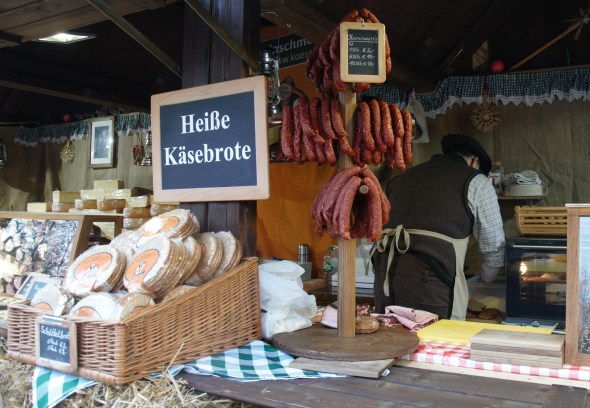
As darkness fell, the market took on a magical atmosphere. Open fires and strings of fairylights added to the romance of the market and there were plenty of stalls to browse. It’s at dusk when you really start to appreciate the attention to detail. Stallholders decorate their huts with freshly cut branches from pines, spruces and firs: the smells as well as the aesthetics are something to savour.
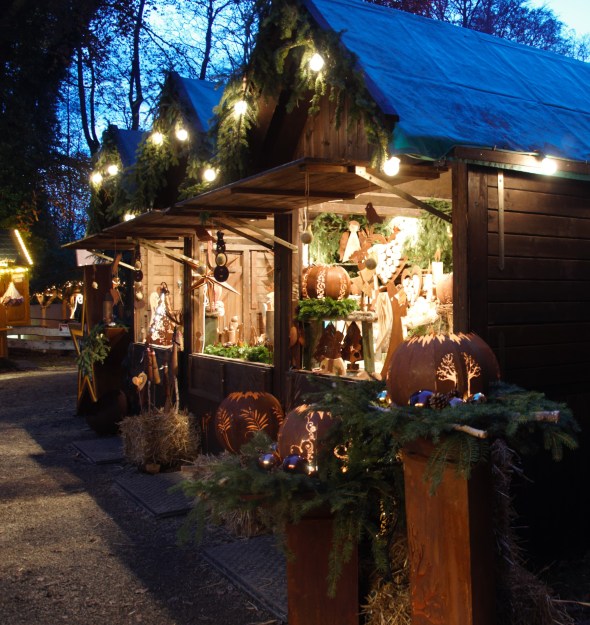
The good thing about not having to pay for accommodation is that there was plenty of cash in the budget that could be used for souvenir shopping instead: I was spoilt for choice amongst a wide selection of products including sheepskin rugs, rustic Christmas ornaments, clothing and handcrafted metal ware.


The palace itself, larger than Buckingham Palace, looked spectacular as the lights came on. At six, a pair of trumpeters heralded the official start to the festivities, followed by a choir and costumed soloists. The balcony overlooking the main courtyard provided the perfect staging.
Eventually, it was time to wander back to the station for a train to take me back to Nuremberg. The seven hours I’d spent in this delightful city was plenty to enjoy it without rushing. My flight departed more or less on time at 10.35pm; I’d landed and cleared immigration well before midnight UK time.
I’m already planning my next day out to a European Christmas market – but this time, I’m off to Copenhagen and I’ll be blogging about it next month.
Just back from – a day trip to Belfast
Strictly speaking, I’m not “just back” from this one, but having recently visited Budapest for the day, I realised that some of my earlier days out by plane haven’t yet made it to the blog, so watch out for Berlin hot on the heels of this one.

Although I’ve been to the Republic of Ireland a couple of times, I’d never been to Northern Ireland and given how many countries I have travelled in, that seemed to be an omission I really needed to put right. With two dogs to consider and a husband not up for multiple day dog sitting, we met in the middle at a day out and I booked my flights. At the time, my closest airport was London Southend and I scored a cheap outbound flight with easyJet at 0715 arriving 0830, returning on the 2055 which landed at 2215. This route isn’t offered anymore, but you can still take advantage of multiple flights from London Gatwick, for instance, if you’re hoping to do this trip yourself.
With 12 hours to make use of, I decided to rent a car and tour the province. A sub-compact doesn’t break the bank and it gave me the opportunity to see some of Northern Ireland’s most well-known sights. First stop was Dunluce Castle. I’m no Game of Thrones fan but it is one of the filming locations. The picture gives you an idea of the drama of its setting and despite being a warm day in late May, the place was deserted.

Next up, a short drive along the coast, was the famous Giant’s Causeway. One of the major beefs with this is the exorbitant cost of entry. Adult admission costs a whopping £9 and I do think the National Trust are pushing their luck. However, as basalt scenery goes, it is impressive, though perhaps less so if you’ve seen some of Iceland’s towering columns. In any case, pre-booking tickets can save you £1.50pp and there are also deals to be had if you do Park and Ride or just take the regular bus. Anyway, I had a very pleasant few hours there strolling around the beach, clambering up nature’s natural staircases and even watching a lone piper play.
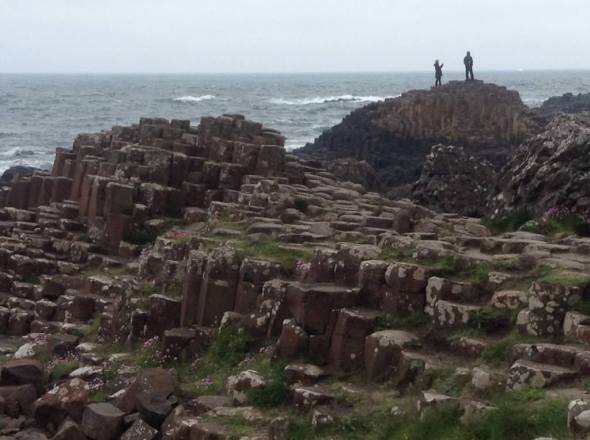
The other National Trust must-see in this part of the world is Carrick-a-Rede, about nine miles along the coast. It’s a bit cheaper than the Giant’s Causeway at £5.90 but for that you get the chance to traverse a rope bridge over the water – a scary but unmissable experience.
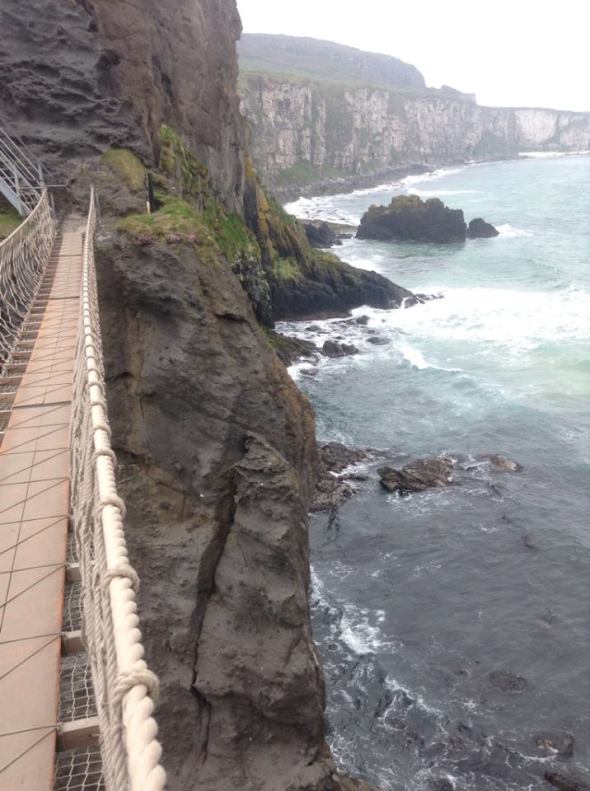
On the day I visited, the wind was negligible, but when the wind picks up… I figured there was a reason you bought your ticket before you caught sight of the bridge – just imagine the revenue they’d miss out on! I’m not too keen on heights if I don’t feel my feet are firmly on the ground, so this would have been a terrifying place if there had been more than just a slight breeze. The scenery, as with the first two locations, was fabulous, leaving me to wonder why I’d left it so long to visit this beautiful part of the United Kingdom.
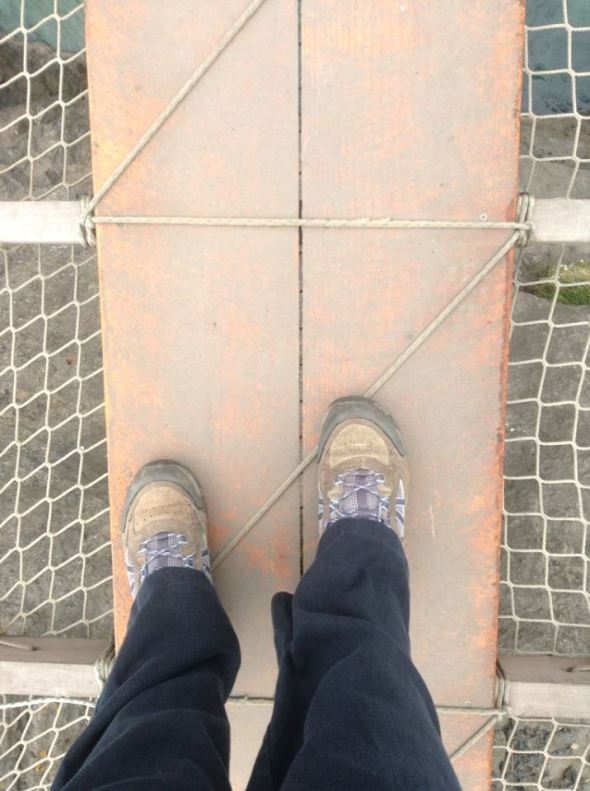
All this coastal exploring was making me hungry and so I drove down to Ballintoy Harbour (another G of T location) for a late lunch at Roark’s Kitchen. The stone cottage which it occupies looks like it’s been there for many centuries and the place offered the chance for me to try out some of the local specialities. In the end, though, I was tempted with the Ulster Fry, like a full English but with potato bread.
Back on the road, I enjoyed the pretty scenery in the sunshine, the blue sky giving me a chance to see the coastline at its best. Cushendun was very quaint – that’s the village in the first picture of this blog. Glenarm was also charming, straddling the water. It has a stately home in the shape of Glenarm Castle which I didn’t visit, but I might have been tempted with its tearooms had I not overdosed on good hearty food at lunch.
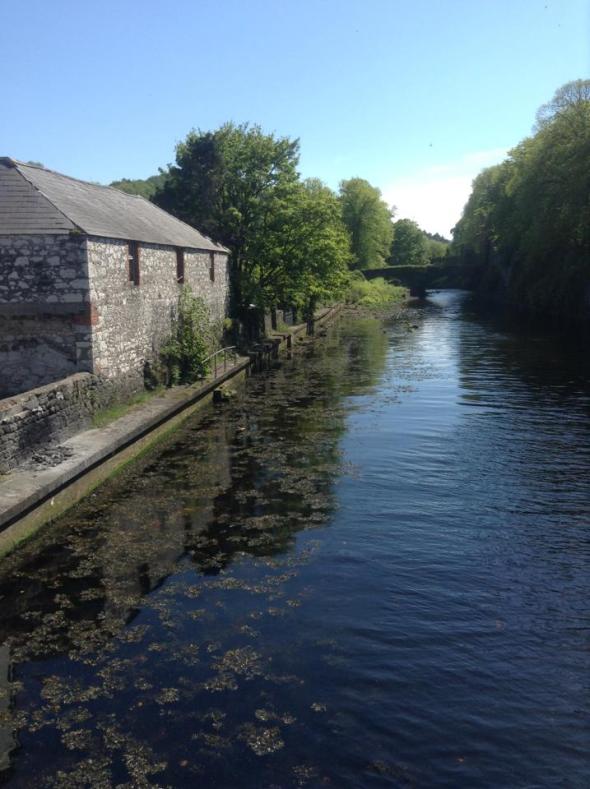
Instead, I decided to head back to the city. Now, by then it was late afternoon, so I didn’t have a huge amount of time. I decided to visit the docks area, seeing the massive yellow Harland and Wolff cranes before parking up at Titanic Belfast. Even the building itself was a stunner, but the exhibits really brought to life that ill-fated voyage. That was my last stop of the day and a very interesting one; the museum was well worth a visit.
That was May 2013 and I promised myself a return visit to this enchanting province and of course, to explore more of Belfast. I haven’t yet, but I do intend to one day.
Just back from – a day in Budapest
If you’re a regular reader of this blog then you’ll know it’s perfectly possible to have a day out in Europe, so long as you don’t live too far away from the airport and the flight schedules permit an early out, late back pairing. Following on from my days out in Amsterdam, Belfast, Bremen and Lisbon, the latest trip saw me heading to the Hungarian capital Budapest. The links to those previous day trips can be found at the end of this post. As with the others, I’ve been to Budapest before, but well over a decade ago, so I was keen to revisit what had been an enjoyable destination.
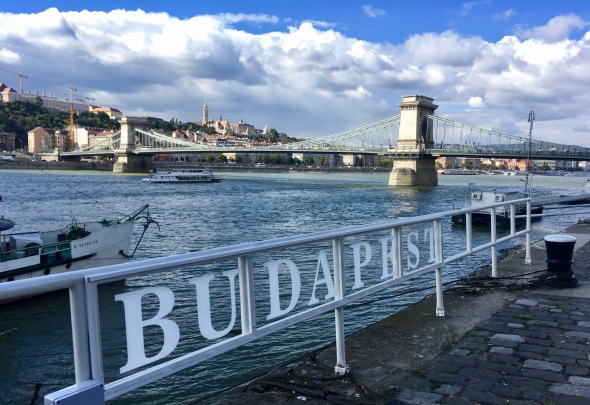
Budapest straddles the Danube
Arriving at midday local time after a civilised 8.30am flight, it was good to hear the famous Ryanair on time hurrah and even better to find that Hungary’s border police valued speed over anything else. An easy bus and metro ride got me into the centre of Budapest, giving me about six and a half hours in the city after the commute to and from the airport had been factored in. Once again, having waited for a flash sale, I paid less for my flight than I would have done for a train ticket into London, with my time equating to less than £5 per hour of sightseeing. I thought that was good value. The one day travel card, good for bus, tram and metro, was also excellent value at 1650 forints, about £5.
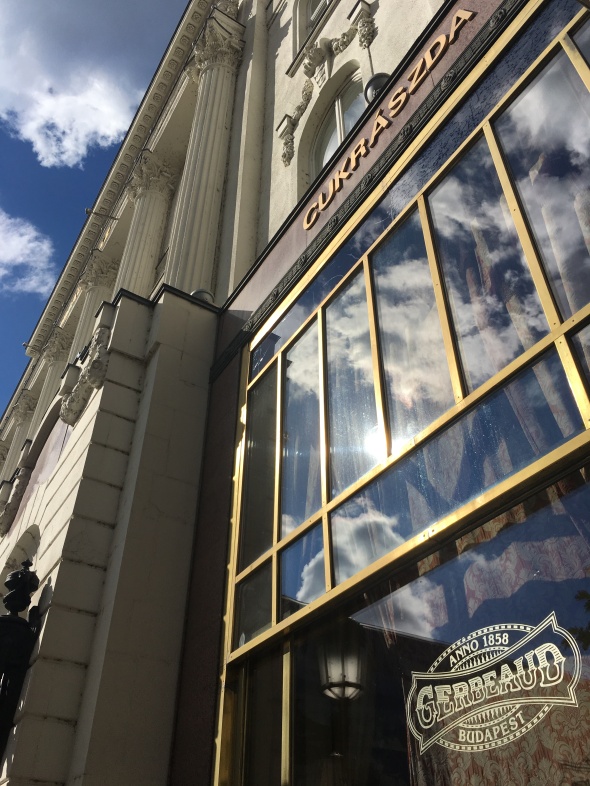
Cafe Gerbeaud has been found at its present location in Vörösmarty tér since 1870
First stop was an old haunt: Cafe Gerbeaud. Located in Pest, this famous coffee house has been a fixture for well over a century and still knows how to put on the style. A cappuccino and some delicious biscuits topped up the massive breakfast of huevos rancheros I’d wolfed down at Stansted. The sun was pleasantly warm for October and so I decided to take a stroll along the banks of the Danube and over the city’s famous Chain Bridge.
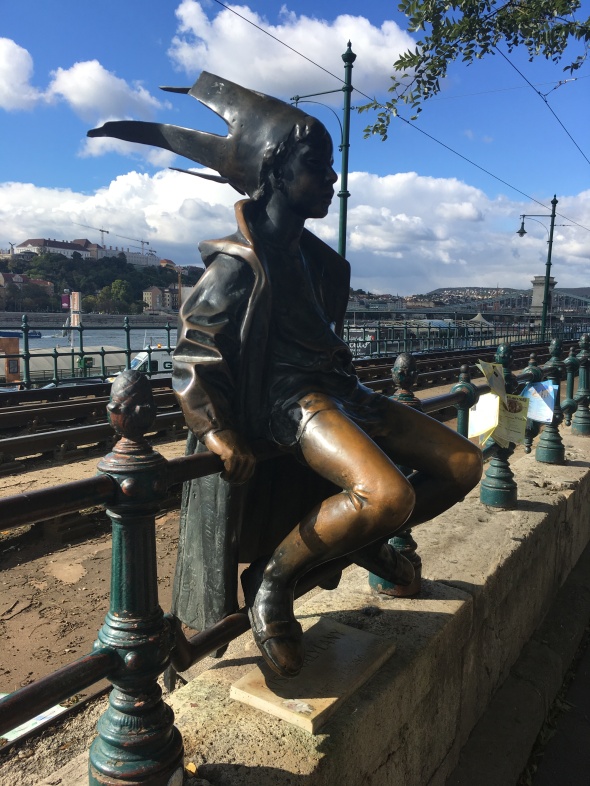
On the waterfront
With skies blue and visibility good, it was too tempting to take the funicular up Buda’s Castle Hill. The ticket wasn’t included in the travel card, more’s the pity, but it was 1200 forints for a single ride – hardly break the bank rates. The views from the top were as fine as any in Europe, with landmarks like Pest’s parliament building easy to spot.
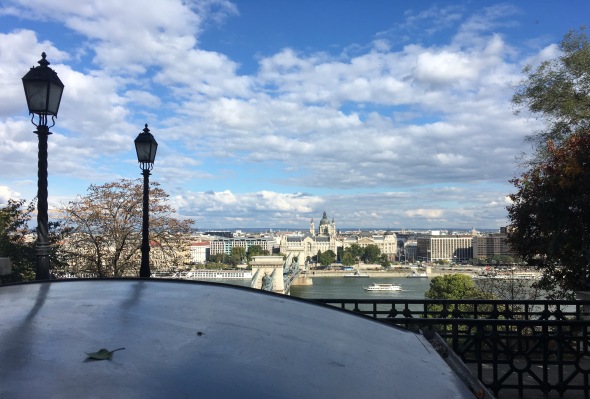
View across to Pest as I ascended the funicular
The castle occupies a prominent position, as you might expect. There are wine tastings to sample and museums to explore, but one of the great pleasures is just to sit in the sunshine and admire that view over Pest. As luck would have it, the changing of the guard ceremony was about to start in front of the Presidential Palace just as I reached the top. A forest of cameras, phones, selfie sticks and mobile phones recorded the occasion, but there was plenty of room for everyone to get their shot.
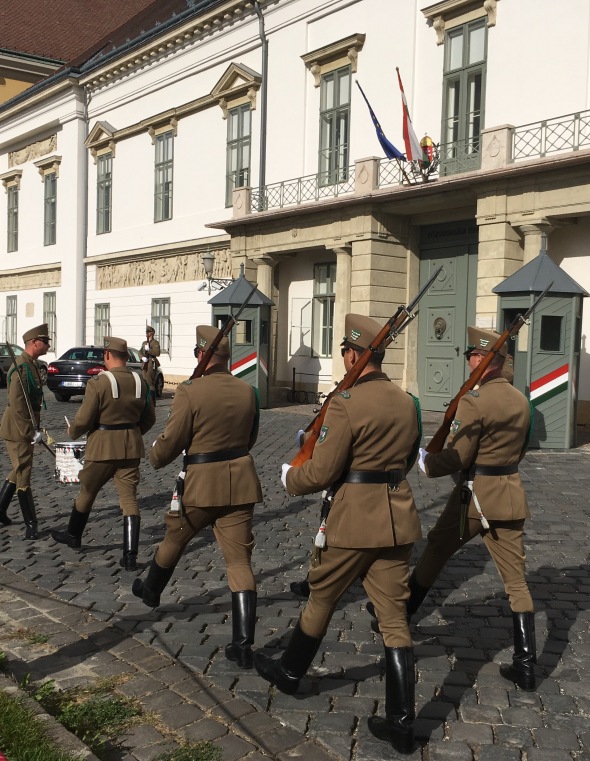
Changing of the guard, a tradition reinstated in 2003
The weather was just too good to resist and so I continued my stroll through Buda’s castle district to picture postcard Fishermen’s Bastion. It’s not a place to hurry, unless an out of control Segway rider is heading your way. There are loads of museums and plenty of cobbled streets, and as access to traffic is limited it’s easy to wander around.
Castle District
The white domes of Fishermen’s Bastion have a touch of the Sacre Coeur about them. The place was constructed between 1901 and 1903, designed to complement the Church of Our Lady which dominates the square adjacent to it. There’s no need to pay to enter for the view, or to have a coffee in the expensive cafe in the ramparts, though, as you can enjoy the same splendid vistas for nothing if you walk a little further along.


Back on the bus, I headed down to the river to search out an old Turkish Bath I’d read about. Instead, I found what looked like an abandoned sanatorium but what was actually a working thermal baths. It turned out to be the Lukács baths, whose website provided a bit of background missing from other web posts about Budapest’s baths:
“The Lukács Thermal Bath has a rich historical background: monastery baths were built in this area as early as the 12th century, the first spa hotel was built in the 1880s, a drinking cure hall was added in 1937, and a daytime hospital was established in 1979. At the end of the 20th century, the thermal bath was thoroughly renovated and all facilities were modernised.”
A surprise find
Budapest has loads of them dotted about the city, including the swanky baths at the Gellert Hotel and the famous Széchenyi Baths in City Park. These were less well known, perhaps off the tourist track because it looked like no one had maintained them for an age. Undeniably atmospheric, I decided against a dip in case the building fell on me and in any case, it was late afternoon and getting a little chilly. Instead, I decided to go back to Pest instead for a stroll through City Park. The lake had been drained for cleaning, alas, so I cut my losses and caught a bus to the market.

Paprika in the market
I could wander around a market all day, and Budapest’s, housed in a glorious building down by the river, is no exception. Ropes of paprika hung like Christmas decorations from greengrocery stalls and rows of salamis adorned the butchers. I’d been tipped off about a cheese pastry, a kind of crispy rolled croissant filled with cream cheese and dipped in finely grated cheese. It was deliciously more-ish.
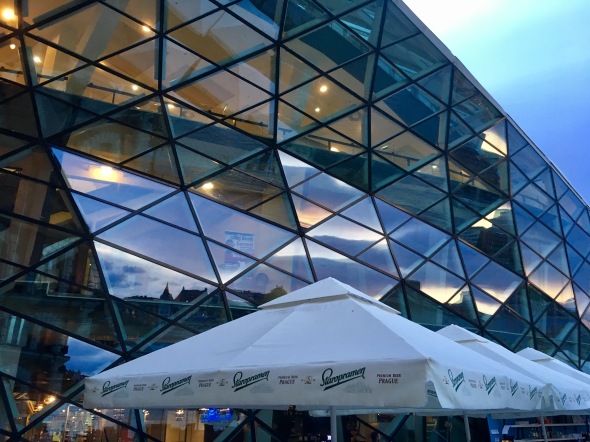
The Whale at dusk
Temptation would have to be resisted though, for almost next door was one of Budapest’s newer architectural efforts. Known as Bálna or the whale, this modern structure connects several old warehouses with a confection of glass and steel. It opened, I read, in November 2013 after protracted disputes between the city and the developer, but not all of the units inside had been filled – a mix of shops, bars and restaurants – leading to some commentators renaming it the white elephant.
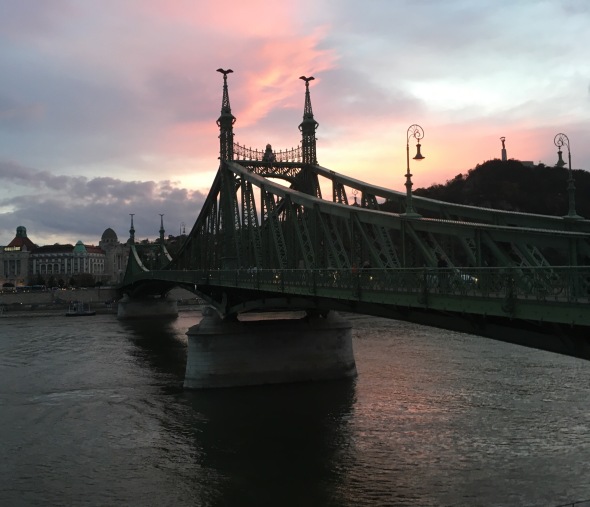
Sunset over the Danube
It was getting late. The sun had cast a pink hue over the Gellert and left the faintest of reflections in the Danube. There was just time for a light supper before heading back to the airport for my 9.35pm flight back home.
Previous day trips…
Bremen
https://juliamhammond.wordpress.com/2016/06/07/just-back-from-a-day-trip-to-bremen/
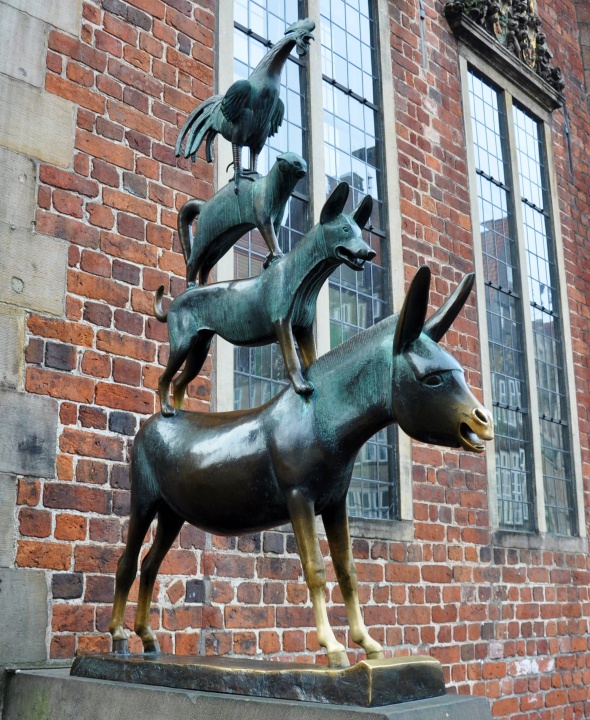
The four budding musicians
Lisbon
https://juliamhammond.wordpress.com/2014/10/20/just-back-from-a-day-trip-to-lisbon/
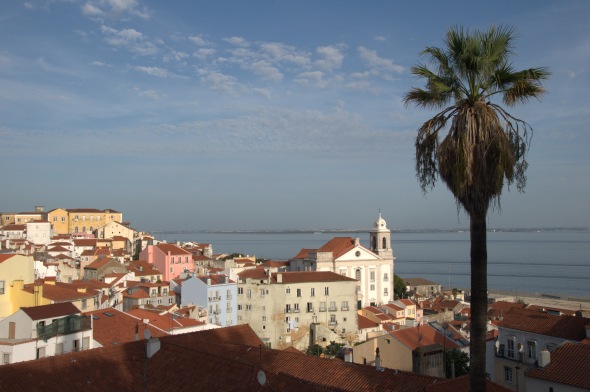
The Alfama district seen from the Mirador at Portas do Sol
Amsterdam
https://juliamhammond.wordpress.com/2015/01/26/just-back-from-a-day-trip-to-amsterdam/
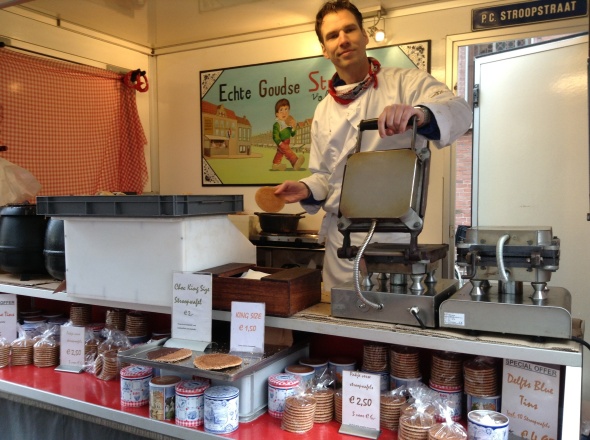
The Stroopwafel man
More from Extremadura: the Roman ruins of Mérida
Spain probably isn’t the first country that springs to mind if you’re planning to explore the legacy of the Romans, but their empire encircled the Mediterranean (and beyond). In Spain, in addition to better known sights like Segovia’s aqueduct and Cordoba’s old bridge, Mérida is one of the best places to see some of the structures left from that age.
The modern city of Mérida has developed around and on top of the Roman colony of Augusta Emerita. It was built around 25BC and was the capital of Lusitana, located the furthest west of the Roman provinces. I began my exploration at the amphitheatre.

Passageway leading to the main arena
Though not as well preserved as others I’d visited – Tunisia’s El Djem, Nîmes in France and of course Rome’s Colosseum spring to mind – it had a certain charm. Being a weekday in the height of summer, visitors were thin on the ground, giving me a place free of tour groups to savour at a leisurely pace.
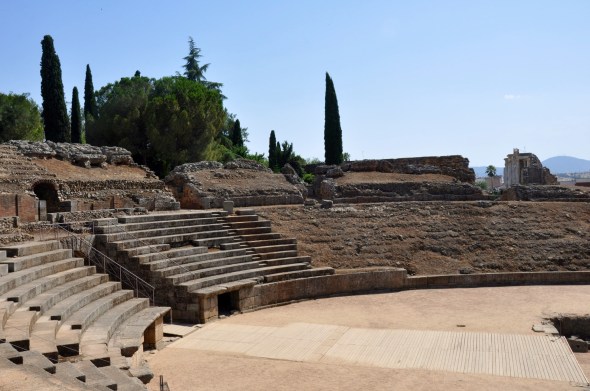
The amphitheatre viewed from the top of the stands
The amphitheatre itself was built about 8BC, designed to stage gladiatorial fights and other such spectacles. It would have had a capacity of around 15000 people, making it considerably smaller than the Colosseum which could seat almost four times that number. Adjacent to the amphitheatre is the theatre. More impressive, in my opinion, it’s a few years older than its neighbour, though back then, it wouldn’t have been nearly as popular. Give the Romans a choice between a bloodthirsty fight and a stage play and the fight would win every time.
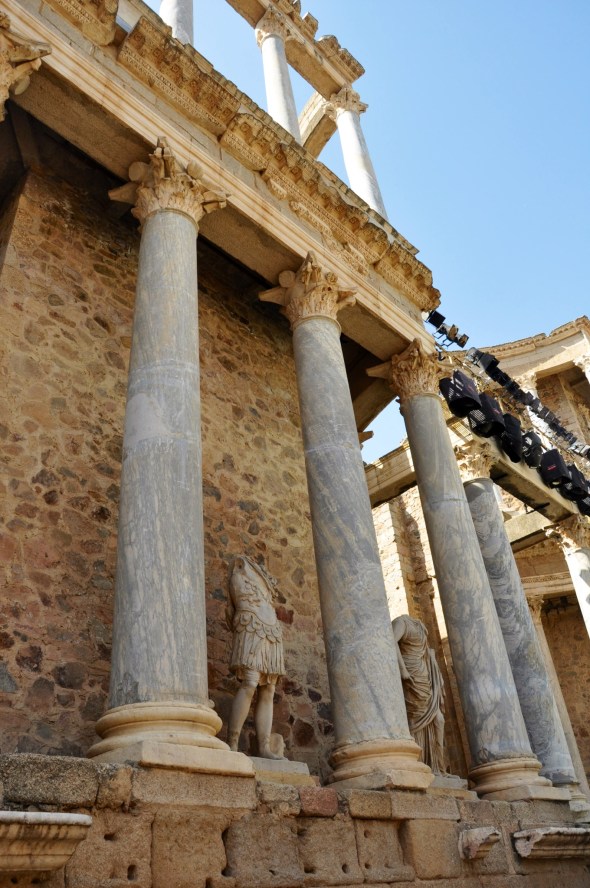
The headless statues behind the stage
Six thousand people would have been able to watch the proceedings. These days, the theatre is still in use; the Festival de Mérida takes full advantage of the atmospheric setting for a summer of plays. My schedule didn’t coincide, so I had to content myself with sitting on the front row in front of an empty stage gazing up at statues of deified emperors.
Perhaps the most impressive structure in the city is that of the Temple of Diana.
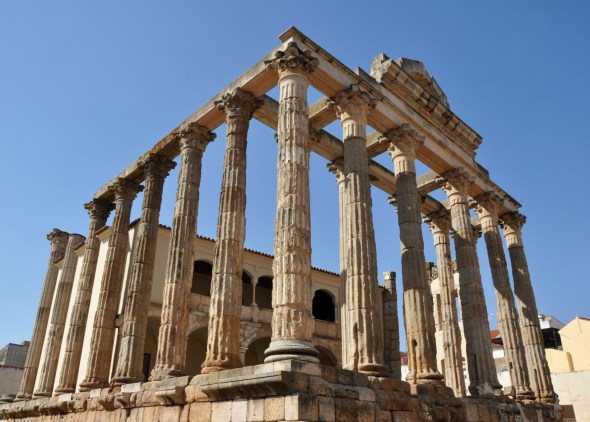
The Temple of Diana
Its Corinthian columns make it an impressive sight. Behind, lies the Palace of the Duke of Corbis, into which the temple was absorbed in the 16th Century. The temple lies on one of Mérida’s main streets and there’s a cafe next to it, which makes it a surreal sight. Nearby, is the Forum, again surrounded by the town’s modern buildings.

Mérida’s Forum
Strolling downhill, it’s not long before you reach the Guadiana river and there, you find the old bridge. Built in two sections, it links the river’s banks via an island. Sixty of its original sixty two spans still exist, and wisely the bridge was pedestrianised over two decades ago.

The Roman bridge at Mérida
Following the river bank from the bridge, after exploring the 9th Century Moorish Alcazaba that abuts its western bank, I headed to the Casa del Mitreo. There, Mérida’s most beautiful mosaics can be found. Best known is the mosaico cosmológico, laid in the 3rd Century and partially intact today.

Parts of the mosaic can be seen to this day
The city also has a Hippodrome, but I made a conscious decision not to go. I could blame the weather – who wants to do such a walk when the temperature is still 40°C at six in the evening – but actually it was to avoid comparisons with the excellent experience I had at Jerash in Jordan. Its Hippodrome is used for the wonderfully entertaining RACE project.
You can read about it here:
https://juliamhammond.wordpress.com/2016/07/25/gladiators-we-salute-you/
Gladiators, we salute you!
As the theme tune from “Gladiator” filled the arena, I felt the hairs on my arm stand to attention.

I’d come to watch a spectacle. Jerash’s RACE project had both impressive credentials and great reviews. Ticket clutched in sweaty palm, I hurried into the auditorium, eager to secure a good seat. A Roman soldier adjusted his strap under a stubble-pocked chin, bristle-brush helmet conferring stature, scarlet tunic incongruous under masculine armour. An air of anticipation rippled through the crowd.
A small group of legionaries arrived, interrupting excited chatter, and took their place in the sand of the legendary Hippodrome. Though few in number, they were a formidable sight behind their flag bearer.

Known as the Legion VI Ferrata, “the ironclads”, they treated us to an impressive demonstration of battle tactics and formation marching. As they recreated the classic Roman two-sided shield barrier, it was clear how effective this would have been in war. Not a finger or stray hem was visible outside the shield.
The music played, unashamedly tongue in cheek. A diverse band of gladiators entered the arena ready to fight, clad in robes and armed with assorted weapons: net, shield, trident. All were muscle-bound and postured aggressively. Once they might have been slaves or criminals facing the death penalty, but today they had the best job in Jerash.

“Ave, imperator, morituri te salutant!”
“We who are about to die salute you!”

Passive spectating wasn’t allowed; thumbs up or thumbs horizontal – we had to vote. The loser kept his life with thumbs up. Caught up in the moment, I voted thumbs horizontal, before realising, embarrassed, that everyone else had pardoned him. Feeling audience pressure, next time I voted thumbs up.
A Roman general tore into the stadium in a horse-drawn chariot. Two others followed, kicking up clouds of dust. Their wheels angled outwards, giving the impression of imminent collapse every time their horses tackled the tight turns. The centre of the track was marked by a fragile wooden fence which didn’t seem at all like it might withstand a misjudged move.
Leaning forward over the barrier, I urged the racers on ever more enthusiastically, reminiscent of ‘My Fair Lady’ though with slightly more ladylike language. I cheered myself hoarse for a bearded driver clad in an emerald tunic, who threw himself into the job with gusto and wasn’t going to let anyone pass under any circumstances. My favourite strode to a clear win after the regulation seven laps. I whooped unashamedly and thought it was a pity I couldn’t have put a bet on.

As the winner received his prize and our respect, it was time to clamber down to the track for some photos. Not allowed to take a chariot for a spin (clearly my reputation for a lack of hand-eye-wheel coordination had preceded me) my hero had been swallowed up within a crowd of well wishers. I had to settle for a picture with the runner up – same beard, same tunic but, alas, a lot less balls.
Just back from – a day trip to Bremen
Regular readers may recall previous posts about days out I’ve done by air:
- to Amsterdam https://juliamhammond.wordpress.com/2015/01/26/just-back-from-a-day-trip-to-amsterdam/
- to Lisbon https://juliamhammond.wordpress.com/2014/10/20/just-back-from-a-day-trip-to-lisbon/
This time, Ryanair are in the hot seat and it’s off to London Stansted for my flight to the north German city of Bremen.
Flight times, for once, are very convenient. The outbound flight departs at 7.55am and is scheduled to arrive in Bremen at 10.20am. It’s a short flight with a one hour time difference. The only downside is that you hit Stansted at peak rush hour. Don’t be tempted to rock up too late; the queues for security are long and just as tedious as anywhere. Of course, with Ryanair your boarding passes are already printed and as it’s a day trip, there’s no luggage to worry about. If you are tempted to shop before you take off, Stansted offers a buy and collect service and you can pick up your shopping on your way back in. Coming back, the flight’s at 9.20pm, but the ten minute tram ride from the city centre and the diminutive size of Bremen Airport mean that you can get away with leaving as late as 8pm. Touchdown at Stansted is scheduled for 9.45pm though we were a little late.
Arrival
After a take off delay of fifteen minutes or so due to earlier fog at Stansted, I passed swiftly through passport control at Bremen’s tiny airport. Ryanair use a separate terminal. It is as pared down as Ryanair users would expect, but the advantage of being apart are of course that there is no one else to share the passport queue with. In less than ten minutes from the wheels hitting the tarmac, I was through the airport and off to find transport into the city.
Getting to the city
Bremen Airport is obscenely close to the city centre and by far the easiest method of getting there is by tram. Exit the Ryanair terminal and turn right. Walk past the main terminal and ahead of you is the tram stop. You’ll need Tram 6 marked Universität which departs every ten minutes. The fare costs 2,70 euros. You can either buy your ticket at the machine at the stop or hop on board and buy one from the tram’s machine. Small notes and euro coins are accepted – don’t go trying to use a 50 euro note as it won’t let you. It’s only a few minutes to the Domsheide tram stop. Alight there and you’re a minute from the cathedral, town hall and main square. The tram then goes on to the main train station.
Getting around
A network of buses and trams can take you all over the city. The Bremen tourist board have produced a series of very useful PDF guides which include a very clear street plan as well as a map of tram and bus routes. I downloaded these onto my Kindle app before setting out, but you can of course pick up paper copies from the tourist information desk when you get to Bremen if you prefer a hard copy, or they’ll send them to you through the post on request. Here’s the link: https://www.bremen-tourism.de/information-material
Much of the city centre is walkable as it is a compact place, but if laziness or inclement weather strike then it’s handy to know which tram to jump on and the guides also detail opening hours and which buses or trams to use. As with the airport tram ride, fares are 2,70 euros for a single but you can also buy a day pass for 8,90 euros which also gives you discounts off some of those city’s must-see attractions.
How to spend the day
First stop for me was the obligatory pose with donkey, dog, cat and rooster. The famous bronze sculpture resides beside the town hall. You’ll see donkey’s front feet are well worn – it’s considered good luck to give them a rub. The four creatures are Bremen’s mascots if you remember the Brothers Grimm’s fairytale.
Next, I walked through the main square. The Rathaus (town hall) was under wraps which was a pity as it is a splendid building minus its scaffolding. It’s UNESCO listed and it is possible to take tours of the inside. The cafes in the main square are tempting and I can recommend coffee and cake of course. Duck behind the Schütting (Guildhall), which sadly isn’t open to the public, and you’ll come across Böttcherstraße which is the marvellous Art Deco creation of a famous local coffee manufacturer. If you can, time your visit to coincide with the chiming of the hour at the House of the Glockenspiel (look up and you’ll see it).
A short stroll from Böttcherstraße took me to the Schnoor quarter. This is one of the oldest neighbourhoods in Bremen and was once where the sailors hung out. The name Schnoor comes from the low German “Snoor” meaning string, which could have been a reference to the way the old houses line up or perhaps to the making of ropes or nets for the ships that passed through here. The area’s very touristy but worth a visit nevertheless.
Still in Schnoor, I had a schnitzel lunch in Beck’s; if you get there early enough you can bag the table with the window out onto quaint Wuste Statte. Flipping the main meal to lunchtime makes sense; most restaurants offer reasonably priced lunch menus and the local cafe culture lends itself to an early evening coffee or an aperitif with a cake or snack before you leave.
Wandering the streets of the Schnoor to walk off lunch was a delight. There, you’ll find many artists and artisans, but for me the delight was the intricate detailing and artwork that formed part of many of the buildings. It’s very important not to rush and also to look up, or you’ll miss them.
From the Schnoor quarter, it would have been logical to move on to Viertel, but as the sun was shining I decided to take a boat trip up the Weser instead. A 75-minute round trip cost 10,50 euros and was rather pleasant, passing the Docklands area of Uberseestadt. Boats depart from Schlachte. Look out for the Beck’s brewery and also some famous names on some of the factories and warehouses: Kellogg’s and Primark among them. With little wind and a clear sky, there were some lovely reflections on the water.
Back on dry land, I walked up to the park that lines the northern edge of the city centre. There’s an old windmill on a hill overlooking the park which was the perfect stop for a cherry juice: a cooling breeze to take the edge off a humid day. Because of the weather, I opted to catch a number 10 tram to Viertel. It’s one of Bremen’s more Bohemian neighbourhoods: think Notting Hill but not quite as affluent. There’s some fantastic street art to be seen, a few shops selling vintage clothes and furniture as well as plenty of decent cafes. I was glad of one of the latter when a thunderstorm brewed suddenly and equally glad when it was short lived.
Strolling back through the Schnoor, the thunderstorm had an unexpected silver lining. Crowds of tourists typically frequent the narrow streets but even though the sun had reappeared, people were slow to venture out again, so I almost had the district to myself. A meander to the main square for a coffee and it was time to head back to the airport after what had been a very pleasant day. The hot weather had prompted me to take it easy, but there is a lot more to see in this Hanseatic city. I could have taken a tour of Beck’s brewery, seen how Mercedes-Benz make cars or ponder whether modern works of art have as much value as their earlier counterparts. Another time, I think. This place is worth another visit.
For more on Bremen, check out my previous blog on the city here https://juliamhammond.wordpress.com/2015/10/03/beautiful-bremen/.
Elephant spotting in Uda Walawe
Uda Walawe National Park is home to the largest concentration of elephants in Sri Lanka. It was created in 1972 and centres on the Uda Walawe reservoir. Although in March there was quite dense vegetation on the way in to the park, it thinned by the lake shore and thus made it easier to see wildlife. At first, sightings were limited to a few monitor lizards and birds, neither of which excited me much. But at the lake, a couple of herons were pottering about in the shadows seemingly oblivious to the crocodile skulking behind them. In the middle distance, some water buffalo wallowed.

But I’d come to see the elephants, said to number around six hundred, making it the best place to view them in the country. Easily seen year-round, herds can number over fifty but the largest family group I saw was eleven, still impressive. Our first sighting, a mother with two juveniles, was entertaining. They took a stroll down to the lake where the youngest couldn’t wait to relieve himself in the water. Toilet taken care of, it could bathe happily before the trio wandered back into the bush.


As we drove along the lake shore dirt track, a lone adolescent passed us at close range, near enough to leave us in no doubt that he was a male. Unperturbed by the camera clicking, he ambled past towards the lake.
In the vegetation, the thick leaves can provide excellent camouflage, but the guide was equally skilled in locating the wildlife. This was our closest encounter, though fortunately the creature was very docile and didn’t warn us off.

A herd of eleven including two babies was the highlight of the drive. One infant looked to be just three months old or thereabouts, with the other perhaps six months. It’s always delightful to see how the older members of the family protect the youngest when they’re on the move, keeping the babies close by but placing themselves between infant and safari vehicle just in case.



There are other species to keep the elephants company, and I saw plenty of water buffalo and in the distance, a couple of spotted deer. A family of monkeys swung in the branches of a tree and amongst the birds I recognised were a grey heron and a kingfisher by a lake so full of green algae it was hard to decide which was the most vibrant in colour. Leopards are said to be present in small numbers though I wasn’t lucky enough to encounter one.

While some people stay at one of the nearby hotels or guesthouses, I took a game drive en route from Ella to Galle. The three hour stop was a welcome diversion from sitting in the car. My driver arranged a safari jeep within minutes and it cost about £45 for a private excursion with Wild Safari Service including all entrance fees. Be prepared to haggle.
How to get the best out of a Heathrow layover (Part 2)
In my first blog on Heathrow layovers, I dealt with how you should go about getting into Central London.
Depending on how much time you have, there’s lots to do between flights – it’s London, after all – and you won’t be encumbered by heavy bags. If you have something in mind but aren’t sure if it’s feasible, and it’s not featured here, drop me a line via Facebook (Julia Hammond Travel Writing) and I’ll give you some ideas. Note: the time available is measured from when you emerge landside after landing to when you need to be back at the airport for your next flight. Allow at least 60 minutes to get through security and to your gate; you don’t want to miss that onward flight!
Time available 4 hours: NOTTING HILL
You’ll need to keep a close eye on your time with this amount of time. With this short a layover, you need to restrict yourself to the west of the capital.

Portobello Road Market
My suggestion is a quick visit to Notting Hill, a vibrant neighbourhood where Julia Roberts once filmed, Jimi Hendrix died and The Clash called home. Take the District or Circle lines two stops from Paddington to Notting Hill Gate and walk via Portobello Road, where you’ll find the famous market (stalls can be found in the area most days but it’s best to visit on Friday or Saturday) and there are some great eateries including the Hummingbird Bakery. If you have time, the excellent Museum of Brands on Lancaster Road is worth a stop.
The Museum of Brands, Packaging and Advertising
When you’re done, there’s no need to walk back to Notting Hill Gate. Head back to Paddington from Ladbroke Grove tube station via the Circle or Hammersmith & City lines.
Time available 5 hours: MARYLEBONE
Marylebone, a neighbourhood squeezed between the West End’s shopping streets and beautiful Regent’s Park, is fast becoming the fashionable place to be seen in London. With an extra hour for your layover, you should have time to pay a visit to Sherlock Holmes at 221B Baker Street. Located between 237 and 241 Baker Street, it’s just a three minute walk from Baker Street Tube, linked to Paddington via the Bakerloo Line.

The Sherlock Holmes Museum
You’ll most likely see a policeman in a cape on the door, but be warned there’s often a queue to get in. It’s open from 9.30am to 6pm. Walk north from the museum and it’s only a few minutes to London’s beautiful Regent’s Park. With its elegant Georgian mansions framing the park and a mixture of manicured lawns and open space, this is one of the capital’s most beloved green lungs.

Regent’s Park
Cross over York Bridge, keeping an eye out for the herons sometimes seen here, and skirt the southern part of the park. When you’re ready to leave, use Regent’s Park station, one stop along from Baker Street on the Bakerloo Line. From there, it’s four stops back to Paddington or, if you have time, one stop down to Oxford Circus, still London’s main shopping artery and home to Selfridges & Co. department store, west of the tube station just past Bond Street. Alternatively, Marylebone High Street and its neighbouring streets have plenty to offer in terms of quirky boutiques and historic landmarks.
Time available 6 hours or more: HAMPSTEAD
With longer between flights, the whole of London is at your fingertips, so why not try somewhere that’s a bit off the beaten tourist track? Hampstead requires a change of Tube trains but is well worth the effort; take the Hammersmith & City or Circle Line as far as Kings Cross or the Bakerloo Line to Embankment, and then change to the Edgware Road branch of the Northern Line to travel to Hampstead station. Total journey time is about 35 minutes, so don’t be put off.

Hampstead “village”, packed with grand mansions and town houses
Hampstead feels more like a village in parts, but with phenomenal views from its vantage points across London, you can tick off the capital’s landmarks all at once. Try the view from Holly Mount, just down the road from the excellent Holly Bush pub or continue up to the Heath.
The charming Holly Bush pub
Hampstead Heath is well worth the trek up the hill. Walking across this huge open space will make you forget you’re in one of the world’s largest cities and help you realise why it’s also one of the world’s most liveable cities. On your way, take a detour along Hampstead Grove and you’ll pass a small observatory run by the Hampstead Scientific Society. Inside is a 6″ Cooke refracting telescope dating from the turn of the 20th Century.
View of London from Parliament Hill, Hampstead Heath by Ed Webster via Flickr CC BY 2.0
On your way back to the High Street, stop to take a look at the house once inhabited by Ernő Goldfinger of Trellick Tower fame, who lived at Number 2 Willow Road. Local resident Ian Fleming, creator of James Bond, hated the modernist structure and allegedly took his revenge by naming one of his Bond villains after the man responsible for the eyesore.
Of course, if you don’t fancy Notting Hill, or Marylebone, or Hampstead, then there’s always St Paul’s Cathedral, Buckingham Palace or Big Ben. One short layover just isn’t going to be enough, of course, but these ideas surely beat staying in an airport lounge drinking coffee and browsing duty free shops.
And if you are tempted to come back, then why not try my Unanchor guide to London’s Villages, which consists of three day-long walking tours, one in each of the three locations featured above. Packed with ideas and information, it’s available on Amazon as well as direct from Unanchor.com and can be downloaded as a PDF or straight to your Kindle. Here are the links:
How to get the best out of a Heathrow layover (Part 1)
Flying via Heathrow? There’s no need to stay at the airport. Instead, take a trip into London and have a taste of what the British capital has to offer.
Part One: Getting to Central London

Notting Hill is comfortably doable on a layover
Take the train. Don’t be tempted with taxi or bus transfers; London’s traffic is too unreliable for you to risk wasting valuable layover time stuck in traffic. Instead, you have several options.
Most expensive, but fast, is the Heathrow Express. It takes 15 minutes to get from LHR to London Paddington station, from where you’re well connected by Tube to the centre and its attractions. Machines (and conductors) accept cash as well as credit and debit cards, but you’ll save a lot if you don’t use it.

Heathrow Express ticket machines

Heathrow Express Second Class
Heathrow Express First Class
However, there’s now a better way, which is almost as fast (quickest journey time to Paddington is 24 minutes) but significantly cheaper. The Elizabeth Line crosses London. Along the way it handily links Heathrow with key central London stations such as Paddington, Bond Street, Tottenham Court Road and Liverpool Street.
Cheaper still is the Tube, but it stops more frequently so your journey will take longer. The Piccadilly line connects Heathrow to popular tourist destinations such as Piccadilly Circus, Covent Garden, Hyde Park and Leicester Square. Journey times can feel tediously slow as the numerous stations aren’t far apart, but on average you’re looking at around 45 to 50 minutes to get into Central London. Fares vary according to the time of day and whether you have an Oyster card/tap in and out with a credit or debit card.
Useful links
Heathrow Express: https://www.heathrowexpress.com/
London Underground including information about the Elizabeth Line: https://tfl.gov.uk/
Tube and rail map: https://tfl.gov.uk/maps/track
Fares: https://tfl.gov.uk/campaign/new-fares
Heathrow transport information: http://www.heathrow.com/transport-and-directions#
For some well-known and more unusual suggestions for what to do once you’ve reached Central London, read my next blog: https://juliamhammond.wordpress.com/2015/12/09/how-to-get-the-best-out-of-a-heathrow-layover-part-2/
A spin off blog: essexology.com
My last blog post, Travels closer to home, sowed a seed of an idea. I’ve lived in Essex for decades, but there are plenty of places I’ve never visited, and some attractions I’d never heard of. Last week, I spent an afternoon walking the myriad paths of beautiful Marks Hall Arboretum in glorious autumn sunshine, yet the day before I didn’t even know it was there.

A spin-off blog, essexology, was born and I’ve been having fun uploading photos and information about some of my favourite places in my home county. If you think Essex is just what you see on TOWIE, then think again. You’ll be surprised at the variety, history and natural beauty of what many write off as merely a commuter belt for London.
If you have a suggestion for a place or a visitor attraction that I should feature, then please leave me a comment and I’ll check it out. And please do visit http://www.essexology.com and tell me what you think.
Travels closer to home
With no foreign trips planned until 2016, I’ve decided to focus on exploring the county that’s been my home for over four decades: Essex. In the beautiful October sunshine, this week I headed to Paper Mill Lock, a tranquil spot yet an easy drive from the county town of Chelmsford. It’s times like these that I’m glad to live in the driest part of the UK. In this sheltered spot, I had an al-fresco sandwich filled with thick butcher’s sausages and tangy onion chutney while watching a pair of ducks glide up and down alongside the boats.
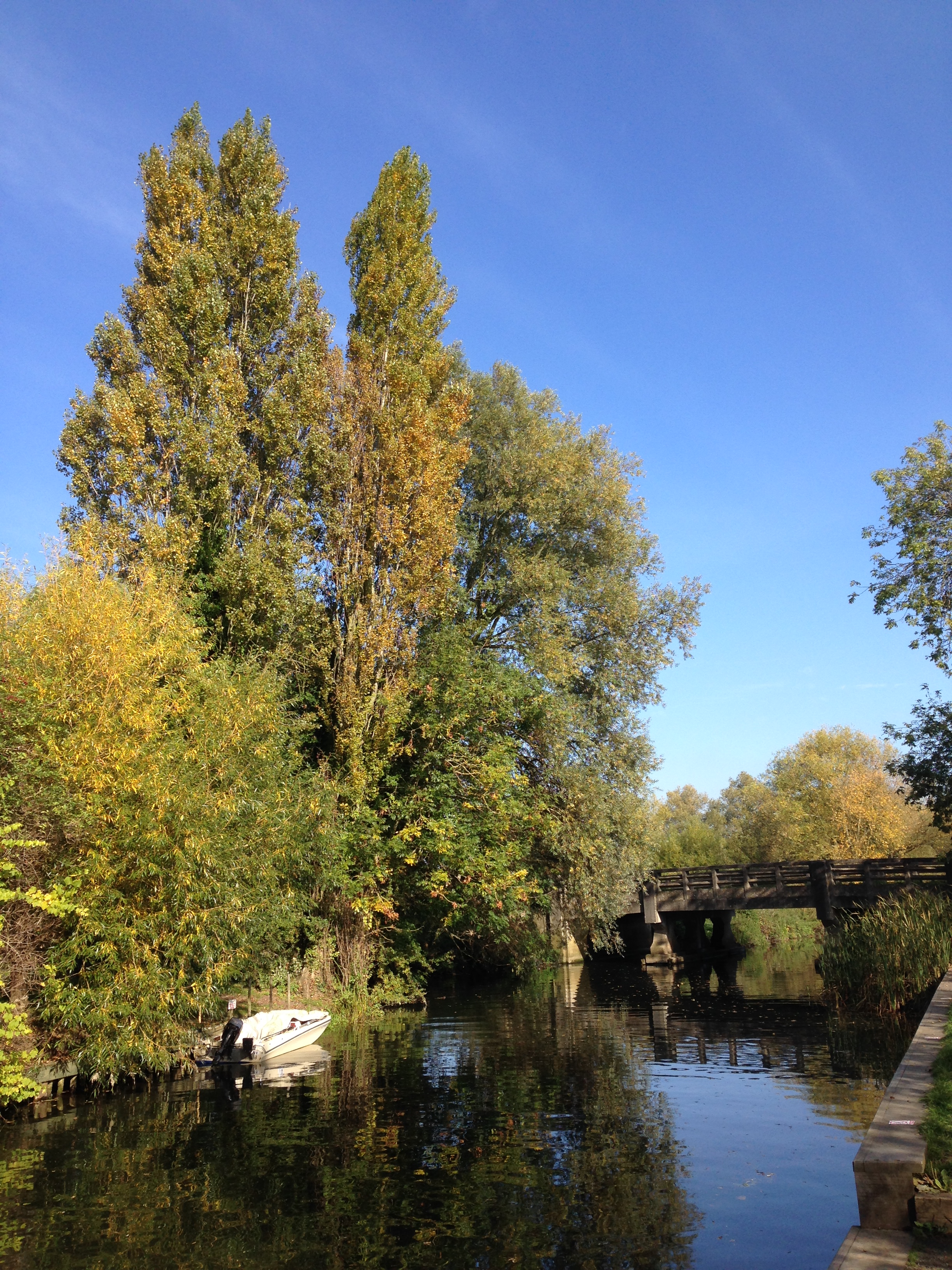
The Chelmer and Blackwater Navigation dates from the 1790s, linking Chelmsford to the coast near Maldon. In the early days, its cargo was mostly coal, bricks and timber heading inland; these days it’s a leisure and pleasure canal. The lock’s one of twelve; it takes its name from the paper mill that stood next to another grinding corn as far back as 1792. It’s possible to walk the length of the canal. At the coast, you’ll end up at Heybridge Basin where you’ll find a couple of decent pubs including the dog-friendly Jolly Sailor.

The Cinque Terre
Today’s visit to the Cinque Terre was tinged with disappointment as much of the Sientero Azzurro was closed and the weather, though mostly dry, remained resolutely cloudy pretty much all day. Even this early in the season, crowds are building, so I’m not sure I’d want to risk a later visit to improve my chances of sunshine. Trains saved the day for speedy transfers between villages, but for wow factor views I was glad I took to the sea.
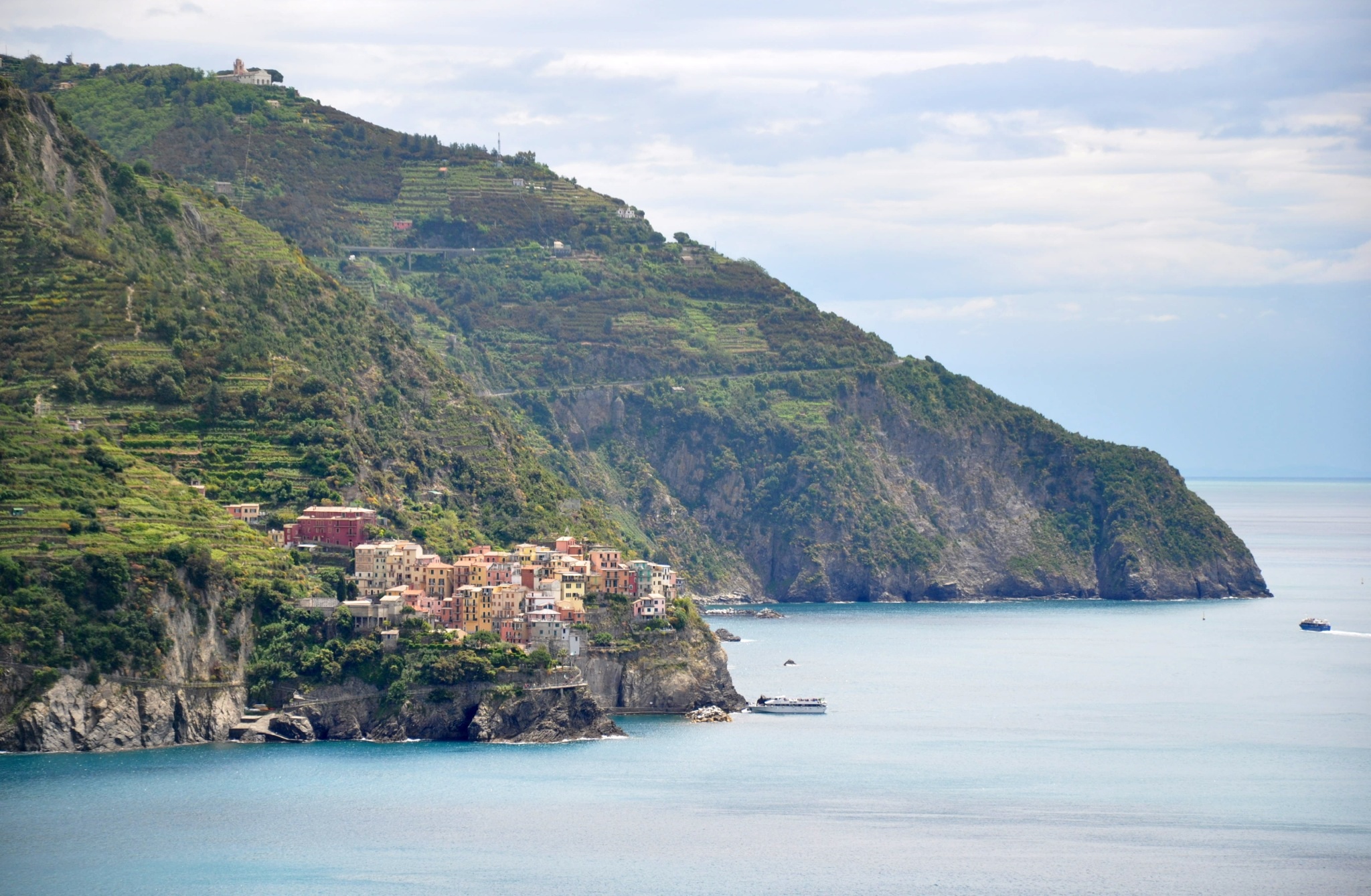
Manarola, as viewed from Corniglia

A splash of colour on a wall in Corniglia

Vernazza as viewed from the stairwell of its ancient tower

Typical local produce on sale in Vernazza

Cliff top Corniglia as seen from the boat
Just back from – a day trip to Amsterdam
Is an Amsterdam day trip viable? In the second of an occasional series, I test whether it’s really worth making the effort for just a single day’s visit to this popular Dutch city. Would I regret not paying for a hotel room as I dashed from attraction to attraction?
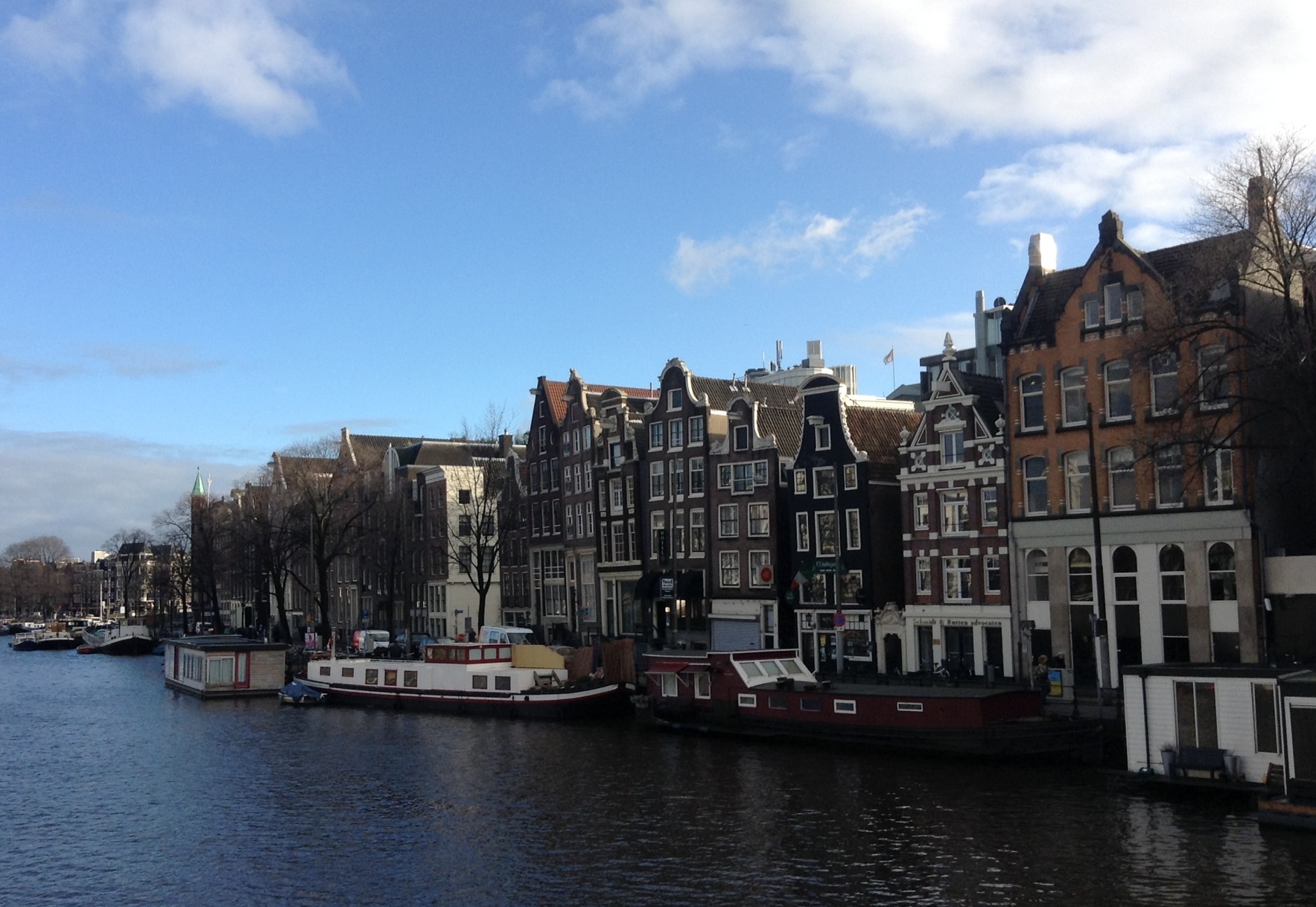
Amsterdam’s canals
Logistics
I chose to fly from London’s Southend airport, around an hour from Central London but only a short drive from my Essex home. Southend, though expanding, is still a small airport, making it possible to transit the airport in just a few minutes – none of the long queues for security or marathon hikes to the gate that characterise Britain’s larger airports. easyJet fly out to Amsterdam at 7.30am and back at 6pm, making a short day out a cheap possibility. It’s wise to note that easyJet fly into a satellite terminal at Schipol, making for a tidy walk to the gate for your return flight. But they have a good track record for punctuality and my outbound flight was on time. On the return leg, we landed early and thanks to the time difference, I was back in my kitchen feeding the dogs their dinner almost before I should have left Schipol. (Don’t worry about them, we have doggie day care for such occasions.)
Getting into the city
Having made it across the airport without getting distracted by the many shops and even a branch of the Rijksmuseum (Schipol has got to be the best airport in Europe, don’t you think?) I exited through self-service passport control leaving the tulip bulb purchases for my return. Keep straight on as you exit customs for the train station, the quickest way into central Amsterdam. Directly in front of you are bright yellow ticket machines which take cash and cards. A single ticket into the city costs 5,10 euros with a 0,50 euro surcharge for using a credit card; UK issued cards work fine. It’s worth noting, though, that they take coins and not notes if you wish to pay cash. Make a left and head for the train; it’s a quick fifteen minute ride into the city. Trains leave frequently for Amsterdam Centraal Station immediately to the north of the main city. I waited one minute for a train and was walking Amsterdam’s streets by 10am.

Centraal Station
Getting around
The city centre of Amsterdam is compact and unless it’s raining, it’s a pleasant experience to wander the back streets and canal side paths on foot. You’ll need eyes in the back of your head, though, to avoid being run over by a bicycle. The city has dedicated cycle lanes but it’s all too easy to forget where the pavement ends if you’re trying to take a photo. If you hire a bike yourself, it’s customary to ring your bell rather than mutter profanities at wayward pedestrians obsessed with getting the perfect selfie.
For longer distances, the easiest method of getting around the city is by tram. Single rides cost 2,90 euros and the ticket is valid for an hour. Tap the ticket on the reader as you are given it to activate it. If you are likely to make more than three journeys, it’s worth your while buying a day pass, costing 7,50 euros. Tap in and out each time you ride.

Cheese!
What did I do?
I’ve been to Amsterdam before, so decided to give the big museums and the Anne Frank House a miss this time. If you are making a first visit then you should really consider staying a few days to give you time to do the sights justice. Queues for the Anne Frank house are frequently long (even on a Monday in January!) so if you do want to go, and you should, plan to make this first on your day’s agenda when you visit.
I made for the Begijnhof instead. It’s an easy walk from Centraal Station – cross over the canal and head down Damrak, the main drag. Damrak is tourist central, but you can arrange everything from canal boats to bicycle hire here and buy souvenirs tackier than you’ve ever imagined. From Dam Square, continue down Kalverstraat (almost as bad as Damrak) until you get to Spui.
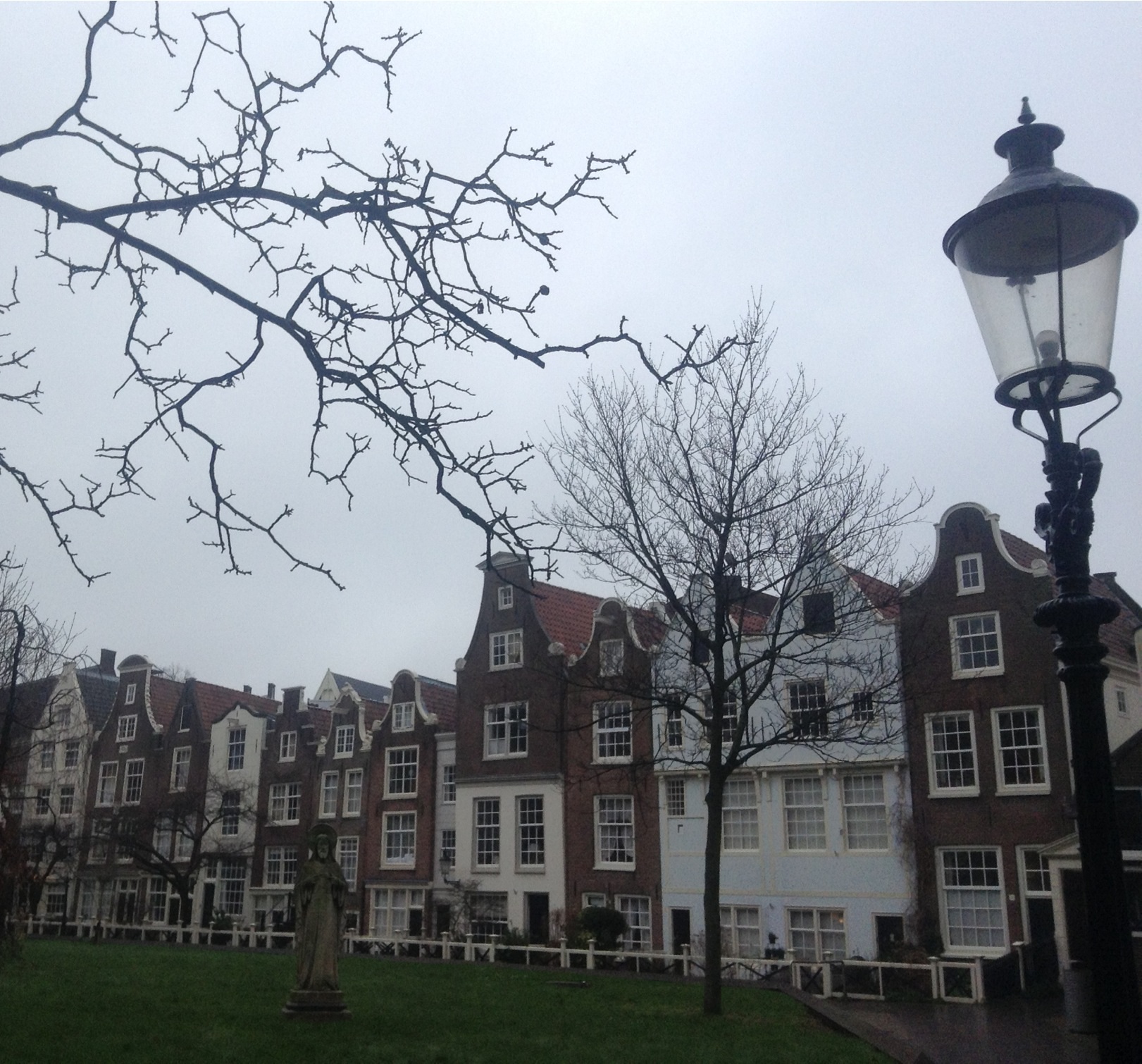
The Begijnhof
Accessed through a wooden door, a passageway with impressive vaulted ceilings leads through to an enclosed square, the Begijnhof. Women have lived on this site since 1150, primarily to care for the sick. By the fourteenth century, the place had become a nunnery, the women referred to as “beguines”. Taking pride of place in this inner courtyard is the church. The Begijnhof is also the site of one of only two surviving timber buildings in the city, this one dating from 1528. Visitors can access half the square, so long as they keep off the well-manicured lawns; the rest is for residents only. Entrance is free, though donations to the church are welcomed.
The Begijnhof is around the corner from the Bloemenmarkt, on the Singel, which claims to be the only floating flower market in the world. Don’t worry if you haven’t timed your visit for spring, even in winter the stalls are a riot of colour, selling cut flowers and bulbs. The packaged bulbs are aimed squarely at the tourist market – locals make a beeline for the loose bulbs as they’re considerably cheaper.

Tulips from Amsterdam
Next, I set about exploring the area known as “De Negen Straatjes” – the nine streets. This is an area bisected by canals from the Singel to the Prinsengracht and gentrification has resulted in a wealth of designer boutiques, gift shops and art galleries that lend themselves to ambling. This is not a district to walk with a purpose, more an area in which to potter and dither before recharging your batteries in a cafe. Forget Starbucks – though there are plenty – a canal side coffee shop is the way to go. I recommend the Koffee Huis “De Hoek”, a far cry from the smoky cannabis cafes for which Amsterdam is better known. Try their cheese and ham pancake washed down with proper freshly- squeezed orange juice and bag a window seat for brunch with a view.
Off licence, Nine Streets
Continuing along Prinsengracht, and just past Westermarkt I passed the long queue for the Anne Frank House. Further along on the opposite side of the canal is an interesting little museum devoted to tulips. Behind the extensive gift shop and down a steep flight of steps, a series of small interconnecting rooms tell the history of this iconic Dutch flower, which you’ll soon learn, isn’t Dutch at all. In fact, it is native to Asia (who knew?) and it was the Ottomans who introduced the flower to the Netherlands in the sixteenth century. They soon became fashionable, with growers competing to see who could produce the most sought after bloom. Speculators moved in on the industry and soon bulbs with the right “pedigree” were changing hands for crazy sums of money, with some selling for twenty times the annual salary of the average Amsterdam resident at the time. Out of control, the market crashed in 1637 and it was to take a further 200 years to steadily rebuild it. Fortunately, the prices of tulips are far more reasonable today, as is the 5 euro entrance fee.
The Tulip Museum
Back at the Westerkerk, I jumped on a number 14 tram heading east to my second museum of the day – the Dutch Resistance Museum. This absorbing museum recounts the experiences of the Netherlands from 14 May 1940 to 5 May 1945, the period when the country was occupied by Nazi Germany. As well as resistance, the museum explains how people chose different paths in coping with the invasion – some collaborated, some fought back. The exhibition covers all forms of resistance: going on strike, forging documents, helping people to go into hiding, publishing underground newspapers, maintaining escape routes, and even armed resistance and espionage. Entrance costs 10 euros which I thought was good value for money. Take the free audio set that’s offered as it unlocks a series of explanations in English; the exhibits are all signed in dual language but some of the text is on the small size. A short film puts the museum in context, in kid-friendly language, and there’s a special children’s section to the museum as well. Families, this is your part of town – Artis zoo’s just across the street.

Dutch Resistance Museum
All that history had made me thirsty (and my back ache) so sinking into a chair in the Cafe Koosje on the corner of Kerklaan and Plantage Middenlaan came as a welcome relief. The hot chocolate topped, of course, with a generous dollop of cream and the friendly wait staff made this a good place to take a break.
It was time to head back to the centre for some shopping and my mind was on food. Taking the number 14 tram back to Waterlooplein, I walked to Staalstraat where I’d read about a foodie’s paradise at number 20. Het Hanze Huis is crammed full of European foods, from syrups to flavoured tea, chocolate to tasty biscuits. Mouth already watering, I decided to continue by number 24 tram (tram-hopping like a local!) to the market on Albert Cuypstraat. A mix of market tat, food trucks and cheese stalls, this place is definitely worth a visit. I stocked up on Stroopwafels, a family favourite, from a charming man who posed happily for a photo. Bag full, I had to pass on the Gouda cheese, but figured I could at least get that in Sainsbury’s.
The Stroopwafel man
Heading back to the centre on the number 4 tram, my final stop was to a pub with no bar. I’d come across De Pilsener Club, located on Begijnensteeg, via several bloggers on the net. The pub’s nickname is De Engelse Reet, which apparently translates as “The English Ass”. Perfect, I thought. After all today’s walking I need a seat for my own ass. According to what I read, the pub has been in business since the end of the nineteenth century. It’s been in the current owner’s family for four generations (I read that they all share the same first name, so that’s four men called Tuen Van Veen) and they don’t like change. Stepping over the threshold is like travelling back in time, with sanded floorboards and tables pockmarked through years of use. Given the early hour (for a pub, anyway) I expected to have to drink alone, but two tables were occupied when I walked in and by the time I left, it was full. It seems it’s a very popular meeting place in the late afternoon for Amsterdam’s over 60s.
De Engelse Reet
The lowdown
As with Lisbon, I pre-planned my itinerary in order to minimise the chances of wasting time arriving somewhere that’s not yet opened up for the day or unnecessarily backtracking across town. Both times I’ve been fully prepared to ditch things as the day goes on, but was once again surprised by how much I ended up doing. I’ll admit, Amsterdam has never been one of my favourite cities, but I wanted to prove to myself that I could find a city I love within a tourist city I really don’t. A bit of extra research this time uncovered parts of Amsterdam that were a whole lot more rewarding than the Red Light District, tacky souvenir shops and mainstream museums I might otherwise have felt obliged to visit.
I also made good use of the Travel Telegraph’s app, and grew increasingly fond of its “favourites” capability and very functional zoomable map – particularly helpful as my paper map began to disintegrate in the drizzle. Because of the shorter flight time and the exceptionally quick train connection, having a later outbound flight and earlier inbound flight wasn’t an issue, though I could quite happily have holed up in De Engelse Reet and made a night of it. Next time that’s where you’ll find me, though perhaps I’ll get Tuen Van Veen to serve me up a couple of hard boiled eggs to soak up the Heineken.

 Julia's Travels