juliamhammond

Latest

Why I’m not thrilled at Stansted’s expansion plans

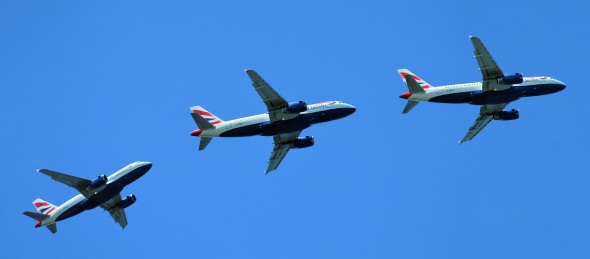
A few days ago Uttlesford District Council approved plans that would see Stansted grow its passenger numbers to 43 million a year.  The news comes hot on the heels of a press release announcing that the airport had just experienced its busiest October ever. 2.5 million passengers used the airport, up almost 9% on the same month in 2017, bringing the annual total to over 27 million. It’s good news for the local economy, with an already buoyant job market fuelled by such growth. Stansted claims that 5000 new jobs would be created by the continued expansion of its facilities. An increase in flights, with some long haul routes now offered, increases choice and offers an alternative to driving over an hour further to Heathrow or Gatwick.

airport-802008

So why am I unhappy?

First, it’s not a case of NIMBY-ism. Though Stansted airport is my nearest, it’s still a forty minute drive away. By the time Stansted’s planes fly over my home, they’re at such an altitude that noise pollution isn’t an issue. I’m not affected by increased traffic, nor am I impacted by any kind of blight on house prices, though I’m sympathetic to those who are.

No, my concerns lie with the airport experience. I travel fairly frequently and time spent at the airport is a necessary evil if I am to do my job. My recent experience of Stansted hasn’t been a positive one, with issues cropping up every time. Parking is the first problem. I remember not so long ago being able to turn up to long term parking without having to pre-book. Clearly that’s not the case anymore, not just at Stansted but elsewhere too, just as you don’t generally have the option to drive up to drop off in front of a terminal free of charge either. But a fair number of my Stansted visits are day stays – and long term parking at Stansted has a minimum three day stay. Mid term is often full, leaving me with a fee of £30 or more to park at short stay. (Living in a small village I don’t have a public transport option.) I appreciate that with increased passengers, rationing spaces by cost is the logical solution. But allowing this day tripper to use the long term parking would reduce my parking cost by a third.
british-airways-2132653

Inside the terminal, it’s common for the space to be excessively crowded. Once, this Norman Foster designed building was a pleasure to transit. Now, with the security gates shifted from the back of the terminal to the side, it has become a veritable obstacle course. The queues first thing in the morning usually reach the gates, and sometimes extend beyond them. Security staff seem less friendly than in other airports and occasionally rude. Management, to be fair, do listen but there does seem to be a need for training. My luggage “fails” at a disproportionately high rate compared to other airports. I have no idea why. It’s not like I pack differently for those journeys. On one occasion, a staff member moved my coat to cover my iPad, necessitating a manual check “because your items were stacked on top of each other”. On another, I was told that my wheelie case required an additional check because it had been placed “at the wrong side of the bin” – I wasn’t aware there was a wrong side of the bin and neither was the manager I spoke to afterwards.

security-3364277

Security eventually navigated, the queues funnel through the duty free and shopping area. The space is narrow and littered with passengers and bags. The main holding area is also rammed, partly because gates aren’t announced until late on. Stansted have tried to tackle this, not by clearing out the clutter, but by closing the airport overnight in an attempt to foil travellers who plan to sleep stretched out across several seats. A long term programme of investment to the time of £600m and significant expansion is underway. The sooner that has an impact the better. Right now I feel more stressed waiting for my Ryanair flight to be called than with the boarding process. Yes, you did read that right – Ryanair’s part has generally been the best part of the whole process. If that doesn’t jinx December’s flight, I don’t know what will.

So forgive me if I’m not dancing with delight at the news Stansted is going to get even busier. If by some miracle, Ken O’Toole, Stansted’s CEO, happens to read this, then please think carefully about how you plan for all these additional visitors. The good news is that your airport surely can’t get any worse.

What’s it like to visit Oaxaca for Day of the Dead?

IMG_7536

This October I’m teaming up with Lauren of Diary of a Spanglish Girl for a feature on Day of the Dead. It’s one of my favourite festivals so when Lauren posted a shout out on her Twitter feed asking if anyone had been to Mexico for Day of the Dead and would like to share their experience with her, I jumped at the chance. You can read the interview here. By the way, Lauren’s also the person behind an excellent Facebook group for travel bloggers called Share Your Travel Blog Post And Connect With The World. If you have a travel blog, it’s well worth signing up as there are plenty of tips and experiences to inspire your future travels. She also has her own Facebook page which is a helpful resource if you love to visit Spain.

The Day of the Dead, or  Día de Muertos as it’s known locally, is a big deal in Mexico, nowhere more so than in the southern city of Oaxaca.  Celebrated at the end of October and beginning of November each year, the festival focuses on the dead, and the whole town gets involved in some way.  What I didn’t bargain for was how involved I’d get as well.

IMG_7396

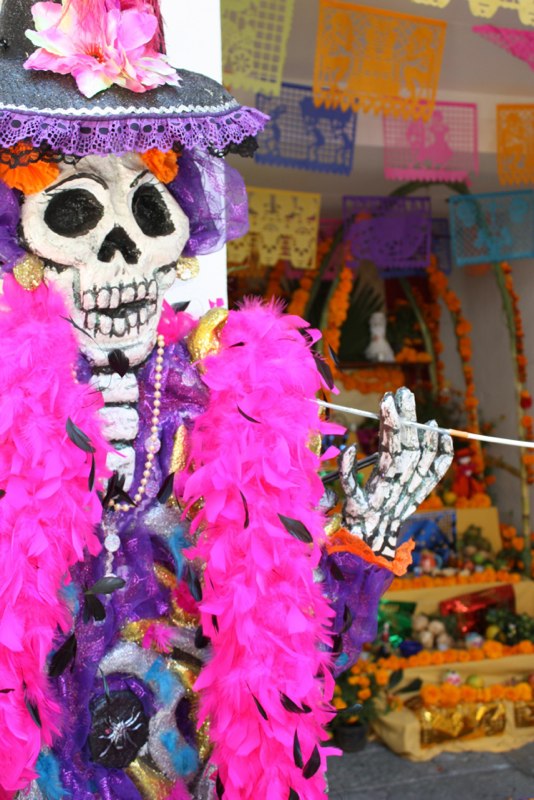
Arriving a few days before the main celebrations, work was beginning to get underway on the altars.  Each family creates an altar to tempt their ancestors’ spirits back to earth.  I’d been in touch with Mariana from a small hotel called Las Bugambilias and she’d invited me to join them.  In the courtyard, stood a life-sized model of Catrina, the mascot of the Day of the Dead.  For a century or so, La Calavera Catrina has been associated with Día de Muertos, thanks to a cartoonist by the name of Jose Guadalupe Posada. He was known for satire and drew the rich in fancy hats and feather boas, ridiculing them by implying death was only for the poor.

IMG_7431

Catrina takes the form of a skeleton dressed in elegant clothing, dripping in furs or, in this case, feather boas, strings of beads draped around her neck and an elegant cigarette holder in her hand. She was comical rather than creepy, my first hint that this festival has fun as well as respect at its heart.

IMG_7370

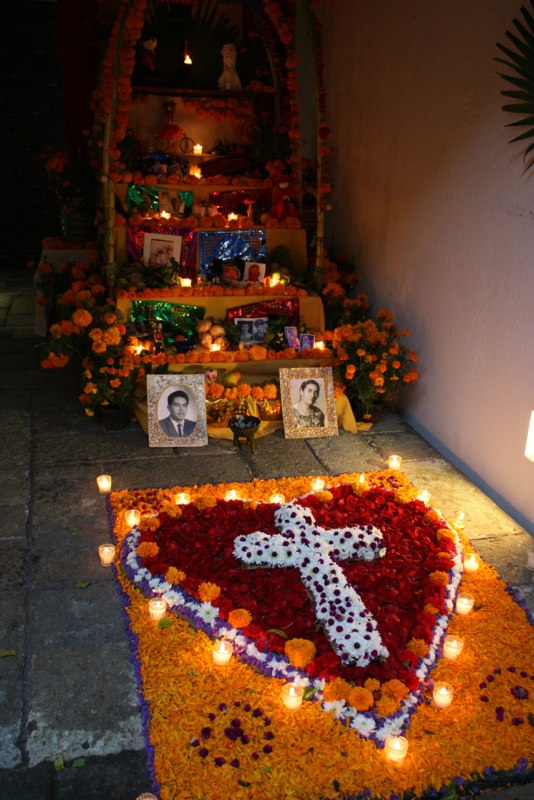
With a small group of fellow tourists and under Mariana’s expert guidance, we set about creating an altar called an ofrenda.  Each of us had been allocated a specific task: some threaded marigold blooms onto strings; others dusted icing sugar skulls in the yard to form a pathway to the altar.  My job was to create a centrepiece cross of white carnations and dot it with tiny purple buds. It was harder than it looked to get the blooms just right. Mariana was a perfectionist, but after her intervention, the cross really did look the business. After several hours of preparation, the ofrenda began to take shape.  Loose marigold petals defined the path, their pungent aroma pervading the tiny courtyard.  The altar itself was decorated with candles, fruit, nuts, incense and brightly coloured bunting.  Sepia photographs of family ancestors peeked out from behind yet more marigolds.

IMG_7505

Finally, we’d finished, and to celebrate, out came a bottle of Mezcal for a toast, to our efforts and to the ancestors we’d honoured.  I’d been asked to bring along family photos and raised a glass to my sorely missed grandparents, their picture wedged between a bicycle candleholder and a lime. I pledged to myself and to them that I would make an effort this time next year to recreate this feeling with my own ofrenda.

The following evening, a group of us headed for the cemetery.  On the night of 31st October, residents and visitors alike flock to the old and new cemeteries in Xoxocotlan, on the outskirts of Oaxaca. They were busy with people tending graves, laying marigolds and other offerings and lighting candles in memory of their deceased relatives.  Many families would stay all night.  I wandered amongst the weathered graves in the packed old cemetery, taking care not to trip over tree roots in the gloom of the candlelight.

Vibrant scarlet gladioli added a splash of colour to the warm amber tones lent by the flickering flames. White canna lilies added grandeur.  Vivid orange cempasuchil dominated the scene through sheer weight of numbers.  Some graves were a hive of activity; at others, the mood of the relatives was more reflective.  Once or twice, a lone mourner wept softly at a graveside, their grief recent and still raw. It was hard not to feel emotional. Yet, I was warmly welcomed, invited to share a spot at several gravesides.

IMG_7532

At the new cemetery, there was a party atmosphere.  The floral colour palette was enhanced by fluorescent wands that poked out of pushchairs. Lovestruck teenagers sneaked a kiss behind their parents’ backs.  Small children munched on sugar skulls and sucked skull lollipops.  The sounds of Michael Jackson’s Thriller boomed from a loudspeaker, almost masking the cries of the many hawkers selling snacks and party treats.  At the edge of the cemetery, a funfair had been set up with the usual stalls and rides.  If it hadn’t been for the tombstones, it would have been easy to forget you were in a cemetery at all.

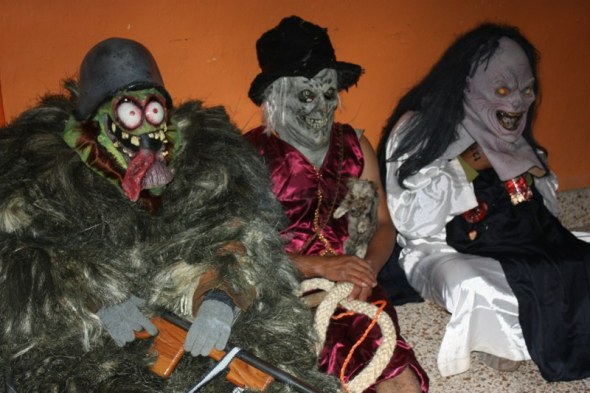
Comparsas (local groups) parade all night through the streets in costume, celebrating the return of the ancestors with music and dancing.  The following evening, the Las Bugambilias team took us out of town to the village of San Agustin Etla, where I’d heard their Muerteada parade was second to none.  Anticipation mounted as a crowd gathered in the narrow lane.  Eventually the procession reached the village, an eclectic band of ogres, devils and monsters, each with a costume more fantastic than the last.  There were ghouls with terrifyingly realistic make up alongside drag queens with pink hair.

The devil carried his scythe, passing a ‘Panteonero’, someone from the pantheon, whose eyeball was missing.  Somehow because of the crowds, most were freakish rather than scary, but they were all to be commended for their efforts.  As the final performer arrived, in one corner of the village square, a play was being re-enacted.  Many of those in the parade weren’t needed, however, and had planted themselves against walls and on kerbstones to have a much-needed drink. I wandered amongst them exchanging pleasantries as far as my limited Spanish would permit, posing for photos and trying on some of the costumes. I was glad I wasn’t wearing one; the weight was impressively heavy. No wonder they’d sat down!

IMG_7959

As the evening wore on, a chill settled on the air and the Mezcal came out again.  Passing the bottle round, glasses were raised.

“Salud!” Compared to the sombre way we remembered our deceased back home, the Mexicans embraced their spirits, celebrating with them and having fun in the same way they would have done when they were alive.  I decided my grandparents, gregarious even in old age, would have given it the thumbs up.

If you’d like to find out more about my experience of Day of the Dead, make sure you check out Lauren’s blog post. For my take on why I prefer Day of the Dead to Halloween, have a read of an earlier post of mine.

Moldova’s National Wine Day

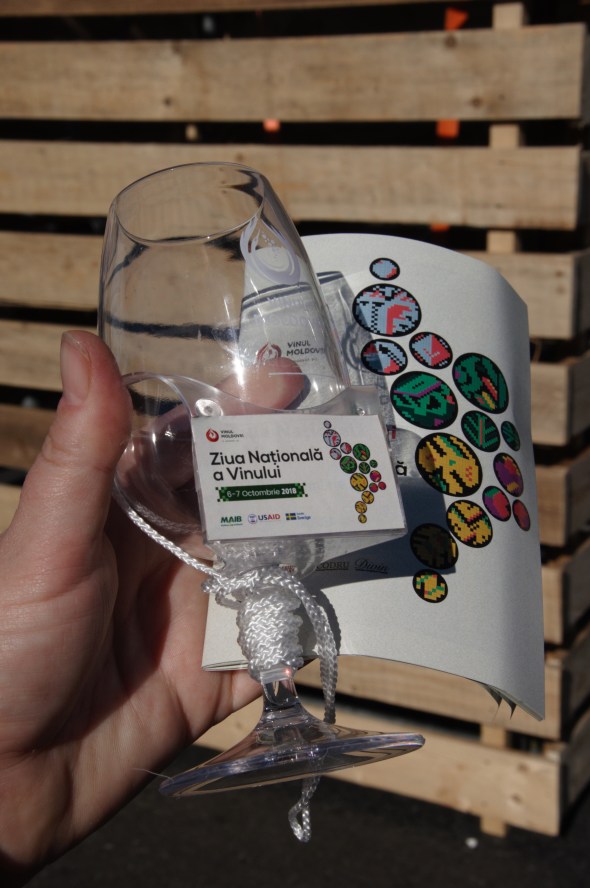
Moldova celebrates its National Wine Day over the first weekend in October. If you want to sample wines from the country’s many wineries without putting in the legwork, this is your chance. Representatives from the major labels come to the capital Chișinău and set up beside Cathedral Park. The organisers even offer a wine tasting passport with tour guide to provide key background information should you wish to know a little more about what you’re drinking.

DSC_0184 (2)

Getting there

From the UK, there are pretty much two direct options: Air Moldova from Stansted and Wizz Air from Luton. (I also found an airline called FlyOne, but it didn’t seem to be operating flights at this time of year.) When I booked, the Wizz Air option was significantly cheaper but did have the disadvantage of flying overnight on the outbound leg. If you’re going to do this one, hope that your hotel will allow you to check in early or prepare to take an afternoon nap. That’s of course if like me you’ve reached the age where staying up all night is no longer a good thing.

DSC_0069 (2)

Getting around

There’s a convenient trolley bus which departs from right outside the arrivals terminal door. It takes about half an hour to get into the city centre and costs just 2 lei, about 10p. Look for the number 30 and pay the conductor on the bus. If you need to find change, there are exchange facilities that open early in the morning landside; I bought a cup of coffee which gave me somewhere warm to wait for the bus and the right money to buy a ticket. It was a little disconcerting when the bus stopped and the driver got out; I’d forgotten that trolley buses are a lot of effort when the wires don’t extend the length of the route. What was good, though, was that the buses ran from very early in the morning until late at night, even on Sunday.

Getting a room

I opted for the almost brand new City Center Hostel. It was located just across the road from Cathedral Park and around the corner from the bus stop. My room had twin bunks and for single occupancy cost just £27 for the night. The shared bathrooms were down the hall but were spotless. If you can’t bring yourself to stay in a hostel, next door is the conveniently located Bristol Central Park Hotel and opposite is the Radisson Blu. Both I’m sure are very nice but would set you back a whole lot more.

DSC_0111 (2)

Getting your culture fix

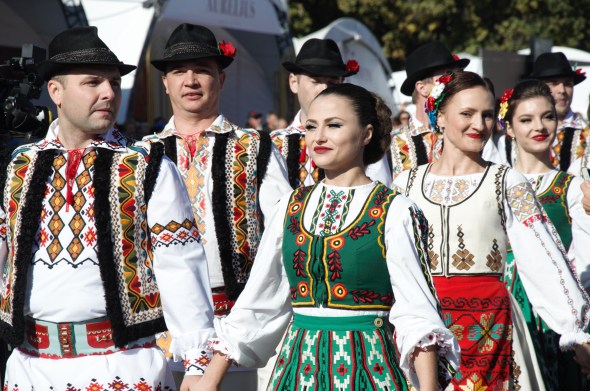
I’d read that there was a parade and early signs were promising. There were plenty of people in national costume and in front of the big sound stage, rehearsals were still in full swing just minutes before the action was supposed to kick off. I was able to get close enough to see the dancers, which was fortunate as once the formal proceedings began, some rather surly security personnel did a very good job of keeping everyone right back out of the way. The view was further obstructed by press photographers and cameramen.  There were no programmes in English, but this lady had brought her own from the local newspaper – no help to me, alas:

DSC_0107 (2)

Though I did manage to see some of the winery representatives presenting their baskets of grapes, this part of the proceedings was something of a let down. However, later, once all the dignitaries had said their piece, the bands came on and the dancing started – fun to watch and even more fun to join in. The event’s free too, which was even better.

DSC_0152 (2).jpg

Getting drunk

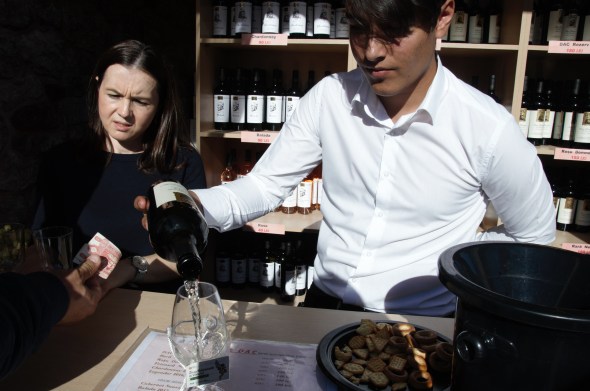
With a tasting passport costing just 200 lei (£10), it’s hard to resist the chance to try as many of the wines on offer as you can. I made my way to one of the information kiosks (they’re located at either end of the main drag) and grabbed a place for one of the English speaking tours.

DSC_0191 (2)

Our guide was as hipster as they come, but explained the different characteristics of the wine well at first. As the afternoon wore on, he became progressively more tipsy (like the rest of us) and at one point dropped a bottle of wine on the floor in front of him.

DSC_0201 (2)

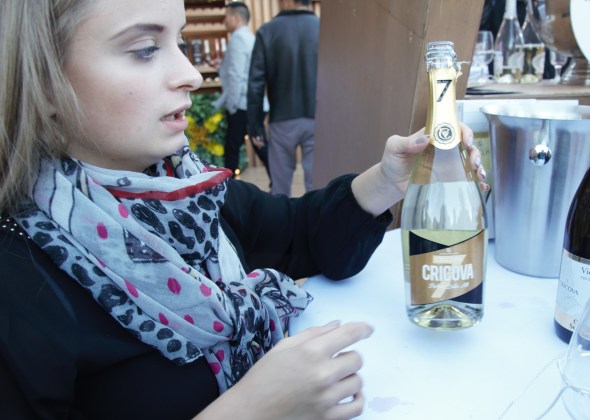
Some of the wines were too dry for my taste but I did enjoy the Cricova sparkling wines. I’m no connoisseur – the sweeter and fizzier the wine, the more I like it. Fortunately, the passport contained an extra token for “your favourite” wine so I had a second glass. It was a pity there are such stringent regulations at airports these days as I’d have liked to buy some to bring back.

DSC_0209 (2)

By the way, if you are going to visit one of the wineries outside Chișinău, I’d recommend Mileștii Mici. Its huge underground vault can hold almost 2 million bottles of wine and its subterranean rooms and passageways extend for around 120 miles. They run organised tours so there’s no need to worry about getting lost down there forever.

Getting food

Fortunately, there was plenty of opportunity to taste the local food as well, which helped to soak up a little of the alcohol I’d consumed. Adjacent to the wine stands are the food stalls. Many sold similar fare: succulent pork, tasty sausage, cabbage and potatoes. A lot of the stalls sold by weight; you indicated roughly how much they should pile on your plate and they told you how much you owed them. I had a heaped plate for about 75 lei, which worked out to under £4, and it was delicious. Communal tables mean it’s easy to make friends while you eat.

Getting to see more of the city

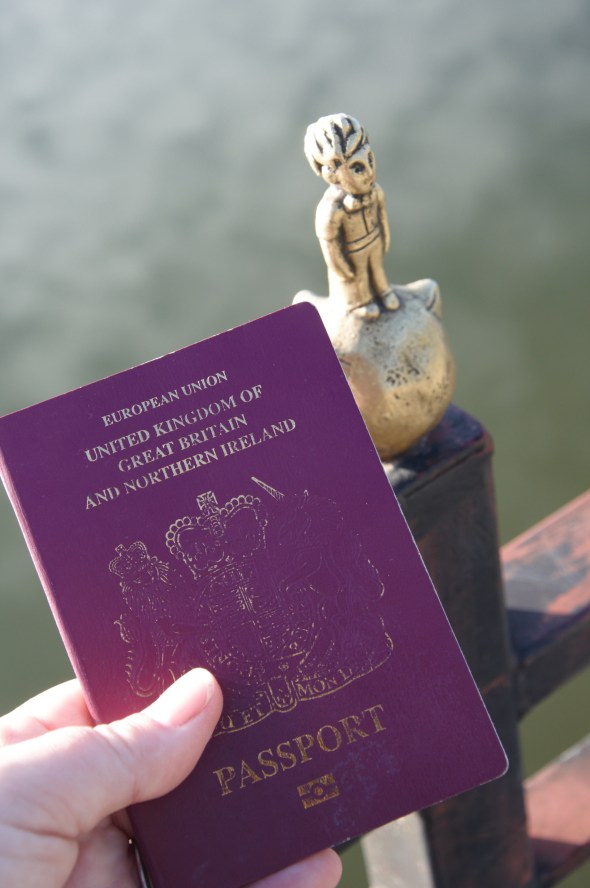
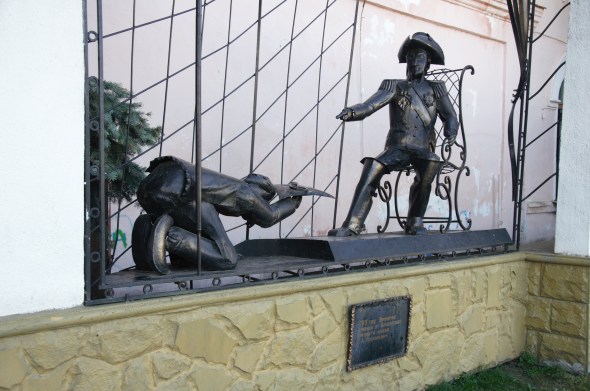
As I was visiting Transnistria, my time in Chișinău was limited. I did get to see the city’s smallest statue. Representing the Little Prince in Antoine de Saint-Exupéry’s novella, it took a while to locate, not least because someone I asked for directions Googled it and found an old article which said it was yet to be installed. It’s on the railings lining the lake in Valea Morilor Park – persevere and you’ll find it.

DSC_0032 (2)

I also had a wander around an open air museum outside the city centre on the airport road; there was a wedding taking place so I didn’t have the chance to go in the wooden church. I finished up at the Ciuflea Monastery. Despite being close to the main road, it was remarkably peaceful.

How to visit Transnistria from Chisinau

When the Soviet Union broke up, Moldova became an independent country. But the region that’s now Transnistria was home to a high percentage of ethnic Russians and decided it didn’t want to remain part of Moldova. It operates as a country in its own right, with its own government, military, currency and so on, though it’s not widely recognised.
DSC_0276 (2)
Many reports suggest it’s very Soviet, but there are plenty of beautiful monasteries, gatehouses and other interesting buildings. But with day excursions from the Moldovan capital Chisinau costing as much as 163 euros for a private tour and no group trips running on the day I was in town, I decided to go it alone. If you want to do the same, here’s what you need to know.


Getting there
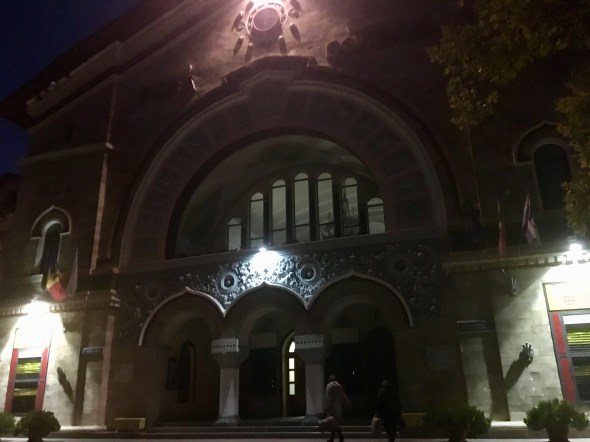
The day before my visit had been National Wine Day. A tasting menu of twelve glasses cost just 200 lei (about £10) and it had been a very enjoyable way to spend the day. It perhaps wasn’t the wisest move to opt to travel to Transnistria by train the morning after, and especially as that train departed before 7am. The train station’s not central either, which pushed the alarm clock back even further. That said, I would still recommend the rail option: trains are much more comfortable than buses or marshrutkas (minibuses).
IMG_5330
To reach the station from the centre of Chisinau, catch a trolley bus costing 2 lei to the main station (numbers 4, 5, 8, 17 and 20). There’s a map on Wikipedia that shows the entire network. You’ll pay the attendant on the bus and the ride takes about 15 minutes. Get off opposite the station and walk under the underpass; when you emerge you’ll see the station building.


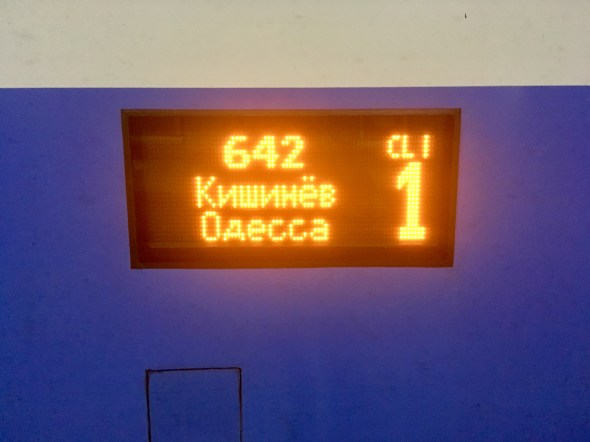
Buying your train ticket is straightforward and you don’t need to pre-book. The train is number 642 and it’s a cross-border train that runs to Odessa in Ukraine. The relatively short hop to Tiraspol, the Transnistrian capital, costs just 21 lei in second class which is just over £1. Your documents may be checked by a station official as most passengers are bound for Ukraine. The train left bang on time at 6.57am and arrived exactly at 8.21am. As you can see I had the fabled seat 61 and was excited* enough to tweet to the man himself!
* as excited as you can be when up before daylight and the worse for wear from all that wine the night before.


Passport control
You don’t complete border formalities on the train. In fact, once the carriage attendants see that your ticket says Tiraspol, you won’t even need to show your passport. However, you do need to take your passport. While the Moldovan authorities class Transnistria as part of Moldova, the Transnistrian government does not. When you get to Tiraspol station, you need to look for a small booth just to the left of the main exit. An immigration official will hand you a form to complete; you’ll need to fill in both sections. Hand the form in with your passport and it will be checked and one part returned with your passport. Do not lose this piece of paper as you will need to show it in order to exit Transnistria.
IMG_5356
Money
To buy anything in Transnistria you need Transnistrian rubles. Though there is an ATM at the station, there’s no foreign language translation and it doesn’t accept foreign cards. I read on the internet that these ATMs dispense Russian rubles in any case, which themselves need to be exchanged for the local currency. Instead, take cash: US dollars, euros, Russian rubles, Ukrainian hryvnia and of course Moldovan lei are all good. Pounds sterling wasn’t on the list, though it is easy to change into Moldovan lei in Chisinau.
DSC_0275 (2)
It’s hard to know how much to change up, and the last thing you want with a currency that’s useless outside its own territory is to be left with a wad of notes. I decided to change 200 lei (about £10), thinking I’d need more but would see how I went. The exchange rate is almost at a parity so I received 190 Transnistrian rubles. In actual fact, it was hard to get rid of it. My biggest expenditure was a hearty brunch costing 60 Transnistrian rubles. I took a bus from the bridge in the centre of Tiraspol to the monastery at Kitskany and that cost 4 rubles. The monastery was free to enter.


A cramped but otherwise acceptably comfortable minibus departed for Bender from right outside the monastery and cost 10 rubles. It might have even been 8 but I wasn’t sure how many fingers the driver was holding up so gave him 10 just in case. I also visited Bender fortress. I’d read on the internet that there was an entrance fee but there wasn’t. A couple of drinks cost me a further 29 rubles. If you’re adding up as you go, I spent a total of 140 rubles (including the return bus fare) and came home with a 50 ruble note as a souvenir. £7.50 for a day out (£8.60 if you include the train fare from Chisinau) has to be one of my best bargain trips ever.
DSC_0404 (2)
Getting away
From Bender to Chisinau cost 37 rubles by marshrutka. I’d have been tempted to catch the train but the first one back from Bender, a Moscow-bound international train, was due to arrive just two and a half hours before my late evening flight departed. Given the strong chance of a delay, and information on the internet indicating that the last bus left around 6.30pm, I decided not to risk getting stranded. The marshrutka was already nearly full when I got in, so I had the back row seat. It was very bumpy – not the most comfortable ride I’ve ever had. Time-wise, it was very similar to the train, though the Moscow train would have been slower.
IMG_5332 (1)
What’s there to see
Everything I’d read online said the same thing: Tiraspol is very Soviet. The signage is in Russian, so I had to adjust to using the Cyrillic alphabet again. One thing I’d forgotten to look up was how Chisinau would translate; the Russians call it Kishinev so the “b” on the end threw me a bit. As it was Sunday morning, the place was dead. I strolled down from the railway station and along the main drag, 25 October Street. It was pleasant enough but nothing to write home about with any enthusiasm. I snapped pictures of the Kvint factory and the Kotovsky museum, but the former was closed as it was Sunday and I figured the displays in the latter would be labelled in Russian only.
DSC_0267 (2).jpg
I walked across to have a closer look at the monument to Alexander Suvorov, who founded the city. A bunch of young soldiers had gathered there, waiting for a ride, so I didn’t hang around too long with the camera. What I should have done is walk a short distance further to the House of Soviets and Transnistria’s Parliament building.
DSC_0278 (2).jpg
Instead, I was distracted by a tank beside the Dniester River and never ticked off Lenin’s statue. It’s listed as one of the must-sees in Tiraspol, but probably that’s due to a lack of anything more interesting. I read one highlights list which extolled the virtues of changing money as one of their “top things to do in Tiraspol”.  Beside the tank, a few bored kids chucked stones into the river and an elderly man made slow, painful circles on his roller blades.


Not far was a bridge and on the other side, a marshrutka waiting to load up for Kitskany. I decided to cut my losses and hop aboard. Kitskany monastery was a super diversion. It’s a working monastery and there were plenty of monks in black robes wandering about. There was also a service taking place inside the richly decorated main church. Some people had come from Tiraspol as I’d seen them on the bus.


Noul Neamţ Monastery, as it’s correctly called, also has a bell tower with a frescoed ceiling and, in its lobby, two wooden changing rooms where women can pull on a skirt over their trousers if needed. The golden domes glittered as the sun caught them and women sat in the dappled shade of the monastery’s tranquil garden. I couldn’t help but think that in many countries, you’d have to pay an entrance fee to visit somewhere as special as this.


Eventually I wandered back to the road. A derelict facade caught my eye and I set off up a lane to see it close up. The lane was sandy, which was a little odd, so far from the sea. As I strode up the lane, a man called out to me. It turned out he was Ukrainian and was trying to show me the house. I don’t understand what he was telling me; he kept referring to “monastery” but pointing at the house. He signalled clearly that I shouldn’t go any further, so I headed back to the bus stop.
IMG_5383
When I bought my ticket, I fully intended to come back and finish my walk along 25 October Street. But outside Kitskany monastery, a minibus came along for Bender and I decided to go there instead, having seen the spectacular fortress from the train. The ride to Bender was a pretty one, past fields and rural dwellings. Hay was stacked in what I call Dalek style, familiar from a previous trip to Romania. The road, by rural standards, was pretty good. Soon we came to an unmanned control point and then into the town itself.


Bender, once scene of fierce fighting, was delightful. Several pleasant cafes lined the main street. I ducked into a couple but there were no toilets. Finally I found a cafe next to a fake McDonald’s with decent cakes – pastry swans – and an obliging barista who escorted me around the corner into some offices to use the bathroom facilities. Back at the cafe, the coffee was good, the food even better. I saw the #19 trolley bus pull up, which links Bender and Tiraspol – the cheapest way to travel at a fare of something in the region of 2 rubles. Bender also had a wide pedestrian street. I saw a place renting out toy cars for kids, similar to what I’d seen at Sukhumi last year – maybe it’s a Russian thing?
DSC_0387 (2)
Across the street from a series of posters in Russian detailing the history of Bender, I spotted the outdoor museum. This amounted to a park which was home to several statues and castings, each representing an event in the town’s history. The information for both was in Russian so I’m none the wiser, but one looked rather like Napoleon Bonaparte. Nearby was an art installation featuring multiple coloured umbrellas – cue lots of people taking selfies.
IMG_5390
The star of the show, however, was Bender’s fortress. There was a special event on and the fortress had been adorned with swags of cheap white satin. Many of the stalls had a mediaeval theme. I was invited to try my hand at firing a crossbow, which I declined as I didn’t want to harm anyone through clumsiness. But I did walk the walls and look out over the Dniester River and surrounding countryside. There were plenty of men barbecuing and people dressed in mediaeval costume, plus a fair number of plastic ducks. No idea why, in case you’re wondering – the frustrations of travelling where you don’t speak the language.


Was Transnistria worth the visit?
While I wouldn’t make the trip specially, it was a pleasant day out from Chisinau. Lots of reports online, especially older ones, refer to this as a rebel state with border guards taking bribes. It certainly didn’t feel like that to me, though of course on such a short visit I’m no expert. If you are tempted to visit, I’d suggest going on a weekday so that more businesses and museums are open, but having said that, Bender had a really nice family vibe which you possibly wouldn’t get if everyone was at work.
DSC_0457 (2)
Would it have been worth 163 euros? No, definitely not. Even the most committed of country counters (which I’m not) would have a hard time justifying that cost. But to do it independently and on a tight budget, definitely yes. In terms of value for money, it was incredibly cheap. It’s hard to find fault with a day out that only cost £8.60!
Postscript
It’s great when you realise other travellers have found a post useful; check this out too if you’re planning a trip:
I’ve also had a couple of comments about why I would use the term Transnistria in this post. I use the English versions of place names on this site, hence Chisinau rather than Chișinău, Kishinev, Kishineu or Кишинэу. Hence, I refer to it as Transnistria for consistency, as do many other UK sources including the highly regarded travel magazine Wanderlust: https://www.wanderlust.co.uk/content/step-by-step-guide-to-transnistria-by-bus/

Why it’s hard for me to choose the best places for solo travel

It’s a popular topic, and one editors are keen to publish. You’ll find a glut of listicles all over the internet touting the places you “must go” if you’re a solo traveller, and a whole bunch more specifically aimed at females missing a plus one. I’ve been travelling on my own for over thirty years and if I’ve learned one thing, it’s that solo travel, by its very nature, is a personal thing. What’s perfect for me is unlikely to be right for someone else. When it comes to choosing a destination, perhaps it’s better to think first about the kind of person you are, where you’re likely to be happiest and what you hope to get from the trip. The decision about where to go will follow on naturally from that.

IMG_8664

Are you truly seeking solitude?
It’s not a smart idea to find yourself on the established tourist trail if what you’re really after is some time out to gather your thoughts. But equally, it can be daunting to be completely on your own. Isolation can bring on acute loneliness very quickly. When I first visited Cuba fifteen years ago, I travelled west from Havana. I had no phone signal and no internet. At the time, I wasn’t ready to be that cut off. I was probably more homesick than I’d ever been before or since. I learnt that although I can quite happily go for days without speaking to people, I draw comfort from the knowledge I can talk to friends and family back at home if I feel like it. If anything, with the increased role social media plays in our lives, that’s even more the case for me today. I enjoy spending time on my own, but I also enjoy posting status updates and sending texts (hey – phoning’s expensive!) which allow me to share photographs and experiences with friends and family. Know yourself, and your limits, and you’ll have a much better trip for it.

FullSizeRender (48)

Is it about the company?
I enjoy taking holidays with my husband (and I’m not just saying that because he’ll read this blog). But he’s not an adventurous traveller and there are places that I want to visit that I know will be so far out of his comfort zone that he just won’t be happy. I have no wish to force him to waste his precious annual leave on something or somewhere he’s going to hate, so going it alone is my preference. I could opt to travel with a friend instead, of course. But years of solo travel has, if I’m totally honest, made me quite selfish when it comes to travelling. I have become used to doing whatever I want, whenever I want. It’s the exact opposite of home, where family commitments mean there’s plenty of give and take. So this becomes my reward: a few days of doing whatever I please, whenever I like. I’d describe it as a kind of adult time out. I recharge my “me” batteries and come back to the real world refreshed and ready to join in again.
image

Solo travel isn’t the same as a singles holiday
When I talk about travelling solo, I mean just that. I mean jumping on a plane, booking a single room and spending my days and nights largely by myself. I’m not single, and I’m not travelling in the hope of finding a life partner. I already have one, and I’m extremely fortunate that he’s very tolerant of my desire to wander. I like being on my own and I’m comfortable being by myself. I don’t care one iota if I don’t have a meaningful conversation with someone for days on end. I guess that makes me unsociable, but even at home, I often take myself out for the afternoon without asking someone if they’d like to join me. But home or away, if I want to, it’s easy to call a friend or join a group excursion. And that’s pretty nice too.

image

How do you know you’re not missing out?
The main drawback for me of not taking a group tour is losing the opportunity to tap into the specialist knowledge of a guide. But being saddled with a tour leader that knows less about the place than I do has frustratingly been a reality on more than one occasion. Researching a destination is as much a delight as seeing the places in real life. I relish the chance to choose the perfect hotel and tailor the itinerary to my needs without the hefty price tag that comes with bespoke travel. Instead of a packaged tour, I tend to book day excursions, particularly if I think I’d get more out of a place if I tap into someone else’s specialist knowledge or when, logistically, it’s the smart thing to do. Booking Envoy Tours’ Enlinking Caucasus tour facilitated sightseeing between Tbilisi and Yerevan without the need to backtrack. And on my most recent visit to New York, I joined the excellent Free Tours by Foot food tour of the Lower East Side – proving that no matter how many times you visit a place, there’s always something new to learn.

img_7532

Would you feel constrained on a group tour?
A few years back I won a trip to America’s Deep South. By and large it was a good trip, but going off piste made it better. When it came to spending the alloted five hours at Graceland, I cut it to two and caught a bus back downtown to watch the duck parade at Memphis’ famous Peabody Hotel. There had been some teething problems at the start of the trip in New Orleans as the tour leader was understandably reluctant to let her precious charges out of her sight. Her protests were cut short when I told her that I’d not long returned from El Salvador – on my own of course – and come out unscathed. Let me emphasise at this point, I’ve nothing against group tours. but I do appreciate it when the tour leaders realise that there’s no “one size fits all” when it comes to their clients’ travel experience.

So where’s good for solo travel?
The honest answer: everywhere and nowhere. In the same way that being confined to a trans-Atlantic cruise for days on end would be my idea of holiday hell, solo travel isn’t holiday heaven for everyone. If that’s you, then you’re potentially going to feel uncomfortable wherever you book. Not sure? Challenge yourself. Try a short break and test the water. Fill your days during that first trip with lots of sightseeing, minimising your downtime so that you don’t have time to stop and think that you’re on your own. When you get home, take stock. Be honest about what worked and what didn’t. If you enjoy your new-found freedom, make your next solo trip a longer one. And if you didn’t, there’s no shame at all in accepting that you’re more suited to a group tour or travel with friends or family.

DSC_0033 (2)

That said, it’s wise to mitigate against loneliness. It’s easier to meet fellow travellers if you stay in hostels rather than all-inclusives which tend to attract couples and families. Also, pick somewhere where there’s likely to be a lot of singles: the Antipodes, for example, South America’s traveller circuit, the South East Asia backpacker trail or Europe’s big cities. If you’re keen to visit somewhere off the beaten track but don’t know if you can handle being alone, sandwich it in between two places you know you’ll find company or can book excursions. But be prepared to put yourself out there: no one’s going to come knocking at your door if they don’t know you’re there.

IMG_7208