juliamhammond

Latest

Dude ranch vs. working ranch – how do you know what’s best for you?

Yee-ha!  There’s still some kind of magic associated with the cowboy lifestyle, isn’t there?  I don’t know about you, but seeing a man in chaps astride a horse is enough to get me all of a tizzy.  Back home (and I’m not referring to my husband here) men can seem just a little too in touch with their feminine side.  Out on the ranch, though, as they gallop off leaving a trail of dust behind them, well, it’s work for real men…

Austin10

Yep, a ranch holiday is for me.  But whether to spend my holiday on a dude ranch or on a working ranch was too difficult a choice – so I booked both.  How did they compare?

The activities

Panagea Ranch, located an hour outside Tacuarembó in Uruguay, accepts visitors but expects them to get involved in ranch life.  Juan inherited the ranch that his grandfather bought and has an emotional commitment as well as financial to the place which is obvious almost as soon as you arrive.

17240059_10210816519876816_1614859367195478704_o

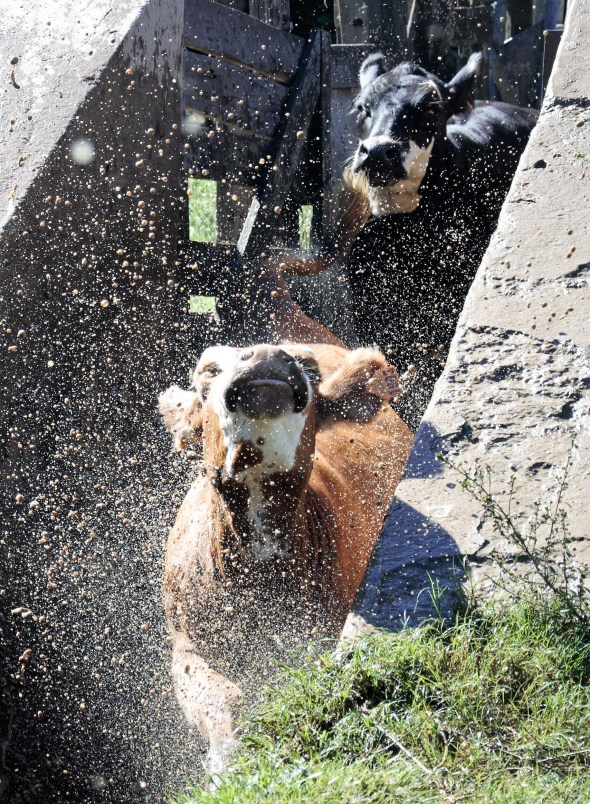
During my stay, getting involved meant riding out to check on the progress of a sick sheep (and finding it incredibly quickly considering there are 1800 of them!), rounding up some of the 1100 head of cattle to move them to new pasture and herding them into the dip so that they could be treated for ticks.  It was hard work for a novice rider (though they don’t require any prior riding ability, it helps to have spent at least a bit of time in the saddle) but there was also a huge sense of accomplishment.
DSC_0660 (2).jpg

In contrast, the Dixie Dude Ranch, on the outskirts of the Cowboy Capital of the World (that’s Bandera, Texas if you didn’t know) offered more of a vacation experience.  It has been welcoming visitors since 1937 and offers sedate trail rides, hiking and a huge pool with hot tub.  There’s evening entertainment too.  On the first night, we were treated to a ride in a hay cart to feed the couple of dozen longhorn cattle that can be found on the ranch.

18698039_10211471250844681_6464142046817995568_n

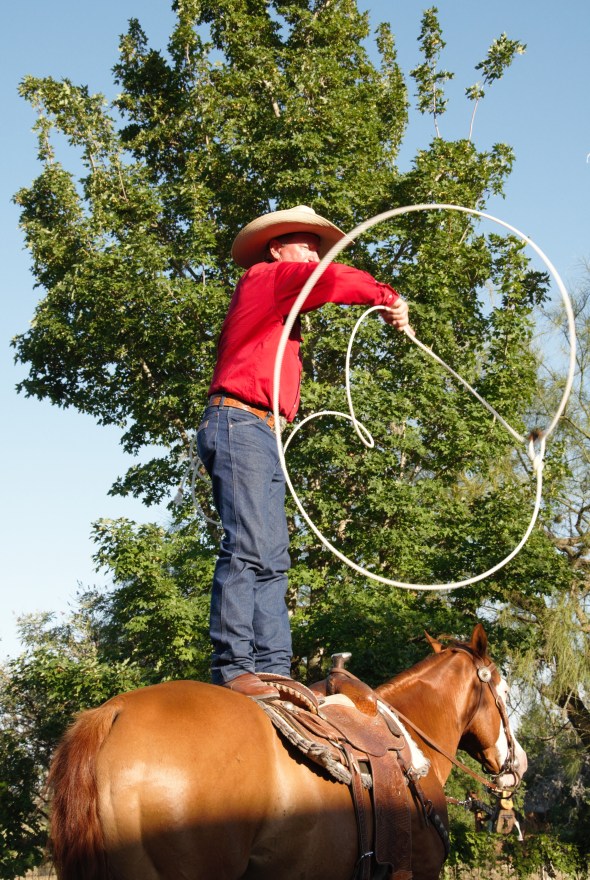
The next, we were treated to a show by a trick roper who was in town for the Bandera rodeo before heading off to Morgan Freeman’s 80th birthday party.  Marshmallows were also provided to toast over the campfire.  I travelled as part of a group and so we enjoyed relaxing by the fire in the evening – it’s a great place to head with a group of friends, though you may wish to stop off at Walmart on the way in as no alcohol is provided.  They’re fine with BYOB.
Rope5

The staff

In Uruguay, Juan Manuel was a little gruff at first but has a heart of gold and a genuine desire to both learn more about his guests and teach them how his ranch works.  The sole female in a group of men on the first night, things were a bit macho at the start, but I did warm to Juan and have a huge respect for what he does.  Susana makes you feel like one of the family from the get-go.

DSC_0580 (2).jpg

A warm Southern welcome was just what you’d expect from Texas and the staff made you feel like a VIP rather than any old guest.  On the rides, at both ranches I felt safe and well looked after.  The horses at both ranches were well looked after and their welfare a high priority.

The accommodation

Accommodation provided by Panagea is, by their own admission, fairly basic.  Rooms were comfortable but when the ranch is full, single travellers might need to share.  The beds were firm and everything spotlessly clean.  Hot water is usually available but electricity is only available for a couple of hours each evening. There’s no WiFi.  To be honest, I enjoyed that.  It made me focus on the outdoors and I slept more soundly as a result.  I also thought it was excellent value at US$65 per person per night full board including activities.

Horse roll 1

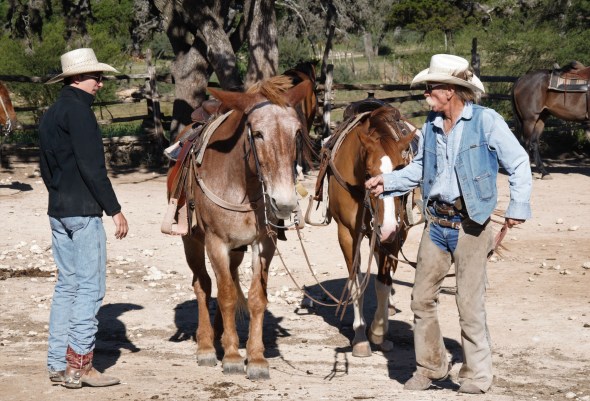
Dixie Dude Ranch is more akin to holiday accommodation with a range of chalets for guests and WiFi near the main building (though guests are asked to limit data usage due to restrictions outside the control of the ranch).  I stayed in one of the oldest cabins, which was a little more basic than the newer ones.  The latter were spacious enough to contain armchairs and even a fireplace.  Water is sourced from the property’s well which was temporarily down one morning during our stay; service was resumed rapidly.  My only niggle was the noise from the air conditioner which interrupted my sleep!  As you’d expect, accommodation in the States is more expensive than in South America.  Dixie Dude Ranch charges $165pppn for single occupancy and $145pppn if you share.
Cowboys

The food

Both ranches welcomed guests on a full board basis.  At Panagea, Juan’s wife Susana was an incredible cook and the food was in equal parts tasty and plentiful.  When Susana’s in town, Juan cooks, and he does a mean barbecue.  Dinner is when everyone’s back and the fire’s going; preparing, setting the table and eating is a communal affair with the family.  Juan loves to promote Uruguayan wine and will happily toast to that with his guests.  In the mornings, everyone helps themselves to what’s there; the wood-fired range was somewhat different to the induction hob at home but a fun challenge to master.  The food at Dixie Dude Ranch was good too (though not quite to Susana’s standards) and there was plenty for second helpings.  Service there was attentive and sincere.

DSC_0235 (2)

The verdict

Which ranch stay would I recommend?  I enjoyed both of them immensely, but in terms of the experience, it will be Panagea which I’ll more fondly remember.  I think it’s probably because I felt a real sense of achievement there.  As a novice rider who’s just about mastered a trot, I didn’t have the confidence to think I could help to herd cattle until Juan showed me I could.  He is a great fan of making people step outside their comfort zone!  Juan claims he can teach even a beginner in just a few days but I was glad I’d had a few lessons back home to learn the basics.
Hummingbirds

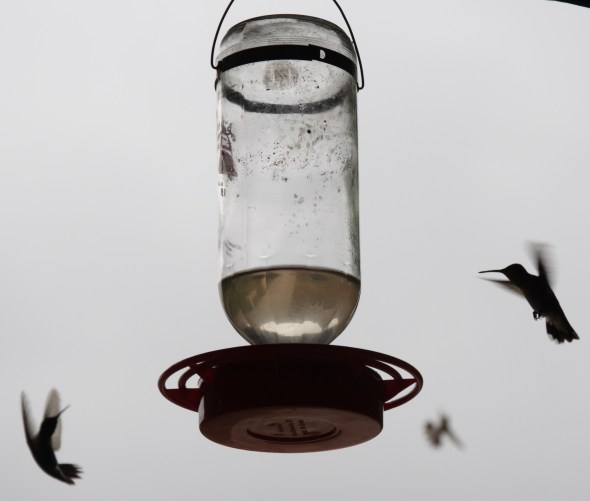
But I think if I’d never been on a horse before, Panagea might have been a bit too ambitious.  Being able to mix riding with other activities (such as lazing by the pool or watching the hummingbirds come and go on the front porch) made Dixie Dude Ranch a great choice for a relaxing holiday.  But get those riding lessons booked so like me, you can make it to Uruguay one day!
Is Austin weird?

The Texan city of Austin would like to think so. Proud of its alternative culture and buzzing music scene, the city’s slogan is “Keep Austin weird”. The dictionary definition of weird has the word’s meaning as “suggesting something supernatural; unearthly” or more informally “very strange; bizarre”.Compared to America’s many identikit cities, some parts of Austin have an indy feel, but is this enough to warrant the label?

FullSizeRender (100)

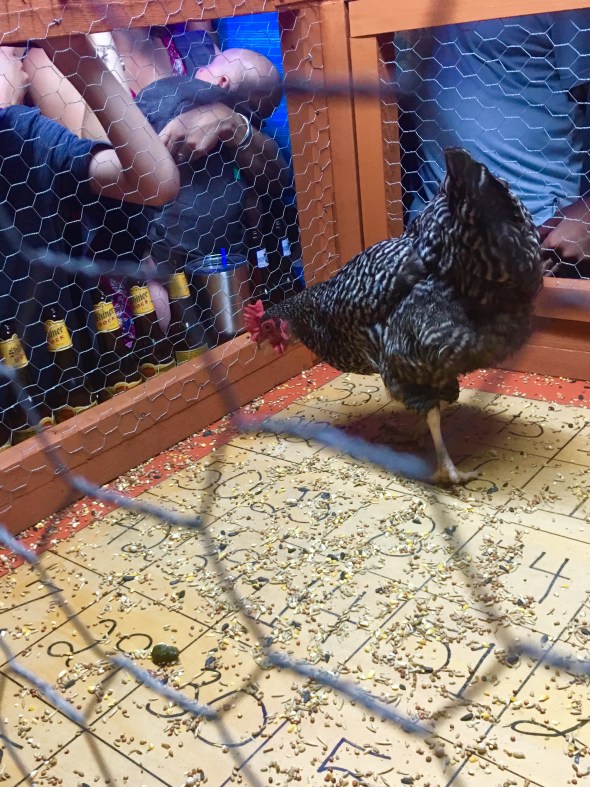
Google “weird Austin” and there’s no end of blogs and e-zine articles trying to justify the term. From watching bats leave their roost under South Congress bridge to playing Chicken Shit Bingo at Ginny’s Little Longhorn Saloon, there are no end of suggestions.

Austin3

But read a little more carefully and you’ll perhaps find such writers are a little economical with the facts. There are suggestions that drinking a particular cocktail or watching a band play live in a bar is weird. Given that you can do that in any major city, I don’t see how that qualifies as weird.

Austin8

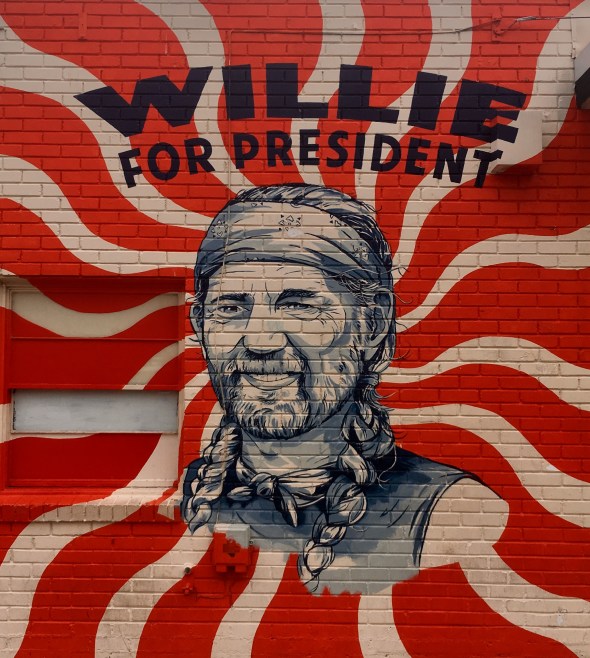
There’s a whole load of street murals which are a common sight in many a city these days and a cathedral of junk – but isn’t that just someone’s interpretation of art? Someone even went so far as to suggest the local propensity for eating tacos qualified the place as weird. Seriously?

Austin4

I didn’t take to Austin. In its defence, I was there for the weekend – and Memorial Day weekend at that. Entertainment venues were heaving, the restaurants were packed and added to the mix was a bunch of thunderstorms that brought unusually high humidity for the time of year.

Austin6

The music was pumping, the bass was thumping. If you’re 21, you’d have loved it, but for this middle-aged traveller, it wasn’t ideal. Ginny’s had a classic car show on its forecourt and was even more rammed than the regulars said it should be. The bats left it so late to come out from their hiding place it was too dark to see them when they did. Disappointing it was, weird it was not.

Austin

And I’m not alone. Google “Austin is overrated” and you’ll also find plenty of results. For those of us that like to sightsee as well as socialise, there’s a relatively limited number of sights to see. OK it has the State Capitol, which as you’d expect from Texas is bigger than everyone else’s and impressive inside. There’s a couple of good museums, including the LBJ Library and Museum dedicated to President Lyndon Baines Johnson. The riverfront is pleasant, but nothing to write home about. There’s a certain charm to SoCo, with its quirky shops and the excellent Jo’s for coffee, but it’s bisected by the busy road which gives the district its name.

IMG_9060

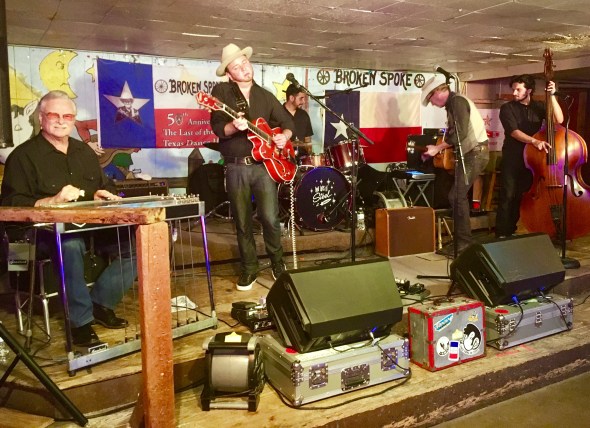
Amidst the noise, the many panhandlers that were just a stone’s throw from 6th Street and the Saturday night vomit on the pavement, one place stood out. The Broken Spoke had an excellent band, Two Tons of Steel, and a comfortable family vibe.

Austin7

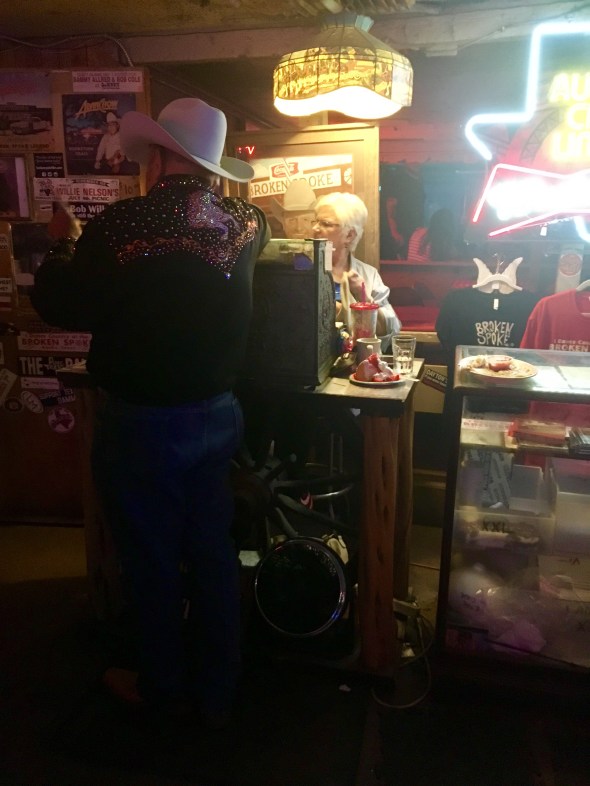
Sure, people were drinking, but there were also granddads dancing with their granddaughters and young couples deep in conversation in between masterful circuits of the dance floor. (Yes, the music wasn’t so loud as to drown out their voices.) My brief Texas Two Step lesson wasn’t sufficient to give me the confidence to join them but it was fun to watch. From the moment we stepped through the door to be greeted by an elderly cowboy in a rhinestone studded shirt, we were welcomed. By the time the charming Ben Rogers doffed his Stetson and took a break from propping up the bar to call us a cab home, we were made to feel like we came every weekend.

Austin5

You see, what made Austin special was its residents. It’s that Southern hospitality thing kicking in again. In every venue and on every street corner, locals were keen to share their city. You don’t need a guidebook in Austin, you just need to hang around and chat. There’ll be no end of people to talk to.

Austin10.jpg

We were given recommendations for places to eat, drink and shop without soliciting for information. What’s more, they turned out to be good. I’d have not known about the Iced Turbo coffee at Jo’s in SoCo if the friendly gent at the lights hadn’t passed the time of day, nor would I have found Easy Tiger, its yummy bratwurst a welcome change from the ubiquitous (but tasty) Mexican fare.

Austin2

So, no, Austin’s not weird, no matter how much it would like to be, and as a tourist destination it’s a little dull, but its welcome is possibly the best you’ll get in the Lone Star state.

The Great Storm, Galveston

“I should as soon think of founding a city on an iceberg as on Galveston Island, if I looked to its safety and perpetuity.”

image

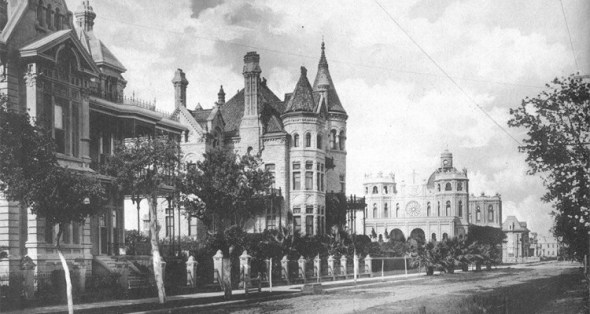
Before the deadliest storm in US history left low-lying Galveston flattened and in shock, it was a prosperous town. Forty thousand people called it home and a steady stream of cotton steamers created a reliable source of income. The town was littered with mansions, symbolic of the immense wealth being accumulated here; before the storm there were 26 millionaires living within a five block radius. Trolleys carried those too lazy, rich or old to walk about town. At the end of the 19th century, it was the most important seaport in the USA and it seemed nothing could hold it back.

image

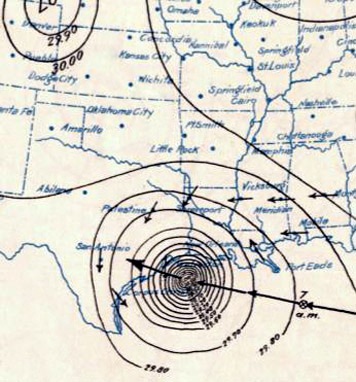
Except the weather had other ideas. After a calm, sunny week, as evening turned into the night of Friday 7th September 1900 the winds began to pick up. Rain lashed the two-storey homes that lined the Strand and weather observers looked on anxiously. Forecasting was in its infancy in those days, but even then the rudimentary instruments told a frightening story. Wind speeds were increasing, reaching 100mph that night, before the equipment blew away. Some meteorologists think the wind speeds could have reached as much as 145mph at their peak. The barometric pressure was the lowest ever recorded up to that point in US history.

image

By 4am, the sea had surged inland, flooding the town’s streets. A four and a half metre storm surge was more than the island could cope with, the highest ground being being little more than half that. The heavy swell continued to be a concern as day broke. By noon, much of the island was underwater, but there was worse to come. Strengthening winds battered the feeble housing. Debris flew around in the wind acting as missiles against any building still standing.

image

One observer was sheltering in a house that had withstood such an attack for several hours. He noted that a man trying to reach that same home had his faced sliced clean off by a flying roof slate. It must have been a terrifying time for those who were to become the survivors, that thud of wave-driven timbers on the walls like a mediaeval battering ram on a wooden castle door.

image

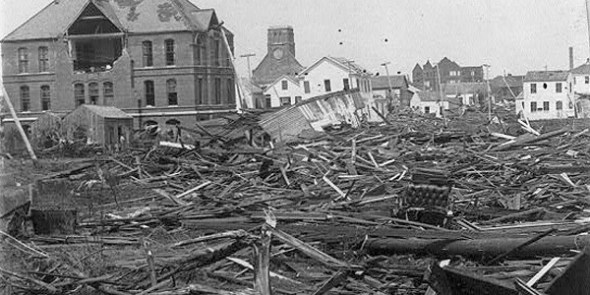
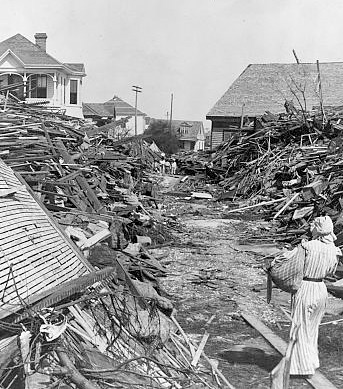
At least 6000 would never know such lasting fear. Whole families were wiped out, making a confirmed death toll impossible to ascertain, but it’s generally agreed that the figure is a conservative estimate of the final death toll. As Sunday morning dawned, the skies had cleared and the storm had passed. What was left was unrecognisable. Much of the island was completely flattened, the powerful waves scouring the landscape and leaving it in places as pristine as when the first settlers had laid out their street plan. A few blocks further along, huge mounds of debris concealed the bodies of the dead. Here and there, properties listed at angles more commonly associated with earthquake damage; a few had been turned completely upside down. From 9th Street east towards the beach, block after block no longer existed.

image

The human cost was appalling. 5000 families were left destitute; it would be days before word reached the Red Cross in Washington and the much-needed aid would arrive. Marshal law was instigated in an attempt to stave off looting. Pilferers were shot. Those in authority also had to deal with the tricky question of burying the dead. With no time in the heat and humidity to dig sufficient graves, rocks were attached to bodies and they were buried at sea. The water that had killed them would be their final resting place.

image

Yet the sea had other ideas, washing bloated and putrid corpses up on the shore day after day. A decision was taken to burn the bodies. Those enduring such a horrendous task were paid in whiskey until they threw up from the disgusting stench. It was a job no one wanted but someone had to do. The risk of disease for the survivors was just too high a price to pay to leave the bodies to rot. As the impact of the disaster sank in, page after page of the newspaper was filled with the names of those who had perished.

image

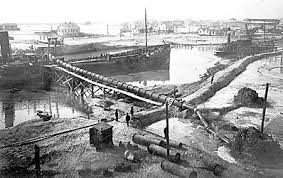
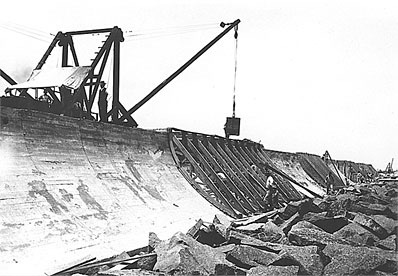
But the survivors stayed to resurrect their city. In 1902 a solid sea wall was proposed and within two years the designs had become a reality. Together with the wall, a regrading of the roads was undertaken, raising the level of the streets. 3000 houses would be lifted and sand dredged from the a Gulf of Mexico pumped underneath them so the buildings would sit three metres higher, above the danger level. In future, any incoming wave would be weakened by the increased gradient. The cost of this ambitious engineering project was a staggeringly high $6 million. By 1905, Galveston was ready to take on the elements once more. It didn’t have to wait long. In 1915, a hurricane hit, similar in magnitude to the Great Storm of 1900. The city’s residents held their breath. Would their defences hold?

image

They would: just eight people died. Galveston had a future, though it would never regain its pre-storm commercial status.

What you need to know about the US laptop ban

Much has been written in the press over the past week on the subject of a ban on larger electronics items entering the United States with airline passengers.  Following on from the March policy shift in which inbound flights from certain Middle Eastern and North African destinations, there’s speculation that such a policy could be extended to European destinations.

What’s the current situation?

At present, passengers travelling to the US from ten airports are affected: Queen Alia International Airport (AMM), Cairo International Airport (CAI), Ataturk International Airport (IST), King Abdul-Aziz International Airport (JED), King Khalid International Airport (RUH), Kuwait International Airport (KWI), Mohammed V Airport (CMN), Hamad International Airport (DOH), Dubai International Airport (DXB) and Abu Dhabi International Airport (AUH).

IMG_5286 (2)

Large electronics items, including laptops but also larger cameras like DSLRs and tablets such as the iPad, must be carried in the hold and cannot be taken on board the flight.  How airlines are implementing this varies, but some are offering gate check in and secure packaging in the form of bubble wrap and cardboard boxes.  This policy doesn’t extend to the return leg; flights departing the US for these ten airports are not subject to the same restrictions.

So why are people getting upset?  Surely they can do without their gadgets for a few hours?

As talk grows about an extension to the ban, so too do certain worrying facts emerge.  Many of these larger items are powered by lithium ion batteries, which up to now have been banned from the hold for safety reasons.  They carry a risk of catching fire, something that could have disastrous consequences if unnoticed.  The FAA itself stated its concerns in 2016:

http://abcnews.go.com/US/lithium-batteries-spark-catastrophic-plane-fires-faa-warns/story?id=36816040

There’s more here, from The Independent:

http://www.independent.co.uk/travel/news-and-advice/laptop-ban-uk-flights-usa-america-donald-trump-british-airline-pilots-association-heathrow-a7736076.html

There’s also the issue of sensitive data on company laptops and directives from some businesses to their employees requiring them to keep such equipment on their person whilst travelling.  For the regular tourist, it’s more a case of a lack of insurance.  I might just about be able to cope without my iPad on a long flight if I went back to those old fashioned paperback things I used to lug around, but if the airline then loses my suitcase, my travel insurance policy won’t pay out.  I really can’t afford to replace my DSLR if the lens gets smashed in transit.  So, with a flight to Houston looming on Friday, I’ve been watching the TSA website and Twitter like a stalker.

texas-1656861_1920

So have they made a decision yet?

There were some misleading headlines last week, like this one in NYMag following a piece in The Daily Beast:

http://nymag.com/selectall/2017/05/laptops-banned-in-plane-cabin-on-flights-from-europe-to-u-s.html

Retweeted and quoted to within an inch of its life, The Daily Beast’s article, claiming an announcement would be made Thursday 11 May, sparked an angry reaction.  In part, there was a touch of indignation along the lines of European nations being way too civilised to be lumped together with the Middle East.

london-1405911

But amidst all the fuss, some serious issues for the Americans began to be raised, not least the impact that it would have to the US economy and its tourism sector.  This article from The Independent explains:

http://www.independent.co.uk/travel/news-and-advice/laptop-ban-on-flights-electronic-devices-travel-industry-airlines-travelport-a7737671.html

Yes, you read that right: 1 in 3 potential foreign tourists would think twice about going if this policy becomes a reality.  I’m among them.  I’d be seriously concerned about that fire risk, especially on such a long flight.

Here’s a follow up article, also from The Independent:

http://www.independent.co.uk/travel/news-and-advice/laptop-ban-europe-economic-tsunami-travel-industry-electronic-devices-flights-plane-hold-uk-usa-a7740396.html

I’m hoping, as we get closer to my departure date, that even if the electronics ban is widened, the changes won’t take effect until after I’m there.  Getting my valuables back to Blighty in one piece will be, as it has always been, down to me.  But after that, much as it pains me to say given my love of the USA, I’d have to give it a miss, at least until the TSA came to its senses once more.  It was reported that the TSA met with representatives of the US’ major airlines last Friday to see how a ban could be implemented; sources indicate that further meetings were to be held with EU personnel today.  At the time of writing, there’s been no announcement.

Watch this space.

Update 18.5.17

Well as it turned out we didn’t have to wait too long for an update.  Common sense has prevailed and the EU have persuaded the US authorities that widening the ban on larger electronics would be foolish:

http://www.bbc.co.uk/news/world-europe-39956968

The ban still exists for the ten Middle Eastern and North African airports, so think about your safety before you opt to fly.  Happy travels!
Just back from: a day in Ibiza

This, perhaps, wasn’t going to be one of my usual days out. A few days before I was due to fly – out of Stansted at 7am on a Tuesday – an email arrived from Ryanair announcing certain restrictions on the flight.

IMG_8664

Amongst other words of caution, it said:

• Customers will not be allowed to carry alcohol on board and all cabin baggage will be searched at the boarding gates.
• Boarding gates will be carefully monitored and customers showing any signs of anti-social behavior or attempting to conceal alcohol will be denied travel without refund or compensation.

For a moment I wondered what I had let myself in for. In the event, though we did have a stag party on board, they were very well behaved and remarkably quiet. The plane was too, empty seats an indication that some of our passengers had fallen victim to one of Stansted’s worst mornings for queues at security I’d ever seen. I’d made the flight in good time and jetted off on time to the hippy isle with a row of three seats to myself.

FullSizeRender (99)

Arriving slightly ahead of schedule, I picked up a hire car and set off on an itinerary I’d found on the Ibiza Spotlight website. As my main focus of the day was to be a trial of a Sunwise kaftan, I’d originally planned to hole up at one of Ibiza’s stylish beach clubs and chill out all day. In the event, my geographer’s curiosity got in the way and I just couldn’t resist the chance to go exploring, especially up in the north of the island where the agricultural landscape was more verdant and prettier than the south. That said, I needed to be in the sun, so there were going to be plenty of stops.

DSC_0099 (2)

The first was supposed to be in Santa Eulària des Riu, Ibiza’s third largest resort. Incidentally, road signs are in Catalan, though my map was in Spanish, with this particular resort being Santa Eulalia – mostly the names were similar enough for this not to be confusing. I’d read about an excellent ice cream parlour called Mirreti’s. Reaching the town, I decided it just wasn’t my kind of place: too busy and lacking charm. I drove straight through, headed for Sant Carles de Peralta.

FullSizeRender (97)

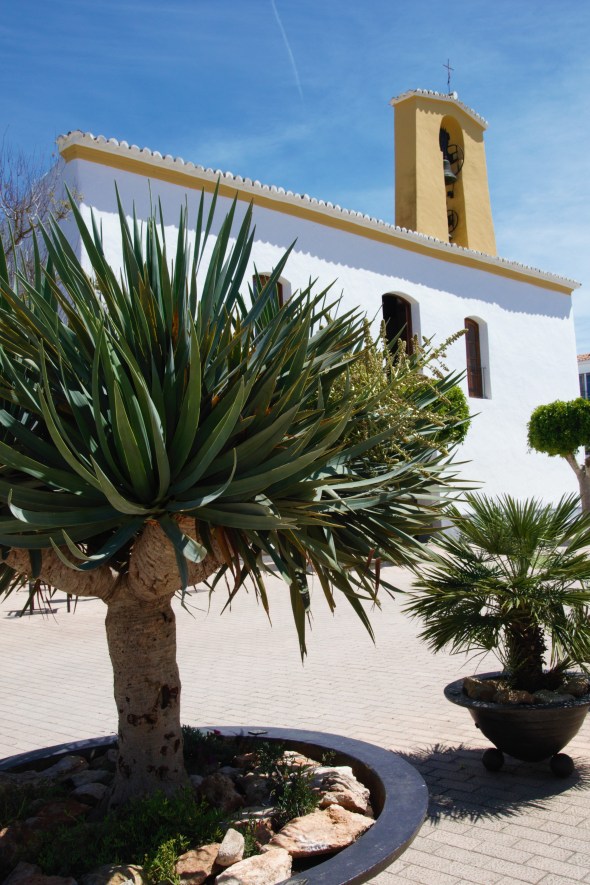
This small village, dominated by a delightful whitewashed church, was the perfect spot for a stroll in the sunshine. There wasn’t much to see, but I’d been tipped off about a cafe called Bar Anita across the road. I spent a pleasant half an hour sipping a cold drink in the warm sunshine, watching the world go by.

DSC_0014 (2)

Onwards and northwards, as the hire car wound its way around the back lanes following the Cala de Sant Vicenç coast road for a few kilometres before ducking inland across the Serra de la Mala Costa. Turning north at Sant Joan de Labritja, I snaked across country on a tiny lane which led to the resort of Portinatx on the island’s rugged north coast. Smaller than Santa Eulària des Riu but nevertheless a resort, it was more my scene and I had a wander to explore.

DSC_0035 (2)

Back in the car, I drove back to Sant Joan, this time via the main road and on to my next stop, another village dominated by a magnificent church, Sant Miquel de Balansat. Sited on top of the hill, this whitewashed church is impossible to miss. It’s the second oldest on the island, after the cathedral and like the one in Sant Carles, had three crosses on the front wall, something you’ll see on all the churches on the island, the symbol of Golgotha. The painted chapel walls are very special.  This bronze sculpture outside also caught my eye.

DSC_0049 (2)

But by now, I was getting hungry and so drove the few kilometres to Santa Gertrudis de Fruitera. This was my favourite of all the villages I stopped at, and I feasted on jamon serrano and queso manchego in the sunshine, choosing a spot opposite the church.

DSC_0067 (2)

Somehow the village managed to hang onto its character despite its popularity with day trippers. I had time to browse in a few boutiques before they closed for a siesta and I hit the road again.

DSC_0064 (2)

This part of Ibiza is greener than the scrubby south and I drove across the countryside towards Santa Agnès de Corona, known as Santa Ines in Spanish. I passed olive groves, almond trees and orange trees laden with fruit. Ruined windmills completed the agricultural scene.

DSC_0105 (2)

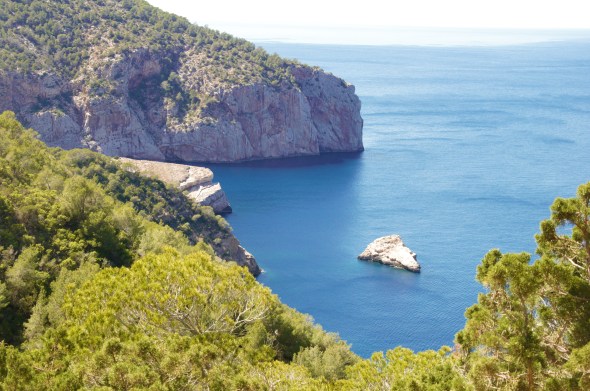
The road layout here forms a circle, so it as it was such a fine day, I decided to backtrack a bit and go for a short hike. My target was the hidden fishermen’s cove of Es Portitxol, said to be one of the prettiest spots on the island.

IMG_8692

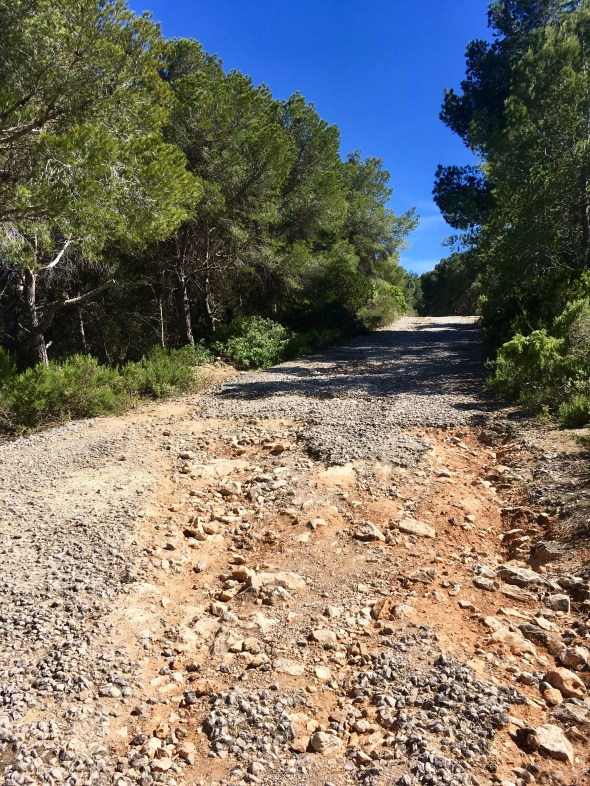
The road was in pretty poor shape, so I parked up and picked my way down the lane on foot. When I saw poor shape, it looked like a digger had gone rogue and there were great rifts gouged out of the stones. I wished at that point I’d had on walking boots rather than sandals, as it was hard going. The path did level out for a while and led through a shady forest; alongside were sweeping views over the ocean and towards the cove. Improperly clad, I decided to bail before I ripped my sandal straps, but had I continued, I’d have been rewarded with one of Ibiza’s hidden gems. Ah, next time.

DSC_0085 (2)

It was time to head into Eivissa, the island’s capital. I’d seen the cathedral and fortifications of its Dalt Vila or old town as I’d passed earlier, and now it was time to explore on foot. Luck was on my side when it came to finding a parking space; yellow spaces reserved for workers become free for anyone who finds them empty after 4pm.

DSC_0128 (2)

For anyone whose experience of Ibiza is solely the lively mass tourism resorts and club scene, Dalt Vila is the very antithesis: elegant, ancient and impressive. The thick wall and fortifications once protected Eivissa from marauding pirates; now they provide lofty vantage points from which you can admire the Mediterranean and watch the fishing boats bring their catch in, trailing clouds of seagulls in their wake. This defensive settlement dates from the 7th century BC when the Phoenicians founded the city, though the walls themselves are even older.

DSC_0110 (2)

Today, Dalt Vila is threaded with alleyways and tunnels which, unsigned, invite you to partake of a lucky dip; when you step through the doorway, you might have no idea where you’ll emerge. I popped up in the Plaça d’Espanya for a time. One of the tunnels here was a Civil War refuge; Ibiza was Republican for a time before Franco stepped up his campaign and occupied the island, forcing the Republicans to flee.

DSC_0124 (2)

In the Plaça d’Espanya traders were setting up a mediaeval fayre which should, according to the road signs, have opened three hours earlier but looked like it was still a while off. From there, I climbed a little further to the cathedral, its fussy architectural details contrasting with the simplicity of the whitewashed churches I’d seen in the villages.

DSC_0137 (2)

Overlooking the marina, it was a good place to perch on a wall and soak up both the sun and the view. Refreshed, I wandered the streets of the old town for a while before ducking randomly into a tunnel and emerging some considerable way beneath them. I took it as a sign and headed back to the airport.

DSC_0146 (2)

The details

Outbound: Ryanair STN to IBZ departing 0700 with a scheduled arrival time of 1040 (we were about 20 minutes early)
Inbound: Ryanair IBZ to STN departing 2140 and arriving at 2320 (also early)

Flights available from £19.99 each way.
Car hire with Alamo purchased through the Ryanair website was a little over £30 for the day; airport buses into Eivissa cost 3,50 euros each way.

Have you seen my other blogs on days out by plane? They’re perfect if you are desperate to travel but can’t get the time off you need for a longer trip. You’ll be surprised at how much you can do in a single day. For how to visit Amsterdam, Belfast, Bremen, Budapest, Lisbon, Regensburg and Copenhagen for the day from London, please follow this link:
http://juliahammond.co.uk/Travel/BLOG.html