juliamhammond

Latest

How to travel solo without the hefty price tag

An email popped up into my inbox the other day touting an article that promised a selection of holidays this summer for under £600 per person. Intrigued, I clicked – the dreaded click bait! Though there were a couple of holidays that fell within the price range, most required a group of six people to share a villa to achieve the deal. I prefer to travel alone – yes, it’s a choice! – so the thought of spending a week with five other people is not my bag. But it got me thinking and here’s the result – how to travel solo without the hefty price tag.

Be independent
DSC_0677
Singles holidays are often a no when it comes to budget solo travel as they usually slap on a significant single supplement. Even when they don’t, the price of that single supplement has usually been absorbed into the package cost which bumps the price up. Ditch the tour operator (but not the insurance!) and go it alone. You’ll be more in control of what you pay and who you pay it to. If you’re a bit worried about travelling solo, why not read my post about travel hacks for solo travellers which contains tips and tricks learned from years of going it alone.

Consider a hostel


The cheapest option for a solo traveller is a bed in a dorm room, but that’s not going to cut it if you need quiet to sleep and you like to shut the door on the world when you turn in. Instead, consider a private room in a hostel. Check out the cleanliness ratings on a reliable website and if it scores well, don’t rule out a shared bathroom. Try the Acco Hostel in Stockholm’s Södermalm district. £18 will get you a bed in a four-person dorm room but double the budget to £39 and you can have a room of your own. I can also recommend the excellent Adventure Queenstown Hostel in New Zealand. They only have one private double (book well ahead!) but it has a balcony and starts at a budget friendly £59 a night. If that’s too dear, their 6 bed dorm rooms will cost you £17.50 per night.

Seek out accommodation that’s designed for one
IMG_6234
The best way to avoid a single supplement is to find somewhere that isn’t big enough for two. There’s plenty of budget accommodation out there that will keep your costs down. I stayed in the central but basic Pension Vergara in the heart of Seville’s old town for £18 a night. If you think you have to travel off season, you don’t – that price is available this August. It wasn’t a room I intended to use other than to sleep, so the lack of space didn’t bother me, and I really couldn’t have found a more convenient location. Turkey’s also a good option. I travelled to Cappadocia and stayed at the Kelebek Cave Hotel. Their most expensive suites come in at 180 euros per night but stay in one of their atmospheric cave rooms to keep the cost down. The cheapest double is currently £39 per night, including a 20% discount for single occupancy. Yes – you read that right – a discount, not a supplement.

Save money by self-catering
barbados-233988
Renting an apartment doesn’t have to break the bank and if you can find one with a kitchen, you can save money on eating out too. I’m off to Barbados as soon as rainy season ends and have found a studio apartment for just £45 a night by using Airbnb. It’s part of a complex on a golf course near the beach which means I have access to a shared pool too, and the apartment is configured so that the bed is on a mezzanine, leaving the ground floor free for a living room and kitchen. It’s a short stroll to the bus stop so I can get around easily and just 15 minutes’ walk from the beach. On paper it sounds perfect: check back later in the year to read my review.

Grab a flight deal while it lasts
british-airways-2132653
Unless you’re holidaying close to home, it’s often the cost of travel that represents the biggest outlay. I try to keep an open mind about where I might travel to next and keep my dates flexible. If you’re tied to school holidays, plan well in advance and take full advantage of February and October half terms as they often throw up the best deals. Sign up for email alerts from airlines so you don’t miss out on any flash sales and also from deal spotters such as Secret Flying as they will hunt out the bargains for you. If a bargain flight crops up, grab it while it’s available and worry about booking accommodation later. But don’t believe all you read: I once saw a post from a respected blogger promoting a fare of almost £1000 as a cheap flight to Seattle yet a couple of weeks ago, Secret Flying advertised the same route for £290. Both were on scheduled airlines. Keep an eye on these comparison sites and you’ll soon learn what’s a good price.

Do you have tips for saving money as a solo traveller? Why not share them by leaving a comment?

Is it time you visited Colchester?

Colchester’s been busy – a new advert using the tagline #ifthesewallscouldtalk has popped up on our television screens and sets out to promote the town’s many historic attractions. As England’s oldest recorded town and also its first Roman city, there’s a lot of history to uncover. But while most of us in the region know about Colchester’s castle, some of its more recent history can get overlooked.

As part of Greater Anglia’s summer #railadventure campaign, I set out to rediscover Colchester. The first decision I had to make was which station to use: Colchester has three railway stations. I opted to alight at Colchester Town (formerly known as St Botolph’s) as it is closer to the town centre than Colchester (also known as Colchester North) and Hythe.  From there it was a six minute stroll to my first stop.

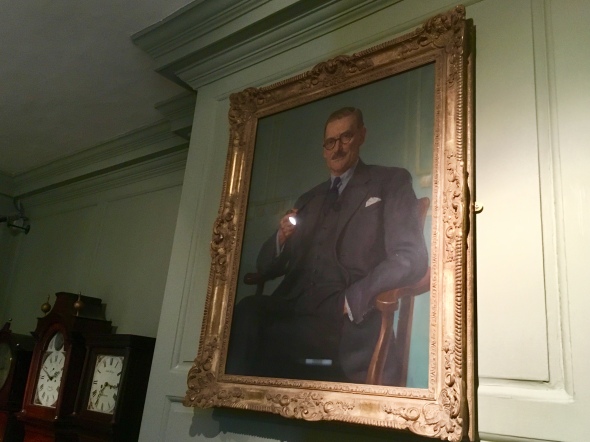
Tymperleys is a Tudor mansion tucked away in a courtyard off historic Trinity Street. Building began in the 1490s and over time it was added to and altered as the place changed hands. Among its illustrious owners was William Gilberd, an Elizabethan scientist who, it’s said, came up with the term “electricity”. Later, Colchester businessman Bernard Mason, who owned a successful printing firm, bought the place. His passion was clocks and amassed a collection of over 200 timepieces, one of the largest in Britain. This is what Wikipedia has to say about him:

Mason was a Freeman of the Worshipful Company of Clockmakers and the author of “Clock and Watchmaking in Colchester” (1969) which originally cost four guineas (£4 4s 0d £4.20). He was made an OBE in 1959. Mason claimed that there are 375 known examples of Colchester clocks and he managed to collect 216 of them in his lifetime, travelling far and wide to bring them back “home”.

5C5D71DF-1F55-4864-8513-0EB9C853F229

After Mason’s death, he bequeathed his collection – and the house – to the people of Colchester. In 1987, the Tymperleys Clock Museum opened and would remain a popular attraction until 2011. But I had another reason to visit. These days, Tymperleys is perhaps (despite stiff competition!) the best cafe in the town centre and it’s especially lovely in the summer when you can eat al fresco in the delightful walled garden. No surprise, therefore, that most customers were sitting outside. With a fierce July sun beating down, I was glad of the shade of a garden umbrella as I enjoyed a tasty lunch surrounded by the pretty floral displays.

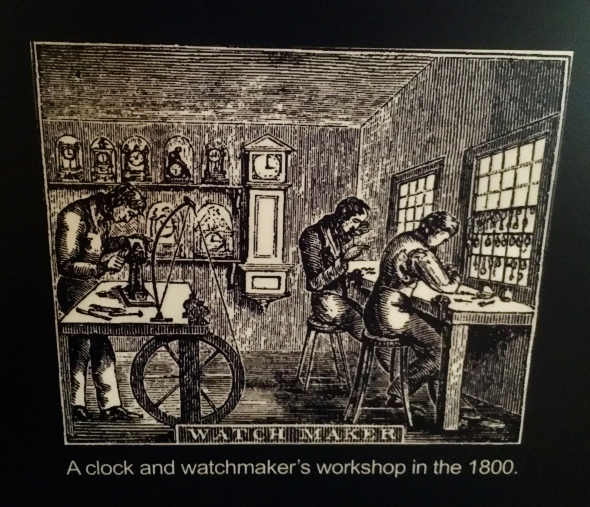
These days, not a single clock from Bernard’s collection – I asked – is left in Tymperleys. Before you fret, however, they have been moved. A short stroll across the town centre you’ll find them in the excellent Hollytrees Museum. It’s free to look around and learn something of the Colchester clockmaking industry which, it turns out, was quite something back in the day. Once a centre for baymaking (the manufacture of a felted woollen cloth), Colchester’s industry diversified in the Georgian era and it was then that the town became a centre for clock making.

2A2F3B37-E622-49E5-A4EA-D87C61E7EAC5

Perhaps most productive of these craftsmen was Nathaniel Hedge. The Hedge family set up in business in 1739, running a factory from 1745 until the late 1780s. Other names to look out for include John Smorthwait, who trained up the young Nathaniel. One of the oldest clocks on display is a Thirty Hour Longcase clock made in 1698 by Jeremy Spurgin out of oak. Many of the pendulum clocks on display feature adornment in a style known as Japanning, a lacquered decorative finish involving paint and varnish. It’s an intricate style, a reminder that fashion was as important as function when it came to clockmaking.

By 1800, however, the industry had peaked and went into a steep decline as clocks could be made elsewhere much more cheaply. The industry and its contribution to Colchester’s history would be all but forgotten if it wasn’t for Bernard Mason. Whether you’re local or visiting from outside the region, it’s well worth the detour to take a look at this fascinating collection.

The visitor information centre is housed on the ground floor of Hollytrees Museum; their walking tours of the town provide an insight into the town’s past that you’d be hard pressed to achieve without their knowledgeable guide. For this and more on the town’s historic attractions, check out my previous blog.

The lowdown

Greater Anglia offered me a free train ticket in exchange for writing this review of my #railadventure. Travelling by train is an inexpensive way to travel, particularly off peak. For instance, if booked in advance, tickets from Norwich to London cost just £10, Cambridge to London can be had for £7 and Southend to London only £5 (all fares quoted are one way). Accompanied children travel for just £2 return and you don’t even have to pre-book their ticket – this fare is valid on all off peak trains within the Greater Anglia network. On top of this, GA are offering a 2FOR1 deal on top London attractions; with the summer holidays fast approaching this is great news for families. And don’t forget, the excellent Hollytrees Museum is free. It even has a kid-friendly display of vintage toys and a couple of nursery rhyme surprises, though I’ll leave you to discover those for yourself.

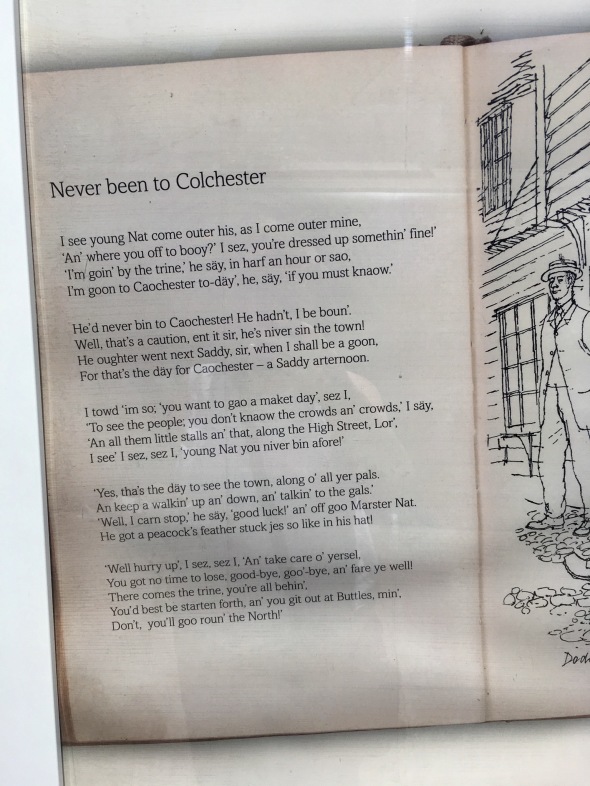
Colchester Town station had one last treat as I was waiting to board my train home. This poem, written by C. E. Benham in 1890 is entitled “A ballad of the Tendring Hundred” and you’ll find it on the station wall. Best read out loud – see how well your North Essex accent turns out!

E87DD6C4-7475-463B-BB65-A21527CDBA34

Discover destinations and ticket prices at www.greateranglia.co.uk and plan your journey at www.nationalrail.co.uk.

Did you feel inspired to plan your own rail adventure after reading this blog? Why not complete Greater Anglia’s survey using this link:

https://www.surveymonkey.co.uk/r/5CG9TGG

On safari in Kent: review of Port Lympne

The thrill of seeing animals in the wild in Africa’s national parks is one of life’s great travel adventures. But sometimes you can’t wait for Africa to get your travel fix. A visit to Port Lympne Reserve in Kent, owned and managed by the Aspinall Foundation, provides an opportunity to go on safari without leaving the UK, but how does it compare to the real thing?

DSC_0018 (2)

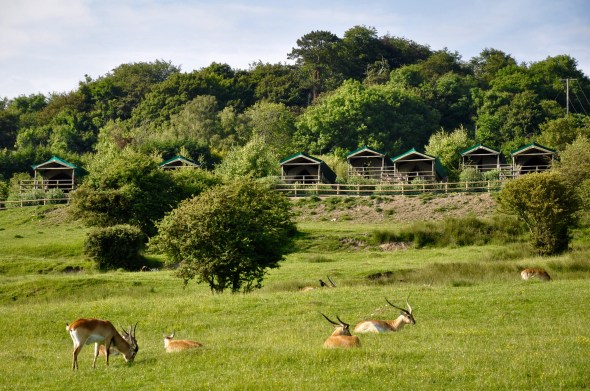
The organisation’s credentials are good: known for its work breeding rare and endangered species, the park is home to 25 painted dogs, 17 Western lowland gorillas, 15 Eastern black rhinoceros and 5 Rothschild giraffes. The park’s animals are housed in a variety of ways, with some roaming freely across acres of rolling fields and others in purpose built enclosures.

It’s possible to visit for the day but for a special occasion, Port Lympne has a range of overnight accommodation. We chose to rent a cottage, but could equally have spent the night in a glamping tent, hotel or even a treehouse suite. Further accommodation is planned, as is a spa, expected in around 18 months time.

Our cottage slept eight and was very comfortable for our party of six. Each of the four bedrooms was a generous size, in particular the master suite, which had a huge bathroom attached. Attention to detail was evident throughout, such as finding cute little elephant hooks for the bathroom robes. We enjoyed the services of a personal chef who cooked us a three course dinner and came back to serve up a full English the following morning. It was an impressive set up which pleased everyone.

From the windows, we looked down over fields grazed by some of the park’s animals, though admittedly from a distance. If you’re serious about wildlife spotting from your bedroom, you’re going to need to bring binoculars. There was something almost surreal about hearing the shout of “Quick! I can see a rhino from the bathroom window!” when your brain is protesting you are so close to home. Less fun was finding the nieces had hidden the resident oversized gorilla plushy with the spooky eyes in our bath as a joke, though they found my screams hilarious.

But it was the safari experience that set the trip apart. Our guide, Rebecca, was knowledgable without being preachy and supplied enough anecdotes to prevent the whole thing turning into a Biology field trip. She explained about conservation and environmental pressures on creatures in the wild in the context of the animals’ own personal histories. We didn’t see the new born giraffe that was resolutely hiding inside, but we did meet the extended family from our Land Rover vantage point.

Larger safari trucks ferry passengers around Port Lympne’s extensive site, but the advantage of being in a smaller vehicle was that we could go off road from time to time to get a closer look at some of the grazing herds.

DSC_0182 (2)

The Bactrian camels looked somewhat scruffy as they were blowing their fur coats, and somehow wildebeest always do, but the small herd of Chapman zebra looked to be in fine condition. Save for the distant view of the English Channel, we could have been on that African safari.The morning safari was shorter, but took us to different parts of the park to see ostrich, eland, baboons and more.

Afterwards, we spent a few more hours wandering the pedestrian paths that looped the animal enclosures, timing our visit to the gorillas to coincide with feeding time and watching a Siberian tiger hunt out meat that had been hidden in her patch.

It felt slightly odd to be seeing primates in cages after our safari, but obviously it wasn’t going to be safe, practical or possible for a silverback to be mingling with the crowd.

How did I feel about the trip? Well I came home and booked a flight to Uganda. I’m going to be taking my third African safari in early 2019.

https://www.aspinallfoundation.org/port-lympne/

On the trail of the Witchfinder General

Summer’s here and the skies are blue over my corner of Essex. Our river estuaries are at their most attractive at this time of year with plenty of birdlife making the most of the shallow water. Some of the best walks in the county follow the river banks and many are easy to reach by rail. So when Greater Anglia asked if I would like to help promote this summer’s #railadventure campaign, I jumped at the chance. Many of my favourite North Essex coastal towns and resorts are easily reached by rail, among them delightful Walton-on-the-Naze and Dovercourt’s historic lighthouses and Blue Flag beach. Regular readers of this blog might remember the super Greater Anglia days out I had in Harwich and Wivenhoe last summer – if you’ve never been, I’d definitely recommend them.

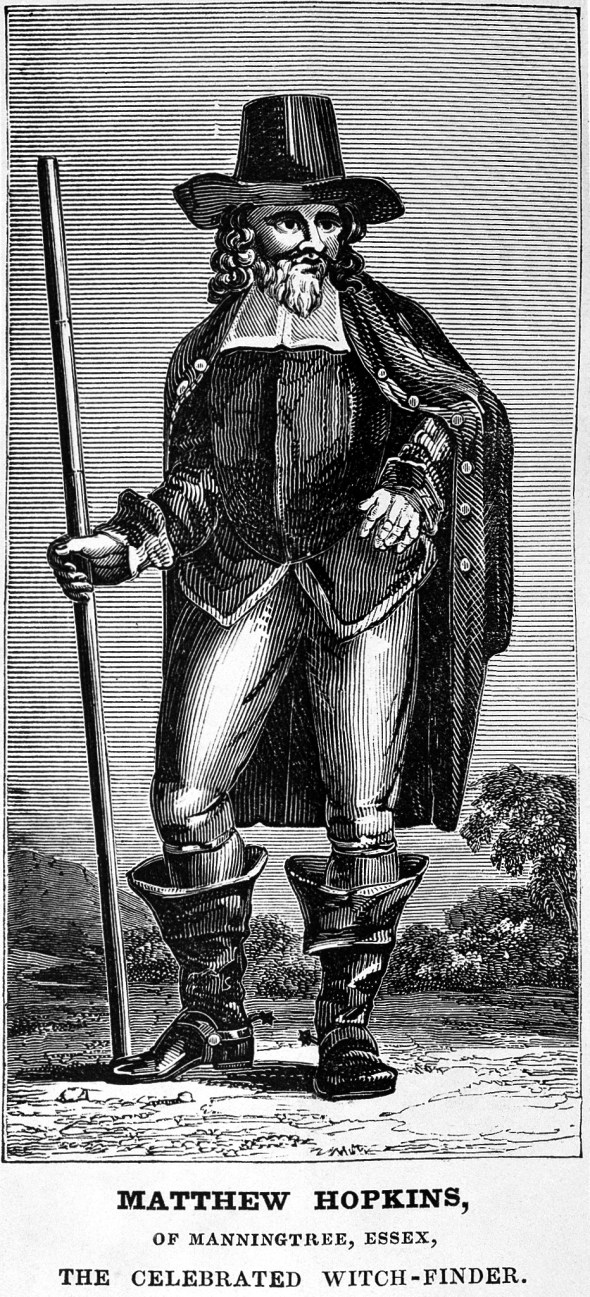
This excursion was inspired by a novel I found on a book exchange shelf in a guest house in Cape Verde. My charger wouldn’t function, the Kindle was out of juice and I’d resigned myself to a long flight back with no reading material. It was the only book on the shelf which was in English and when I turned it over to read the blurb, I found it was set in Essex. That book was “The Witch Finder’s Sister”, the debut novel by Beth Underwood which told the unsavoury tale of Matthew Hopkins, who held the position of Witchfinder General in 17th century Essex. Though born in Suffolk, Hopkins was closely associated with Manningtree and Mistley. Nowadays, they’re not only both reachable by train but a half hour walk apart.

L0000660 Portrait of Matthew Hopkins, the celebrated witch-finder.

The journey from Kelvedon required two changes of train but nevertheless ran like clockwork, taking just over half an hour in total. There’s even more opportunity to enjoy the countryside views on the way back – time it right as I did and there’s a direct train from Manningtree to Kelvedon taking just 20 minutes. It’s faster than driving, as well as being much less stressful. We’re wedded to the convenience of our cars, but on the train it’s nice to be able to get up and walk around – or sit back and relax on the comfortable seats. There was even sufficient time on the Colchester to Manningtree train to grab a coffee from the onboard buffet. For a less hurried walk when connecting to the Mistley train via the underpass my tip would be to find a seat nearer to the front of the train.

43F03476-024C-41FB-A65F-551C9618A951

Alighting from the train, my first impressions of Mistley were favourable. The port, once centred on the transportation of grain and malt for the brewing industry, is still operational but many of the old buildings that line the quayside have been renovated and repurposed. The malt extract works on the opposite side of the road are still in business and the smell of malt permeated the air as I strolled down towards the village centre.

EC0AE918-6B4C-4D28-AE7A-AC1C47262B74

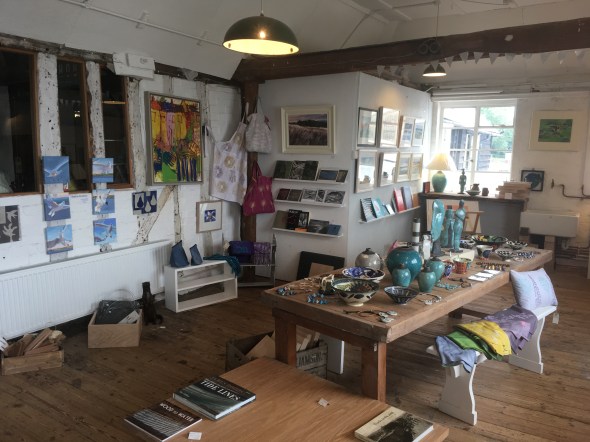
I couldn’t resist popping into Cooper’s Gallery to browse the colourful ceramics, paintings and textiles. Next time I shall walk in the opposite direction so that the gallery is my final stop; as it’s just across the road from the station I won’t have to walk far fully laden. This time, however, willpower was required as I wished to walk to Manningtree unencumbered by shopping bags. Liz, the gallery owner, was a mine of useful information about Mistley and the history of the quayside, lending me a calendar of old photographs to browse as I ate lunch at the T House cafe next door.

It was low tide and Liz explained how the partially submerged barge I could see from her window came to be stuck in the mud. Apparently, the sails of the Bijou caught alight during a bombing raid in 1940. So that the fire wouldn’t spread, she was cut free from her moorings and allowed to drift away from the quay. Burnt out, she’s been there ever since, the tide covering and uncovering this century-old vessel and gradually eroding what’s left.

ECF2F988-AC8A-4BDC-97C3-DE1455BACC83

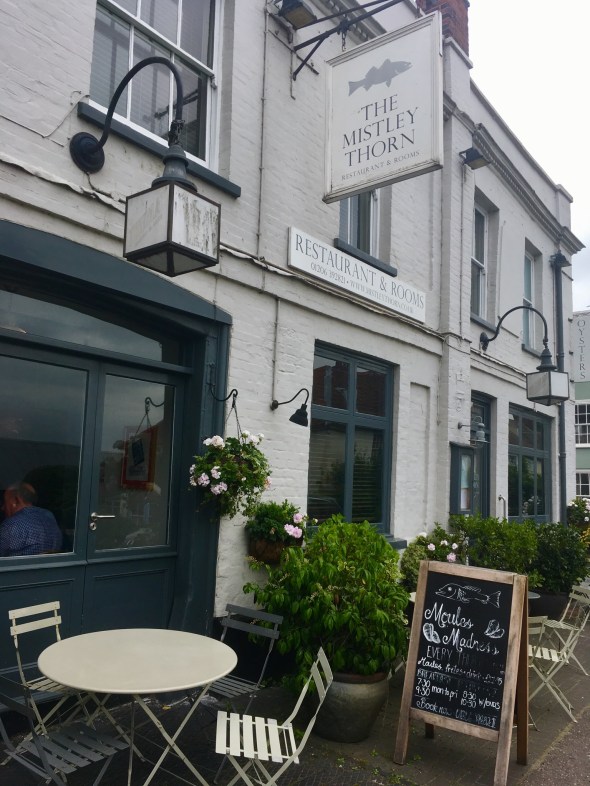
Across the street was The Mistley Thorn. The present day building was built as a coaching inn about 1723 and is now a restaurant with rooms to stay in. A pub stood on the site in the mid 17th century which was reputedly owned by Matthew Hopkins. He was supposed to have “examined” his first witch at the Thorn in 1644. An information board on the side of the Thorn tells a little of the story that Beth Underwood so cleverly adapted for her novel.

In an age of mistrust and religious upheaval, Hopkins decided there was more money to be made as a witch finder than as a lawyer, switching professions and assuming the role of Witchfinder General by 1645. Witch hunting set in motion a chilling sequence of denunciation, interrogation and finally execution. The trials were a joke. So-called witches were said to bear the Devil’s mark, a part of their body that didn’t feel pain. This could be a mole or a birthmark, which Hopkins prodded with a spike or cut with a blunt knife to see if it bled.

E9FC9755-C67F-47A1-A7CD-8CCDF4DA18F6

Another method was to tie the alleged witch to a chair and throw her into a pond. God’s pure water would reject a witch, it was thought, and she would float, but if “proved” to be a witch, she would be hung. Hopkins used to carry out such practices at Mistley’s Hopping Bridge, a short walk from the Thorn. It’s said that his ghost haunts the site and is most likely to be seen when there’s a full moon.

The exact number of women who were targeted by Hopkins is not known, but it is thought that the prolific Hopkins was responsible for several hundred deaths. In less than two years the number of witches he convicted represented about 60% of the total number punished in England from the early 15th to the late 18th century. In 1646, a parson from Huntingdon by the name of John Gaule published a pamphlet exposing Hopkins methods for the nonsense they were. The Witchfinder General wrote back in an attempt to defend himself, but popular support for his actions had begun to wane. Hopkins retired to Manningtree, a rich man. He died in 1647 of tuberculosis and was buried in the churchyard at Mistley Heath; both the graveyard and his body are long gone.

050391d6-8c90-42fa-adca-d45ab056ffcc (2)

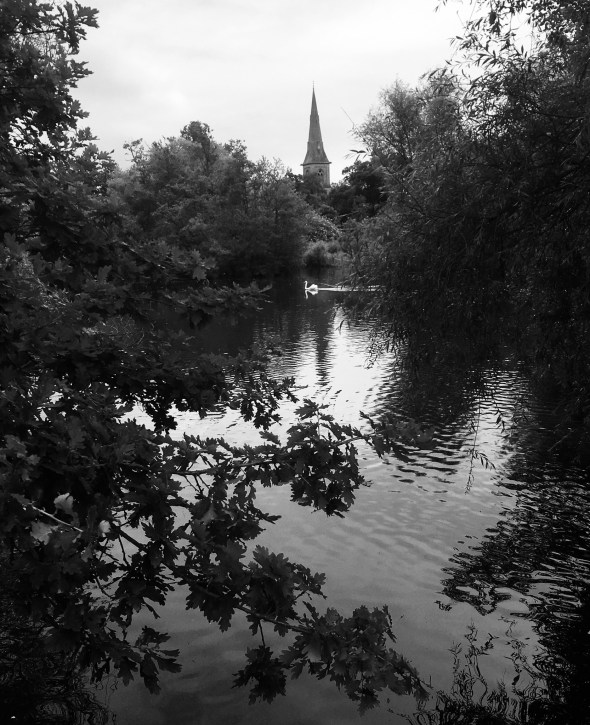
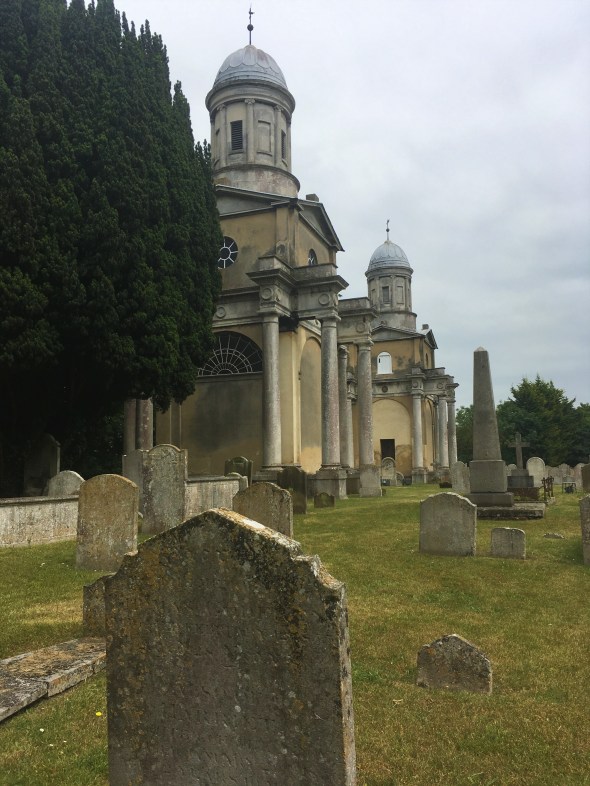
I headed to Manningtree, passing Mistley Towers, erected as part of a failed scheme in the late 18th century to reinvent Mistley as a saltwater spa town. The twin towers that remain are all that’s left of a grand Georgian church, designed by Robert Adams and eventually demolished in 1870. I walked over the Hopping Bridge – in broad daylight I saw no ghosts. A lone swan glided across the still waters of the pond.

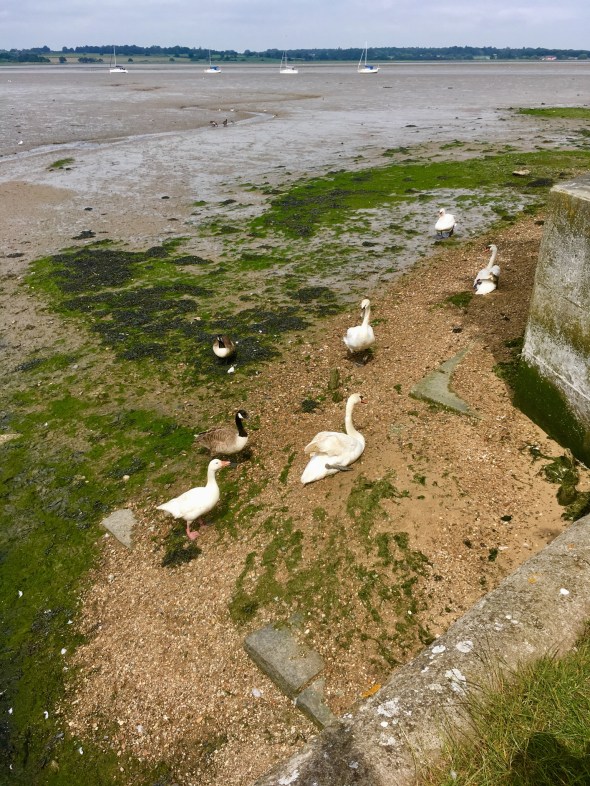
Across the road, following the south bank of the River Stour along what’s known as The Walls, I encountered more of these graceful birds. Mistley has been traditionally associated with a large population of mute swans, which have made their home here since the 18th century. Back then, as barley and other grain was unloaded at the quayside, some would be blown by the wind into the waters of the Stour and its tributary channels. Not surprisingly, the swans hung around to feed off this grain and have done so ever since. These days, those that remain are part of a domesticated herd.

4DA681D3-740D-4ED0-8F65-89C9DEF7F07F

The sun was out, fittingly for what’s termed the Essex Sunshine Coast, and I couldn’t resist an ice cream as I walked towards Manningtree. In Tudor times a centre for the cloth trade, later a port, Manningtree claims to be England’s smallest town (by area, not population). The town also gets a mention in the Shakespeare play Henry IV Part One, as Falstaff is likened to a “roasted Manningtree ox”. The Witch Finder’s evil reach extended to Manningtree too, for it was here that some of his victims were hanged, and the town sign bears his picture.

With bunting out and kids playing on the town beach, it was hard to imagine such troubled times. As I made my way to the train station, I thought what a pleasant afternoon I’d had on my latest #railadventure.

The lowdown

I received free train travel from Greater Anglia in exchange for writing this review of my #railadventure, but there are some great deals to be had for paying customers, particularly if you travel off peak. For instance, if you book in advance, tickets from Norwich to London are available at just £10, Cambridge to London at £7 and Southend to London at just £5 (all fares quoted are one way). Accompanied children travel for just £2 return and you don’t even have to pre-book for their ticket as this fare is valid on all off peak trains within the Greater Anglia network. On top of this, they are offering  2FOR1 on top London attractions, helping your summer holiday budget stretch further.

Discover destinations and ticket prices at www.greateranglia.co.uk and plan your journey at www.nationalrail.co.uk.

Did you feel inspired to plan your own rail adventure after reading this blog? Why not complete Greater Anglia’s survey using this link:

https://www.surveymonkey.co.uk/r/5CG9TGG

East vs west: routes to New Zealand compared

I’m just back from my latest trip to New Zealand and this time took a different route, flying west from London to Los Angeles and then on to Auckland instead of the easterly route I followed before which took me via Singapore. Both flights were on a Boeing 777 but how do the routes compare and which do I recommend?

airport-1937761

West: via Los Angeles

I was tempted by an excellent Black Friday deal offered by Air New Zealand. By signing up to email alerts with Secret Flying (you might remember their tip off saw me travel business class from London to New York for under £350), I learned of a special offer. Fifty flights were on offer for just £399, which is exceptional value for a trip that takes 26 hours in the air westbound and 24 coming back. I went online and uploaded my details to the Air New Zealand site in preparation for the offer to go live, saving valuable minutes and ensuring I was one of the lucky recipients.

aircraft-742833

In practice, one of the downsides to travelling in this direction is of course having to go through the US immigration process. An ESTA is required for UK passport holders even if they are only in transit; this costs about £10 but is valid for up to 2 years. I’ve just renewed mine and incidentally, it’s a more detailed form than before. On the outbound leg, passengers transiting on NZ1 were fast-tracked to some empty kiosks and desks which saved a fair bit of time on the regular queues. This wasn’t the case on the inbound leg, NZ2, when we were all directed to the main queue, adding about fifteen minutes to the process.

Though it isn’t necessary to fill out a customs form or clear customs, there’s still the requirement to queue through security. This took about fifteen minutes on both legs. NZ1 and NZ2 use the same plane for both legs, with suitcases remaining in the hold. Passengers must alight and take all hand luggage with them while the plane is cleaned and restocked. Some passengers only fly one of the legs. I found that the London to LA (and vice versa) part of the flight was considerably less full than the LA to Auckland segment.

usa-2661636

I had hoped to be seated in a Skycouch row. Air New Zealand’s trio seats on either side of the plane are fitted with pull out, sturdy padded footrests which can be converted into a couch. You have to pay extra for this and not all reports are good, with some travellers saying it’s hard for a couple to get comfortable enough to sleep. For a comprehensive review of Skycouch, why not take a look at this excellent review from etrip.tips?

Air NZ Skycouch: Flying Cuddle Class to San Francisco

As a solo traveller, to be able to guarantee the use of one of these would have signifcantly increased my fare. On the inbound LA to London leg, the Skycouch adjacent to my centre section aisle seat was vacant. Cabin crew did not permit me to use it, however. Instead they moved a mother and baby there which is fair enough as they were more in need of the space than me. However, this kindness resulted in the family being split on opposite sides of the aircraft. Throughout the flight they came and went, knocking my seat and making sleep difficult for me. The baby slept soundly like, well, a baby.

city-1031706

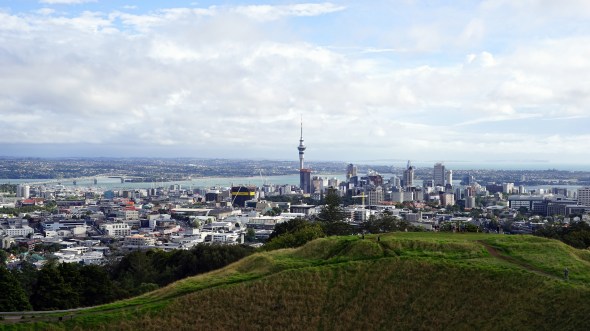
The outbound leg was quicker than scheduled, taking 10 hours 30 minutes from London to LA, followed by a layover of 2 hours 5 minutes and then an onward flight of around 12 hours 30 minutes. Auckland Airport was very busy when we touched down around 5.15am and I wasn’t on the bus out of the airport until well after 7am. However, I was fortunate that my hotel room was available and after showering, enjoyed a pleasant day’s sightseeing without the need for a nap. Julia 1 Jetlag 0. Now I’m home, I can report to have been very tired for a few days but not very jetlagged as I was going to bed and waking at normal times.

auckland-2160547

Verdict

Though transiting the USA wasn’t an issue and there was no danger of missing the second leg of the journey as it used the same aircraft, the short layover wasn’t enough to stretch my legs properly, take a shower or have a sleep in a proper bed. The food and entertainment were both above average, yet over such a long time in the air I found the time dragged, particularly on the second half of the journey. Also, so many seats required additional payment (for extra legroom, priority boarding or of course the Skycouch option) it meant that the availablity of my preferred aisle seat was very limited. I checked in online immediately the systems opened but even so, only three aisle seats were showing as available and no window seats.

East: via Singapore

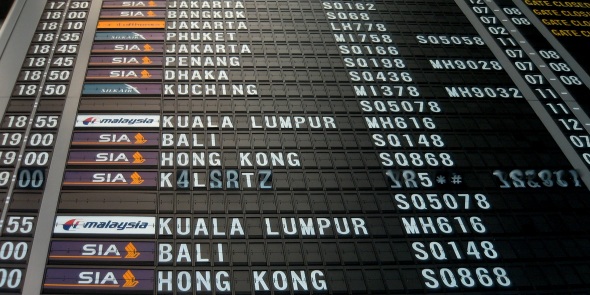
I’d call this the classic route for Brits travelling to Australia or New Zealand. Asian stopovers are a popular choice, and especially Singapore as Changi Airport has such a stellar reputation. I used Singapore Airlines in 2013 and wasn’t disappointed.

asia-1782429

Outbound, I opted for an 8.30pm departure with Singapore Airlines, an overnight flight which reached Singapore at 4.30pm the following day. As my second leg flight didn’t depart until after 9pm, there was plenty of time to enjoy an unhurried dinner, a shower in the airport hotel and a stroll around the airport’s orchid garden. I could have visited Changi’s cinema to catch a movie, but figured there’d be plenty of opportunity for that on the flight itself.

singapore-1383023

The inbound flight departed Auckland at 12 noon, arriving in the Asian hub at about 7pm. I chose to extend the layover to facilitate a night in a nearby hotel. My second leg thrrefore left Singapore at 9am the following day, reaching London by about 3.30pm that afternoon. This didn’t come at any extra cost, and the chance to stretch out in a full length bed with decent bed linen was very much appreciated. I came back to the airport the following morning considerably more refreshed than I did arriving from LAX.

city-1283634

On both legs, I was easily able to secure my preferred aisle seat and would have been able to get a window seat if I’d have wished. Meals were good and the inflight entertainment system as good as you’d expect from an airline which regularly secures high approval ratings from travellers.

Where this option falls short, however, is the increased risk of jet lag affecting the first few days of your holiday. Some people swear by a stopover to give them time to adjust. Personally I think that just means you need to put your body clock through two changes in just a few days which isn’t ideal. However, it’s a good way of seeing a bit of Asia if you haven’t visited before. As well as Singapore, Hong Kong, Kuala Lumpur and Bangkok are conveniently located. Hubbing through Dubai is possible but the two legs are pretty uneven and it is hard to psyche yourself up for that second leg from Dubai to the Antipodes as you’ve barely covered a third of your total journey time at that point.

singapore-1896764

Verdict

I found the overnight layover with a hotel stay made the Singapore option considerably less arduous. The lengthy outbound layover was also helpful. I’d done something similar with Malaysian Airlines to Sydney, hubbing through KL. That time, however, the jetlag was fierce and I remember stumbling around Sydney as if drunk on the first day before crashing and sleeping it off. I’ve read that for every hour’s difference in the time zones travelled, your body needs a day to recover. In practice, if you keep hydrated and try to sleep on the plane it can be considerably less than that. Arriving in Auckland from Singapore, I expected the jetlag to kick in, but in fact enjoyed a pleasant day pottering about Ponsonby before heading off to bed about 8pm.

hands-600497

So would I choose east or west next time?

Price would be a deciding factor but unless I got an especially good deal I’d pay a little extra to fly eastbound and a bit more on top to be able to have a night’s sleep en route. As I get older, I really need the rest, though as a twenty something, getting to NZ as fast as possible would rank higher in the list of priorities. I was lucky not to have to suffer a middle seat with Air New Zealand so I’d look for an airline which permitted seat allocations at the time of booking, something which is increasingly being phased out as airlines seek to raise income. What I would say is that the US immigration and security procedures and staff which tend to put a lot of travellers off transiting via an American airport really shouldn’t. I’ve noticed in the last few years that staff attitudes have improved immensely and the norm is now a polite and friendly welcome.

Have you flown from London to Australia or New Zealand? Did you do it in one go? Which route gets your vote?