
Looking at the familiar with fresh eyes
“The whole object of travel is not to set foot on foreign land; it is at last to set foot on one’s own country as a foreign land.”
London born writer Gilbert K. Chesterton wrote this oft quoted phrase about Battersea in his essay “The Riddle of the Ivy”. It’s an idea I’m embracing while out and about in my home county of Essex.
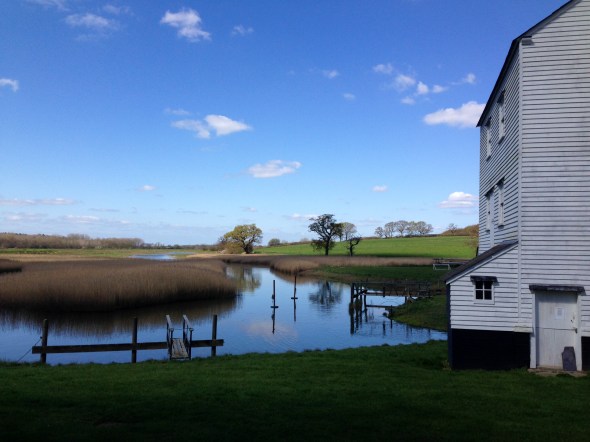
Thorrington Tide Mill
Often overlooked in favour of neighbouring Suffolk or Kent, the greatest pleasure for me of travelling in my local area is the lack of visitors in all but the most obvious of destinations.

In the grounds of Layer Marney Tower
Researching for Countryside Dog Walks, I’ve quite literally walked for miles without seeing a soul. It’s taken me to parts of the county I’ve never visited and to my delight, I’ve had as much enjoyment discovering new sights in my own backyard as I’ve had anywhere in the world.

Marks Hall Arboretum
Part of the joy of independent solo travel for me is to unpick somewhere new, to learn how it’s constructed and to find out how it ticks. Realising I can still do this in Essex has been a satisfying revelation. Another great British writer, Lawrence Durrell, famously wrote:
“Travel can be one of the most rewarding forms of introspection.”
Walking along the Essex coastline and through its surprisingly empty countryside, the lack of specific sights and attractions makes it perfect for pondering while wandering. Life’s full of things to be done and these walks feel deliciously self-indulgent, yet unlike a big trip, they only require me to take a few hours off.
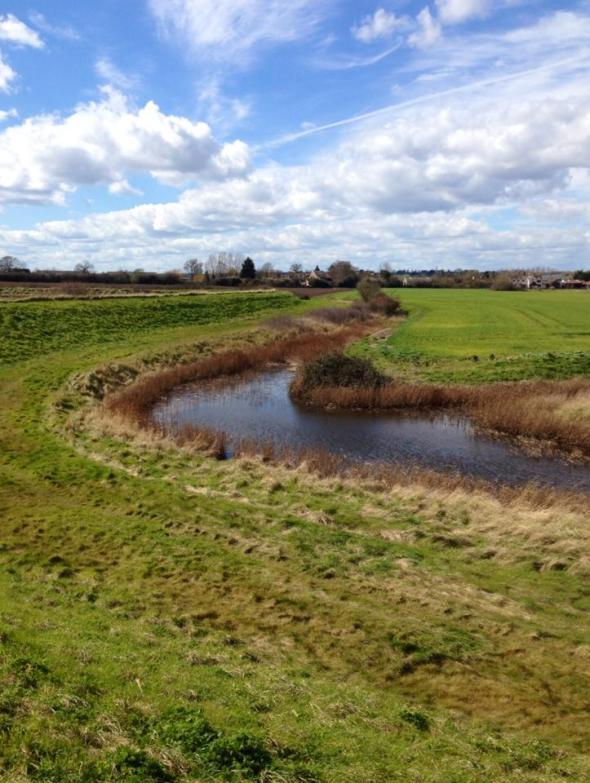
Salcott Creek
Being alone makes me more in tune with my surroundings. Sounds that are concealed by conversations push their way in to a solo walk. The salt marsh fizzing, the wind vibrating the rushes, the stream trickling – all lost unless you really listen. For me, one of the biggest distractions from the landscape is my camera. It can be hard to give up the search for the perfect shot and just look without a lens. But when I force myself to do so, it’s more than worth it.

Lion Creek, Paglesham
To find out more about the hidden corners of Essex, why not visit my Essexology blog? You’ll find it at http://www.essexology.com
Are these the world’s best railway journeys?
This week, in preparation for my upcoming trip to Sri Lanka, I’ve been booking train tickets to explore the country’s beautiful hill country. The Man in Seat 61 has, of course, been an invaluable tool as ever, and I’ve been very impressed with the service provided by Visit Sri Lanka Tours, a recommendation gleaned from Seat 61. It’s got me thinking about previous rail journeys I’ve taken. These are my favourites, but are they yours?
Peru: Cusco to Machu Picchu
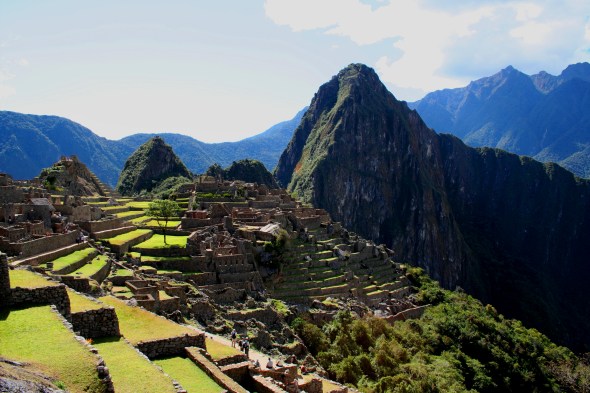
Machu Picchu, Peru’s mighty Inca citadel
Before tourist numbers reached epic proportions, to reach Machu Picchu by train you used to have to crawl out of bed in the dark to catch the early morning local train from central Cusco’s gloomy station, travel for five hours as the wooden bench seating slowly petrified your buttocks and emerge blinking into the middle of the market at Aguas Calientes to find your diesel-belching ride to the famous mountaintop Inca ruins. Periodically, the train halted in the dark to facilitate trade. Hands used to appear through the tiny windows to offer roasted corn and alpaca wool hats. It was one of those iconic travel journeys that is better relived from the comfort of your armchair several months later. Taking the journey again years later, this time in a glass-roofed backpacker train (boy, hadn’t backpacker expectations grown?!) I was delighted to see that snow-capped peaks lined the route and that the PeruRail authorities had built a fancy new station. The increase in comfort was worth the hike in the fare and best of all, the switchbacks to enable the train to haul the train out of Cusco’s bowl-shaped valley were still the most fascinating stretch of the journey. Then, in 2010, flooding and landslides caused severe damage to the track and when repairs were completed, the train began from Poroy, just outside the city, rather than from Cusco’s Wanchaq station. Despite the changes, it remains one of the best railway journeys in the world.
Switzerland: the Bernina Express
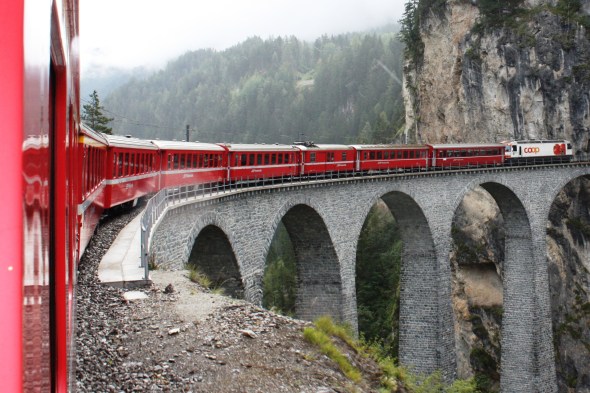
The Landwasser viaduct from the Bernina Express
It’s hard to pick a favourite amongst so many standout lines, but if forced to choose, then the Bernina Express gets my vote. Run by the Rhaetian Railway, the Bernina Express covers two lines which together comprise a UNESCO World Heritage site – Albula and Bernina. During its 122km run from Chur to the Italian town of Tirano, the train passes through 55 tunnels and over 196 bridges and viaducts including the spectacular Landwasser Viaduct pictured here. To fully appreciate this engineering marvel, take a local train (the panoramic picture windows don’t open), head to the back and lean out of a right hand side window. The train loops and glides over the Bernina Pass, with the Morteratsch and Palü glaciers and alpine Lago Bianco darker Lej Nair lakes providing the glamour in terms of scenery. With no cogwheels aiding its descent, this impressive adhesion railway has one final wow up its sleeve: the 360° spiral that encompasses the nine arches of the century-old Brusio Viaduct.
Kenya: the Lunatic Express

Mombasa’s beach, the prize for those surviving the Lunatic Express
I first read about this railway in Bill Bryson’s African Diary. His descriptions of being flung around as if being tumbled in a washing machine were as compelling as you’d expect from the undisputed king of humourous travel writing and I decided there and then I’d make the same journey. This narrow gauge railway runs from Nairobi to the coast at Mombasa, cutting through Tsavo National Park on its way. It gained its unusual nickname as several workers involved in its construction ended up as dinner for the hungry lions, dragged from their tents as they slept exhausted from the day’s hard labour. I didn’t see any lions, just a beautiful sunset over the savannah plains, though I was plagued by hungry mosquitoes and arrived in Mombasa covered in bites.
The best of the rest!
Russia: Trans-Mongolian
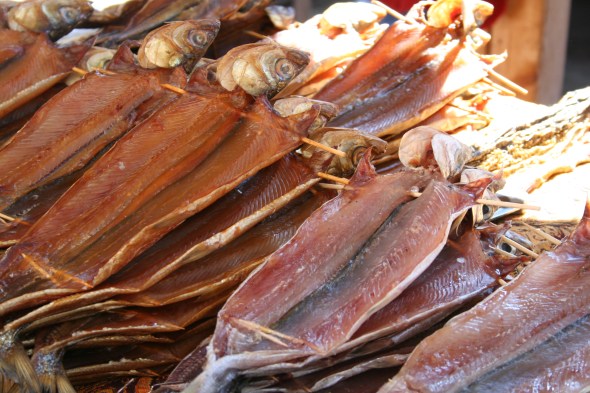
Omul on sale at Listvyanka, on the shores of Lake Baikal
The longest rail trip I’ve done, with a trip that took me from Moscow to the Mongolian capital Ulan Bator by train. I saw a lot of trees, but I also learned first hand what a warm and welcoming bunch of people the Russians are: a special mention here for Aleksander the army officer who fed me smoked omul and showed me his family photos.
New Zealand: Tranz-Alpine
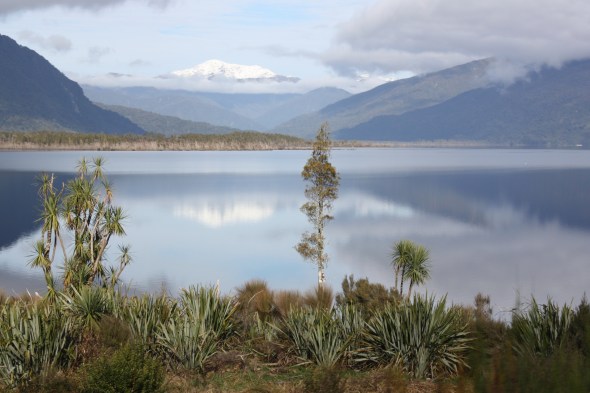
Serene Lake Brunner
Not the Alps in Europe, but instead, New Zealand’s South Island. Crossing from Christchurch to Greymouth, this scenic ride crossed Arthur’s Pass and chugged alongside pretty Lake Brunner. Wrap up warm if you’re going to ride the open air viewing car in winter as I did – it’s freezing!
Update: I’ve just booked a ride on the Northern Explorer to see more of North Island out of a Kiwi Rail train window. Watch out in 2018 to see how I got on.
The Devil reads Pravda?
Putin’s “Don’t mess with me” attitude and his questionable actions and policies have given Russia back its bad name. But don’t let that put you off visiting: Russia’s an absorbing and diverse country which deserves your attention. The reality of a holiday in Russia is is as far removed from the country’s political reputation as it gets: http://travelexperts.justgorussia.co.uk/2015/10/13/whats-it-really-like-to-holiday-in-russia-nowadays/

Steve Sack, Star Tribune
When I took a rail holiday following the Trans-Mongolian route, I had no idea what to expect, but my most enduring memory from that fortnight is of the warmth of the Russian people. From the army officer who shared his food and photos of his wife to the little old lady who made sure I got the right bus back to Irkutsk from Lake Baikal, I experienced a welcome that, if I’m honest, I didn’t expect. You can read more about it here: http://travelexperts.justgorussia.co.uk/2015/11/03/russia-by-rail/

Family time by Lake Baikal
Really, the only gruffness came from the guards at Lenin’s Mausoleum who shooed me on when I paused just a little too long to look at that waxy body. The provodnitsas on my trains ran a tight ship, for sure, but they needed to make sure everything ran smoothly – who wants to witness an altercation from a sleeping compartment when you didn’t plan to get off the train for three days?
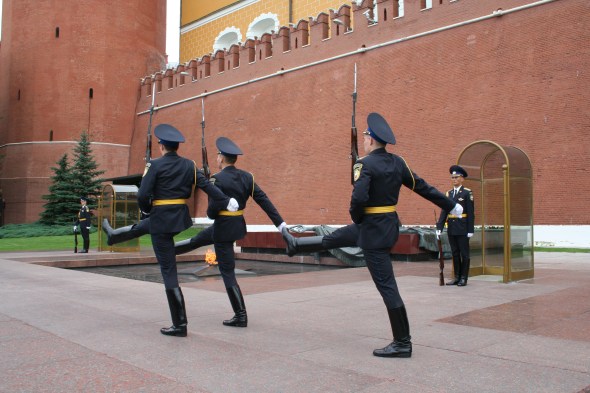
High kicks of which a dancer would be proud
For me, Russia was a country of immense beauty; from Suzdal’s magical churches to the tumbledown wooden shacks of rural Siberia, the country presented photo opportunity after photo opportunity.

Suzdal is packed full of historic churches
Moscow was fascinating, and aside from rather wet walk through flooded streets on arrival, a city I enjoyed immensely. The language and alphabet are different, but didn’t prove an insurmountable problem, and there are plenty of companies out there to assist with booking train tickets and securing visas.
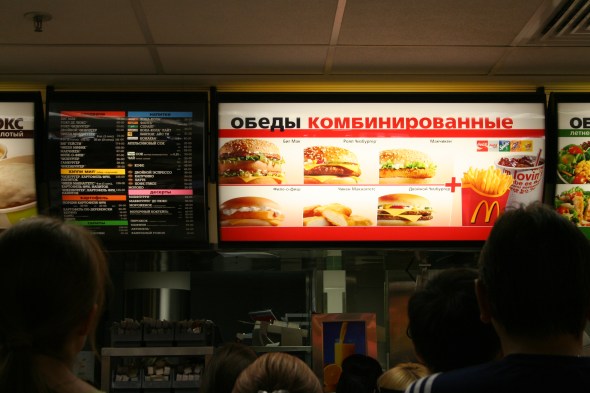
If all else fails, look for somewhere with a picture menu

Or an English menu!
My advice is to go. You’re hardly likely to bump into Putin in a country that size. Why not read some more of my blogs for Just Go Russia and see what you’d be missing. Here are just a few:
A diverse country http://travelexperts.justgorussia.co.uk/2015/10/12/dobry-den-welcome/
Northern Lights http://travelexperts.justgorussia.co.uk/2015/12/10/see-the-northern-lights-in-russia-this-year/
Historic treasures http://travelexperts.justgorussia.co.uk/2015/10/30/the-kremlins-hidden-treasures/
Enjoy your trip!
If it’s geysers you’re after…
If it’s geysers you’re after, then here’s where you need to be heading.
Iceland
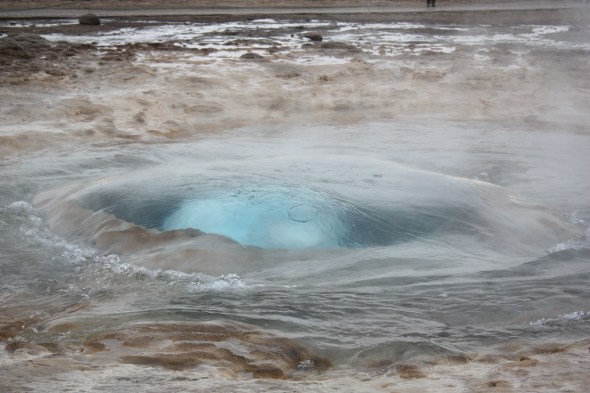
Strokkur on the verge of blowing
The original, in name at least, can be found a short distance from the country’s capital Reykjavik. The original geyser, Geysir, has decided it’s had enough, but Strokkur puts on a show every few minutes delighting those who visit. It’s easily accessible as part of the Golden Circle tour, or if you prefer to go it alone, then download my Unanchor Kindle guide from the UK Amazon site here: http://www.amazon.co.uk/Iceland-Unanchor-Travel-Guide-self-drive-ebook/dp/B017SDBNE8/ref=sr_1_8?s=books&ie=UTF8&qid=1452095658&sr=1-8.
It’s also available on the US site here: http://www.amazon.com/gp/product/B017SDBNE8/ref=s9_simh_gw_p351_d0_i1?pf_rd_m=ATVPDKIKX0DER&pf_rd_s=desktop-1&pf_rd_r=152KPS2974X3G9P0D5RQ&pf_rd_t=36701&pf_rd_p=2079475242&pf_rd_i=desktop
New Zealand

Pohutu, Rotorua
For a small country, New Zealand packs in a lot of geothermal sights, from other-worldly Craters of the Moon to photogenic Orakei Korako. But for sheer wow factor, then join the crowds watching Pohutu, located in the Te Whakarewarewa Thermal Valley on the outskirts of Rotorua to see the jet of boiling water shoot high into the sky.
Chile

Atmospheric El Tatio
El Tatio geyser field might not have the dramatic gushers of Iceland or New Zealand, but it has atmosphere in spades. It’s essential to crawl out of bed in the middle of the night (don’t overdo it on the pisco the night before like I did) but watching the sunrise illuminate the steaming geysers is well worth the effort.
USA
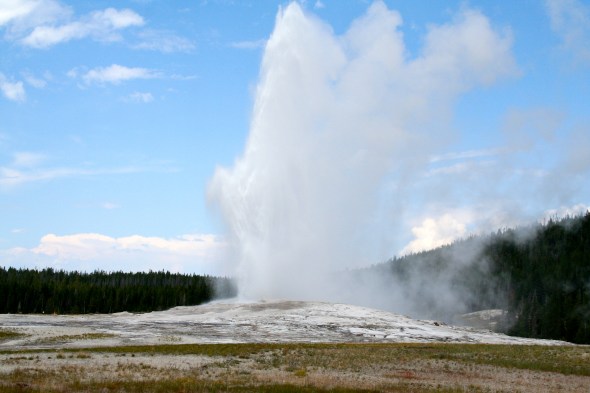
Old Faithful
I couldn’t blog about geysers and leave out Old Faithful. It’s been drawing the crowds at Yellowstone National Park for as long as the park’s been in existence and has had its name since 1870. It erupts on average 50 metres into the air about every 90 minutes or so; check the ranger’s board on arrival to see when the next show is expected.
And finally, one on the wish list…
Russia

Kamchatka by Einar Fredriksen via Flickr CC BY-SA 2.0
Kamchatka’s Valley of Geysers has the second largest concentration of geysers in the world after Yellowstone, packing over ninety of them into a 6km long valley. It’s difficult to reach, and therefore expensive, but it’s a trip that’s on my ever-growing bucket list. You too?
Weather to travel: London
Mention weather and Britain in the same breath and cue much eye rolling and sighing. You don’t go to the UK for the weather, sure, but it’s not as bad as the naysayers would have you believe, and you certainly shouldn’t be put off visiting.

Winter in Regent’s Park
The UK is influenced by a maritime rather than a continental climate and when it comes to the rain, that means our hills give a north west/south east split. So don’t panic if you’re headed to the UK capital and your news feed is full of flood pictures. Whilst the disruption is dreadful for those affected, London, in the drier half of the country, has had an average rainfall over the last three decades of just 557mm. 400mm or below would qualify it as a desert. If we compare that rainfall total to some of the major US cities, it’s less than half that which falls on Boston or New York City, and only a couple of hundred millimetres more than Los Angeles.
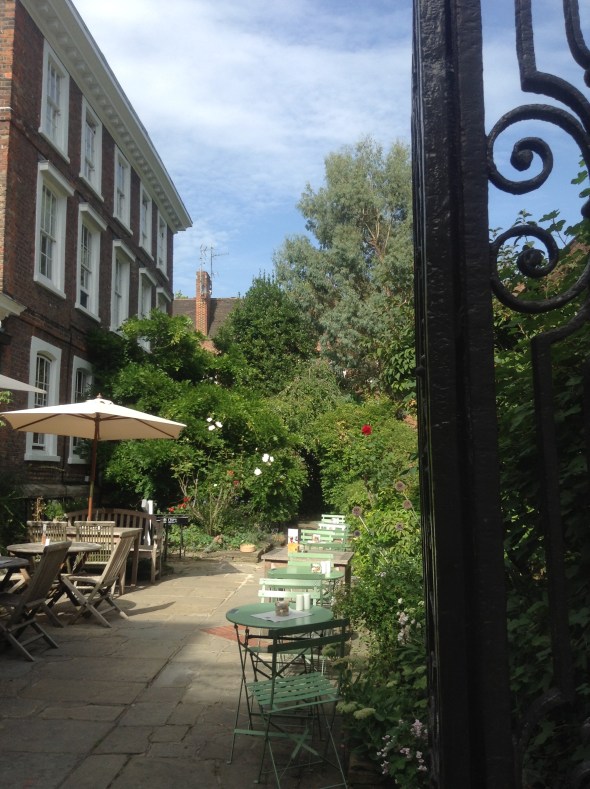
A summer morning in Hampstead
London’s rainfall is spread throughout the year, with the lowest totals seen in July. Typically, most months see rain about one in three days, but often that’s only a light drizzle and confined to short periods. Even in the autumn and winter, statistically the wettest, pack a brolly or a waterproof coat and you’re good to go. It’s not like there’s a dearth of indoor attractions to check out during a shower.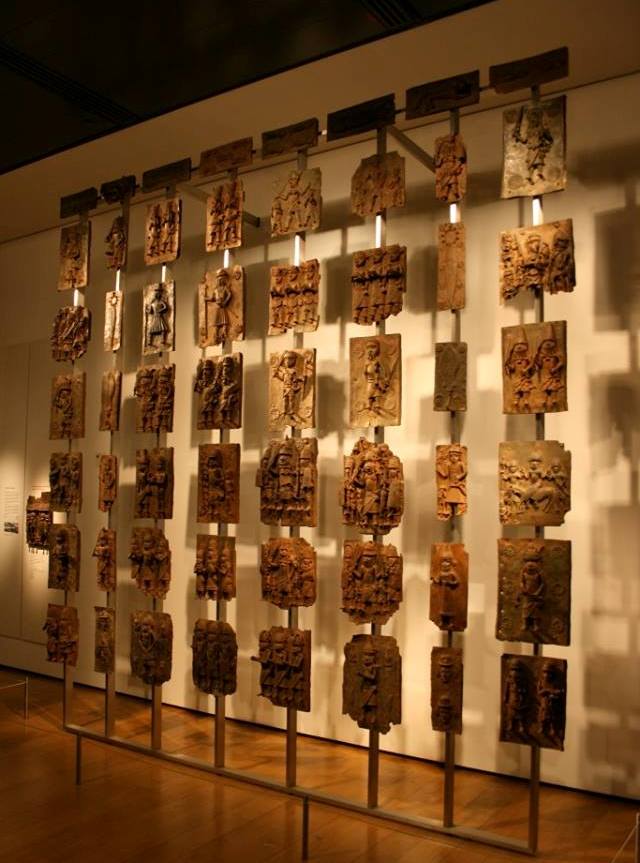 Masks from Benin on display at the British Museum
Clearly, at 50°N of the Equator, no one’s going to come to Britain in search of the scorching temperatures you’ll find in the Med, but sightseeing in big cities is no fun in sweltering heat. Here in the UK, we don’t see really hot temperatures often enough to warrant the expense of air conditioning, so if the mercury rises, London isn’t the best. If you do find yourself here in those circumstances (and you’ll know about it, believe me, because the newspapers will splash it all over the front pages), then avoid the Tube, grab a couple of cold drinks and head for one of London’s many green spaces.
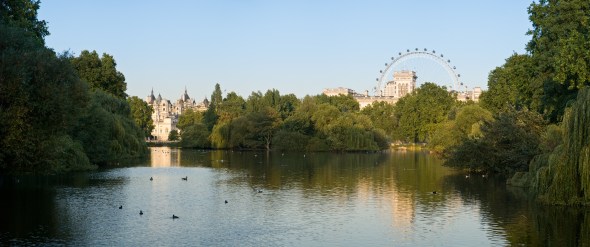
September in St James’ Park: photo by David Iliff CC-BY-SA 3.0
Fortunately, average temperatures even in the warmest month, July, rise only to about the mid-twenties (that’s Celsius and not Fahrenheit!). In the shoulder seasons of spring and autumn, it’s a comfortable 15-18°C and even in winter, the temperature rarely dips below about 5°C. Not for us those biting Arctic winds or toe-numbing blizzards. This year, it was a balmy 19°C the week before Christmas – exceptional but not a record.
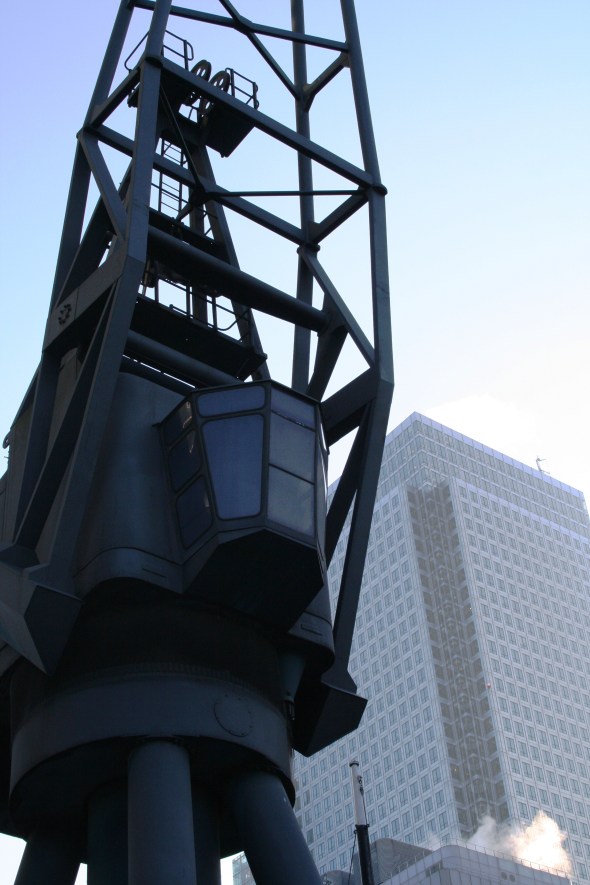
Docklands in the sunshine
So, remember what they say: there’s no such thing as bad weather, only bad preparation. Timing your London visit to miss the summer season gives you a chance of avoiding the worst of the crowds, so why not take a chance on the weather and come out of season. Enjoy your stay!
How to get the best out of a Heathrow layover (Part 2)
In my first blog on Heathrow layovers, I dealt with how you should go about getting into Central London.
Depending on how much time you have, there’s lots to do between flights – it’s London, after all – and you won’t be encumbered by heavy bags. If you have something in mind but aren’t sure if it’s feasible, and it’s not featured here, drop me a line via Facebook (Julia Hammond Travel Writing) and I’ll give you some ideas. Note: the time available is measured from when you emerge landside after landing to when you need to be back at the airport for your next flight. Allow at least 60 minutes to get through security and to your gate; you don’t want to miss that onward flight!
Time available 4 hours: NOTTING HILL
You’ll need to keep a close eye on your time with this amount of time. With this short a layover, you need to restrict yourself to the west of the capital.

Portobello Road Market
My suggestion is a quick visit to Notting Hill, a vibrant neighbourhood where Julia Roberts once filmed, Jimi Hendrix died and The Clash called home. Take the District or Circle lines two stops from Paddington to Notting Hill Gate and walk via Portobello Road, where you’ll find the famous market (stalls can be found in the area most days but it’s best to visit on Friday or Saturday) and there are some great eateries including the Hummingbird Bakery. If you have time, the excellent Museum of Brands on Lancaster Road is worth a stop.
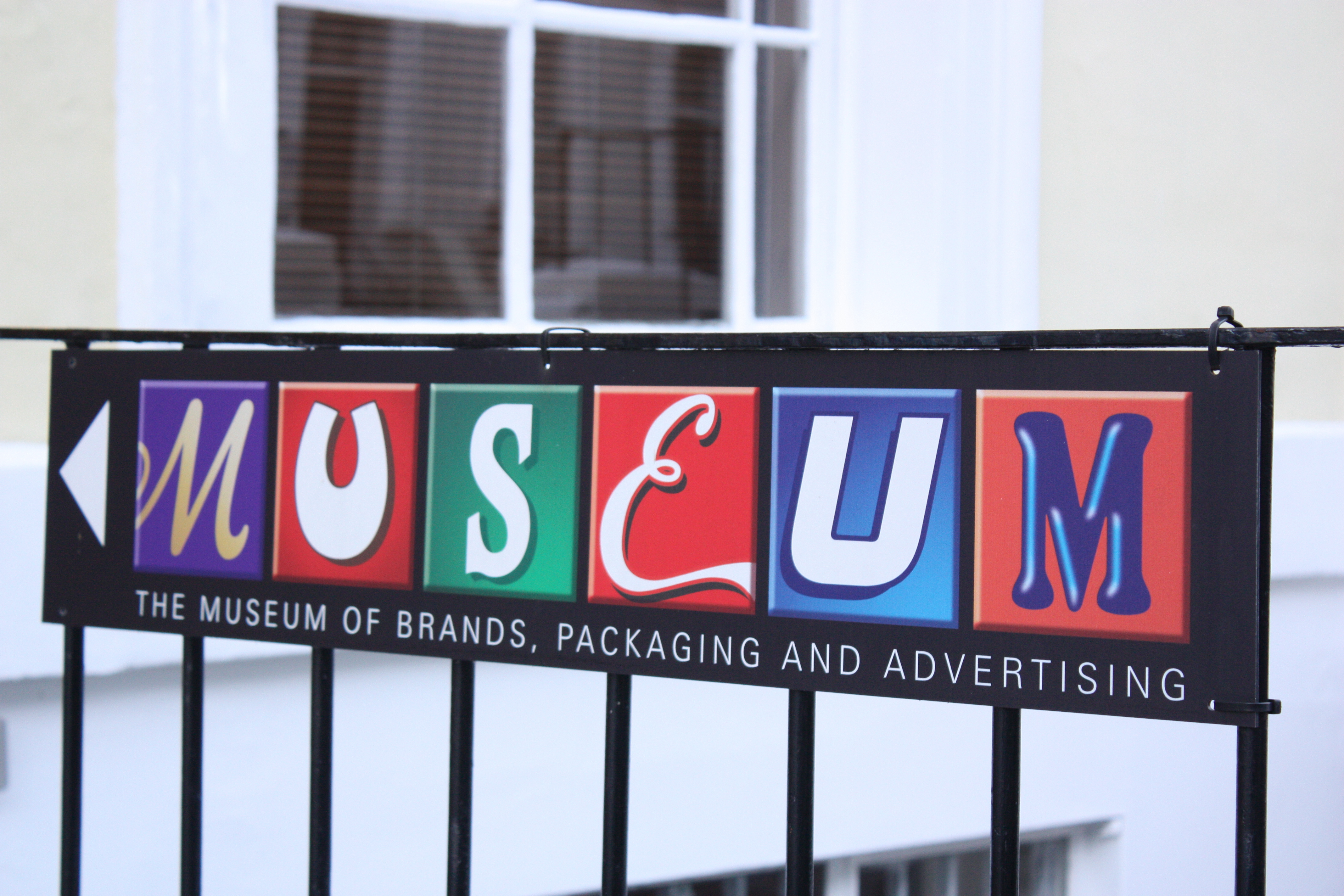
The Museum of Brands, Packaging and Advertising
When you’re done, there’s no need to walk back to Notting Hill Gate. Head back to Paddington from Ladbroke Grove tube station via the Circle or Hammersmith & City lines.
Time available 5 hours: MARYLEBONE
Marylebone, a neighbourhood squeezed between the West End’s shopping streets and beautiful Regent’s Park, is fast becoming the fashionable place to be seen in London. With an extra hour for your layover, you should have time to pay a visit to Sherlock Holmes at 221B Baker Street. Located between 237 and 241 Baker Street, it’s just a three minute walk from Baker Street Tube, linked to Paddington via the Bakerloo Line.

The Sherlock Holmes Museum
You’ll most likely see a policeman in a cape on the door, but be warned there’s often a queue to get in. It’s open from 9.30am to 6pm. Walk north from the museum and it’s only a few minutes to London’s beautiful Regent’s Park. With its elegant Georgian mansions framing the park and a mixture of manicured lawns and open space, this is one of the capital’s most beloved green lungs.

Regent’s Park
Cross over York Bridge, keeping an eye out for the herons sometimes seen here, and skirt the southern part of the park. When you’re ready to leave, use Regent’s Park station, one stop along from Baker Street on the Bakerloo Line. From there, it’s four stops back to Paddington or, if you have time, one stop down to Oxford Circus, still London’s main shopping artery and home to Selfridges & Co. department store, west of the tube station just past Bond Street. Alternatively, Marylebone High Street and its neighbouring streets have plenty to offer in terms of quirky boutiques and historic landmarks.
Time available 6 hours or more: HAMPSTEAD
With longer between flights, the whole of London is at your fingertips, so why not try somewhere that’s a bit off the beaten tourist track? Hampstead requires a change of Tube trains but is well worth the effort; take the Hammersmith & City or Circle Line as far as Kings Cross or the Bakerloo Line to Embankment, and then change to the Edgware Road branch of the Northern Line to travel to Hampstead station. Total journey time is about 35 minutes, so don’t be put off.

Hampstead “village”, packed with grand mansions and town houses
Hampstead feels more like a village in parts, but with phenomenal views from its vantage points across London, you can tick off the capital’s landmarks all at once. Try the view from Holly Mount, just down the road from the excellent Holly Bush pub or continue up to the Heath.
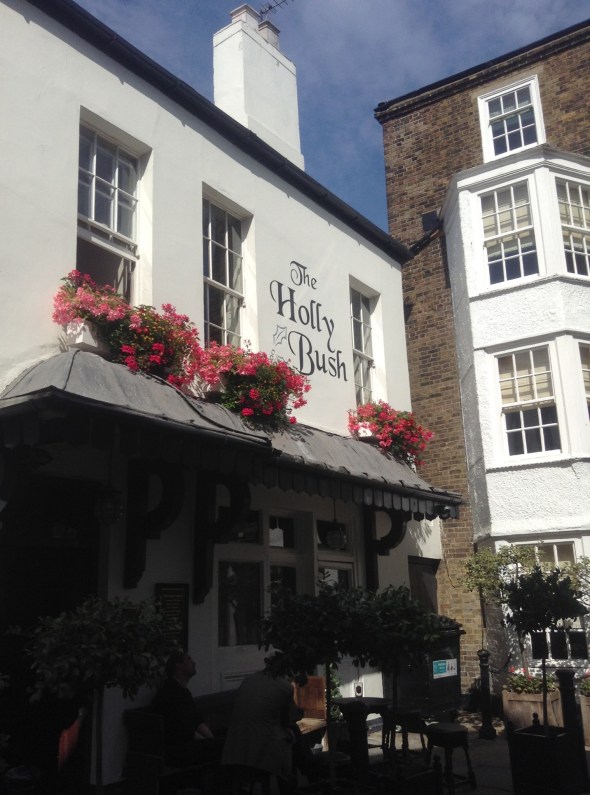
The charming Holly Bush pub
Hampstead Heath is well worth the trek up the hill. Walking across this huge open space will make you forget you’re in one of the world’s largest cities and help you realise why it’s also one of the world’s most liveable cities. On your way, take a detour along Hampstead Grove and you’ll pass a small observatory run by the Hampstead Scientific Society. Inside is a 6″ Cooke refracting telescope dating from the turn of the 20th Century.
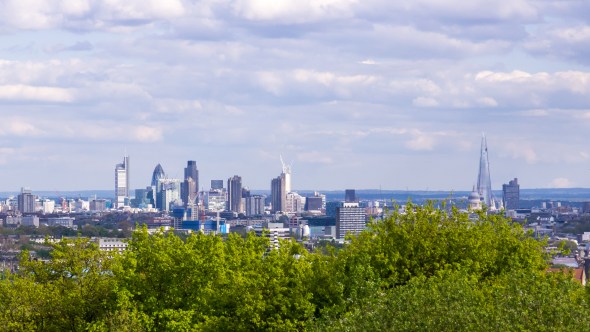
View of London from Parliament Hill, Hampstead Heath by Ed Webster via Flickr CC BY 2.0
On your way back to the High Street, stop to take a look at the house once inhabited by Ernő Goldfinger of Trellick Tower fame, who lived at Number 2 Willow Road. Local resident Ian Fleming, creator of James Bond, hated the modernist structure and allegedly took his revenge by naming one of his Bond villains after the man responsible for the eyesore.
Of course, if you don’t fancy Notting Hill, or Marylebone, or Hampstead, then there’s always St Paul’s Cathedral, Buckingham Palace or Big Ben. One short layover just isn’t going to be enough, of course, but these ideas surely beat staying in an airport lounge drinking coffee and browsing duty free shops.
And if you are tempted to come back, then why not try my Unanchor guide to London’s Villages, which consists of three day-long walking tours, one in each of the three locations featured above. Packed with ideas and information, it’s available on Amazon as well as direct from Unanchor.com and can be downloaded as a PDF or straight to your Kindle. Here are the links:
How to get the best out of a Heathrow layover (Part 1)
Flying via Heathrow? There’s no need to stay at the airport. Instead, take a trip into London and have a taste of what the British capital has to offer.
Part One: Getting to Central London

Notting Hill is comfortably doable on a layover
Take the train. Don’t be tempted with taxi or bus transfers; London’s traffic is too unreliable for you to risk wasting valuable layover time stuck in traffic. Instead, you have several options.
Most expensive, but fast, is the Heathrow Express. It takes 15 minutes to get from LHR to London Paddington station, from where you’re well connected by Tube to the centre and its attractions. Machines (and conductors) accept cash as well as credit and debit cards, but you’ll save a lot if you don’t use it.

Heathrow Express ticket machines

Heathrow Express Second Class
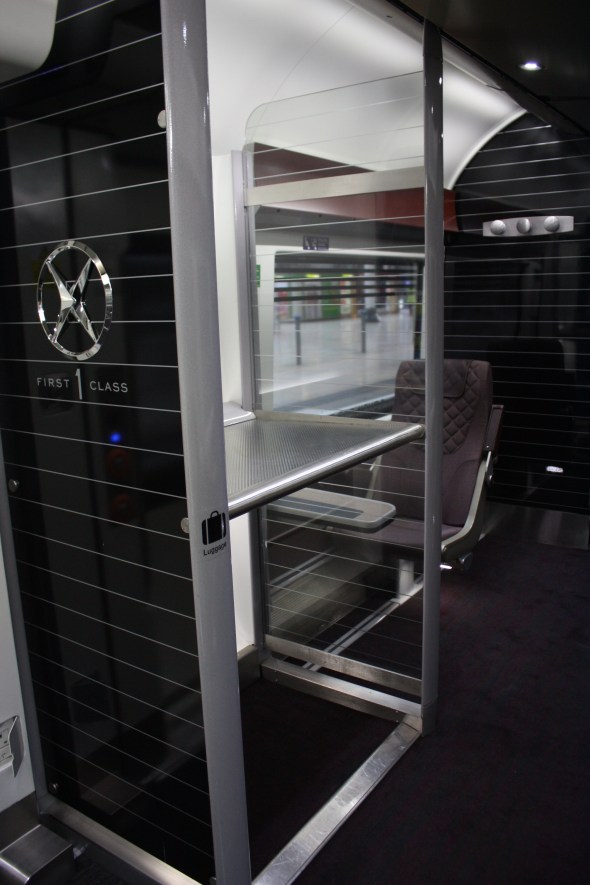
Heathrow Express First Class
However, there’s now a better way, which is almost as fast (quickest journey time to Paddington is 24 minutes) but significantly cheaper. The Elizabeth Line crosses London. Along the way it handily links Heathrow with key central London stations such as Paddington, Bond Street, Tottenham Court Road and Liverpool Street.
Cheaper still is the Tube, but it stops more frequently so your journey will take longer. The Piccadilly line connects Heathrow to popular tourist destinations such as Piccadilly Circus, Covent Garden, Hyde Park and Leicester Square. Journey times can feel tediously slow as the numerous stations aren’t far apart, but on average you’re looking at around 45 to 50 minutes to get into Central London. Fares vary according to the time of day and whether you have an Oyster card/tap in and out with a credit or debit card.
Useful links
Heathrow Express: https://www.heathrowexpress.com/
London Underground including information about the Elizabeth Line: https://tfl.gov.uk/
Tube and rail map: https://tfl.gov.uk/maps/track
Fares: https://tfl.gov.uk/campaign/new-fares
Heathrow transport information: http://www.heathrow.com/transport-and-directions#
For some well-known and more unusual suggestions for what to do once you’ve reached Central London, read my next blog: https://juliamhammond.wordpress.com/2015/12/09/how-to-get-the-best-out-of-a-heathrow-layover-part-2/
Travels closer to home
With no foreign trips planned until 2016, I’ve decided to focus on exploring the county that’s been my home for over four decades: Essex. In the beautiful October sunshine, this week I headed to Paper Mill Lock, a tranquil spot yet an easy drive from the county town of Chelmsford. It’s times like these that I’m glad to live in the driest part of the UK. In this sheltered spot, I had an al-fresco sandwich filled with thick butcher’s sausages and tangy onion chutney while watching a pair of ducks glide up and down alongside the boats.
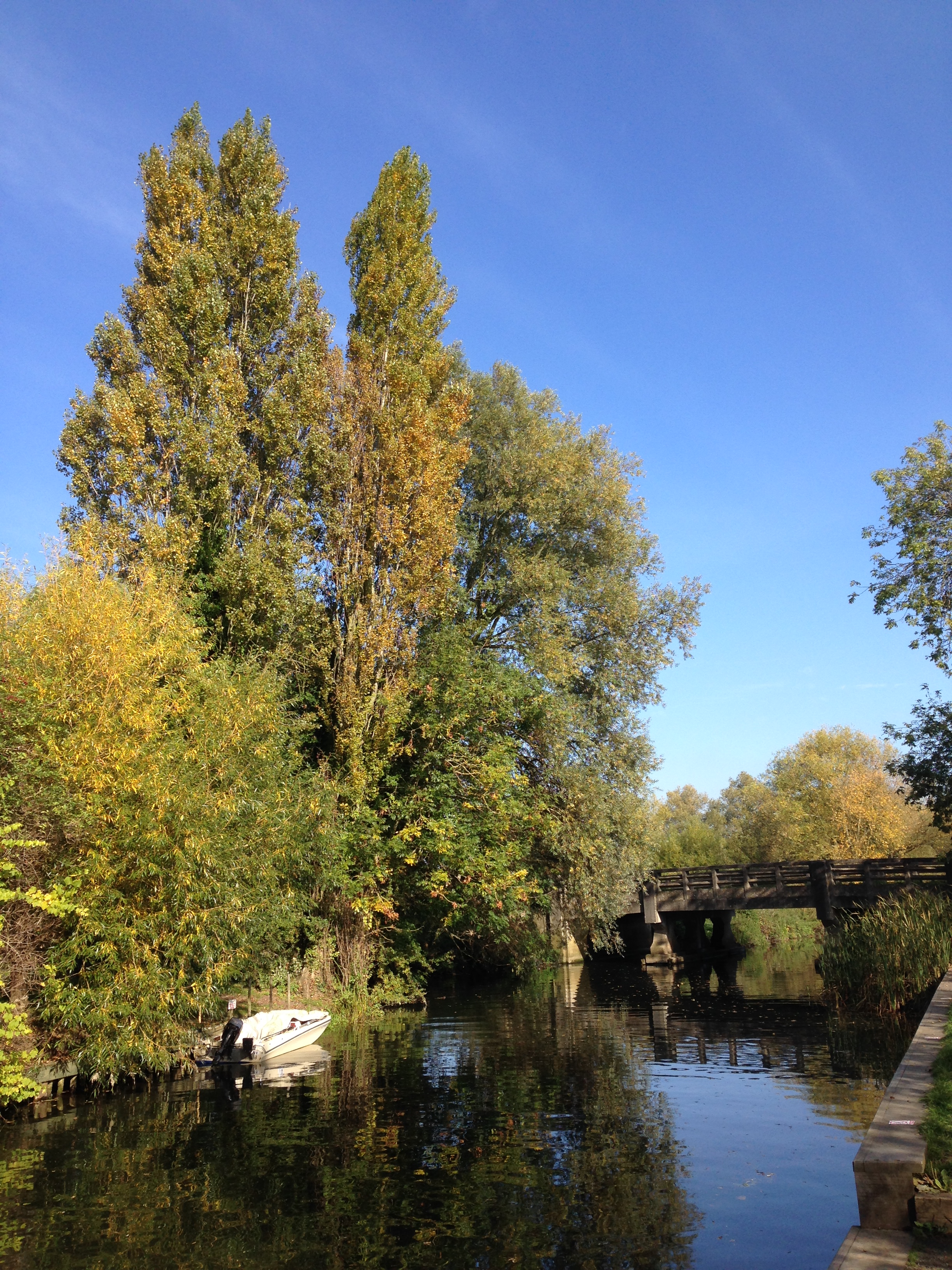
The Chelmer and Blackwater Navigation dates from the 1790s, linking Chelmsford to the coast near Maldon. In the early days, its cargo was mostly coal, bricks and timber heading inland; these days it’s a leisure and pleasure canal. The lock’s one of twelve; it takes its name from the paper mill that stood next to another grinding corn as far back as 1792. It’s possible to walk the length of the canal. At the coast, you’ll end up at Heybridge Basin where you’ll find a couple of decent pubs including the dog-friendly Jolly Sailor.

Rothenburg ob der Tauber – does Germany get any better than this?
Yesterday I had the good fortune to visit Rothenburg ob der Tauber, a well preserved walled mediaeval town on Germany’s Romantic Road. In summer, so I’m told, the town’s full of tour groups but in October, the crowds thin allowing you a little breathing space. And if you’re lucky, like I was, to be blessed with a beautifully sunny day, then it surely doesn’t get much better than this?

The most photographed spot in town: Plonlein and the Siebertor

Rothenburg’s side streets are just as quaint
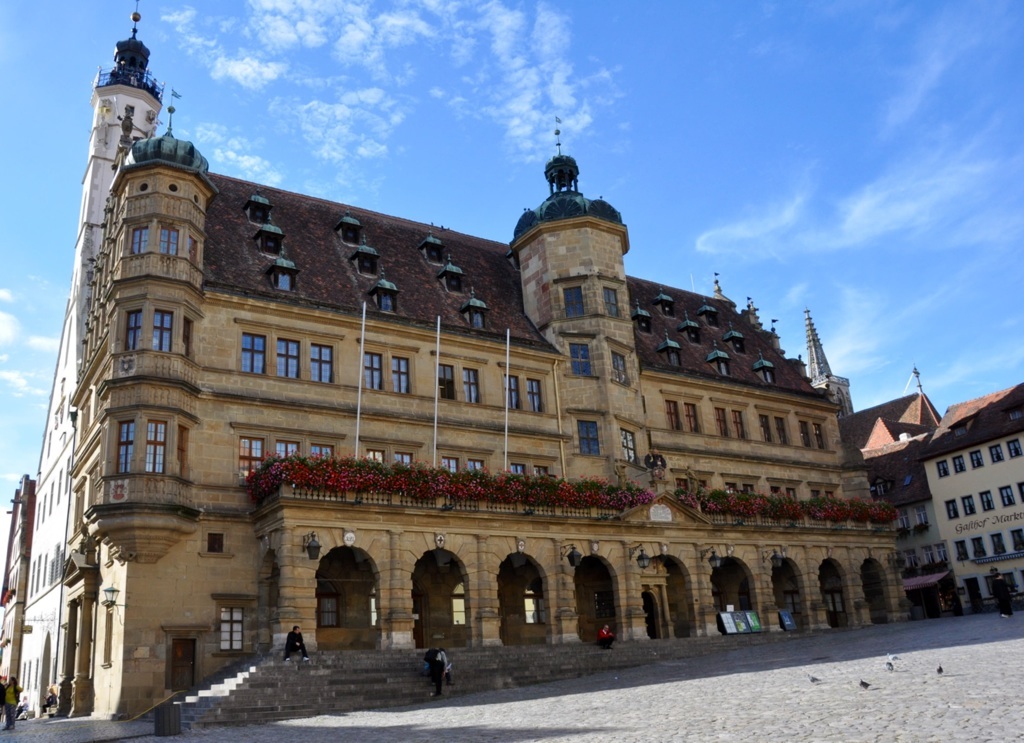
The Town Hall dates from 1250, Gothic style at the rear and Renaissance style at the newer front of the building (as pictured here)

Dancers from a visiting English theatre company perform in front of the tourist office, housed in a former tavern
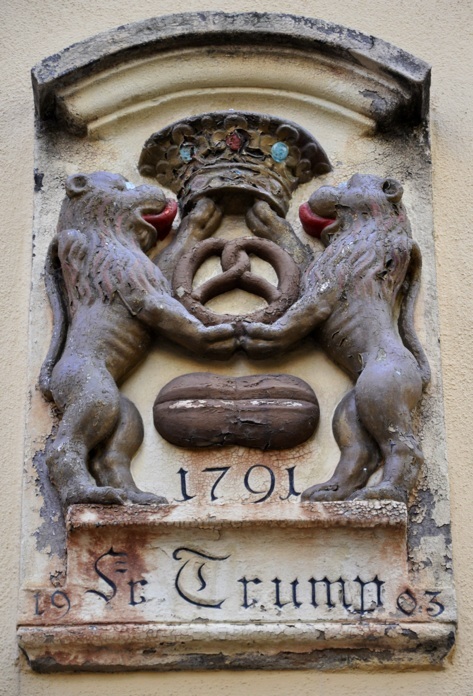
On a bakery wall

There’s nothing delicate about the local delicacy, Schneebälle

Troughs and window boxes crammed with flowers can be found throughout the town
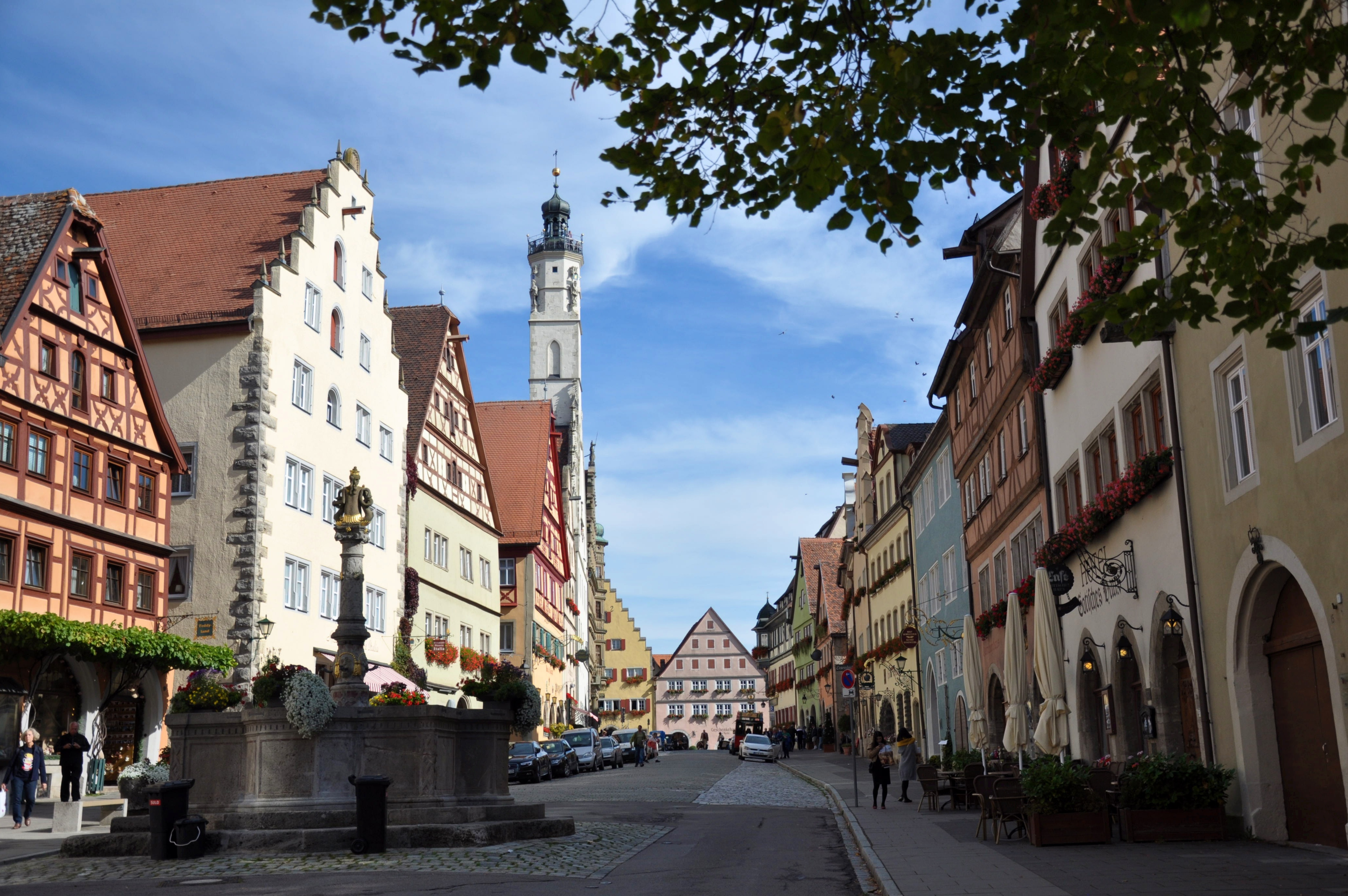
Herrngasse looking back towards the market square
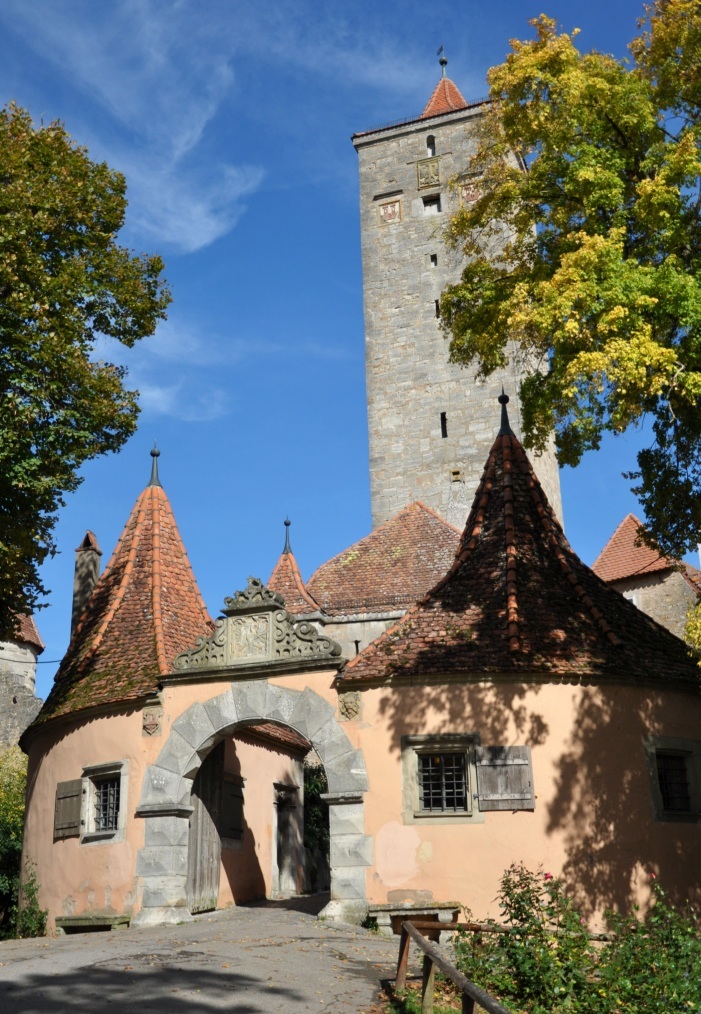
Burgtor featuring spectacular views across the Tauber Valley from the adjacent gardens
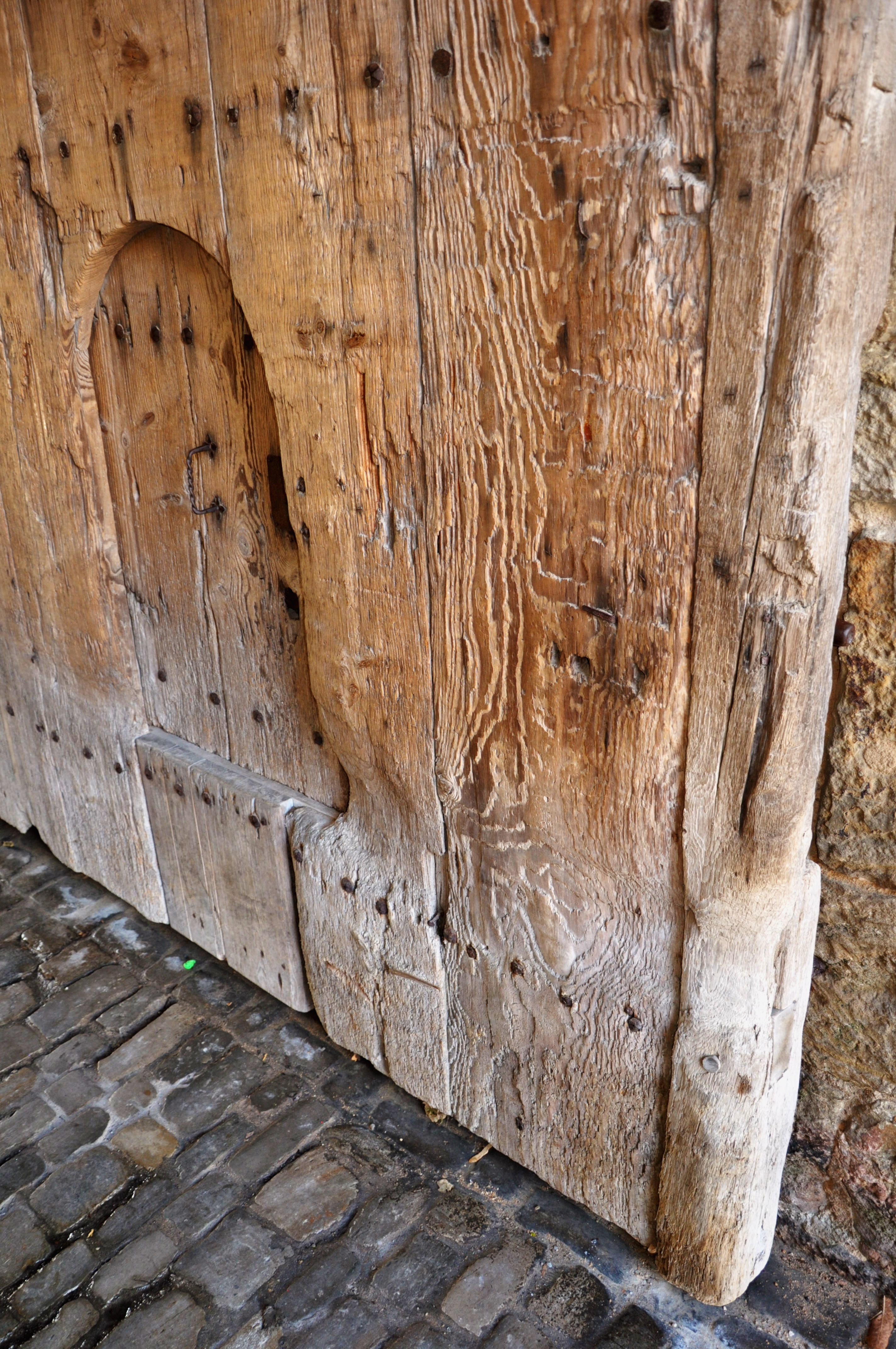
One of the old wooden gates

The bottom of Klingentor

Autumn colours, viewed from the bottom of Klingengasse

Mediaeval walls enclose the Old Town
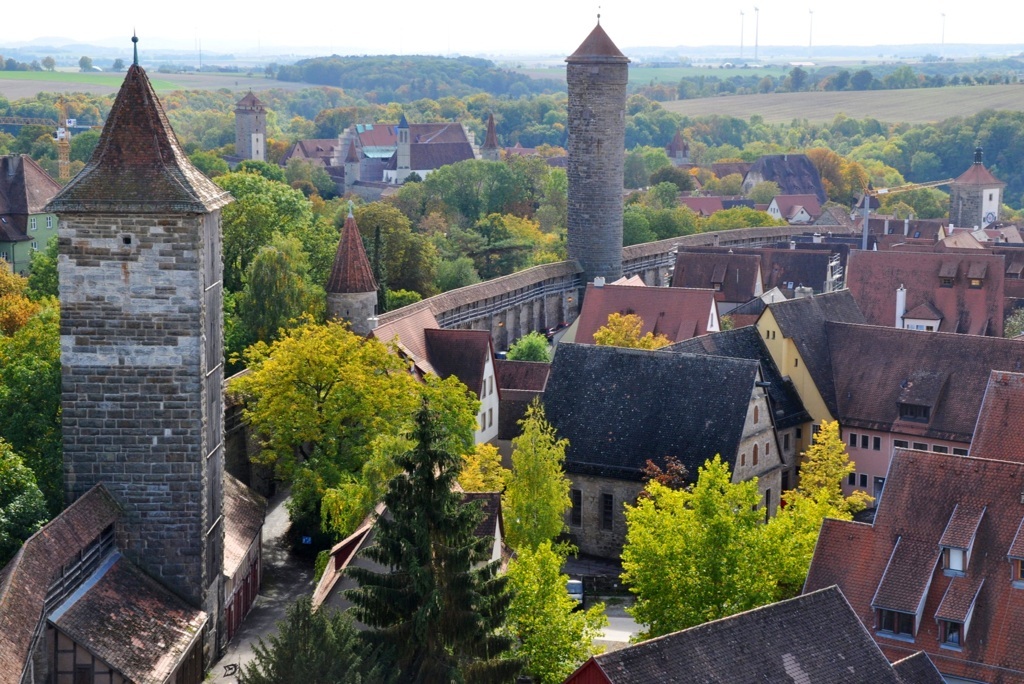
The view from the top of Rödertor

The Gatekeeper’s Lodge as seen from the top of Rödertor
Beautiful Bremen
How did it take me so long to cotton on to Bremen? I’ve known it since I was a kid thanks to the Brothers Grimm’s fairytale about a donkey, dog, cat and rooster who, on the scrapheap of old age, decide to run away and try their luck as musicians in Bremen. The walk makes them tired, and they scare the owners out of a house they come across on the way, liking it so much they never make it to Bremen. That hasn’t stopped the city adopting the four scoundrels as their mascot, and you’ll see references all over the place.
But there’s more to the city than just a fairytale, which you’ll see for yourself by looking at the pictures below.

Pigs used to roam along Sogestraße munching on scraps

Roland and the Rathaus

The four budding musicians
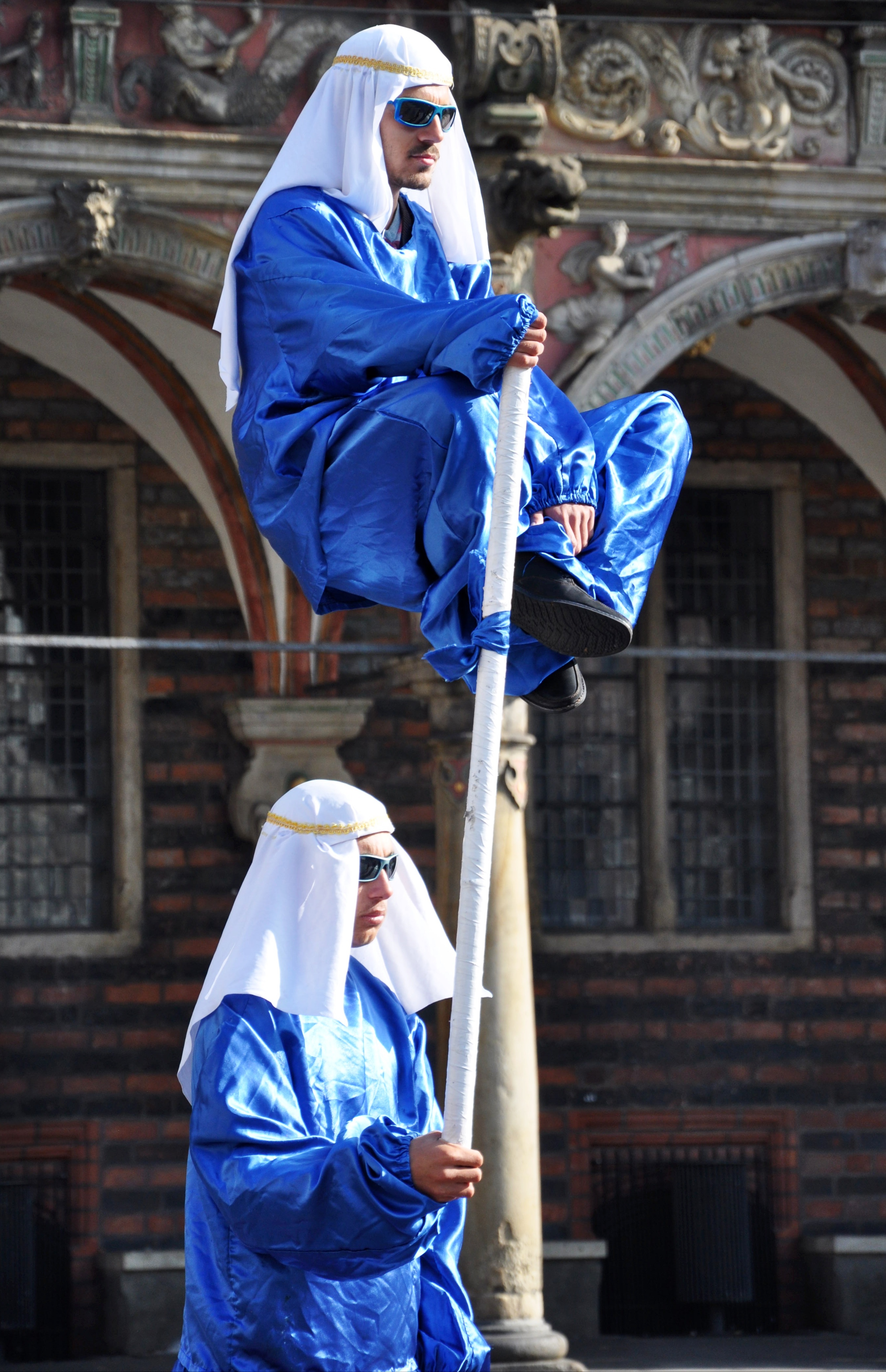
Not the only balancing act by the square

Cafes in the square
The Rathaus occupies pride of place in a square crammed full of historic treasures. Opposite is the Schütting, a beautiful guildhall which sadly isn’t open to the public. It was designed and built back in 1538 and when you see it, you’ll think it wouldn’t look out of place in the Netherlands. Designed by Flemish architect Johann den Buschener, you’d be right. Take a seat in the morning sunshine at one of the pavement cafes and you can admire both, together with the statue of Roland, a knight symbolising freedom, until your coffee goes cold. Bremen even has a specific word for the act of going for a coffee, Kaffeesieren, so it is an essential stop on your itinerary.

Close up of the Schütting, opposite the Rathaus

Böttcherstraße
Around the corner from the square you’ll find a tiny street with a big attitude. Böttcherstraße, famous for its unusual architecture and a shed-load of artwork, is a tourist attraction in itself. At the House of the Glockenspiel, the bells up on the roof go crazy at 12, 3 and 6pm playing tunes that last for a full ten minutes after the hour has been struck. Hidden in a little courtyard, you’ll find another sculpture of those wandering critters, this time adorning a water feature outside a candy store.
The street has ancient beginnings as the site was once occupied by the coopers that give the street its name. But Böttcherstraße in its present form actually dates only from the 1920s when a local coffee merchant by the name of Ludwig Roselius began buying up the houses in what was a pretty rundown street. With the aid of architects Eduard Scotland and Alfred Runge, he transformed the tiny lane into a much-loved arcade of Art Deco and brick shops and museums that is now one of the city’s most attractive destinations.
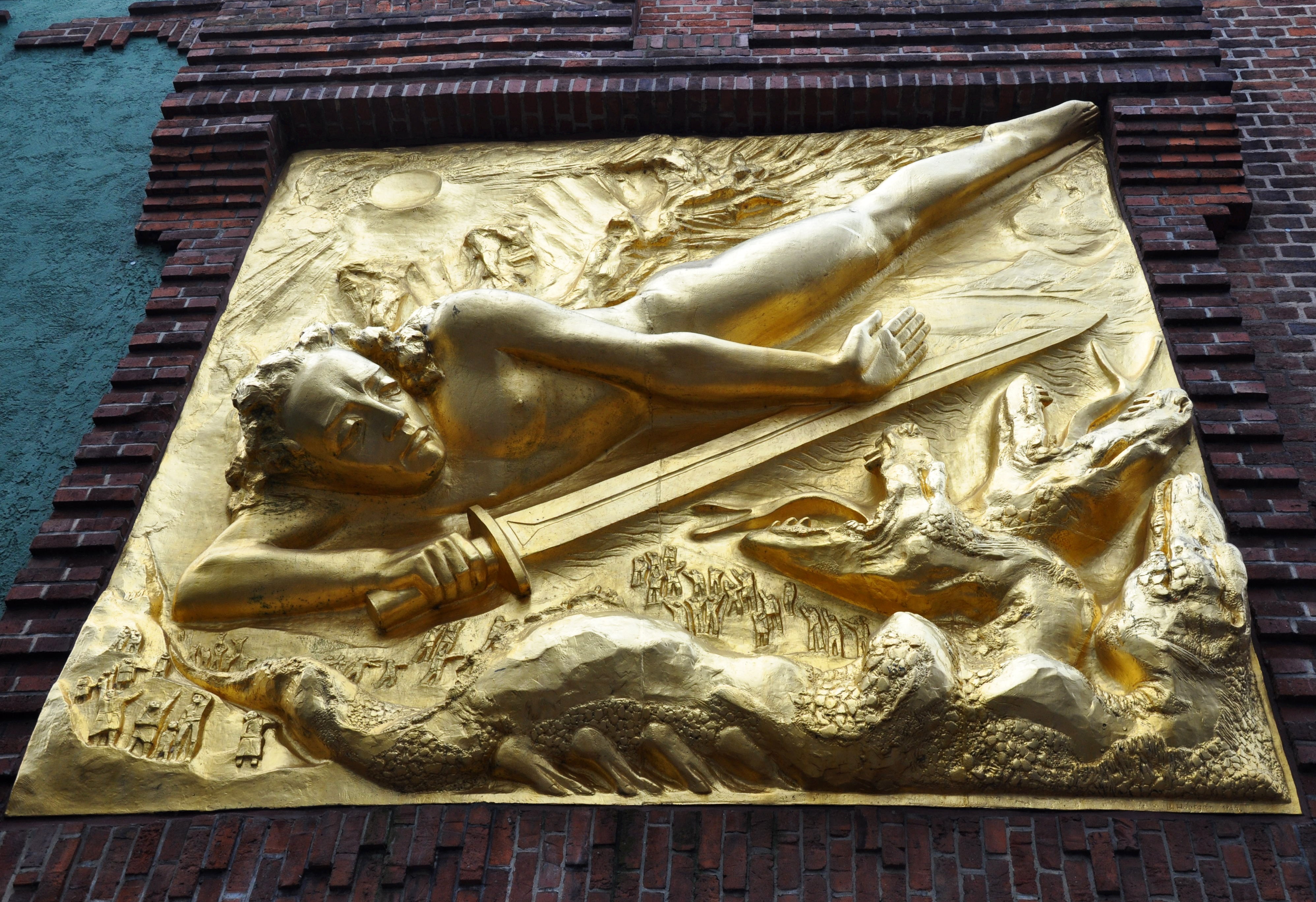
At the entrance to this arty little street
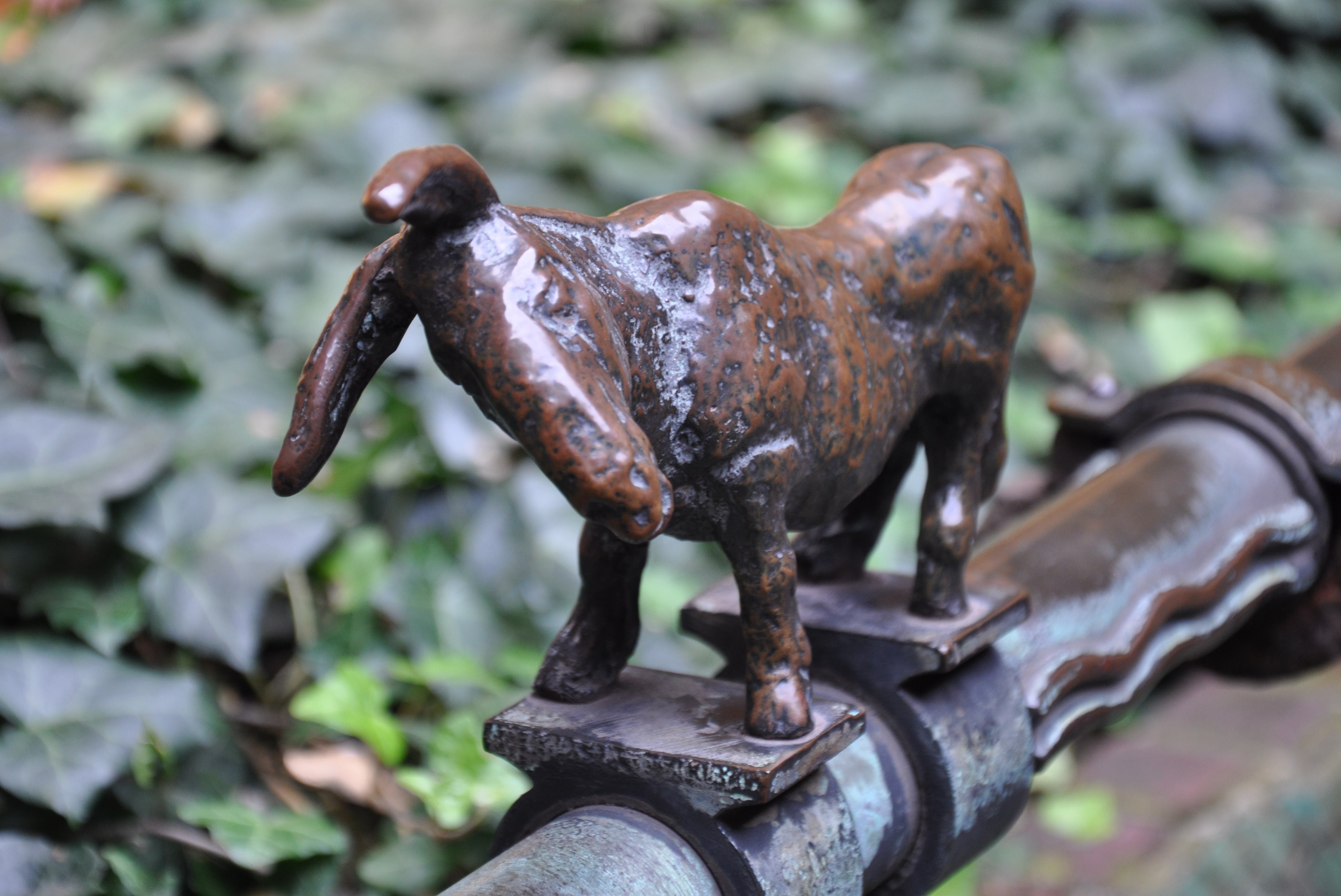
Another donkey

Is it me or does this look like Shrek?
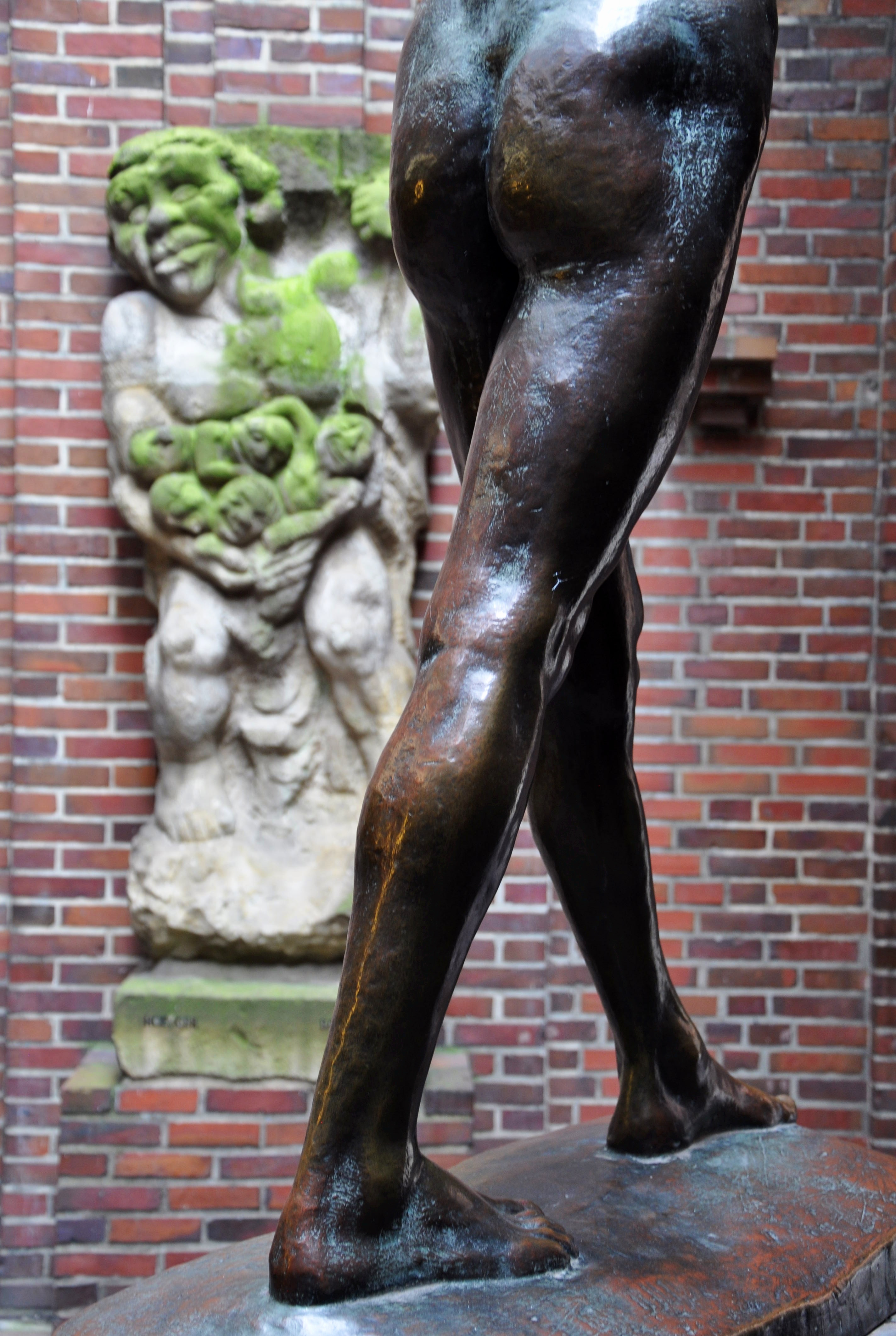
Definitely too skinny to be Shrek
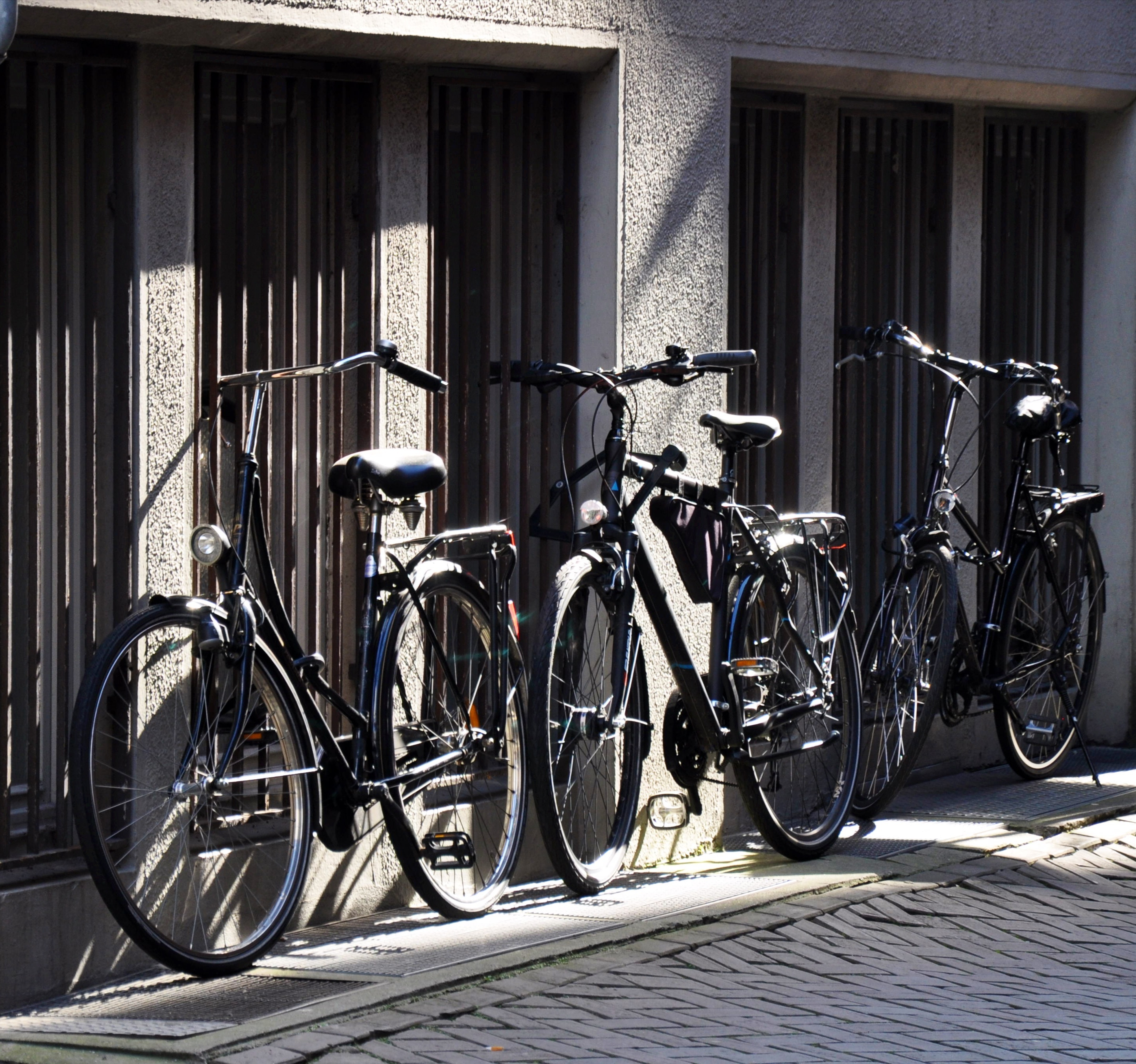
Like many German cities, Bremen’s great for cycling

Windmill in the park

At the Neptune fountain in the market place; don’t you just know how she feels?
Evening in Krakow’s Old Town Square
A few photos from the other night, pottering around Rynek Glowny, Krakow’s beautiful Old Town market square.

Horse and carriages lined up ready for their next fare

The twin towers of St Mary’s church next to the Renaissance-era Cloth Hall
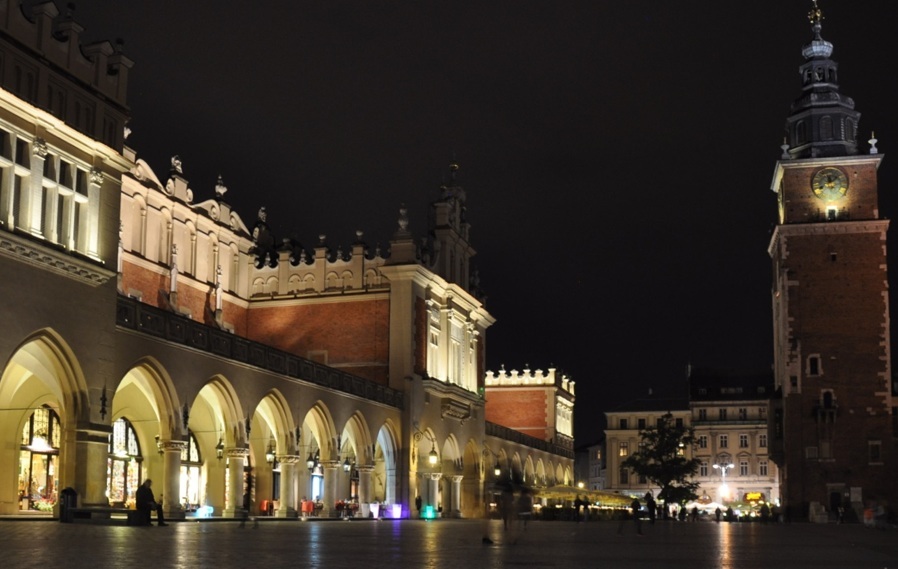
The Cloth Hall, packed full of amber sellers

Interior of the Cloth Hall
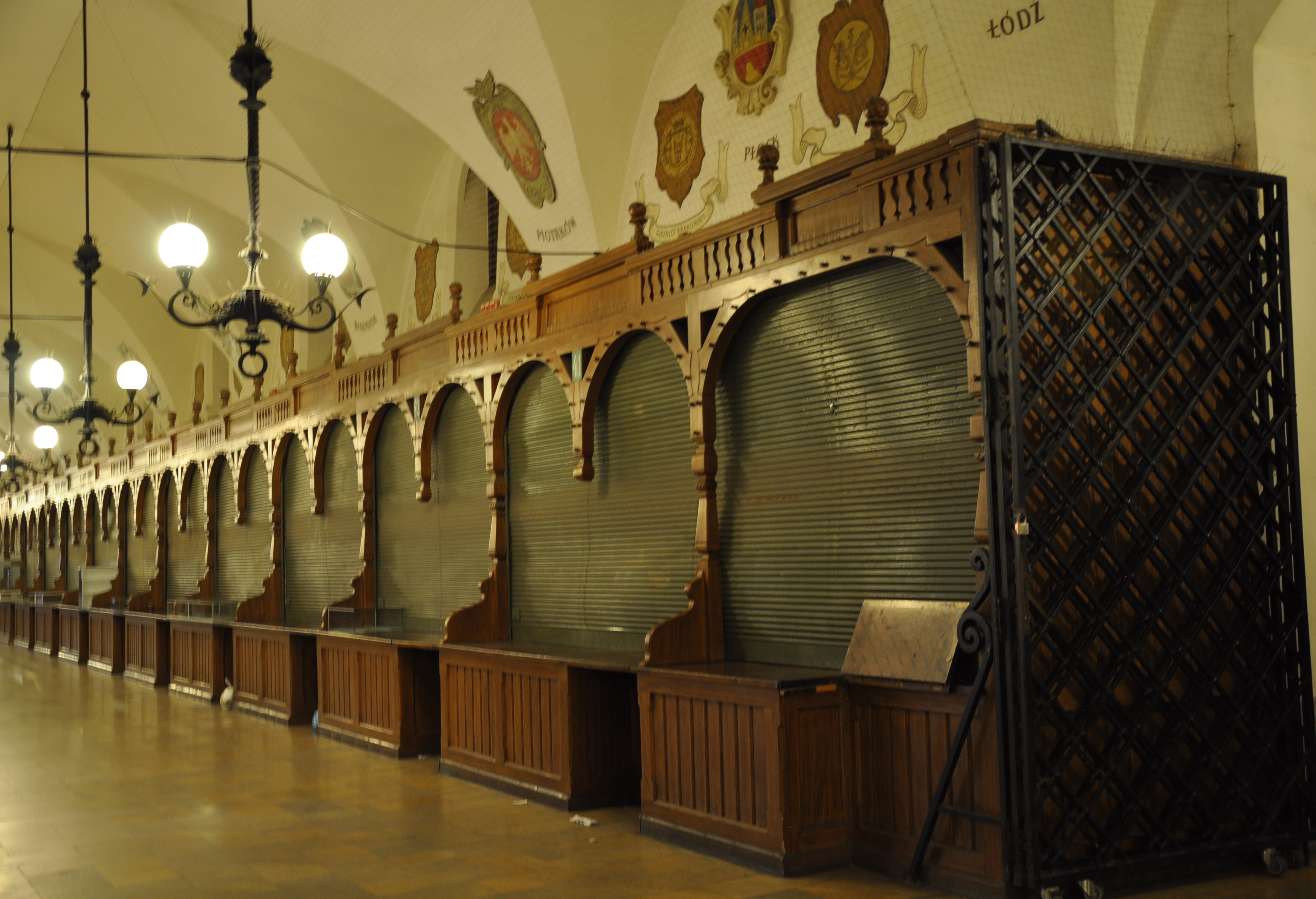
Closed up for the night around 8pm

Exterior colonnaded walkways

Exterior of Cloth Hall

St Adalbert’s Church with its pretty verdigris domes

Ham hocks for sale

Ham hock with fried potatoes and black pudding

Piwo (beer) stall

The only miserable face I saw all evening!
Salzburg on two wheels
I was a small child when I first went to Salzburg and have very fond memories of this elegant Austrian city, though mostly of getting a soaking from the trick fountains at Schloss Hellbrunn on the outskirts of town.

The trick fountains of Hellbrunn; this one still caught me out!
Since then, most Christmases I’ve had a virtual revisit courtesy of the film The Sound of Music, which was partially filmed on location in the city. On a whistle-stop detour from Italy whilst working for Trainline Europe, I was fortunate enough to have just enough time to fit in Fräulein Maria’s Cycling Tour.

Rupert provides the words in case you’ve forgotten
Founded by Rupert Riedl back in 1999, his passion for both Salzburg and cycling was infectious and I was excited about joining the tour. He also signed off his emails “so long, farewell, auf wiedersehen, goodbye” which meant I couldn’t wait to meet him.
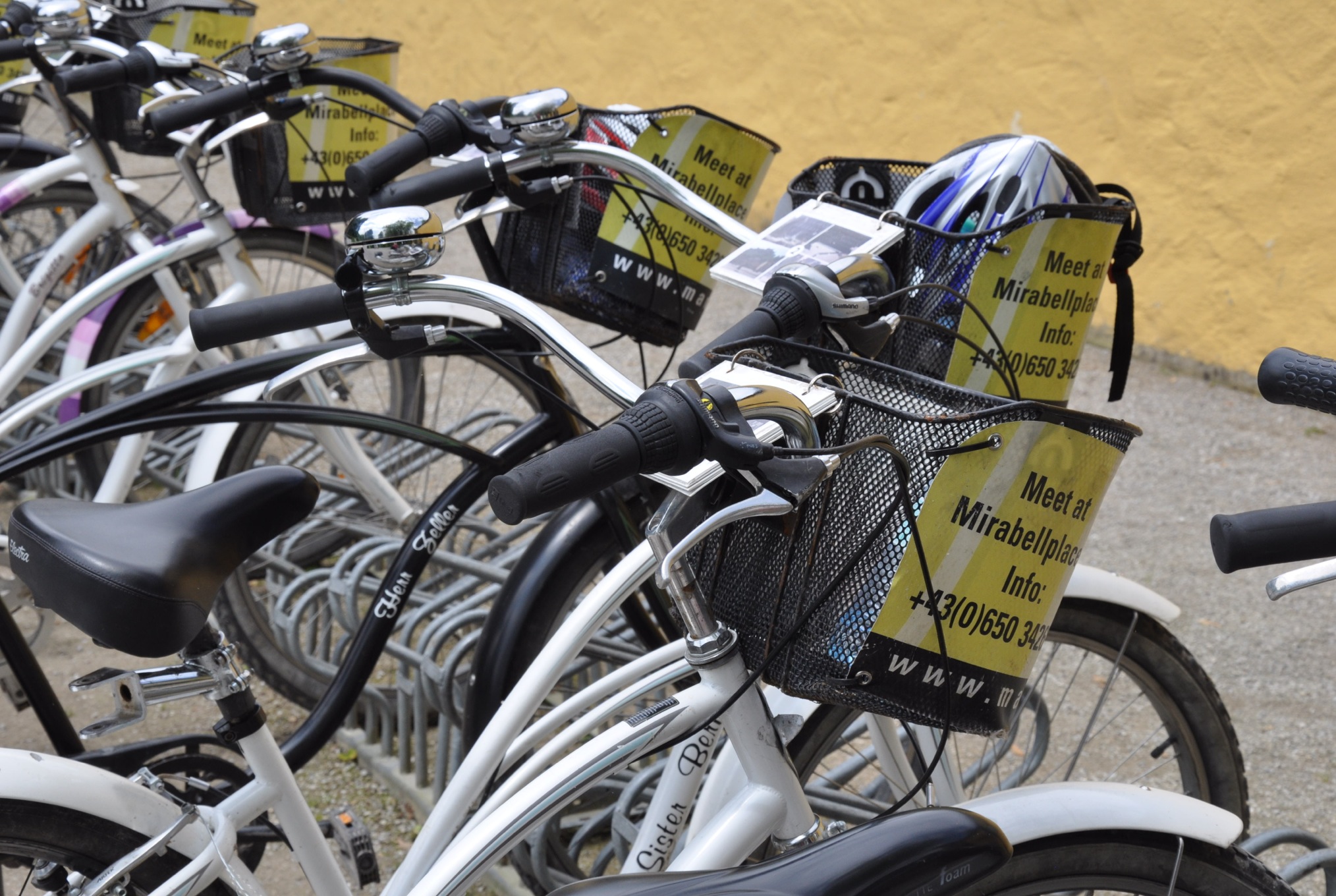
Rupert’s bikes
Rupert was just as charming in real life and so was our guide Elise, a warm and friendly ex-pat Brit whose encouragement and enthusiasm helped to make this tour so thoroughly enjoyable from shaky start to racing finish. The bike, it has to be said, took a little getting used to; wider handlebars and a different style of gears to that which I’m used to had me wobbling around like a beginner and cornering in a panic. It didn’t take long before I’d got the hang of it, and with plenty of stops, it was a manageable and fun tour.
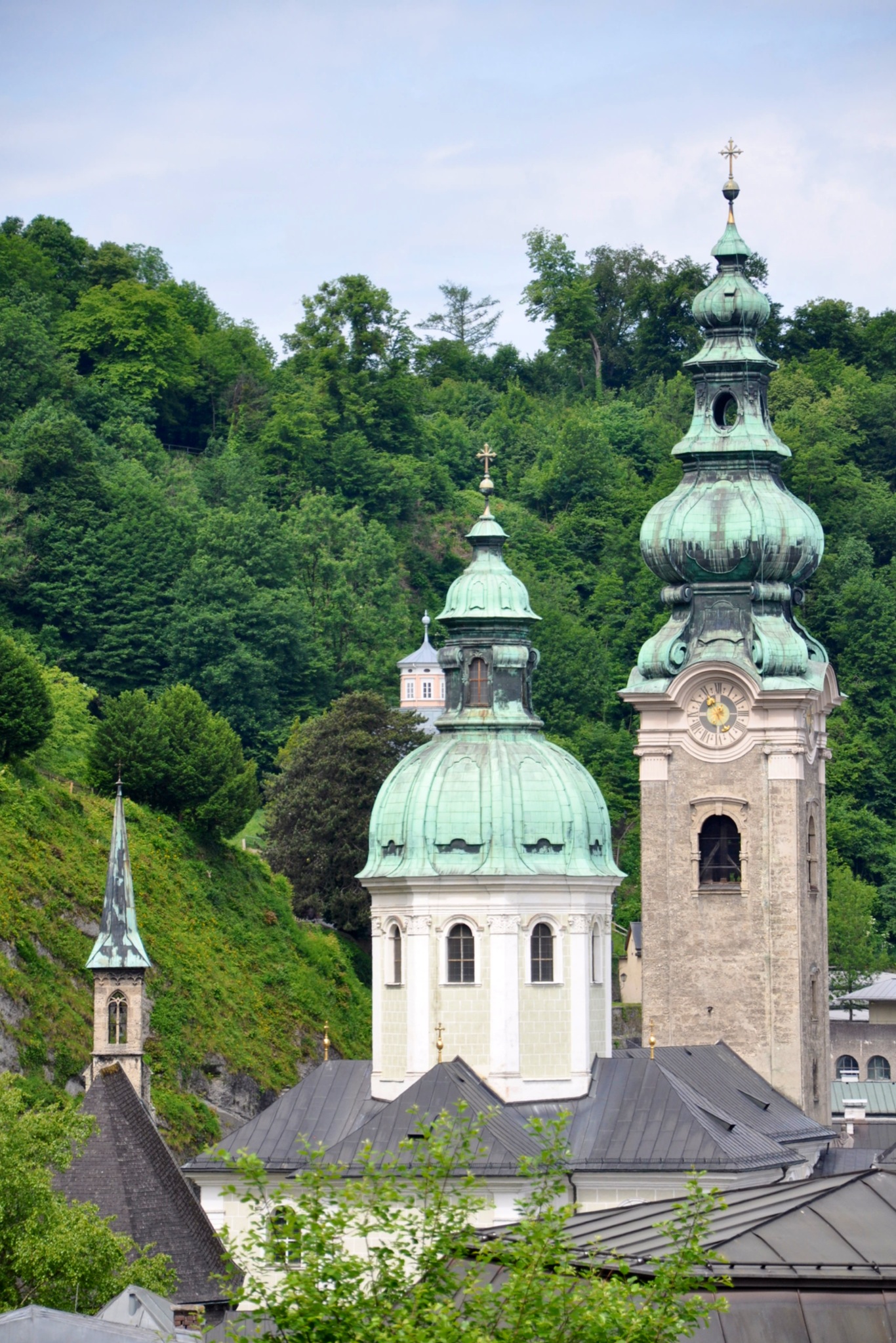
Rooftop views of Salzburg’s many churches made the climb worthwhile
I’m not super-fit (I’m not even fit) and was a little apprehensive about going uphill. Elise was quick to let us all know that she’d be walking part of the way up the steepest hill so we shouldn’t be embarrassed if we needed to do the same. She was also very partial to pastry and so her suggestion we stop by the beautiful cathedral for a bretzel was most welcome also.
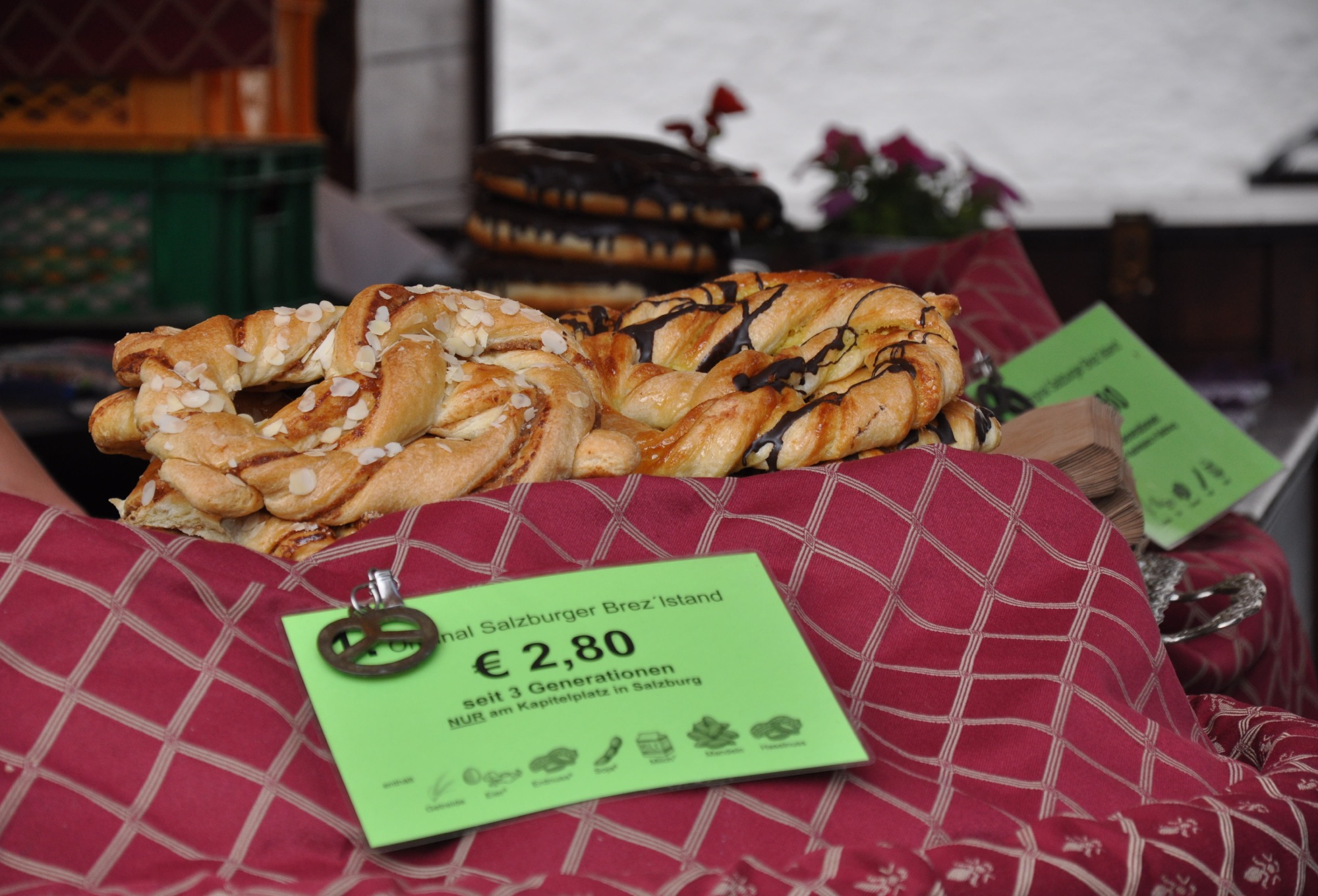
Delicious bretzels, just the thing once you’ve worked up an appetite
The tour began at Mirabellplatz and headed straight into the Altstadt, the old town of the city where vehicles are banned. We parked our bikes in front of several recognisable movie locations including the Pferdeschwemme, where Maria and the children skip by singing “My favourite things” and the Felsenreitschule, now an open air theatre but in the movie where the Von Trapps perform on stage before their daring escape.

Residenzplatz
Residenzplatz with its beautiful fountain, the backdrop for “I have confidence”, was also a backdrop for one of several group photos which Elise took as a memento of our tour. It’s a thoughtful touch, and a bonus souvenir once downloaded from Facebook.
Some stops aren’t actually in the movie; the quaint cemetery at Sankt Peter’s abbey provided the inspiration for a set which was recreated in a Hollywood studio. Climbing up past the funicular to the hilltop fortress, we had some splendid views of Salzburg’s imposing fortress, its many churches and the mountains beyond.

The views are worth the uphill ride
At the Nonnberg, not only did we see a nun at the nunnery where Maria decides she’s not suited to the job, but we also saw the dodgy weld in its gate, the result of the film crew needing to film through a gap too small for the camera. It’s details like these that made me glad I was on a tour – I’d never have noticed it on my own.

The dodgy weld at the nunnery
Freewheeling downhill was a blast, and as we cut across the cycle path out of town, Elise put the soundtrack on and unleashed a whole tour group full of Maria-wannabes, some more in tune than others. We made for the Leopoldskron Palace and lake. It’s where Maria falls into the lake and where the film crew discovered to their horror that the young actress playing Gretel couldn’t swim. Fortunately, none of us fell in but we did play along for a photo.

Leopoldskron Palace and lake
With the music blaring and the breeze in my hair, this was my favourite part of the tour. As we belted out Lonely Goatherd, several passing walkers gave us a cheer and a round of applause, thoroughly deserved of course!

Outside Frohnburg Palace
Stopping at Frohnburg Palace, where Captain Von Trapp tears down the Nazi flag, there was plenty of time for more photos before a flat ride to Schloss Hellbrunn. Our stop there wasn’t for the fountains (though it’s an easy bus ride back) but instead for the gazebo where Liesl sings “I am sixteen going on seventeen”. Elise told us that during filming, the actress playing Liesl slipped off the marble benches and twisted her ankle.

The famous gazebo, now located at Schloss Hellbrunn
The filming schedule, already running late, didn’t permit any more delays, so she performed with a bandaged ankle. It was later retouched, but, this being the 1960s, it’s apparently very noticeable in the film if you know to look. Well now I know, I’d say that’s a pretty good excuse to put the film on one more time…
To book Rupert’s Fräulein Maria’s Cycling Tour, visit his website at http://www.mariasbicycletours.com. The tour costs 30 Euros, which is a bargain given how much ground you’ll cover and what a fantastic introduction it is to the city of Salzburg.
Eating Italy food tour – the highlight of my time in Rome
When I was invited to join a Twilight Trastevere Tour in Rome last week, I had an inkling it was going to be good. I just didn’t know how good.

Trastevere is a charming neighbourhood
Having been to Rome before, I was keen to ditch the fake Roman centurions down by the Colosseum and the crowds of people sitting on the Spanish Steps. The former working-class neighbourhood of Trastevere, in English meaning “across the Tiber”, buzzes at night and has a restaurant almost on every corner. Knowing where to start was the problem, and with limited time, I was keen to join Eating Italy’s tour so they could show me around. The tour takes in around eight to ten stops in an eclectic mix of delis and eateries, rounded off with a lesson in how to identify real gelato from the fakes. It would be the perfect way to spend an evening, I decided.

Da Enzo’s trattoria
Sebastiana, our knowledgeable and very entertaining guide, half Italian and half American, had the cultural knowledge and understanding to bridge both the places we were visiting and the largely American clientele who made up the tour group. She was effervescent, bubbling away (in a good way) like a chilled glass of Prosecco and just as welcome a companion on a sunny evening. Our first stop was to a tiny trattoria called Da Enzo al 29. Getting a table here is difficult, but we beat the crowd for a glass of Prosecco accompanied by a delicious starter of prosciutto, melon and a delicious cheese called burata. Here we were introduced to “aperitivo” – an Italian ritual firmly based around the understanding that one should never consume alcohol without food, something I should bring back to the UK with me, I felt.

The wine cellar at Spirito di Vino
The second stop on the tour took us underground and back in time. The Ristorante Spirito di Vino was once a synagogue, as evidenced by the Hebrew lettering on its stonework. There, in a wine cellar dating from the first century BC, we tried taster portions of three scrummy local favourites: frittata, a kind of spaghetti omelette (far tastier than that sounds), followed by Maiale di Mazio, a slow-roasted pork dish and favourite of Caesar, no less, and finally a whipped cauliflower and cheese dish. Iliana, the chef, clearly knew her stuff and if I hadn’t have been leaving on that evening’s night train, I’d have begged her for a table for dinner.
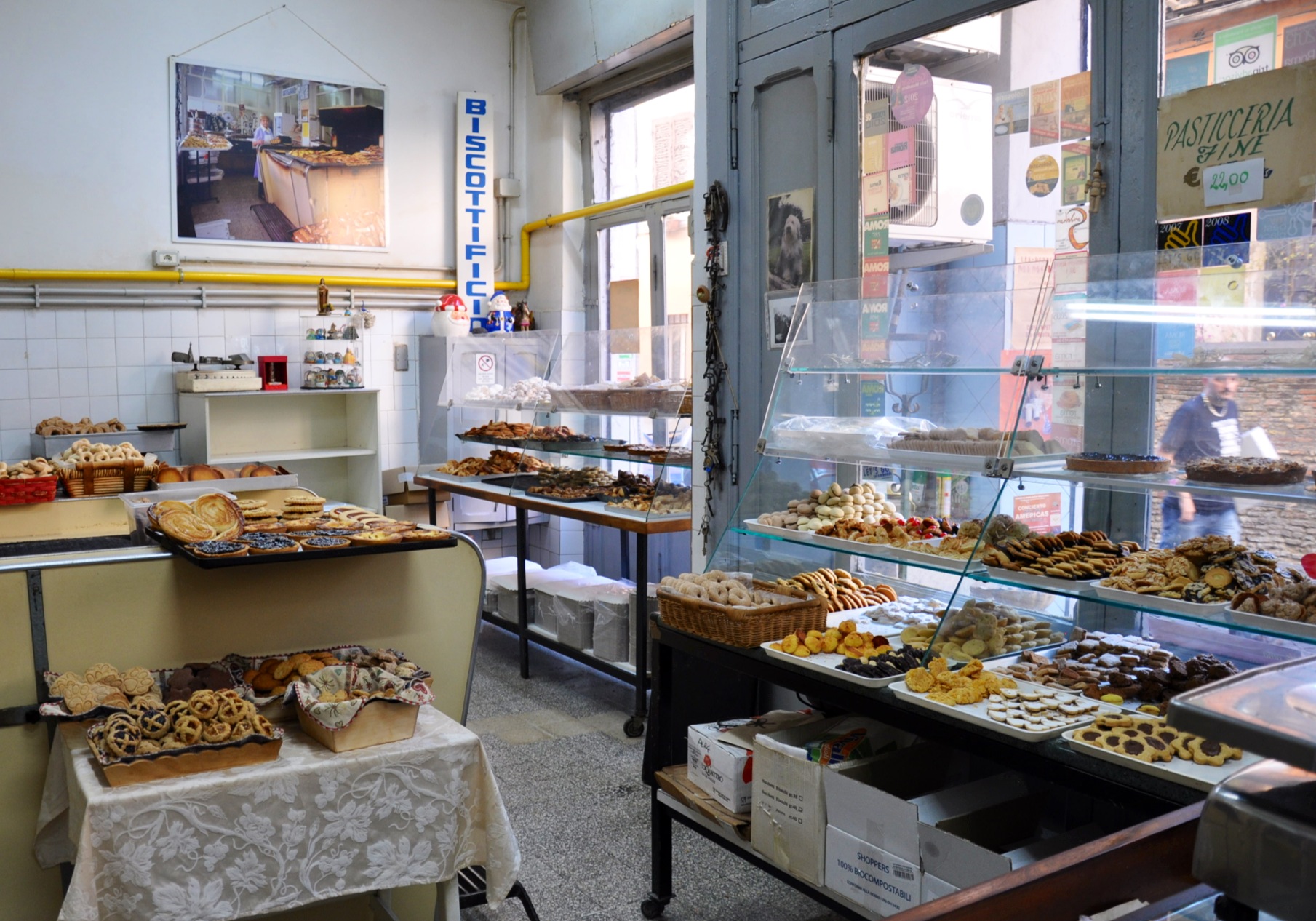
Innocenti’s
Afterwards, we strolled through the backstreets to a family-run biscotti place so local that it didn’t even have to have a sign outside. I’m not a nut fan, so passed on the hazelnut brutti ma buoni (it means “ugly but good”), but judging by the reactions of the rest of the group, I’d say I missed out on something good. The Innocenti family have run this place for years, with recipes little changed in half a century, and sell by weight. If you have a sweet tooth, this would be the place to hang out. Another neighbourhood “celebrity” was Signore Roberto who ran the nearby Antica Caciara, a cheese and meat deli that was our next port of call. Over a century of trading makes this a real gem of a place to sample the deliciously salty Pecorino Romano cheese made in the traditional way by Roberto’s uncle. Sebastiana taught us how to order: un etto being 100g and due etto, 200g. Now what was half a kilo, again?
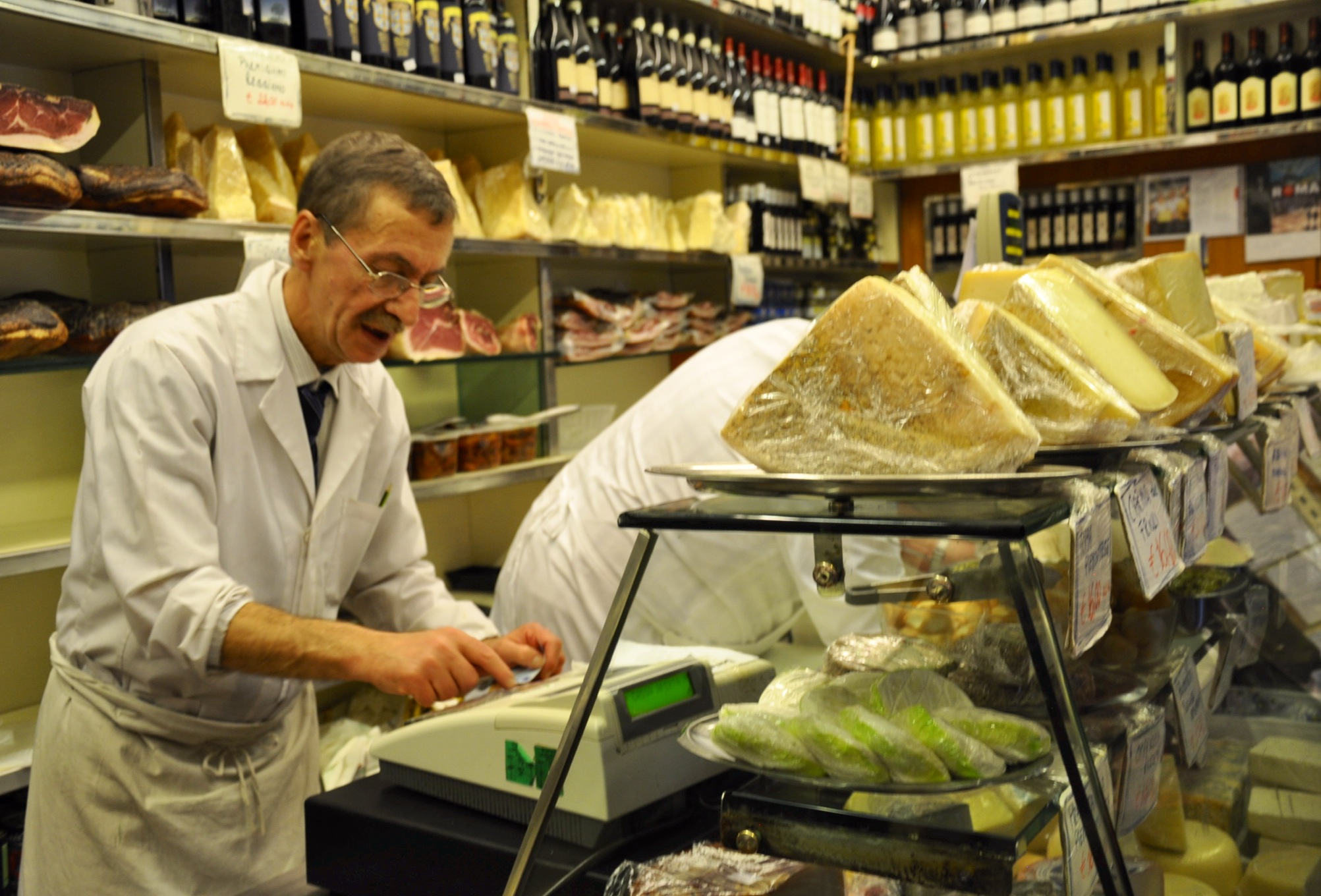
Signore Roberto
From there, we moved on to meat, porchetta to be precise, at La Norcinera, named after Norcia, an Umbrian town where this pork comes from. This wasn’t like the tough, dry supermarket pork that we are forced to endure in the UK, its goodness sucked out by the healthy eating do-gooders. This was juicy, fatty, melt in the mouth pork, hung from hooks on racks on the ceiling to tempt even the most fastidious of dieters to fall off the wagon. Served on pizza bianca, I didn’t stand a chance.
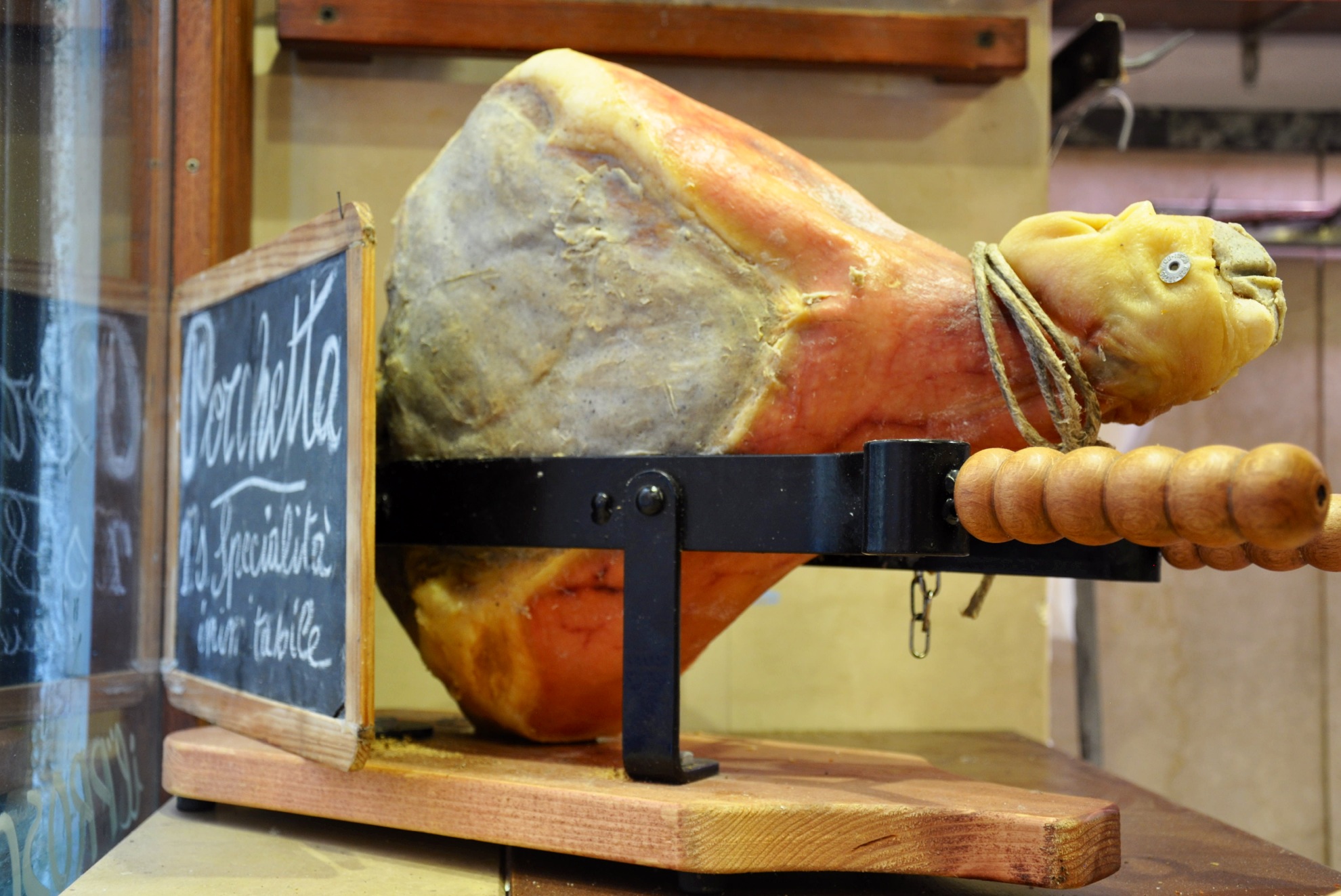
Delectable porchetta
When Sebastiana described suppli’, our next offering, I have to admit, it didn’t sound as good. It was nothing to do with her skills as a host, but more to do with the fact that suppli’ are deep-fried and, despite skipping lunch, I was beginning to feel very full indeed. These fast food treats of rice cooked in tomato sauce and stuffed with cheese are to Roman nights out what a kebab is back home – except that they taste amazing! In spite of myself, I wolfed mine down in record time and could quite happily have gone back for seconds.

Suppli’
The penultimate stop was at Enoteca Ferrara. An enoteca is an Italian wine bar but remember, Italians never drink without food; here we had a private table in the al fresco dining area out back, where we prized delicious ravioli away from Sebastiana (it’s her favourite) and feasted on gnocchi and cacio e pepe, a kind of square-ish spaghetti, literally translating as “cheese and pepper”. Rich but not overpowering, it was a lesson in how pasta should be served, and utterly more-ish.
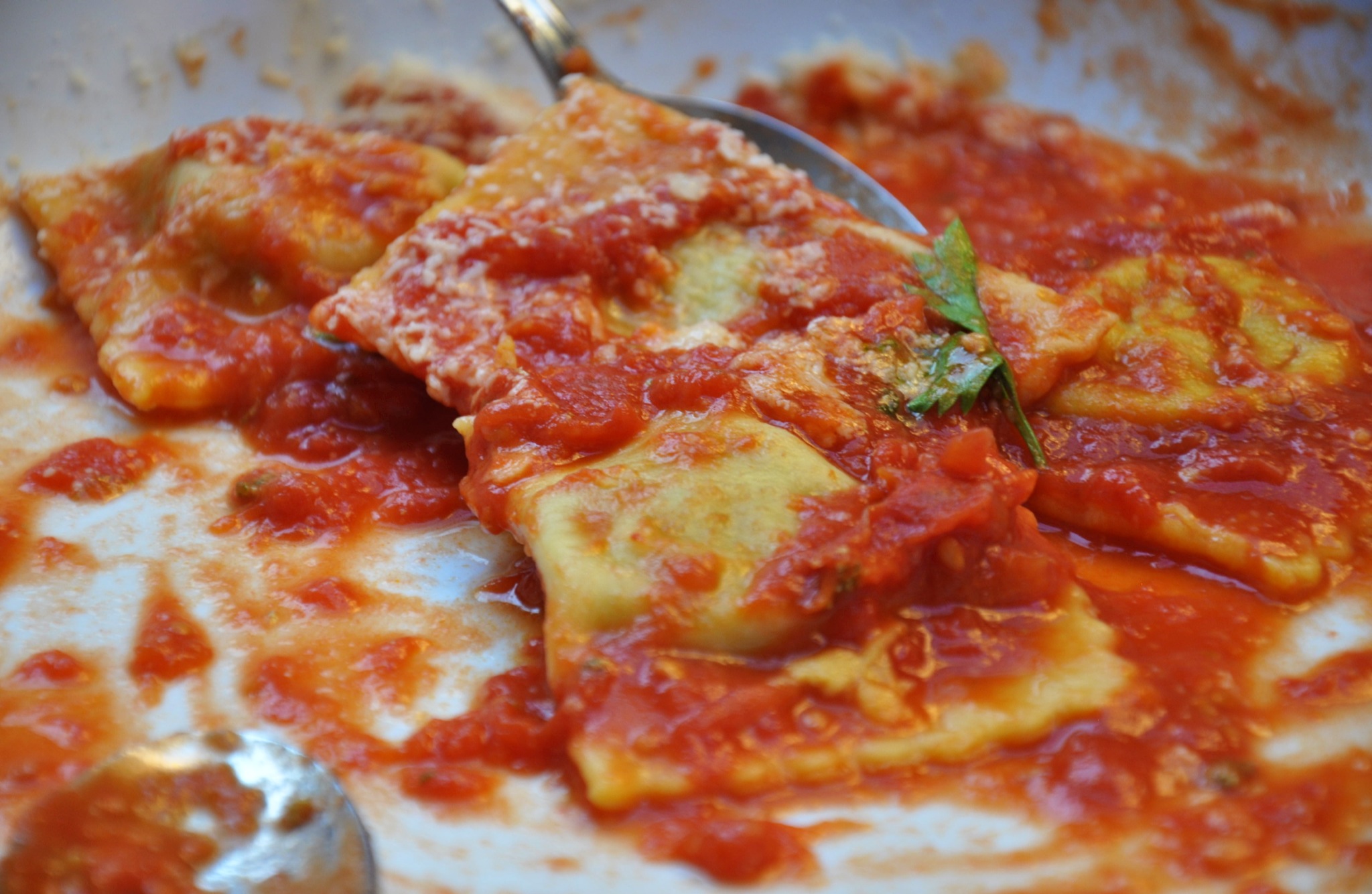
Sebastiana’s favourite ravioli
But there was one place left to visit, and the one for which no one wanted to be too full. Fatamorgana makes real gelato – not the fake stuff – but with an originality of flavours that sets it apart from its competitors. I couldn’t resist the zabaglione flavour, a dessert that Mum used to serve us years ago, while the more adventurous could opt for flavours such as rosebud and black sesame, pear and Gorgonzola cheese and even pink grapefruit with ginger, horseradish and preserved lemon peel.

Fatamorgana’s artisan ice cream parlour
And how to tell the real thing from the imposter? Well, you’ll just have to take the tour yourself to find out…
To find out more and to book a tour online, head to Eating Italy Food Tours in Rome here: http://www.eatingitalyfoodtours.com/
An unexpected trip up Mount Vesuvius
Its top shrouded in cloud, the great hulk of Mount Vesuvius looms over the Bay of Naples, an ever present reminder that the residents of this area could one day face an unimaginable disaster. But the last significant eruption of Vesuvius was way back in 1944, and of course, its most famous eruption in AD79 wiped out Pompeii and Herculaneum before they knew what had happened.
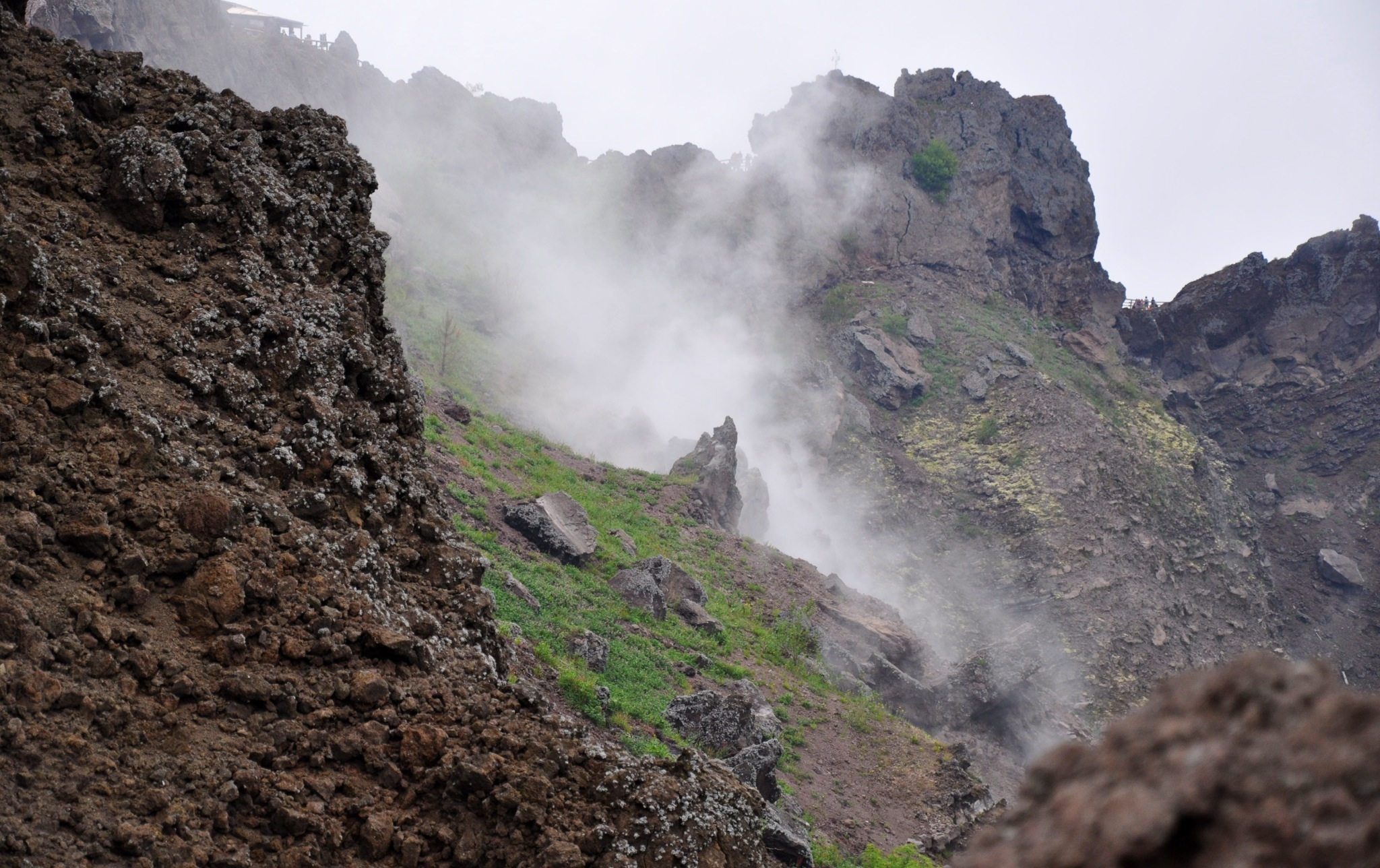
Vesuvius won’t let you forget it’s still active
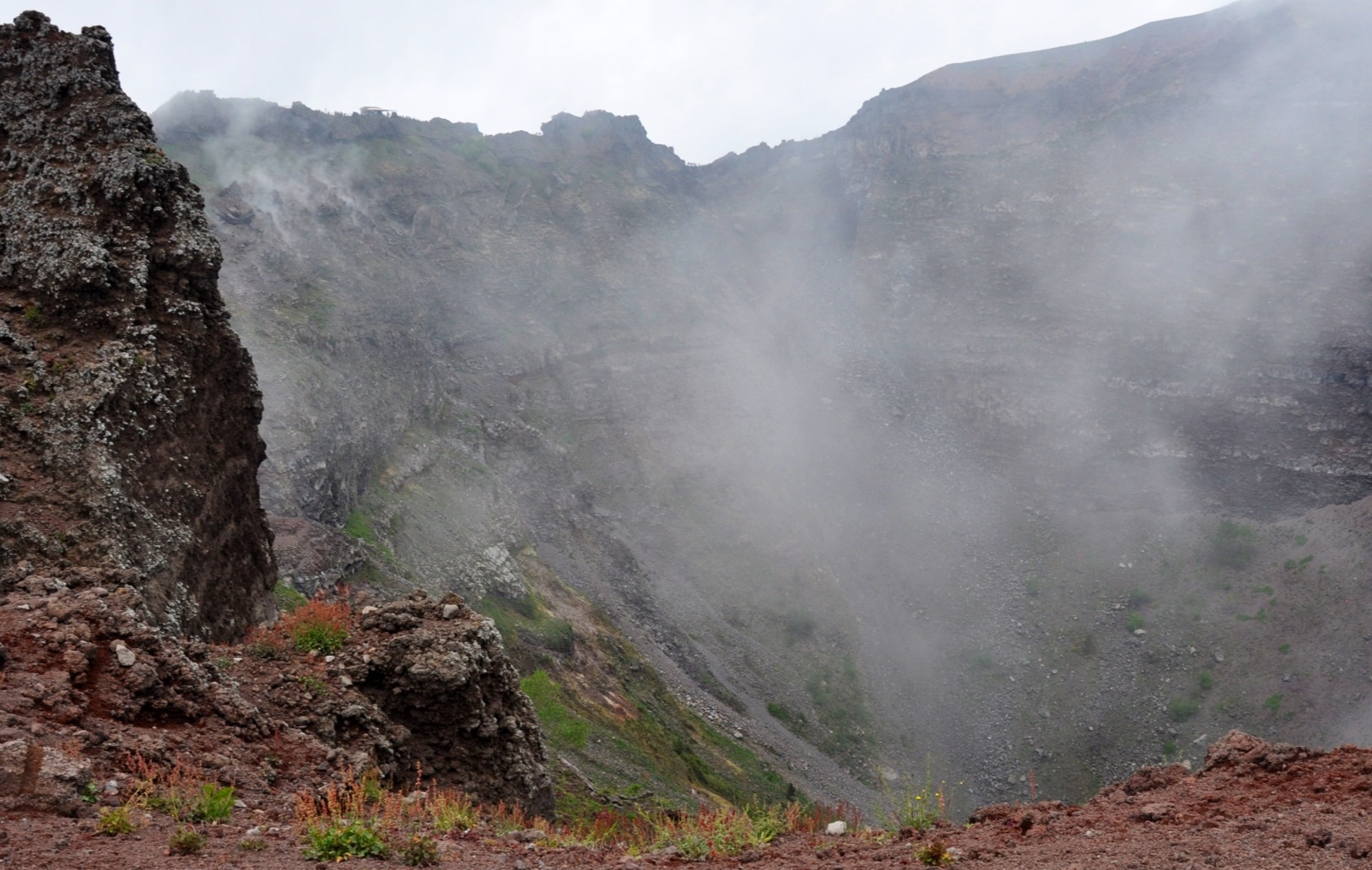
Definitely worth the hike!
I’d come to Ercolano Scavi station on the Circumvesuviana train from Naples’ Garibaldi station, itself buried under Napoli Centrale, to see for myself what Herculaneum looked like. As I exited the station, a sign advertising Vesuvius trips by bus caught my eye. Having spoken to the charming and very helpful Agostino, I was invited to join them as a guest on the next tour and I jumped at the chance to step onto a volcano I’d previously only read about.

Erculano Scavi station on the Circumvesuviana railway line
The company, Vesuvio Express, usually operate tours on a very comfortable coach, but as there was extra demand, the company laid on an eight-seater minibus for some of us. It’s worth asking if you are a large party whether they might be able to do this for you. The 15km trip up to the ticketing area, about a kilometre below the crater, took less than half an hour and our accommodating driver paused for us to get some photos of the Bay of Naples, pointing out the island of Capri and lava flows from 1944.
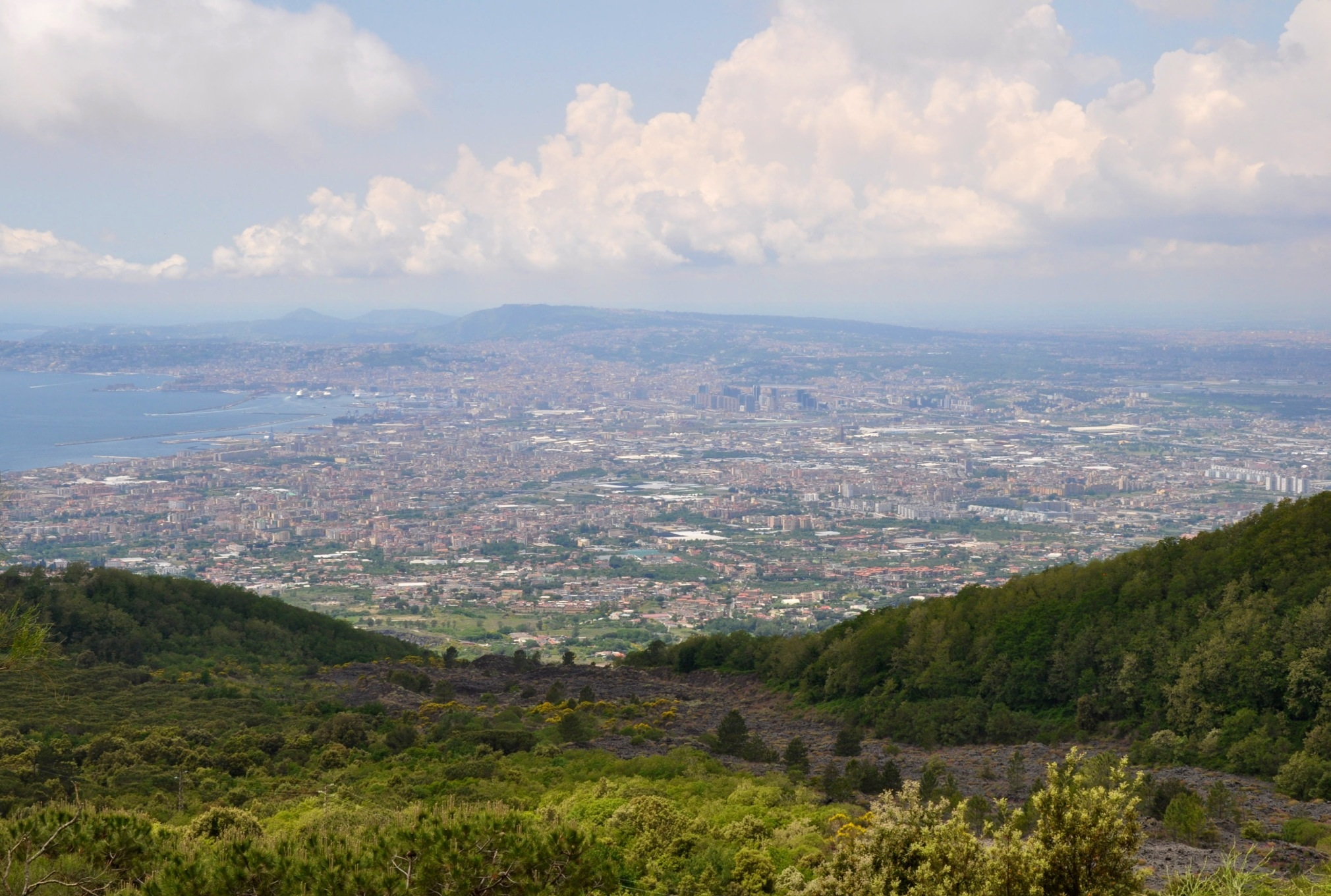
View over the Bay of Naples with 1944 lava flows in the foreground
At the top, it was a moderately tough climb for someone who lives in flat Essex, but manageable. Some people found it easier to hike up with the aid of a wooden stick, bought from someone about to finish their hike for a going rate of a Euro. Don’t be afraid to ask someone to sell one on! Fitter souls would manage the hike in around 15-20 minutes, but it took me just under half an hour to reach the crater rim, having stopped countless times to take photos.
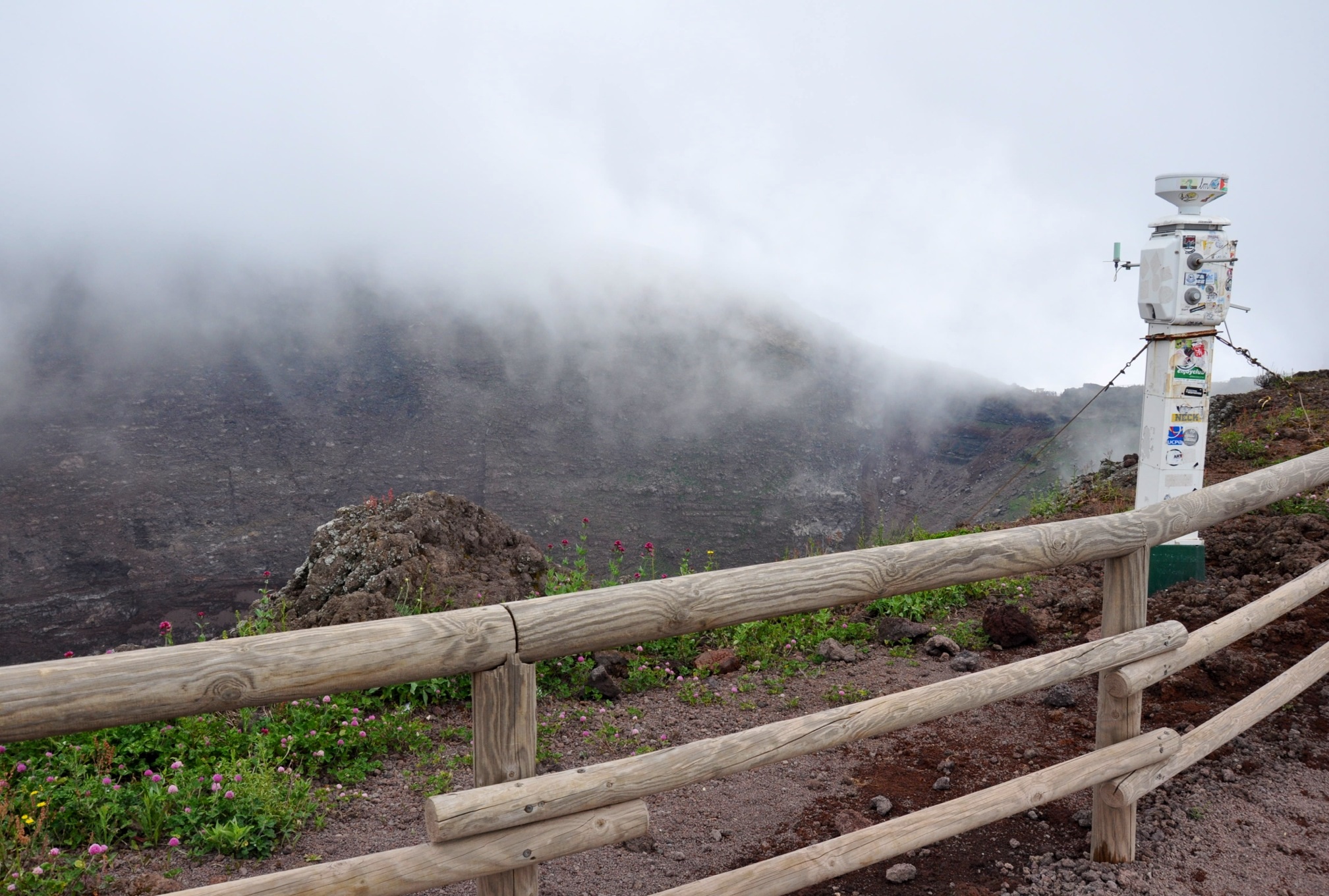
Not surprisingly, this is a volcano that is very closely monitored!
The cloud was low, good hiking weather, though not great for the views back down to the bay, though that made me focus on the closer scenery, such as hardy flowering shrubs and a huge lava bomb by the side of the path.

A typical scene on the slopes of the volcano
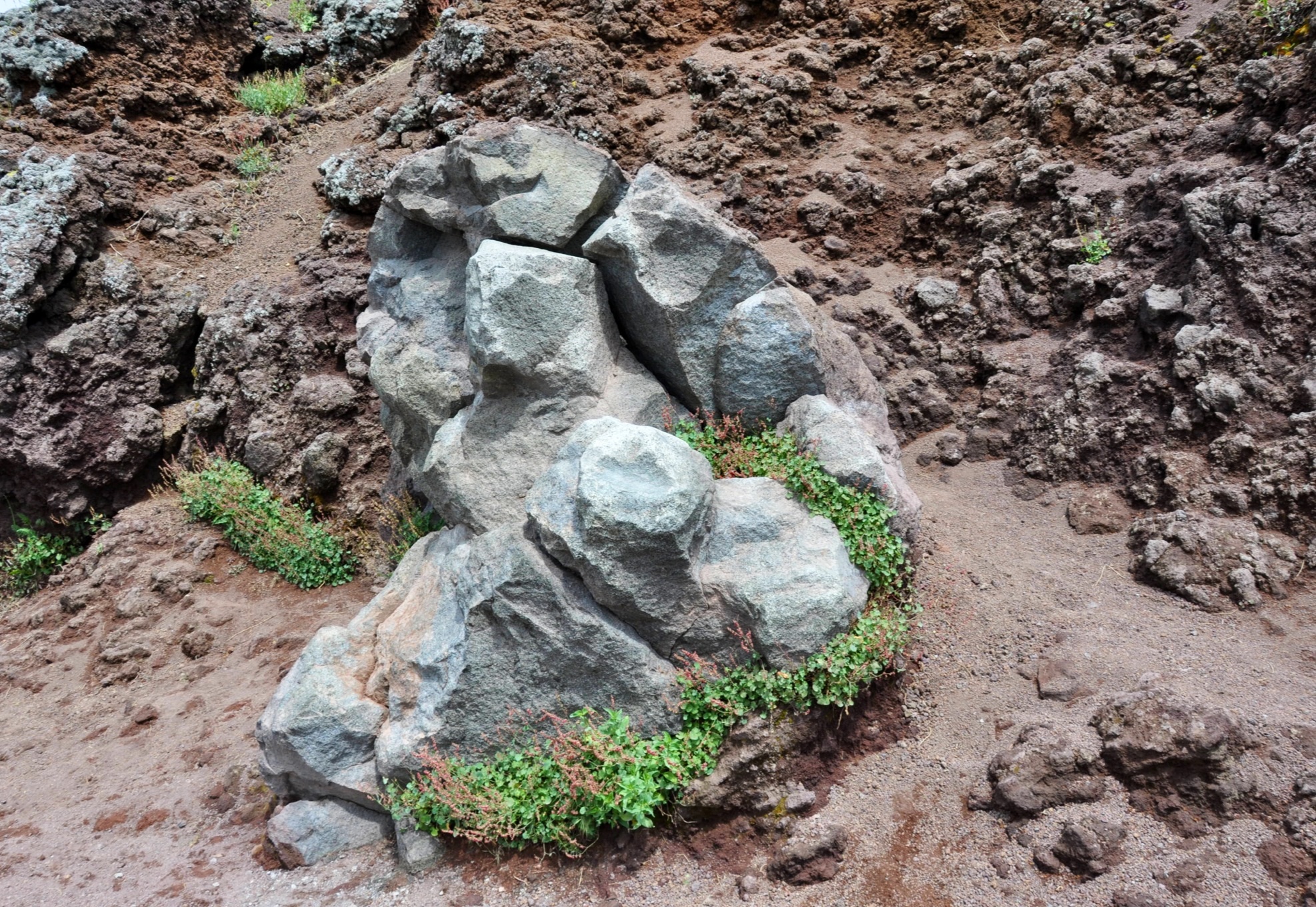
Lava bomb in front of lava from a different eruption, hence the different colours
The volcano is impressive, with a large crater that puffs sulphury smoke. You’ll notice the smell of rotten eggs if you get downwind, but it wasn’t too strong.
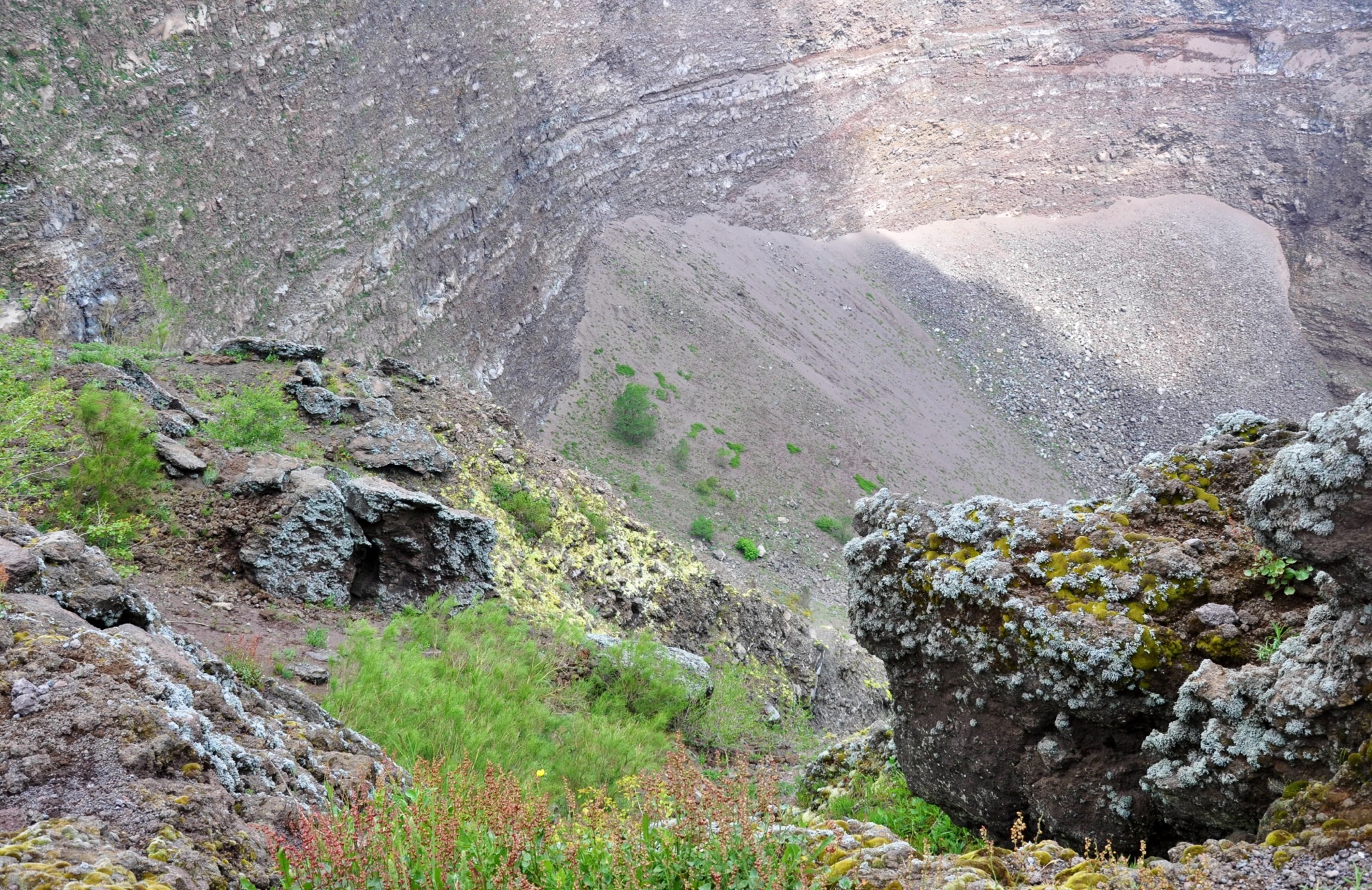
First look at the crater
The gravel path alongside the crater leads to some steps; go up these and follow the trail to a second crater for a wow factor end to your climb. Coming down was faster, though I did skid a few times on the gravel. The trouble with a surprise hike is that you aren’t wearing your hiking boots!
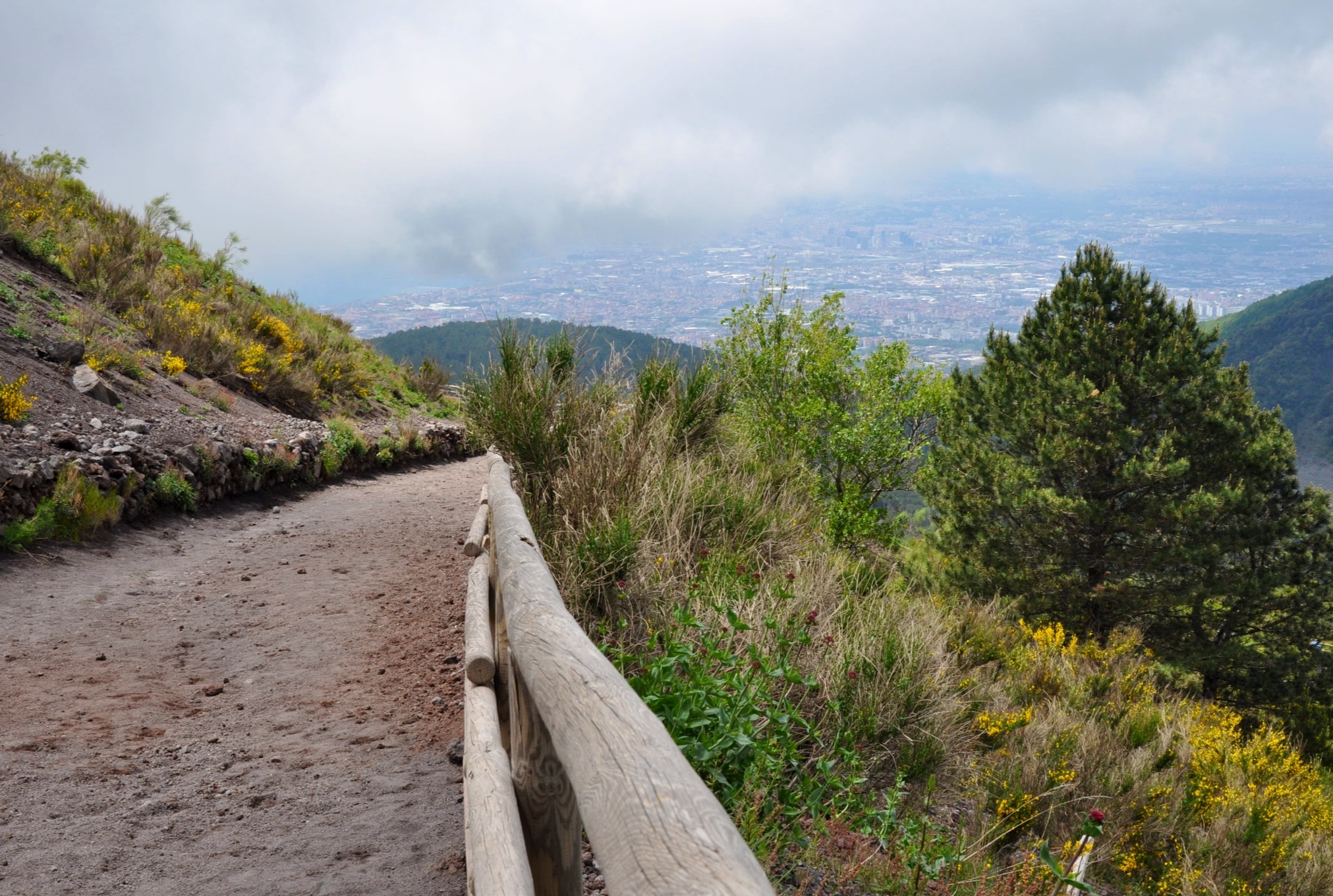
The gravel path back down to the parking lot
Vesuvio Express charges just 20 Euros for this fascinating trip, half for the ride up and half for the ticket onto Vesuvius’ high trail. School groups receive a discount. They allow a generous 90 minutes at the top, which is ample time for even slow walkers to have plenty of time to absorb the views. Pre-booking isn’t essential. Tours begin around 9.30am daily and depart approximately every forty minutes. They’ll even store your bags in their office if you need them to. I definitely recommend this as a trip if you’re in the area.
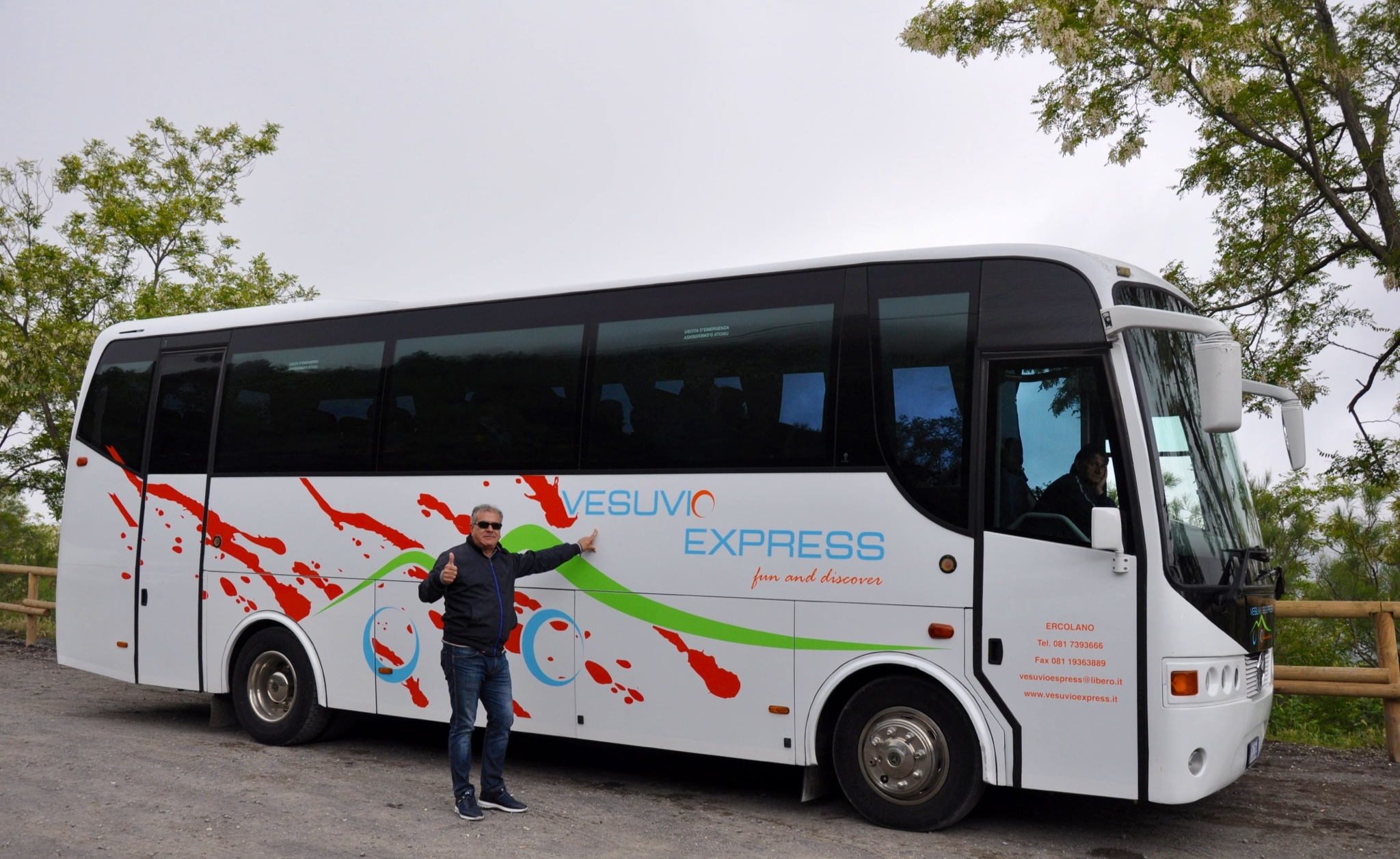
The Vesuvio Express bus
Rome under wraps
If you’re planning a first visit to the Eternal City, you should be aware that a number of Rome’s main tourist sights are currently under renovation. You can still visit, of course, but you’ll need to rely on your guidebook or a postcard vendor to see the view you’ve missed out on. Here’s what it looked like when I visited at the end of May 2015:

At the Spanish Steps it’s business as usual, but its pretty church, Trinità dei Monti, is currently covered up.
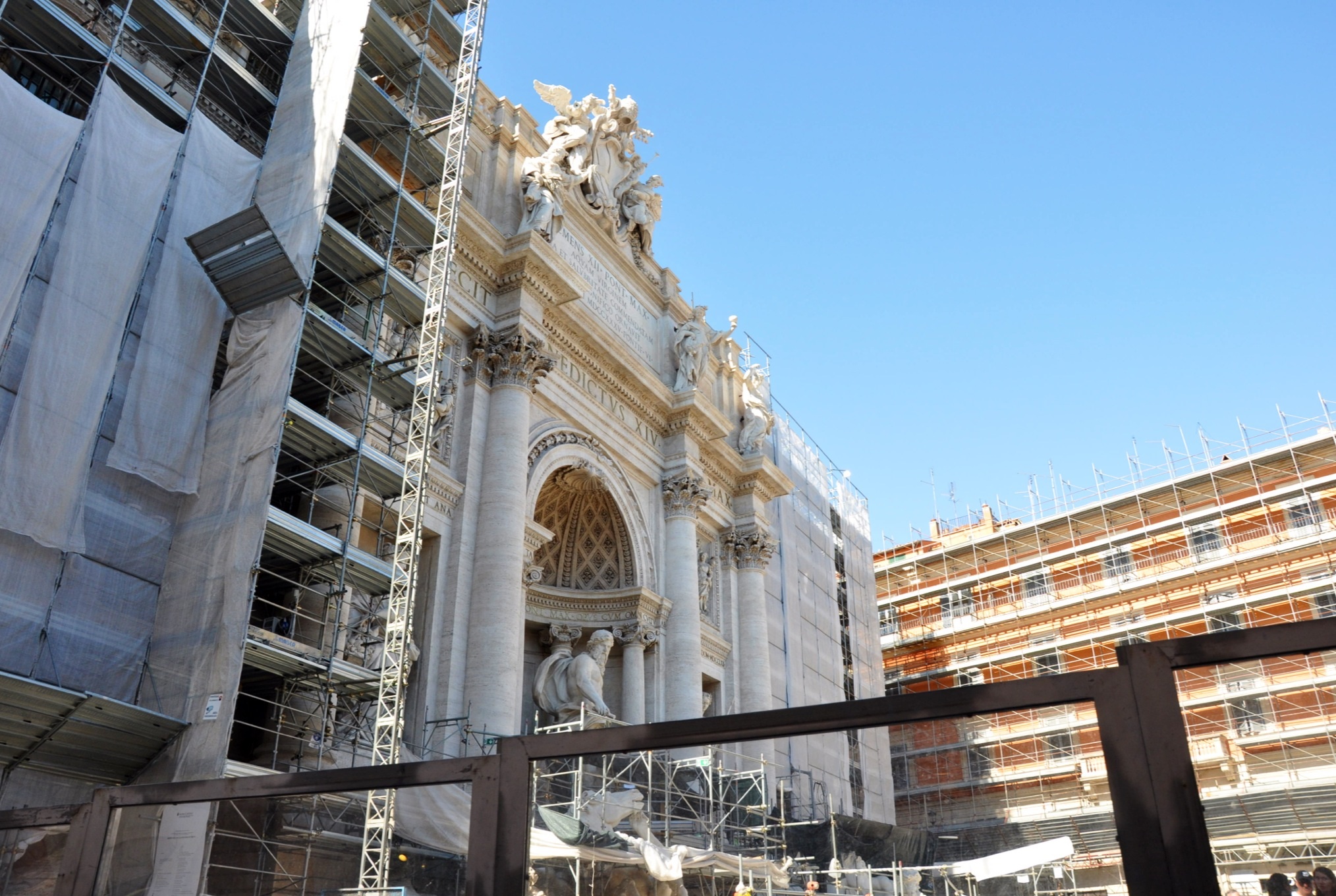
All you’ll get at the moment is a glimpse of the Trevi Fountain as it’s being extensively renovated. Save your coin for another time.

The lower level and much of the rear of the Colosseum is undergoing repair, though it’s still open to visitors.

In preparation for Italy’s Festa della Repubblica on 2nd June, when a parade will pass, temporary grandstands are being constructed along the streets alongside the Roman Forum.
Know of any other tourist attractions currently undergoing repair? Add a comment and let us all know, thanks.
To Florence, for some sunshine!
Beautiful Florence never looks more charming than it does when the sun is shining. Here are some of my favourite shots from this trip. The sun was reluctant to make an appearance at first, but when it did, wow, what a show!

The city’s famous domed marble cathedral and tower
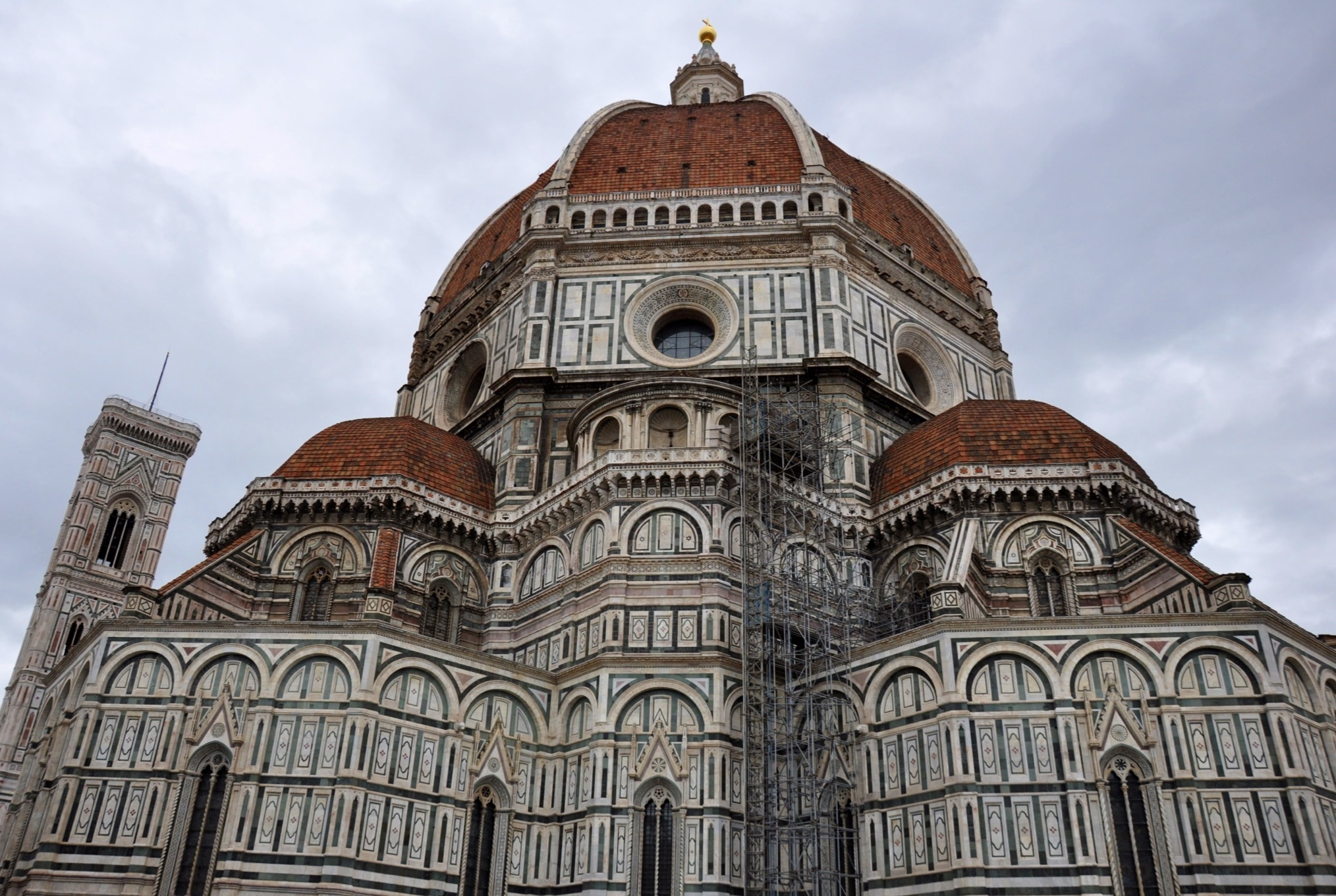
A cathedral that’s world-class
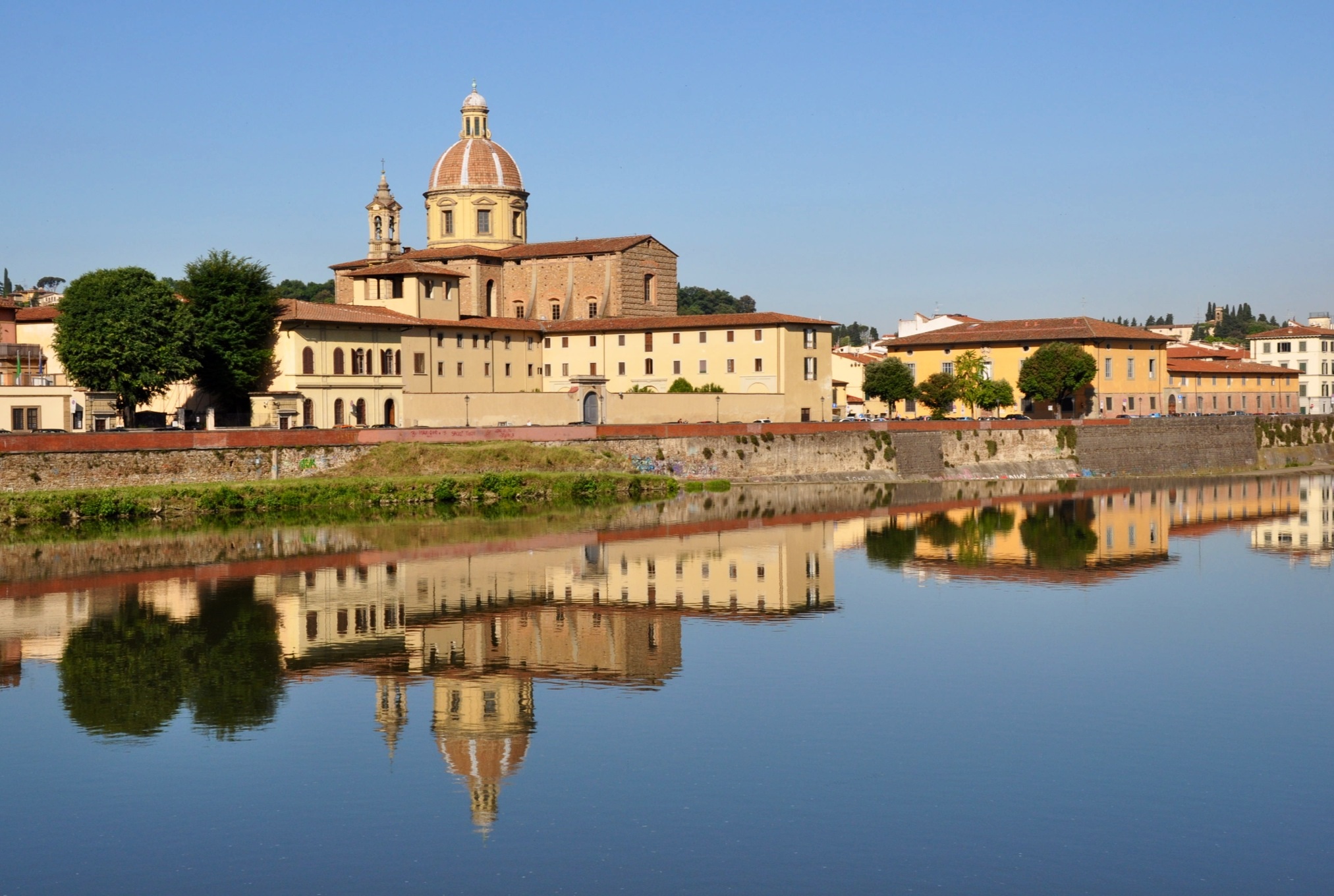
Perfect reflections on the still water, River Arno
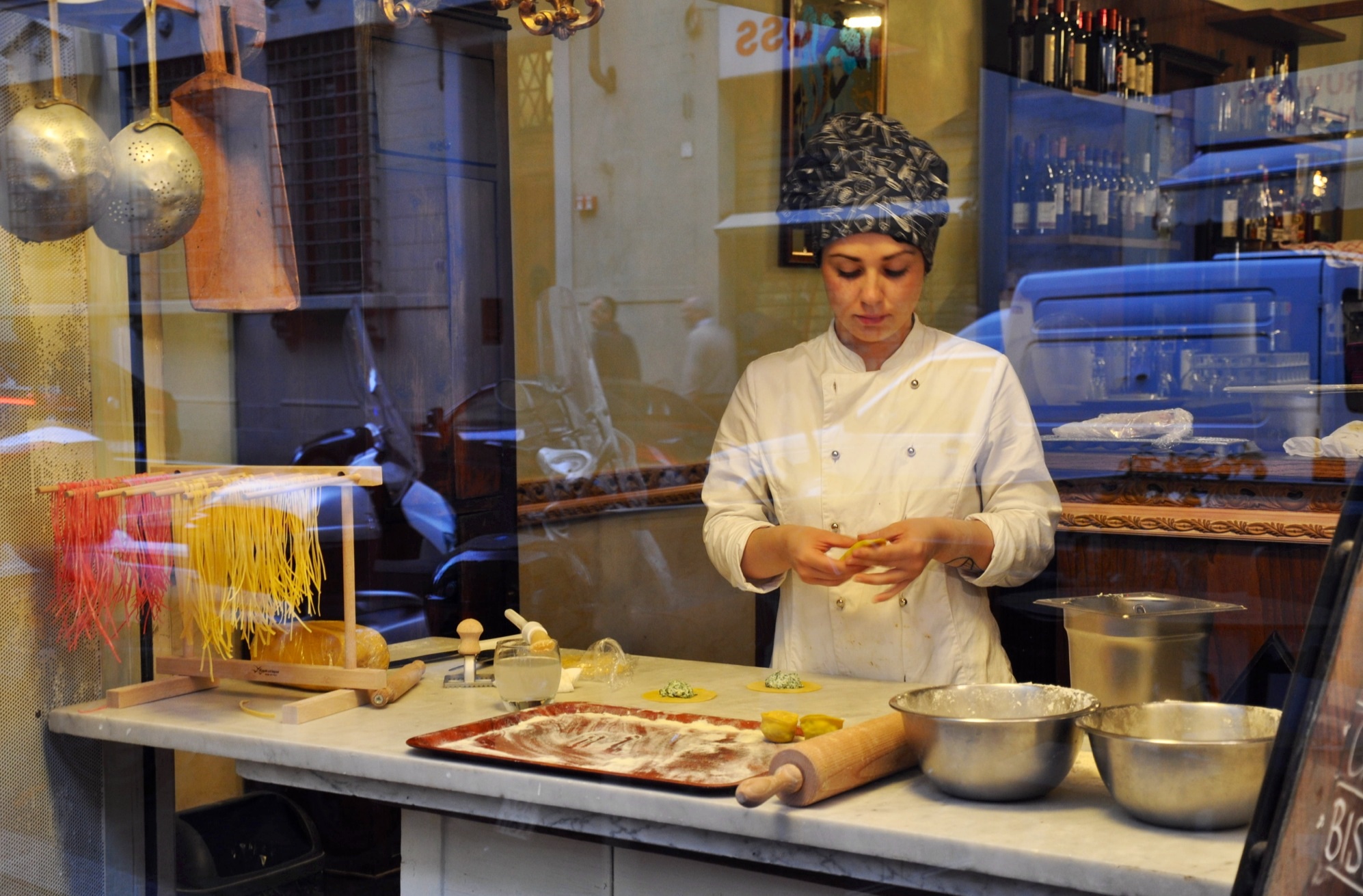
Pasta-making

Dusk falls over the River Arno

Reflections on the water, River Arno, with the famous Ponte Vecchio to the left of the shot
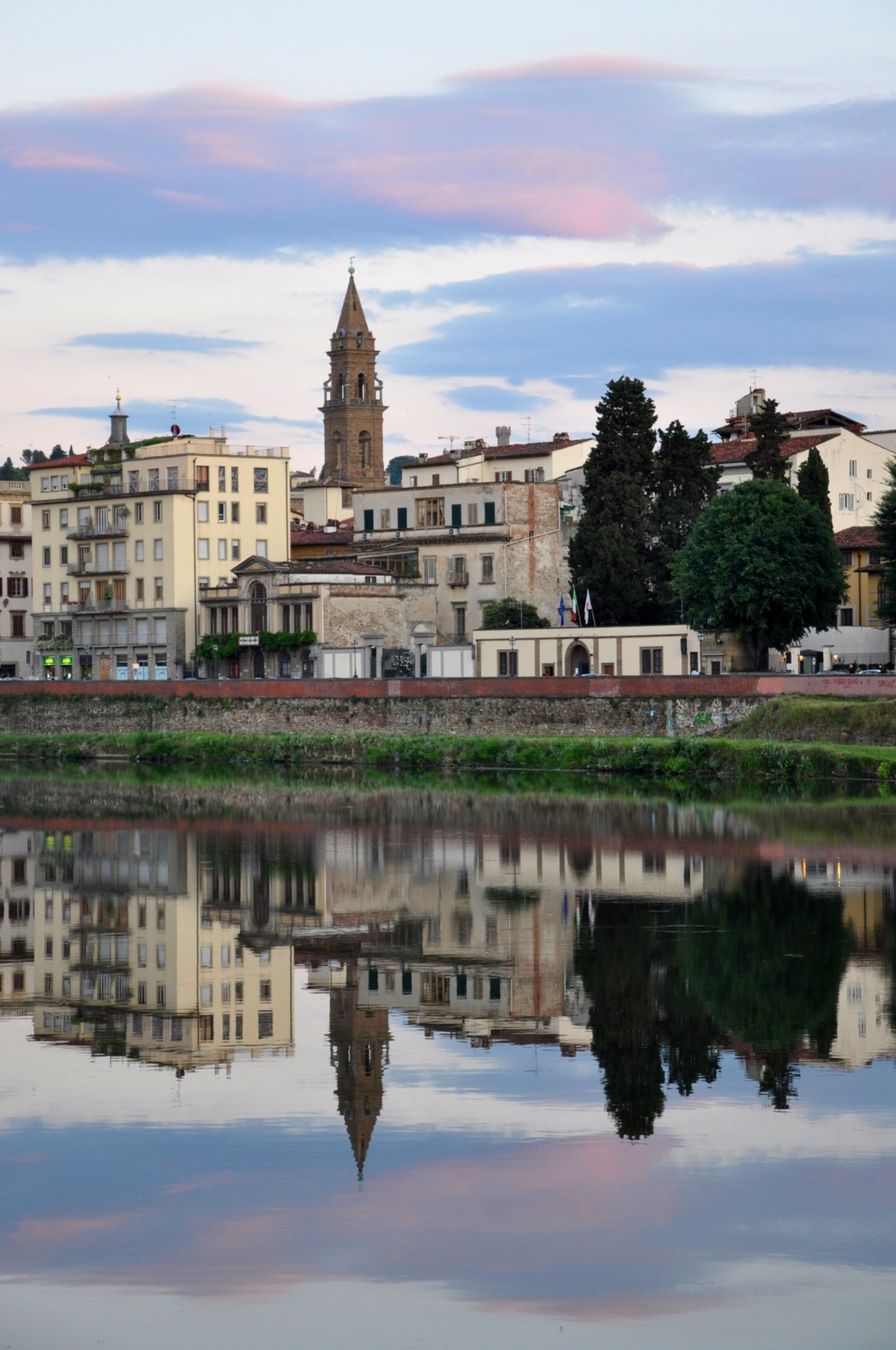
A classic Italian riverfront scene

A plane departs as the sun sets
The Cinque Terre
Today’s visit to the Cinque Terre was tinged with disappointment as much of the Sientero Azzurro was closed and the weather, though mostly dry, remained resolutely cloudy pretty much all day. Even this early in the season, crowds are building, so I’m not sure I’d want to risk a later visit to improve my chances of sunshine. Trains saved the day for speedy transfers between villages, but for wow factor views I was glad I took to the sea.
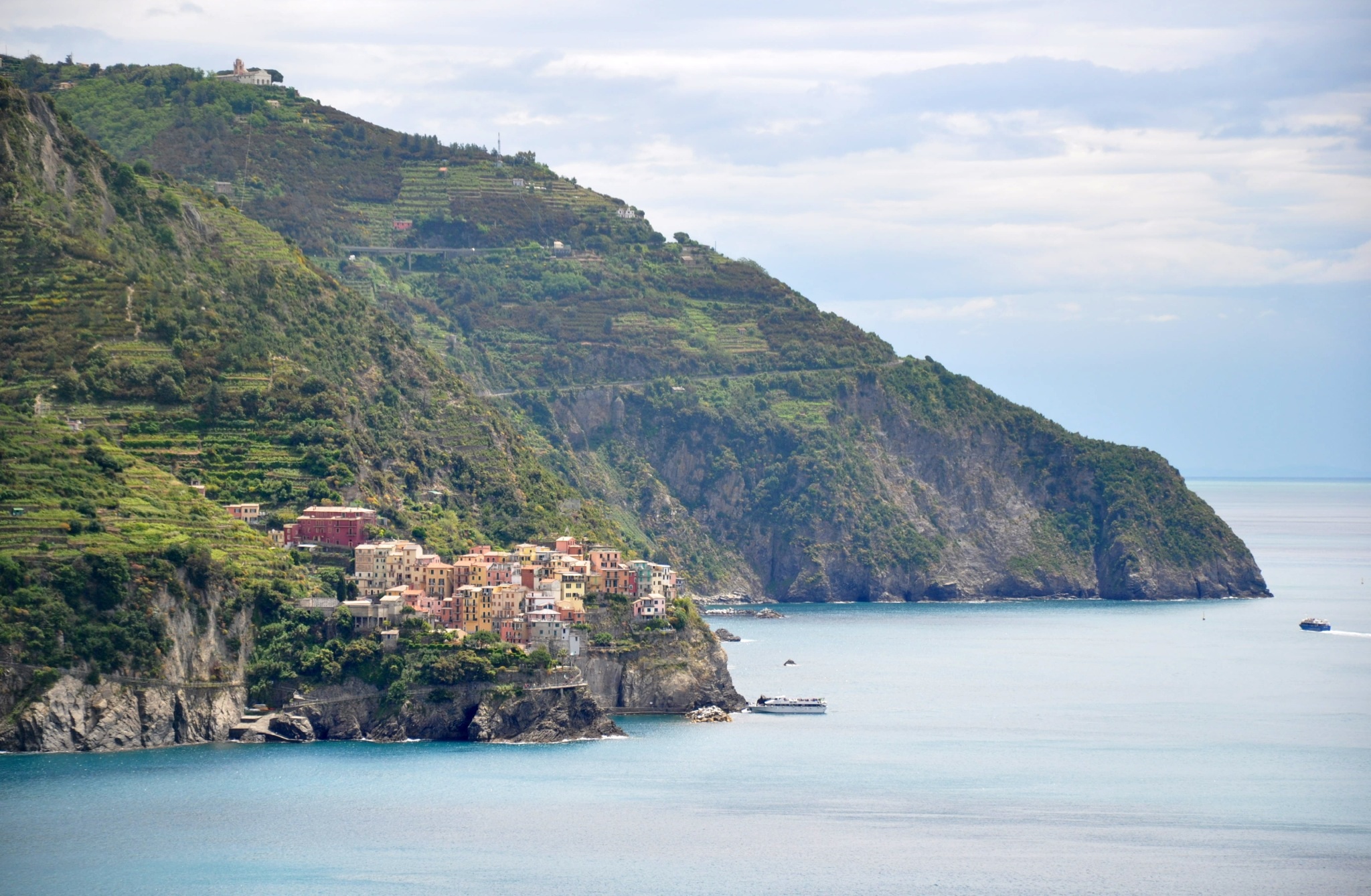
Manarola, as viewed from Corniglia

A splash of colour on a wall in Corniglia

Vernazza as viewed from the stairwell of its ancient tower

Typical local produce on sale in Vernazza

Cliff top Corniglia as seen from the boat
A day out on Lake Como
An easy half hour train ride from Milan, Lake Como is worth seeing for a day out if, like me, you don’t have time in your schedule for a longer visit. EuroCity and Regionale trains arrive at Como San Giovanni station and from there it’s a short stroll down to the lake shore.
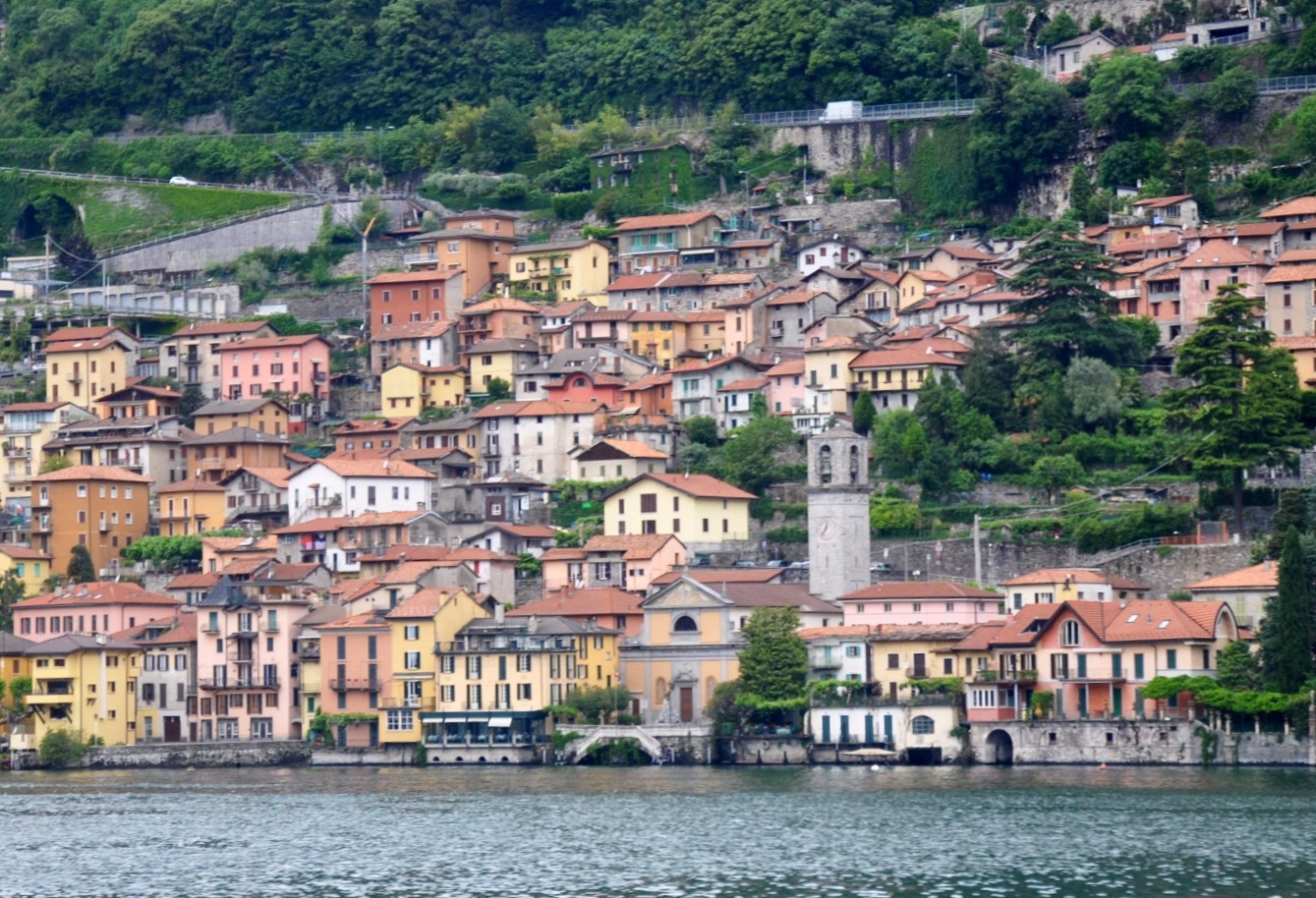
A boat trip gives you the opportunity to see lots of Como’s villages
From there, you can take a boat ride onto Lago di Como. If you only have a day, an express boat will save you time. I took one to Bellagio, paying just under 15 Euros; there’s a supplement for the fast boat which bumps up the price by about half. The vessel makes a few stops as it heads for this pretty village, passing George Clooney’s Villa Oleandra in Laglio on the way.

Laglio, where George Clooney owns a villa.
On a sunny day, with the snowcapped peaks of the Alps in the background, it’s a beautiful ride. Sit on the left hand side of the boat to get the best views as you aren’t supposed to switch seats once underway.

The Alps rising behind Lake Como
In Bellagio itself, there’s an attractive waterfront with gardens overlooking the lake and the Alps. Cafes line the street behind. You’ll pay a premium to sit and look at this view, but prices aren’t exorbitant.

The waterfront is packed with restaurants and hotels
I wanted something a little different, and had lunch at Cava Turacciolo. It’s a bar serving food, crammed full of bottles of wine from all over Italy. I’m not a wine connoisseur but they indulged my inappropriate choice of spumante without making me feel it wasn’t suitable. I didn’t care – it was like drinking alcoholic honey – and I really couldn’t resist a second glass.
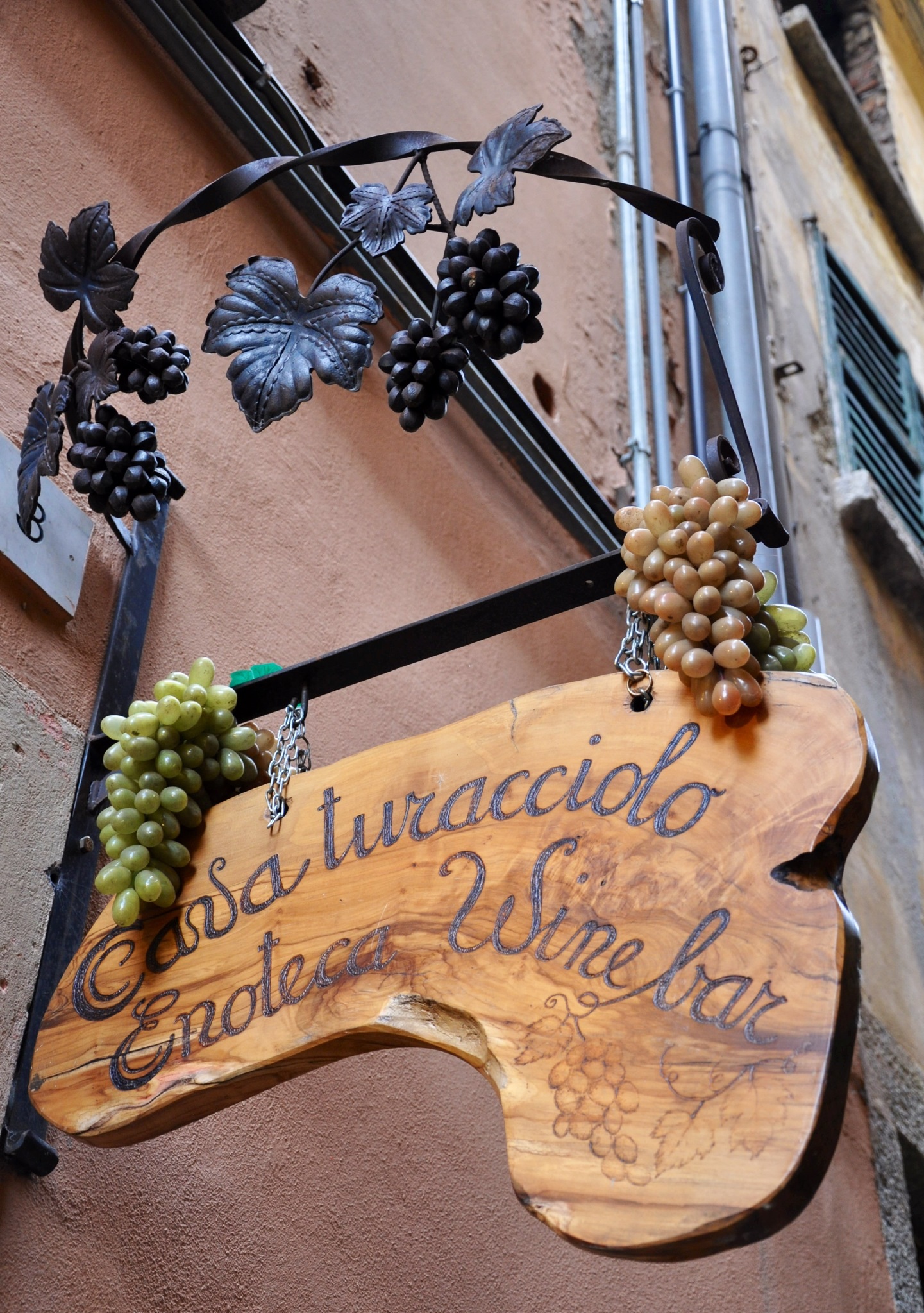
Heaven for wine aficionados
To walk off lunch, I climbed the steps up to the main street, not as tough as it looked as the steps were shallow. At the top, there were plenty of shops to browse, including several selling silk, which is a speciality of Como. There’s also a church and tower.

Don’t be so focused on where you’re going you forget to look down side streets
On account of the extended window shopping, I didn’t have time for the gardens for which Bellagio is known, such as the Villa Melzi D’Eril. I caught a glimpse of it on the bus back to Como, a much cheaper option than the boat at less than 4 Euros. Sit on the right hand side when you return to Como for the best views as it hugs the lakeshore most of the way back.
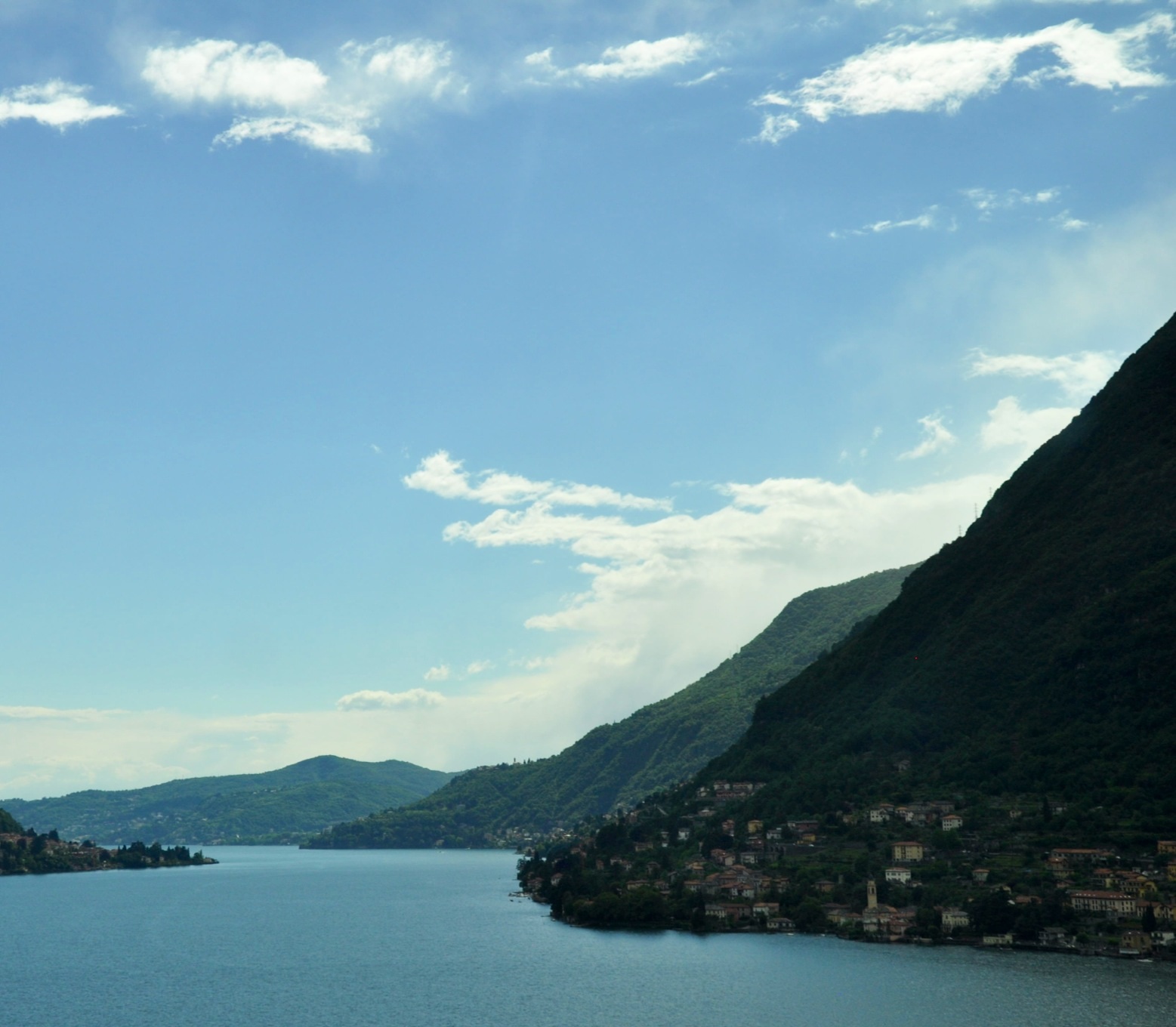
View from the C30 bus
Six feet up a mountain
Later this month, I’m off to Italy to review trains on behalf of Trenitalia and Trainline Europe, but I shall also be making a brief detour north of the border into Austria. I first visited at the tender age of nine months and since then it’s remained one of my favourite countries for a summertime visit. One of my most treasured memories is from a trip I took with my golden retriever Einstein a few years ago. The Pet Passport Scheme has made taking a pet abroad a simple and easy process. So long as I pack his favourite soft toy, Einstein happily travels in the boot of the car and loves nothing better than to give customs officials a surprise when they open up the tailgate to check what they expect to be luggage.
Here’s what happened when Einstein and I decided to take to the hills…
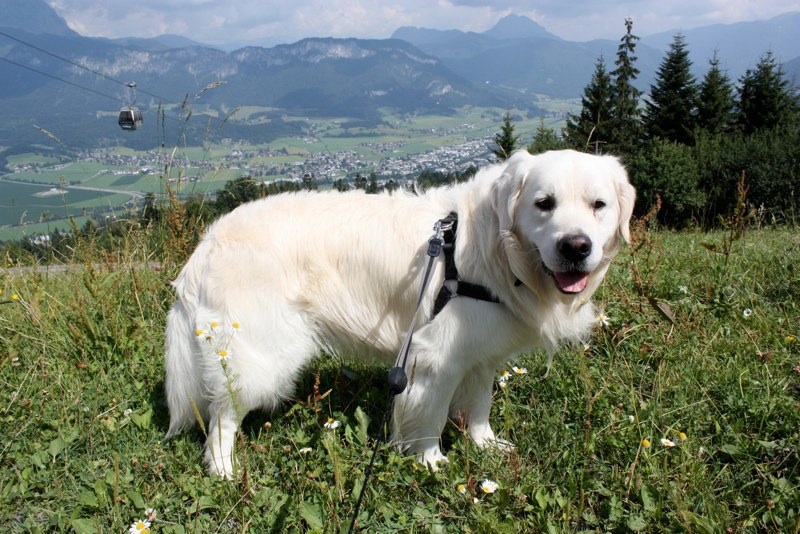
My walking companion, Einstein
There was no way either of us was walking up.
Both of us were far too lazy for that, so I’d decided on the gondola. It was located up a gravel track, steep enough to confirm that the decision was a correct one. He looked at me expectantly, checking to make sure I wasn’t going to change my mind and demand that we walk to the top. I looked up the mountain and then at him and then climbed the few steps to the ticket office.
“Ein und ein Hund, bitte.” That was about as far as my German went (grammatically appalling I expect) but taking a dog on a gondola was common practice here and the woman slid me my ticket without comment.
Inside, we hit a snag. The gondola couldn’t stop and the dog wouldn’t move. Einstein was having none of it, digging his back paws firmly into the ground and refusing to go near the terrifying machine with its hum and its swing. Lifting him was not an option; he’s 32kg of solid golden retriever. After several aborted attempts, we managed to board, me first and Einstein preferring to jump into the unknown than remain behind without me.
This walking business was tougher than we thought.

Time for a rest
At the upper station, we got off with somewhat less drama and took off at a slight run in the direction of down. Unfortunately, the path passed within a couple of feet of a toboggan run and a couple of kids flew past us, screaming and laughing. Slothful Einstein sensed his chance to speed our return to the village cafe where we’d both enjoyed a splendid Austrian breakfast, and dragged me forward in an attempt to slide down the mountain instead of walk. I yanked hard on his lead and disaster was averted.
Once we actually got into a proper routine, the walk down the meadow and along the mountain stream was really rather pleasant. From time to time, we’d pause to admire the view of the Wilder Kaiser in front of us. Stray clouds caught on craggy summit ridges. Geranium-adorned chalets peaked out from behind pine tree plantations down in the valley.
This area, in the Austrian Tirol, is one of my favourite. I’ve been walking in these mountains, off and on, since I was four years old. In the early days, I remember walks with my younger sister, a lot of cows and bellowing thunder – or was that a lot of thunder and bellowing cows? We got wet, she got chased, that I do remember. Later, as a student, I took Wilder walks, (that’s vill-der, not wild-er) and watched the cows being herded down to the village complete with flower-adorned headdresses for the annual Alm Festival. I always feel calm on these pastures, totally relaxed, breathing in the crisp mountain air and letting the freedom envelope the whole of my being.

Relief for hot paws
That day, the sun shone on Einy and I, but the mountain stream was still icy cold and perfect for soaking tired paws as we trundled downhill. I chattered, he listened, ambling beside me obediently unless he saw a squirrel or a bird or a hiker. Aside from the odd cattle grid, always problematic, the walk passed without further incident and, down in the valley, we reached the main road.
Where was the village?
“Oh, bugger, Einstein. The village has moved. Not sure the last part of our walk is going to be as scenic…”
Yes, this walking business was tougher than we thought, I decided, as we finished our walk along hard pavements. But if you have to tough it out, then tough it out with the Wilder Kaiser in front of you, I’d say.
And so would Einstein, if he could talk.
A trip to Sicily sounds tempting!
Last night Leigh Travel Club hosted the delightful Francesca Sanniti from Chic and Unique Tours, down from Yorkshire to speak to the club’s members about Sicily. I didn’t know a lot about the island except about Mount Etna, but learnt a lot about its role as an Italian cultural melting pot, as well as having the chance to sample some delicious Sicilian chocolate. Now I’m sold, and shall be taking a look at Francesca’s website http://www.chicanduniquetours.com to see which holiday might suit me best.
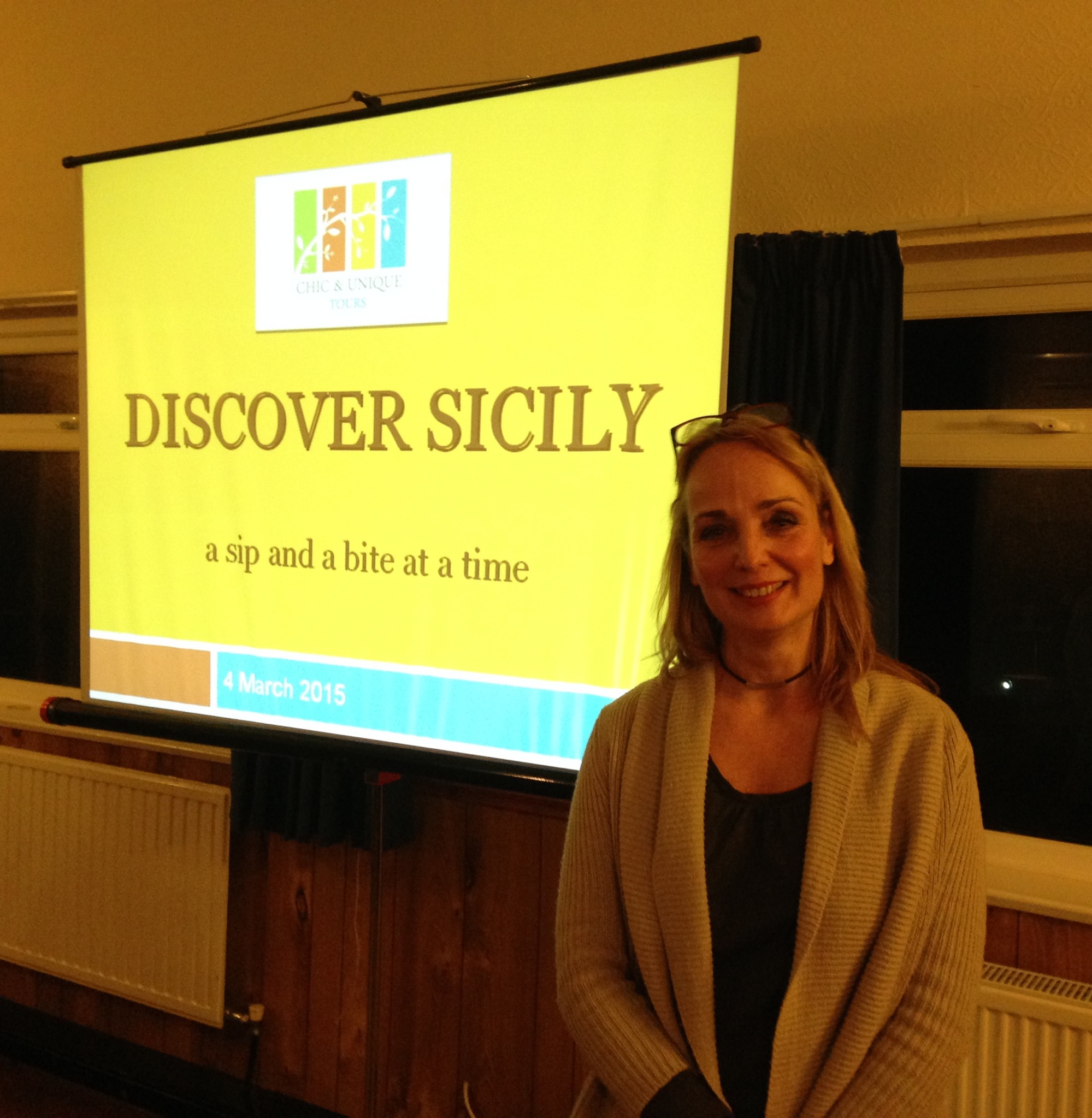
Francesca’s talk was informative and entertaining
A beginner’s guide to Dalmatia
Dalmatia is the region of the Adriatic extending from the Croatian town of Zadar in the north down to Kotor, Montenegro in the south. Rising sea levels once drowned the lower parts of glacial valleys leaving a string of islands reminiscent of the spots and splodges on the backs of the dogs which share the region’s name. Long a favourite of the Italians, this beautiful stretch of coastline has become increasingly popular with UK visitors over the past few years, with those in the know finding a Mediterranean holiday at a fraction of the price of more established destinations. The most scenic part of the region links the historic cities of Split and Dubrovnik, so this blog will focus on making a journey between the two.
Getting there
The region is much better connected than it was a decade ago, emphasising the area’s tourist resurgence. British Airways has direct summer season flights to both Split and Dubrovnik, flying to the latter a couple of times a week in winter. The budget airline easyJet flies to Split and Dubrovnik offering flights to the region from Luton, Gatwick, Stansted, Manchester, Newcastle and Bristol. Ryanair serves Zadar. Other airlines operating flights to Split and/or Dubrovnik include Wizz Air, Thomsonfly, Norwegian, Monarch and Jet2. As with BA, there are considerably more flights in summer. To get to the area with Croatia Airlines you’ll need to hub through Zagreb and change planes. For an up to date list of flight schedules, try http://www.visit-croatia.co.uk/index.php/getting-to-croatia/flights-to-croatia-from-the-uk-ireland/.
Getting around
If you’re beginning your trip in the Croatian capital, a train service links Zagreb to Split but even the fast train takes almost six hours – strictly a journey for aficionados. A convenient bus network links the mainland towns. The Visit Croatia website is invaluable and lists the bus companies here http://www.visit-croatia.co.uk/index.php/travelling-around-croatia/bus-travel-in-croatia/. Autotrans offer the facility to make online bookings. A fleet of ferries facilitates island hopping. Taxis are cheap in the region but where the old towns are characterised by labyrinthine alleyways, it’s best to explore on foot.
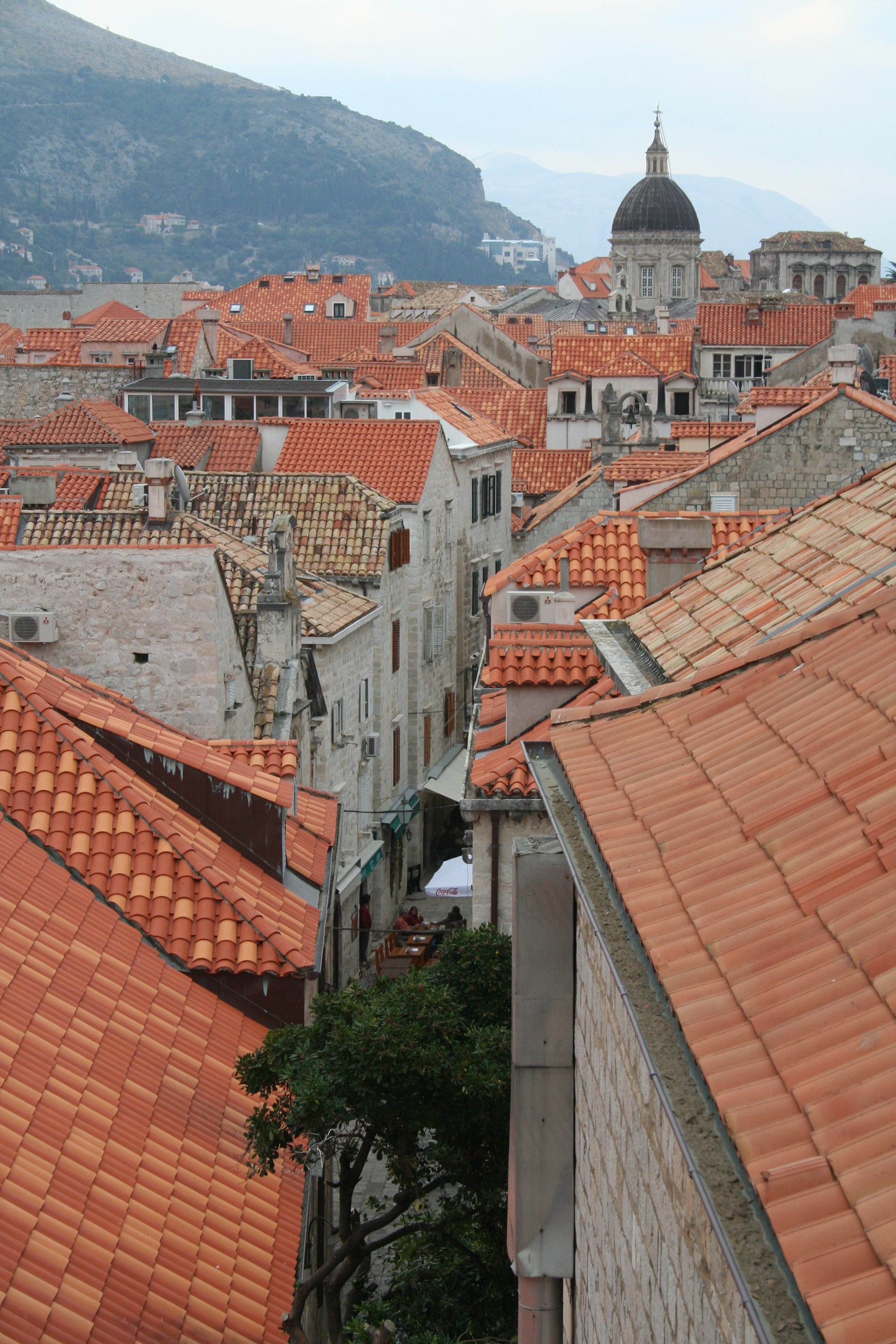
Narrow streets lend themselves to exploring on foot
What to see
Split
Split is the Adriatic’s main ferry port, its quayside thronging with workers as well as tourists. The city’s residents are always on the go and business is conducted frenetically and noisily. The mild and sunny climate makes for an outdoor cafe culture in all but the depths of winter.
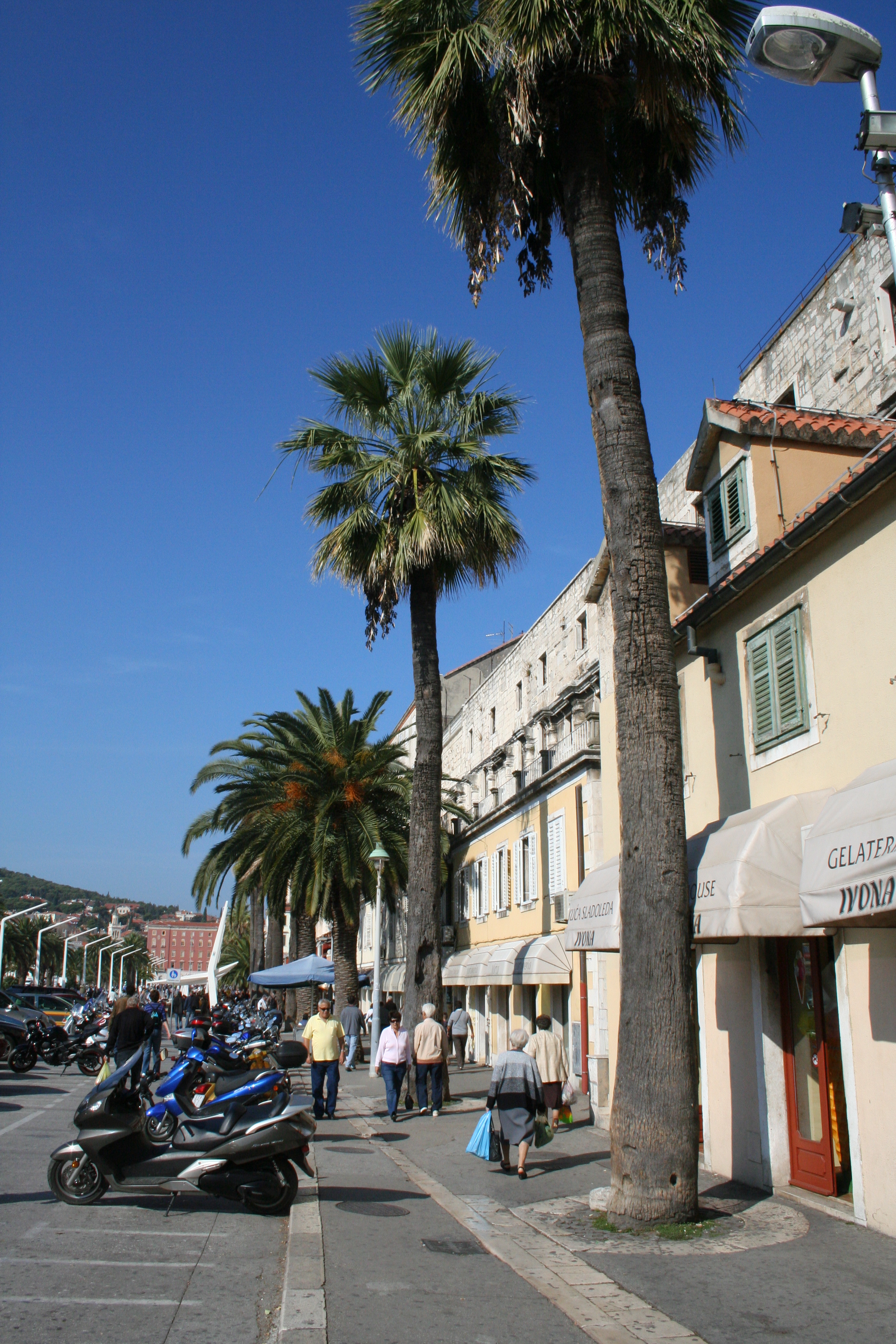
Split has a vibrant cafe culture
Undisputedly, the jewel of Split’s crown is Diocletian’s Palace. Roman emperor Diocletian came here to retire, commissioning an elaborate fortified palace which is now a UNESCO world heritage site. Some time after Diocletian’s death, the palace fell into a state of disrepair, but was seized upon by refugees fleeing from the town of Salona, five kilometres inland and a Roman stronghold thought to be the birthplace of the emperor himself. These new residents added their own fortifications to the palace, building on the original two-metre thick walls, towers and keeps of the original design. Split grew steadily, forging trading links with the interior and was eventually absorbed into the Hungaro-Croatian empire in the eleventh century.
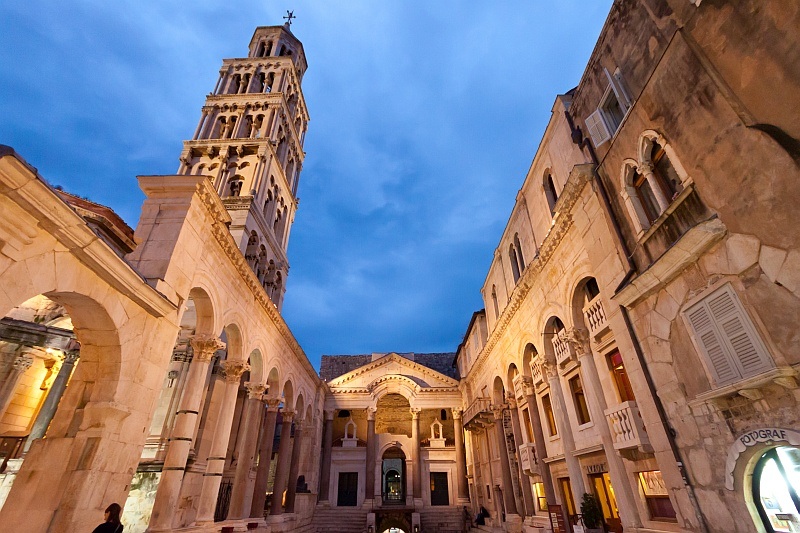
Diocletian’s Palace, by Ballota, courtesy of Wikicommons CC BY-SA 4.0
Now, Diocletian’s Palace blends almost seamlessly with the mediaeval buildings that crowd its western flank. The narrow alleyways beg to be explored at a snail’s pace before heading back to the waterfront Riva to while away the afternoon over a glass or two of wine.
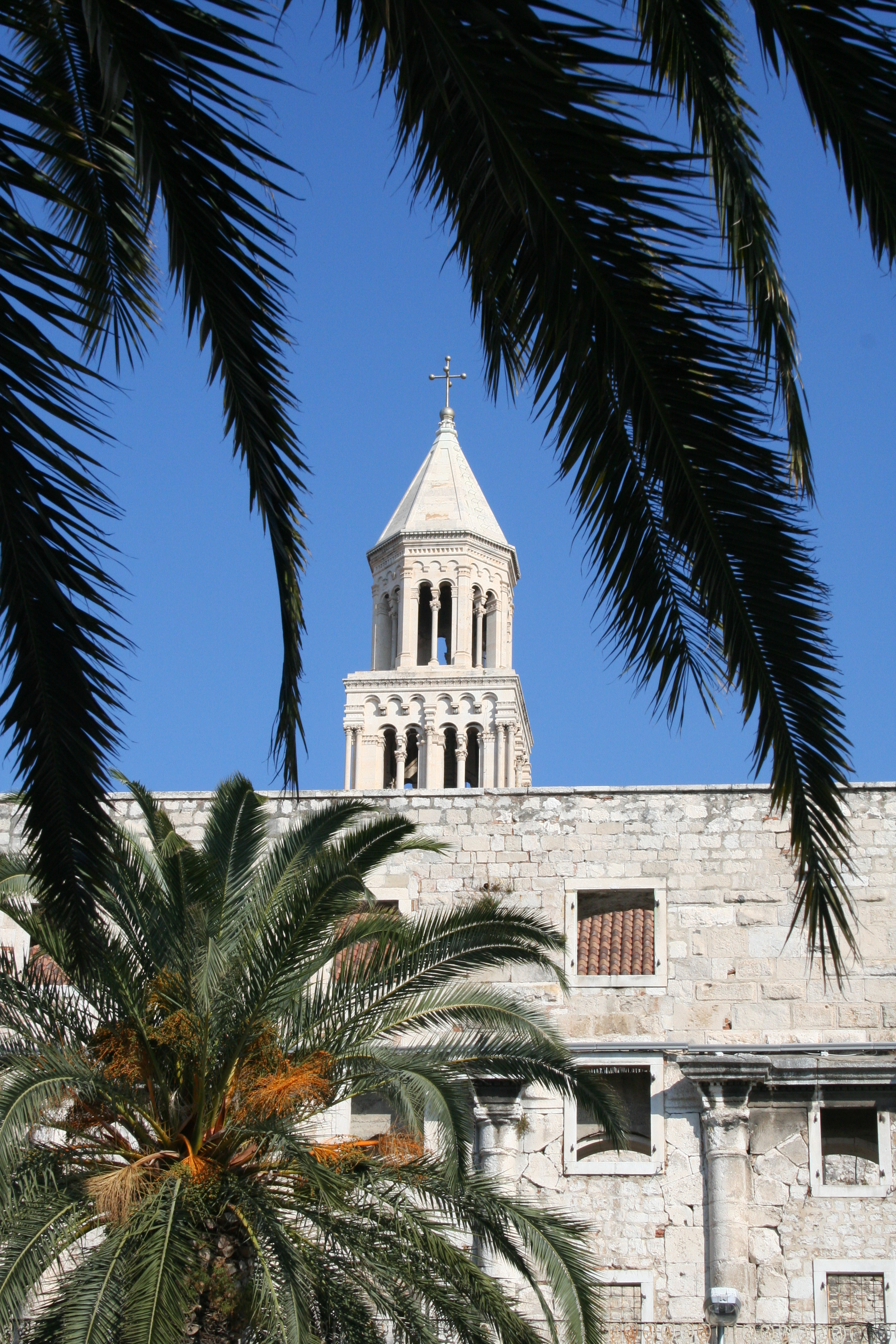
Split
Mostar
It’s worth making a detour inland to the town of Mostar in neighbouring Bosnia-Herzegovina. A three and a half hour bus ride from the coast (see timetables here http://www.buscroatia.com/split-mostar/), pockmarked buildings still bear the scars of the bullets that so recently ripped out its heart. The conflict in 1993 saw the destruction of the town’s iconic Stari Most bridge, a sixteenth century structure spanning the Nevetna River. In peace time, the town’s young daredevils once dived from its ledge outdoing each other in bravado and skill. The bridge was blown up by the Croats. Some say it was destroyed for strategic reasons, but others believe that it was a deliberate act of vandalism intended to enrage.
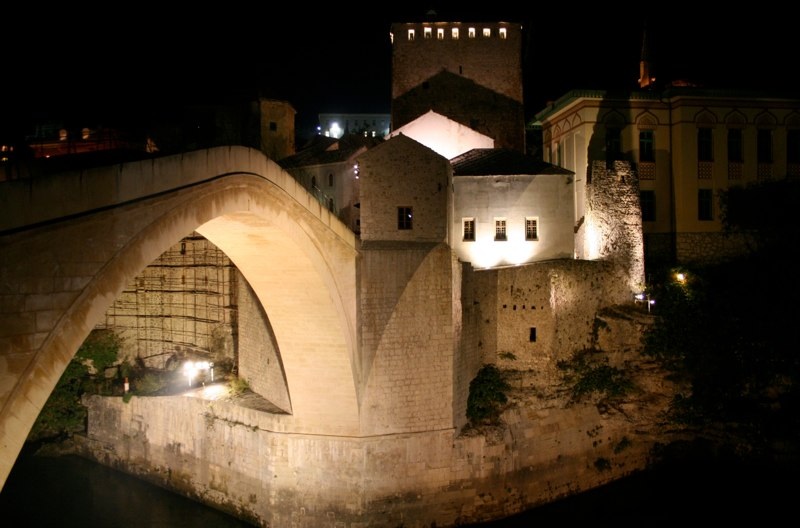
Mostar, Stari Most
Today, the bridge has been rebuilt, a simple engraved stone acting as a reminder to the futility of war. The streets it connects are lined with souvenir shops, selling tin hats and bullets alongside postcards and nick nacks. This old town district was originally settled by Ottomans and the area has a distinctly Turkish feel. Many of Mostar’s mansions were severely damaged by the shelling, but it’s worth checking out the Muslibegovic House which was miraculously untouched. Owner Tadz, will show you round and offer you a room in this museum-guest house hybrid. Book through online agencies such as booking.com or visit the website http://www.muslibegovichouse.com/.
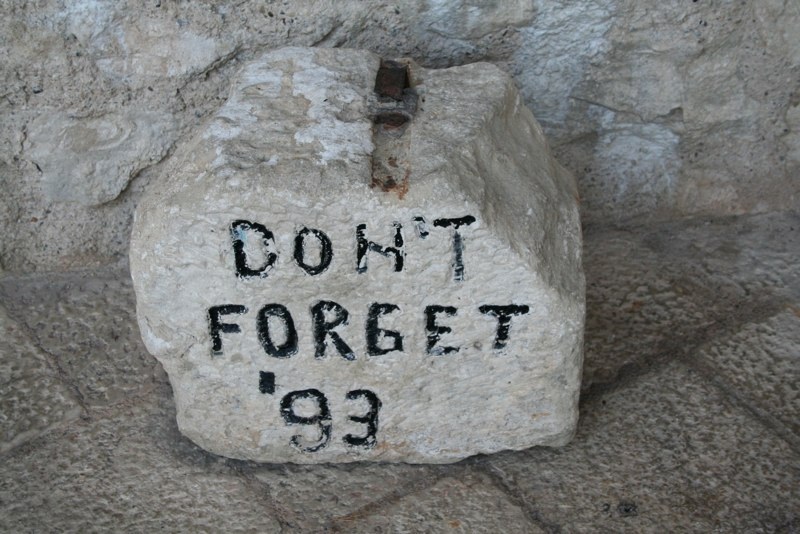
A poignant reminder of a recent conflict
The islands
The mountains that hem the coastal strip from the interior force the focus out to sea and it’s hard to spend any length of time looking out at the sparkling Adriatic without resisting the urge to hop on a boat. There’s an island for everyone. Šolta, close to Split, is a sleepy place characterised by quiet lanes and yachts bobbing serenely in tiny inlets. Base yourself near the harbour in Maslinica. Neighbouring Brač is perfect for beach lovers; try those at Zlatni Rat, Bol and Supetar. Better known Hvar has a fashionable old town packed with bars and clubs, palaces and chapels, a kind of offshore mini-Dubrovnik without the cruise ships. Known for its olive groves, Korčula offers a similar variety to Hvar but on a smaller scale. Further off the beaten track, if you want to escape the crowds, try the island of Vis, popular with urban escapees from the Croatian capital, Zagreb.
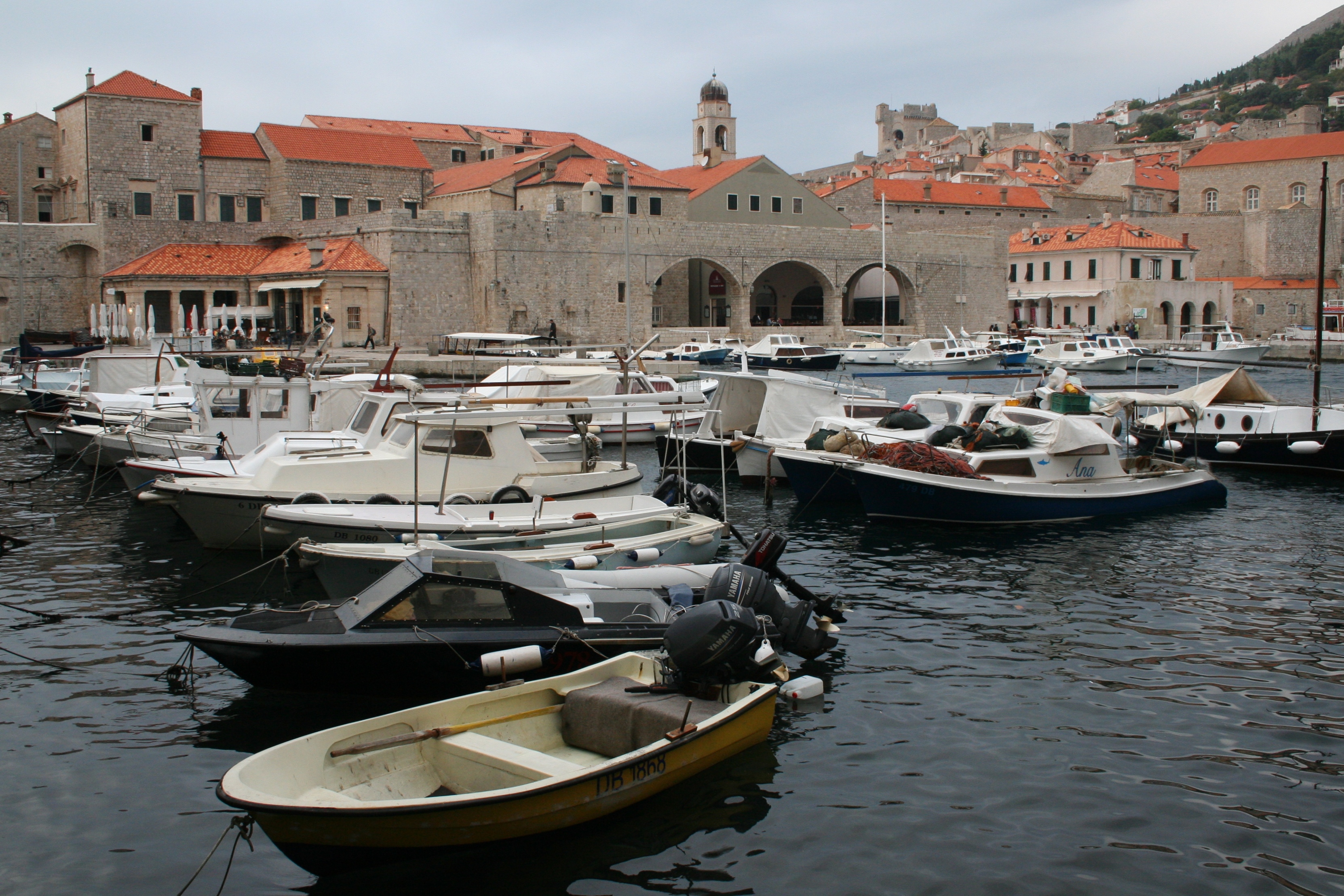
Boats, Dubrovnik harbour
If you’re based in Dubrovnik, the islands of Koločep, Lopud and Šipanhen are all within easy reach. Sold to the city of Dubrovnik in 1333 by the kings of Bosnia, Mljet is do-able as a day trip, but those staying for longer are rewarded with beautiful countryside and much sought after peace and quiet. The west of the island has been designated a national park, the highlights of which are two saltwater lakes framed by pristine woodland. You could even spot a mongoose, imported from India in an attempt to rid Mljet of its persistent snake problems.
Dubrovnik
Get Dubrovnik wrong, and you battle hordes of cruise ship passengers clogging the narrow streets of the Old Town, tacky souvenirs and unappetising food. That’s not to say don’t visit, just do your homework first. Best in spring or summer (avoid January when many business owners take the month off) the crowds ease when the day trippers leave in late afternoon. Restaurants offering al fresco dining tout for custom, but get off the main drag to avoid inflated prices.
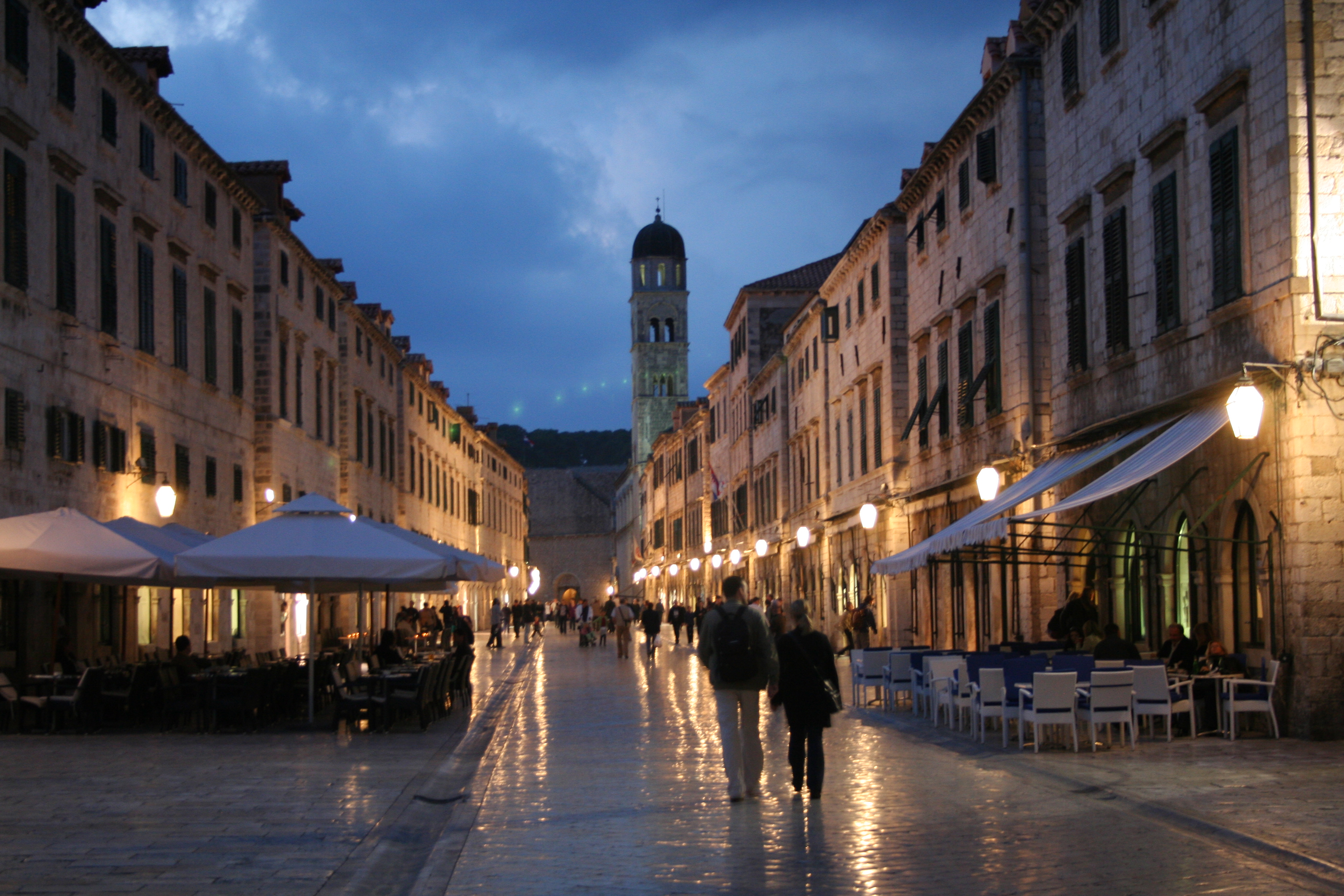
Dubrovnik
The city has a long history. Originally settled in the seventh century, it became an important trading post, a neutral port between the Ottomans and the West. The money generated by sales of wool, hides, wheat and even slaves underpinned the city’s cultural development. The Sponza Palace, Rector’s Palace and the fountains designed by Onofrio della Cava are evidence of this building boom.
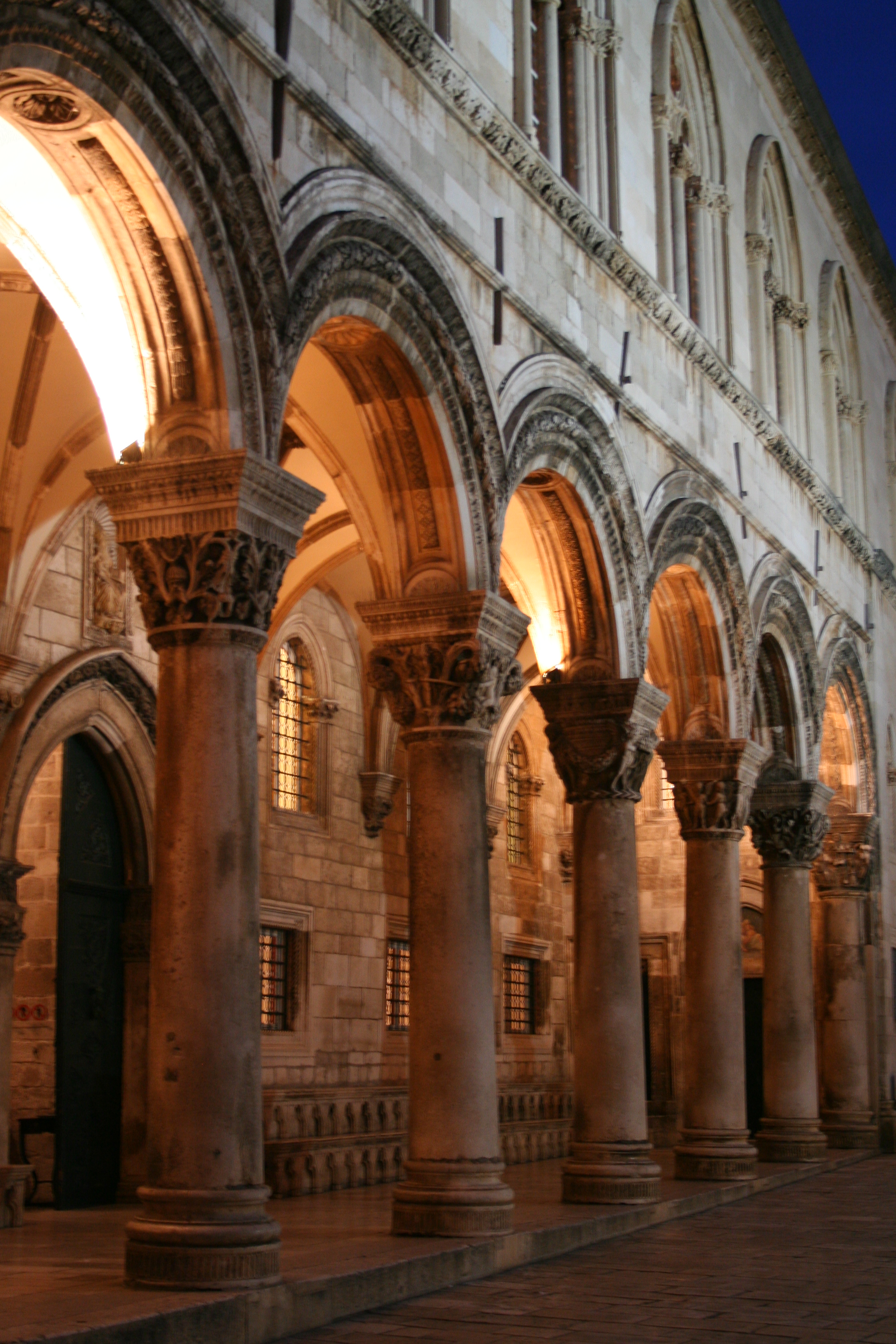
Rector’s Palace, Dubrovnik
Climb the walls of the fortified Old Town for stunning views across terracotta rooftops to the Adriatic, hidden courtyards revealing themselves to those high enough to peer over their walls. The sea pounds away but is no match for the thick stone that Michelozzo Michelozzi and Juraj Dalmatinac designed to protect the city from the waves. After 1995, war damage was repaired speedily and you’d be forgiven for thinking the city was spared; only newer tiles and patched walls give it away.
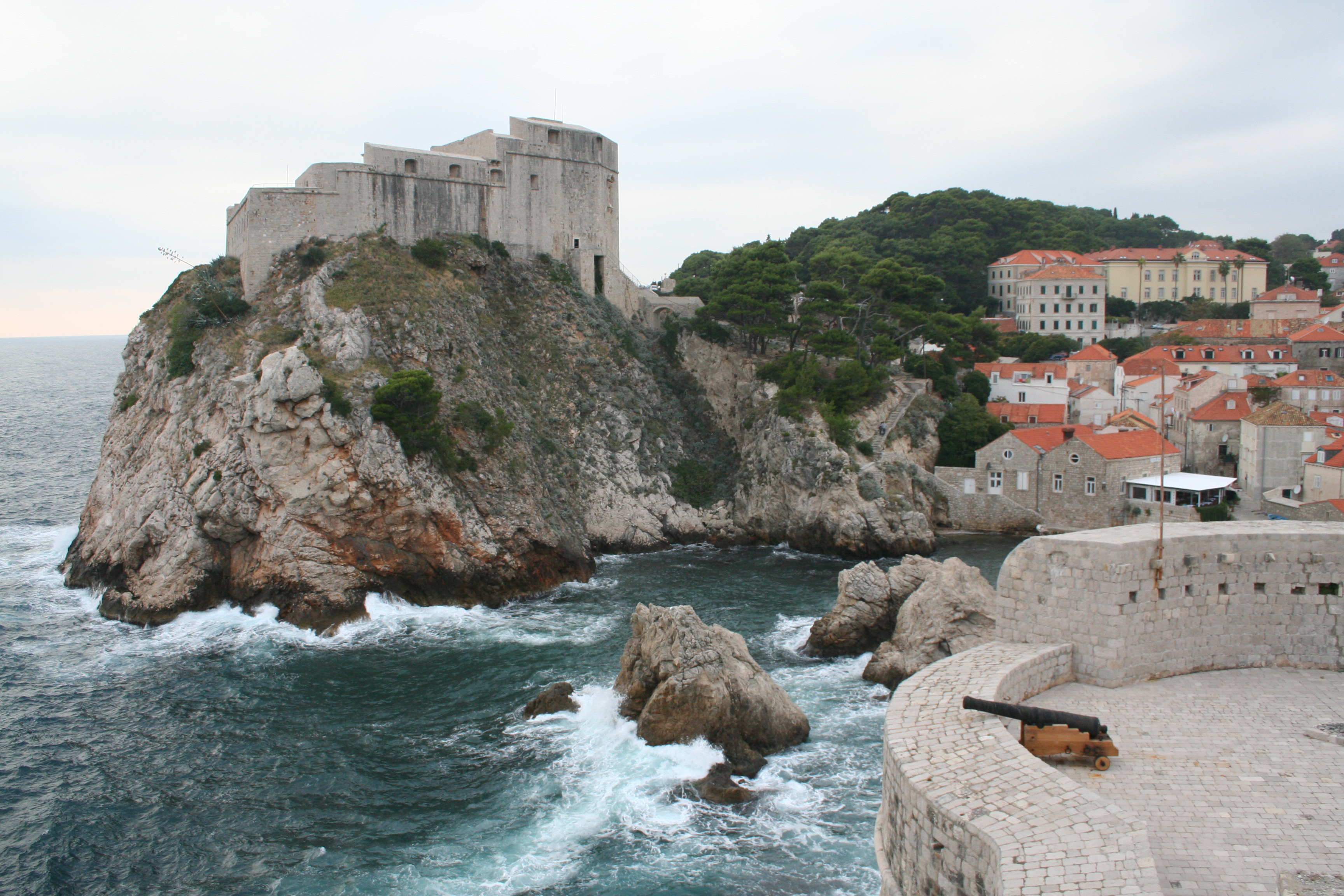
A fortified city, Dubrovnik’s thick walls were designed to protect from waves as well as invaders
The compact Old Town is a delight to wander aimlessly, but accommodation is expensive. It’s worth considering renting an apartment or staying just outside the city walls to achieve better value for money. Some people stay in the resorts of Cavtat or Župa Dubrovačka and visit Dubrovnik just for the day, but it’s worth basing yourself in the city for at least part of your stay.
Moving on
The pretty town of Kotor to the south of Dubrovnik across the border in Montenegro lies at the head of a fjord. Like Dubrovnik, it has a sprawling Old Town and a thriving cafe culture.
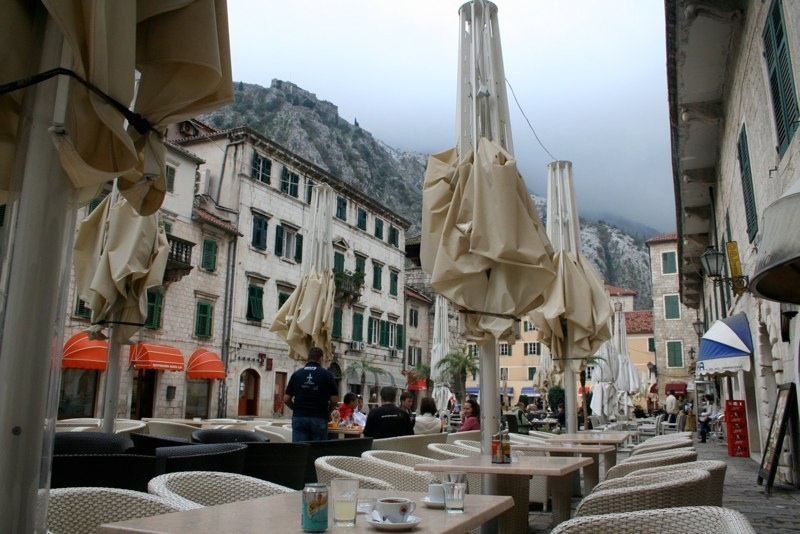
Kotor
It’s worth taking a boat trip out on the fjord if the weather is fine; there are some pretty churches at the water’s edge. Also, make the effort to climb to the castle at the top of the hill – the views are spectacular on a clear day.

Kotor’s fjord side setting – better luck with the weather than I had!
As a beginner’s guide, this blog post isn’t intended to be complete, but there are lots more resources on the web to help you plan a trip. Try the Croatia traveller site here: http://www.croatiatraveller.com/Dalmatia.htm
For Northern Dalmatia, fly into Zadar and then head out from there. Rough Guides have a comprehensive description on their website here: http://www.roughguides.com/destinations/europe/croatia/northern-dalmatia/
For specific attractions, the Lonely Planet is a good bet. Find the relevant Croatia section here: http://www.lonelyplanet.com/croatia
Finally, for accommodation, I find http://www.booking.com reliable and the reviews generally accurate.
A beginner’s guide to Barcelona
With a two thousand year history and a vibrant culture, it’s no wonder the Mediterranean city of Barcelona is the UK’s undisputed favourite when it comes to Spanish city break destinations. As well as having its own ample stretches of sand, the city is perfectly situated to combine some sightseeing with a beach holiday to the Costa Brava or Costa Dorada. But what should you see on a first visit? Follow my beginner’s guide to this captivating Catalan gem.
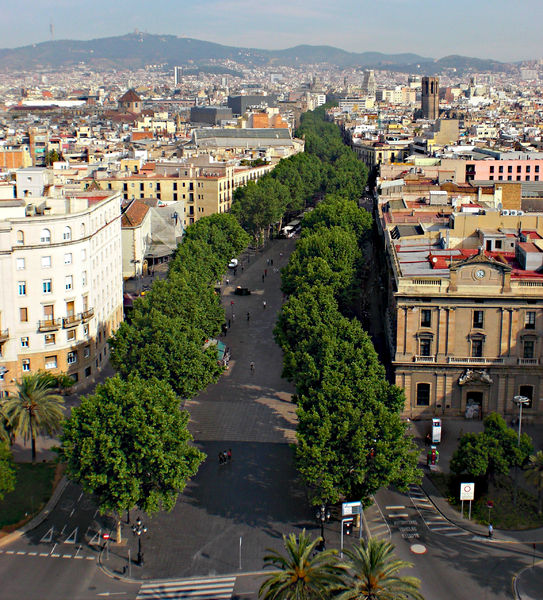
La Rambla by Oh-Barcelona.com reproduced under the terms of the Creative Commons licence CC by 2.0
Getting there
A number of airlines fly from the UK to Barcelona, from regional airports as well as London. To give you an idea of the choice available, there are almost 200 direct flights a week from London, on airlines such as British Airways, Iberia, easyJet, Monarch and Vueling. It’s not difficult to pick up a return ticket for as little as £50 (flying with easyJet from Southend at the end of February, price correct at time of writing) but book well in advance for a summer trip as demand is obviously higher.
Getting from the airport
Most flights arrive at Barcelona’s El Prat airport (some Ryanair services fly into Girona) and there is a train service direct into the city. Take the RENFE R2 Cercanias service (the local stopping train, sometimes referred to as Rodalies in Catalan) as far as Passeig de Gracia. Tickets cost 4,10 euros and there’s no need to buy a ticket in advance. Alternatively there’s an airport bus costing 5,90 euros which takes on average about a half hour to reach the city centre. You can buy tickets online in advance here http://www.aerobusbcn.com/en/buy-tickets or just pay cash to the driver. Expect to pay up to 40 euros for a taxi from the airport to the city centre.
Getting around
The Barcelona metro is extensive and easy to use, though as with any busy city, take care of your belongings and ensure bags are zipped or fastened securely.

LlefiàL10 by Javierito92, licensed under CC BY 3.0 via Wikimedia Commons
A single ride on the metro (or bus) costs 2,15 euros but if you are planning on taking five or more journeys then you could buy a T10 card costing 9,95 euros which covers you for ten journeys over a year (i.e. there’s no need to use all ten on the same day). If you make a journey and change lines without exiting the metro, then that counts as one ride, so long as your total journey time is under 75 minutes. Multi-day travel cards are available, giving you two days’ unlimited travel for 14 euros for instance. 3, 4 and 5 day cards are also offered. Check current prices here:
http://www.tmb.cat/en/barcelona-travel-card
Alternatively, you might consider the Barcelona card. This is a tourist pass offering free transport (including the airport train but not the express airport bus), free or discounted admission to some tourist attractions and discounts in some restaurants and shops. It costs 45 euros for a three-day pass. Examples of free attractions (correct at the time of writing but check on arrival) include the Botanical Gardens and Museum of Modernism. Do your homework; work out what you might like to see and total up the cost – as with all these cards, you need to use it a lot to make it worth your while. A full list of discounts is found here:
For a first-time visitor who perhaps is less confident about using public transport, I’d recommend a hop on, hop off sightseeing bus. Barcelona is a city of over 4 million people and therefore its sights are scattered over a wide area. Although there is a lot to see in a fairly small downtown area, if you wish to see some of the more far-flung attractions it’s easier to catch the sightseeing bus. It’s more expensive than public transport, with a one day ticket costing 24,30 euros if purchased online and a two day ticket about 10 euros more. Their informative website can be found here: https://www.barcelonabusturistic.cat/en/home and provides details of routes, prices and current schedules.
Where to stay
I stayed at the Hotel Duquesa de Cardona, a luxury boutique hotel on the waterfront close to the Columbus statue at the end of La Rambla and a short walk from the aquarium. Its beautifully appointed rooms can cost as little as £75 a night for a double in low season, but the convenient location and excellent service mean that it does sell out in peak periods. The W chain are represented in Barcelona at Plaça de la Rosa dels Vents by Barceloneta beach. The hotel’s 473 rooms feature funky décor and both its pool terrace and 26th floor Eclipse bar afford stunning views of the Mediterranean Sea. On a tighter budget, try the Chic and Basic Ramblas, under £50 per night but only a stone’s throw from La Rambla, or for around £20 more, the Hotel Sant Agustí, a converted convent near to the Plaça Reial. The building dates from 1720 and has been a hotel since 1840, making it one of the city’s oldest.
What to see
Antoni Gaudi’s work

Sagrada Familia nave roof detail by SBA73, licensed under CC BY-SA 2.0 via Wikimedia Commons
If there’s one name that is synonymous with Barcelona, it’s that of Antoni Gaudi, the architect responsible for the as yet unfinished Sagrada Familia church. This elaborately constructed church was begun in 1882, consecrated by Pope Benedict XVI in 2010 but is unlikely to be complete until at least 2026. George Orwell was not a fan, branding it one of the world’s most hideous buildings, but millions of impressed visitors beg to differ. It’s definitely worth a look.
Gaudi’s architecture can be found elsewhere in the city. Slightly north of Barcelona’s city centre in the Gràcia district, it’s worth making a special effort to pay a visit to Parc Güell. Another of Antoni Gaudi’s bonkers creations, as you’d expect its planting is interspersed by wacky benches, columns and platforms featuring the architect’s trademark mosaic tiling. The extraordinary Parc Güell now charges admission, but is a must-see.
Casa Milà, better known as La Pedrera, is another building bearing the hallmarks of the architect’s unique style. Its odd chimneys are classic Gaudi. I also loved Casa Batlló which Gaudi redesigned in 1904. Once a family home and now a UNESCO world heritage sight, it’s unique, quirky and delightful, both inside and out. The entrance fee is a bit steep but looking at the exterior is free.

Casa Batlló
La Rambla
This single street is possibly the most famous in the city. For this reason, it has to figure in your itinerary but be warned, it’s also a popular stomping ground for pickpockets and scammers. This pedestrian thoroughfare is crammed with souvenir vendors, street performers, human statues and, at night, prostitutes. It features a mosaic created by the artist Joan Miró, located near the Liceu metro station. If you look closely, you’ll be able to spot his signature on one of the tiles. A museum dedicated to his work can be found at Montjuïc. The street also has a selection of restaurants but you’d do better heading off the street and away from the crowds.
Montjuïc
This hill overlooking the city literally translates as “the hill of the Jews”. Getting up there is half the fun. Head up by funicular and then take the Port Vell aerial tramway back down to the waterfront at Barceloneta. At the top, there’s a whole load of things to do. As well as the Fundació Miró, Montjuïc
is also home to the Museu d’Arqueologia, the Museu Etnològic and the Museu Nacional d’Art de Catalunya-MNAC, housed in the impressive Palau Nacional. In addition you’ll find the Magic Fountain and the artisan village at Poble Espanyol, both built for the 1929 International Exhibition.

Parc Montjuïc by Canaan, reproduced under the Creative Commons licence CC BY-SA 3.0
Barri Gòtic
Barcelona’s Gothic Quarter is its old town, linking La Rambla to the Mediterranean seafront. Many of the buildings of this area date from mediaeval times, though there was extensive modernisation and renovation in the 19th and early 20th century. One of the area’s most popular attractions is the Picasso Museum. Suggested by the artist himself back in 1960, Barcelona is a fitting choice for the museum; although Picasso was born in Malaga, he spent his teenage years in the city before moving to Paris in his twenties. The five buildings that house a collection of 3500 of his earlier works are as much an attraction as the art itself – Palau Aguilar, Palau del Baró de Castellet and Palau Meca date back to the 14th century.
The Barri Gòtic is a fabulous area in which to wander, with alleyways linking attractive squares, my favourite being the Plaça Reial. This palm-filled square provides respite from the heat of the summer sun; in my opinion there’s no better place in the whole of the city to sip a coffee and people-watch. As with other touristy areas, keep a close eye on your belongings.

Barcelona – Plaça Reial by Josep Renalias, licensed under CC BY-SA 3.0 via Wikimedia Commons
Camp Nou
For football fans, there’s only one unmissable attraction in the city – Barcelona’s Camp Nou stadium, home to Futbol Club Barcelona, or Barça to its adoring fans. It is possible to take tours of the stadium. Visit the FCB Museum, walk down the players’ tunnel and out onto the pitch, stand in the dressing room and see behind the scenes in areas such as the press room.

Camp Nou colours by DJ Lucifer, licensed under CC BY 2.0 via Wikimedia Commons
Something for the evening
Cava is to Spain as champagne is to France, and the most atmospheric place in town to drink the stuff is at El Xampanyet. This small bar has a take me as you find me vibe, with a mixed clientele of locals and visitors. The tiled walls and tasty tapas have barely changed since the place opened back in 1929. Its location on Carrer de Montcada in El Born district, is within an easy stroll of the cathedral and Parc de la Ciutadella, and perfect for a few glasses before dinner in the Old Town.
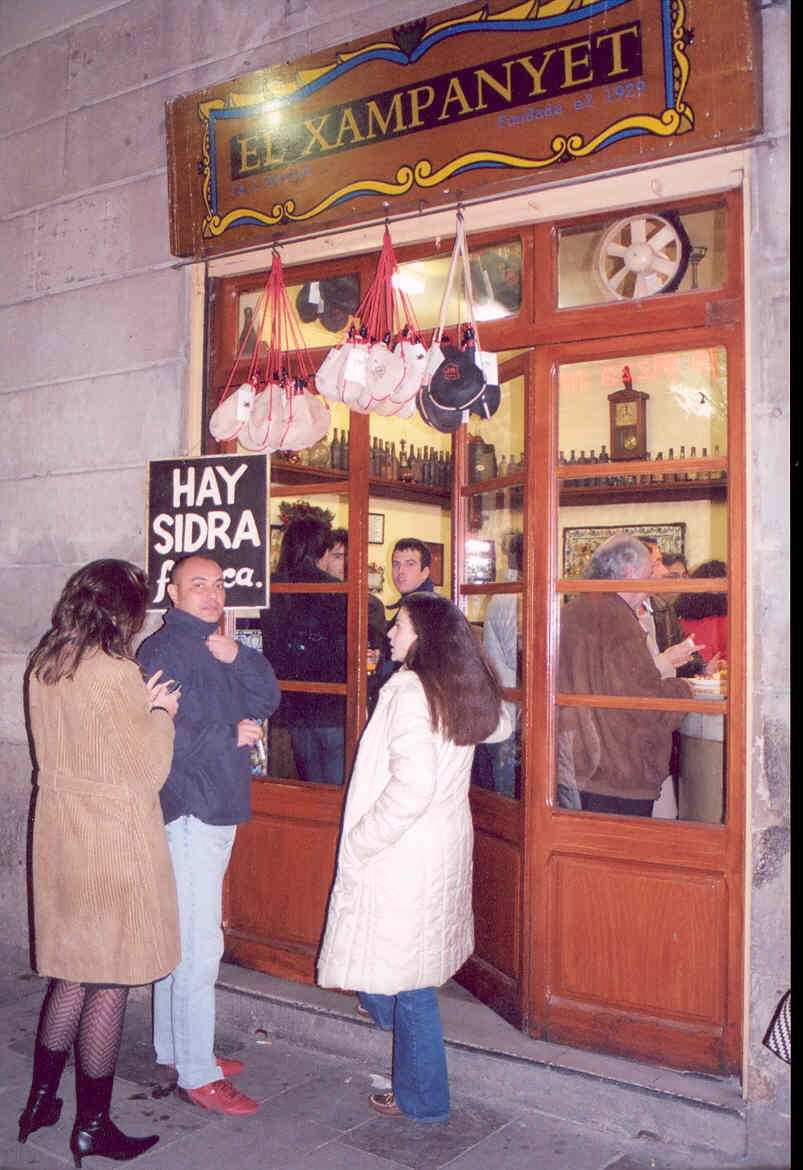
El Xampanyet
Just back from – a day trip to Amsterdam
Is an Amsterdam day trip viable? In the second of an occasional series, I test whether it’s really worth making the effort for just a single day’s visit to this popular Dutch city. Would I regret not paying for a hotel room as I dashed from attraction to attraction?
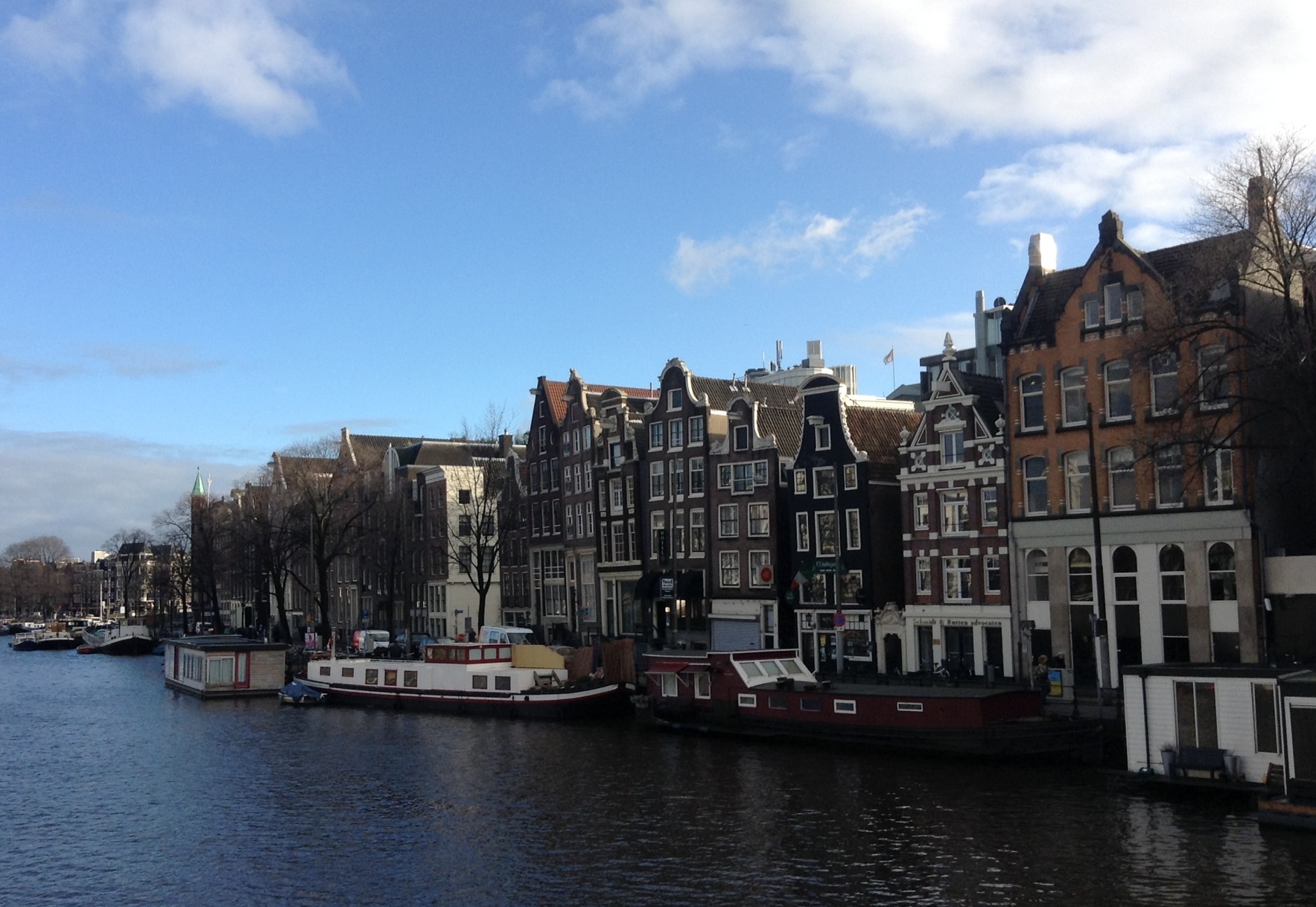
Amsterdam’s canals
Logistics
I chose to fly from London’s Southend airport, around an hour from Central London but only a short drive from my Essex home. Southend, though expanding, is still a small airport, making it possible to transit the airport in just a few minutes – none of the long queues for security or marathon hikes to the gate that characterise Britain’s larger airports. easyJet fly out to Amsterdam at 7.30am and back at 6pm, making a short day out a cheap possibility. It’s wise to note that easyJet fly into a satellite terminal at Schipol, making for a tidy walk to the gate for your return flight. But they have a good track record for punctuality and my outbound flight was on time. On the return leg, we landed early and thanks to the time difference, I was back in my kitchen feeding the dogs their dinner almost before I should have left Schipol. (Don’t worry about them, we have doggie day care for such occasions.)
Getting into the city
Having made it across the airport without getting distracted by the many shops and even a branch of the Rijksmuseum (Schipol has got to be the best airport in Europe, don’t you think?) I exited through self-service passport control leaving the tulip bulb purchases for my return. Keep straight on as you exit customs for the train station, the quickest way into central Amsterdam. Directly in front of you are bright yellow ticket machines which take cash and cards. A single ticket into the city costs 5,10 euros with a 0,50 euro surcharge for using a credit card; UK issued cards work fine. It’s worth noting, though, that they take coins and not notes if you wish to pay cash. Make a left and head for the train; it’s a quick fifteen minute ride into the city. Trains leave frequently for Amsterdam Centraal Station immediately to the north of the main city. I waited one minute for a train and was walking Amsterdam’s streets by 10am.

Centraal Station
Getting around
The city centre of Amsterdam is compact and unless it’s raining, it’s a pleasant experience to wander the back streets and canal side paths on foot. You’ll need eyes in the back of your head, though, to avoid being run over by a bicycle. The city has dedicated cycle lanes but it’s all too easy to forget where the pavement ends if you’re trying to take a photo. If you hire a bike yourself, it’s customary to ring your bell rather than mutter profanities at wayward pedestrians obsessed with getting the perfect selfie.
For longer distances, the easiest method of getting around the city is by tram. Single rides cost 2,90 euros and the ticket is valid for an hour. Tap the ticket on the reader as you are given it to activate it. If you are likely to make more than three journeys, it’s worth your while buying a day pass, costing 7,50 euros. Tap in and out each time you ride.

Cheese!
What did I do?
I’ve been to Amsterdam before, so decided to give the big museums and the Anne Frank House a miss this time. If you are making a first visit then you should really consider staying a few days to give you time to do the sights justice. Queues for the Anne Frank house are frequently long (even on a Monday in January!) so if you do want to go, and you should, plan to make this first on your day’s agenda when you visit.
I made for the Begijnhof instead. It’s an easy walk from Centraal Station – cross over the canal and head down Damrak, the main drag. Damrak is tourist central, but you can arrange everything from canal boats to bicycle hire here and buy souvenirs tackier than you’ve ever imagined. From Dam Square, continue down Kalverstraat (almost as bad as Damrak) until you get to Spui.
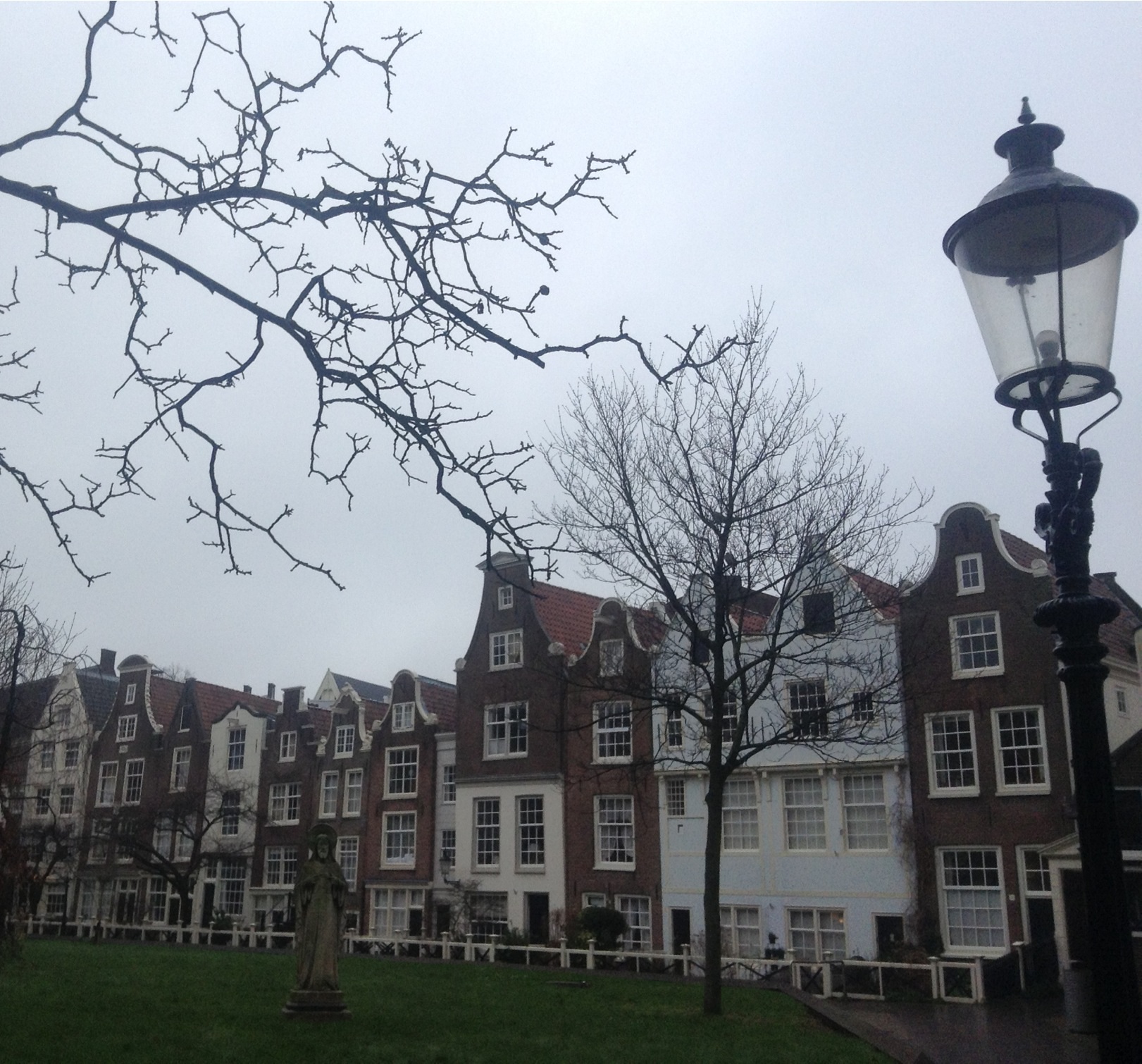
The Begijnhof
Accessed through a wooden door, a passageway with impressive vaulted ceilings leads through to an enclosed square, the Begijnhof. Women have lived on this site since 1150, primarily to care for the sick. By the fourteenth century, the place had become a nunnery, the women referred to as “beguines”. Taking pride of place in this inner courtyard is the church. The Begijnhof is also the site of one of only two surviving timber buildings in the city, this one dating from 1528. Visitors can access half the square, so long as they keep off the well-manicured lawns; the rest is for residents only. Entrance is free, though donations to the church are welcomed.
The Begijnhof is around the corner from the Bloemenmarkt, on the Singel, which claims to be the only floating flower market in the world. Don’t worry if you haven’t timed your visit for spring, even in winter the stalls are a riot of colour, selling cut flowers and bulbs. The packaged bulbs are aimed squarely at the tourist market – locals make a beeline for the loose bulbs as they’re considerably cheaper.

Tulips from Amsterdam
Next, I set about exploring the area known as “De Negen Straatjes” – the nine streets. This is an area bisected by canals from the Singel to the Prinsengracht and gentrification has resulted in a wealth of designer boutiques, gift shops and art galleries that lend themselves to ambling. This is not a district to walk with a purpose, more an area in which to potter and dither before recharging your batteries in a cafe. Forget Starbucks – though there are plenty – a canal side coffee shop is the way to go. I recommend the Koffee Huis “De Hoek”, a far cry from the smoky cannabis cafes for which Amsterdam is better known. Try their cheese and ham pancake washed down with proper freshly- squeezed orange juice and bag a window seat for brunch with a view.
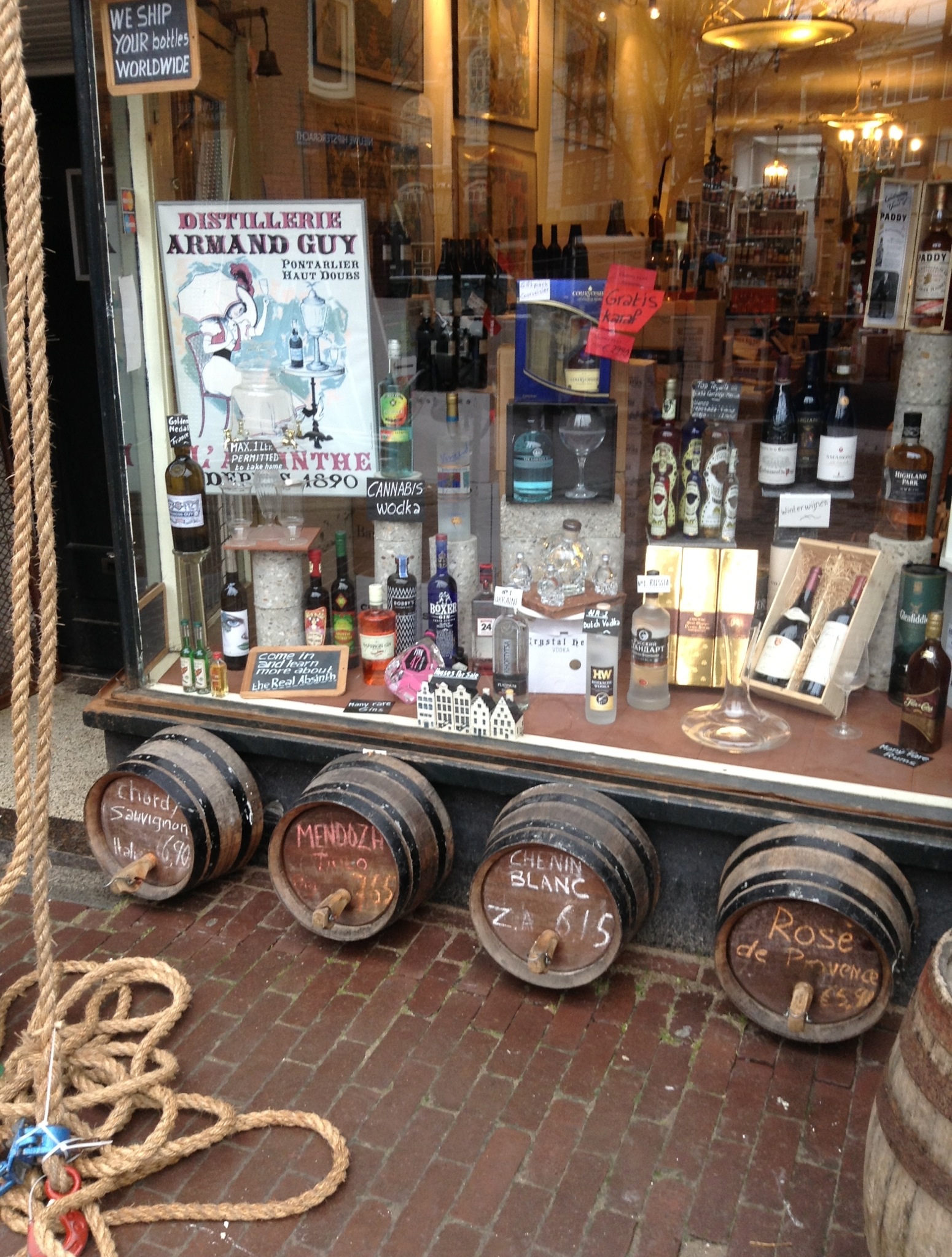
Off licence, Nine Streets
Continuing along Prinsengracht, and just past Westermarkt I passed the long queue for the Anne Frank House. Further along on the opposite side of the canal is an interesting little museum devoted to tulips. Behind the extensive gift shop and down a steep flight of steps, a series of small interconnecting rooms tell the history of this iconic Dutch flower, which you’ll soon learn, isn’t Dutch at all. In fact, it is native to Asia (who knew?) and it was the Ottomans who introduced the flower to the Netherlands in the sixteenth century. They soon became fashionable, with growers competing to see who could produce the most sought after bloom. Speculators moved in on the industry and soon bulbs with the right “pedigree” were changing hands for crazy sums of money, with some selling for twenty times the annual salary of the average Amsterdam resident at the time. Out of control, the market crashed in 1637 and it was to take a further 200 years to steadily rebuild it. Fortunately, the prices of tulips are far more reasonable today, as is the 5 euro entrance fee.
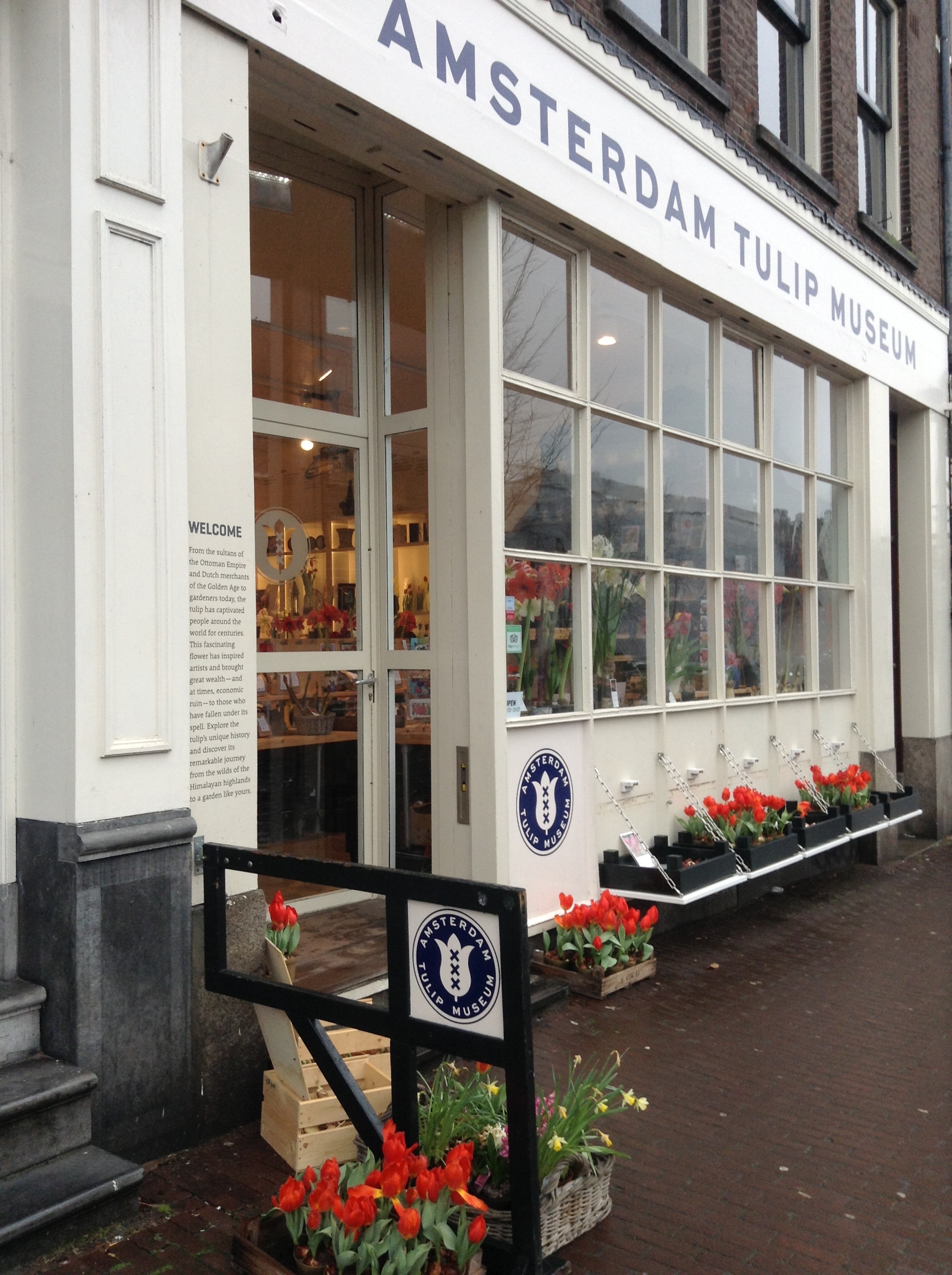
The Tulip Museum
Back at the Westerkerk, I jumped on a number 14 tram heading east to my second museum of the day – the Dutch Resistance Museum. This absorbing museum recounts the experiences of the Netherlands from 14 May 1940 to 5 May 1945, the period when the country was occupied by Nazi Germany. As well as resistance, the museum explains how people chose different paths in coping with the invasion – some collaborated, some fought back. The exhibition covers all forms of resistance: going on strike, forging documents, helping people to go into hiding, publishing underground newspapers, maintaining escape routes, and even armed resistance and espionage. Entrance costs 10 euros which I thought was good value for money. Take the free audio set that’s offered as it unlocks a series of explanations in English; the exhibits are all signed in dual language but some of the text is on the small size. A short film puts the museum in context, in kid-friendly language, and there’s a special children’s section to the museum as well. Families, this is your part of town – Artis zoo’s just across the street.

Dutch Resistance Museum
All that history had made me thirsty (and my back ache) so sinking into a chair in the Cafe Koosje on the corner of Kerklaan and Plantage Middenlaan came as a welcome relief. The hot chocolate topped, of course, with a generous dollop of cream and the friendly wait staff made this a good place to take a break.
It was time to head back to the centre for some shopping and my mind was on food. Taking the number 14 tram back to Waterlooplein, I walked to Staalstraat where I’d read about a foodie’s paradise at number 20. Het Hanze Huis is crammed full of European foods, from syrups to flavoured tea, chocolate to tasty biscuits. Mouth already watering, I decided to continue by number 24 tram (tram-hopping like a local!) to the market on Albert Cuypstraat. A mix of market tat, food trucks and cheese stalls, this place is definitely worth a visit. I stocked up on Stroopwafels, a family favourite, from a charming man who posed happily for a photo. Bag full, I had to pass on the Gouda cheese, but figured I could at least get that in Sainsbury’s.
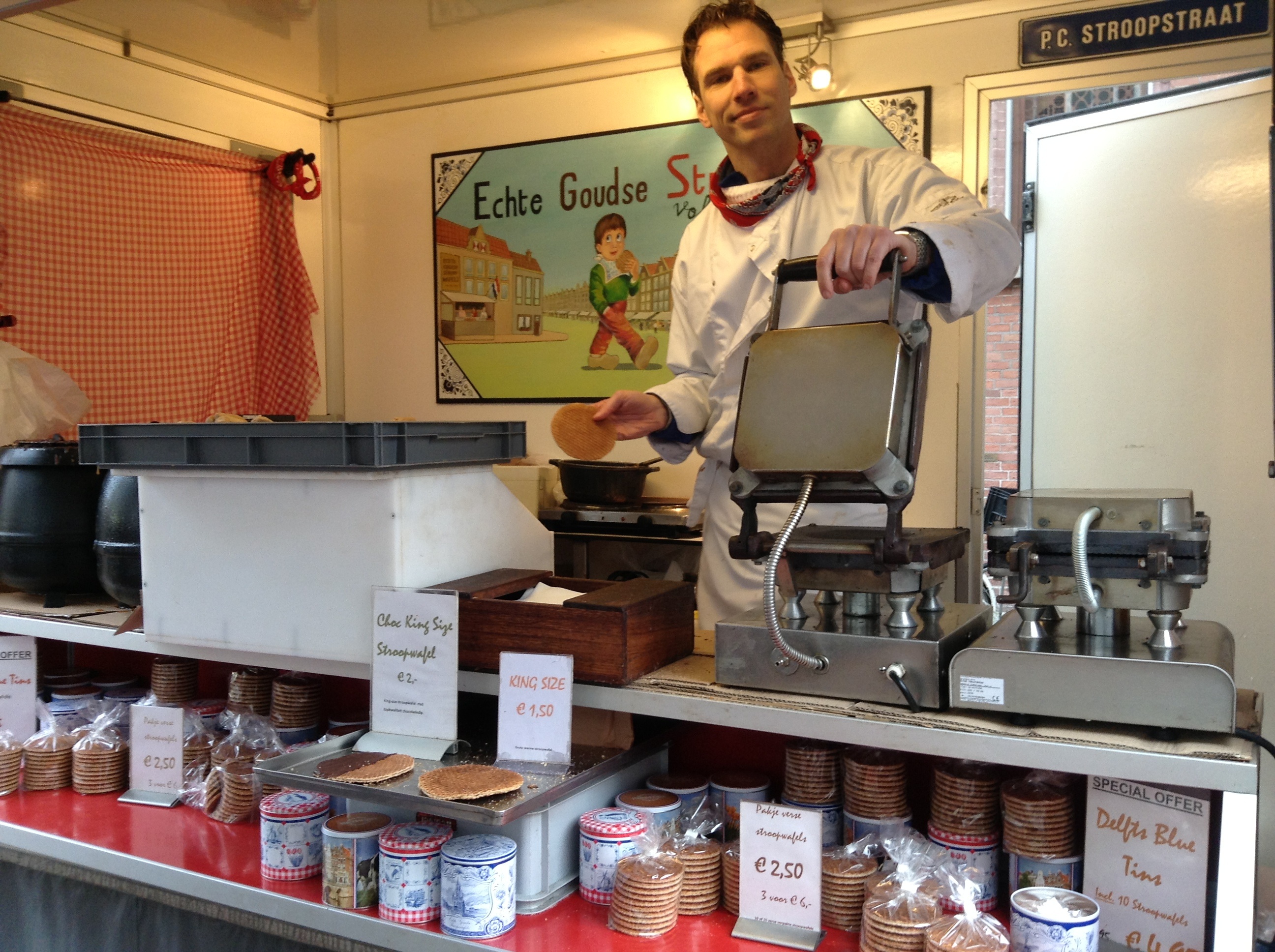
The Stroopwafel man
Heading back to the centre on the number 4 tram, my final stop was to a pub with no bar. I’d come across De Pilsener Club, located on Begijnensteeg, via several bloggers on the net. The pub’s nickname is De Engelse Reet, which apparently translates as “The English Ass”. Perfect, I thought. After all today’s walking I need a seat for my own ass. According to what I read, the pub has been in business since the end of the nineteenth century. It’s been in the current owner’s family for four generations (I read that they all share the same first name, so that’s four men called Tuen Van Veen) and they don’t like change. Stepping over the threshold is like travelling back in time, with sanded floorboards and tables pockmarked through years of use. Given the early hour (for a pub, anyway) I expected to have to drink alone, but two tables were occupied when I walked in and by the time I left, it was full. It seems it’s a very popular meeting place in the late afternoon for Amsterdam’s over 60s.
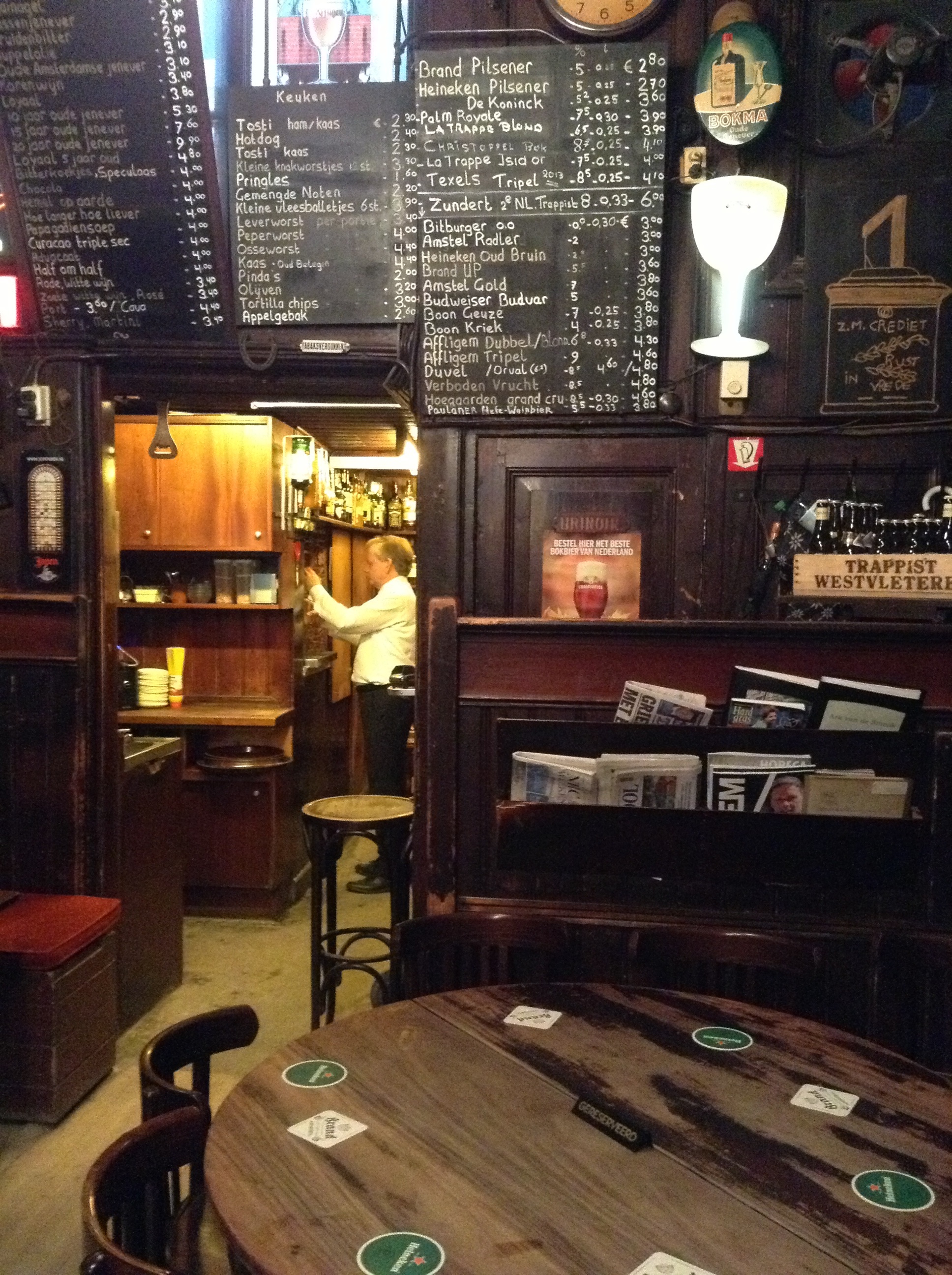
De Engelse Reet
The lowdown
As with Lisbon, I pre-planned my itinerary in order to minimise the chances of wasting time arriving somewhere that’s not yet opened up for the day or unnecessarily backtracking across town. Both times I’ve been fully prepared to ditch things as the day goes on, but was once again surprised by how much I ended up doing. I’ll admit, Amsterdam has never been one of my favourite cities, but I wanted to prove to myself that I could find a city I love within a tourist city I really don’t. A bit of extra research this time uncovered parts of Amsterdam that were a whole lot more rewarding than the Red Light District, tacky souvenir shops and mainstream museums I might otherwise have felt obliged to visit.
I also made good use of the Travel Telegraph’s app, and grew increasingly fond of its “favourites” capability and very functional zoomable map – particularly helpful as my paper map began to disintegrate in the drizzle. Because of the shorter flight time and the exceptionally quick train connection, having a later outbound flight and earlier inbound flight wasn’t an issue, though I could quite happily have holed up in De Engelse Reet and made a night of it. Next time that’s where you’ll find me, though perhaps I’ll get Tuen Van Veen to serve me up a couple of hard boiled eggs to soak up the Heineken.
A beginner’s guide to Iceland
Updated Spring 2022
Iceland’s fortunes are looking up. Years have passed since the volcanic eruption that resulted in flight chaos throughout the northern hemisphere. Post-economic crash and coping admirably with the fallout from the coronavirus pandemic, Iceland is fully open for business.

Iceland’s scenery is dramatic and beautiful
How to get there from the UK
Flights with BA and also Icelandair, the national carrier, depart from London Heathrow to Keflavik (KEF), the airport nearest to the Icelandic capital Reykjavik. Budget airlines also serve Keflavik. easyJet offer a good service from London Luton and London Gatwick, while Play operates out of London Stansted. A non-stop flight takes a little over 3 hours from London. There are also flights from Manchester and Edinburgh. Icelandair offers fares to North America with Reykjavik as a stopover destination for the same fare making it possible to combine an Icelandic break of 1 to 7 days with cities such as New York.

Jökulsárlón glacial lagoon
Getting from Keflavik airport into the city centre
The simplest and cheapest way to get to Reykjavik is to use the FlyBus. This bus will take you from the airport to either the bus station or to some hotels. To find out whether yours is served, there’s a list on the FlyBus website – check Google maps if yours isn’t listed to identify which listed hotel is closest. Single fares to the bus station are 3499 ISK (about £21) and to your hotel 4599 ISK (about £28). The journey takes 45 minutes, there’s free Wi-Fi on board and tickets are flexible, so if your plane is late, you just take the next available bus. There are frequent departures throughout the day and evening.
If you are travelling as a larger group or further afield, you may prefer to hire a car. The easiest way to do this is to book with one of several car hire companies based at the airport. I’ve used Thrifty a couple of times now. They’re not the cheapest but the cars are reasonably new and the rates are competitive. Note that you’ll need special insurance if you plan to drive off road or on some of the interior’s gravel roads (note: the latter are closed during the winter). It’s also advisable to take out an insurance policy that covers you for damage caused by sand (especially if you plan to travel along the south coast) or gravel. You might be a careful driver but there’s nothing you can do to mitigate against those travelling at speed who pass you from the opposite direction.

Icelandic fishing villages such as Olafsvik are charming
Getting around
If you’ve chosen not to hire a car, it is possible to use public buses to travel between some parts of the country. Check schedules carefully as it can be a long wait between buses. Consult this useful map of the main long distance routes in Iceland to see at a glance whether the places you plan to visit are connected or not. Alternatively, use a company such as Reykjavik Excursions which can offer day or multi-day tours. They can also sell you a ticket for a summer-only bus up to Landmannalaugar in the highlands.

Seljalandsfoss
Reykjavik
The Icelandic capital is charming and a good base for the first time visitor. Pay a visit to the unusual Hallgrímskirkja church; it’s only 1200 ISK to go up it and take in the views of the city. Also great for the views though a little out of the centre is Perlan; it features an excellent Áróra Northern Lights planetarium show and now also has a double zipline. The area around Tjörnin lake is worth a stroll if the weather’s good; it’s not far from the main drag and is popular with joggers. Down by the harbour there’s a cool structure known as Sun Voyager or ‘Sólfar’ which is worth making the effort to visit; walk past Harpa, the city’s concert hall and along to the Old Harbour for a pleasant walk. In the opposite direction, you’ll come to Höfði House where Reagan and Gorbachev met in 1986 to begin the process of ending the Cold War.
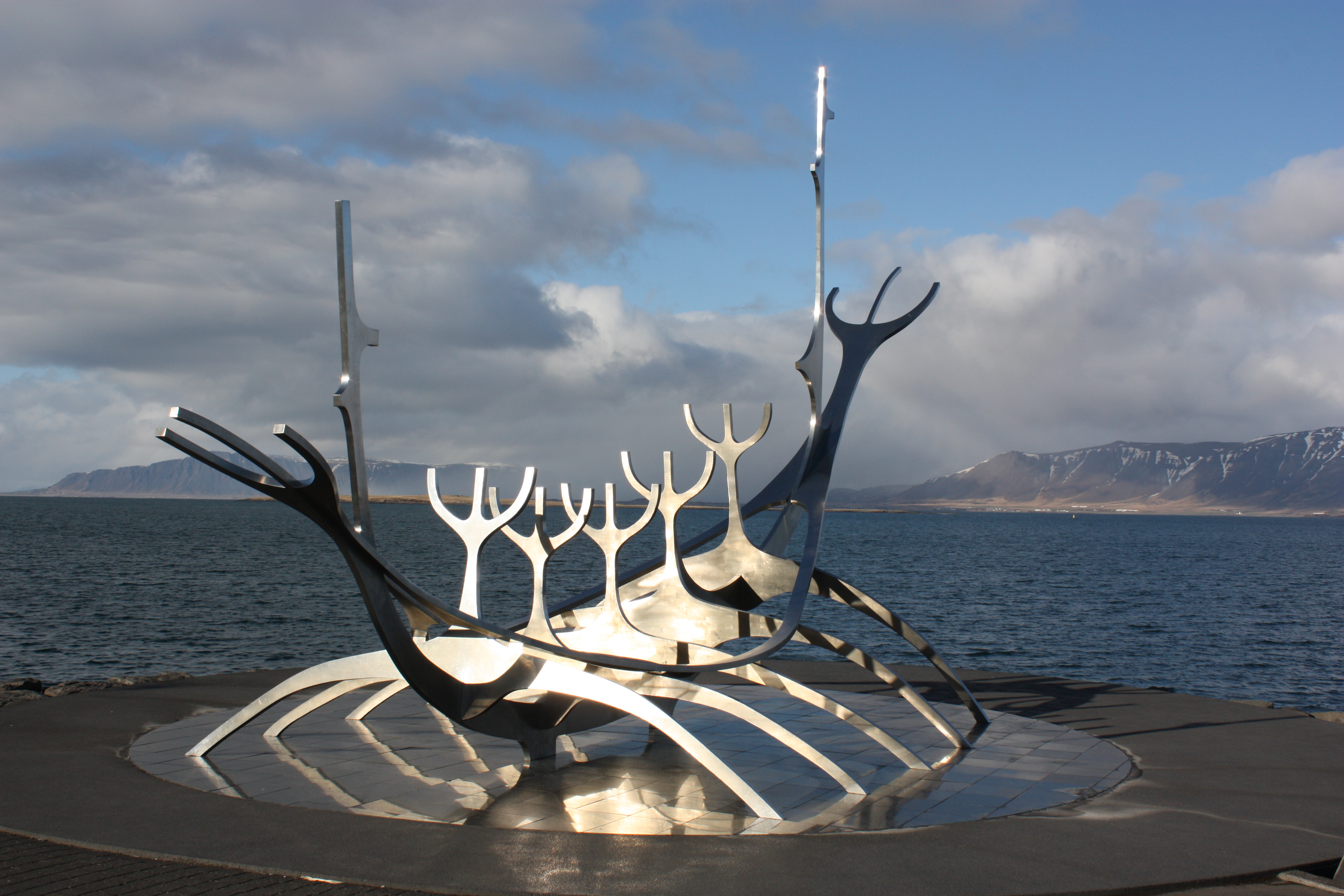
The Sun Voyager statue, Reykjavik
Must-see attractions beyond the capital
Reykjanes
The Blue Lagoon is a world-renowned spa consisting of a large pool fed by geothermally-heated water. It’s possible to book massages and other treatments; even if you just want a dip you’ll need to pre-book (evening slots are cheapest). There’s also a bar if you’d like a drink whilst relaxing in the warm water. Pots of white silica-rich mud are yours to try out – spread it on your face and body for an enriching treatment. Tip: in cold weather, turn left on your way out and enter the pool indoors before swimming out – it’s warmer than making a run for it from the main door. It’s possible to visit the Blue Lagoon on your way to or from Keflavik airport and lockers large enough to take a suitcase are available. The Blue Lagoon is the main attraction on the Reykjanes peninsula where the North American and European plates meet. With your own transport you can stand on Leif the Lucky’s bridge that straddles the two – but be warned, it’s one of the windiest places in the country.

The Blue Lagoon
The Golden Circle
The Golden Circle comprises three of Iceland’s most awe-inspiring attractions: Gullfoss waterfall, Haukadalur and Þingvellir, the site of the original Icelandic parliament. One of Iceland’s many dramatic waterfalls, Gullfoss is the spot where the Hvítá river rushes south and plunges into a chasm where the water explodes into a maelstrom of white water and eroded rock. At nearby Haukadalur, the original geyser, Geysir, has long since given up erupting, but the plume of water that spurts from nearby Strokkur is impressive and conveniently frequent. The Alþingi, or parliament, met at Þingvellir from 930 to 1798 and thus the site is important culturally and historically in addition to its stunning physical characteristics. The three sites can be combined on a morning or afternoon organised tour departing from Reykjavik, but it is worth spending more time at each than the tour allows. If you do decide to go it alone, consider stopping at the excellent Laugarvatn Fontana spa where they bake rye bread in the hot sand twice a day. Spa admission costs 3950 ISK per person (about £24) and the bread baking, including tasting, is 2300 ISK (about £14).
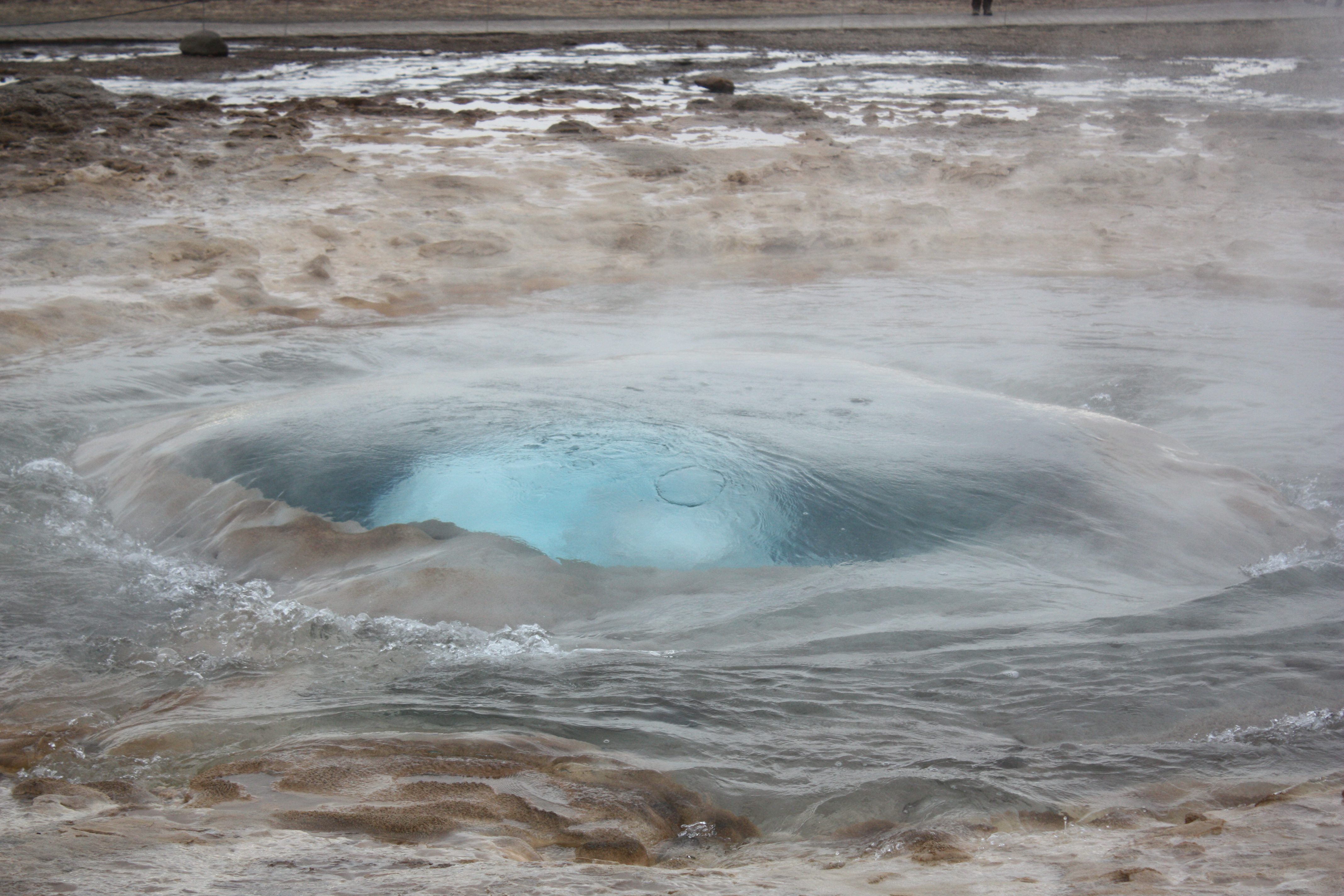
Strokkur on the verge of blowing
The Snæfellsnes peninsula
The Snæfellsnes peninsula is ignored by many but is a worthwhile day out. It’s a remote peninsula with a dramatic coastline perfect for a scenic drive. Its expanses of countryside are punctuated by small fishing villages including the charming Olafsvik. The Hollywood film “The Secret Life of Walter Mitty” was filmed here, focusing on the village of Stykkishólmur whose centre is crammed with historic buildings. Another highlight is the Shark Museum at Bjarnarhöfn. There you can find out how the Icelandic delicacy of hákarl is created and, if you’re brave enough, try a cube of this dried rotted shark flesh for yourself.

Trying hákarl, rotted shark meat
The south coast
Take the southern ring road towards Vik and you will come across two impressive waterfalls. Skógafoss waterfall has an impressive 60 metre drop, but for sheer drama, my choice is the beautiful Seljalandsfoss waterfall. Climb up the wooden staircase to the right of the falls as you face them and the path takes you behind the curtain of water. You will get wet but it’s a lot of fun. In Skaftafell, don’t miss the glorious sight of Svartifoss, an impressive waterfall flanked by basalt columns. To ride nearby, see my post about Glacier Horses. On a secluded ash-grey beach (once accessible by 4×4 but now accessed only on foot) is the wreck of a plane. Near Vik, the DC3 crashed back in 1973 with no loss of life, and the plane has been there, abandoned, ever since. It’s worth the five mile round trip walk over the volcanic sand to see this curious and fascinating wreck but allow plenty of time to return before sunset. Just before you reach Vik, keep an eye out for the notorious sneaker waves as you visit Reynisfjara beach. In Vik itself, meet up with the guide from Katlatrack and don helmet and crampons for one of their ice cave tours up on Mýrdalsjökull. Their three hour fast track tour costs 19,900 ISK per person (about £121) but although it’s expensive it’s worth every penny.

The crashed DC3 near Vik
Jökulsárlón
Situated on the edge of Vatnajökull National Park, itself a fun destination if you’d like to try out snowmobiling on Europe’s largest glacier, Jökulsárlón is a large glacial lake in the south west of Iceland. As the Breiðamerkurjökull calves into the lake, icebergs travel the short distance to the Atlantic Ocean where they bob about on the waves, washed on and off the beach until they finally melt. It’s a magical place; though both the beach and the lagoon itself can get crowded. In summer, it’s possible to take a boat trip. The best value tour is on an amphibious vehicle which gets you close to some of the icebergs for 6000 ISK per person (about £36), but you’ll get closer to the glacier if you pay the extra for the Zodiac tour. Just west is the sometimes overlooked Fjallsárlón. It too has icebergs and boat trips though it’s not quite as impressive as its more famous neighbour.
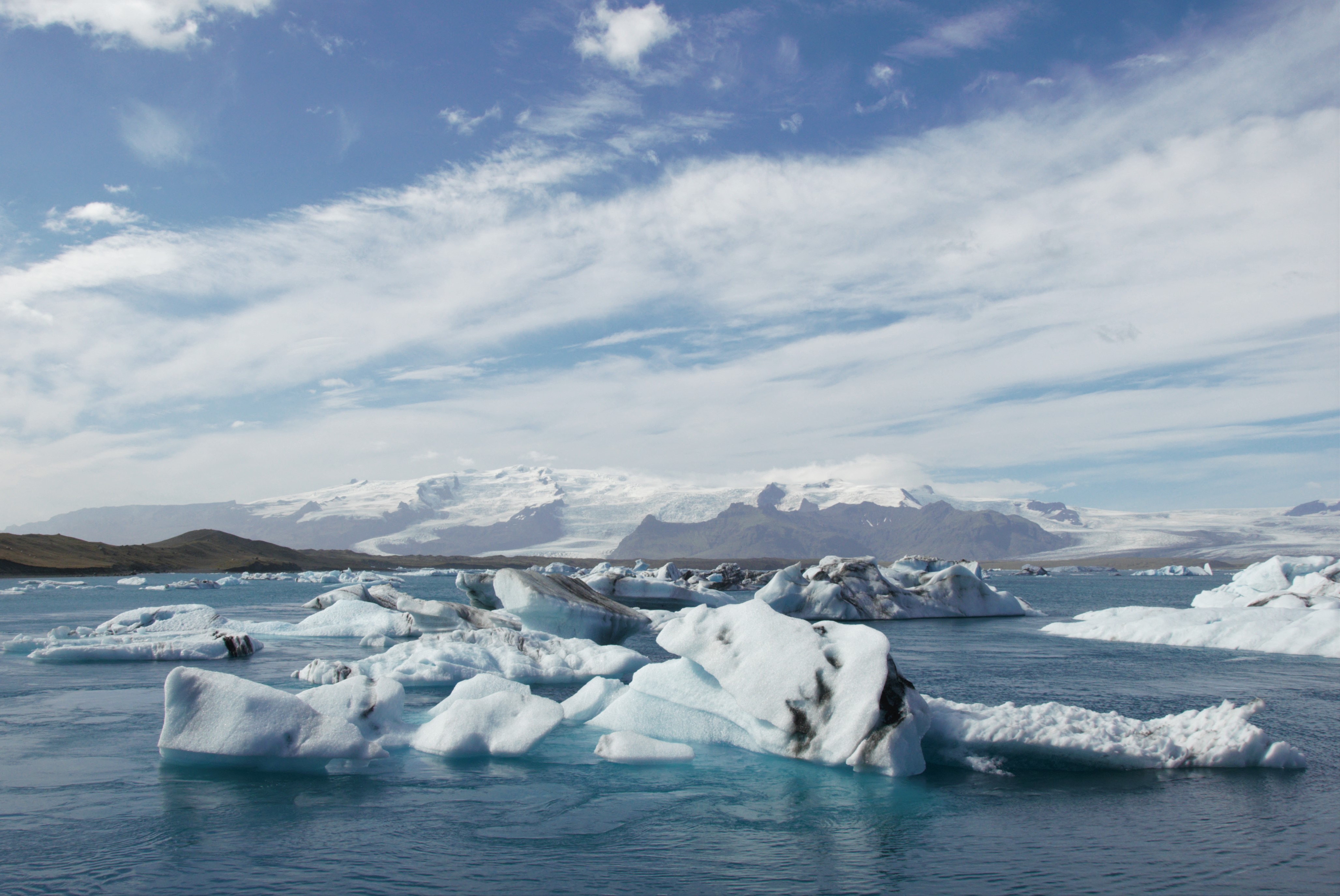
Jökulsárlón Glacier Lagoon
Austurland
East Iceland receives far fewer visitors than the popular south, but there are some breathtaking sights there too. A couple of the coastal villages stand out. You might recognise Seyðisfjörður for the rainbow path leading to its pretty church; it’s accessed by a tarmac road as this is also the place to jump on a ferry to Denmark or the Faroe Islands. In contrast the road to Borgarfjörður eystri, another of the area’s spectacular fjords, winds up and over a mountain pass. For an off the beaten track retreat, the Blabjorg Guesthouse with its open air hot tubs overlooking the water is a great choice. The east’s most unmissable sight is a relative newcomer: until a nearby hydro-electric plant was built which held back the water, the breathtaking Stuðlagil Canyon was hidden to the world.

Stuðlagil Canyon
The Diamond Circle
North Iceland’s answer to the well-established Golden Circle launched officially as a marketing concept in September 2020 but travellers have been drawn to its attractions for much longer. Base yourself in the delightful port town of Húsavík, where you can visit the excellent whale museum and then head out into Skjálfandi bay to see if you can spot them for yourself with a company such as North Sailing. They offer tours for a reasonable 10990 ISK (about £67) with a 98% chance of a sighting. The other four stops on the Diamond Circle are Goðafoss waterfall, Mývatn (Midge Lake – in summer it lives up to its name!), Ásbyrgi canyon and last but not least Dettifoss waterfall, the largest in Europe. This part of Iceland is geothermal; take advantage of that naturally occurring hot water with a dip at GeoSea in Húsavík or the Mývatn Nature Baths. Reservations are advised for both, especially in peak season. Further west, detour off the ring road for a visit to Siglufjörður. This charming town made its money on processing herring; today, the old industrial buildings have been converted into a fascinating museum (2200 ISK per person, about £13).
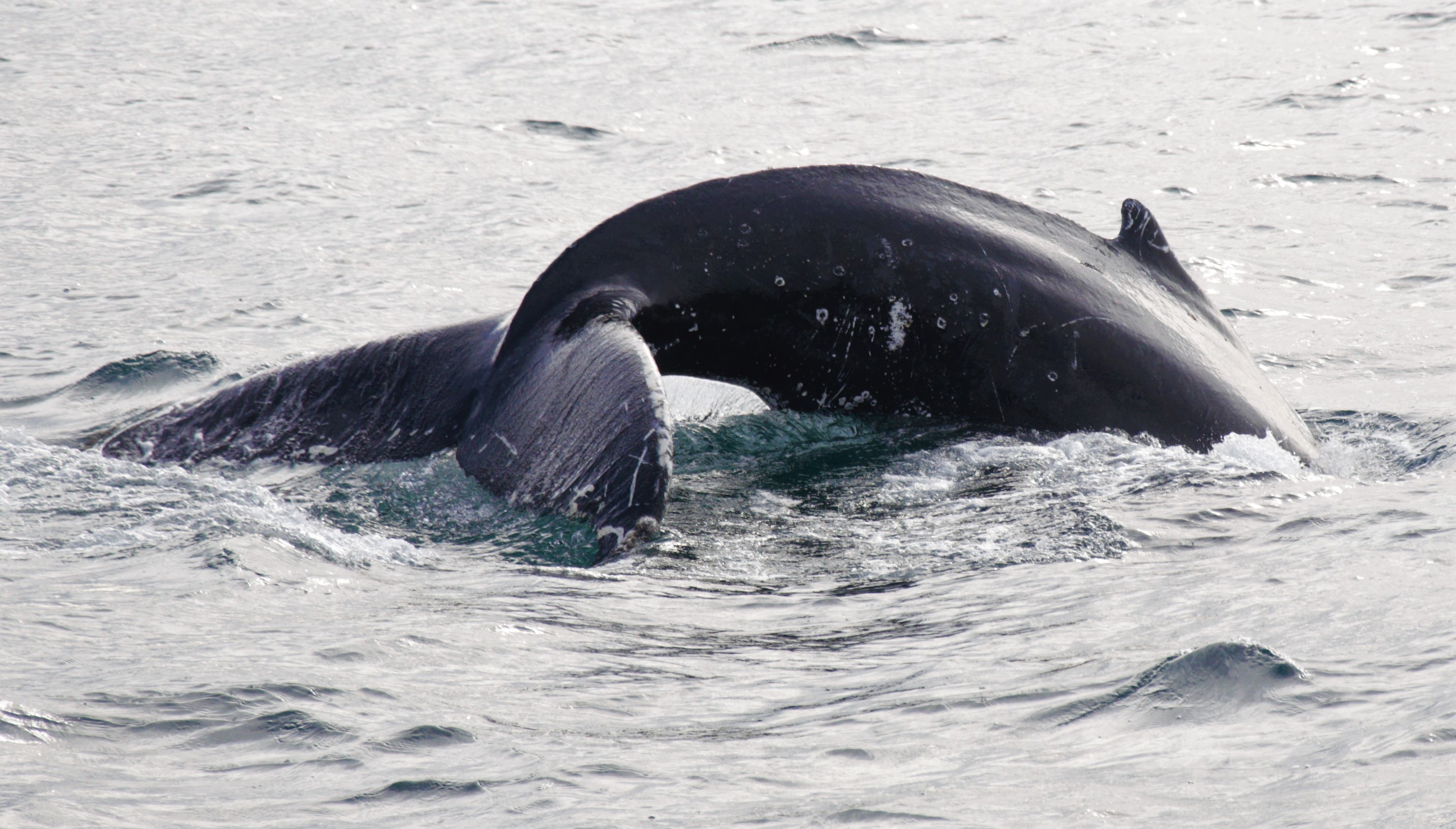
Humpback whale near Húsavík
The north west
The north west of Iceland and in particular the remote Westfjords are often missed by visitors. From Akureyri, Iceland’s second city, the road east is relatively quiet. The old turf buildings at Glaumbær are interesting to explore and well priced at 1700 ISK (about £10). Make a detour to visit the Icelandic Seal Center in Hvammstangi (admission 1200 ISK (abotu £7). Note that it is closed during the winter. Afterwards, head north to see if you can spot seals at Illugastaðir or Hvítserkur – the latter is also worth a stop for its magnificent sea stack. Ísafjörður is the capital of the sparsely populated Westfjords and even has its own brewery. From here you can take a boat trip with Borea Adventures to Hornstrandir in the hope of spotting Arctic foxes (sightings not guaranteed); there’s a few stuffed ones in a museum just outside Ísafjörður itself. Detour to Flateyri to Iceland’s oldest bookstore, or to Holmavik to visit the quirky but creepy Museum of Icelandic Sorcery and Witchcraft. Another excursion is to Simbahöllin in Thingeyri, which does fabulous waffles in summer. To feel like you’ve reached the end of the world try Patreksfjörður, a fish processing settlement within easy reach of the attractive Rauðasandur – a distinctive red sand beach – and the Látrabjarg bird cliffs. It’s also handy for the ferry to Stykkishólmur in Snæfellsnes.

Glaumbær – The old turf farm
Practical information
It’s possible to loop the ring road in about a week but you’ll be pleased that you allowed more time, at least ten days and two weeks if you can manage. Roads outside the mountainous interior still vary a lot; the ring road is tarmacked and aside from the occasional blind hill and many one-lane bridges, you’ll have no issues at all in fine weather. Keep abreast of local weather conditions online and don’t underestimate the impact of wind speeds. Another invaluable website is that showing road surfaces; gravel roads are generally simple to drive unless they are very steep, though you’ll appreciate the extra grip of a 4×4. The interior shuts in the autumn and doesn’t reopen until late spring; most of its F roads require a high clearance 4×4.

 Julia's Travels