
Salzburg on two wheels
I was a small child when I first went to Salzburg and have very fond memories of this elegant Austrian city, though mostly of getting a soaking from the trick fountains at Schloss Hellbrunn on the outskirts of town.

The trick fountains of Hellbrunn; this one still caught me out!
Since then, most Christmases I’ve had a virtual revisit courtesy of the film The Sound of Music, which was partially filmed on location in the city. On a whistle-stop detour from Italy whilst working for Trainline Europe, I was fortunate enough to have just enough time to fit in Fräulein Maria’s Cycling Tour.

Rupert provides the words in case you’ve forgotten
Founded by Rupert Riedl back in 1999, his passion for both Salzburg and cycling was infectious and I was excited about joining the tour. He also signed off his emails “so long, farewell, auf wiedersehen, goodbye” which meant I couldn’t wait to meet him.
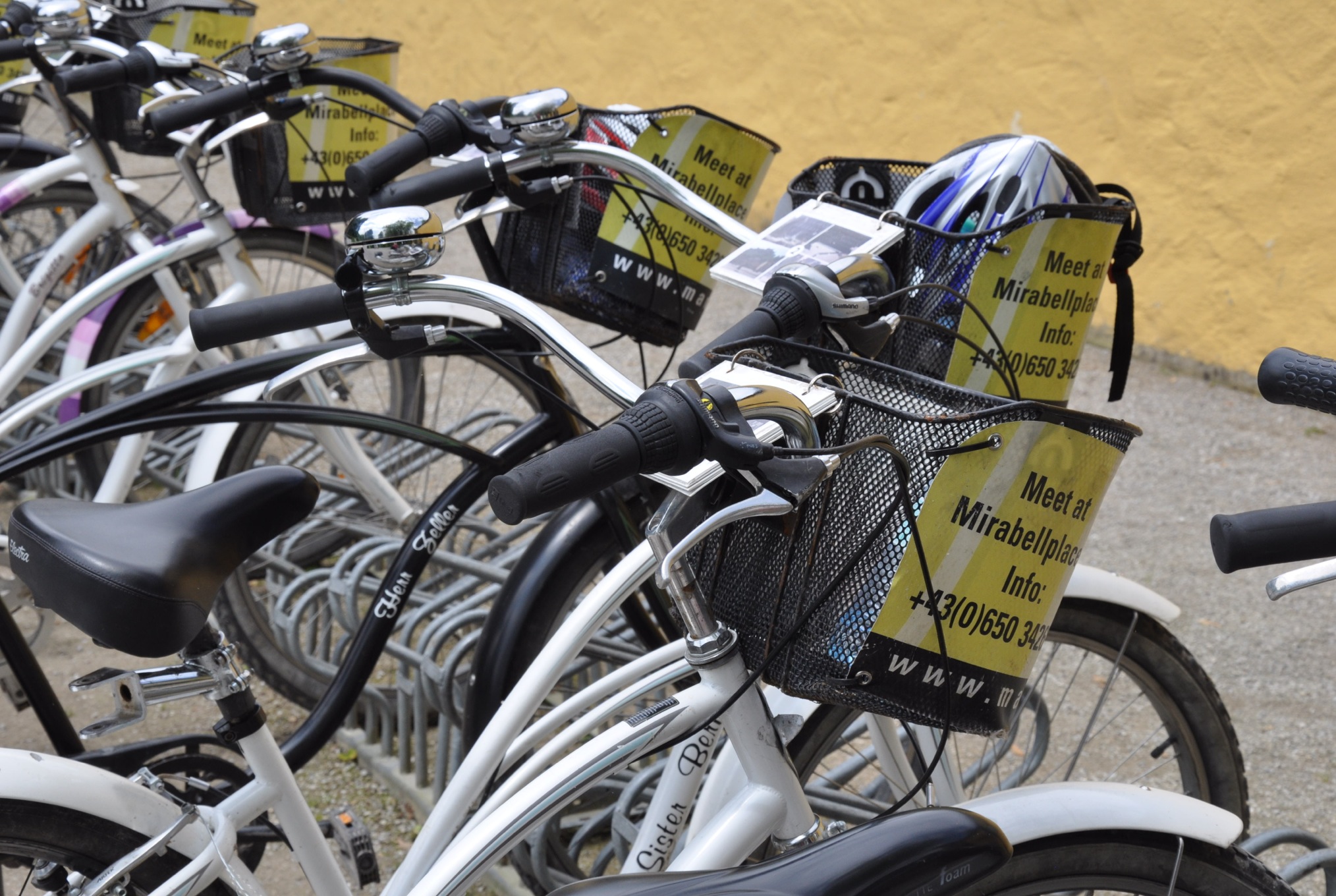
Rupert’s bikes
Rupert was just as charming in real life and so was our guide Elise, a warm and friendly ex-pat Brit whose encouragement and enthusiasm helped to make this tour so thoroughly enjoyable from shaky start to racing finish. The bike, it has to be said, took a little getting used to; wider handlebars and a different style of gears to that which I’m used to had me wobbling around like a beginner and cornering in a panic. It didn’t take long before I’d got the hang of it, and with plenty of stops, it was a manageable and fun tour.
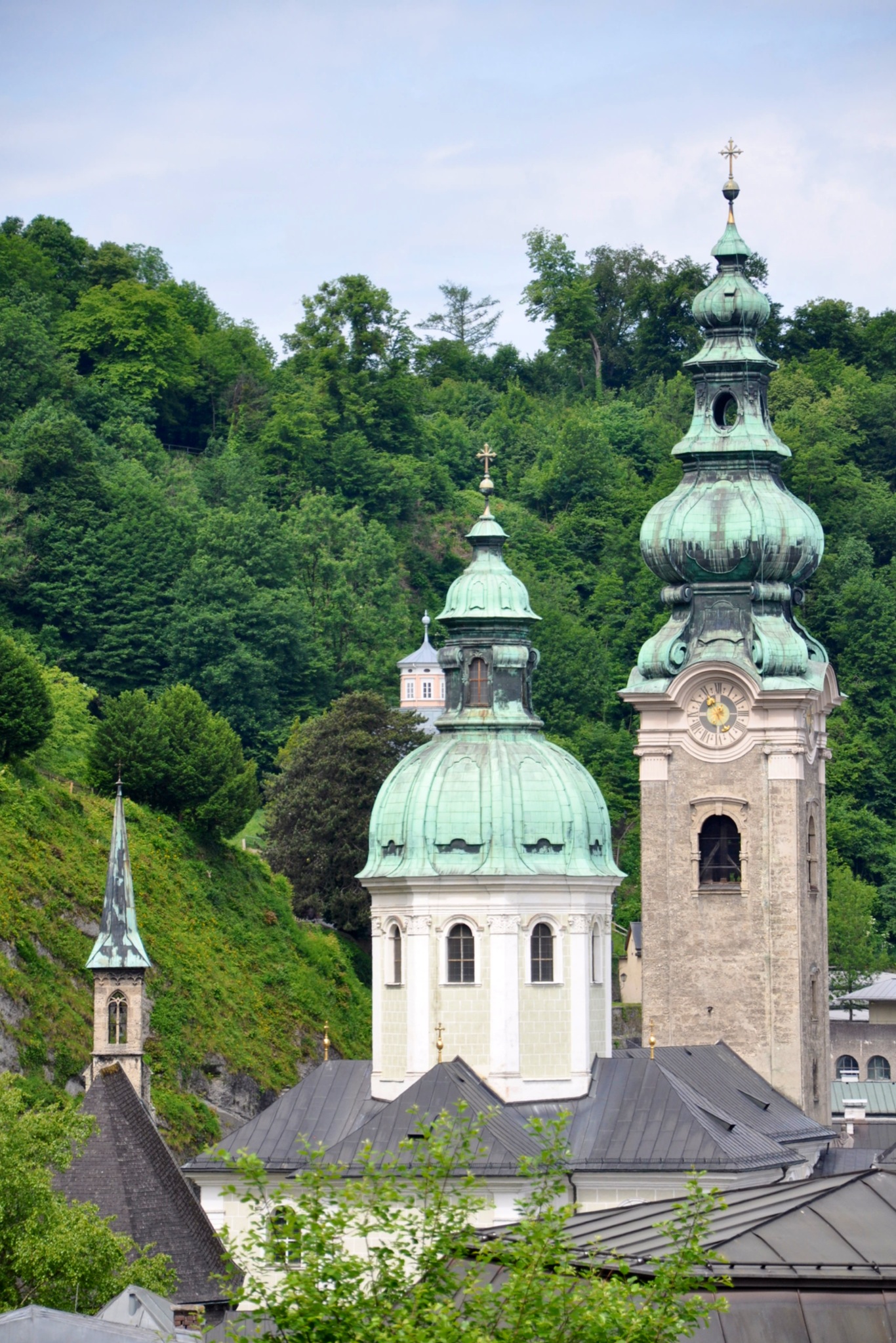
Rooftop views of Salzburg’s many churches made the climb worthwhile
I’m not super-fit (I’m not even fit) and was a little apprehensive about going uphill. Elise was quick to let us all know that she’d be walking part of the way up the steepest hill so we shouldn’t be embarrassed if we needed to do the same. She was also very partial to pastry and so her suggestion we stop by the beautiful cathedral for a bretzel was most welcome also.
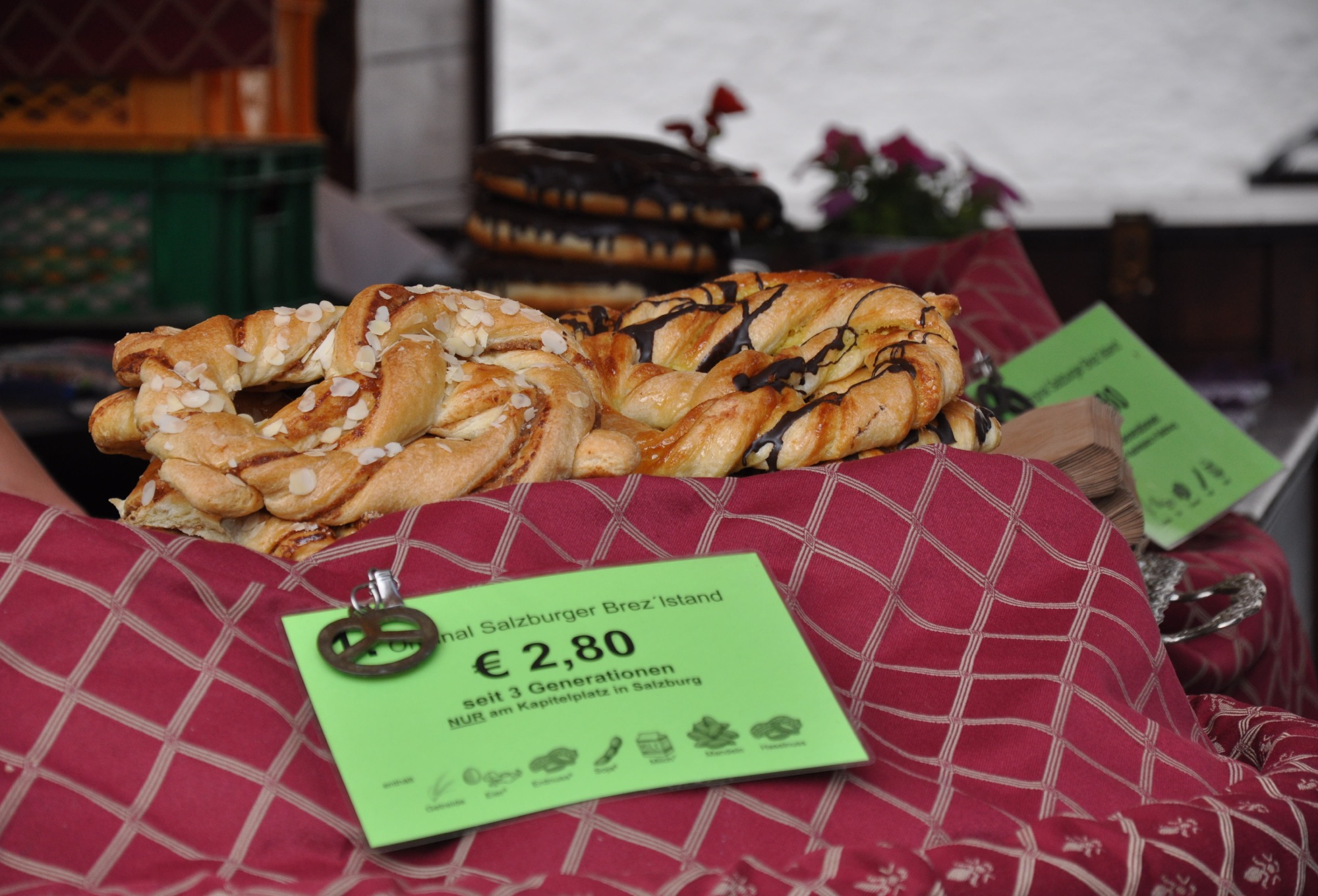
Delicious bretzels, just the thing once you’ve worked up an appetite
The tour began at Mirabellplatz and headed straight into the Altstadt, the old town of the city where vehicles are banned. We parked our bikes in front of several recognisable movie locations including the Pferdeschwemme, where Maria and the children skip by singing “My favourite things” and the Felsenreitschule, now an open air theatre but in the movie where the Von Trapps perform on stage before their daring escape.

Residenzplatz
Residenzplatz with its beautiful fountain, the backdrop for “I have confidence”, was also a backdrop for one of several group photos which Elise took as a memento of our tour. It’s a thoughtful touch, and a bonus souvenir once downloaded from Facebook.
Some stops aren’t actually in the movie; the quaint cemetery at Sankt Peter’s abbey provided the inspiration for a set which was recreated in a Hollywood studio. Climbing up past the funicular to the hilltop fortress, we had some splendid views of Salzburg’s imposing fortress, its many churches and the mountains beyond.

The views are worth the uphill ride
At the Nonnberg, not only did we see a nun at the nunnery where Maria decides she’s not suited to the job, but we also saw the dodgy weld in its gate, the result of the film crew needing to film through a gap too small for the camera. It’s details like these that made me glad I was on a tour – I’d never have noticed it on my own.

The dodgy weld at the nunnery
Freewheeling downhill was a blast, and as we cut across the cycle path out of town, Elise put the soundtrack on and unleashed a whole tour group full of Maria-wannabes, some more in tune than others. We made for the Leopoldskron Palace and lake. It’s where Maria falls into the lake and where the film crew discovered to their horror that the young actress playing Gretel couldn’t swim. Fortunately, none of us fell in but we did play along for a photo.

Leopoldskron Palace and lake
With the music blaring and the breeze in my hair, this was my favourite part of the tour. As we belted out Lonely Goatherd, several passing walkers gave us a cheer and a round of applause, thoroughly deserved of course!

Outside Frohnburg Palace
Stopping at Frohnburg Palace, where Captain Von Trapp tears down the Nazi flag, there was plenty of time for more photos before a flat ride to Schloss Hellbrunn. Our stop there wasn’t for the fountains (though it’s an easy bus ride back) but instead for the gazebo where Liesl sings “I am sixteen going on seventeen”. Elise told us that during filming, the actress playing Liesl slipped off the marble benches and twisted her ankle.

The famous gazebo, now located at Schloss Hellbrunn
The filming schedule, already running late, didn’t permit any more delays, so she performed with a bandaged ankle. It was later retouched, but, this being the 1960s, it’s apparently very noticeable in the film if you know to look. Well now I know, I’d say that’s a pretty good excuse to put the film on one more time…
To book Rupert’s Fräulein Maria’s Cycling Tour, visit his website at http://www.mariasbicycletours.com. The tour costs 30 Euros, which is a bargain given how much ground you’ll cover and what a fantastic introduction it is to the city of Salzburg.
Eating Italy food tour – the highlight of my time in Rome
When I was invited to join a Twilight Trastevere Tour in Rome last week, I had an inkling it was going to be good. I just didn’t know how good.

Trastevere is a charming neighbourhood
Having been to Rome before, I was keen to ditch the fake Roman centurions down by the Colosseum and the crowds of people sitting on the Spanish Steps. The former working-class neighbourhood of Trastevere, in English meaning “across the Tiber”, buzzes at night and has a restaurant almost on every corner. Knowing where to start was the problem, and with limited time, I was keen to join Eating Italy’s tour so they could show me around. The tour takes in around eight to ten stops in an eclectic mix of delis and eateries, rounded off with a lesson in how to identify real gelato from the fakes. It would be the perfect way to spend an evening, I decided.

Da Enzo’s trattoria
Sebastiana, our knowledgeable and very entertaining guide, half Italian and half American, had the cultural knowledge and understanding to bridge both the places we were visiting and the largely American clientele who made up the tour group. She was effervescent, bubbling away (in a good way) like a chilled glass of Prosecco and just as welcome a companion on a sunny evening. Our first stop was to a tiny trattoria called Da Enzo al 29. Getting a table here is difficult, but we beat the crowd for a glass of Prosecco accompanied by a delicious starter of prosciutto, melon and a delicious cheese called burata. Here we were introduced to “aperitivo” – an Italian ritual firmly based around the understanding that one should never consume alcohol without food, something I should bring back to the UK with me, I felt.

The wine cellar at Spirito di Vino
The second stop on the tour took us underground and back in time. The Ristorante Spirito di Vino was once a synagogue, as evidenced by the Hebrew lettering on its stonework. There, in a wine cellar dating from the first century BC, we tried taster portions of three scrummy local favourites: frittata, a kind of spaghetti omelette (far tastier than that sounds), followed by Maiale di Mazio, a slow-roasted pork dish and favourite of Caesar, no less, and finally a whipped cauliflower and cheese dish. Iliana, the chef, clearly knew her stuff and if I hadn’t have been leaving on that evening’s night train, I’d have begged her for a table for dinner.
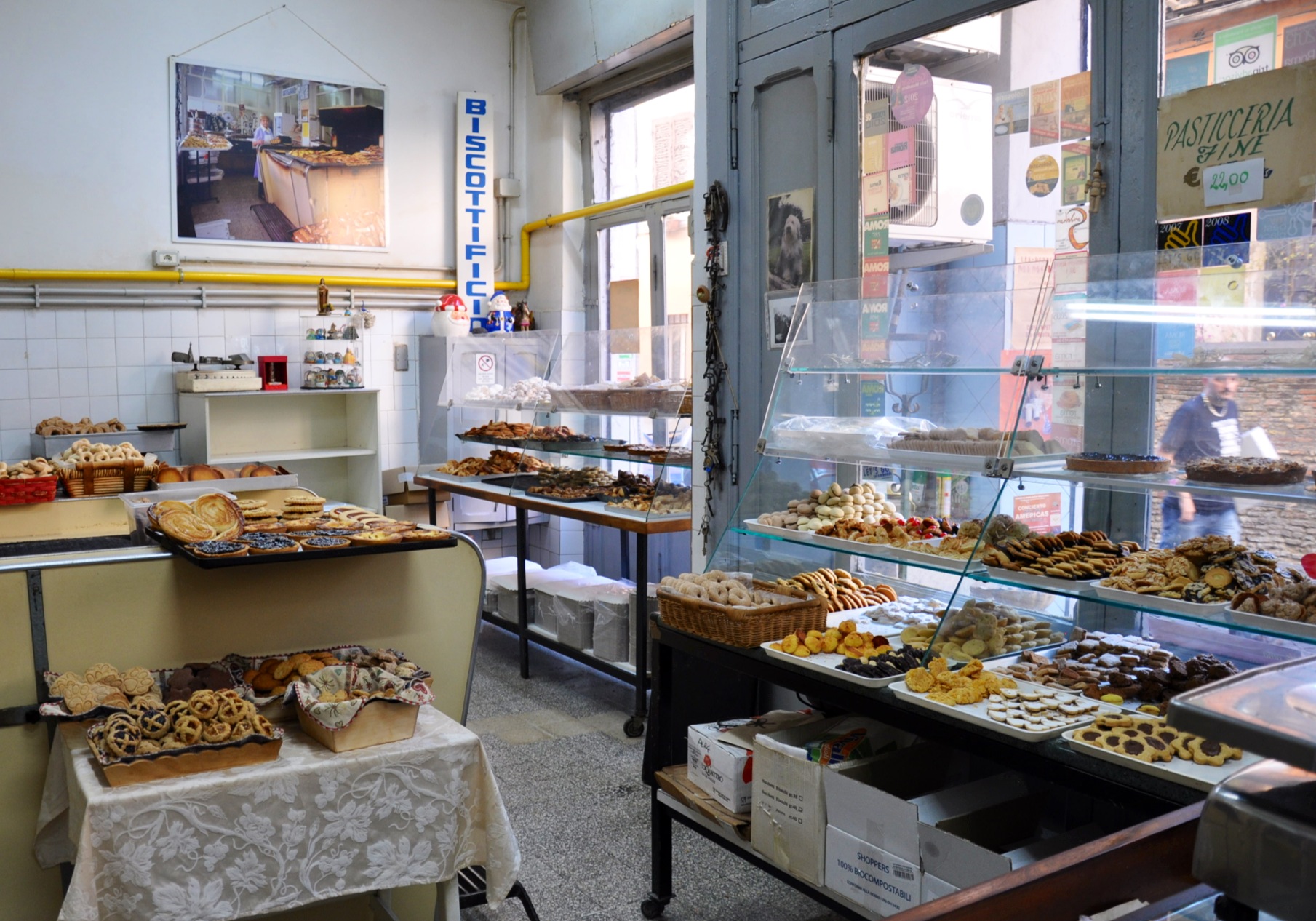
Innocenti’s
Afterwards, we strolled through the backstreets to a family-run biscotti place so local that it didn’t even have to have a sign outside. I’m not a nut fan, so passed on the hazelnut brutti ma buoni (it means “ugly but good”), but judging by the reactions of the rest of the group, I’d say I missed out on something good. The Innocenti family have run this place for years, with recipes little changed in half a century, and sell by weight. If you have a sweet tooth, this would be the place to hang out. Another neighbourhood “celebrity” was Signore Roberto who ran the nearby Antica Caciara, a cheese and meat deli that was our next port of call. Over a century of trading makes this a real gem of a place to sample the deliciously salty Pecorino Romano cheese made in the traditional way by Roberto’s uncle. Sebastiana taught us how to order: un etto being 100g and due etto, 200g. Now what was half a kilo, again?
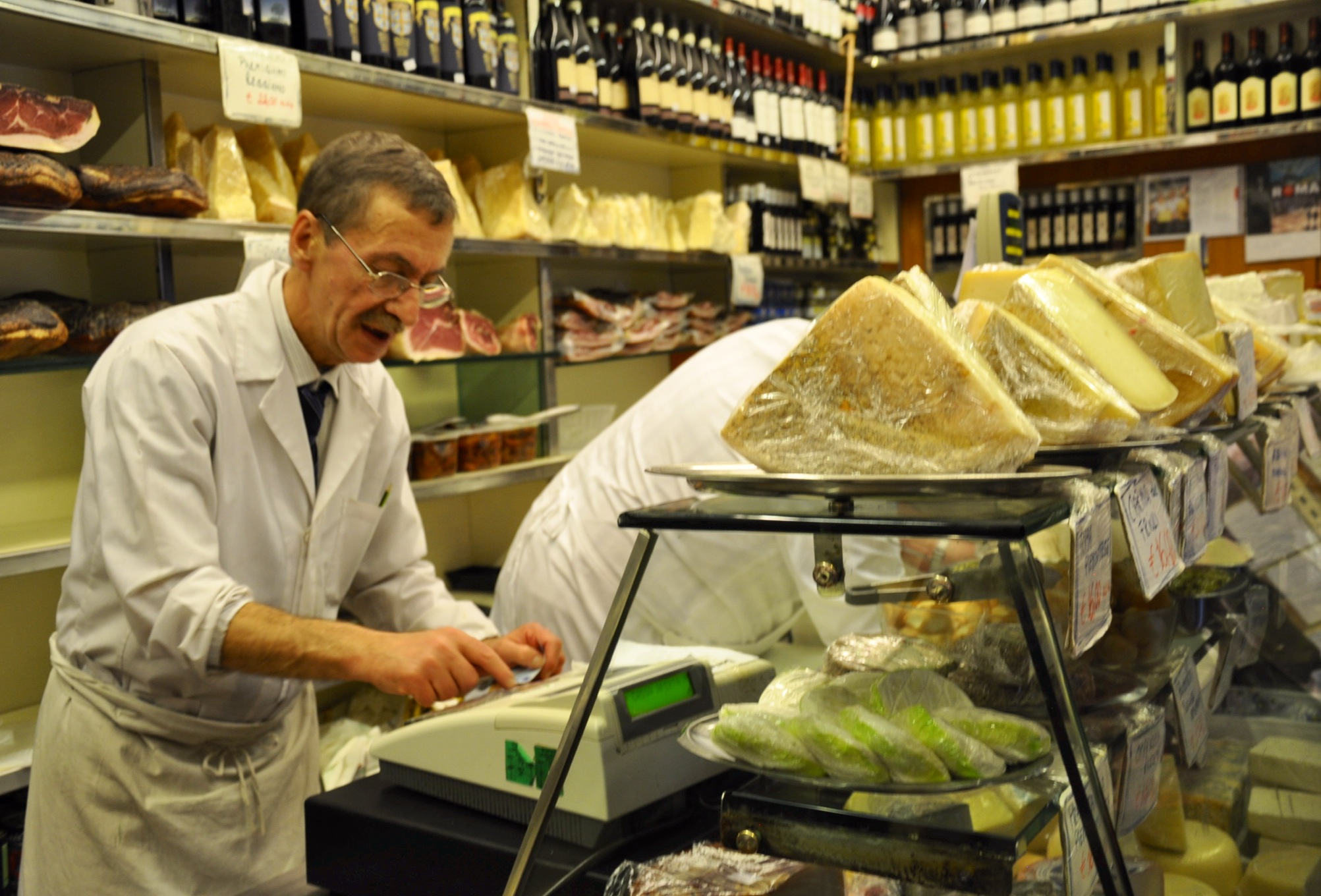
Signore Roberto
From there, we moved on to meat, porchetta to be precise, at La Norcinera, named after Norcia, an Umbrian town where this pork comes from. This wasn’t like the tough, dry supermarket pork that we are forced to endure in the UK, its goodness sucked out by the healthy eating do-gooders. This was juicy, fatty, melt in the mouth pork, hung from hooks on racks on the ceiling to tempt even the most fastidious of dieters to fall off the wagon. Served on pizza bianca, I didn’t stand a chance.
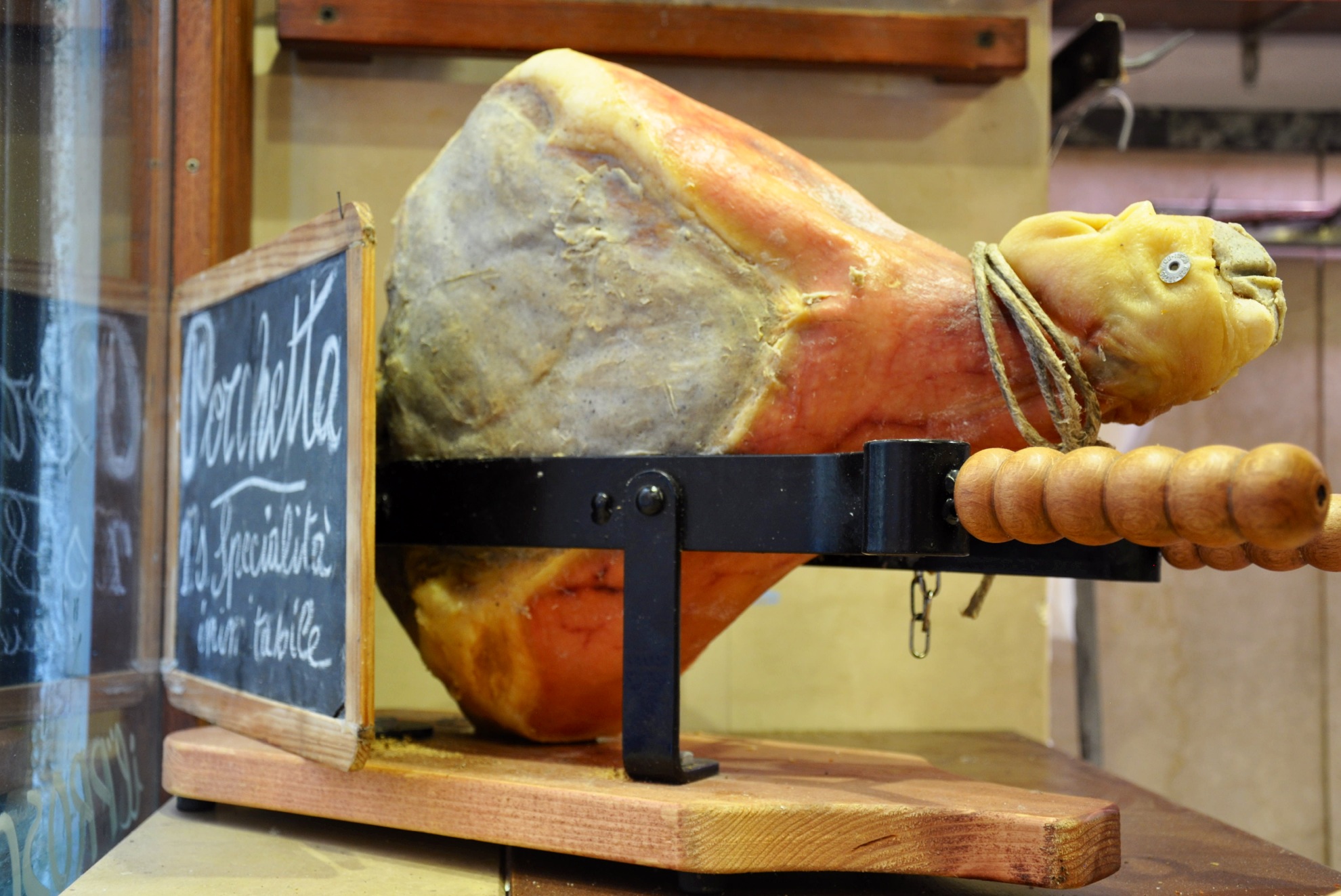
Delectable porchetta
When Sebastiana described suppli’, our next offering, I have to admit, it didn’t sound as good. It was nothing to do with her skills as a host, but more to do with the fact that suppli’ are deep-fried and, despite skipping lunch, I was beginning to feel very full indeed. These fast food treats of rice cooked in tomato sauce and stuffed with cheese are to Roman nights out what a kebab is back home – except that they taste amazing! In spite of myself, I wolfed mine down in record time and could quite happily have gone back for seconds.

Suppli’
The penultimate stop was at Enoteca Ferrara. An enoteca is an Italian wine bar but remember, Italians never drink without food; here we had a private table in the al fresco dining area out back, where we prized delicious ravioli away from Sebastiana (it’s her favourite) and feasted on gnocchi and cacio e pepe, a kind of square-ish spaghetti, literally translating as “cheese and pepper”. Rich but not overpowering, it was a lesson in how pasta should be served, and utterly more-ish.
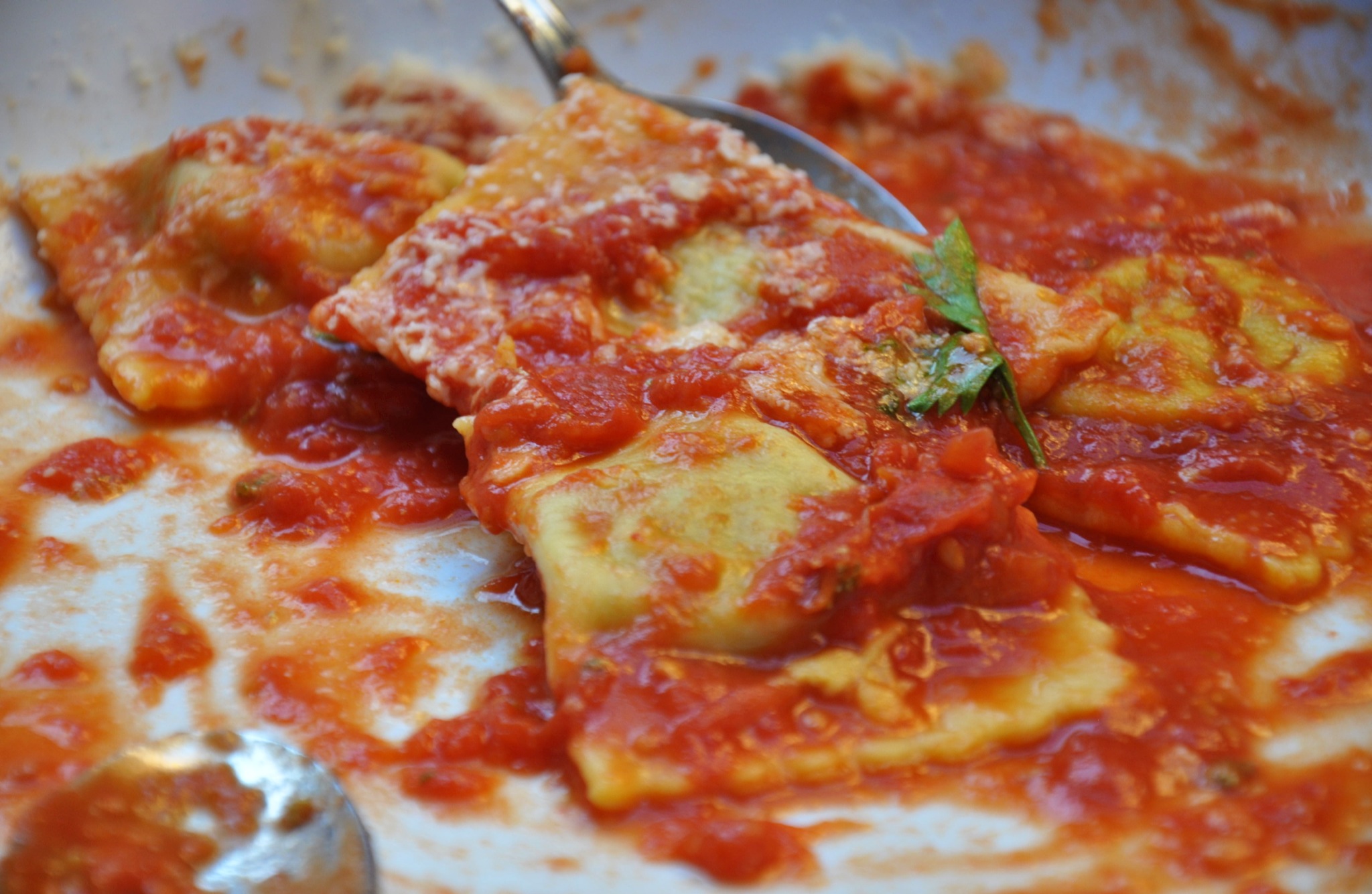
Sebastiana’s favourite ravioli
But there was one place left to visit, and the one for which no one wanted to be too full. Fatamorgana makes real gelato – not the fake stuff – but with an originality of flavours that sets it apart from its competitors. I couldn’t resist the zabaglione flavour, a dessert that Mum used to serve us years ago, while the more adventurous could opt for flavours such as rosebud and black sesame, pear and Gorgonzola cheese and even pink grapefruit with ginger, horseradish and preserved lemon peel.

Fatamorgana’s artisan ice cream parlour
And how to tell the real thing from the imposter? Well, you’ll just have to take the tour yourself to find out…
To find out more and to book a tour online, head to Eating Italy Food Tours in Rome here: http://www.eatingitalyfoodtours.com/
Easter Island in pictures
Easter Island, the second most isolated island on the planet, yet famous the world over for the moai which stand sentinel, their backs to its shores. Spending Easter here has been a blessing, the island’s beauty a revelation and the warmth of its people ensuring the memories go beyond mere statues.

Sunrise at Tongariki, site of the greatest number of moai

Long shadows in the morning’s first hour of daylight, beginning in April at a civilised 8am

Sunrise in full colour

Heading north to the coast, but watch out for horses, wild or herded

The moai quarry, Rano Raraku
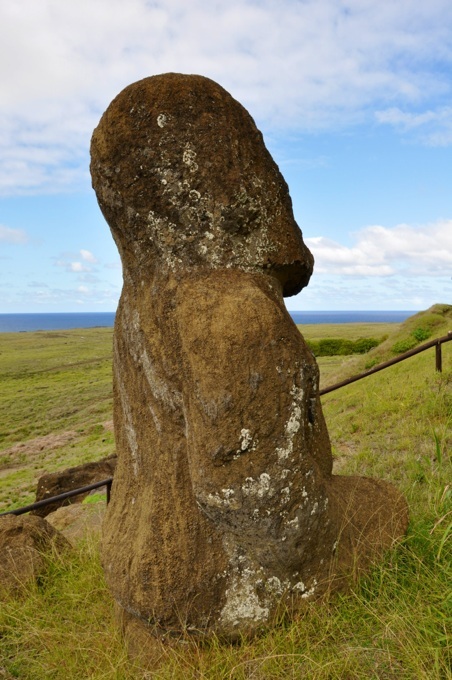
The kneeling moai at Rano Raraku

Moai quarried right out of the stone cliffs
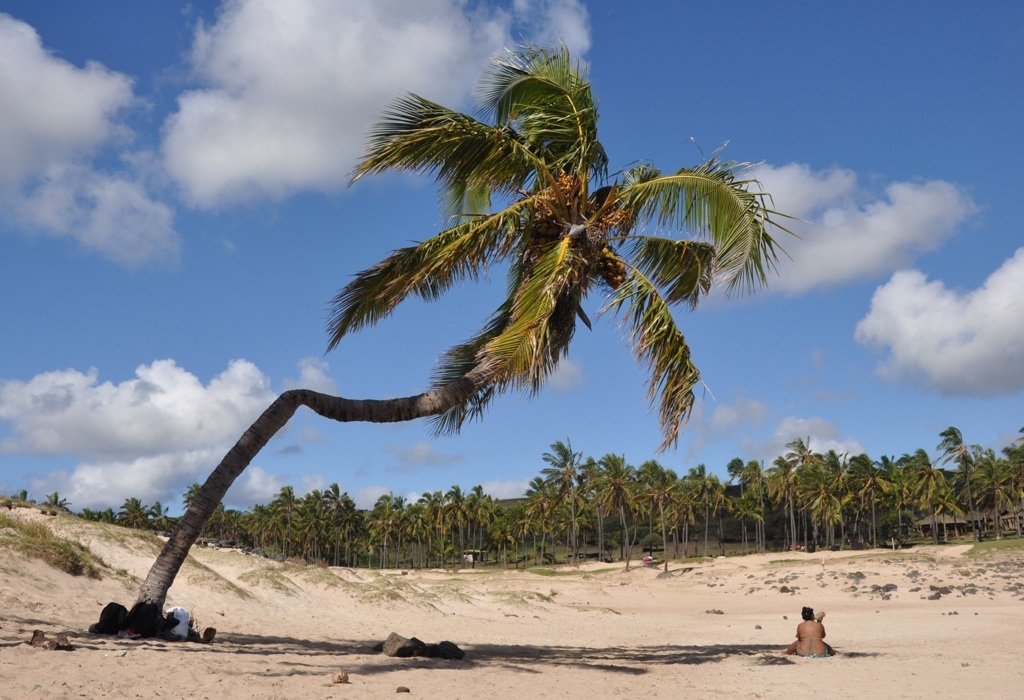
The beach at Anakena, one of only two sandy shores on an island characterised by rocky cliffs

Ahu Nau Nau: Sand piled up right
behind the ahu (platform) on which stand seven moai

Close up shot of one of the moai at Anakena
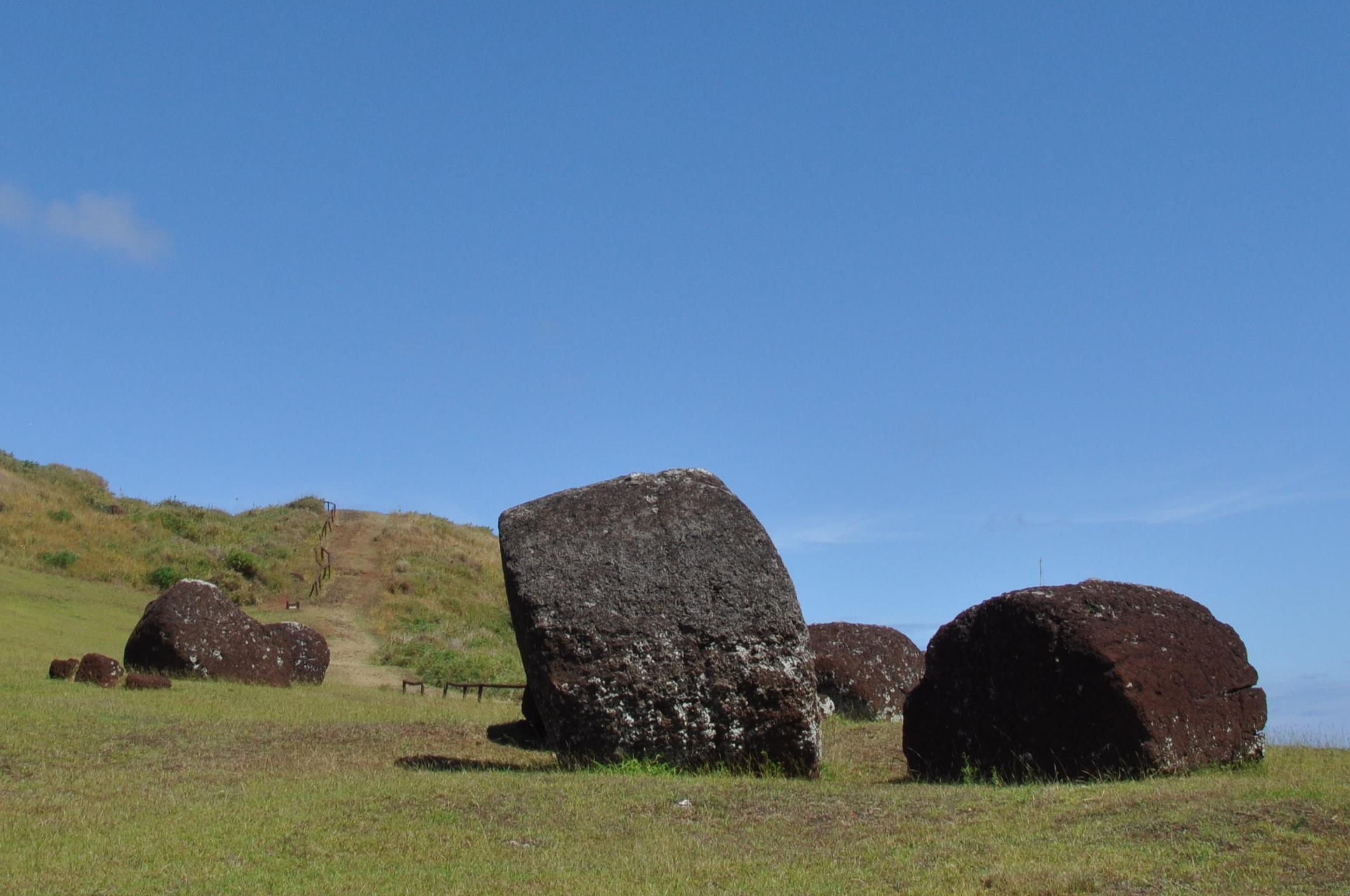
Puna Pau top knot quarry

The seven moai at Ahu Akivi, unusual in that they face the sea

Visitors are requested to respect the island’s heritage and keep off the ahu, but the horses don’t always get the message
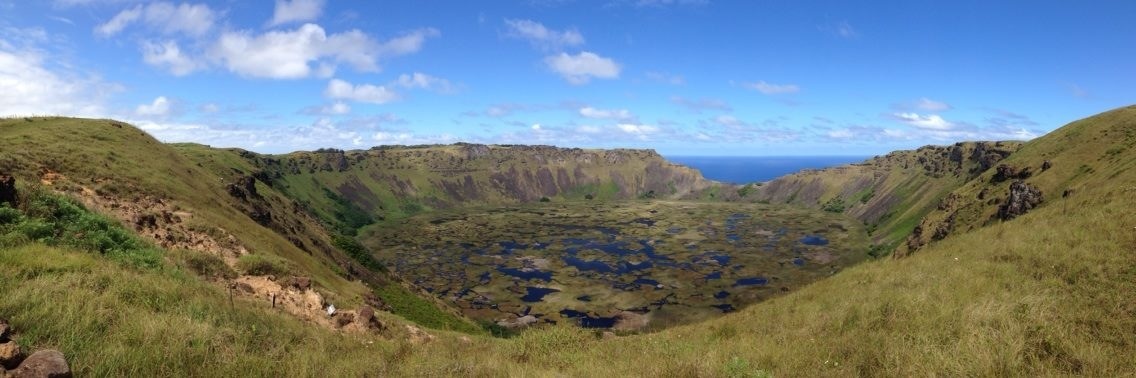
Rano Kau crater, near the main settlement of Hanga Roa
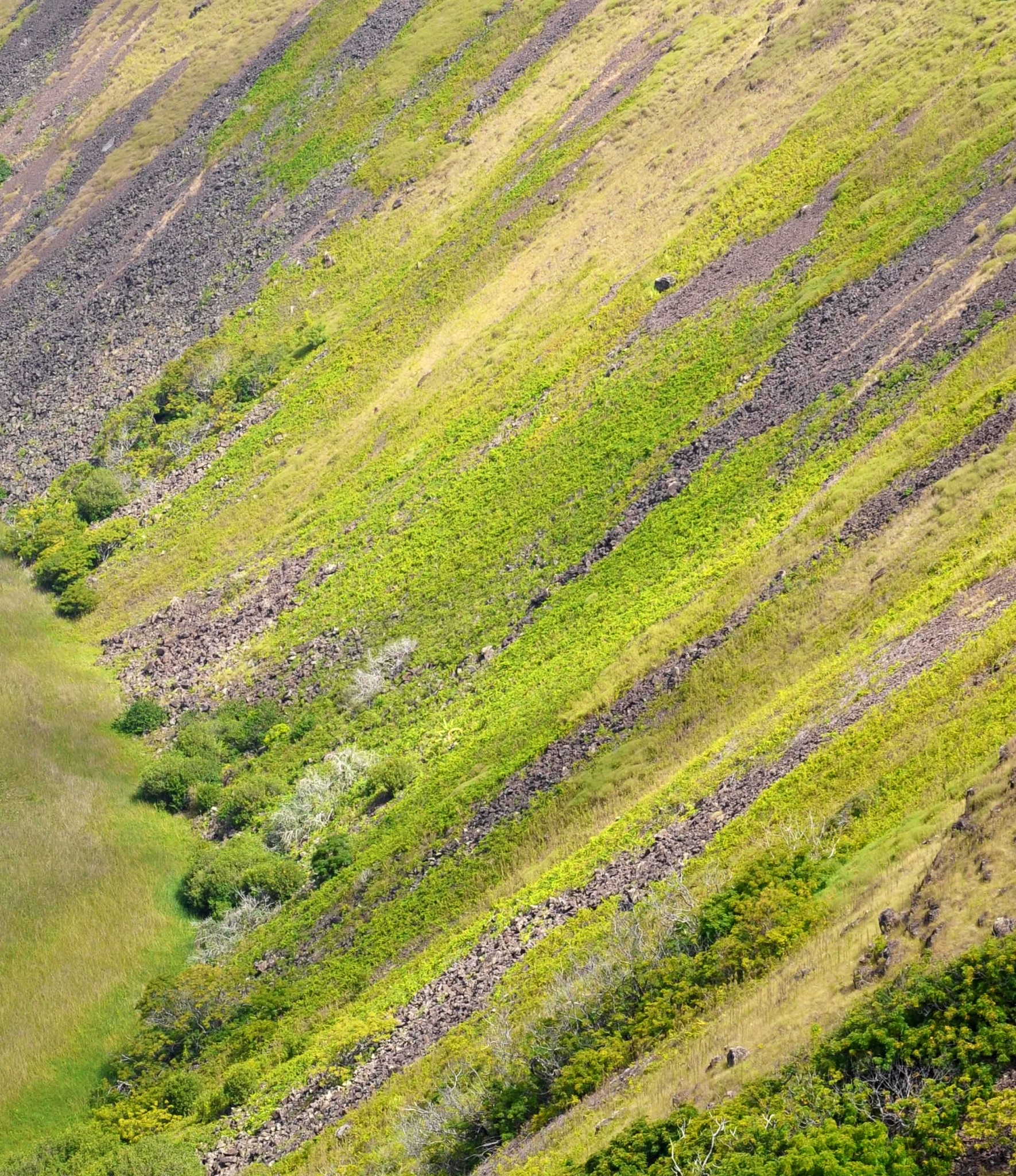
Vivid colours of the vegetation on the crater rim
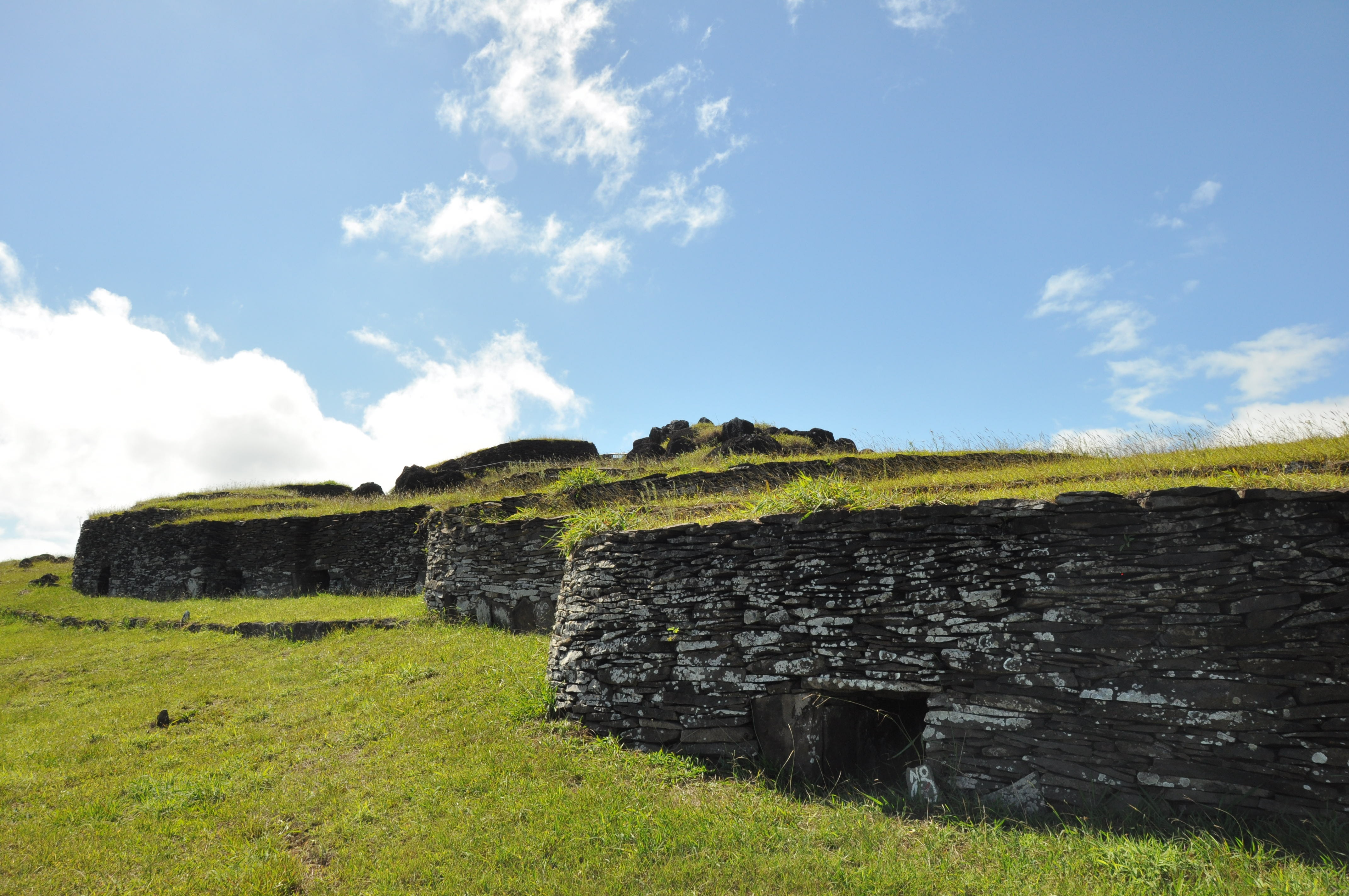
The unusual buildings at Orongo

Hanga Roa’s quirky cemetery
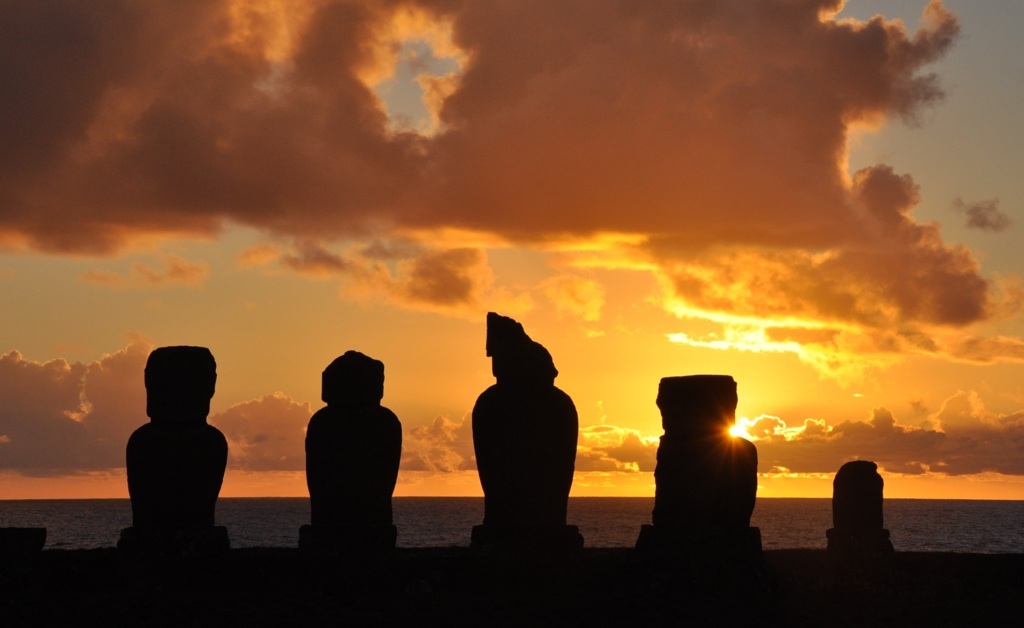
Sunset at Ahu Vai Uri, Tahai

Rapa Nui flag – at present the Chilean government aren’t collecting (aren’t able to collect?) the National Park fee; the Rapanui people have roadblocks and are recording visitor details

Boeing Dreamliner takes off to begin its five hour journey back to Santiago on the mainland
A beginner’s guide to Barcelona
With a two thousand year history and a vibrant culture, it’s no wonder the Mediterranean city of Barcelona is the UK’s undisputed favourite when it comes to Spanish city break destinations. As well as having its own ample stretches of sand, the city is perfectly situated to combine some sightseeing with a beach holiday to the Costa Brava or Costa Dorada. But what should you see on a first visit? Follow my beginner’s guide to this captivating Catalan gem.
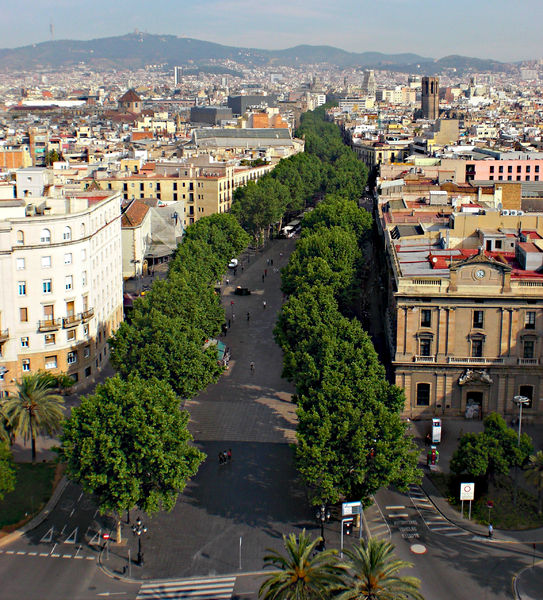
La Rambla by Oh-Barcelona.com reproduced under the terms of the Creative Commons licence CC by 2.0
Getting there
A number of airlines fly from the UK to Barcelona, from regional airports as well as London. To give you an idea of the choice available, there are almost 200 direct flights a week from London, on airlines such as British Airways, Iberia, easyJet, Monarch and Vueling. It’s not difficult to pick up a return ticket for as little as £50 (flying with easyJet from Southend at the end of February, price correct at time of writing) but book well in advance for a summer trip as demand is obviously higher.
Getting from the airport
Most flights arrive at Barcelona’s El Prat airport (some Ryanair services fly into Girona) and there is a train service direct into the city. Take the RENFE R2 Cercanias service (the local stopping train, sometimes referred to as Rodalies in Catalan) as far as Passeig de Gracia. Tickets cost 4,10 euros and there’s no need to buy a ticket in advance. Alternatively there’s an airport bus costing 5,90 euros which takes on average about a half hour to reach the city centre. You can buy tickets online in advance here http://www.aerobusbcn.com/en/buy-tickets or just pay cash to the driver. Expect to pay up to 40 euros for a taxi from the airport to the city centre.
Getting around
The Barcelona metro is extensive and easy to use, though as with any busy city, take care of your belongings and ensure bags are zipped or fastened securely.

LlefiàL10 by Javierito92, licensed under CC BY 3.0 via Wikimedia Commons
A single ride on the metro (or bus) costs 2,15 euros but if you are planning on taking five or more journeys then you could buy a T10 card costing 9,95 euros which covers you for ten journeys over a year (i.e. there’s no need to use all ten on the same day). If you make a journey and change lines without exiting the metro, then that counts as one ride, so long as your total journey time is under 75 minutes. Multi-day travel cards are available, giving you two days’ unlimited travel for 14 euros for instance. 3, 4 and 5 day cards are also offered. Check current prices here:
http://www.tmb.cat/en/barcelona-travel-card
Alternatively, you might consider the Barcelona card. This is a tourist pass offering free transport (including the airport train but not the express airport bus), free or discounted admission to some tourist attractions and discounts in some restaurants and shops. It costs 45 euros for a three-day pass. Examples of free attractions (correct at the time of writing but check on arrival) include the Botanical Gardens and Museum of Modernism. Do your homework; work out what you might like to see and total up the cost – as with all these cards, you need to use it a lot to make it worth your while. A full list of discounts is found here:
For a first-time visitor who perhaps is less confident about using public transport, I’d recommend a hop on, hop off sightseeing bus. Barcelona is a city of over 4 million people and therefore its sights are scattered over a wide area. Although there is a lot to see in a fairly small downtown area, if you wish to see some of the more far-flung attractions it’s easier to catch the sightseeing bus. It’s more expensive than public transport, with a one day ticket costing 24,30 euros if purchased online and a two day ticket about 10 euros more. Their informative website can be found here: https://www.barcelonabusturistic.cat/en/home and provides details of routes, prices and current schedules.
Where to stay
I stayed at the Hotel Duquesa de Cardona, a luxury boutique hotel on the waterfront close to the Columbus statue at the end of La Rambla and a short walk from the aquarium. Its beautifully appointed rooms can cost as little as £75 a night for a double in low season, but the convenient location and excellent service mean that it does sell out in peak periods. The W chain are represented in Barcelona at Plaça de la Rosa dels Vents by Barceloneta beach. The hotel’s 473 rooms feature funky décor and both its pool terrace and 26th floor Eclipse bar afford stunning views of the Mediterranean Sea. On a tighter budget, try the Chic and Basic Ramblas, under £50 per night but only a stone’s throw from La Rambla, or for around £20 more, the Hotel Sant Agustí, a converted convent near to the Plaça Reial. The building dates from 1720 and has been a hotel since 1840, making it one of the city’s oldest.
What to see
Antoni Gaudi’s work

Sagrada Familia nave roof detail by SBA73, licensed under CC BY-SA 2.0 via Wikimedia Commons
If there’s one name that is synonymous with Barcelona, it’s that of Antoni Gaudi, the architect responsible for the as yet unfinished Sagrada Familia church. This elaborately constructed church was begun in 1882, consecrated by Pope Benedict XVI in 2010 but is unlikely to be complete until at least 2026. George Orwell was not a fan, branding it one of the world’s most hideous buildings, but millions of impressed visitors beg to differ. It’s definitely worth a look.
Gaudi’s architecture can be found elsewhere in the city. Slightly north of Barcelona’s city centre in the Gràcia district, it’s worth making a special effort to pay a visit to Parc Güell. Another of Antoni Gaudi’s bonkers creations, as you’d expect its planting is interspersed by wacky benches, columns and platforms featuring the architect’s trademark mosaic tiling. The extraordinary Parc Güell now charges admission, but is a must-see.
Casa Milà, better known as La Pedrera, is another building bearing the hallmarks of the architect’s unique style. Its odd chimneys are classic Gaudi. I also loved Casa Batlló which Gaudi redesigned in 1904. Once a family home and now a UNESCO world heritage sight, it’s unique, quirky and delightful, both inside and out. The entrance fee is a bit steep but looking at the exterior is free.

Casa Batlló
La Rambla
This single street is possibly the most famous in the city. For this reason, it has to figure in your itinerary but be warned, it’s also a popular stomping ground for pickpockets and scammers. This pedestrian thoroughfare is crammed with souvenir vendors, street performers, human statues and, at night, prostitutes. It features a mosaic created by the artist Joan Miró, located near the Liceu metro station. If you look closely, you’ll be able to spot his signature on one of the tiles. A museum dedicated to his work can be found at Montjuïc. The street also has a selection of restaurants but you’d do better heading off the street and away from the crowds.
Montjuïc
This hill overlooking the city literally translates as “the hill of the Jews”. Getting up there is half the fun. Head up by funicular and then take the Port Vell aerial tramway back down to the waterfront at Barceloneta. At the top, there’s a whole load of things to do. As well as the Fundació Miró, Montjuïc
is also home to the Museu d’Arqueologia, the Museu Etnològic and the Museu Nacional d’Art de Catalunya-MNAC, housed in the impressive Palau Nacional. In addition you’ll find the Magic Fountain and the artisan village at Poble Espanyol, both built for the 1929 International Exhibition.

Parc Montjuïc by Canaan, reproduced under the Creative Commons licence CC BY-SA 3.0
Barri Gòtic
Barcelona’s Gothic Quarter is its old town, linking La Rambla to the Mediterranean seafront. Many of the buildings of this area date from mediaeval times, though there was extensive modernisation and renovation in the 19th and early 20th century. One of the area’s most popular attractions is the Picasso Museum. Suggested by the artist himself back in 1960, Barcelona is a fitting choice for the museum; although Picasso was born in Malaga, he spent his teenage years in the city before moving to Paris in his twenties. The five buildings that house a collection of 3500 of his earlier works are as much an attraction as the art itself – Palau Aguilar, Palau del Baró de Castellet and Palau Meca date back to the 14th century.
The Barri Gòtic is a fabulous area in which to wander, with alleyways linking attractive squares, my favourite being the Plaça Reial. This palm-filled square provides respite from the heat of the summer sun; in my opinion there’s no better place in the whole of the city to sip a coffee and people-watch. As with other touristy areas, keep a close eye on your belongings.

Barcelona – Plaça Reial by Josep Renalias, licensed under CC BY-SA 3.0 via Wikimedia Commons
Camp Nou
For football fans, there’s only one unmissable attraction in the city – Barcelona’s Camp Nou stadium, home to Futbol Club Barcelona, or Barça to its adoring fans. It is possible to take tours of the stadium. Visit the FCB Museum, walk down the players’ tunnel and out onto the pitch, stand in the dressing room and see behind the scenes in areas such as the press room.

Camp Nou colours by DJ Lucifer, licensed under CC BY 2.0 via Wikimedia Commons
Something for the evening
Cava is to Spain as champagne is to France, and the most atmospheric place in town to drink the stuff is at El Xampanyet. This small bar has a take me as you find me vibe, with a mixed clientele of locals and visitors. The tiled walls and tasty tapas have barely changed since the place opened back in 1929. Its location on Carrer de Montcada in El Born district, is within an easy stroll of the cathedral and Parc de la Ciutadella, and perfect for a few glasses before dinner in the Old Town.
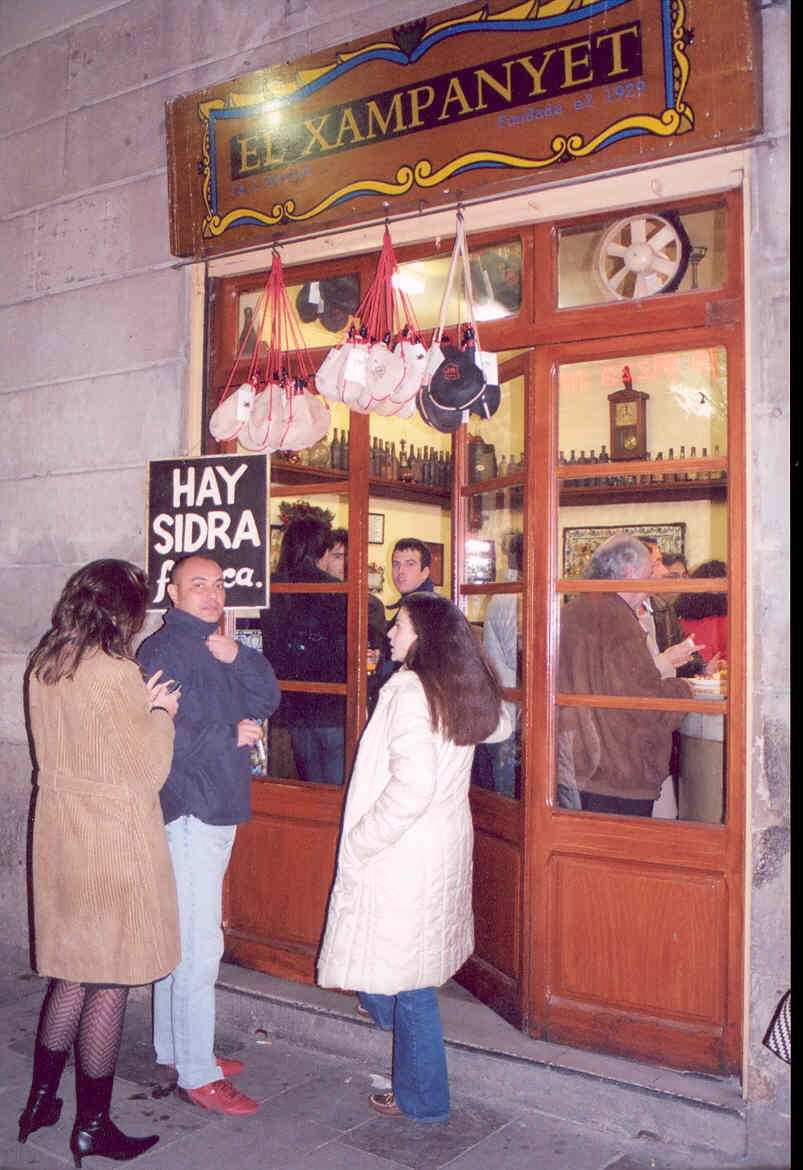
El Xampanyet
Just back from – a day trip to Amsterdam
Is an Amsterdam day trip viable? In the second of an occasional series, I test whether it’s really worth making the effort for just a single day’s visit to this popular Dutch city. Would I regret not paying for a hotel room as I dashed from attraction to attraction?
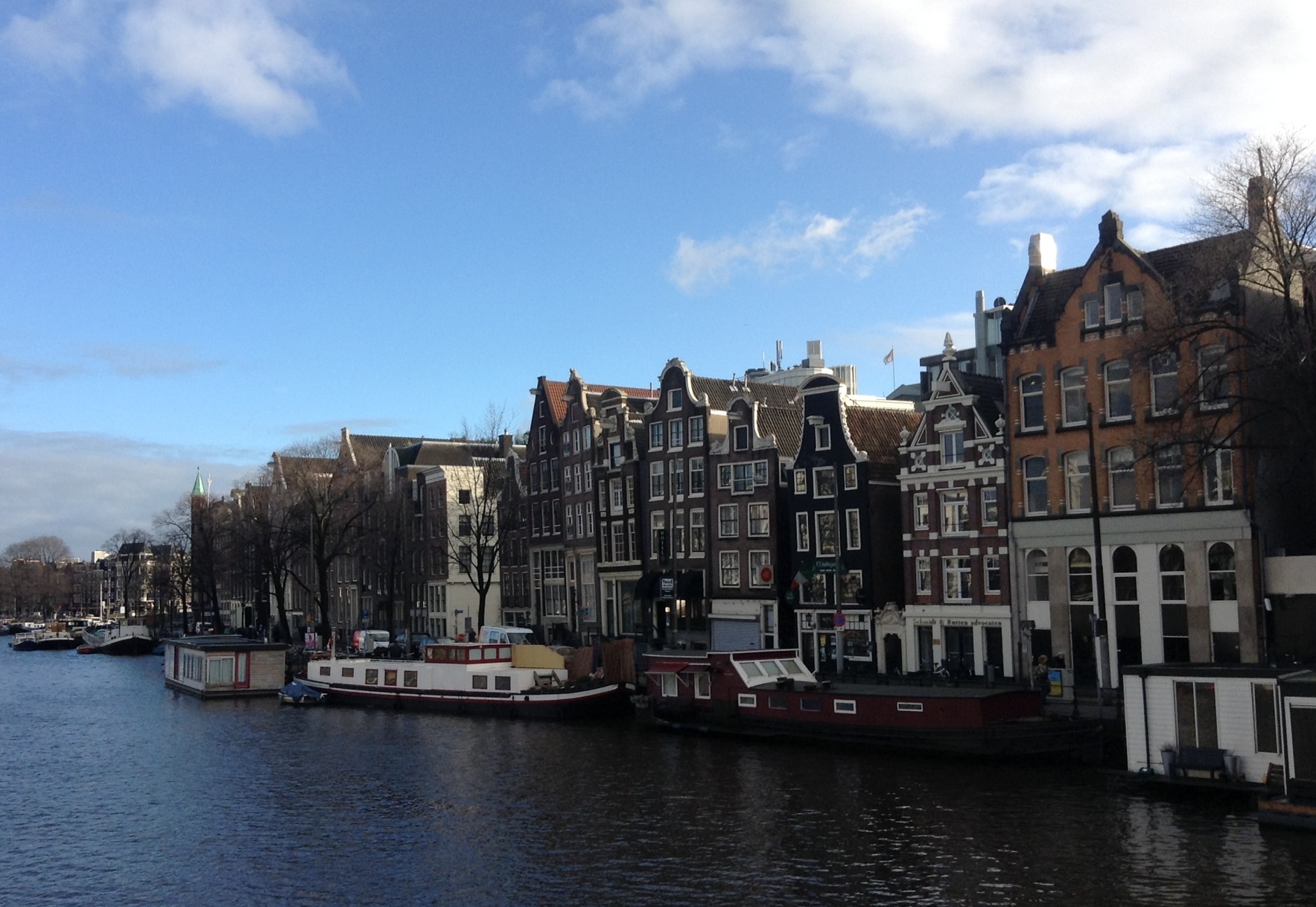
Amsterdam’s canals
Logistics
I chose to fly from London’s Southend airport, around an hour from Central London but only a short drive from my Essex home. Southend, though expanding, is still a small airport, making it possible to transit the airport in just a few minutes – none of the long queues for security or marathon hikes to the gate that characterise Britain’s larger airports. easyJet fly out to Amsterdam at 7.30am and back at 6pm, making a short day out a cheap possibility. It’s wise to note that easyJet fly into a satellite terminal at Schipol, making for a tidy walk to the gate for your return flight. But they have a good track record for punctuality and my outbound flight was on time. On the return leg, we landed early and thanks to the time difference, I was back in my kitchen feeding the dogs their dinner almost before I should have left Schipol. (Don’t worry about them, we have doggie day care for such occasions.)
Getting into the city
Having made it across the airport without getting distracted by the many shops and even a branch of the Rijksmuseum (Schipol has got to be the best airport in Europe, don’t you think?) I exited through self-service passport control leaving the tulip bulb purchases for my return. Keep straight on as you exit customs for the train station, the quickest way into central Amsterdam. Directly in front of you are bright yellow ticket machines which take cash and cards. A single ticket into the city costs 5,10 euros with a 0,50 euro surcharge for using a credit card; UK issued cards work fine. It’s worth noting, though, that they take coins and not notes if you wish to pay cash. Make a left and head for the train; it’s a quick fifteen minute ride into the city. Trains leave frequently for Amsterdam Centraal Station immediately to the north of the main city. I waited one minute for a train and was walking Amsterdam’s streets by 10am.

Centraal Station
Getting around
The city centre of Amsterdam is compact and unless it’s raining, it’s a pleasant experience to wander the back streets and canal side paths on foot. You’ll need eyes in the back of your head, though, to avoid being run over by a bicycle. The city has dedicated cycle lanes but it’s all too easy to forget where the pavement ends if you’re trying to take a photo. If you hire a bike yourself, it’s customary to ring your bell rather than mutter profanities at wayward pedestrians obsessed with getting the perfect selfie.
For longer distances, the easiest method of getting around the city is by tram. Single rides cost 2,90 euros and the ticket is valid for an hour. Tap the ticket on the reader as you are given it to activate it. If you are likely to make more than three journeys, it’s worth your while buying a day pass, costing 7,50 euros. Tap in and out each time you ride.

Cheese!
What did I do?
I’ve been to Amsterdam before, so decided to give the big museums and the Anne Frank House a miss this time. If you are making a first visit then you should really consider staying a few days to give you time to do the sights justice. Queues for the Anne Frank house are frequently long (even on a Monday in January!) so if you do want to go, and you should, plan to make this first on your day’s agenda when you visit.
I made for the Begijnhof instead. It’s an easy walk from Centraal Station – cross over the canal and head down Damrak, the main drag. Damrak is tourist central, but you can arrange everything from canal boats to bicycle hire here and buy souvenirs tackier than you’ve ever imagined. From Dam Square, continue down Kalverstraat (almost as bad as Damrak) until you get to Spui.
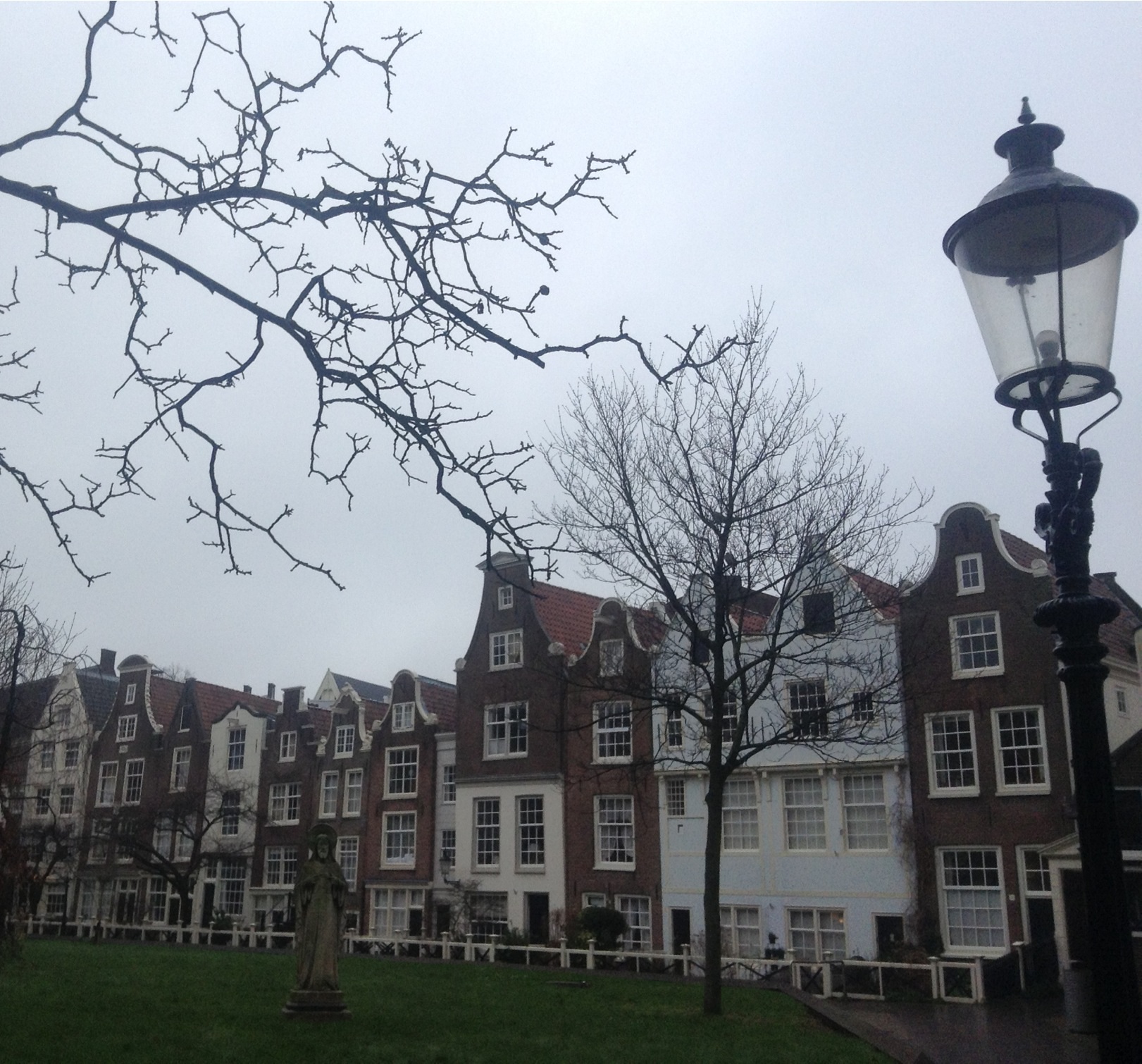
The Begijnhof
Accessed through a wooden door, a passageway with impressive vaulted ceilings leads through to an enclosed square, the Begijnhof. Women have lived on this site since 1150, primarily to care for the sick. By the fourteenth century, the place had become a nunnery, the women referred to as “beguines”. Taking pride of place in this inner courtyard is the church. The Begijnhof is also the site of one of only two surviving timber buildings in the city, this one dating from 1528. Visitors can access half the square, so long as they keep off the well-manicured lawns; the rest is for residents only. Entrance is free, though donations to the church are welcomed.
The Begijnhof is around the corner from the Bloemenmarkt, on the Singel, which claims to be the only floating flower market in the world. Don’t worry if you haven’t timed your visit for spring, even in winter the stalls are a riot of colour, selling cut flowers and bulbs. The packaged bulbs are aimed squarely at the tourist market – locals make a beeline for the loose bulbs as they’re considerably cheaper.

Tulips from Amsterdam
Next, I set about exploring the area known as “De Negen Straatjes” – the nine streets. This is an area bisected by canals from the Singel to the Prinsengracht and gentrification has resulted in a wealth of designer boutiques, gift shops and art galleries that lend themselves to ambling. This is not a district to walk with a purpose, more an area in which to potter and dither before recharging your batteries in a cafe. Forget Starbucks – though there are plenty – a canal side coffee shop is the way to go. I recommend the Koffee Huis “De Hoek”, a far cry from the smoky cannabis cafes for which Amsterdam is better known. Try their cheese and ham pancake washed down with proper freshly- squeezed orange juice and bag a window seat for brunch with a view.
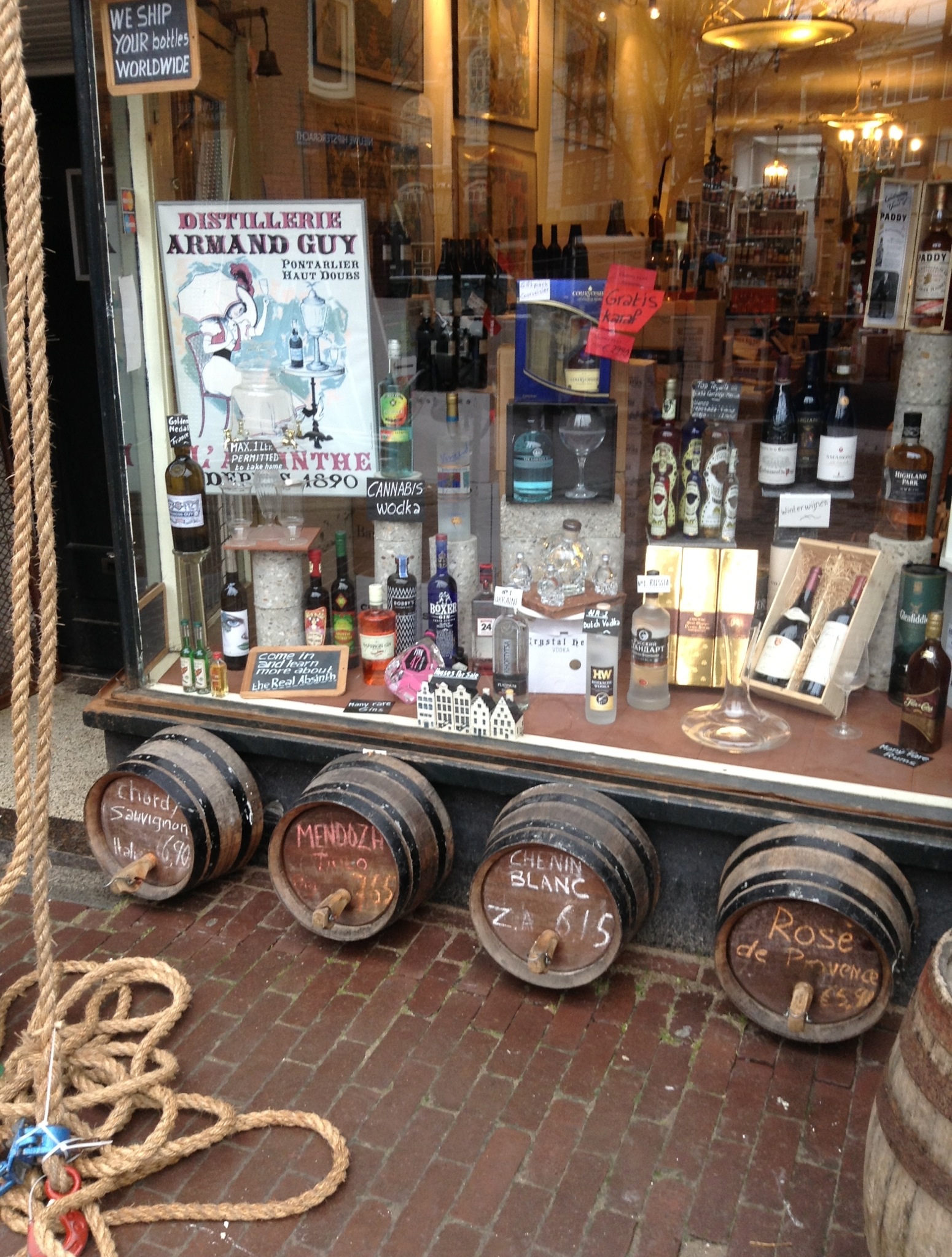
Off licence, Nine Streets
Continuing along Prinsengracht, and just past Westermarkt I passed the long queue for the Anne Frank House. Further along on the opposite side of the canal is an interesting little museum devoted to tulips. Behind the extensive gift shop and down a steep flight of steps, a series of small interconnecting rooms tell the history of this iconic Dutch flower, which you’ll soon learn, isn’t Dutch at all. In fact, it is native to Asia (who knew?) and it was the Ottomans who introduced the flower to the Netherlands in the sixteenth century. They soon became fashionable, with growers competing to see who could produce the most sought after bloom. Speculators moved in on the industry and soon bulbs with the right “pedigree” were changing hands for crazy sums of money, with some selling for twenty times the annual salary of the average Amsterdam resident at the time. Out of control, the market crashed in 1637 and it was to take a further 200 years to steadily rebuild it. Fortunately, the prices of tulips are far more reasonable today, as is the 5 euro entrance fee.
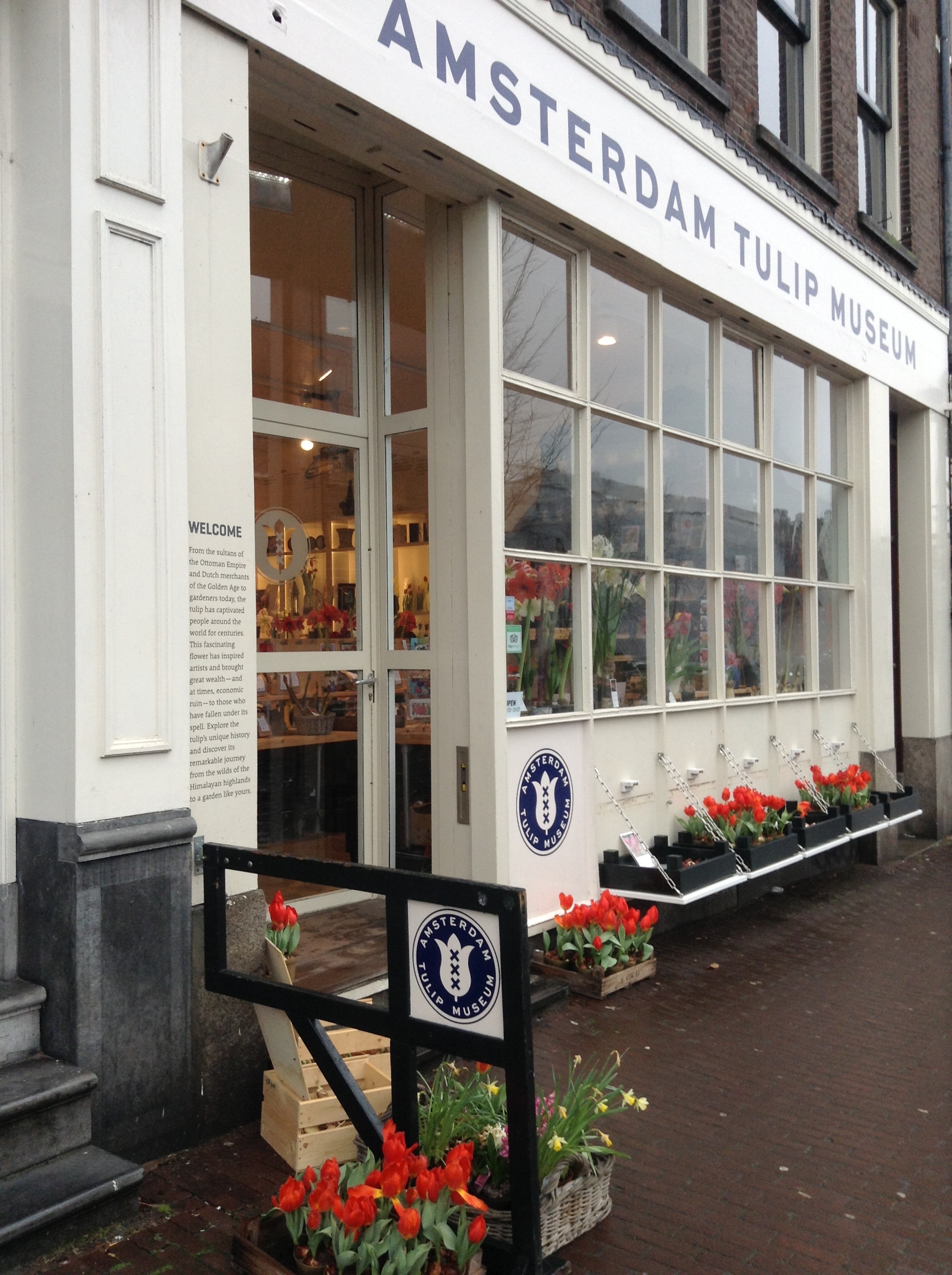
The Tulip Museum
Back at the Westerkerk, I jumped on a number 14 tram heading east to my second museum of the day – the Dutch Resistance Museum. This absorbing museum recounts the experiences of the Netherlands from 14 May 1940 to 5 May 1945, the period when the country was occupied by Nazi Germany. As well as resistance, the museum explains how people chose different paths in coping with the invasion – some collaborated, some fought back. The exhibition covers all forms of resistance: going on strike, forging documents, helping people to go into hiding, publishing underground newspapers, maintaining escape routes, and even armed resistance and espionage. Entrance costs 10 euros which I thought was good value for money. Take the free audio set that’s offered as it unlocks a series of explanations in English; the exhibits are all signed in dual language but some of the text is on the small size. A short film puts the museum in context, in kid-friendly language, and there’s a special children’s section to the museum as well. Families, this is your part of town – Artis zoo’s just across the street.

Dutch Resistance Museum
All that history had made me thirsty (and my back ache) so sinking into a chair in the Cafe Koosje on the corner of Kerklaan and Plantage Middenlaan came as a welcome relief. The hot chocolate topped, of course, with a generous dollop of cream and the friendly wait staff made this a good place to take a break.
It was time to head back to the centre for some shopping and my mind was on food. Taking the number 14 tram back to Waterlooplein, I walked to Staalstraat where I’d read about a foodie’s paradise at number 20. Het Hanze Huis is crammed full of European foods, from syrups to flavoured tea, chocolate to tasty biscuits. Mouth already watering, I decided to continue by number 24 tram (tram-hopping like a local!) to the market on Albert Cuypstraat. A mix of market tat, food trucks and cheese stalls, this place is definitely worth a visit. I stocked up on Stroopwafels, a family favourite, from a charming man who posed happily for a photo. Bag full, I had to pass on the Gouda cheese, but figured I could at least get that in Sainsbury’s.
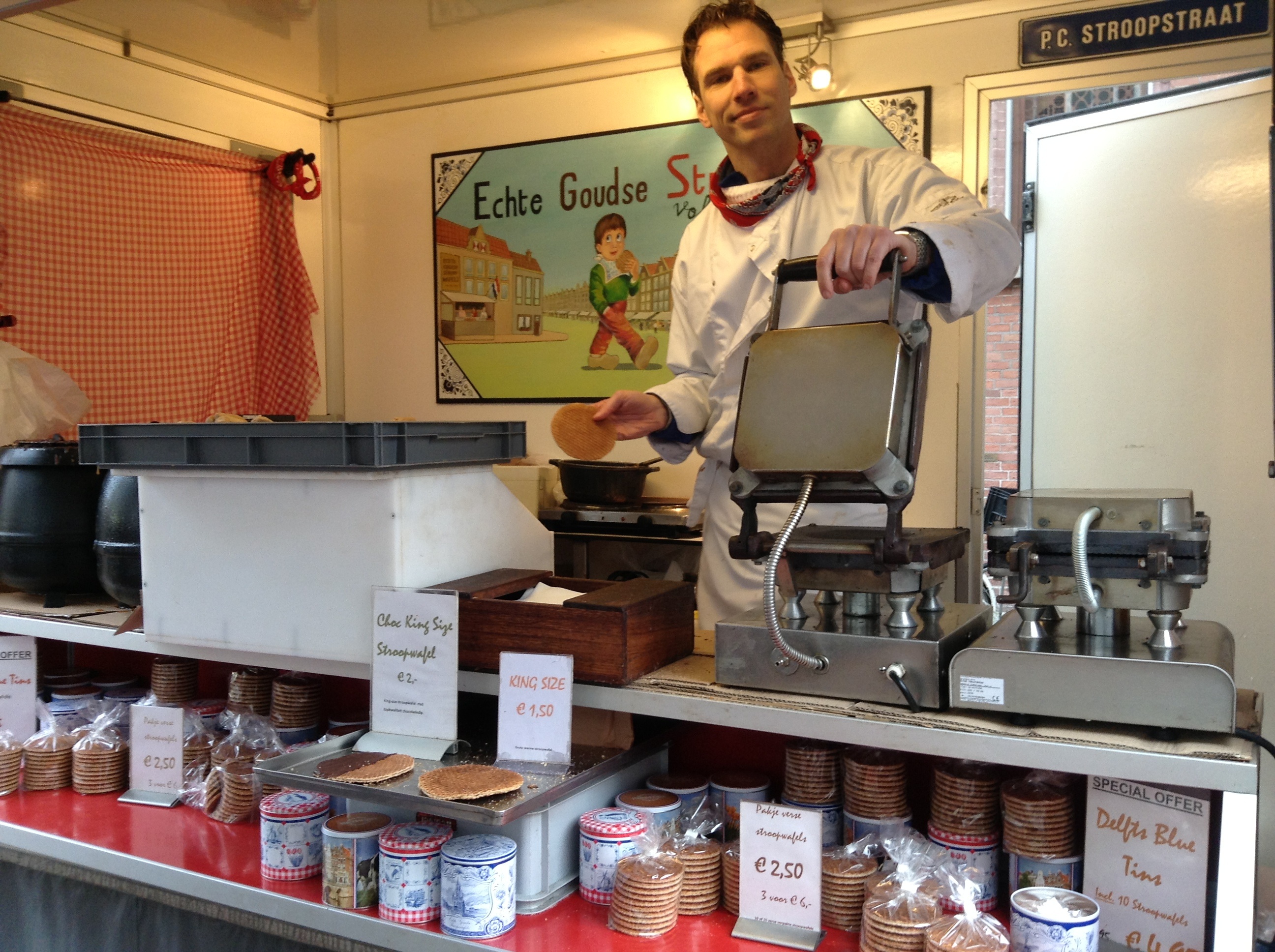
The Stroopwafel man
Heading back to the centre on the number 4 tram, my final stop was to a pub with no bar. I’d come across De Pilsener Club, located on Begijnensteeg, via several bloggers on the net. The pub’s nickname is De Engelse Reet, which apparently translates as “The English Ass”. Perfect, I thought. After all today’s walking I need a seat for my own ass. According to what I read, the pub has been in business since the end of the nineteenth century. It’s been in the current owner’s family for four generations (I read that they all share the same first name, so that’s four men called Tuen Van Veen) and they don’t like change. Stepping over the threshold is like travelling back in time, with sanded floorboards and tables pockmarked through years of use. Given the early hour (for a pub, anyway) I expected to have to drink alone, but two tables were occupied when I walked in and by the time I left, it was full. It seems it’s a very popular meeting place in the late afternoon for Amsterdam’s over 60s.
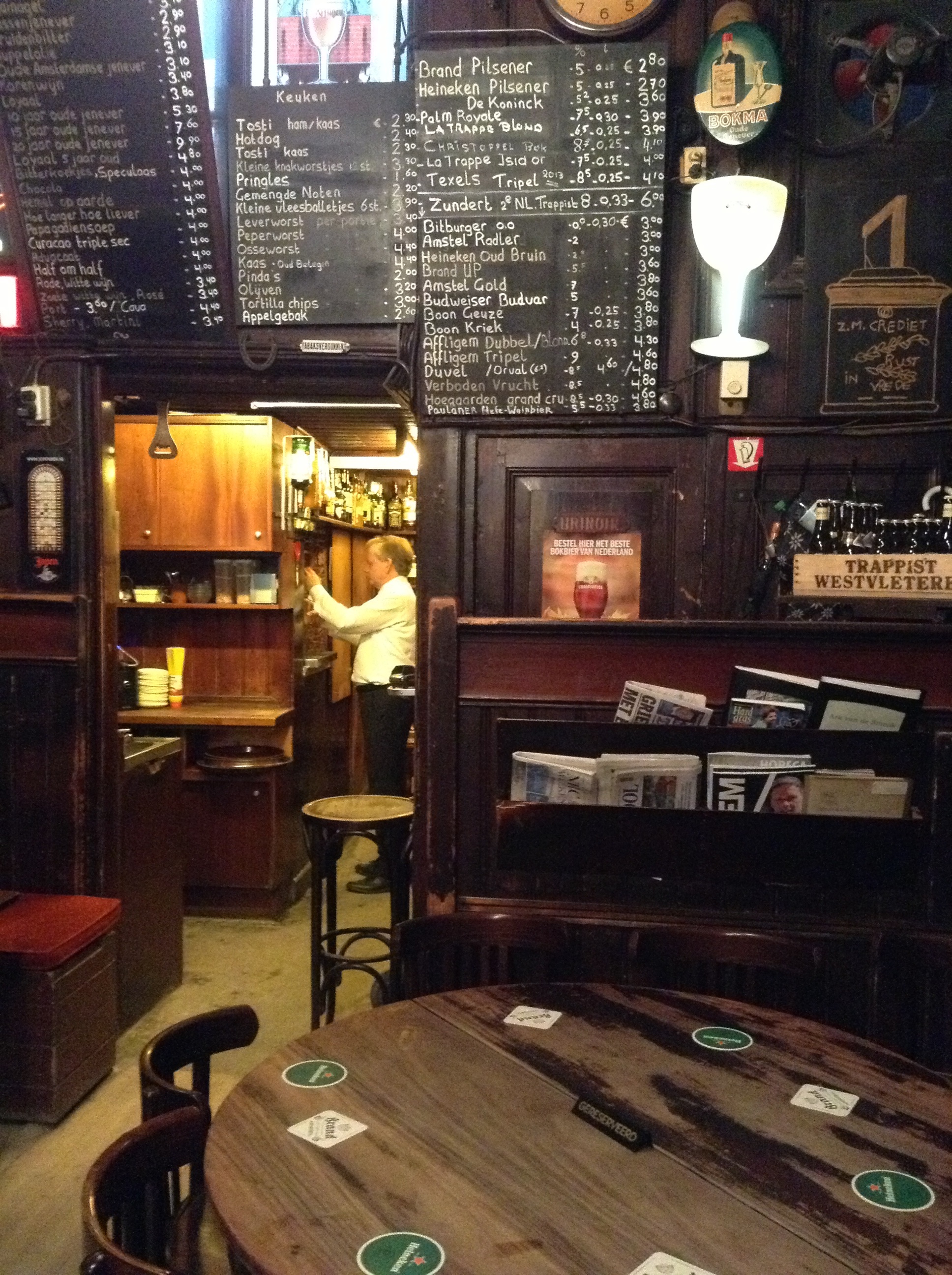
De Engelse Reet
The lowdown
As with Lisbon, I pre-planned my itinerary in order to minimise the chances of wasting time arriving somewhere that’s not yet opened up for the day or unnecessarily backtracking across town. Both times I’ve been fully prepared to ditch things as the day goes on, but was once again surprised by how much I ended up doing. I’ll admit, Amsterdam has never been one of my favourite cities, but I wanted to prove to myself that I could find a city I love within a tourist city I really don’t. A bit of extra research this time uncovered parts of Amsterdam that were a whole lot more rewarding than the Red Light District, tacky souvenir shops and mainstream museums I might otherwise have felt obliged to visit.
I also made good use of the Travel Telegraph’s app, and grew increasingly fond of its “favourites” capability and very functional zoomable map – particularly helpful as my paper map began to disintegrate in the drizzle. Because of the shorter flight time and the exceptionally quick train connection, having a later outbound flight and earlier inbound flight wasn’t an issue, though I could quite happily have holed up in De Engelse Reet and made a night of it. Next time that’s where you’ll find me, though perhaps I’ll get Tuen Van Veen to serve me up a couple of hard boiled eggs to soak up the Heineken.
A beginner’s guide to Iceland
Updated Spring 2022
Iceland’s fortunes are looking up. Years have passed since the volcanic eruption that resulted in flight chaos throughout the northern hemisphere. Post-economic crash and coping admirably with the fallout from the coronavirus pandemic, Iceland is fully open for business.

Iceland’s scenery is dramatic and beautiful
How to get there from the UK
Flights with BA and also Icelandair, the national carrier, depart from London Heathrow to Keflavik (KEF), the airport nearest to the Icelandic capital Reykjavik. Budget airlines also serve Keflavik. easyJet offer a good service from London Luton and London Gatwick, while Play operates out of London Stansted. A non-stop flight takes a little over 3 hours from London. There are also flights from Manchester and Edinburgh. Icelandair offers fares to North America with Reykjavik as a stopover destination for the same fare making it possible to combine an Icelandic break of 1 to 7 days with cities such as New York.

Jökulsárlón glacial lagoon
Getting from Keflavik airport into the city centre
The simplest and cheapest way to get to Reykjavik is to use the FlyBus. This bus will take you from the airport to either the bus station or to some hotels. To find out whether yours is served, there’s a list on the FlyBus website – check Google maps if yours isn’t listed to identify which listed hotel is closest. Single fares to the bus station are 3499 ISK (about £21) and to your hotel 4599 ISK (about £28). The journey takes 45 minutes, there’s free Wi-Fi on board and tickets are flexible, so if your plane is late, you just take the next available bus. There are frequent departures throughout the day and evening.
If you are travelling as a larger group or further afield, you may prefer to hire a car. The easiest way to do this is to book with one of several car hire companies based at the airport. I’ve used Thrifty a couple of times now. They’re not the cheapest but the cars are reasonably new and the rates are competitive. Note that you’ll need special insurance if you plan to drive off road or on some of the interior’s gravel roads (note: the latter are closed during the winter). It’s also advisable to take out an insurance policy that covers you for damage caused by sand (especially if you plan to travel along the south coast) or gravel. You might be a careful driver but there’s nothing you can do to mitigate against those travelling at speed who pass you from the opposite direction.

Icelandic fishing villages such as Olafsvik are charming
Getting around
If you’ve chosen not to hire a car, it is possible to use public buses to travel between some parts of the country. Check schedules carefully as it can be a long wait between buses. Consult this useful map of the main long distance routes in Iceland to see at a glance whether the places you plan to visit are connected or not. Alternatively, use a company such as Reykjavik Excursions which can offer day or multi-day tours. They can also sell you a ticket for a summer-only bus up to Landmannalaugar in the highlands.

Seljalandsfoss
Reykjavik
The Icelandic capital is charming and a good base for the first time visitor. Pay a visit to the unusual Hallgrímskirkja church; it’s only 1200 ISK to go up it and take in the views of the city. Also great for the views though a little out of the centre is Perlan; it features an excellent Áróra Northern Lights planetarium show and now also has a double zipline. The area around Tjörnin lake is worth a stroll if the weather’s good; it’s not far from the main drag and is popular with joggers. Down by the harbour there’s a cool structure known as Sun Voyager or ‘Sólfar’ which is worth making the effort to visit; walk past Harpa, the city’s concert hall and along to the Old Harbour for a pleasant walk. In the opposite direction, you’ll come to Höfði House where Reagan and Gorbachev met in 1986 to begin the process of ending the Cold War.
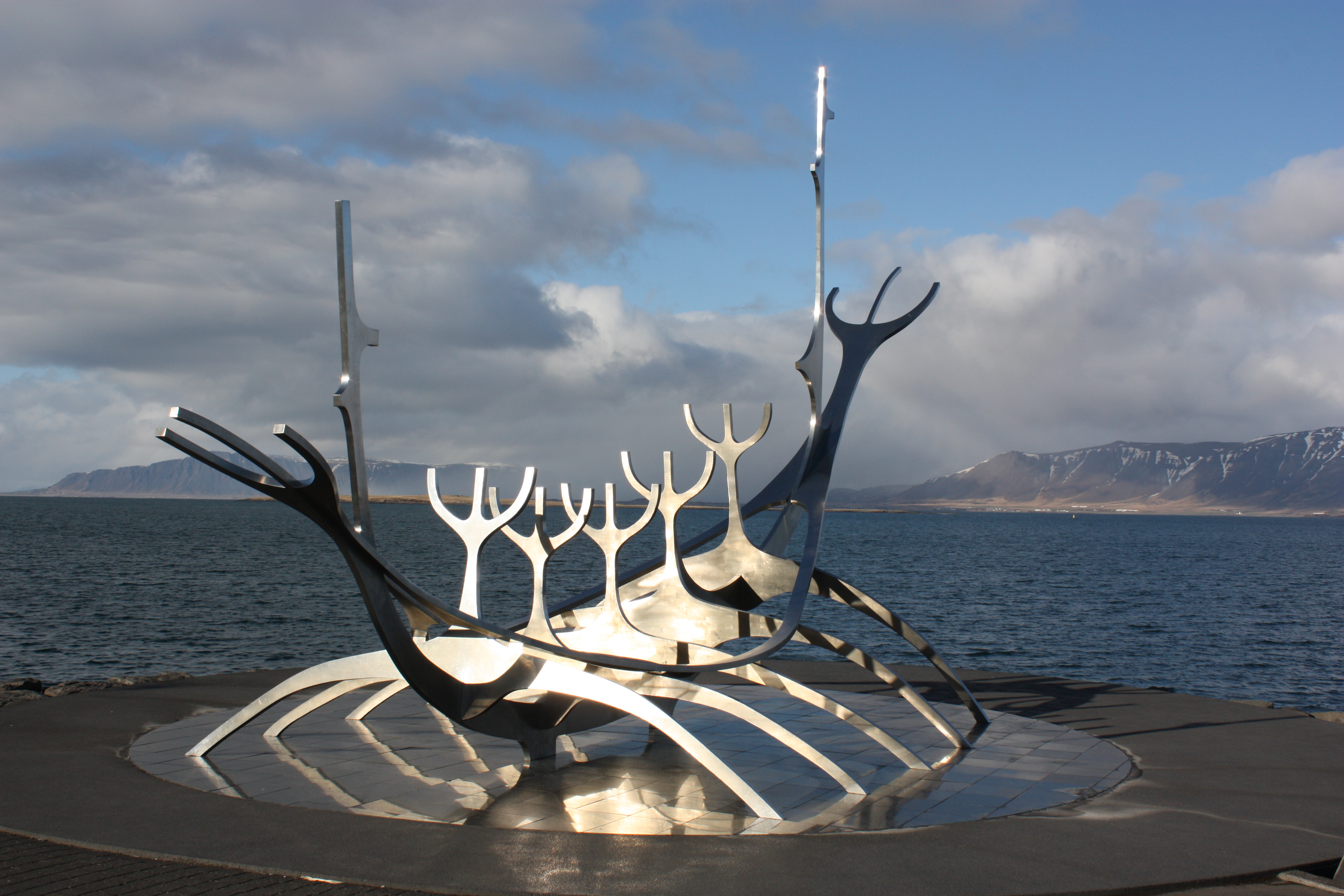
The Sun Voyager statue, Reykjavik
Must-see attractions beyond the capital
Reykjanes
The Blue Lagoon is a world-renowned spa consisting of a large pool fed by geothermally-heated water. It’s possible to book massages and other treatments; even if you just want a dip you’ll need to pre-book (evening slots are cheapest). There’s also a bar if you’d like a drink whilst relaxing in the warm water. Pots of white silica-rich mud are yours to try out – spread it on your face and body for an enriching treatment. Tip: in cold weather, turn left on your way out and enter the pool indoors before swimming out – it’s warmer than making a run for it from the main door. It’s possible to visit the Blue Lagoon on your way to or from Keflavik airport and lockers large enough to take a suitcase are available. The Blue Lagoon is the main attraction on the Reykjanes peninsula where the North American and European plates meet. With your own transport you can stand on Leif the Lucky’s bridge that straddles the two – but be warned, it’s one of the windiest places in the country.

The Blue Lagoon
The Golden Circle
The Golden Circle comprises three of Iceland’s most awe-inspiring attractions: Gullfoss waterfall, Haukadalur and Þingvellir, the site of the original Icelandic parliament. One of Iceland’s many dramatic waterfalls, Gullfoss is the spot where the Hvítá river rushes south and plunges into a chasm where the water explodes into a maelstrom of white water and eroded rock. At nearby Haukadalur, the original geyser, Geysir, has long since given up erupting, but the plume of water that spurts from nearby Strokkur is impressive and conveniently frequent. The Alþingi, or parliament, met at Þingvellir from 930 to 1798 and thus the site is important culturally and historically in addition to its stunning physical characteristics. The three sites can be combined on a morning or afternoon organised tour departing from Reykjavik, but it is worth spending more time at each than the tour allows. If you do decide to go it alone, consider stopping at the excellent Laugarvatn Fontana spa where they bake rye bread in the hot sand twice a day. Spa admission costs 3950 ISK per person (about £24) and the bread baking, including tasting, is 2300 ISK (about £14).
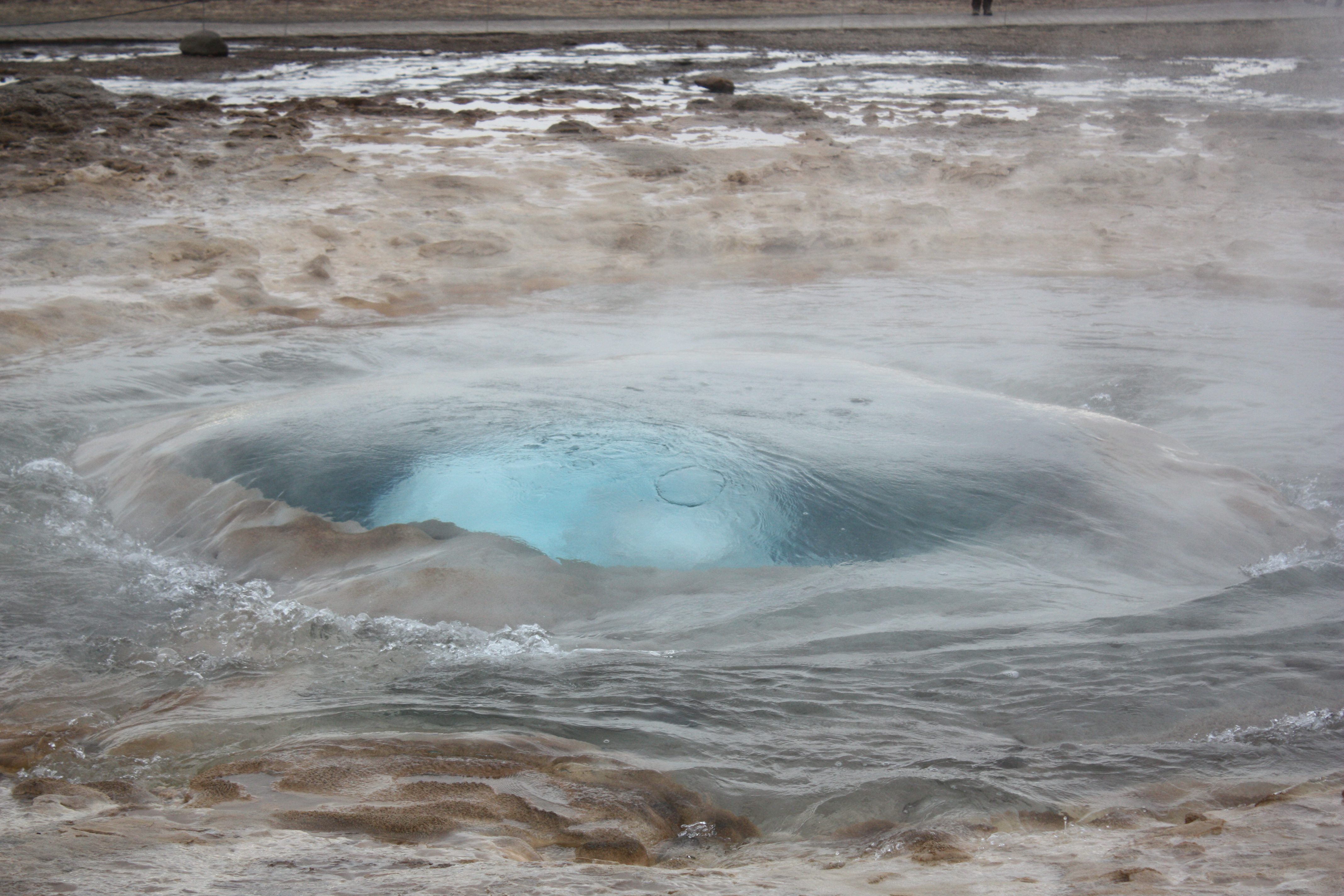
Strokkur on the verge of blowing
The Snæfellsnes peninsula
The Snæfellsnes peninsula is ignored by many but is a worthwhile day out. It’s a remote peninsula with a dramatic coastline perfect for a scenic drive. Its expanses of countryside are punctuated by small fishing villages including the charming Olafsvik. The Hollywood film “The Secret Life of Walter Mitty” was filmed here, focusing on the village of Stykkishólmur whose centre is crammed with historic buildings. Another highlight is the Shark Museum at Bjarnarhöfn. There you can find out how the Icelandic delicacy of hákarl is created and, if you’re brave enough, try a cube of this dried rotted shark flesh for yourself.

Trying hákarl, rotted shark meat
The south coast
Take the southern ring road towards Vik and you will come across two impressive waterfalls. Skógafoss waterfall has an impressive 60 metre drop, but for sheer drama, my choice is the beautiful Seljalandsfoss waterfall. Climb up the wooden staircase to the right of the falls as you face them and the path takes you behind the curtain of water. You will get wet but it’s a lot of fun. In Skaftafell, don’t miss the glorious sight of Svartifoss, an impressive waterfall flanked by basalt columns. To ride nearby, see my post about Glacier Horses. On a secluded ash-grey beach (once accessible by 4×4 but now accessed only on foot) is the wreck of a plane. Near Vik, the DC3 crashed back in 1973 with no loss of life, and the plane has been there, abandoned, ever since. It’s worth the five mile round trip walk over the volcanic sand to see this curious and fascinating wreck but allow plenty of time to return before sunset. Just before you reach Vik, keep an eye out for the notorious sneaker waves as you visit Reynisfjara beach. In Vik itself, meet up with the guide from Katlatrack and don helmet and crampons for one of their ice cave tours up on Mýrdalsjökull. Their three hour fast track tour costs 19,900 ISK per person (about £121) but although it’s expensive it’s worth every penny.

The crashed DC3 near Vik
Jökulsárlón
Situated on the edge of Vatnajökull National Park, itself a fun destination if you’d like to try out snowmobiling on Europe’s largest glacier, Jökulsárlón is a large glacial lake in the south west of Iceland. As the Breiðamerkurjökull calves into the lake, icebergs travel the short distance to the Atlantic Ocean where they bob about on the waves, washed on and off the beach until they finally melt. It’s a magical place; though both the beach and the lagoon itself can get crowded. In summer, it’s possible to take a boat trip. The best value tour is on an amphibious vehicle which gets you close to some of the icebergs for 6000 ISK per person (about £36), but you’ll get closer to the glacier if you pay the extra for the Zodiac tour. Just west is the sometimes overlooked Fjallsárlón. It too has icebergs and boat trips though it’s not quite as impressive as its more famous neighbour.

Jökulsárlón Glacier Lagoon
Austurland
East Iceland receives far fewer visitors than the popular south, but there are some breathtaking sights there too. A couple of the coastal villages stand out. You might recognise Seyðisfjörður for the rainbow path leading to its pretty church; it’s accessed by a tarmac road as this is also the place to jump on a ferry to Denmark or the Faroe Islands. In contrast the road to Borgarfjörður eystri, another of the area’s spectacular fjords, winds up and over a mountain pass. For an off the beaten track retreat, the Blabjorg Guesthouse with its open air hot tubs overlooking the water is a great choice. The east’s most unmissable sight is a relative newcomer: until a nearby hydro-electric plant was built which held back the water, the breathtaking Stuðlagil Canyon was hidden to the world.

Stuðlagil Canyon
The Diamond Circle
North Iceland’s answer to the well-established Golden Circle launched officially as a marketing concept in September 2020 but travellers have been drawn to its attractions for much longer. Base yourself in the delightful port town of Húsavík, where you can visit the excellent whale museum and then head out into Skjálfandi bay to see if you can spot them for yourself with a company such as North Sailing. They offer tours for a reasonable 10990 ISK (about £67) with a 98% chance of a sighting. The other four stops on the Diamond Circle are Goðafoss waterfall, Mývatn (Midge Lake – in summer it lives up to its name!), Ásbyrgi canyon and last but not least Dettifoss waterfall, the largest in Europe. This part of Iceland is geothermal; take advantage of that naturally occurring hot water with a dip at GeoSea in Húsavík or the Mývatn Nature Baths. Reservations are advised for both, especially in peak season. Further west, detour off the ring road for a visit to Siglufjörður. This charming town made its money on processing herring; today, the old industrial buildings have been converted into a fascinating museum (2200 ISK per person, about £13).
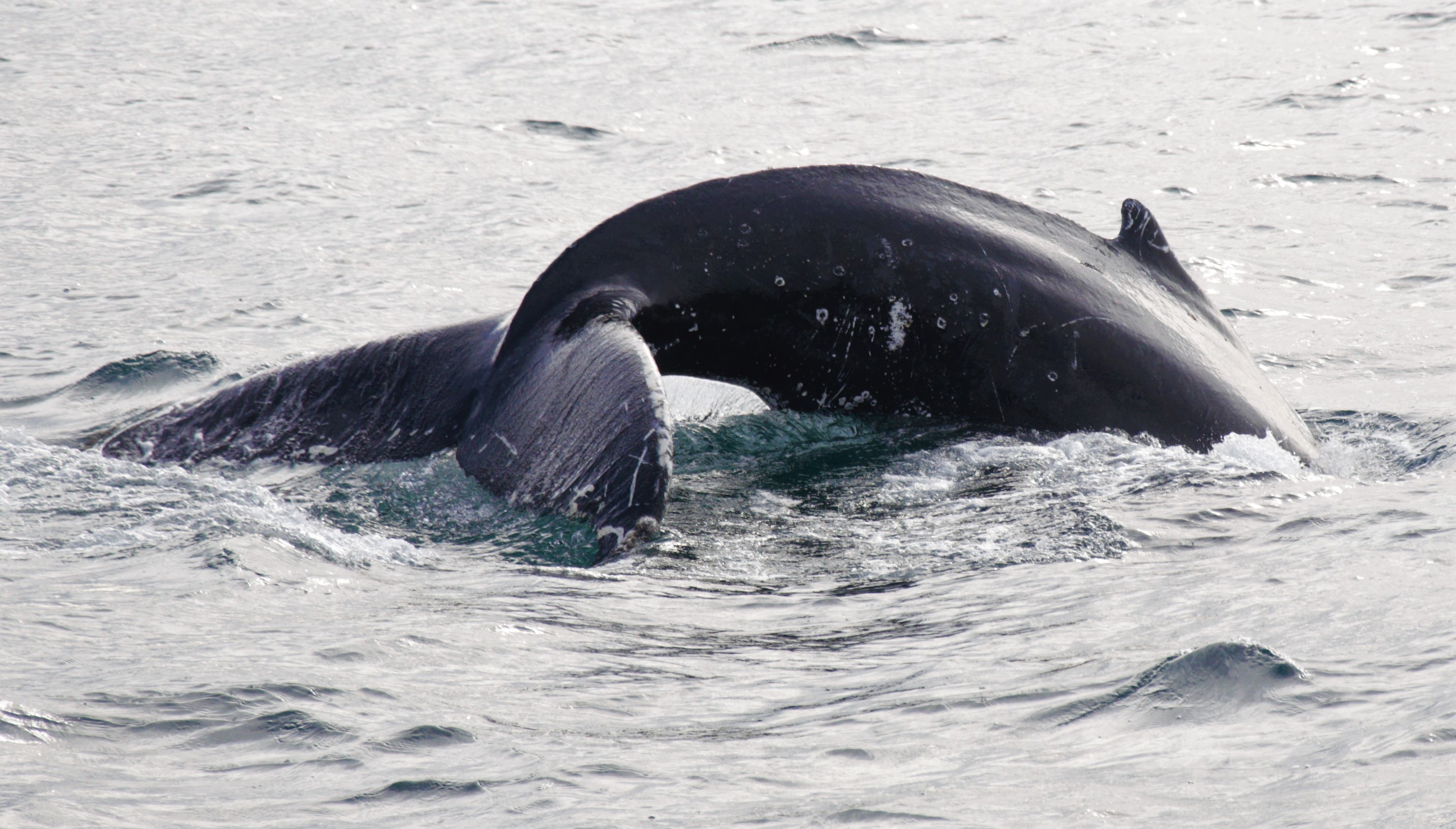
Humpback whale near Húsavík
The north west
The north west of Iceland and in particular the remote Westfjords are often missed by visitors. From Akureyri, Iceland’s second city, the road east is relatively quiet. The old turf buildings at Glaumbær are interesting to explore and well priced at 1700 ISK (about £10). Make a detour to visit the Icelandic Seal Center in Hvammstangi (admission 1200 ISK (abotu £7). Note that it is closed during the winter. Afterwards, head north to see if you can spot seals at Illugastaðir or Hvítserkur – the latter is also worth a stop for its magnificent sea stack. Ísafjörður is the capital of the sparsely populated Westfjords and even has its own brewery. From here you can take a boat trip with Borea Adventures to Hornstrandir in the hope of spotting Arctic foxes (sightings not guaranteed); there’s a few stuffed ones in a museum just outside Ísafjörður itself. Detour to Flateyri to Iceland’s oldest bookstore, or to Holmavik to visit the quirky but creepy Museum of Icelandic Sorcery and Witchcraft. Another excursion is to Simbahöllin in Thingeyri, which does fabulous waffles in summer. To feel like you’ve reached the end of the world try Patreksfjörður, a fish processing settlement within easy reach of the attractive Rauðasandur – a distinctive red sand beach – and the Látrabjarg bird cliffs. It’s also handy for the ferry to Stykkishólmur in Snæfellsnes.

Glaumbær – The old turf farm
Practical information
It’s possible to loop the ring road in about a week but you’ll be pleased that you allowed more time, at least ten days and two weeks if you can manage. Roads outside the mountainous interior still vary a lot; the ring road is tarmacked and aside from the occasional blind hill and many one-lane bridges, you’ll have no issues at all in fine weather. Keep abreast of local weather conditions online and don’t underestimate the impact of wind speeds. Another invaluable website is that showing road surfaces; gravel roads are generally simple to drive unless they are very steep, though you’ll appreciate the extra grip of a 4×4. The interior shuts in the autumn and doesn’t reopen until late spring; most of its F roads require a high clearance 4×4.
Julia’s Guide to New York Part 3: Manhattan East
Begin at Canal Street. Head along Canal and into Chinatown. My favourite parts are around Mott and Mulberry but the whole area is interesting just to see how different it is from other nearby areas. I can never suppress a snigger when I pass Mei Dick barbers. Vietnamese businesses are slowly colonising parts of Chinatown and of course it has Starbucks et al, but it remains a very Chinese neighbourhood. It’s also a great place to pick up a bargain I ♥ NY T-shirt or Hoodie. Haggle hard!
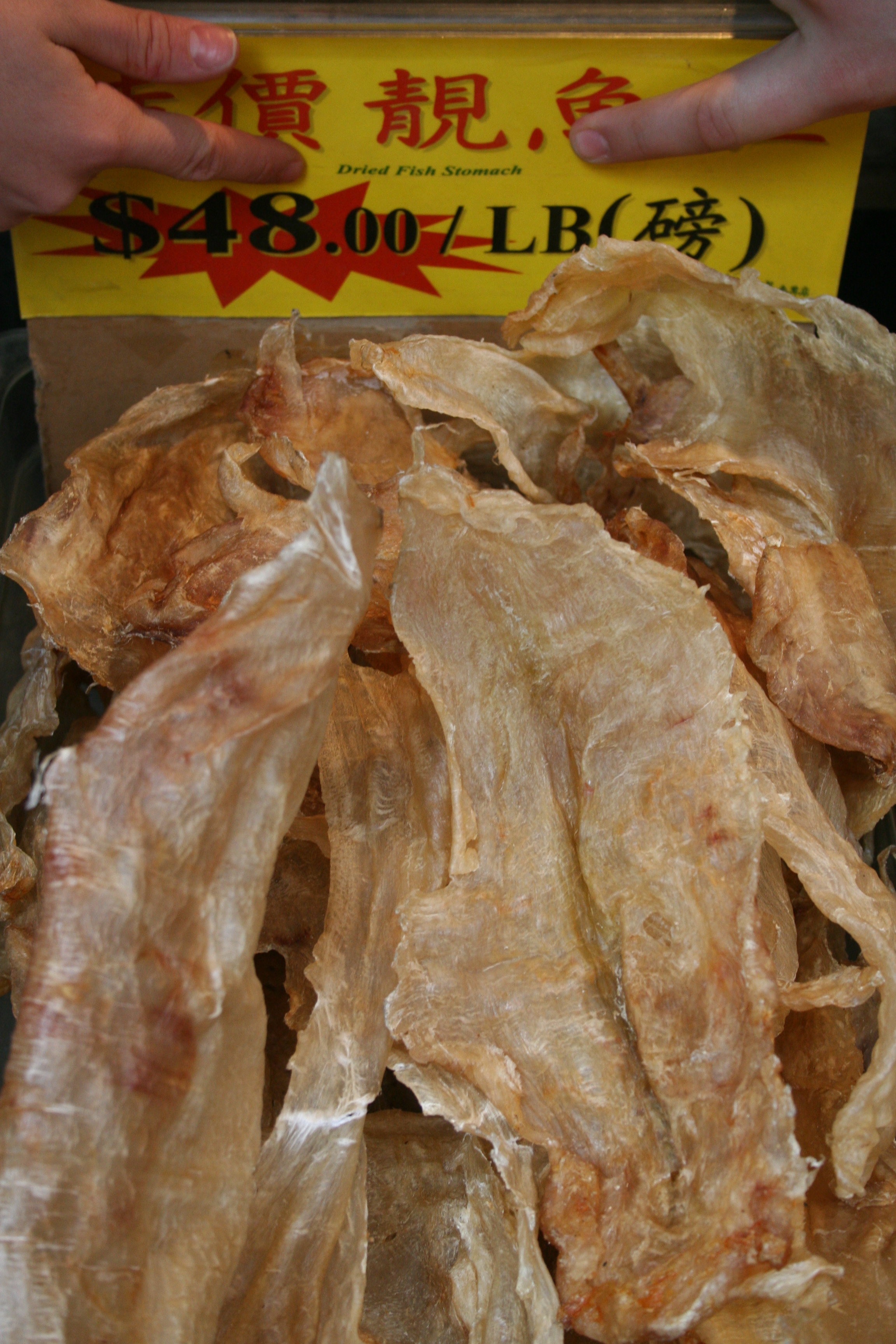
Shopping in Chinatown is never dull
Next, take the J or Z subway (brown) to Essex and Delancey. Head across the street to Orchard Street and visit the Lower East Side Tenement museum. By European standards this isn’t old, but it is for Manhattan and the room sets give a clear picture of what life would have been like for garment workers in this district back in the 19th Century. Architecturally it’s very interesting inside too as some of the rooms are in their original condition complete with years of peeling wallpaper. You can book in advance at www.tenement.org and there are various tours you can book onto which give you a themed talk into an aspect of tenement life that appeals. It really does bring history to life and helps you understand the context of the buildings.
Cross the street and head for 205 East Houston Street, in particular Katz’s deli. This old Jewish deli has been there for years; it’s a New York institution. The food is amazing; the setting is humble. I can recommend the pastrami on rye and you should also taste the knish. Wash it down with an egg cream. This was the setting for the famous fake orgasm scene in When Harry Met Sally but as you’ll see from the many pictures that adorn the walls, this is a favourite of many celebrities and politicians as well as the NYPD and FDNY.

“I’ll have what she’s having!”
Two of my favourite squares are a short walk from each other. Take the subway to Union Square which has a thriving farmers’ market every Wednesday, Friday and Saturday. It began in 1976 with a few farmers and the number of stallholders has grown steadily to around 140 today. North of Union Square at 23rd Street is Madison Square Park, alongside which you’ll find the triangular Flat Iron Building which dates from 1902.
North via the subway again at 42nd Street is what’s been termed the greatest railway terminal in the world: Grand Central station. It certainly outshines Liverpool Street at rush hour. This building is spectacular on a sunny day when the light shafts in through the windows, rivalling nature’s crepuscular rays. Walk across 42nd Street and pass the Chrysler Building. You can’t go up, but the building is worth a look nevertheless.
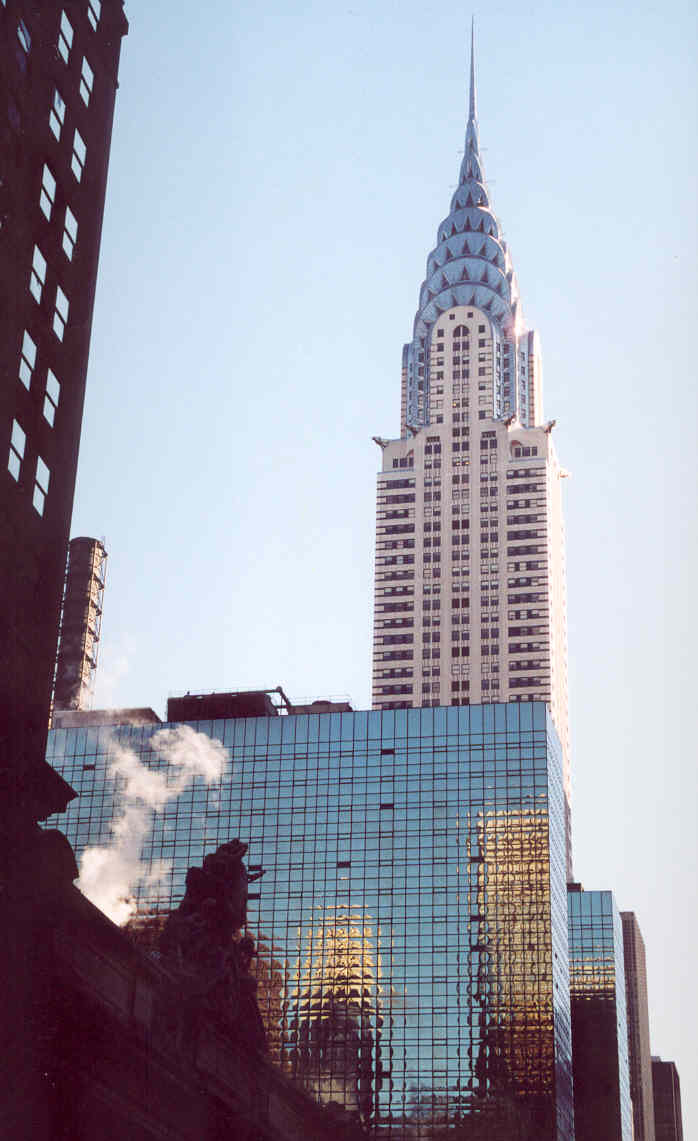
The Chrysler Building
Keep heading towards the river for a look at the United Nations Building (44th Street and 1st Avenue). You can book guided tours which are interesting, with the disarmament exhibits particularly poignant. It is necessary to pre-book tickets at http://visit.un.org/wcm/content/site/visitors/home/plan and as with the Statue of Liberty and the Empire State you do have security screening for which you need to allow time.
At 59th Street and Lexington, you’ll find Bloomingdales. Buy a Little Brown Bag and walk a block up to 60th Street. Serendipity 3 is a cute cafe featuring as its signature drink frozen hot chocolate, located at 225 East 60th Street. From there, head for the Roosevelt Island tramway. There isn’t a lot to see on Roosevelt Island itself but this tiny cable car is worth a ride in itself for the view back to Manhattan. Metro cards are accepted. Website http://rioc.ny.gov/tramtransportation.htm has the schedule.
Museum Mile is an integral part of the Upper East Side and my two favourites are both alongside Central Park. The Guggenheim is an amazing building for its architecture, all white curves of loveliness. Frank Lloyd Wright designed this building; if I’m honest, it fascinates me more than the exhibits inside but this is a must-see on your itinerary. Find out about the current exhibits at http://www.guggenheim.org/new-york. Up at 103rd Street is the Museum of the City of New York. Overlooked by many visitors, it tells the story of New York’s growth over time via a must-see film. Exhibits change, but will stay in your mind. A permanent fixture is the Activist New York display, featuring campaigns that range from anti-slavery to the suffragette movement, artefacts such as the Gay Bob doll and changing attitudes to the preservation of historic buildings. While you’re up here, it’s worth crossing the road into Central Park to see its only formal space, the Conservatory Garden, and Harlem Meer.

Museum of New York City
For dinner, head into Spanish Harlem. A block north of Tito Puente Way, a street named in honour of the outstanding Latino musician though I couldn’t find a plaque, I dined at Amor Cubano. It’s Cuban, obviously, though much around it is Puerto Rican. The food is delicious, the welcome familial and the atmosphere enhanced by live music. Camaradas el Barrio, a couple of blocks away, offers the best Puerto Rican food in the area and again has live music most evenings. But if you want to follow in the footsteps of Frank Sinatra, Dean Martin and Tony Bennett, then there’s only one place to go. Patsy’s Pizzeria has been a favourite since it first opened its First Avenue doors back in 1933.
Julia’s Guide to New York Part 2: Manhattan West
Part 2 of my guide to the Big Apple covers Manhattan’s west side from Washington Square to Central Park.
This route begins in Washington Square, where Harry left Sally after their road trip from Chicago. This landmark square has also featured in the Will Smith film I am Legend and is worth a visit for a picture of the arch. Head north along West 4th Street, through the attractive residential area of Greenwich Village. Turn left into Grove Street and a couple of blocks further on you’ll come to the building that featured as the apartment building in the hit TV show Friends. Backtrack a block and head north along Bleecker Street. There are plenty of boutiques and cafes, but the one that may well have a queue outside is the original branch of the Magnolia Bakery, whose melt-in-the-mouth cupcakes featured in the HBO show Sex and the City.
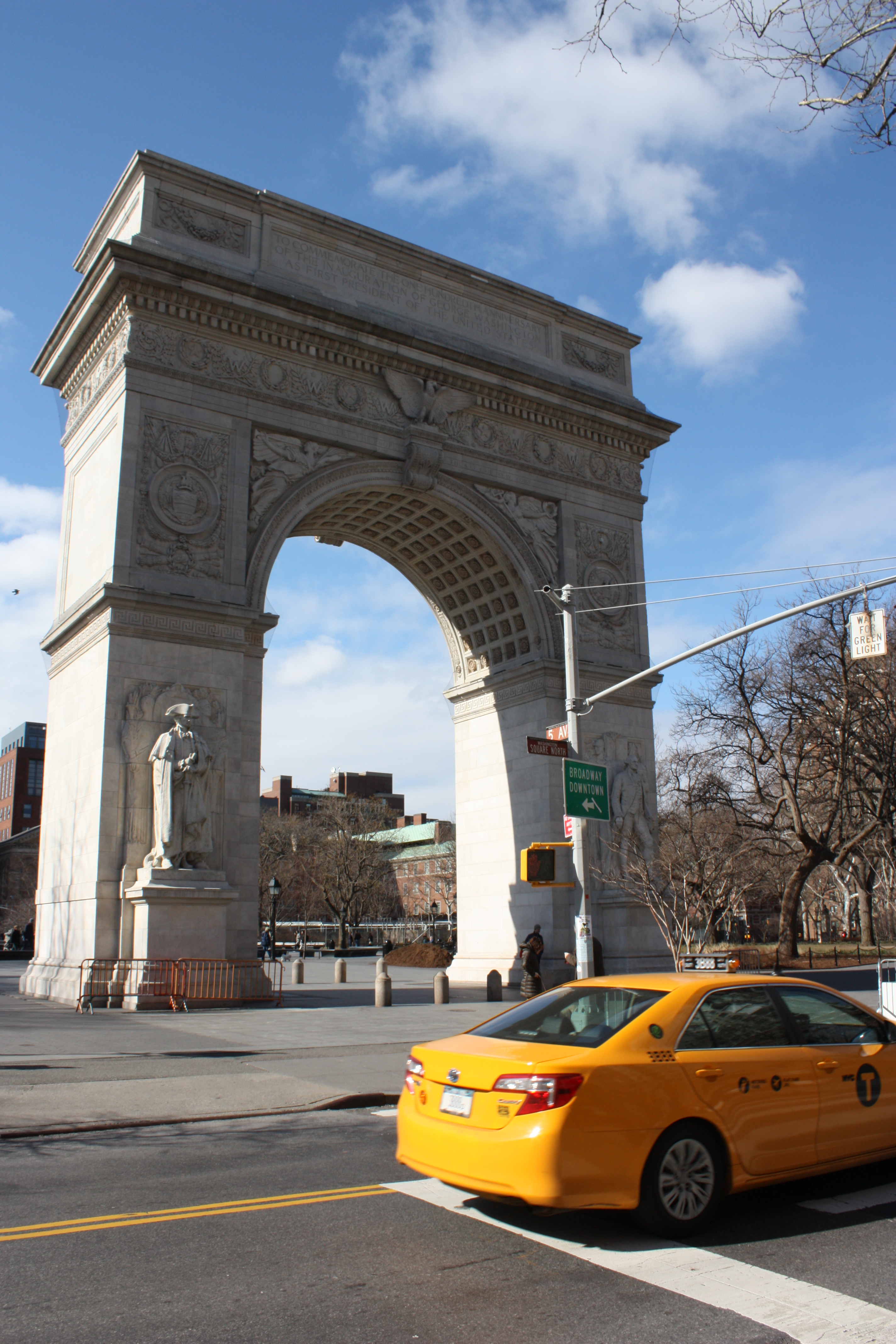
Washington Square arch
One of my favourite things about New York is its capacity for change so today I’d recommend you then have a wander in what was once the heart of New York’s butchery area. Today the Meatpackers’ District is home to cute cafes and designer clothes stores, where warehouses have been turned into cutting edge businesses.
To get to the heart of the Meatpackers District, continue north along Hudson Street and right into Gansevoort Street. In the area bounded by Gansevoort and West 14th Street, you’ll pass enough boutiques and outlets to get a feel for the area. Turn down Washington Street and at the corner with West 13th Street is the Hogs and Heifers bar from the film Coyote Ugly. One block south is the start of the High Line, a fantastic community-driven renovation that showcases the architecture of the area whilst turning an overground railway into a recreational facility for locals and tourists alike. It’s heaving in the summer but in the winter, pick a clear day and you’ll be able to wander in peace and really appreciate your surroundings. Wrap up warm against the wind though – when a cold wind blows across the Hudson, it bites into your face like a swarm of angry mosquitoes. One of the architectural highlights is The Standard Hotel which straddles the High Line. Nip down for a Fat Witch brownie from the Fat Witch Bakery in Chelsea Market at 9th Avenue. Go online to www.fatwitch.com to see what might tempt you.
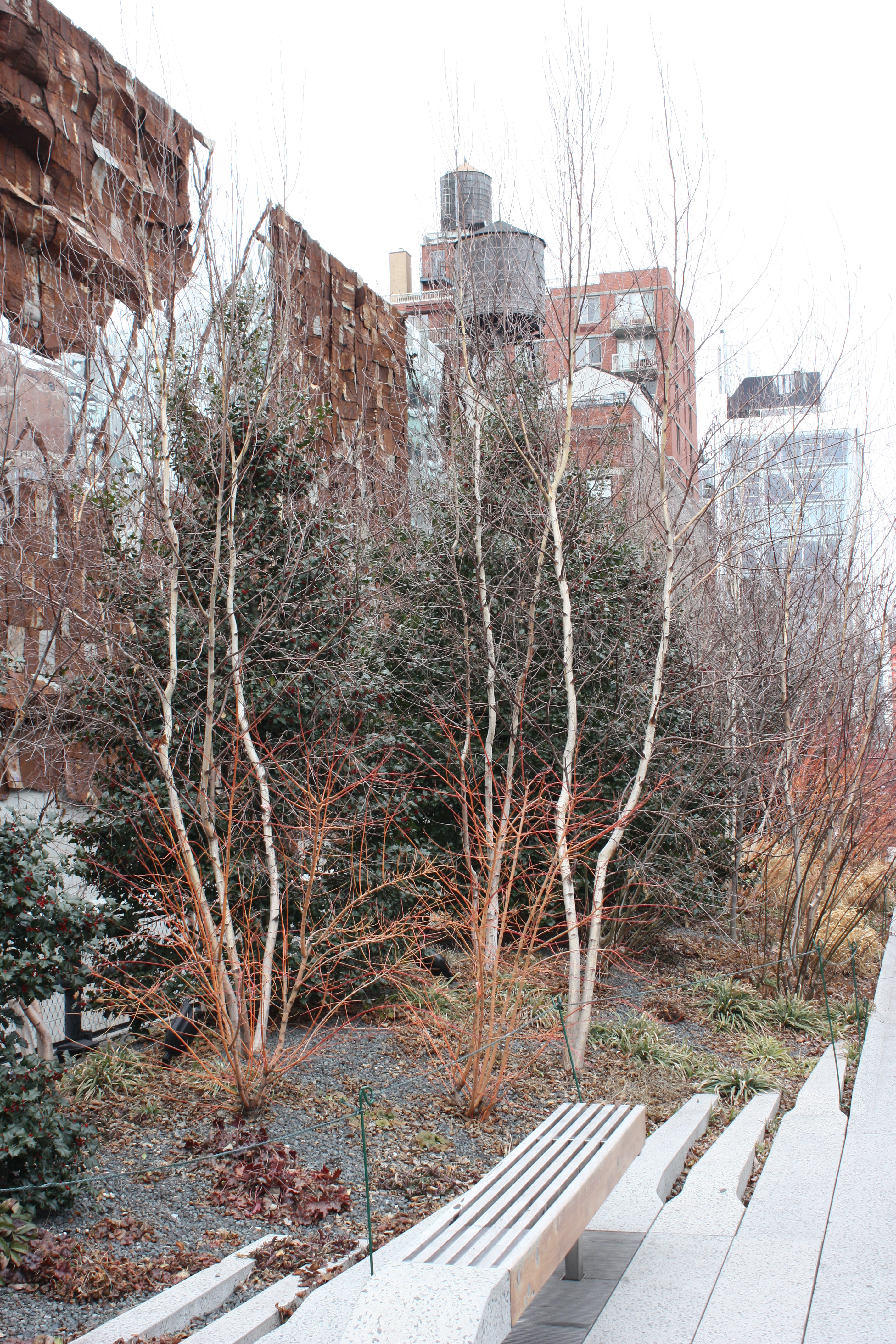
The High Line in winter
Back on the High Line, continue north; the park narrows and widens, offering vistas over art installations and views across to skyline landmarks like the Empire State. There are plenty of cosy nooks and crannies to snuggle up and you’ll have some of these pretty much to yourself in winter.
Follow the High Line right up to 30th Street and then head east past the Post Office (don’t stand too close to the building or you might get an unwelcome souvenir from the pigeons). It’s a fair walk across so you might wish to hail a yellow cab, but the walk will take you to 6th Avenue. Make a left and walk three (shorter) blocks to Herald Square at the back of Macys – the largest department store in the world, allegedly. Plenty of cafes and food outlets are located in this area as this is the heart of Midtown.
Just a block over, on 5th Avenue, is the Empire State Building. You may wish to reserve in advance as it can be pretty busy; go online at www.esbnyc.com. This Art Deco structure is one of the world’s most iconic buildings and definitely worth a visit. Don’t let them upsell you to the Skyride – it’s not worth the time or the money. The views from the 86th floor on a clear day are excellent, but the wind can be strong on at least one side of the viewing platform. Prepare yourself with a photogenic hat or plenty of hairspray.
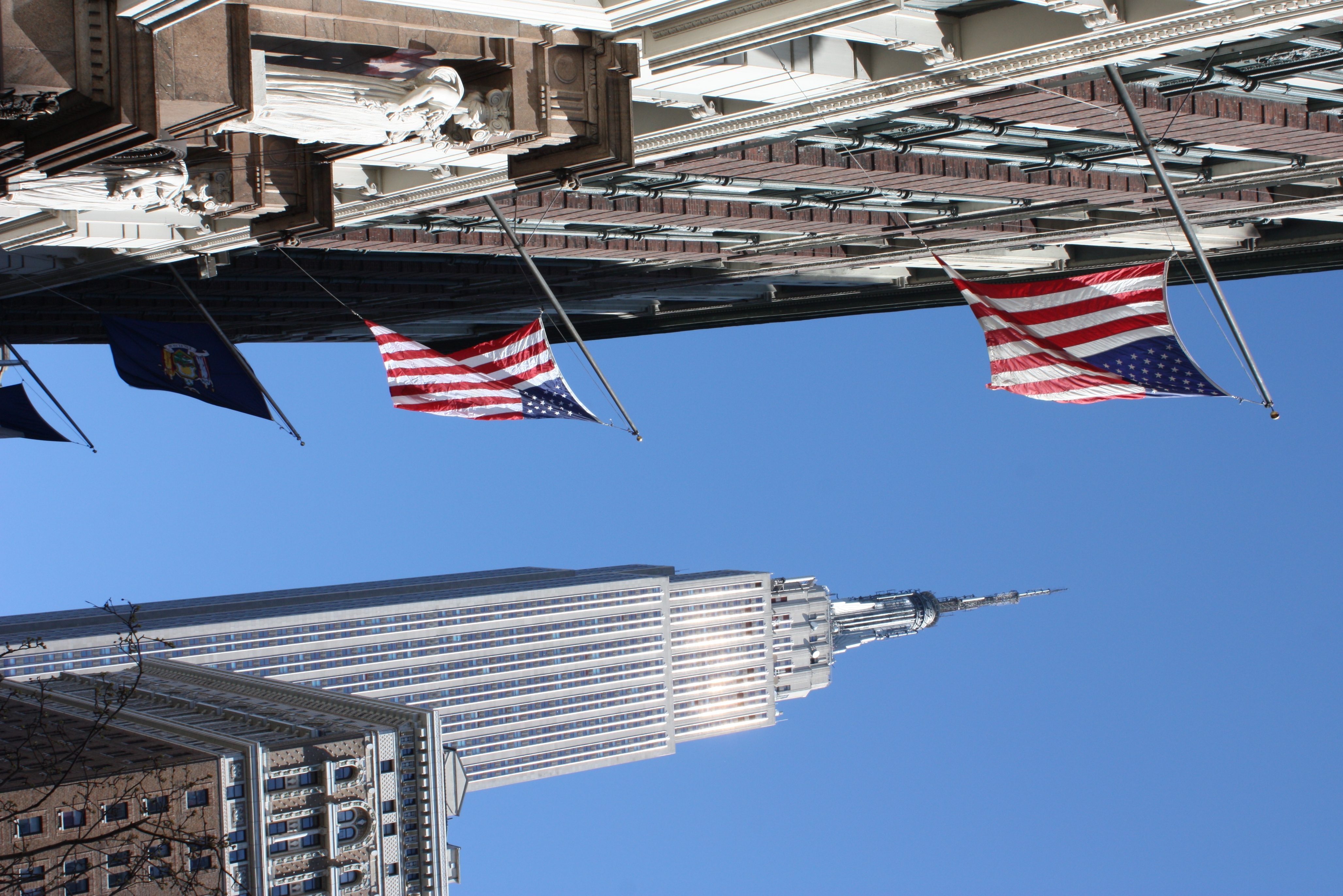
The Empire State Building
North along 5th Avenue takes you to Bryant Park, where there’s a good Christmas market and, when the weather’s warm, al fresco eateries. Cut back west to Times Square and note the location. It’s tourist central, of course, emblazoned with neon and awash with comic book characters just dying to pose for a photo. If you like what you see, come back after dark. From Times Square, head for the subway and take the red line to 72nd Street (it’s an express stop, so the 1, 2 and 3 are all fine). If you’re hungry, try a hot dog from Gray’s Papaya and walk a couple of blocks over to the park.
Central Park is a must and from the west, you’ll follow a trail of pampered pooches heading into the park. If you have your own back home, pick up a canine-friendly gift from the New York Dog Shop on 73rd Street – purple squeaky Empire State toy, anyone? Enter the park at the 72nd Street Traverse and look for the memorial to John Lennon, the legendary musician shot on December 8th 1980 outside the Dakota Building which stands across the street. The Imagine mosaic forms part of a tribute area known as Strawberry Fields, funded by a $1 million donation from John’s widow Yoko Ono. Continue through the park. In summer, you might rent a boat from the Loeb Boathouse; in winter, perhaps try your luck at ice-skating on the Wollman rink.

Central Park
The days of one Central Park attraction might be numbered, however. Despite Mayor de Blasio’s intention to ban them, at the time of writing it is still possible to take a horse and carriage ride through the park; they congregate along 59th Street at the southern edge of the park. They’ve been a part of the Park since the day it opened back in 1858 and Hollywood stars such as Liam Neeson and Danny Glover have made no secret of their opposition to the Mayor’s plans, along with an estimated 67% of New Yorkers. Find out more about the issue at www.savenychorsecarriages.com.
When you’re done, make your way back to see the lights of Times Square. You may wish to eat at Ellen’s Stardust Diner. It’s not to everyone’s taste, but those that love it enjoy the singing wait staff and its 1950s retro diner decor. You’ll find it at Broadway and 51st, or if you can’t see it, listen out for a song. To round off the evening, pay a visit to the observatory platform at the Top of the Rock. This offers unrivalled views of Manhattan for one reason – your view will include the Empire State Building. Depending on the season, this after-dinner slot may coincide with sunset, and it’s certainly an impressive vista after dark, although you may not wish to ascend this and the ESB in the same trip, especially if your time is limited. Pre-book your ticket at http://www.topoftherocknyc.com to avoid having to wait in line.

Sunset at the Top of the Rock NYC
Julia’s Guide to New York Part 1: Lower Manhattan
Here’s my guide for the first-time visitor to Lower Manhattan.
Begin at the southern tip of Manhattan, on the reclaimed land known as Battery Park City. Walk across Battery Park until you see Castle Clinton (the large circular fort) and get tickets for the Statue of Liberty – I’d advise an early start as the queues can be long, even out of season. Take the Circle Line cruise, get off at Liberty Island and have a close-up shot with the Statue. You can go up inside the crown but you need to pre-book tickets which have limited availability. When I last visited, the exhibition inside explained the technology behind creating the structure. Book tickets ahead of time at www.statuecruises.com

The Statue of Liberty
The second stop on the Circle Line cruise is Ellis Island. Temporarily closed after damage sustained by Storm Sandy’s flooding, it has now reopened. This fascinating museum tells the story of immigration to the USA, focused on the migrants that came through Ellis Island. You can imagine how scared some of them would have been as they stood in the hall with its huge arched windows. Some of the pictures are haunting and it’s definitely worth hiring an audio guide to hear the stories. Allow at least a couple of hours to absorb the information – more if you’re a history buff or genealogy fan.
If you’re not bothered about seeing Lady Liberty close up, you can take the Staten Island ferry from right next to the South Ferry subway building. It’s free and runs every 15 to 30 minutes. You get the same amazing view of southern Manhattan and Battery Park from the back of the ferry without having to pay, or queue. The platform at the rear of the ferry is small, so wait by it when you board to be sure of a good spot on the left as you look back to Manhattan and across to the Statue of Liberty.

Lower Manhattan as viewed from the Staten Island Ferry
On your return to Battery Park, walk across the park to the Skyscraper Museum, tucked away opposite the Museum of Jewish Heritage on its western side. Lots of people don’t know about this place but it has some interesting exhibits of skyscrapers within Manhattan and a main exhibit that changes regularly. Check for current exhibit details at www.skyscraper.org
Head over to Bowling Green subway (green line) back towards the South Ferry station – you’ll see a sculpture crafted from 9/11 debris. Walk north up Broadway and you’ll soon come across the Charging Bull sculpture the centre of the street – worth a brief photo and you sometimes get street performers or musicians hanging out here.

Arturo di Modica’s famous Charging Bull sculpture
Carry on up the street until you get to Wall Street and take the obligatory pictures of the New York Stock Exchange and opposite, Federal Hall. You get a cool view standing next to the statue of George Washington and looking out over the street. Now head north towards Fulton Street and turn down the street heading for South Street Seaport. It’s worth noting that there’s a TKTS booth here which often has shorter queues than its better known counterpart in Times Square. The old fish market has closed and relocated to the Bronx. The seaport buildings were hit badly by Storm Sandy in 2012 but renovations have been extensive. Pier 17 has reopened and there are a range of pleasant eateries in and around this area which makes a good spot for a lazy lunch. If you want something quick and on the run, I love Ruben’s Empanadas – a little taste of Latin America right on Fulton Street.
Stroll off lunch with a walk along the East River boardwalk until you are just short of the Brooklyn Bridge – it makes for a good view. You may wish to head up onto the bridge itself – you need to walk at least halfway across to you get a true feel for the bridge’s amazing architectural quality. Alternative views can be had by taking a yellow water taxi across to Brooklyn and view Manhattan’s skyscrapers from the east. Note that water taxi fares in summer are cheaper because in winter you have to buy a day pass.

The Brooklyn Bridge
Backtrack along Fulton Street and head for the tiny church of St Paul’s Chapel at 209 Broadway. You’ll find the 9/11 Chapel of Remembrance here and if you walk around the back, you find the Liberty Bell in the churchyard. Take the road to the right of the church and cut across to the junction of Liberty and West Streets for the entrance to the 9/11 memorial. There’s no need to pre-book tickets anymore now that the museum is open – all the security checks now take place inside the museum, which is worth a visit. You can also ascend New York’s tallest building, the Freedom Tower. Your final stop just a few steps up from the memorial site at 233 Broadway is the Woolworth Building; built in 1913 and once the tallest building in the world.
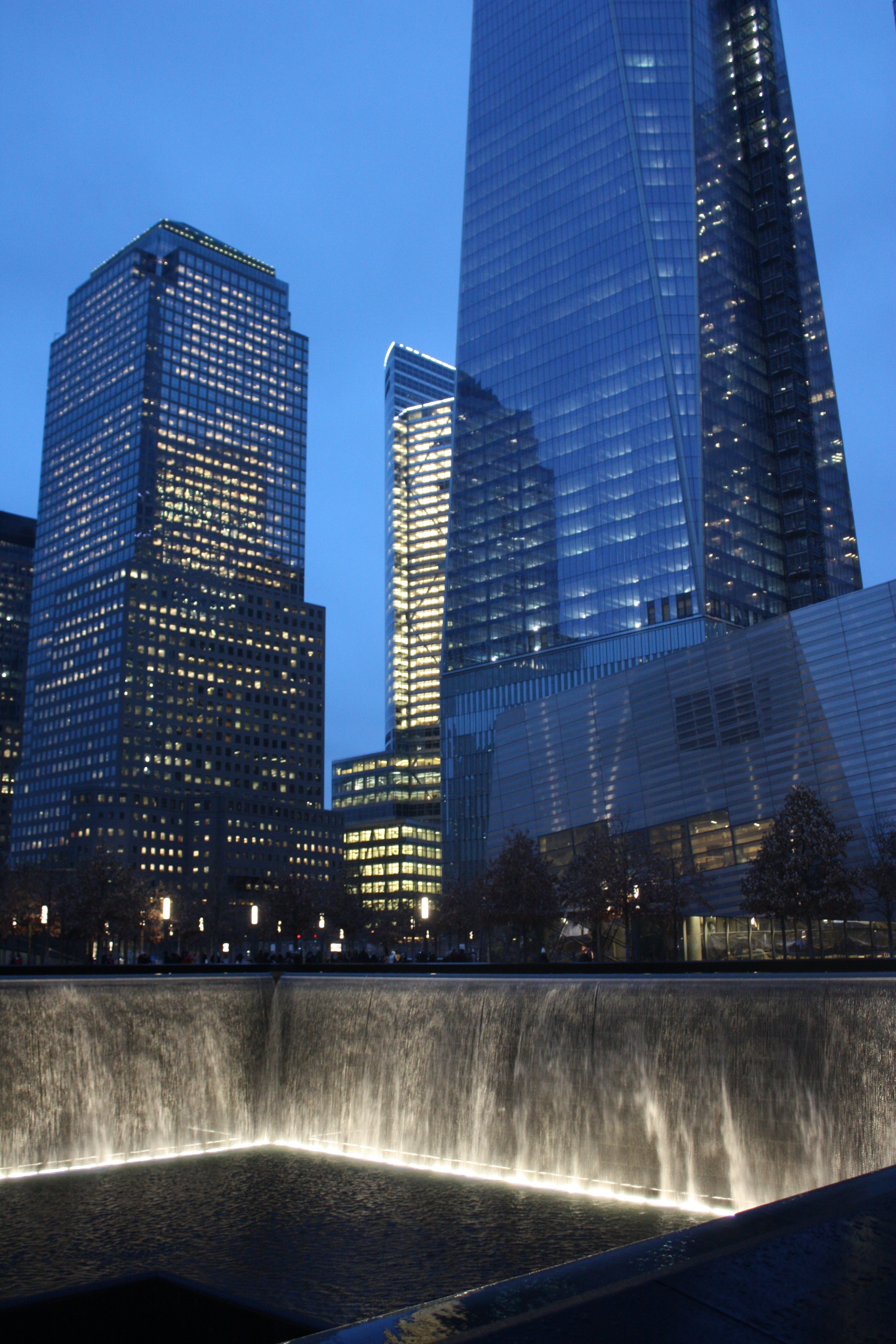
9/11 Memorial at dusk
My choice of dining in Lower Manhattan is at Fraunces Tavern, located at 54 Pearl Street. Hop on the subway and travel a few stops to go back in time – this is the place where George Washington bade his farewells to his officers back in 1783. Fittingly, there is now a museum of American Revolutionary War history in the building. The bar has an extensive menu of over 130 craft beers and ciders, hosts live music at weekends and the food is good too.
Kindle guide to Cusco now available to download at Unanchor.com & on Amazon
I’m pleased to announce that my latest Kindle guide is now available to download. It’s a five day itinerary covering the best of Cusco and the Sacred Valley and you can purchase it now on Unanchor’s website here:
http://www.unanchor.com/itinerary/view/509.
It is also available on Amazon here:
There’s a free sample on Amazon, so why not download it and perhaps write a review?
Cusco, the ancient capital of the Inca Empire, is Peru’s top visitor destination. Around two million foreign visitors travel to this part of South America annually, with numbers steadily growing year on year. Aside from nearby Machu Picchu, the jewel in Peru’s tourist crown by some considerable margin, there are enough historic and cultural attractions in the Cusco area to keep visitors occupied for weeks.

Alpacas are a common sight in the countryside around Cusco
Cusco, with its colonial architecture set around characterful squares, warrants a whole trip in itself. The historic city is centred on the bustling Plaza de Armas. The imposing cathedral and its tiny neighbour, the Iglesia del Triunfo, face off against the Iglesia de la Compania de Jesus, built by the Jesuits to rival their Catholic counterpart. The most important temple of the Inca Empire, Koricancha, occupies a prime location on Avenida El Sol, just a short walk from the plaza. Neighbourhoods such as San Blas, with steep cobbled streets packed with cafes, bars and galleries, have much to delight tourists. Higher still, exploring the Inca fortress of Sacsayhuaman, with its enormous blocks of stone and impressive Inca engineering, is a must on every visitor’s itinerary.
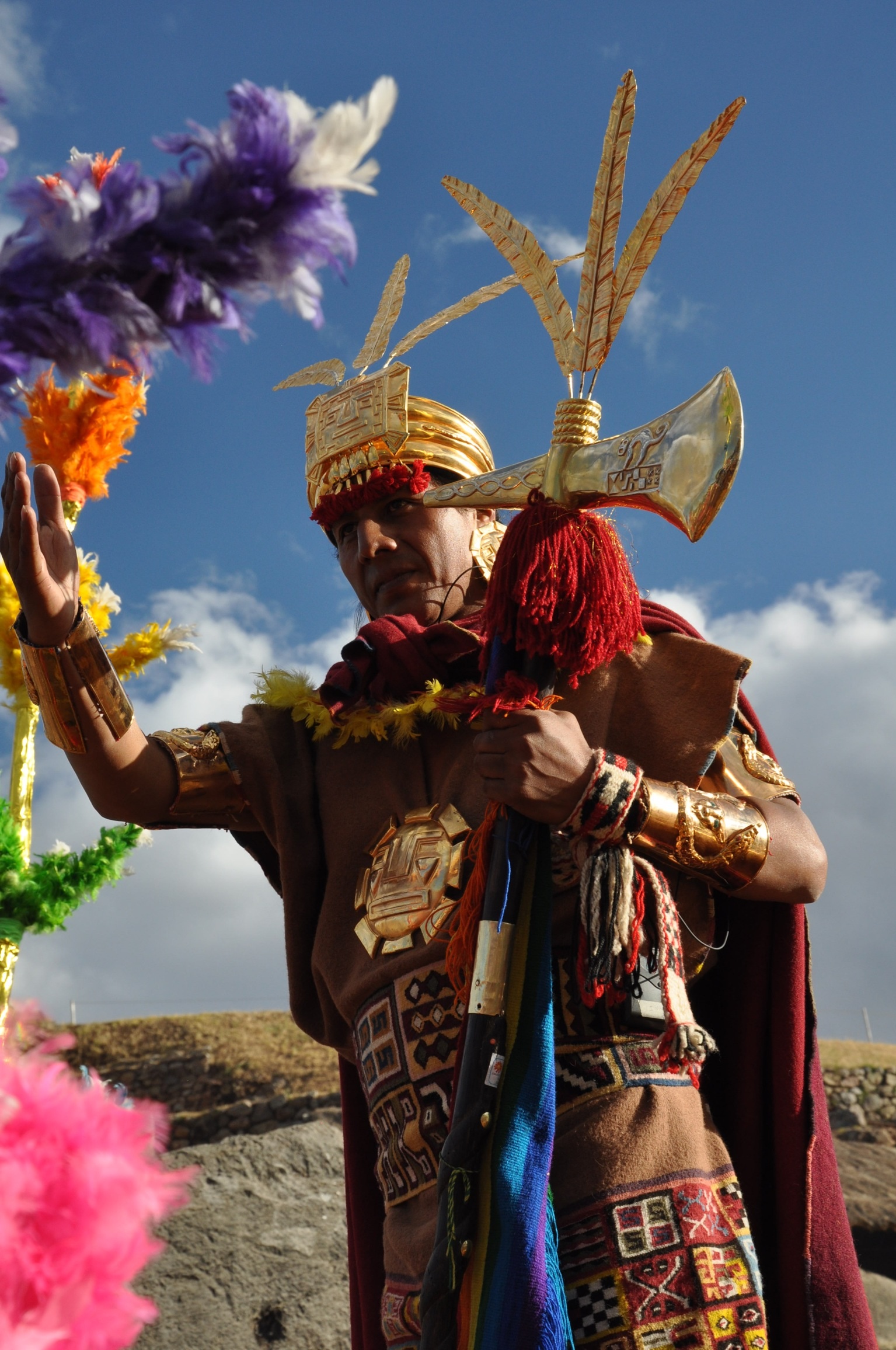
Inti Raymi celebrations take place each June
But that’s not all. Cusco is a short drive away from the Sacred Valley, crammed full of Inca archaeological sites amidst stunning highland scenery. The agricultural terraces and storehouses of Ollantaytambo offer a fascinating glimpse into the everyday life of the Incas. The valley is settled and farmed to this day and the bustling markets at Pisac and Chinchero draw thousands seeking the perfect souvenir to take home.

Chinchero market
Therein lies the problem: there’s so much to see that careful planning is essential. Knowing what to leave out and what not to miss is crucial to making the best of your time here. Lesser known attractions such as the circular terraces of the Inca’s agricultural laboratory at Moray or the incredible salt pans, the Salineras de Maras, are often overlooked as the tour buses hurtle past on their way to the big attractions.

Salt production near Maras
That’s where this guide comes in. I’ve visited Cusco and the Sacred Valley on numerous occasions spanning a period of twenty years, most recently in 2014. This tailor-made itinerary explains how to dodge the crowds and see the best of the area without relying on expensive tours. It offers recommendations for accommodation options to suit all tastes and budgets as well as detailing the best places to eat. Day by day plans with clear maps and photographs make navigating on foot and by public transport simple, giving you the confidence to step out on your own.
A beginner’s guide to the Riviera Maya
Mexico’s Riviera Maya is the name given to the stretch of Quintana Roo coastline that extends from Cancun in the north (or a few kilometres south of it, definitions vary) to the Sian Ka’an Biosphere Reserve to the south. Together with the neighbouring state of Yucatan, it is a deservedly popular package and independent tourism destination. This guide is aimed at the first-time visitor and should help you to make the most of your holiday. Prices are shown in Mexican pesos, which at the time of writing had an exchange rate of about twenty to the pound. The information given was correct at the time of writing, but check locally as things change.
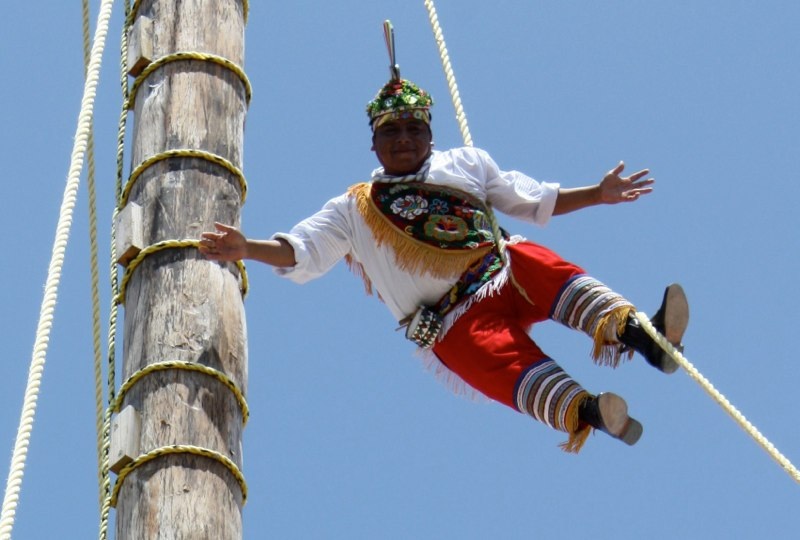
One of the four voladores
How to get there
Most visitors arrive at Cancun’s international airport just to the south of town, well served by direct scheduled flights from the UK, for example, with British Airways and Virgin Atlantic. It is possible to fly to Mexico City and catch a connecting flight but this takes longer. A wide range of packages are available with operators such as Thomson, Thomas Cook and First Choice. From the airport, the best way of getting to your hotel depends on your location. ADO buses serve the centres of Cancun and Playa del Carmen on a half-hourly basis, with fares of 148 pesos per person to Playa and 62 pesos to Cancun. Airport shuttles are available to the main resort areas for around four times as much and private hotel transfers considerably more. If you’re on a package, transfers will usually be included but check your booking documents.

Parrot in Xcaret Eco-park
How to get around
Taxis are cheap but better still are the minibuses called colectivos that ply the main road at regular intervals. To catch one, simply flag it down and tell the conductor your intended destination. Fares are cheap so take loose change and small notes. In Playa, colectivos can be found in town at Calle 2 Norte between 15th and 20th, whereas in Cancun you’ll need to come out of the Zona Hotelera into downtown, where they congregate outside La Comercial Mexicana supermarket on Avenida Tulum. In Tulum, look for them opposite the ADO bus station in the town. Several bus companies serve a large network across Quintana Roo (the state containing the coastal strip) and neighbouring Yucatan (where you’ll find Chichen Itza). The best quality buses, with fewer stops and therefore slightly dearer fares, are run by ADO, whose website http://www.ado.com.mx is easy to navigate. Local routes are also served by the cheaper Oriente and Mayab buses, which tend to be a little less comfortable and stop more frequently.
Where to stay
Cancun is the largest of the Mayan Riviera resorts. Created from scratch four decades ago, it basically consists of two areas: downtown, where the locals live, and the Zona Hotelera, a narrow strip of land flanked by a lagoon on one side and white sand in the other. Its lively nightlife and many bars attract a young crowd, especially from the USA and Canada. However, Cancun’s too noisy and brash for many, who Instead head an hour down the coast to Playa del Carmen. Playa has grown immensely in the last decade, but its pedestrian street, Quinta, with a good selection of shops, bars and restaurants still attracts many people. Try Sur, which serves Argentine steaks in a swanky setting, or Blue Lobster for seafood and glow in the dark blue margaritas. The central beach, though eroded in places, is busy and lined with popular beach clubs playing music while its water is safe for swimming.

Blue margarita
Alternatives to Cancun and Playa
Another hour by bus further south, Tulum is rapidly developing with accommodation strung out along the beach. Once home to a few hippy hangouts, it now also hosts beach clubs and luxury hotels alongside the hammocks. Puerto Morelos, midway between Cancun and Playa, is a small town that contains a few hotels, such as Casa Caribe to which the excellent Little Mexican Cooking School is attached. Akumal, a quarter of an hour south of Playa, serves those who like their resort to be local and relatively unspoilt. The easiest way to get to both Puerto Morelos and Akumal is by flagging down a colectivo on the side of the main road, known as the 307. Connecting Cancun to Tulum and beyond is a string of all-inclusive luxury resorts, gated from the main road and fiercely protective of their private patch of beach. These are well suited to families as the all-inclusive option makes budgeting easier and there are plenty of water-based activities for all ages. Whether you’re a backpacker on a budget or a family seeking a fortnight of water sports and lazy days by the pool, there’s something on the Mayan Riviera that will cater for you. If you don’t mind being away from the beach, the town of Valladolid, two hours inland from Cancun, offers an alternative to independent travellers seeking a less touristy experience. ADO buses run frequently, costing 176 pesos each way from both Cancun and Playa del Carmen.
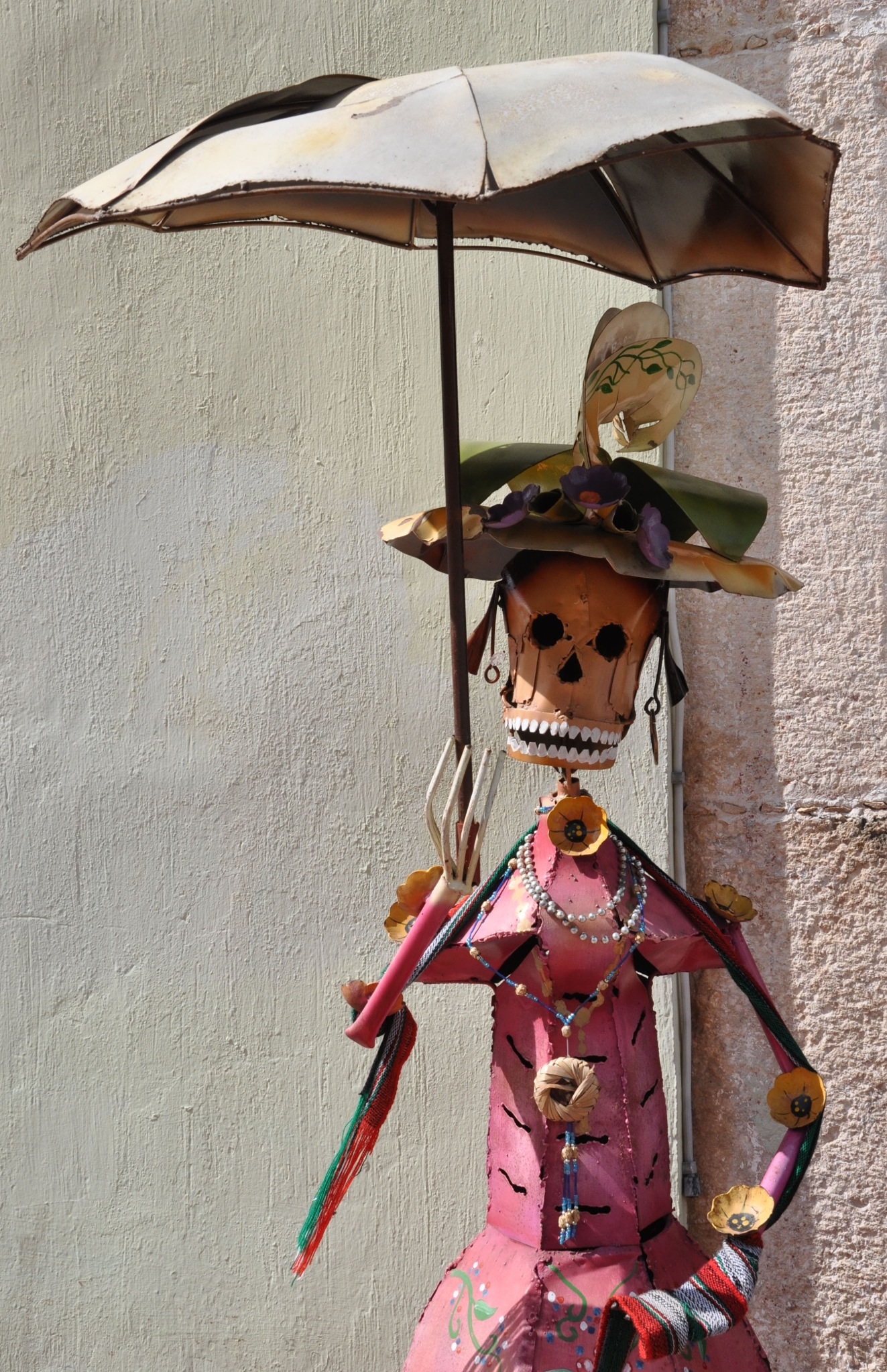
Art gallery in Valladolid selling all things Catrina, the symbol of the Day of the Dead festivities
Set around a charming plaza, there are a handful of hotels and restaurants, the best being El Meson de Marques right on the main square. From Valladolid, it’s easy to get to the ruins of Chichen Itza and Ek Balam as well as to the pretty town of Merida to the north of the peninsula, itself a good base for visiting the ruins of Uxmal and Sayil. The town is busy and it can feel less comfortable in the heat without a cooling sea breeze, but Valladolid’s a useful stopping off point between the coast and Merida if you wish to tour the peninsula.
Theme parks
As you’d expect from a well-established destination, there’s a number of water and eco-parks to tempt holidaymakers out of their resorts. If you go to only one, make it Xcaret. Pronounced “ish-ca-rett”, the site was once a Mayan port. Its archaeological remains can be visited without having to pay the entrance fee to the main park, and cost 43 pesos, but the park itself is a fun way to spend the day. You can swim in a lazy river and visit the park’s wildlife including turtles and dolphins. The park features a reconstructed Mayan ball court as well as a typical hacienda and folk art museum. At night, stay for the spectacle that condenses a thousand years of history into a couple of hours. It features everything from Mayan sport played with balls of fire to dance and folklore set pieces representing Mexico’s diverse regions. This and other performances such as an equestrian show and the exciting display put on by the Voladores de Papantla are included in the ticket price. It’s simple to find booths selling tickets in Cancun and Playa del Carmen or you can book online. Tickets start from US$89 with some activities such as swimming with dolphins carrying a supplement. For more information visit http://www.xcaret.com or pick up a leaflet when you arrive.

The show at Xcaret
Xplor is the go-to park for thrill seekers. Tickets cover four attractions: a ride in an amphibious vehicle, a lazy river swim, underground rafting and the highest zip lines in Latin America. Full instruction is given and a helmet mounted camera ensures that you have a selection of photos as a memento of your day. Tickets cost from US$119 and can be purchased in much the same way as Xcaret. Xplor’s website http://www.xplor.travel has all the information. As well as Xcaret and Xplor, there are a range of other attractions run by the same company, including Xel-Ha and Rio Secreto. Perhaps even more fun is to do what the locals do to make the best of the landscape. Beneath the peninsula, the limestone rock has slowly been weathered away to create a fascinating underground world of sinkholes and caverns into which water has gradually filtered. These lagoons, known as cenotes, form natural swimming pools popular with families at weekends but often quiet in the week. There are many close to the coast, but one of the best is Cenote Xkeken at Dzitnup. Located a little way out of Valladolid, it is a glistening turquoise lake lit through a hole in the roof of a huge cavern dangling with stalactites. Entrance costs 80 pesos.

Cenotes can be found throughout the peninsula
Mayan ruins
The large number of historical sites in Quintana Roo and the Yucatan can leave the visitor ruined out. It’s best to choose a few and enjoy them, rather than attempt to tick them all off in one trip. The jewel in the crown is without a doubt Chichen Itza. A sprawling site surrounded by jungle, it centres around the restored Kukulkan pyramid and an interesting collection of other structures including an observatory and ball court. Every tour operator offers day trips, but the site is easy to visit independently. ADO buses connect Chichen Itza directly to Cancun and Playa del Carmen via good roads. Guides can be hired at the entrance if you wish. A ticket to get in costs 533 pesos for foreign tourists. (Mexicans enjoy a discounted rate, locals even more so).

The Kukulkan pyramid at Chichen Itza
The must-see on the coast is Tulum, not for its scale but for its location. Tulum’s temples sit right on top of the cliff above a small patch of sand and a turquoise sea and unsurprisingly as a result receives the highest number of visitors of any of the peninsula’s archaeological sites. Like Chichen Itza, the volume of tourists necessitates obvious management and many structures are roped off, but the grey of the stone against the blue sky makes this a very atmospheric place despite the crowds. It’s still just possible to find a quiet spot with just a lizard or two for company, especially first thing in the morning. Tickets are priced at 80 pesos.

Tulum’s dramatic setting
Coba, just a few years ago off the beaten track but now increasingly in the tour operators’ sights, is situated an hour or so from Tulum. Once a thriving Mayan city, the ruins are scattered through an area of jungle crisis-crossed with Mayan roads known as sacbe. The pyramid here is less well preserved than that at Chichen Itza and for now at least can be climbed by anyone untroubled by vertigo – with just a single rope to cling on to, this is not a climb for those with a fear of heights. Entrance costs 80 pesos but due to the size of the site, many people opt to rent bicycles or take a ride to the ruins in a cycle rickshaw at extra cost.
Note that at present Coba is closed to visitors.
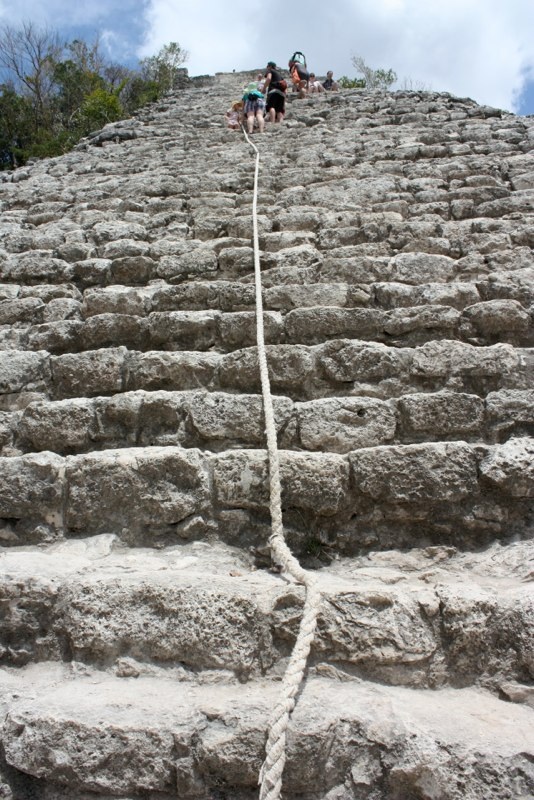
Coba’s pyramid
Less well-known and yet only twenty minutes by colectivo from Valladolid are the extensive ruins at Ek Balam. Relatively recently rediscovered, like Coba the site has a pyramid to climb, the Acropolis, its 106 worn steps rising steeply from the ground to offer extraordinary views of the surrounding jungle from the top. Ek Balam means dark jaguar in Mayan and as a result, the observant will spot jaguar motifs carved into the stone throughout the site. The entrance fee is 456 pesos for foreign tourists. Colectivo taxis from Valladolid cost upwards of 150 pesos each way; either pay for a seat and wait for others to join you or pay for the whole car. As they’re taxis rather than minibuses, you’ll find them on Calle 44 between 37 and 35, tucked inside the courtyard of a building rather than on the road outside.

The little-visited Ek’ Balam
Further afield, the attractive colonial town of Merida makes a convenient base if you wish to visit the Yucatecan sites of Sayil, Labna and Uxmal. It’s also close to Izamal whose ruins boast the largest surviving Mayan structure in the area. Getting to Merida takes around five hours by bus from the coastal resorts of Quintana Roo.
Natural wonders
A coral reef extends from the Riviera Maya down past Belize and on to Honduras. The second longest in the world, after Australia’s Great Barrier Reef, it provides excellent opportunities for both snorkelling and diving. The largest protected reserve in the area is the Sian Ka’an Biosphere Reserve, south of the main tourist strip. Tours showcase its flora and fauna, in particular birds, dolphins and turtles, plus occasionally manatees for those lucky enough to spot them. Akumal’s public beach is a good place for green turtle watching. There’s no need to book a tour, as snorkelling equipment can be rented from the dive shop on the beach, from where it’s a short swim out to the reef. Even in busy spots such as the main beach at Playa del Carmen, you’ll see flamingos diving for fish and bobbing about amidst the breakers.

Playa del Carmen beach
Off the coast
Cozumel, an established cruise ship and diving destination, is easily reached by ferry from the terminal at the southern end of Playa del Carmen. It offers the facilities you’d usually expect from a place where the majority of visitors are only in town for a short while. Island tours are expensive as are taxis. Isla Mujeres and Isla Holbox, reached by ferry from Cancun, are better bolt holes if you want a more laid back island stay.

 Julia's Travels